Q1521.In the following triads, each group of letters is related to the subsequent one following a certain logic. Select from the given options, the one which follows the same logic. HIVE - EHVI - HEIV
FANG - GFNA - FGAN
निम्नलिखित त्रिकों में, अक्षरों का प्रत्येक समूह एक निश्चित तर्क का अनुसरण करते हुए अगले समूह से संबंधित है। दिए गए विकल्पों में से उस विकल्प का चयन कीजिए जो उसी तर्क का अनुसरण करता है। HIVE - EHVI - HEIV
FANG - GFNA - FGAN
- ASORT - TSOR - ORTS
- BMUSK - KMSU - MKUS
- CTENS - ETNS - SENT
- DRAIN - NRIA - RANI
Show answer
Concept: Number the letters' positions and copy the shuffle.
- HIVE (1234) → EHVI = 4,1,3,2; EHVI (1234) → HEIV = 2,1,4,3.
- FANG → GFNA → FGAN follows the same.
- MUSK → 4,1,3,2 = KMSU; KMSU → 2,1,4,3 = MKUS ✓.
Trick: Step 1 brings the last letter to the front.
Answer: (B) MUSK - KMSU - MKUS
अवधारणा: अक्षरों के स्थान क्रमांकित कर वही फेरबदल लगाएँ।
- HIVE (1234) → EHVI = 4,1,3,2; EHVI (1234) → HEIV = 2,1,4,3।
- FANG → GFNA → FGAN भी यही।
- MUSK → 4,1,3,2 = KMSU; KMSU → 2,1,4,3 = MKUS ✓।
ट्रिक: पहले चरण में अंतिम अक्षर आगे आता है।
उत्तर: (B) MUSK - KMSU - MKUS
RRB NTPC Undergraduate CBT 1General Intelligence and ReasoningLetter rearrangementRRB NTPC Undergraduate CBT 1 2024 · 8 Aug Shift 3
Q1522.Read the given statements and conclusions carefully. Assuming that the information given in the statements is true, even if it appears to be at variance with commonly known facts, decide which of the given conclusion(s) logically follow(s) from the statements.
Statements:
Some birds are animals.
All animals are tables.
Conclusions:
(I): Some birds are tables.
(II): All tables are animals.
दिए गए कथनों और निष्कर्षों को ध्यानपूर्वक पढ़िए। कथनों में दी गई जानकारी को सत्य मानते हुए, भले ही वह सामान्यतः ज्ञात तथ्यों से भिन्न प्रतीत होती हो, निर्णय कीजिए कि दिए गए निष्कर्षों में से कौन-सा/कौन-से निष्कर्ष कथनों का तार्किक रूप से अनुसरण करता है/करते हैं।
कथन:
कुछ पक्षी, जानवर हैं।
सभी जानवर, मेज़ें हैं।
निष्कर्ष:
(I): कुछ पक्षी, मेज़ें हैं।
(II): सभी मेज़ें, जानवर हैं।
- ANeither conclusion (I) nor (II) follows.न तो निष्कर्ष (I) और न ही (II) अनुसरण करता है।
- BOnly conclusion (I) follows.केवल निष्कर्ष (I) अनुसरण करता है।
- CBoth conclusions (I) and (II) follow.दोनों निष्कर्ष (I) और (II) अनुसरण करते हैं।
- DOnly conclusion (II) follows.केवल निष्कर्ष (II) अनुसरण करता है।
Show answer
Concept: Draw the least-overlap Venn diagram.
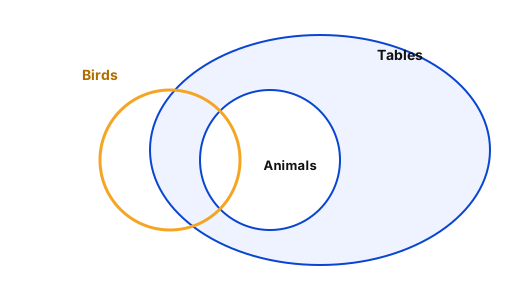
- Animals lie inside tables; some birds overlap animals.
- That overlapping part is also inside tables → some birds are tables (I follows).
- Tables may have members that are not animals → II does not follow.
Yaad rakhein: 'All A are B' cannot be reversed to 'All B are A'.
Answer: (B) Only conclusion (I) follows.
अवधारणा: न्यूनतम ओवरलैप वाला वेन आरेख बनाएँ।
- Animals, tables के अंदर; कुछ birds, animals से मिलते हैं।
- वह भाग tables में भी है → कुछ birds, tables हैं (I सही)।
- Tables में animals के अलावा भी हो सकते हैं → II सही नहीं।
याद रखें: 'सभी A, B हैं' को उलटकर 'सभी B, A हैं' नहीं कह सकते।
उत्तर: (B) केवल निष्कर्ष (I) अनुसरण करता है।
RRB NTPC Undergraduate CBT 1General Intelligence and ReasoningSyllogismRRB NTPC Undergraduate CBT 1 2024 · 8 Aug Shift 3
Q1523.Based on the English alphabetical order, three of the following four letter-clusters are alike in a certain way and thus form a group. Which letter-cluster DOES NOT belong to that group?
(Note: The odd one out is not based on the number of consonants/vowels or their position in the letter-cluster.)
अंग्रेज़ी वर्णमाला क्रम के आधार पर, निम्नलिखित चार अक्षर-समूहों में से तीन किसी निश्चित प्रकार से एकसमान हैं और इस प्रकार एक समूह बनाते हैं। कौन-सा अक्षर-समूह उस समूह से संबंधित नहीं है?
(नोट: असंगत, अक्षर-समूह में व्यंजनों/स्वरों की संख्या या उनके स्थान पर आधारित नहीं है।)
- ALHK
- BOKM
- CUQT
- DRNQ
Show answer
Concept: Compare position gaps in each cluster.
- LHK: 12, 8, 11 → −4, +3. UQT: 21, 17, 20 → −4, +3. RNQ: 18, 14, 17 → −4, +3.
- OKM: 15, 11, 13 → −4, +2 → odd.
Trick: First and last letters differ by 1 in the group (L-K, U-T, R-Q), but O-M differ by 2.
Answer: (B) OKM
अवधारणा: हर समूह में स्थानों का अंतर देखें।
- LHK: 12, 8, 11 → −4, +3। UQT: 21, 17, 20 → −4, +3। RNQ: 18, 14, 17 → −4, +3।
- OKM: 15, 11, 13 → −4, +2 → विषम।
ट्रिक: समूह में पहला और अंतिम अक्षर 1 के अंतर पर (L-K, U-T, R-Q), पर O-M में 2।
उत्तर: (B) OKM
RRB NTPC Undergraduate CBT 1General Intelligence and ReasoningOdd one out – lettersRRB NTPC Undergraduate CBT 1 2024 · 8 Aug Shift 3
Q1524.What should come in place of the question mark (?) in the given series?
36 51 45 64 54 77 63 90 72 ?
दी गई श्रृंखला में प्रश्न चिह्न (?) के स्थान पर क्या आना चाहिए?
36 51 45 64 54 77 63 90 72 ?
- A110
- B113
- C103
- D106
Show answer
Concept: Two series are interleaved.
- Odd terms: 36, 45, 54, 63, 72 → +9.
- Even terms: 51, 64, 77, 90 → +13.
- Next even term .
Trick: 10 terms with an up-down pattern → split into two.
Answer: (C) 103
अवधारणा: दो श्रृंखलाएँ बारी-बारी से चल रही हैं।
- विषम पद: 36, 45, 54, 63, 72 → +9।
- सम पद: 51, 64, 77, 90 → +13।
- अगला सम पद ।
ट्रिक: ऊपर-नीचे होती श्रृंखला → दो भागों में बाँटें।
उत्तर: (C) 103
RRB NTPC Undergraduate CBT 1General Intelligence and ReasoningAlternate number seriesRRB NTPC Undergraduate CBT 1 2024 · 8 Aug Shift 3
Q1525.Babar starts from Point A and drives 14 km towards West. He then takes a left turn, drives 7 km, turns right and drives 9 km. He then takes a right turn and drives 7 km. He takes a final right turn, drives 5 km and stops at Point P. How far (shortest distance) and towards which direction should he drive in order to reach Point A again? (All turns are 90° turns only unless specified.)
बाबर बिंदु A से चलना शुरू करता है और पश्चिम की ओर 14 km गाड़ी चलाता है। फिर वह बाएँ मुड़ता है, 7 km गाड़ी चलाता है, दाएँ मुड़ता है और 9 km गाड़ी चलाता है। फिर वह दाएँ मुड़ता है और 7 km गाड़ी चलाता है। वह अंतिम बार दाएँ मुड़ता है, 5 km गाड़ी चलाता है और बिंदु P पर रुक जाता है। बिंदु A पर पुनः पहुँचने के लिए उसे कितनी दूर (न्यूनतम दूरी) और किस दिशा में गाड़ी चलानी चाहिए? (जब तक निर्दिष्ट न हो, सभी मोड़ केवल 90° के मोड़ हैं।)
- A20 km towards Westपश्चिम की ओर 20 km
- B18 km towards Eastपूर्व की ओर 18 km
- C18 km towards Westपश्चिम की ओर 18 km
- D20 km towards Northउत्तर की ओर 20 km
Show answer
Concept: Trace the path on axes (east +x, north +y).
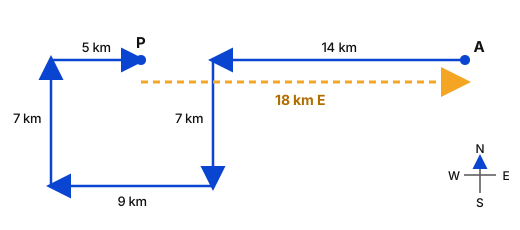
- 14 km west → (−14, 0); left (south) 7 → (−14, −7).
- Right (west) 9 → (−23, −7); right (north) 7 → (−23, 0).
- Right (east) 5 → P(−18, 0), on the same line as A, west of it.
- To return: 18 km towards east.
Trick: North-south cancels (); west net .
Answer: (B) 18 km towards East
अवधारणा: रास्ते को अक्षों पर बनाएँ (पूर्व +x, उत्तर +y)।
- 14 km पश्चिम → (−14, 0); बाएँ (दक्षिण) 7 → (−14, −7)।
- दाएँ (पश्चिम) 9 → (−23, −7); दाएँ (उत्तर) 7 → (−23, 0)।
- दाएँ (पूर्व) 5 → P(−18, 0), A की सीध में पश्चिम में।
- वापस जाने हेतु: 18 km पूर्व की ओर।
ट्रिक: उत्तर-दक्षिण कट जाते हैं; पश्चिम शुद्ध ।
उत्तर: (B) 18 km पूर्व की ओर
RRB NTPC Undergraduate CBT 1General Intelligence and ReasoningDirection and distanceRRB NTPC Undergraduate CBT 1 2024 · 8 Aug Shift 3
Q1526.Based on the English alphabetical order, three of the following four letter-cluster pairs are alike in a certain way and thus form a group. Which letter-cluster pair DOES NOT belong to that group?
(Note: The odd one out is not based on the number of consonants/vowels or their position in the letter-cluster.)
अंग्रेज़ी वर्णमाला क्रम के आधार पर, निम्नलिखित चार अक्षर-समूह युग्मों में से तीन किसी निश्चित प्रकार से एकसमान हैं और इस प्रकार एक समूह बनाते हैं। कौन-सा अक्षर-समूह युग्म उस समूह से संबंधित नहीं है?
(नोट: असंगत, अक्षर-समूह में व्यंजनों/स्वरों की संख्या या उनके स्थान पर आधारित नहीं है।)
- ASO−ON
- BAW−XT
- CPL−MI
- DTP−QM
Show answer
Concept: Compare gaps inside each cluster and between the first letters.
- PL-MI: P→L −4, M→I −4, P→M −3.
- TP-QM: −4, −4, −3. AW-XT: A→W −4 (cyclic), X→T −4, A→X −3.
- SO-ON: S→O −4 but O→N −1 → odd.
Yaad rakhein: Count backward cyclically: A −4 → W.
Answer: (A) SO−ON
अवधारणा: हर समूह के अंदर और पहले अक्षरों के बीच अंतर देखें।
- PL-MI: P→L −4, M→I −4, P→M −3।
- TP-QM: −4, −4, −3। AW-XT: A→W −4 (चक्रीय), X→T −4, A→X −3।
- SO-ON: S→O −4 पर O→N −1 → विषम।
याद रखें: पीछे चक्रीय गिनती: A −4 → W।
उत्तर: (A) SO−ON
RRB NTPC Undergraduate CBT 1General Intelligence and ReasoningOdd one out – letter pairsRRB NTPC Undergraduate CBT 1 2024 · 8 Aug Shift 3
Q1527.What should come in place of the question mark (?) in the given series?
102 108 120 138 162 ?
दी गई श्रृंखला में प्रश्न चिह्न (?) के स्थान पर क्या आना चाहिए?
102 108 120 138 162 ?
- A204
- B212
- C230
- D192
Show answer
Concept: Look at the differences.
- Differences: 6, 12, 18, 24 – multiples of 6.
- Next difference .
- .
Trick: Difference series .
Answer: (D) 192
अवधारणा: अंतर देखें।
- अंतर: 6, 12, 18, 24 – 6 के गुणज।
- अगला अंतर ।
- ।
ट्रिक: अंतर श्रृंखला ।
उत्तर: (D) 192
RRB NTPC Undergraduate CBT 1General Intelligence and ReasoningNumber seriesRRB NTPC Undergraduate CBT 1 2024 · 8 Aug Shift 3
Q1528.Seven boxes F, G, H, I, K, L and O are kept one over the other but not necessarily in the same order.
O is kept second from the bottom. Only three boxes are kept between O and G. L is kept at one of the positions below O. Only I is kept between G and H. F is kept at one of the positions above G.
How many boxes are kept between L and F?
सात बक्से F, G, H, I, K, L और O एक के ऊपर एक रखे गए हैं, लेकिन ज़रूरी नहीं कि इसी क्रम में हों।
O नीचे से दूसरे स्थान पर रखा गया है। O और G के बीच केवल तीन बक्से रखे गए हैं। L, O के नीचे किसी एक स्थान पर रखा गया है। G और H के बीच केवल I रखा गया है। F, G के ऊपर किसी एक स्थान पर रखा गया है।
L और F के बीच कितने बक्से रखे गए हैं?
- AThreeतीन
- BOneएक
- CFourचार
- DFiveपाँच
Show answer
Concept: Number positions 1 (top) to 7 (bottom).
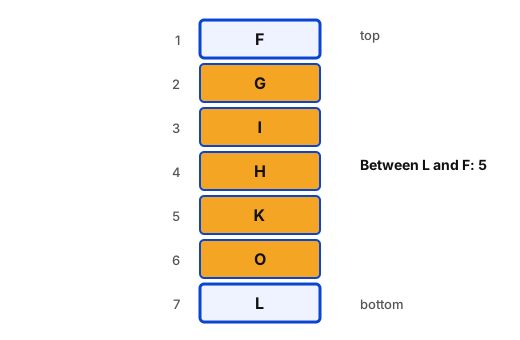
- O second from bottom → 6; L below O → L at 7.
- Three between O and G → G at 2.
- Only I between G and H → I at 3, H at 4 (position 0 does not exist). F above G → F at 1; K at 5.
- Between L (7) and F (1): G, I, H, K, O → 5.
Trick: Top and bottom boxes → 7 − 2 = 5 in between.
Answer: (D) Five
अवधारणा: स्थान 1 (ऊपर) से 7 (नीचे) मानें।
- O नीचे से दूसरा → 6; L, O के नीचे → 7।
- O और G के बीच तीन → G 2 पर।
- G और H के बीच केवल I → I 3, H 4। F, G के ऊपर → F 1; K 5।
- L (7) और F (1) के बीच: G, I, H, K, O → 5।
ट्रिक: सबसे ऊपर और सबसे नीचे के बीच 7 − 2 = 5 बॉक्स।
उत्तर: (D) पाँच
RRB NTPC Undergraduate CBT 1General Intelligence and ReasoningBox arrangementRRB NTPC Undergraduate CBT 1 2024 · 8 Aug Shift 3
Q1529.J, K, L, M, N, O and S are sitting around a circular table, facing the centre of the table. Only three people sit between O and J when counted from the left of O. Only three people sit between K and M when counted from the right of M. S sits to the immediate right of K. N is an immediate neighbour of M as well as J. Who sits second to the left of L?
J, K, L, M, N, O और S एक वृत्ताकार मेज़ के चारों ओर मेज़ के केंद्र की ओर मुख करके बैठे हैं। O के बाएँ से गिनने पर O और J के बीच केवल तीन व्यक्ति बैठे हैं। M के दाएँ से गिनने पर K और M के बीच केवल तीन व्यक्ति बैठे हैं। S, K के ठीक दाएँ बैठा है। N, M और J दोनों का निकटतम पड़ोसी है। L के बाएँ से दूसरे स्थान पर कौन बैठा है?
- AN
- BM
- CJ
- DO
Show answer
Concept: Facing the centre, right = anticlockwise and left = clockwise.
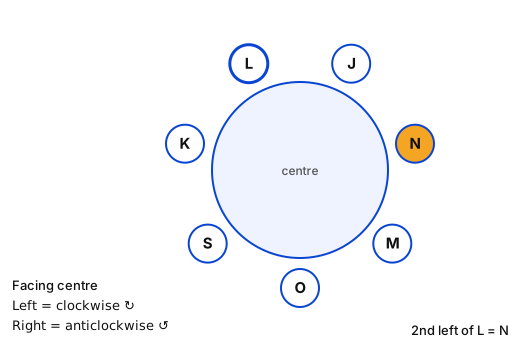
- Going left from O, three people then J → J is 4th to the left of O (= 3rd to the right).
- N is next to both M and J. If N is on J's far side, K (4th right of M) and S clash with J; so order to the right of O is M, N, J.
- K is 4th to the right of M, S right after K; L takes the last seat: O, M, N, J, L, K, S (anticlockwise).
- Second to the left of L: J, then N.
Trick: 'Three between, counted from left' = 4th to the left.
Answer: (A) N
अवधारणा: केंद्र की ओर मुख हो तो दायाँ = वामावर्त, बायाँ = दक्षिणावर्त।
- O के बाएँ से तीन लोग फिर J → J, O के बाएँ चौथा (= दाएँ तीसरा)।
- N, M और J दोनों के पास। दूसरी स्थिति में K व S, J से टकराते हैं; अतः O के दाएँ क्रम M, N, J।
- K, M के दाएँ चौथा, S उसके ठीक दाएँ; L शेष स्थान पर: O, M, N, J, L, K, S (वामावर्त)।
- L के बाएँ दूसरा: J, फिर N।
ट्रिक: 'बाएँ से गिनने पर बीच में तीन' = बाएँ चौथा।
उत्तर: (A) N
RRB NTPC Undergraduate CBT 1General Intelligence and ReasoningCircular seating arrangementRRB NTPC Undergraduate CBT 1 2024 · 8 Aug Shift 3
Q1530.In the following number-pairs, the second number is obtained by applying certain mathematical operation(s) to the first number. Select the number-pair in which the numbers are related in the same way as are the numbers of the following pairs. (NOTE: Operations should be performed on the whole numbers, without breaking down the numbers into their constituent digits. E.g. 13 – Operations on 13 such as adding to/subtracting from/multiplying with 13 can be performed. Breaking down 13 into 1 and 3 and then performing mathematical operations on 1 and 3 is not allowed.)
227, 112
240, 125
निम्नलिखित संख्या-युग्मों में, पहली संख्या पर कुछ गणितीय संक्रिया/संक्रियाएँ करके दूसरी संख्या प्राप्त की जाती है। उस संख्या-युग्म का चयन कीजिए जिसमें संख्याएँ उसी प्रकार संबंधित हैं जिस प्रकार निम्नलिखित युग्मों की संख्याएँ संबंधित हैं। (नोट: संख्याओं को उनके घटक अंकों में विभाजित किए बिना, संक्रियाएँ पूर्ण संख्याओं पर की जानी चाहिए। उदाहरण: 13 – 13 पर संक्रियाएँ जैसे 13 में जोड़ना/13 में से घटाना/13 से गुणा करना आदि की जा सकती हैं। 13 को 1 और 3 में विभाजित करके फिर 1 और 3 पर गणितीय संक्रियाएँ करने की अनुमति नहीं है।)
227, 112
240, 125
- A210, 85
- B254, 129
- C262, 147
- D215, 110
Show answer
Concept: Find the operation linking the numbers in each pair.
- and → second = first − 115.
- ✓.
- Others: , , .
Trick: Try the simple difference first.
Answer: (C) 262, 147
अवधारणा: युग्म की संख्याओं को जोड़ने वाली संक्रिया खोजें।
- और → दूसरी = पहली − 115।
- ✓।
- अन्य: , , ।
ट्रिक: पहले साधारण अंतर आज़माएँ।
उत्तर: (C) 262, 147
RRB NTPC Undergraduate CBT 1General Intelligence and ReasoningNumber pair relationRRB NTPC Undergraduate CBT 1 2024 · 8 Aug Shift 3
Q1531.If ‘+’ means ‘subtraction’, ‘−’ means ‘multiplication’, ‘×’ means ‘division’ and ‘÷’ means ‘addition’, then what will come in place of the question mark (?) in the following equation?
12 + 105 × 3 ÷ 14 − 3 = ?
यदि ‘+’ का अर्थ ‘घटाना’, ‘−’ का अर्थ ‘गुणा’, ‘×’ का अर्थ ‘भाग’ और ‘÷’ का अर्थ ‘जोड़ना’ है, तो निम्नलिखित समीकरण में प्रश्न चिह्न (?) के स्थान पर क्या आएगा?
12 + 105 × 3 ÷ 14 − 3 = ?
- A30
- B19
- C23
- D27
Show answer
Concept: Replace each symbol by its meaning, then apply BODMAS.
- becomes .
- .
- .
Yaad rakhein: Swap symbols first on paper, then solve – never solve mentally while swapping.
Answer: (B) 19
अवधारणा: प्रत्येक चिह्न को उसके अर्थ से बदलें, फिर BODMAS लगाएँ।
- बन जाता है ।
- ।
- ।
याद रखें: पहले कागज़ पर चिह्न बदलें, फिर हल करें।
उत्तर: (B) 19
RRB NTPC Undergraduate CBT 1General Intelligence and ReasoningMathematical operationsRRB NTPC Undergraduate CBT 1 2024 · 8 Aug Shift 2
Q1532.In a certain code language, ‘PEST’ is coded as ‘6324’ and ‘PENS’ is coded as ‘8634’. What is the code for ‘N’ in the given code language?
एक निश्चित कूट भाषा में, ‘PEST’ को ‘6324’ लिखा जाता है और ‘PENS’ को ‘8634’ लिखा जाता है। उस कूट भाषा में ‘N’ के लिए क्या कूट है?
- A4
- B8
- C6
- D3
Show answer
Concept: Letters common to both words share the common digits; the leftover letter takes the leftover digit.
- PEST → 6324, PENS → 8634.
- Common letters P, E, S ↔ common digits 6, 3, 4.
- Left: T ↔ 2 and N ↔ 8.
Yaad rakhein: Compare only the non-common letter and digit.
Answer: (B) 8
अवधारणा: दोनों शब्दों के उभयनिष्ठ अक्षरों के कोड भी उभयनिष्ठ अंक होते हैं; बचे अक्षर का कोड बचा अंक।
- PEST → 6324, PENS → 8634।
- उभयनिष्ठ अक्षर P, E, S ↔ उभयनिष्ठ अंक 6, 3, 4।
- शेष: T ↔ 2 तथा N ↔ 8।
याद रखें: केवल गैर-उभयनिष्ठ अक्षर और अंक मिलाएँ।
उत्तर: (B) 8
RRB NTPC Undergraduate CBT 1General Intelligence and ReasoningCoding-decodingRRB NTPC Undergraduate CBT 1 2024 · 8 Aug Shift 2
Q1533.LGEI is related to RMKO in a certain way based on the English alphabetical order. In the same way, JECG is related to PKIM. To which of the given options is HCAE related, following the same logic?
अंग्रेज़ी वर्णमाला क्रम के आधार पर LGEI एक निश्चित प्रकार से RMKO से संबंधित है। उसी प्रकार, JECG, PKIM से संबंधित है। समान तर्क का अनुसरण करते हुए, HCAE दिए गए विकल्पों में से किससे संबंधित है?
- AINKG
- BNIKG
- CINGK
- DNIGK
Show answer
Concept: Find the shift of each letter position.
- L→R, G→M, E→K, I→O: each .
- J→P, E→K, C→I, G→M: each ✓.
- H+6 = N, C+6 = I, A+6 = G, E+6 = K → NIGK.
Yaad rakhein: Position values: A1, E5, J10, O15, T20, Y25 (EJOTY).
Answer: (D) NIGK
अवधारणा: प्रत्येक अक्षर का स्थानांतरण ज्ञात करें।
- L→R, G→M, E→K, I→O: प्रत्येक ।
- J→P, E→K, C→I, G→M: प्रत्येक ✓।
- H+6 = N, C+6 = I, A+6 = G, E+6 = K → NIGK।
याद रखें: स्थानीय मान: A1, E5, J10, O15, T20, Y25 (EJOTY)।
उत्तर: (D) NIGK
RRB NTPC Undergraduate CBT 1General Intelligence and ReasoningLetter analogyRRB NTPC Undergraduate CBT 1 2024 · 8 Aug Shift 2
Q1534.Based on the English alphabetical order, three of the following four letter-clusters are alike in a certain way and thus form a group. Which letter-cluster DOES NOT belong to that group?
(Note: The odd one out is not based on the number of consonants/vowels or their position in the letter-cluster.)
अंग्रेज़ी वर्णमाला क्रम के आधार पर, निम्नलिखित चार अक्षर-समूहों में से तीन किसी निश्चित प्रकार से एकसमान हैं और इस प्रकार एक समूह बनाते हैं। कौन-सा अक्षर-समूह उस समूह से संबंधित नहीं है?
(ध्यान दें: असंगत अक्षर-समूह, उस अक्षर-समूह में व्यंजनों/स्वरों की संख्या या उनकी स्थिति पर आधारित नहीं है।)
- ANJL
- BLHJ
- CTPS
- DQMO
Show answer
Concept: Check the gaps between consecutive letters.
- NJL: N−4 = J, J+2 = L.
- LHJ: −4, +2; QMO: −4, +2.
- TPS: T−4 = P, but P+3 = S → odd.
Yaad rakhein: Write alphabet positions: T20, P16, S19.
Answer: (C) TPS
अवधारणा: क्रमागत अक्षरों के बीच का अंतर जाँचें।
- NJL: N−4 = J, J+2 = L।
- LHJ: −4, +2; QMO: −4, +2।
- TPS: T−4 = P, पर P+3 = S → विषम।
याद रखें: स्थानीय मान लिखें: T20, P16, S19।
उत्तर: (C) TPS
RRB NTPC Undergraduate CBT 1General Intelligence and ReasoningOdd one out – lettersRRB NTPC Undergraduate CBT 1 2024 · 8 Aug Shift 2
Q1535.What should come in place of the question mark (?) in the given series?
670 669 661 634 570 ?
दी गई शृंखला में प्रश्न चिह्न (?) के स्थान पर क्या आना चाहिए?
670 669 661 634 570 ?
- A441
- B445
- C440
- D447
Show answer
Concept: Differences are cubes of natural numbers.
- , , , .
- Next: .
Yaad rakhein: Differences 1, 8, 27, 64 … are .
Answer: (B) 445
अवधारणा: अंतर प्राकृत संख्याओं के घन हैं।
- , , , ।
- अगला: ।
याद रखें: अंतर 1, 8, 27, 64 … हैं।
उत्तर: (B) 445
RRB NTPC Undergraduate CBT 1General Intelligence and ReasoningNumber series – cubesRRB NTPC Undergraduate CBT 1 2024 · 8 Aug Shift 2
Q1536.Read the given statements and conclusions carefully. Assuming that the information given in the statements is true, even if it appears to be at variance with commonly known facts, decide which of the given conclusion(s) logically follow(s) from the statements.
Statements:
Some woods are chisels.
Some chisels are graphs.
Conclusions:
(I) Some woods are graphs.
(II) All graphs are chisels.
दिए गए कथनों और निष्कर्षों को ध्यानपूर्वक पढ़िए। यह मानते हुए कि कथनों में दी गई जानकारी सत्य है, भले ही वह सामान्यतः ज्ञात तथ्यों से भिन्न प्रतीत होती हो, निर्णय लीजिए कि दिए गए निष्कर्षों में से कौन-सा/से निष्कर्ष तार्किक रूप से कथनों का अनुसरण करता है/करते हैं।
कथन:
कुछ लकड़ियाँ, छेनियाँ हैं।
कुछ छेनियाँ, ग्राफ़ हैं।
निष्कर्ष:
(I) कुछ लकड़ियाँ, ग्राफ़ हैं।
(II) सभी ग्राफ़, छेनियाँ हैं।
- ABoth conclusions (I) and (II) follow.निष्कर्ष (I) और (II) दोनों अनुसरण करते हैं।
- BOnly conclusion (I) follows.केवल निष्कर्ष (I) अनुसरण करता है।
- COnly conclusion (II) follows.केवल निष्कर्ष (II) अनुसरण करता है।
- DNeither conclusion (I) nor (II) follows.न तो निष्कर्ष (I) और न ही (II) अनुसरण करता है।
Show answer
Concept: Two 'some' statements give no definite relation between the end terms.
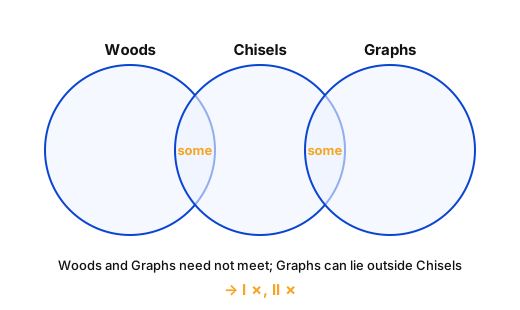
- Some woods are chisels; some chisels are graphs – woods and graphs may not overlap → I does not follow.
- 'Some chisels are graphs' cannot become 'All graphs are chisels' → II does not follow.
Yaad rakhein: Some + Some = no conclusion.
Answer: (D) Neither conclusion (I) nor (II) follows.
अवधारणा: दो 'कुछ' कथनों से अंतिम पदों के बीच कोई निश्चित संबंध नहीं बनता।
- कुछ लकड़ियाँ छेनी हैं; कुछ छेनी ग्राफ हैं – लकड़ी व ग्राफ का मिलना आवश्यक नहीं → I अनुसरण नहीं करता।
- 'कुछ छेनी ग्राफ हैं' से 'सभी ग्राफ छेनी हैं' नहीं निकलता → II अनुसरण नहीं करता।
याद रखें: कुछ + कुछ = कोई निष्कर्ष नहीं।
उत्तर: (D) न तो (I) न ही (II) अनुसरण करता है।
RRB NTPC Undergraduate CBT 1General Intelligence and ReasoningSyllogismRRB NTPC Undergraduate CBT 1 2024 · 8 Aug Shift 2
Q1537.Read the given statements and conclusions carefully. You have to take the given statements to be true even if they seem to be at variance from commonly known facts. You have to decide which conclusion(s) logically follow(s) from the given statements Statements:
Some nuts are berries.
All fruits are berries.
Conclusions (I): Some nuts are fruits.
Conclusions (II): All berries are fruits.
दिए गए कथनों और निष्कर्षों को ध्यानपूर्वक पढ़िए। आपको दिए गए कथनों को सत्य मानना है, भले ही वे सामान्यतः ज्ञात तथ्यों से भिन्न प्रतीत होते हों। आपको निर्णय लेना है कि कौन-सा/से निष्कर्ष तार्किक रूप से दिए गए कथनों का अनुसरण करता है/करते हैं। कथन:
कुछ मेवे, बेरी हैं।
सभी फल, बेरी हैं।
निष्कर्ष (I): कुछ मेवे, फल हैं।
निष्कर्ष (II): सभी बेरी, फल हैं।
- AOnly conclusion (I) follows.केवल निष्कर्ष (I) अनुसरण करता है।
- BBoth conclusions (I) and (II) follow.निष्कर्ष (I) और (II) दोनों अनुसरण करते हैं।
- CNeither conclusion (I) nor (II) follows.न तो निष्कर्ष (I) और न ही (II) अनुसरण करता है।
- DOnly conclusion (II) follows.केवल निष्कर्ष (II) अनुसरण करता है।
Show answer
Concept: Draw the least-overlap diagram; a conclusion follows only if it is true in every possible diagram.
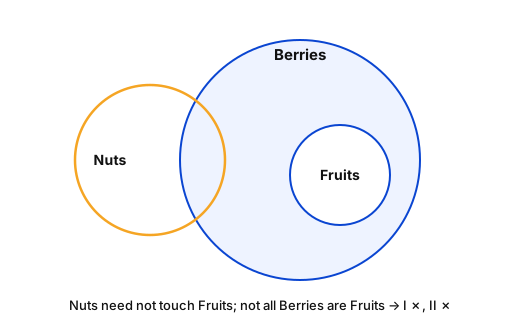
- All fruits are berries; some nuts are berries – those nuts may be berries that are not fruits → I does not follow.
- 'All fruits are berries' does not mean all berries are fruits → II does not follow.
Yaad rakhein: 'All A are B' never reverses to 'All B are A'.
Answer: (C) Neither conclusion (I) nor (II) follows.
अवधारणा: न्यूनतम-संबंध वाला चित्र बनाएँ; निष्कर्ष तभी सही है जब हर संभव चित्र में सत्य हो।
- सभी फल बेरी हैं; कुछ नट बेरी हैं – ये नट वे बेरी हो सकते हैं जो फल नहीं → I अनुसरण नहीं करता।
- 'सभी फल बेरी हैं' का अर्थ 'सभी बेरी फल हैं' नहीं → II अनुसरण नहीं करता।
याद रखें: 'सभी A, B हैं' को उलटकर 'सभी B, A हैं' नहीं कह सकते।
उत्तर: (C) न तो (I) न ही (II) अनुसरण करता है।
RRB NTPC Undergraduate CBT 1General Intelligence and ReasoningSyllogismRRB NTPC Undergraduate CBT 1 2024 · 8 Aug Shift 2
Q1538.Binoy starts from Point Y and drives 16 km towards the north. He then takes a right turn and drives 43 km, then turns right and drives 38 km. He then takes a right turn and drives 19 km. He takes a final right turn, drives 22 km and stops at Point Z. How far (shortest distance) and in which direction should he drive in order to reach Point Y again? (All turns are 90-degree turns only unless specified.)
बिनॉय बिंदु Y से चलना शुरू करता है और उत्तर की ओर 16 km गाड़ी चलाता है। फिर वह दाएँ मुड़ता है और 43 km गाड़ी चलाता है, फिर दाएँ मुड़ता है और 38 km गाड़ी चलाता है। फिर वह दाएँ मुड़ता है और 19 km गाड़ी चलाता है। वह अंतिम बार दाएँ मुड़ता है, 22 km गाड़ी चलाता है और बिंदु Z पर रुक जाता है। फिर से बिंदु Y पर पहुँचने के लिए उसे कितनी दूरी (न्यूनतम दूरी) तक और किस दिशा में गाड़ी चलानी चाहिए? (जब तक निर्दिष्ट न किया जाए, सभी मोड़ केवल 90 डिग्री के मोड़ हैं।)
- A31 km towards the southदक्षिण की ओर 31 km
- B24 km towards the westपश्चिम की ओर 24 km
- C29 km towards the eastपूर्व की ओर 29 km
- D22 km towards the eastपूर्व की ओर 22 km
Show answer
Concept: Track net north–south and east–west displacement.
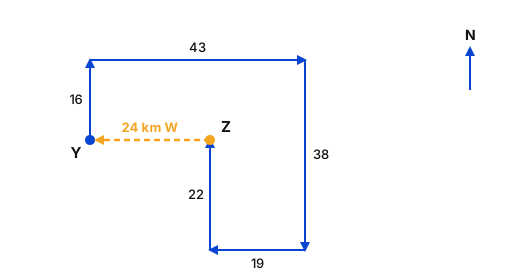
- N 16, then right → E 43, right → S 38, right → W 19, right → N 22.
- North–south: .
- East–west: km east of Y.
- So Z is 24 km east of Y → drive 24 km towards the west.
Yaad rakhein: Four right turns from north: E, S, W, N.
Answer: (B) 24 km towards the west
अवधारणा: उत्तर–दक्षिण और पूर्व–पश्चिम का शुद्ध विस्थापन निकालें।
- उत्तर 16, दाएँ → पूर्व 43, दाएँ → दक्षिण 38, दाएँ → पश्चिम 19, दाएँ → उत्तर 22।
- उत्तर–दक्षिण: ।
- पूर्व–पश्चिम: km, Y के पूर्व में।
- अतः Z, Y से 24 km पूर्व → पश्चिम की ओर 24 km चलना होगा।
याद रखें: उत्तर से चार बार दाएँ: पूर्व, दक्षिण, पश्चिम, उत्तर।
उत्तर: (B) पश्चिम की ओर 24 km
RRB NTPC Undergraduate CBT 1General Intelligence and ReasoningDirection and distanceRRB NTPC Undergraduate CBT 1 2024 · 8 Aug Shift 2
Q1539.In a certain code language, ‘GUNS’ is coded as ‘7642’ and ‘STUN’ is coded as ‘2364’. What is the code for ‘T’ in the given code language?
एक निश्चित कूट भाषा में, ‘GUNS’ को ‘7642’ लिखा जाता है और ‘STUN’ को ‘2364’ लिखा जाता है। उस कूट भाषा में ‘T’ के लिए क्या कूट है?
- A4
- B3
- C2
- D6
Show answer
Concept: Common letters share common digits; the leftover letter gets the leftover digit.
- GUNS → 7642, STUN → 2364.
- Common S, U, N ↔ common digits 2, 6, 4.
- Left: G ↔ 7 and T ↔ 3.
Yaad rakhein: Strike out common digits; what remains in the second code is T.
Answer: (B) 3
अवधारणा: उभयनिष्ठ अक्षरों के कोड उभयनिष्ठ अंक; बचे अक्षर का कोड बचा अंक।
- GUNS → 7642, STUN → 2364।
- उभयनिष्ठ S, U, N ↔ अंक 2, 6, 4।
- शेष: G ↔ 7 तथा T ↔ 3।
याद रखें: उभयनिष्ठ अंक काट दें; दूसरे कोड में बचा अंक T है।
उत्तर: (B) 3
RRB NTPC Undergraduate CBT 1General Intelligence and ReasoningCoding-decodingRRB NTPC Undergraduate CBT 1 2024 · 8 Aug Shift 2
Q1540.DUMB is related to TMCT in a certain way based on the English alphabetical order. In the same way, POYV is related to FGON. To which of the given options is LQUX related, following the same logic?
अंग्रेज़ी वर्णमाला क्रम के आधार पर DUMB एक निश्चित प्रकार से TMCT से संबंधित है। उसी प्रकार, POYV, FGON से संबंधित है। समान तर्क का अनुसरण करते हुए, LQUX दिए गए विकल्पों में से किससे संबंधित है?
- ABIPL
- BBPKI
- CBIPK
- DBIKP
Show answer
Concept: Find the backward shift of each letter (wrap around after A).
- DUMB→TMCT: D−10 = T, U−8 = M, M−10 = C, B−8 = T.
- POYV→FGON: P−10 = F, O−8 = G, Y−10 = O, V−8 = N ✓.
- LQUX: L−10 = B, Q−8 = I, U−10 = K, X−8 = P → BIKP.
Yaad rakhein: Pattern ; is the same as .
Answer: (D) BIKP
अवधारणा: प्रत्येक अक्षर का पीछे की ओर स्थानांतरण निकालें (A के बाद Z से घूमें)।
- DUMB→TMCT: D−10 = T, U−8 = M, M−10 = C, B−8 = T।
- POYV→FGON: P−10 = F, O−8 = G, Y−10 = O, V−8 = N ✓।
- LQUX: L−10 = B, Q−8 = I, U−10 = K, X−8 = P → BIKP।
याद रखें: पैटर्न ; और समान हैं।
उत्तर: (D) BIKP
RRB NTPC Undergraduate CBT 1General Intelligence and ReasoningLetter analogyRRB NTPC Undergraduate CBT 1 2024 · 8 Aug Shift 2

