Q1541.Which of the following numbers divides 4,81,355?
निम्नलिखित में से कौन-सी संख्या 4,81,355 को विभाजित करती है?
- A3
- B15
- C5
- D6
Show answer
Concept: A number is divisible by 5 if its last digit is 0 or 5; by 3 if its digit sum is divisible by 3.
- Last digit of 4,81,355 is 5 → divisible by 5.
- Digit sum , not divisible by 3 → not by 3, 6 or 15.
- Odd number → not divisible by 6 either.
Trick: Check the last digit first – it settles 5 and 2 instantly.
Answer: (C) 5
अवधारणा: कोई संख्या 5 से विभाज्य है यदि अंतिम अंक 0 या 5 हो; 3 से विभाज्य है यदि अंकों का योग 3 से विभाज्य हो।
- 4,81,355 का अंतिम अंक 5 है → 5 से विभाज्य।
- अंकों का योग , 3 से विभाज्य नहीं → 3, 6, 15 से भी नहीं।
- संख्या विषम है → 6 से भी नहीं।
ट्रिक: पहले अंतिम अंक देखें – 5 और 2 की जाँच तुरंत हो जाती है।
उत्तर: (C) 5
RRB NTPC Undergraduate CBT 1MathematicsDivisibility rulesRRB NTPC Undergraduate CBT 1 2024 · 8 Aug Shift 2
Q1542.A regular polygon has 30 sides. Find the measure of one interior angle.
एक सम बहुभुज की 30 भुजाएँ हैं। एक अंतःकोण की माप ज्ञात कीजिए।
- A
- B
- C
- D
Show answer
Concept: Each exterior angle of a regular -gon ; interior angle exterior angle.
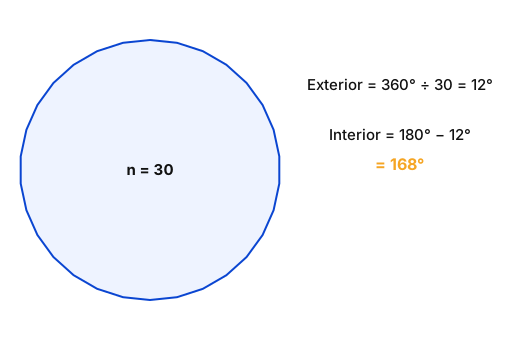
- , exterior angle .
- Interior angle .
- Check: .
Yaad rakhein: is the exterior angle – a trap option; always subtract from .
Answer: (A)
अवधारणा: सम -भुज का प्रत्येक बाह्य कोण ; अंतः कोण बाह्य कोण।
- , बाह्य कोण ।
- अंतः कोण ।
- जाँच: ।
याद रखें: बाह्य कोण है – जाल वाला विकल्प; हमेशा में से घटाएँ।
उत्तर: (A)
RRB NTPC Undergraduate CBT 1MathematicsInterior angle of regular polygonRRB NTPC Undergraduate CBT 1 2024 · 8 Aug Shift 2
Q1543.A shopkeeper marked the price of a table as ₹1,400 and offered two successive discounts, one of which is 12%. If a customer pays ₹1,133.44 for the table, then what was the second discount percentage offered?
एक दुकानदार ने एक मेज़ का अंकित मूल्य ₹1,400 रखा और दो क्रमागत छूटें दीं, जिनमें से एक 12% है। यदि एक ग्राहक मेज़ के लिए ₹1,133.44 का भुगतान करता है, तो दी गई दूसरी छूट का प्रतिशत कितना था?
- A10%
- B8%
- C15 %
- D5%
Show answer
Concept: Price after successive discounts .
- After 12% discount: ₹.
- Second factor .
- So second discount .
Trick: Divide final price by price after first discount; means 8% off.
Answer: (B) 8%
अवधारणा: क्रमिक छूट के बाद मूल्य ।
- 12% छूट के बाद: ₹।
- दूसरा गुणक ।
- अतः दूसरी छूट ।
ट्रिक: अंतिम मूल्य को पहली छूट के बाद के मूल्य से भाग दें; यानी 8% छूट।
उत्तर: (B) 8%
RRB NTPC Undergraduate CBT 1MathematicsSuccessive discountsRRB NTPC Undergraduate CBT 1 2024 · 8 Aug Shift 2
Q1544.Find the value of sin (90 − x) cos (180 − (x − y)) + cos (90 − x) sin (180 − (y − x)).
sin (90 − x) cos (180 − (x − y)) + cos (90 − x) sin (180 − (y − x)) का मान ज्ञात कीजिए।
- Asin y
- Bcos y
- C−cos y
- D−sin y
Show answer
Concept: Use , , , and .
- Expression .
- , so it becomes .
- .
Trick: Put : value . Only fits.
Answer: (C)
अवधारणा: , , , तथा का प्रयोग करें।
- व्यंजक ।
- , अतः ।
- ।
ट्रिक: रखें: मान । केवल सही बैठता है।
उत्तर: (C)
RRB NTPC Undergraduate CBT 1MathematicsTrigonometric identitiesRRB NTPC Undergraduate CBT 1 2024 · 8 Aug Shift 2
Q1545.If the third proportional of 81 and 27 is x, then what is the value of x?
यदि 81 और 27 का तृतीयानुपाती x है, तो x का मान क्या है?
- A6
- B9
- C11
- D7
Show answer
Concept: Third proportional of and is where , i.e. .
- .
- .
Yaad rakhein: Check: and ✓.
Answer: (B) 9
अवधारणा: और का तृतीयानुपाती हो तो , अर्थात् ।
- ।
- ।
याद रखें: जाँच: तथा ✓।
उत्तर: (B) 9
RRB NTPC Undergraduate CBT 1MathematicsThird proportionalRRB NTPC Undergraduate CBT 1 2024 · 8 Aug Shift 2
Q1546.The current population of a town is 12,014. It increases by 25% and 60% in two successive years but decreases by 50% in the third year. What is the population of the town at the end of the third year?
एक कस्बे की वर्तमान जनसंख्या 12,014 है। यह दो क्रमागत वर्षों में 25% और 60% बढ़ती है, परंतु तीसरे वर्ष में 50% घट जाती है। तीसरे वर्ष के अंत में कस्बे की जनसंख्या कितनी है?
- A12,014
- B12,015
- C12,019
- D12,013
Show answer
Concept: Successive % changes multiply: .
- Factors: .
- , and .
- So population .
Trick: In fractions: – no change at all.
Answer: (A) 12,014
अवधारणा: क्रमिक प्रतिशत परिवर्तन गुणा होते हैं: ।
- गुणक: ।
- , और ।
- अतः जनसंख्या ।
ट्रिक: भिन्न में: – कोई बदलाव नहीं।
उत्तर: (A) 12,014
RRB NTPC Undergraduate CBT 1MathematicsPopulation changeRRB NTPC Undergraduate CBT 1 2024 · 8 Aug Shift 2
Q1547.Evaluate: (-9) - (-60) ÷ (-10) + (-3) × 6
मान ज्ञात कीजिए: (-9) - (-60) ÷ (-10) + (-3) × 6
- A-36
- B-33
- C-35
- D-32
Show answer
Concept: BODMAS: division and multiplication before addition/subtraction; mind the signs.
- .
- .
- .
Yaad rakhein: Negative ÷ negative = positive; negative × positive = negative.
Answer: (B)
अवधारणा: BODMAS: पहले भाग व गुणा, फिर जोड़/घटाव; चिह्नों का ध्यान रखें।
- ।
- ।
- ।
याद रखें: ऋण ÷ ऋण = धन; ऋण × धन = ऋण।
उत्तर: (B)
RRB NTPC Undergraduate CBT 1MathematicsBODMAS with integersRRB NTPC Undergraduate CBT 1 2024 · 8 Aug Shift 2
Q1548.Ritik and Sanjay together invested ₹79,200 in a business. At the end of the year, out of a total profit of ₹16,500, Sanjay's share was ₹3,600. What was the difference between their investments?
रितिक और संजय ने मिलकर एक व्यवसाय में ₹79,200 का निवेश किया। वर्ष के अंत में, ₹16,500 के कुल लाभ में से संजय का हिस्सा ₹3,600 था। उनके निवेशों के बीच का अंतर कितना था?
- A₹42,824
- B₹44,640
- C₹46,400
- D₹42,889
Show answer
Concept: For the same time period, profit is shared in the ratio of investments.
- Ritik's profit , ratio .
- Sanjay's investment ; Ritik's .
- Difference .
Trick: Difference .
Answer: (B) ₹44,640
अवधारणा: समान समय के लिए लाभ निवेश के अनुपात में बँटता है।
- रितिक का लाभ , अनुपात ।
- संजय का निवेश ; रितिक का ।
- अंतर ।
ट्रिक: अंतर ।
उत्तर: (B) ₹44,640
RRB NTPC Undergraduate CBT 1MathematicsPartnershipRRB NTPC Undergraduate CBT 1 2024 · 8 Aug Shift 2
Q1549.The average weight of Vipul, Mohan and Mohammad is 45 kg. If the average weight of Vipul and Mohan is 43 kg and that of Mohan and Mohammad is 50 kg, then the weight of Mohan (in kg) is:
विपुल, मोहन और मोहम्मद का औसत भार 45 kg है। यदि विपुल और मोहन का औसत भार 43 kg है तथा मोहन और मोहम्मद का औसत भार 50 kg है, तो मोहन का भार (kg में) कितना है?
- A66
- B61
- C51
- D71
Show answer
Concept: Total = average × number of items; a common member appears in both pair sums.
- (H = Mohammad).
- , ; adding: .
- .
Trick: Mohan (sum of both pair totals) (three-person total).
Answer: (C) 51
अवधारणा: कुल योग = औसत × संख्या; साझा सदस्य दोनों जोड़ियों में आता है।
- (H = मोहम्मद)।
- , ; जोड़ने पर ।
- ।
ट्रिक: मोहन (दोनों जोड़ियों का योग) (तीनों का योग)।
उत्तर: (C) 51
RRB NTPC Undergraduate CBT 1MathematicsAverageRRB NTPC Undergraduate CBT 1 2024 · 8 Aug Shift 2
Q1550.A train with a length of 195 m overtakes a man moving at a speed of 5 km/hr (in the same direction) in 13 seconds. How much time (in seconds) will it take this train to completely cross another train that is 255 m long, moving in the opposite direction at a speed of 76 km/hr?
195 m लंबी एक रेलगाड़ी 5 km/hr की चाल से (उसी दिशा में) चल रहे एक व्यक्ति को 13 सेकंड में पार करती है। यह रेलगाड़ी विपरीत दिशा में 76 km/hr की चाल से चल रही 255 m लंबी दूसरी रेलगाड़ी को पूरी तरह से पार करने में कितना समय (सेकंड में) लेगी?
- A13
- B31
- C32
- D12
Show answer
Concept: Same direction: relative speed = difference; opposite: sum. Crossing distance = sum of lengths.
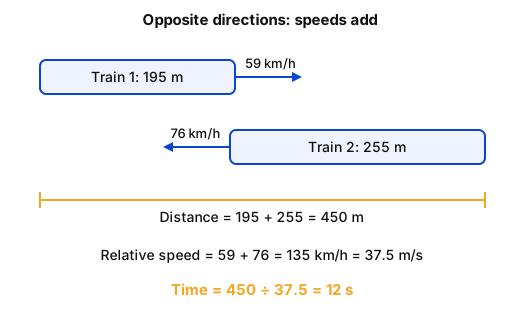
- Overtaking man: relative speed , so train speed .
- Opposite train: .
- Time .
Yaad rakhein: : multiply by .
Answer: (D) 12
अवधारणा: समान दिशा: सापेक्ष चाल = अंतर; विपरीत दिशा: योग। पार करने की दूरी = दोनों लंबाइयों का योग।
- व्यक्ति को पार करना: सापेक्ष चाल , अतः ट्रेन की चाल ।
- विपरीत ट्रेन: ।
- समय ।
याद रखें: : से गुणा करें।
उत्तर: (D) 12
RRB NTPC Undergraduate CBT 1MathematicsTrains – relative speedRRB NTPC Undergraduate CBT 1 2024 · 8 Aug Shift 2
Q1551.Find the simple interest (in ₹) on ₹1,200 at an interest rate of 3% per month for 11 months.
₹1,200 पर 3% प्रति माह की ब्याज दर से 11 माह का साधारण ब्याज (₹ में) ज्ञात कीजिए।
- A₹53
- B₹396
- C₹66
- D₹33
Show answer
Concept: , with and in the same time unit (here months).
- , per month, months.
- .
Yaad rakhein: 3% per month per year; too.
Answer: (B) ₹396
अवधारणा: , जहाँ और एक ही इकाई (यहाँ माह) में हों।
- , प्रति माह, माह।
- ।
याद रखें: 3% प्रति माह प्रति वर्ष; भी।
उत्तर: (B) ₹396
RRB NTPC Undergraduate CBT 1MathematicsSimple interestRRB NTPC Undergraduate CBT 1 2024 · 8 Aug Shift 2
Q1552.The sum of the squares of two consecutive odd natural numbers is 394. The sum of the numbers is:
दो क्रमागत विषम प्राकृत संख्याओं के वर्गों का योग 394 है। संख्याओं का योग कितना है?
- A24
- B22
- C32
- D28
Show answer
Concept: Let the consecutive odd numbers be and .
- .
- .
- Numbers 13 and 15: ✓; sum .
Trick: , so the numbers sit around 14: 13 and 15.
Answer: (D) 28
अवधारणा: मान लें क्रमागत विषम संख्याएँ और हैं।
- ।
- ।
- संख्याएँ 13 व 15: ✓; योग ।
ट्रिक: , अतः संख्याएँ 14 के आस-पास: 13 और 15।
उत्तर: (D) 28
RRB NTPC Undergraduate CBT 1MathematicsNumber system – squaresRRB NTPC Undergraduate CBT 1 2024 · 8 Aug Shift 2
Q1553.Pipe P can fill part of a tank in 30 hours, and pipe Q can fill part of the same tank in 28 hours. Both P and Q were kept open for 7 hours, then both were closed. Pipe R alone was then opened and it emptied the water in the tank in 8 hours. Pipes P, Q and R together can fill the empty tank in:
पाइप P किसी टंकी के भाग को 30 घंटे में भर सकता है, और पाइप Q उसी टंकी के भाग को 28 घंटे में भर सकता है। P और Q दोनों को 7 घंटे तक खुला रखा गया, फिर दोनों को बंद कर दिया गया। इसके बाद अकेले पाइप R को खोला गया और उसने टंकी का पानी 8 घंटे में खाली कर दिया। पाइप P, Q और R मिलकर खाली टंकी को कितने समय में भर सकते हैं?
- A210 hours210 घंटे
- B204 hours204 घंटे
- C222 hours222 घंटे
- D214 hours214 घंटे
Show answer
Concept: Find each pipe's full-tank time, then add rates (emptying pipe negative).
- P fills in 30 h → full in h; Q fills in 28 h → full in 70 h.
- In 7 h: filled.
- R empties in 8 h → full in h.
- Net rate → 210 h.
Trick: Take capacity units (LCM of 42, 70, 30): rates unit/h.
Answer: (A) 210 hours
अवधारणा: प्रत्येक पाइप का पूरी टंकी भरने का समय निकालें, फिर दरें जोड़ें (खाली करने वाला ऋणात्मक)।
- P, 30 घंटे में भरता है → पूरा घंटे; Q, 28 घंटे में → पूरा 70 घंटे।
- 7 घंटे में: भरा।
- R, को 8 घंटे में खाली करता है → पूरा घंटे।
- कुल दर → 210 घंटे।
ट्रिक: क्षमता इकाई (42, 70, 30 का LCM) लें: दरें इकाई/घंटा।
उत्तर: (A) 210 घंटे
RRB NTPC Undergraduate CBT 1MathematicsPipes and cisternsRRB NTPC Undergraduate CBT 1 2024 · 8 Aug Shift 2
Q1554.A can do a work in 10 days and B can do the same work in 20 days. If they work on it together for 6 days, then what fraction of the work is left?
A किसी कार्य को 10 दिनों में कर सकता है और B उसी कार्य को 20 दिनों में कर सकता है। यदि वे मिलकर उस पर 6 दिनों तक कार्य करते हैं, तो कार्य का कितना भाग शेष रहता है?
- A
- B
- C
- D
Show answer
Concept: Take total work = LCM of days; one-day work = units per day.
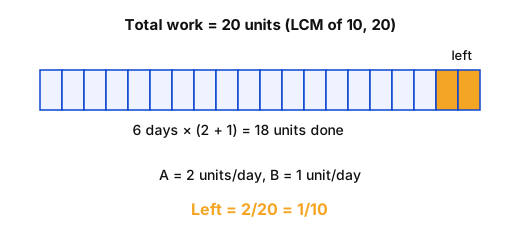
- Total units; A , B unit/day.
- Together in 6 days: units.
- Left units .
Yaad rakhein: Work done ; left .
Answer: (C)
अवधारणा: कुल कार्य = दिनों का LCM लें; एक दिन का कार्य = प्रति दिन इकाइयाँ।
- कुल इकाई; A , B इकाई/दिन।
- 6 दिन में साथ: इकाई।
- शेष इकाई ।
याद रखें: किया गया कार्य ; शेष ।
उत्तर: (C)
RRB NTPC Undergraduate CBT 1MathematicsTime and workRRB NTPC Undergraduate CBT 1 2024 · 8 Aug Shift 2
Q1555.P, Q and R invested a sum in the ratio of 34 : 75 : 6, respectively. If they earned a total profit of ₹3,600 at the end of the year, what is the difference between the shares of Q and R?
P, Q और R ने क्रमशः 34 : 75 : 6 के अनुपात में एक राशि का निवेश किया। यदि वर्ष के अंत में उन्होंने कुल ₹3,600 का लाभ अर्जित किया, तो Q और R के हिस्सों के बीच का अंतर कितना है?
- A₹2,109
- B₹2,316
- C₹2,264
- D₹2,160
Show answer
Concept: Profit is divided in the investment ratio; difference of shares = (difference of ratio terms) × one part.
- Total ratio .
- Q − R parts.
- Difference .
Trick: – spot the common factor 23.
Answer: (D) ₹2,160
अवधारणा: लाभ निवेश के अनुपात में बँटता है; हिस्सों का अंतर = (अनुपात पदों का अंतर) × एक भाग।
- कुल अनुपात ।
- Q − R भाग।
- अंतर ।
ट्रिक: – उभयनिष्ठ गुणनखंड 23 पहचानें।
उत्तर: (D) ₹2,160
RRB NTPC Undergraduate CBT 1MathematicsPartnership – ratioRRB NTPC Undergraduate CBT 1 2024 · 8 Aug Shift 2
Q1556.Seven times the present age of P exceeds the present age of Q by 46 years. After 8 years, six times Q’s age will be 24 years less than six times P’s age at that time. What is the present age (in years) of Q?
P की वर्तमान आयु का सात गुना, Q की वर्तमान आयु से 46 वर्ष अधिक है। 8 वर्ष बाद, Q की आयु का छह गुना, उस समय P की आयु के छह गुने से 24 वर्ष कम होगा। Q की वर्तमान आयु (वर्षों में) कितनी है?
- A11
- B12
- C5
- D3
Show answer
Concept: Form two equations from the statements and solve.
- … (i)
- After 8 years: … (ii)
- From (i): , so .
Yaad rakhein: Check: ✓; after 8 yrs , ✓.
Answer: (D) 3
अवधारणा: कथनों से दो समीकरण बनाकर हल करें।
- … (i)
- 8 वर्ष बाद: … (ii)
- (i) से: , अतः ।
याद रखें: जाँच: ✓; 8 वर्ष बाद , ✓।
उत्तर: (D) 3
RRB NTPC Undergraduate CBT 1MathematicsProblems on agesRRB NTPC Undergraduate CBT 1 2024 · 8 Aug Shift 2
Q1557.The area of a triangle is 1080 cm2 and its sides are in the ratio 5 : 12 : 13. The perimeter of the triangle is:
एक त्रिभुज का क्षेत्रफल 1080 cm2 है और उसकी भुजाएँ 5 : 12 : 13 के अनुपात में हैं। त्रिभुज का परिमाप कितना है?
- A210 cm
- B180 cm
- C150 cm
- D120 cm
Show answer
Concept: is a Pythagorean triplet, so the triangle is right-angled; area .
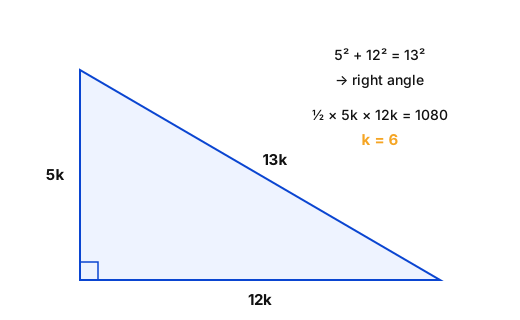
- Sides ; .
- Area , .
- Perimeter .
Yaad rakhein: Triplets 3-4-5, 5-12-13, 8-15-17, 7-24-25 → right triangle, use the two legs.
Answer: (B) 180 cm
अवधारणा: पाइथागोरस त्रिक है, अतः त्रिभुज समकोण है; क्षेत्रफल ।
- भुजाएँ ; ।
- क्षेत्रफल , ।
- परिमाप ।
याद रखें: त्रिक 3-4-5, 5-12-13, 8-15-17, 7-24-25 → समकोण त्रिभुज, दो लंब भुजाएँ लें।
उत्तर: (B) 180 cm
RRB NTPC Undergraduate CBT 1MathematicsMensuration – triangleRRB NTPC Undergraduate CBT 1 2024 · 8 Aug Shift 2
Q1558.Find the simple interest (in ₹) on ₹4,000 at 6.75% per annum rate of interest deposited on 22 February 2024 and withdrawn on 23 April 2024.
22 फ़रवरी 2024 को जमा किए गए और 23 अप्रैल 2024 को निकाले गए ₹4,000 पर 6.75% वार्षिक ब्याज दर से साधारण ब्याज (₹ में) ज्ञात कीजिए।
- A₹44
- B₹43
- C₹46
- D₹45
Show answer
Concept: Count days excluding the deposit day (include withdrawal day); 2024 is a leap year (366 days).
- Days: Feb (23–29) , March , April → days.
- .
- .
Yaad rakhein: , so 61 days of a leap year year.
Answer: (D) ₹45
अवधारणा: जमा वाले दिन को छोड़कर (निकासी दिन गिनें) दिन गिनें; 2024 लीप वर्ष है (366 दिन)।
- दिन: फरवरी (23–29) , मार्च , अप्रैल → दिन।
- ।
- ।
याद रखें: , अतः लीप वर्ष के 61 दिन वर्ष।
उत्तर: (D) ₹45
RRB NTPC Undergraduate CBT 1MathematicsSimple interest – daysRRB NTPC Undergraduate CBT 1 2024 · 8 Aug Shift 2
Q1559.Simplify the given expression.
x(3x − 5) + 5(x2 − 3) + 16
दिए गए व्यंजक को सरल कीजिए।
x(3x − 5) + 5(x2 − 3) + 16
- A
- B
- C
- D
Show answer
Concept: Expand the brackets and combine like terms.
- ; .
- Sum: .
- .
Yaad rakhein: Put : expression → constant term must be .
Answer: (B)
अवधारणा: कोष्ठक खोलें और समान पदों को जोड़ें।
- ; ।
- योग: ।
- ।
याद रखें: रखें: व्यंजक → अचर पद होगा।
उत्तर: (B)
RRB NTPC Undergraduate CBT 1MathematicsAlgebraic simplificationRRB NTPC Undergraduate CBT 1 2024 · 8 Aug Shift 2
Q1560.What smallest number should be added to 91673 so that the sum is completely divisible by 88?
91673 में कौन-सी सबसे छोटी संख्या जोड़ी जानी चाहिए ताकि योगफल 88 से पूर्णतः विभाज्य हो?
- A24
- B21
- C23
- D26
Show answer
Concept: Number to add = divisor − remainder.
- : , remainder .
- Add → .
Yaad rakhein: Least number to subtract = remainder; to add = divisor − remainder.
Answer: (C) 23
अवधारणा: जोड़ी जाने वाली संख्या = भाजक − शेषफल।
- : , शेषफल ।
- जोड़ें → ।
याद रखें: घटाने हेतु न्यूनतम = शेषफल; जोड़ने हेतु = भाजक − शेषफल।
उत्तर: (C) 23
RRB NTPC Undergraduate CBT 1MathematicsDivisibility – least number to addRRB NTPC Undergraduate CBT 1 2024 · 8 Aug Shift 2

