Q141.H, I, J, P, Q, R and S are sitting around a circular table facing the centre of the table. Only one person sits between H and Q when counted from the left of Q. S sits third to the right of R. J sits third to the left of P. S sits to the immediate right of J. I is not an immediate neighbour of J.
How many people sit between I and Q when counted from the right of I?
H, I, J, P, Q, R और S एक वृत्ताकार मेज़ के चारों ओर मेज़ के केंद्र की ओर मुख करके बैठे हैं। Q के बाएँ से गिनने पर H और Q के बीच केवल एक व्यक्ति बैठा है। S, R के दाएँ से तीसरे स्थान पर बैठा है। J, P के बाएँ से तीसरे स्थान पर बैठा है। S, J के ठीक दाएँ बैठा है। I, J का निकटतम पड़ोसी नहीं है।
I के दाएँ से गिनने पर I और Q के बीच कितने लोग बैठे हैं?
- ATwoदो
- BOneएक
- CFourचार
- DThreeतीन
Show answer
Concept: Facing the centre, right = anticlockwise, left = clockwise. Start with the chain J–S–R–P.
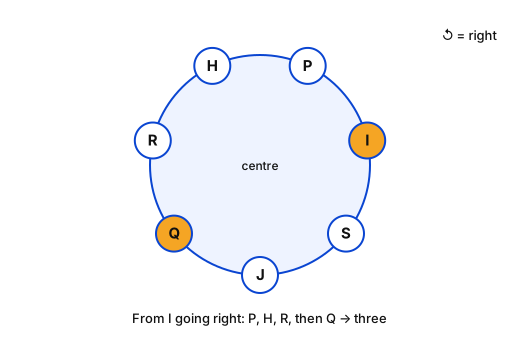
- S is immediately right of J; R is third to the left of S, and P is third to the right of J.
- Seats left for H, I, Q; I cannot sit next to J.
- H must be second to the left of Q – only possible with Q next to J, H beside R and I between S and P.
- Order (going right from J): J, S, I, P, H, R, Q. From I going right: P, H, R, then Q → three.
Trick: With 7 seats, 'third to the right' of one is 'fourth to the left' – fix the chain before placing the rest.
Answer: (D) Three
अवधारणा: केंद्र की ओर मुख होने पर दायाँ = वामावर्त, बायाँ = दक्षिणावर्त। J–S–R–P की कड़ी से शुरू करें।
- S, J के ठीक दाएँ; R, S के बाएँ तीसरा, और P, J के दाएँ तीसरा।
- H, I, Q के लिए स्थान शेष; I, J के पास नहीं बैठ सकता।
- H, Q के बाएँ दूसरा होना चाहिए – यह तभी संभव जब Q, J के पास, H, R के पास और I, S व P के बीच हो।
- क्रम (J से दाएँ): J, S, I, P, H, R, Q। I से दाएँ: P, H, R, फिर Q → तीन।
ट्रिक: 7 स्थानों में 'दाएँ तीसरा' = 'बाएँ चौथा' – पहले कड़ी तय करें।
उत्तर: (D) तीन
RRB NTPC Undergraduate CBT 1General Intelligence and ReasoningCircular Seating ArrangementRRB NTPC Undergraduate CBT 1 2024 · 8 Sep Shift 2
Q142.In the following triads, each group of letters is related to the subsequent one following a certain logic. Select from the given options, the one which follows the same logic. DEAR - DRAE - RAED
BALM - BMLA - MLAB
निम्नलिखित त्रिकों में, अक्षरों का प्रत्येक समूह एक निश्चित तर्क का अनुसरण करते हुए अपने बाद वाले समूह से संबंधित है। दिए गए विकल्पों में से उसका चयन कीजिए, जो समान तर्क का अनुसरण करता है। DEAR - DRAE - RAED
BALM - BMLA - MLAB
- ASWAG - SAWG - GAWS
- BMEAL - MELA - EALM
- CBURN - UBRN - NURB
- DMOST - MTSO - TSOM
Show answer
Concept: Find how the 2nd and 3rd words are made from the 1st word.
- DEAR → DRAE: 2nd and 4th letters swap; DEAR → RAED: word reversed.
- BALM → BMLA (swap A, M) and MLAB (reverse) ✓
- MOST → MTSO (swap O, T) and TSOM (reverse) ✓ – other options fail
Trick: Check the third word first: it must be the exact reverse of the first.
Answer: (D) MOST - MTSO - TSOM
अवधारणा: देखें कि दूसरा और तीसरा शब्द पहले शब्द से कैसे बनते हैं।
- DEAR → DRAE: दूसरा और चौथा अक्षर बदले; DEAR → RAED: शब्द उल्टा।
- BALM → BMLA (A, M बदले) और MLAB (उल्टा) ✓
- MOST → MTSO (O, T बदले) और TSOM (उल्टा) ✓ – अन्य विकल्प असफल
ट्रिक: पहले तीसरा शब्द जाँचें: वह पहले शब्द का ठीक उल्टा होना चाहिए।
उत्तर: (D) MOST - MTSO - TSOM
RRB NTPC Undergraduate CBT 1General Intelligence and ReasoningLetter TriadsRRB NTPC Undergraduate CBT 1 2024 · 8 Sep Shift 2
Q143.Based on the English alphabetical order, three of the following four letter-cluster pairs are alike in a certain way and thus form a group. Which letter-cluster pair DOES NOT belong to that group?
(Note: The odd one out is not based on the number of consonants/vowels or their position in the letter-cluster.)
अंग्रेज़ी वर्णमाला क्रम के आधार पर, निम्नलिखित चार अक्षर-समूह युग्मों में से तीन किसी निश्चित प्रकार से एकसमान हैं और इस प्रकार एक समूह बनाते हैं। कौन-सा अक्षर-समूह युग्म उस समूह से संबंधित नहीं है?
(ध्यान दें: असंगत अक्षर-समूह, उस अक्षर-समूह में व्यंजनों/स्वरों की संख्या या उनके स्थान पर आधारित नहीं है।)
- APL-IM
- BKG-DI
- CIE-BG
- DNJ-GL
Show answer
Concept: Check the gaps within and between the clusters.
- KG-DI: K−4=G, K−7=D, D+5=I
- IE-BG: I−4=E, I−7=B, B+5=G; NJ-GL: N−4=J, N−7=G, G+5=L
- PL-IM: P−4=L, P−7=I, but I+4=M (not +5)
Trick: In the group, the last letter is 2 after the second letter (G→I, E→G, J→L); L→M is only 1.
Answer: (A) PL-IM
अवधारणा: समूहों के भीतर और बीच के अंतर जाँचें।
- KG-DI: K−4=G, K−7=D, D+5=I
- IE-BG: I−4=E, I−7=B, B+5=G; NJ-GL: N−4=J, N−7=G, G+5=L
- PL-IM: P−4=L, P−7=I, पर I+4=M (+5 नहीं)
ट्रिक: समूह में अंतिम अक्षर दूसरे अक्षर से 2 आगे (G→I, E→G, J→L); L→M केवल 1।
उत्तर: (A) PL-IM
RRB NTPC Undergraduate CBT 1General Intelligence and ReasoningOdd One Out (Letter Pairs)RRB NTPC Undergraduate CBT 1 2024 · 8 Sep Shift 2
Q144.Read the given statements and conclusions carefully. Assuming that the information given in the statements is true, even if it appears to be at variance with commonly known facts, decide which of the given conclusions logically follow(s) from the statements.
Statements:
All jars are cups.
Some jars are kettles.
Conclusions:
(I) Some cups are kettles.
(II) Some kettles are jars.
दिए गए कथनों और निष्कर्षों को ध्यानपूर्वक पढ़िए। कथनों में दी गई जानकारी को सत्य मानते हुए, भले ही वह सामान्यतः ज्ञात तथ्यों से भिन्न प्रतीत होती हो, निर्णय लीजिए कि दिए गए निष्कर्षों में से कौन-सा/कौन-से निष्कर्ष तार्किक रूप से कथनों का अनुसरण करता है/करते हैं।
कथन:
सभी जार, कप हैं।
कुछ जार, केतलियाँ हैं।
निष्कर्ष:
(I) कुछ कप, केतलियाँ हैं।
(II) कुछ केतलियाँ, जार हैं।
- AOnly conclusion (I) follows.केवल निष्कर्ष (I) अनुसरण करता है।
- BOnly conclusion (II) follows.केवल निष्कर्ष (II) अनुसरण करता है।
- CBoth conclusions (I) and (II) follow.निष्कर्ष (I) और (II) दोनों अनुसरण करते हैं।
- DNeither conclusion (I) nor (II) follows.न तो निष्कर्ष (I) और न ही (II) अनुसरण करता है।
Show answer
Concept: Draw the Venn diagram; 'Some A are B' can always be converted to 'Some B are A'.
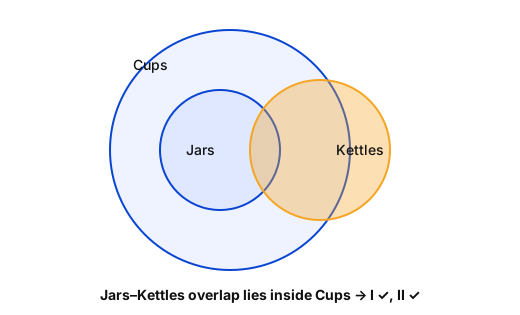
- All jars are inside cups; some jars overlap kettles.
- That jar–kettle overlap lies inside cups, so some cups are kettles – I follows.
- 'Some jars are kettles' converts to 'Some kettles are jars' – II follows.
Trick: All A are B + Some A are C ⇒ Some B are C.
Answer: (C) Both conclusions (I) and (II) follow.
अवधारणा: वेन आरेख बनाएँ; 'कुछ A, B हैं' को सदैव 'कुछ B, A हैं' में बदला जा सकता है।
- सभी जार कपों के अंदर; कुछ जार केतलियों से ओवरलैप।
- जार–केतली ओवरलैप कपों के अंदर है, अतः कुछ कप केतलियाँ हैं – I अनुसरण करता है।
- 'कुछ जार केतलियाँ हैं' का रूपांतरण 'कुछ केतलियाँ जार हैं' – II अनुसरण करता है।
ट्रिक: सभी A, B हैं + कुछ A, C हैं ⇒ कुछ B, C हैं।
उत्तर: (C) निष्कर्ष (I) और (II) दोनों अनुसरण करते हैं।
RRB NTPC Undergraduate CBT 1General Intelligence and ReasoningSyllogismRRB NTPC Undergraduate CBT 1 2024 · 8 Sep Shift 2
Q145.Town A is to the east of Town B. Town C is to the south of Town A. Town D is to the east of Town C. Town E is to the south of Town D. Town F is to the east of Town E. What is the position of Town F with respect to Town A?
नगर A, नगर B के पूर्व में है। नगर C, नगर A के दक्षिण में है। नगर D, नगर C के पूर्व में है। नगर E, नगर D के दक्षिण में है। नगर F, नगर E के पूर्व में है। नगर A के सापेक्ष नगर F की स्थिति क्या है?
- ANorthwestउत्तर-पश्चिम
- BNorthउत्तर
- CNortheastउत्तर-पूर्व
- DSoutheastदक्षिण-पूर्व
Show answer
Concept: Place the towns on a grid step by step.
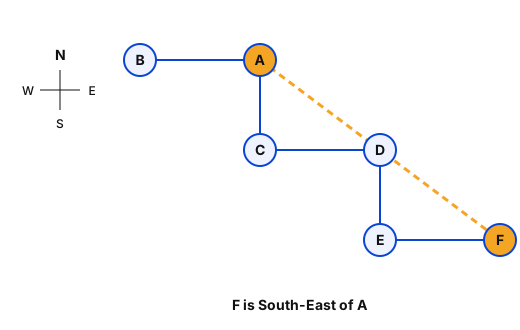
- B is west of A; C is south of A.
- D is east of C; E is south of D; F is east of E.
- F is both south and east of A → south-east.
Trick: Net movement from A: only south and east steps → South-East.
Answer: (D) Southeast
अवधारणा: नगरों को क्रम से ग्रिड पर रखें।
- B, A के पश्चिम में; C, A के दक्षिण में।
- D, C के पूर्व में; E, D के दक्षिण में; F, E के पूर्व में।
- F, A से दक्षिण और पूर्व दोनों ओर → दक्षिण-पूर्व।
ट्रिक: A से केवल दक्षिण और पूर्व की चालें → दक्षिण-पूर्व।
उत्तर: (D) दक्षिण-पूर्व (Southeast)
RRB NTPC Undergraduate CBT 1General Intelligence and ReasoningDirection SenseRRB NTPC Undergraduate CBT 1 2024 · 8 Sep Shift 2
Q146.Each of the digits in the number 3417659 is arranged in the ascending order from left to right. What will be the sum of the digits that are second from the left and second from the right in the new number thus formed?
संख्या 3417659 के प्रत्येक अंक को बाएँ से दाएँ आरोही क्रम में व्यवस्थित किया जाता है। इस प्रकार बनी नई संख्या में बाएँ से दूसरे और दाएँ से दूसरे अंकों का योग क्या होगा?
- A12
- B10
- C11
- D9
Show answer
Concept: Arrange the digits in ascending order and pick the required positions.
- 3417659 → 1 3 4 5 6 7 9
- Second from left = 3; second from right = 7
- Sum
Trick: Second from left/right in ascending order = second smallest/largest digit.
Answer: (B) 10
अवधारणा: अंकों को आरोही क्रम में लगाकर अपेक्षित स्थान चुनें।
- 3417659 → 1 3 4 5 6 7 9
- बाएँ से दूसरा = 3; दाएँ से दूसरा = 7
- योग
ट्रिक: आरोही क्रम में बाएँ/दाएँ से दूसरा = दूसरा सबसे छोटा/बड़ा अंक।
उत्तर: (B) 10
RRB NTPC Undergraduate CBT 1General Intelligence and ReasoningDigit ArrangementRRB NTPC Undergraduate CBT 1 2024 · 8 Sep Shift 2
Q147.Seven boxes, A, B, C, D, E, F and G, are kept one over the other but not necessarily in the same order.
Only G is kept above B. Only F is kept between B and C. Only E is kept below A. How many boxes are kept between E and F?
सात डिब्बे, A, B, C, D, E, F और G, एक के ऊपर एक रखे गए हैं, लेकिन आवश्यक नहीं कि इसी क्रम में हों।
B के ऊपर केवल G रखा गया है। B और C के बीच केवल F रखा गया है। A के नीचे केवल E रखा गया है। E और F के बीच कितने डिब्बे रखे गए हैं?
- A4
- B3
- C1
- D2
Show answer
Concept: 'Only X above Y' puts Y 2nd from top; 'only X below Y' puts Y 2nd from bottom.
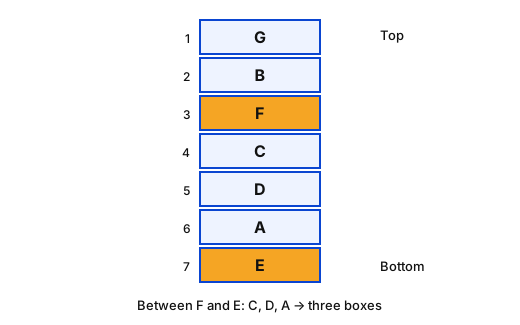
- Only G above B → G 1st, B 2nd.
- Only F between B and C → F 3rd, C 4th.
- Only E below A → E 7th, A 6th; D takes the 5th place.
- Between F (3rd) and E (7th): C, D, A → 3 boxes.
Trick: Boxes between positions and = .
Answer: (B) 3
अवधारणा: 'केवल X, Y के ऊपर' से Y ऊपर से दूसरा; 'केवल X, Y के नीचे' से Y नीचे से दूसरा।
- केवल G, B के ऊपर → G पहला, B दूसरा।
- B और C के बीच केवल F → F तीसरा, C चौथा।
- A के नीचे केवल E → E सातवाँ, A छठा; D पाँचवाँ।
- F (3रा) और E (7वाँ) के बीच: C, D, A → 3 बॉक्स।
ट्रिक: स्थान और के बीच बॉक्स = ।
उत्तर: (B) 3
RRB NTPC Undergraduate CBT 1General Intelligence and ReasoningBox StackingRRB NTPC Undergraduate CBT 1 2024 · 8 Sep Shift 2
Q148.What should come in place of the question mark (?) in the given series?
285 260 237 216 197 ?
दी गई शृंखला में प्रश्न चिह्न (?) के स्थान पर क्या आना चाहिए?
285 260 237 216 197 ?
- A180
- B150
- C160
- D170
Show answer
Concept: Look at the differences between consecutive terms.
- Differences:
- Next difference
Trick: Differences decrease in size by 2 each time.
Answer: (A) 180
अवधारणा: क्रमागत पदों का अंतर देखें।
- अंतर:
- अगला अंतर
ट्रिक: अंतर का मान हर बार 2 घटता है।
उत्तर: (A) 180
RRB NTPC Undergraduate CBT 1General Intelligence and ReasoningNumber SeriesRRB NTPC Undergraduate CBT 1 2024 · 8 Sep Shift 2
Q149.What should come in place of the question mark (?) in the given series?
879 880 884 893 909 ?
दी गई शृंखला में प्रश्न चिह्न (?) के स्थान पर क्या आना चाहिए?
879 880 884 893 909 ?
- A931
- B934
- C937
- D929
Show answer
Concept: Check whether the differences are perfect squares.
- Differences:
- Next difference
Trick: Differences 1, 4, 9, 16 … are always squares – add the next square.
Answer: (B) 934
अवधारणा: देखें कि अंतर पूर्ण वर्ग हैं या नहीं।
- अंतर:
- अगला अंतर
ट्रिक: अंतर 1, 4, 9, 16 … वर्ग हैं – अगला वर्ग जोड़ें।
उत्तर: (B) 934
RRB NTPC Undergraduate CBT 1General Intelligence and ReasoningNumber Series (Squares)RRB NTPC Undergraduate CBT 1 2024 · 8 Sep Shift 2
Q150.In a certain code language, ‘OLEA’ is coded as ‘1542’ and ‘PEAL’ is coded as ‘4651’. What is the code for ‘P’ in that language?
एक निश्चित कूट भाषा में, ‘OLEA’ को ‘1542’ के रूप में कूटबद्ध किया जाता है और ‘PEAL’ को ‘4651’ के रूप में कूटबद्ध किया जाता है। उस भाषा में ‘P’ के लिए कूट क्या है?
- A4
- B1
- C5
- D6
Show answer
Concept: Codes are jumbled; match common letters with common digits.
- OLEA = {1, 5, 4, 2}; PEAL = {4, 6, 5, 1}
- Common letters L, E, A ↔ common digits 1, 4, 5
- Left-over: O ↔ 2 and P ↔ 6
Trick: The letter unique to a word takes the digit unique to its code.
Answer: (D) 6
अवधारणा: कोड क्रम में नहीं हैं; उभयनिष्ठ अक्षरों का मिलान उभयनिष्ठ अंकों से करें।
- OLEA = {1, 5, 4, 2}; PEAL = {4, 6, 5, 1}
- उभयनिष्ठ अक्षर L, E, A ↔ उभयनिष्ठ अंक 1, 4, 5
- शेष: O ↔ 2 और P ↔ 6
ट्रिक: जो अक्षर केवल एक शब्द में है, उसे उसी कोड का अकेला अंक मिलता है।
उत्तर: (D) 6
RRB NTPC Undergraduate CBT 1General Intelligence and ReasoningLetter Coding (Common Letters)RRB NTPC Undergraduate CBT 1 2024 · 8 Sep Shift 2
Q151.Read the given statements and conclusions carefully. Assuming that the information given in the statements is true, even if it appears to be at variance with commonly known facts, decide which of the given conclusions logically follow(s) from the statements.
Statements: Some notes are books. All books are keys.
Conclusions (I): Some notes are keys.
Conclusions (II): All keys are books.
दिए गए कथनों और निष्कर्षों को ध्यानपूर्वक पढ़िए। कथनों में दी गई जानकारी को सत्य मानते हुए, भले ही वह सामान्यतः ज्ञात तथ्यों से भिन्न प्रतीत होती हो, निर्णय लीजिए कि दिए गए निष्कर्षों में से कौन-सा/से निष्कर्ष कथनों का तार्किक रूप से अनुसरण करता है/करते हैं।
कथन: कुछ नोट, पुस्तकें हैं। सभी पुस्तकें, चाबियाँ हैं।
निष्कर्ष (I): कुछ नोट, चाबियाँ हैं।
निष्कर्ष (II): सभी चाबियाँ, पुस्तकें हैं।
- AOnly conclusion (II) follows.केवल निष्कर्ष (II) अनुसरण करता है।
- BOnly conclusion (I) follows.केवल निष्कर्ष (I) अनुसरण करता है।
- CNeither conclusion (I) nor (II) follows.न तो निष्कर्ष (I) और न ही (II) अनुसरण करता है।
- DBoth conclusions (I) and (II) follow.निष्कर्ष (I) और (II) दोनों अनुसरण करते हैं।
Show answer
Concept: Draw the Venn diagram with the minimum possible overlap.
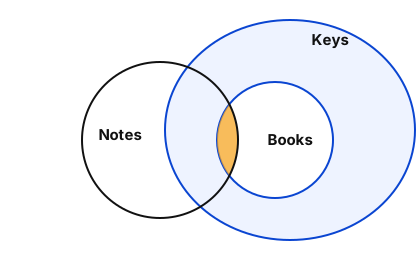
- Some notes are books, and all books lie inside keys.
- So the notes that are books are also keys ⇒ Some notes are keys: (I) follows.
- Keys may contain things that are not books ⇒ (II) does not follow.
Trick: Some A are B + All B are C ⇒ Some A are C. 'All B are C' never gives 'All C are B'.
Answer: (B) Only conclusion (I) follows.
अवधारणा: न्यूनतम संभव ओवरलैप के साथ वेन आरेख बनाएँ।
- कुछ notes, books हैं और सभी books, keys के अंदर हैं।
- जो notes, books हैं वे keys भी हैं ⇒ कुछ notes, keys हैं: (I) सही।
- keys में books के अलावा भी चीज़ें हो सकती हैं ⇒ (II) सही नहीं।
ट्रिक: कुछ A, B हैं + सभी B, C हैं ⇒ कुछ A, C हैं। 'सभी B, C' से 'सभी C, B' नहीं निकलता।
उत्तर: (B) केवल निष्कर्ष (I) अनुसरण करता है।
RRB NTPC Undergraduate CBT 1General Intelligence and ReasoningSyllogismRRB NTPC Undergraduate CBT 1 2024 · 8 Sep Shift 1
Q152.Which of the following letter-number clusters will replace the question mark (?) in the given series to make it logically complete?
VOH 90, SLE 83, PIB 76, MFY 69, JCV 62, ?
निम्नलिखित में से कौन-सा अक्षर-संख्या समूह दी गई श्रृंखला में प्रश्न चिह्न (?) के स्थान पर आकर उसे तार्किक रूप से पूर्ण करेगा?
VOH 90, SLE 83, PIB 76, MFY 69, JCV 62, ?
- AGJS 55
- BHZS 55
- CGZS 55
- DGZI 55
Show answer
Concept: Track each letter position and the number separately.
- 1st letters: V, S, P, M, J → each ⇒ G.
- 2nd letters: O, L, I, F, C → ⇒ Z (C − 3 wraps to Z).
- 3rd letters: H, E, B, Y, V → ⇒ S.
- Numbers: 90, 83, 76, 69, 62 → ⇒ 55.
Trick: Wrap-around: after A comes Z when moving backwards.
Answer: (C) GZS 55
अवधारणा: हर अक्षर स्थान और संख्या को अलग-अलग देखें।
- पहला अक्षर: V, S, P, M, J → हर बार ⇒ G।
- दूसरा: O, L, I, F, C → ⇒ Z (C से 3 पीछे घूमकर Z)।
- तीसरा: H, E, B, Y, V → ⇒ S।
- संख्याएँ: 90, 83, 76, 69, 62 → ⇒ 55।
ट्रिक: पीछे जाते समय A के बाद Z आता है।
उत्तर: (C) GZS 55
RRB NTPC Undergraduate CBT 1General Intelligence and ReasoningLetter-number seriesRRB NTPC Undergraduate CBT 1 2024 · 8 Sep Shift 1
Q153.Each of the digits in the number 8912346 is arranged in ascending order from left to right. What will be the sum of the digits that are second from the left and second from the right in the new number thus formed?
संख्या 8912346 के प्रत्येक अंक को बाएँ से दाएँ आरोही क्रम में व्यवस्थित किया जाता है। इस प्रकार बनी नई संख्या में बाएँ से दूसरे और दाएँ से दूसरे अंकों का योग क्या होगा?
- A7
- B6
- C10
- D8
Show answer
Concept: Arrange the digits in ascending order and read the required positions.
- Digits of 8912346 in ascending order: 1 2 3 4 6 8 9.
- Second from left ; second from right .
- Sum .
Trick: Write the new number fully before counting positions.
Answer: (C) 10
अवधारणा: अंकों को आरोही क्रम में लगाकर माँगे गए स्थान पढ़ें।
- 8912346 के अंक आरोही क्रम में: 1 2 3 4 6 8 9।
- बाएँ से दूसरा ; दाएँ से दूसरा ।
- योग ।
ट्रिक: स्थान गिनने से पहले नई संख्या पूरी लिख लें।
उत्तर: (C) 10
RRB NTPC Undergraduate CBT 1General Intelligence and ReasoningDigit arrangementRRB NTPC Undergraduate CBT 1 2024 · 8 Sep Shift 1
Q154.If 2 is added to each even digit and 1 is subtracted from each odd digit in the number 4376295, then which of the following digits will be third from the right in the new number thus formed?
यदि संख्या 4376295 में प्रत्येक सम अंक में 2 जोड़ दिया जाए और प्रत्येक विषम अंक में से 1 घटा दिया जाए, तो इस प्रकार बनी नई संख्या में दाएँ से तीसरा अंक निम्नलिखित में से कौन-सा होगा?
- A4
- B8
- C7
- D2
Show answer
Concept: Change each digit by the rule: even , odd .
- 4376295 → 4→6, 3→2, 7→6, 6→8, 2→4, 9→8, 5→4.
- New number: 6268484.
- Third from right: 4, 8, 4 → the third is 4.
Trick: Only the last three digits matter here: 2, 9, 5 → 4, 8, 4.
Answer: (A) 4
अवधारणा: नियम लागू करें: सम अंक , विषम अंक ।
- 4376295 → 4→6, 3→2, 7→6, 6→8, 2→4, 9→8, 5→4।
- नई संख्या: 6268484।
- दाएँ से तीसरा: 4, 8, 4 → तीसरा 4 है।
ट्रिक: यहाँ केवल अंतिम तीन अंक काफ़ी हैं: 2, 9, 5 → 4, 8, 4।
उत्तर: (A) 4
RRB NTPC Undergraduate CBT 1General Intelligence and ReasoningDigit operationsRRB NTPC Undergraduate CBT 1 2024 · 8 Sep Shift 1
Q155.What should come in place of the question mark (?) in the given series?
60 71 93 137 225 ?
दी गई श्रृंखला में प्रश्न चिह्न (?) के स्थान पर क्या आना चाहिए?
60 71 93 137 225 ?
- A400
- B401
- C402
- D403
Show answer
Concept: Look at the differences between consecutive terms.
- Differences: 11, 22, 44, 88 — each doubles.
- Next difference ; .
Trick: If differences grow fast, check whether they double ().
Answer: (B) 401
अवधारणा: क्रमागत पदों के अंतर देखें।
- अंतर: 11, 22, 44, 88 — हर बार दोगुना।
- अगला अंतर ; ।
ट्रिक: अंतर तेज़ी से बढ़ें तो पैटर्न जाँचें।
उत्तर: (B) 401
RRB NTPC Undergraduate CBT 1General Intelligence and ReasoningNumber seriesRRB NTPC Undergraduate CBT 1 2024 · 8 Sep Shift 1
Q156.What should come in place of the question mark (?) in the given series based on the English alphabetical order?
TVY QSV NPS KMP ?
अंग्रेज़ी वर्णमाला क्रम के आधार पर, दी गई श्रृंखला में प्रश्न चिह्न (?) के स्थान पर क्या आना चाहिए?
TVY QSV NPS KMP ?
- AHIM
- BHJM
- CHJN
- DHIN
Show answer
Concept: Each letter of the cluster moves back by 3 places.
- 1st: T, Q, N, K → H.
- 2nd: V, S, P, M → J.
- 3rd: Y, V, S, P → M.
Trick: Positions: T20 → Q17 → N14 → K11 → H8 (step ).
Answer: (B) HJM
अवधारणा: समूह का हर अक्षर 3 स्थान पीछे जाता है।
- पहला: T, Q, N, K → H।
- दूसरा: V, S, P, M → J।
- तीसरा: Y, V, S, P → M।
ट्रिक: स्थान: T20 → Q17 → N14 → K11 → H8 (अंतर )।
उत्तर: (B) HJM
RRB NTPC Undergraduate CBT 1General Intelligence and ReasoningLetter seriesRRB NTPC Undergraduate CBT 1 2024 · 8 Sep Shift 1
Q157.A, B, C, D, J, K and L are sitting around a circular table, facing the centre of the table. Only one person sits between A and L when counted from the right of A. Only one person sits between L and J. Only one person sits between A and D. Only two people sit between K and J. Only one person sits between C and D.
Who sits third to the right of B?
A, B, C, D, J, K और L एक वृत्ताकार मेज़ के चारों ओर मेज़ के केंद्र की ओर मुख करके बैठे हैं। A के दाएँ से गिनने पर A और L के बीच केवल एक व्यक्ति बैठा है। L और J के बीच केवल एक व्यक्ति बैठा है। A और D के बीच केवल एक व्यक्ति बैठा है। K और J के बीच केवल दो व्यक्ति बैठे हैं। C और D के बीच केवल एक व्यक्ति बैठा है।
B के दाएँ से तीसरे स्थान पर कौन बैठा है?
- AA
- BC
- CD
- DL
Show answer
Concept: Facing the centre, moving to a person's right means going anticlockwise. Number seats 0–6 to the right of A.
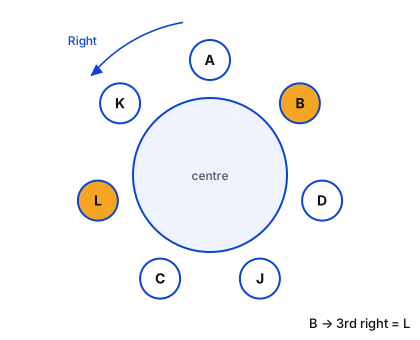
- A ; one between A and L from A's right ⇒ L ; one between L and J ⇒ J .
- One between A and D ⇒ D (2 is taken); one between C and D ⇒ C .
- Two between K and J ⇒ K ; so B . Order to the right: A, K, L, C, J, D, B.
- Third to the right of B: A, K, L ⇒ L.
Trick: With seats numbered rightwards, 'n-th to the right' = add n (mod 7).
Answer: (D) L
अवधारणा: केंद्र की ओर मुख होने पर दाईं ओर = वामावर्त (anticlockwise)। A से दाईं ओर स्थान 0–6 गिनें।
- A ; A के दाईं ओर से A और L के बीच एक ⇒ L ; L और J के बीच एक ⇒ J ।
- A और D के बीच एक ⇒ D ; C और D के बीच एक ⇒ C ।
- K और J के बीच दो ⇒ K ; अतः B । क्रम: A, K, L, C, J, D, B।
- B के दाईं ओर तीसरा: A, K, L ⇒ L।
ट्रिक: दाईं ओर क्रमांक देने पर 'n-वाँ दाएँ' = n जोड़ें (mod 7)।
उत्तर: (D) L
RRB NTPC Undergraduate CBT 1General Intelligence and ReasoningCircular seating arrangementRRB NTPC Undergraduate CBT 1 2024 · 8 Sep Shift 1
Q158.In a certain code language, ‘POUR’ is coded as ‘4527’ and ‘UNIT’ is coded as ‘1356’. What is the code for ‘U’ in that language?
एक निश्चित कूट भाषा में, ‘POUR’ को ‘4527’ लिखा जाता है और ‘UNIT’ को ‘1356’ लिखा जाता है। उस भाषा में ‘U’ के लिए कूट क्या है?
- A2
- B5
- C1
- D3
Show answer
Concept: A letter common to both words takes the digit common to both codes.
- POUR → 4527 and UNIT → 1356.
- Common letter: U; common digit: 5.
- So U = 5.
Trick: Common letter ↔ common digit (order of digits may be jumbled).
Answer: (B) 5
अवधारणा: दोनों शब्दों में सामान्य अक्षर का कोड दोनों कोडों में सामान्य अंक होता है।
- POUR → 4527 और UNIT → 1356।
- सामान्य अक्षर: U; सामान्य अंक: 5।
- अतः U = 5।
ट्रिक: सामान्य अक्षर ↔ सामान्य अंक (अंकों का क्रम उलझा हो सकता है)।
उत्तर: (B) 5
RRB NTPC Undergraduate CBT 1General Intelligence and ReasoningCoding-decodingRRB NTPC Undergraduate CBT 1 2024 · 8 Sep Shift 1
Q159.Seven boxes A, B, C, D, E, F and G are kept one over the other but not necessarily in the same order. Only three boxes are kept above E. Only one box is kept between G and E. Only three boxes are kept between G and C. C is kept at some place above E. B is kept immediately below C. D is kept at one of the places above F. A is not kept immediately above or below G. How many boxes are kept between C and D?
सात बक्से A, B, C, D, E, F और G एक के ऊपर एक रखे गए हैं, परंतु आवश्यक नहीं कि इसी क्रम में हों। E के ऊपर केवल तीन बक्से रखे गए हैं। G और E के बीच केवल एक बक्सा रखा गया है। G और C के बीच केवल तीन बक्से रखे गए हैं। C, E के ऊपर किसी स्थान पर रखा गया है। B, C के ठीक नीचे रखा गया है। D, F के ऊपर के स्थानों में से किसी एक स्थान पर रखा गया है। A, G के ठीक ऊपर या ठीक नीचे नहीं रखा गया है। C और D के बीच कितने बक्से रखे गए हैं?
- A3
- B1
- C2
- D4
Show answer
Concept: Number positions 1 (top) to 7 (bottom) and fix boxes one clue at a time.
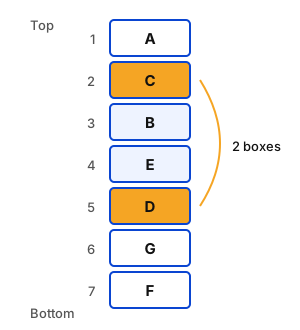
- Three above E ⇒ E . One between G and E ⇒ G or 6.
- Three between G and C with C above E: G , C (G would put C at 6, below E). B just below C ⇒ B .
- A, D, F take 1, 5, 7. A not next to G ⇒ A ; D above F ⇒ D , F .
- Order: A, C, B, E, D, G, F ⇒ between C and D: B, E = 2 boxes.
Trick: Start with the clue giving an exact position (E), then use the 'above/below' clue to reject cases.
Answer: (C) 2
अवधारणा: स्थान 1 (ऊपर) से 7 (नीचे) तक मानें और एक-एक संकेत लगाएँ।
- E के ऊपर तीन ⇒ E । G और E के बीच एक ⇒ G या 6।
- G और C के बीच तीन तथा C, E से ऊपर: G , C । B ठीक C के नीचे ⇒ B ।
- A, D, F के लिए 1, 5, 7। A, G के आस-पास नहीं ⇒ A ; D, F से ऊपर ⇒ D , F ।
- क्रम: A, C, B, E, D, G, F ⇒ C और D के बीच B, E = 2 बॉक्स।
ट्रिक: पहले निश्चित स्थान वाला संकेत (E) लगाएँ, फिर ऊपर/नीचे वाले संकेत से विकल्प हटाएँ।
उत्तर: (C) 2
RRB NTPC Undergraduate CBT 1General Intelligence and ReasoningBox arrangementRRB NTPC Undergraduate CBT 1 2024 · 8 Sep Shift 1
Q160.Paras, Mani, Kajal, Kunj, Vani and Saras are sitting around a circle, facing the centre. Saras sits third to the left of Vani. Vani sits second to the right of Paras. Kunj sits second to the left of Kajal. Who sits to the immediate right of Mani?
पारस, मणि, काजल, कुंज, वाणी और सरस एक वृत्त के चारों ओर केंद्र की ओर मुख करके बैठे हैं। सरस, वाणी के बाएँ से तीसरे स्थान पर बैठा है। वाणी, पारस के दाएँ से दूसरे स्थान पर बैठी है। कुंज, काजल के बाएँ से दूसरे स्थान पर बैठा है। मणि के ठीक दाएँ कौन बैठा है?
- AParasपारस
- BKajalकाजल
- CVaniवाणी
- DSarasसरस
Show answer
Concept: For 6 people facing the centre, number seats 0–5 going to the right (anticlockwise).
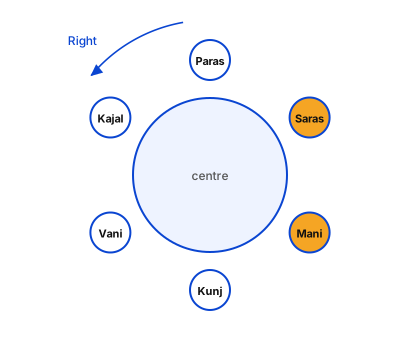
- Paras ; Vani 2nd to the right of Paras ⇒ Vani .
- Saras 3rd to the left of Vani ⇒ opposite Vani ⇒ Saras .
- Left: 1, 3, 4. Kunj 2nd left of Kajal ⇒ Kajal , Kunj ; Mani .
- Immediate right of Mani (seat 5) = Saras.
Trick: In a circle of 6, 3rd to the left = 3rd to the right = directly opposite.
Answer: (D) Saras
अवधारणा: केंद्र की ओर मुख वाले 6 लोगों के लिए दाईं ओर (वामावर्त) स्थान 0–5 गिनें।
- पारस ; वाणी पारस के दाएँ दूसरे ⇒ वाणी ।
- सरस वाणी के बाएँ तीसरे ⇒ ठीक सामने ⇒ सरस ।
- बचे 1, 3, 4। कुंज, काजल के बाएँ दूसरे ⇒ काजल , कुंज ; मणि ।
- मणि के ठीक दाएँ (स्थान 5) = सरस।
ट्रिक: 6 लोगों के वृत्त में बाएँ तीसरा = दाएँ तीसरा = ठीक सामने।
उत्तर: (D) Saras
RRB NTPC Undergraduate CBT 1General Intelligence and ReasoningCircular seating arrangementRRB NTPC Undergraduate CBT 1 2024 · 8 Sep Shift 1

