Q1641.Based on the English alphabetical order, three of the following four letter-clusters are alike in a certain way and thus form a group. Which letter-cluster DOES NOT belong to that group?
(Note: The odd one out is not based on the number of consonants/vowels or their position in the letter-cluster.)
अंग्रेज़ी वर्णमाला क्रम के आधार पर, निम्नलिखित चार अक्षर-समूहों में से तीन किसी निश्चित प्रकार से एकसमान हैं और इस प्रकार एक समूह बनाते हैं। कौन-सा अक्षर-समूह उस समूह से संबंधित नहीं है?
(ध्यान दें: असंगत अक्षर-समूह, अक्षर-समूह में व्यंजनों/स्वरों की संख्या या उनके स्थान पर आधारित नहीं है।)
- ARWS
- BOTP
- CUZV
- DMRO
Show answer
Concept: Check the gaps between consecutive letters.
- RWS: ; OTP: ; UZV: .
- MRO: – different.
Trick: Third letter first letter in the group (R→S, O→P, U→V); M→O breaks it.
Answer: (D) MRO
अवधारणा: क्रमागत अक्षरों के अंतर देखें।
- RWS: ; OTP: ; UZV: ।
- MRO: – भिन्न।
ट्रिक: समूह में तीसरा अक्षर पहला (R→S, O→P, U→V); M→O अलग।
उत्तर: (D) MRO
RRB NTPC Undergraduate CBT 1General Intelligence and ReasoningLetter-cluster odd one outRRB NTPC Undergraduate CBT 1 2024 · 7 Aug Shift 2
Q1642.Read the given statement(s) and conclusions carefully. Assuming that the information given in the statement(s) is true, even if it appears to be at variance with commonly known facts, decide which of the given conclusions logically follow(s) from the statement(s).
Statements:
All detergents are towels.
All detergents are conditioners.
Conclusions:
(I) Some towels are conditioners.
(II) All conditioners are detergents.
दिए गए कथन/कथनों और निष्कर्षों को ध्यानपूर्वक पढ़िए। कथन/कथनों में दी गई जानकारी को सत्य मानते हुए, भले ही वह सामान्यतः ज्ञात तथ्यों से भिन्न प्रतीत होती हो, निर्णय लीजिए कि दिए गए निष्कर्षों में से कौन-सा/से निष्कर्ष तार्किक रूप से कथन/कथनों का अनुसरण करता है/करते हैं।
कथन:
सभी डिटर्जेंट, तौलिए हैं।
सभी डिटर्जेंट, कंडीशनर हैं।
निष्कर्ष:
(I) कुछ तौलिए, कंडीशनर हैं।
(II) सभी कंडीशनर, डिटर्जेंट हैं।
- AOnly conclusion (II) follows.केवल निष्कर्ष (II) अनुसरण करता है।
- BOnly conclusion (I) follows.केवल निष्कर्ष (I) अनुसरण करता है।
- CNeither conclusion (I) nor (II) follows.न तो निष्कर्ष (I) और न ही (II) अनुसरण करता है।
- DBoth conclusions (I) and (II) follow.निष्कर्ष (I) और (II) दोनों अनुसरण करते हैं।
Show answer
Concept: Draw the least-overlap diagram and test each conclusion.
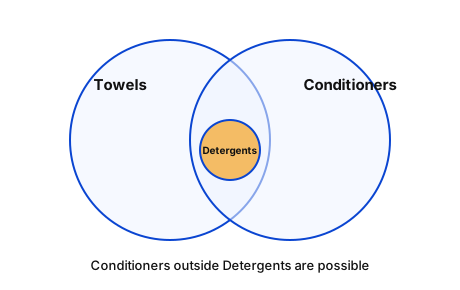
- Detergents lie inside both Towels and Conditioners.
- So towels and conditioners share at least the detergents ⇒ I follows.
- Conditioners may extend beyond detergents ⇒ II does not follow.
Trick: All A are B + All A are C ⇒ Some B are C (always).
Answer: (B) Only conclusion (I) follows.
अवधारणा: न्यूनतम ओवरलैप वाला चित्र बनाकर हर निष्कर्ष जाँचें।
- डिटर्जेंट, तौलिये और कंडीशनर दोनों के अंदर।
- अतः तौलिये और कंडीशनर में कम से कम डिटर्जेंट समान ⇒ I अनुसरण करता है।
- कंडीशनर, डिटर्जेंट से बाहर भी हो सकते हैं ⇒ II नहीं।
ट्रिक: सभी A, B हैं + सभी A, C हैं ⇒ कुछ B, C हैं (हमेशा)।
उत्तर: (B) केवल निष्कर्ष (I) अनुसरण करता है।
RRB NTPC Undergraduate CBT 1General Intelligence and ReasoningSyllogismRRB NTPC Undergraduate CBT 1 2024 · 7 Aug Shift 2
Q1643.Which of the following letter-number clusters will replace the question mark (?) in the given series to make it logically complete?
VPM 153, QUJ 145, LZG 137, GED 129, BJA 121, ?
दी गई श्रृंखला को तार्किक रूप से पूर्ण करने के लिए निम्नलिखित में से कौन-सा अक्षर-संख्या समूह प्रश्न चिह्न (?) का स्थान लेगा?
VPM 153, QUJ 145, LZG 137, GED 129, BJA 121, ?
- AWOX 113
- BVOY 115
- CUPY 115
- DXNW 113
Show answer
Concept: Track each letter position and the number separately.
- 1st letters V, Q, L, G, B: ⇒ W (wrap-around).
- 2nd letters P, U, Z, E, J: ⇒ O.
- 3rd letters M, J, G, D, A: ⇒ X.
- Numbers: ⇒ .
Trick: Use wrap-around: B ⇒ W, A ⇒ X.
Answer: (A) WOX 113
अवधारणा: हर अक्षर-स्थान और संख्या को अलग-अलग देखें।
- पहले अक्षर V, Q, L, G, B: ⇒ W (चक्रीय)।
- दूसरे अक्षर P, U, Z, E, J: ⇒ O।
- तीसरे अक्षर M, J, G, D, A: ⇒ X।
- संख्या: ⇒ ।
ट्रिक: चक्रीय क्रम: B ⇒ W, A ⇒ X।
उत्तर: (A) WOX 113
RRB NTPC Undergraduate CBT 1General Intelligence and ReasoningAlphanumeric seriesRRB NTPC Undergraduate CBT 1 2024 · 7 Aug Shift 2
Q1644.What will come in place of the question mark (?) in the following equation, if ‘+’ and ‘÷’ are interchanged and ‘−’ and ‘×’ are interchanged?
11 − 3 × 88 + 8 ÷ 10 = ?
यदि '+' और '÷' को आपस में बदल दिया जाए तथा '−' और '×' को आपस में बदल दिया जाए, तो निम्नलिखित समीकरण में प्रश्न चिह्न (?) के स्थान पर क्या आएगा?
11 − 3 × 88 + 8 ÷ 10 = ?
- A38
- B23
- C32
- D16
Show answer
Concept: Interchange the signs, then apply BODMAS.
- becomes .
- .
Trick: Rewrite the whole expression first, then solve – avoids sign mix-ups.
Answer: (C)
अवधारणा: चिह्न बदलें, फिर BODMAS लगाएँ।
- बनता है ।
- ।
ट्रिक: पहले पूरा व्यंजक दोबारा लिखें, फिर हल करें।
उत्तर: (C)
RRB NTPC Undergraduate CBT 1General Intelligence and ReasoningMathematical operationsRRB NTPC Undergraduate CBT 1 2024 · 7 Aug Shift 2
Q1645.MOLK is related to RTQP in a certain way based on the English alphabetical order. In the same way, GIFE is related to LNKJ. To which of the given options is VXUT related, following the same logic?
अंग्रेज़ी वर्णमाला क्रम के आधार पर MOLK एक निश्चित प्रकार से RTQP से संबंधित है। उसी प्रकार, GIFE, LNKJ से संबंधित है। समान तर्क का अनुसरण करते हुए, VXUT दिए गए विकल्पों में से किससे संबंधित है?
- AAYZC
- BAYZS
- CACZY
- DACYZ
Show answer
Concept: Compare positions letter by letter.
- M→R, O→T, L→Q, K→P: each .
- G→L, I→N, F→K, E→J: each .
- V→A, X→C, U→Z, T→Y ⇒ ACZY.
Trick: Wrap-around: V ⇒ A, X ⇒ C.
Answer: (C) ACZY
अवधारणा: अक्षरों के स्थान एक-एक करके मिलाएँ।
- M→R, O→T, L→Q, K→P: प्रत्येक ।
- G→L, I→N, F→K, E→J: प्रत्येक ।
- V→A, X→C, U→Z, T→Y ⇒ ACZY।
ट्रिक: चक्रीय क्रम: V ⇒ A, X ⇒ C।
उत्तर: (C) ACZY
RRB NTPC Undergraduate CBT 1General Intelligence and ReasoningLetter analogyRRB NTPC Undergraduate CBT 1 2024 · 7 Aug Shift 2
Q1646.S is the mother of R. R is the brother of P. P is the wife of I. I is the father of O. How is S related to O?
S, R की माँ है। R, P का भाई है। P, I की पत्नी है। I, O का पिता है। S का O से क्या संबंध है?
- AMother's motherमाँ की माँ
- BMother's sisterमाँ की बहन
- CMother's fatherमाँ के पिता
- DMother's brotherमाँ का भाई
Show answer
Concept: Build the family tree step by step.
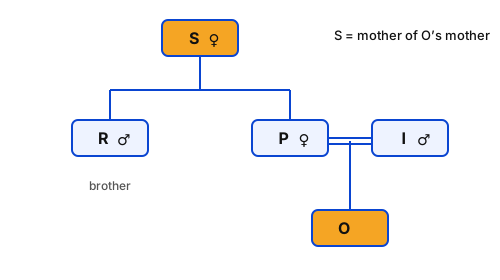
- S is the mother of R; R's sister is P ⇒ S is also P's mother.
- P is the wife of I, and I is the father of O ⇒ P is O's mother.
- So S is O's mother's mother.
Trick: Wife of the father = mother; her mother = maternal grandmother.
Answer: (A) Mother's mother
अवधारणा: क्रम से परिवार वृक्ष बनाएँ।
- S, R की माँ; P, R की बहन ⇒ S, P की भी माँ।
- P, I की पत्नी और I, O के पिता ⇒ P, O की माँ।
- अतः S, O की माँ की माँ (नानी)।
ट्रिक: पिता की पत्नी = माँ; उसकी माँ = नानी।
उत्तर: (A) माँ की माँ
RRB NTPC Undergraduate CBT 1General Intelligence and ReasoningBlood relationRRB NTPC Undergraduate CBT 1 2024 · 7 Aug Shift 2
Q1647.If 2 is added to each even digit and 2 is subtracted from each odd digit in the number 3659247, then what will be the sum of all the even digits in the new number thus formed?
यदि संख्या 3659247 में प्रत्येक सम अंक में 2 जोड़ दिया जाए और प्रत्येक विषम अंक में से 2 घटा दिया जाए, तो इस प्रकार बनी नई संख्या में सभी सम अंकों का योग क्या होगा?
- A18
- B14
- C12
- D16
Show answer
Concept: Apply the rule to each digit, then add the even digits of the new number.
- 3659247 → 3→1, 6→8, 5→3, 9→7, 2→4, 4→6, 7→5.
- New number: 1837465.
- Even digits: 8, 4, 6 ⇒ sum .
Trick: Odd − 2 stays odd and even + 2 stays even, so just add 2 to each original even digit: .
Answer: (A) 18
अवधारणा: हर अंक पर नियम लगाकर नई संख्या के सम अंक जोड़ें।
- 3659247 → 3→1, 6→8, 5→3, 9→7, 2→4, 4→6, 7→5।
- नई संख्या: 1837465।
- सम अंक: 8, 4, 6 ⇒ योग ।
ट्रिक: विषम विषम ही रहता है, सम सम ही; अतः मूल सम अंकों में 2 जोड़ें: ।
उत्तर: (A) 18
RRB NTPC Undergraduate CBT 1General Intelligence and ReasoningDigit operationsRRB NTPC Undergraduate CBT 1 2024 · 7 Aug Shift 2
Q1648.XSLE is related to CWQI in a certain way based on the English alphabetical order. In the same way, RIFU is related to WMKY. To which of the given options is GUUG related, following the same logic?
अंग्रेज़ी वर्णमाला क्रम के आधार पर XSLE एक निश्चित प्रकार से CWQI से संबंधित है। उसी प्रकार, RIFU, WMKY से संबंधित है। समान तर्क का अनुसरण करते हुए, GUUG दिए गए विकल्पों में से किससे संबंधित है?
- ALZXS
- BLYZK
- CLYXZ
- DLZXD
Show answer
Concept: Compare positions letter by letter.
- X→C , S→W , L→Q , E→I .
- R→W , I→M , F→K , U→Y .
- G→L, U→Y, U→Z, G→K ⇒ LYZK.
Trick: Alternate , – note the same letter U gives different results by position.
Answer: (B) LYZK
अवधारणा: अक्षरों के स्थान एक-एक करके मिलाएँ।
- X→C , S→W , L→Q , E→I ।
- R→W , I→M , F→K , U→Y ।
- G→L, U→Y, U→Z, G→K ⇒ LYZK।
ट्रिक: बारी-बारी , – एक ही अक्षर U स्थान के अनुसार अलग बनता है।
उत्तर: (B) LYZK
RRB NTPC Undergraduate CBT 1General Intelligence and ReasoningLetter analogyRRB NTPC Undergraduate CBT 1 2024 · 7 Aug Shift 2
Q1649.Based on the English alphabetical order, three of the following four letter-clusters are alike in a certain way and thus form a group. Which letter-cluster DOES NOT belong to that group?
(Note: The odd one out is not based on the number of consonants/vowels or their position in the letter-cluster.)
अंग्रेज़ी वर्णमाला क्रम के आधार पर, निम्नलिखित चार अक्षर-समूहों में से तीन किसी निश्चित प्रकार से एकसमान हैं और इस प्रकार एक समूह बनाते हैं। कौन-सा अक्षर-समूह उस समूह से संबंधित नहीं है?
(ध्यान दें: असंगत अक्षर-समूह, अक्षर-समूह में व्यंजनों/स्वरों की संख्या या उनके स्थान पर आधारित नहीं है।)
- AKMI
- BHJF
- CEGB
- DNPL
Show answer
Concept: Check the gaps between consecutive letters.
- KMI: ; HJF: ; NPL: .
- EGB: – different.
Trick: In the group, third letter first letter ; E = C, not B.
Answer: (C) EGB
अवधारणा: क्रमागत अक्षरों के अंतर देखें।
- KMI: ; HJF: ; NPL: ।
- EGB: – भिन्न।
ट्रिक: समूह में तीसरा अक्षर पहला ; E = C, B नहीं।
उत्तर: (C) EGB
RRB NTPC Undergraduate CBT 1General Intelligence and ReasoningLetter-cluster odd one outRRB NTPC Undergraduate CBT 1 2024 · 7 Aug Shift 2
Q1650.What should come in place of the question mark (?) in the given series based on the English alphabetical order?
QMS NJP KGM HDJ ?
अंग्रेज़ी वर्णमाला क्रम के आधार पर दी गई श्रृंखला में प्रश्न चिह्न (?) के स्थान पर क्या आना चाहिए?
QMS NJP KGM HDJ ?
- AFEI
- BIAG
- CGEI
- DEAG
Show answer
Concept: Track each position of the clusters separately.
- 1st letters Q, N, K, H: ⇒ E.
- 2nd letters M, J, G, D: ⇒ A.
- 3rd letters S, P, M, J: ⇒ G.
Trick: Every letter moves back by 3 – shift the last term HDJ by .
Answer: (D) EAG
अवधारणा: हर स्थान के अक्षर अलग-अलग देखें।
- पहले अक्षर Q, N, K, H: ⇒ E।
- दूसरे अक्षर M, J, G, D: ⇒ A।
- तीसरे अक्षर S, P, M, J: ⇒ G।
ट्रिक: हर अक्षर 3 पीछे – अंतिम पद HDJ को करें।
उत्तर: (D) EAG
RRB NTPC Undergraduate CBT 1General Intelligence and ReasoningLetter seriesRRB NTPC Undergraduate CBT 1 2024 · 7 Aug Shift 2
Q1651.If 2 is added to each odd digit and 1 is subtracted from each even digit in the number 8354671, then how many digits will appear more than once in the new number thus formed?
यदि संख्या 8354671 के प्रत्येक विषम अंक में 2 जोड़ दिया जाए और प्रत्येक सम अंक में से 1 घटा दिया जाए, तो इस प्रकार बनी नई संख्या में कितने अंक एक से अधिक बार आएँगे?
- AOneएक
- BTwoदो
- CNoneकोई नहीं
- DThreeतीन
Show answer
Concept: Apply the rule to every digit separately, then count digits that occur more than once.
- Odd digit , even digit .
- 8354671 → 7 5 7 3 5 9 3.
- 7, 5 and 3 each appear twice → three digits repeat.
Trick: Write the new digits under the old ones to avoid mistakes.
Answer: (D) Three
अवधारणा: हर अंक पर अलग-अलग नियम लगाएँ, फिर एक से अधिक बार आने वाले अंक गिनें।
- विषम अंक , सम अंक ।
- 8354671 → 7 5 7 3 5 9 3।
- 7, 5 और 3 दो-दो बार → तीन अंक दोहराए गए।
ट्रिक: नए अंक पुराने के नीचे लिखें ताकि गलती न हो।
उत्तर: (D) तीन
RRB NTPC Undergraduate CBT 1General Intelligence and ReasoningNumber Operations – DigitsRRB NTPC Undergraduate CBT 1 2024 · 7 Aug Shift 1
Q1652.In the following triads, each group of letters is related to the subsequent one following a certain logic. Select from the given options, the one which follows the same logic. NEST - ESNT - TSEN
GONE - ONGE - ENOG
निम्नलिखित त्रयी में, अक्षरों का प्रत्येक समूह एक निश्चित तर्क का अनुसरण करते हुए अगले समूह से संबंधित है। दिए गए विकल्पों में से उस त्रयी का चयन कीजिए जो समान तर्क का अनुसरण करती है। NEST - ESNT - TSEN
GONE - ONGE - ENOG
- ALIES - IELS - SEIL
- BMAST - AMST - TASM
- CCOPE - OPCE - OPEC
- DSING - SNIG - GNIS
Show answer
Concept: Find the position pattern: word 1 (1234) → word 2 → word 3.
- NEST → ESNT: letters 2, 3, 1, 4. GONE → ONGE: same.
- Third word is the first word reversed: NEST → TSEN, GONE → ENOG.
- LIES → IELS (2, 3, 1, 4) → SEIL (LIES reversed) ✓.
Trick: Check the easy part first — third word reverse of first. Only LIES–SEIL and COPE–… fit; COPE reversed is EPOC, not OPEC.
Answer: (A) LIES - IELS - SEIL
अवधारणा: स्थान-क्रम पहचानें: शब्द 1 (1234) → शब्द 2 → शब्द 3।
- NEST → ESNT: अक्षर 2, 3, 1, 4। GONE → ONGE: वही।
- तीसरा शब्द पहले शब्द का उल्टा है: NEST → TSEN, GONE → ENOG।
- LIES → IELS (2, 3, 1, 4) → SEIL (LIES उल्टा) ✓।
ट्रिक: पहले आसान भाग जाँचें — तीसरा शब्द पहले का उल्टा। COPE का उल्टा EPOC है, OPEC नहीं।
उत्तर: (A) LIES - IELS - SEIL
RRB NTPC Undergraduate CBT 1General Intelligence and ReasoningLetter Triads – RearrangementRRB NTPC Undergraduate CBT 1 2024 · 7 Aug Shift 1
Q1653.Which of the following letter-number clusters will replace the question mark (?) in the given series to make it logically complete?
ICV 16 LGS 5 OKP -6 ROM -17 ?
निम्नलिखित में से कौन-सा अक्षर-संख्या समूह दी गई शृंखला में प्रश्न चिह्न (?) के स्थान पर आकर उसे तार्किक रूप से पूर्ण करेगा?
ICV 16 LGS 5 OKP -6 ROM -17 ?
- ASJD -21
- BUHT -21
- CUSJ -28
- DJUD -20
Show answer
Concept: Track each letter position and the number separately.
- 1st letters: I, L, O, R, U ().
- 2nd letters: C, G, K, O, S ().
- 3rd letters: V, S, P, M, J ().
- Numbers: 16, 5, , , ().
Trick: Only (C) starts with U and has .
Answer: (C) USJ
अवधारणा: हर अक्षर-स्थान और संख्या को अलग-अलग देखें।
- पहले अक्षर: I, L, O, R, U ()।
- दूसरे अक्षर: C, G, K, O, S ()।
- तीसरे अक्षर: V, S, P, M, J ()।
- संख्याएँ: 16, 5, , , ()।
ट्रिक: केवल (C) U से शुरू होता है और उसमें है।
उत्तर: (C) USJ
RRB NTPC Undergraduate CBT 1General Intelligence and ReasoningLetter-Number SeriesRRB NTPC Undergraduate CBT 1 2024 · 7 Aug Shift 1
Q1654.Refer to the following number and symbol series and answer the question that follows. Counting to be done from left to right only.
(Left) ? > @ ^ @ \ ? + $ 6 7 \ 1 & @ 1 4 2 2 % 9 (Right)
How many such numbers are there, each of which is immediately preceded by a symbol and also immediately followed by another number?
निम्नलिखित संख्या और प्रतीक शृंखला को देखिए और उसके बाद दिए गए प्रश्न का उत्तर दीजिए। गिनती केवल बाएँ से दाएँ की जानी है।
(बाएँ) ? > @ ^ @ \ ? + $ 6 7 \ 1 & @ 1 4 2 2 % 9 (दाएँ)
ऐसी कितनी संख्याएँ हैं, जिनमें से प्रत्येक के ठीक पहले एक प्रतीक है और ठीक बाद एक अन्य संख्या है?
- ANoneकोई नहीं
- BTwoदो
- CThreeतीन
- DOneएक
Show answer
Concept: Check every number: the element just before must be a symbol and the element just after must be a number.
- $ 6 7 → 6 is preceded by $ and followed by 7 ✓.
- @ 1 4 → 1 is preceded by @ and followed by 4 ✓.
- \ 1 & fails (followed by symbol); % 9 has nothing after it; 7, 4, 2, 2 are preceded by numbers.
Trick: Look for the pattern Symbol–Number–Number only.
Answer: (B) Two
अवधारणा: हर संख्या जाँचें: ठीक पहले प्रतीक और ठीक बाद संख्या होनी चाहिए।
- $ 6 7 → 6 से पहले $ और बाद में 7 ✓।
- @ 1 4 → 1 से पहले @ और बाद में 4 ✓।
- \ 1 & असफल (बाद में प्रतीक); % 9 के बाद कुछ नहीं; 7, 4, 2, 2 से पहले संख्याएँ हैं।
ट्रिक: केवल प्रतीक–संख्या–संख्या का पैटर्न खोजें।
उत्तर: (B) दो
RRB NTPC Undergraduate CBT 1General Intelligence and ReasoningSymbol-Number SeriesRRB NTPC Undergraduate CBT 1 2024 · 7 Aug Shift 1
Q1655.Read the given statements and conclusions carefully. Assuming that the information given in the statements is true, even if it appears to be at variance with commonly known facts, decide which of the given conclusion(s) logically follow(s) from the statements.
Statements:
All teas are bins.
No tea is a sock.
Conclusions:
(I): Some socks are bins.
(II): All bins are socks.
दिए गए कथनों और निष्कर्षों को ध्यानपूर्वक पढ़िए। यह मानते हुए कि कथनों में दी गई जानकारी सत्य है, भले ही वह सामान्यतः ज्ञात तथ्यों से भिन्न प्रतीत होती हो, निर्णय कीजिए कि दिए गए निष्कर्षों में से कौन-सा/कौन-से निष्कर्ष तार्किक रूप से कथनों का अनुसरण करता है/करते हैं।
कथन:
सभी चाय, डिब्बे हैं।
कोई चाय, मोज़ा नहीं है।
निष्कर्ष:
(I): कुछ मोज़े, डिब्बे हैं।
(II): सभी डिब्बे, मोज़े हैं।
- ABoth conclusions (I) and (II) follow.निष्कर्ष (I) और (II) दोनों अनुसरण करते हैं।
- BOnly conclusion (I) follows.केवल निष्कर्ष (I) अनुसरण करता है।
- COnly conclusion (II) follows.केवल निष्कर्ष (II) अनुसरण करता है।
- DNeither conclusion (I) nor (II) follows.न तो निष्कर्ष (I) और न ही (II) अनुसरण करता है।
Show answer
Concept: Draw the least-overlap Venn diagram; a conclusion follows only if it is true in every possible case.
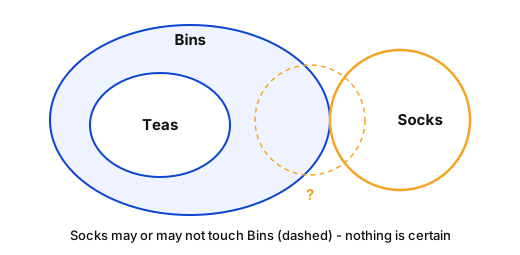
- Teas lie inside Bins; Socks lie outside Teas.
- Socks may or may not overlap the Bins outside Teas → 'Some socks are bins' is only possible (I fails).
- 'All bins are socks' is impossible, since teas are bins but not socks (II fails).
Trick: 'No A is C' + 'All A are B' gives no definite link between B and C.
Answer: (D) Neither conclusion (I) nor (II) follows.
अवधारणा: न्यूनतम-ओवरलैप वेन आरेख बनाएँ; निष्कर्ष तभी निकलता है जब वह हर स्थिति में सत्य हो।
- Teas, Bins के अंदर; Socks, Teas के बाहर।
- Socks, Teas के बाहर वाले Bins को छू भी सकते हैं, नहीं भी → 'कुछ socks bins हैं' केवल संभव है (I असत्य)।
- 'सभी bins socks हैं' असंभव, क्योंकि teas, bins हैं पर socks नहीं (II असत्य)।
ट्रिक: 'कोई A, C नहीं' + 'सभी A, B हैं' से B और C में कोई निश्चित संबंध नहीं बनता।
उत्तर: (D) न तो निष्कर्ष (I) और न ही (II) अनुसरण करता है।
RRB NTPC Undergraduate CBT 1General Intelligence and ReasoningSyllogismRRB NTPC Undergraduate CBT 1 2024 · 7 Aug Shift 1
Q1656.Satish starts from Point Y and drives 19 km towards west. He then takes a right turn, drives 10 km. He then turns right and drives 11 km. He takes a final right turn, drives 10 km and stops at Point Z. How far (shortest distance) and towards which direction should he drive in order to reach Point Y again? (All turns are 90° turns only unless specified.)
सतीश बिंदु Y से चलना शुरू करता है और पश्चिम की ओर 19 km गाड़ी चलाता है। फिर वह दाएँ मुड़ता है और 10 km गाड़ी चलाता है। फिर वह दाएँ मुड़ता है और 11 km गाड़ी चलाता है। वह अंतिम बार दाएँ मुड़ता है, 10 km गाड़ी चलाता है और बिंदु Z पर रुक जाता है। बिंदु Y पर फिर से पहुँचने के लिए उसे कितनी दूर (न्यूनतम दूरी) और किस दिशा में गाड़ी चलानी चाहिए? (जब तक निर्दिष्ट न किया जाए, सभी मोड़ केवल 90° के मोड़ हैं।)
- A7 km towards southदक्षिण की ओर 7 km
- B5 km towards northउत्तर की ओर 5 km
- C6 km towards westपश्चिम की ओर 6 km
- D8 km towards eastपूर्व की ओर 8 km
Show answer
Concept: Trace the path on axes; opposite moves cancel.
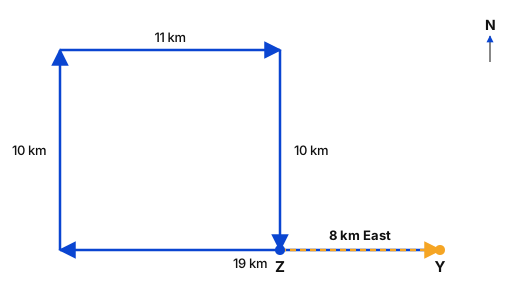
- 19 km West, then right (North) 10 km, right (East) 11 km, right (South) 10 km.
- North 10 and South 10 cancel → Z lies on the same line as Y.
- Net West km, so Y is 8 km East of Z.
Trick: Net displacement: West–East ; North–South .
Answer: (D) 8 km towards east
अवधारणा: रास्ता अक्षों पर बनाएँ; विपरीत दिशाएँ कट जाती हैं।
- 19 km पश्चिम, फिर दाएँ (उत्तर) 10 km, दाएँ (पूर्व) 11 km, दाएँ (दक्षिण) 10 km।
- उत्तर 10 और दक्षिण 10 कट जाते हैं → Z, Y की ही रेखा पर है।
- शुद्ध पश्चिम km, अतः Y, Z से 8 km पूर्व में है।
ट्रिक: शुद्ध विस्थापन: पश्चिम–पूर्व ; उत्तर–दक्षिण ।
उत्तर: (D) 8 km पूर्व की ओर
RRB NTPC Undergraduate CBT 1General Intelligence and ReasoningDirection and DistanceRRB NTPC Undergraduate CBT 1 2024 · 7 Aug Shift 1
Q1657.Based on the English alphabetical order, three of the following four letter-clusters are alike in a certain way and thus form a group. Which letter-cluster DOES NOT belong to that group? (Note: The odd one out is not based on the number of consonants/vowels or their position in the letter-cluster.)
अंग्रेज़ी वर्णमाला क्रम के आधार पर, निम्नलिखित चार अक्षर-समूहों में से तीन किसी निश्चित प्रकार से एकसमान हैं और इस प्रकार एक समूह बनाते हैं। कौन-सा अक्षर-समूह उस समूह से संबंधित नहीं है? (ध्यान दें: असंगत अक्षर-समूह, उस अक्षर-समूह में व्यंजनों/स्वरों की संख्या या उनके स्थान पर आधारित नहीं है।)
- AHLF
- BMQK
- CKOI
- DFJC
Show answer
Concept: Use alphabet positions and compare the gaps between letters.
- HLF: (, ). MQK: (, ).
- KOI: (, ).
- FJC: (, ) ✗.
Trick: First-to-last gap is in HLF, MQK, KOI (H–F, M–K, K–I) but in FJC.
Answer: (D) FJC
अवधारणा: अक्षरों के स्थानीय मान लेकर अंतर की तुलना करें।
- HLF: (, )। MQK: (, )।
- KOI: (, )।
- FJC: (, ) ✗।
ट्रिक: पहले से अंतिम अक्षर का अंतर HLF, MQK, KOI में है पर FJC में ।
उत्तर: (D) FJC
RRB NTPC Undergraduate CBT 1General Intelligence and ReasoningOdd One Out – Letter ClustersRRB NTPC Undergraduate CBT 1 2024 · 7 Aug Shift 1
Q1658.T is the daughter of A. A is married to M. M is the son of K. K is married to J. J is the father of D. D is the brother of N. G is the son of N. How is K related to T?
T, A की पुत्री है। A का विवाह M से हुआ है। M, K का पुत्र है। K का विवाह J से हुआ है। J, D का पिता है। D, N का भाई है। G, N का पुत्र है। K का T से क्या संबंध है?
- AFather's motherपिता की माता
- BMother's brotherमाता का भाई
- CFather's fatherपिता के पिता
- DMother's fatherमाता के पिता
Show answer
Concept: Fix genders from words like son/father, then draw the family tree.
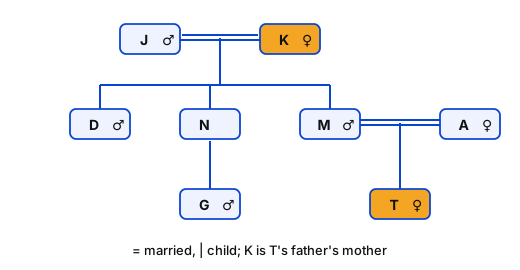
- M is a son (male) and is married to A, so A is female; T is their daughter → M is T's father.
- J is a father (male) and married to K, so K is female; M is K's son → K is M's mother.
- K is T's father's mother (paternal grandmother).
Yaad rakhein: D, N and G are distractors — they do not affect the K–T link.
Answer: (A) Father's mother
अवधारणा: son/father जैसे शब्दों से लिंग तय करें, फिर वंश-वृक्ष बनाएँ।
- M पुत्र (पुरुष) है और A से विवाहित, अतः A महिला; T उनकी पुत्री → M, T का पिता।
- J पिता (पुरुष) है और K से विवाहित, अतः K महिला; M, K का पुत्र → K, M की माँ।
- K, T के पिता की माँ (दादी) है।
याद रखें: D, N और G भ्रमित करने के लिए हैं — K–T संबंध पर इनका असर नहीं।
उत्तर: (A) पिता की माँ
RRB NTPC Undergraduate CBT 1General Intelligence and ReasoningBlood RelationsRRB NTPC Undergraduate CBT 1 2024 · 7 Aug Shift 1
Q1659.In a certain code language, ‘like his attitude’ is coded as ‘nt yg fr’ and ‘his first salary’ is coded as ‘kt lo yg’. How is ‘his’ coded in the given language?
एक निश्चित कूट भाषा में, ‘like his attitude’ को ‘nt yg fr’ के रूप में कूटबद्ध किया जाता है और ‘his first salary’ को ‘kt lo yg’ के रूप में कूटबद्ध किया जाता है। दी गई भाषा में ‘his’ को किस प्रकार कूटबद्ध किया जाता है?
- Ayg
- Bfr
- Ckt
- Dnt
Show answer
Concept: A word common to two sentences takes the code common to both.
- 'like his attitude' → nt yg fr.
- 'his first salary' → kt lo yg.
- Common word: his; common code: yg.
Trick: Match one common word with one common code — no further work needed.
Answer: (A) yg
अवधारणा: दो वाक्यों में उभयनिष्ठ शब्द का कोड भी दोनों में उभयनिष्ठ होता है।
- 'like his attitude' → nt yg fr।
- 'his first salary' → kt lo yg।
- उभयनिष्ठ शब्द: his; उभयनिष्ठ कोड: yg।
ट्रिक: एक उभयनिष्ठ शब्द = एक उभयनिष्ठ कोड — और कुछ नहीं करना।
उत्तर: (A) yg
RRB NTPC Undergraduate CBT 1General Intelligence and ReasoningCoding-Decoding – Common WordsRRB NTPC Undergraduate CBT 1 2024 · 7 Aug Shift 1
Q1660.In a row of people all facing north, Rikshit is 31st from the right end and Palak is 32nd from the right end. The number of people between Palak and Rikshit is same as the number of people between Palak and Huma. If Huma is 10th from the left end of the row, how many people are there in the row?
उत्तर की ओर मुख करके खड़े लोगों की एक पंक्ति में, रिक्षित दाएँ छोर से 31वें स्थान पर है और पलक दाएँ छोर से 32वें स्थान पर है। पलक और रिक्षित के बीच लोगों की संख्या उतनी ही है जितनी पलक और हुमा के बीच लोगों की संख्या है। यदि हुमा पंक्ति के बाएँ छोर से 10वें स्थान पर है, तो पंक्ति में कितने लोग हैं?
- A43
- B41
- C44
- D42
Show answer
Concept: Total position from left position from right .
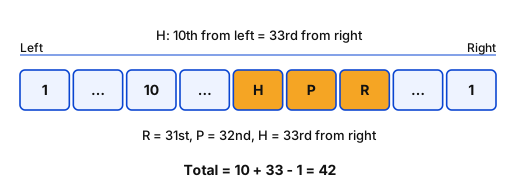
- Rikshit 31st and Palak 32nd from right → they are adjacent, 0 people between.
- So 0 people between Palak and Huma → Huma is next to Palak on the other side: 33rd from right.
- Huma is 10th from left → total .
Trick: Huma cannot be 31st (Rikshit's place), so she must be 33rd from right.
Answer: (D) 42
अवधारणा: कुल बाएँ से स्थान दाएँ से स्थान ।
- रिक्षित दाएँ से 31वाँ, पलक 32वीं → दोनों पास-पास, बीच में 0 व्यक्ति।
- अतः पलक और हुमा के बीच भी 0 → हुमा पलक के दूसरी ओर: दाएँ से 33वीं।
- हुमा बाएँ से 10वीं → कुल ।
ट्रिक: हुमा 31वें स्थान (रिक्षित का) पर नहीं हो सकती, अतः दाएँ से 33वीं।
उत्तर: (D) 42
RRB NTPC Undergraduate CBT 1General Intelligence and ReasoningRanking and OrderRRB NTPC Undergraduate CBT 1 2024 · 7 Aug Shift 1

