Q201.In a certain code language,
A @ B means ‘A is the mother of B’,
A × B means ‘A is the wife of B’,
A + B means ‘A is the brother of B’ and
A ÷ B means ‘A is the father of B’.
How is S related to H if ‘S ÷ D + R @ Y × H’?
एक निश्चित कूट भाषा में,
A @ B का अर्थ है ‘A, B की माता है’,
A × B का अर्थ है ‘A, B की पत्नी है’,
A + B का अर्थ है ‘A, B का भाई है’ और
A ÷ B का अर्थ है ‘A, B का पिता है’।
यदि ‘S ÷ D + R @ Y × H’ है, तो S का H से क्या संबंध है?
- AWife's mother's fatherपत्नी की माता का पिता
- BWife's fatherपत्नी का पिता
- CWife's brotherपत्नी का भाई
- DWife's mother's brotherपत्नी की माता का भाई
Show answer
Concept: Decode each symbol and draw the family tree.
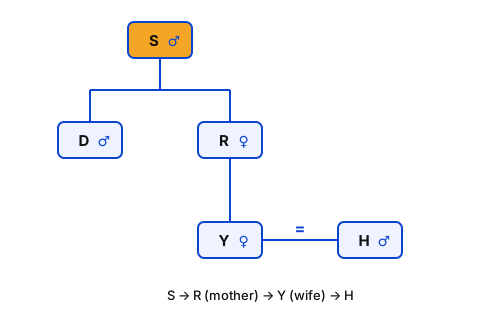
- S ÷ D: S is father of D. D + R: D is brother of R, so S is also father of R.
- R @ Y: R is mother of Y (R is female).
- Y × H: Y is wife of H.
- So for H: wife Y → her mother R → her father S. S is H's wife's mother's father.
Trick: Read the chain from H backwards: wife → mother → father.
Answer: (A) Wife's mother's father
अवधारणा: हर चिह्न को खोलें और वंश-वृक्ष बनाएँ।
- S ÷ D: S, D का पिता है। D + R: D, R का भाई है, अतः S, R का भी पिता है।
- R @ Y: R, Y की माता है (R महिला)।
- Y × H: Y, H की पत्नी है।
- H के लिए: पत्नी Y → उसकी माता R → उसके पिता S। S, H की पत्नी की माता के पिता हैं।
ट्रिक: H से उल्टा पढ़ें: पत्नी → माता → पिता।
उत्तर: (A) पत्नी की माता के पिता (Wife's mother's father)
RRB NTPC Undergraduate CBT 1General Intelligence and ReasoningCoded blood relationsRRB NTPC Undergraduate CBT 1 2025 · 18 Jun Shift 3
Q202.Shishir starts from Point Y and drives 75 km towards East. He then takes a left turn, drives 35 km, turns left and drives 38 km. He then takes a left turn and drives 41 km. He takes a right turn, drives 37 km. He then turns left, drives 26 km to stop at Point Z. How far (shortest distance) and towards which direction should he drive in order to reach Point Y again? (All turns are 90° turns only unless specified.)
शिशिर बिंदु Y से चलना शुरू करता है और पूर्व की ओर 75 km गाड़ी चलाता है। फिर वह बाएँ मुड़ता है, 35 km गाड़ी चलाता है, बाएँ मुड़ता है और 38 km गाड़ी चलाता है। फिर वह बाएँ मुड़ता है और 41 km गाड़ी चलाता है। वह दाएँ मुड़ता है, 37 km गाड़ी चलाता है। फिर वह बाएँ मुड़ता है, 26 km गाड़ी चलाकर बिंदु Z पर रुक जाता है। बिंदु Y पर पुनः पहुँचने के लिए उसे कितनी दूरी (न्यूनतम दूरी) तक और किस दिशा में गाड़ी चलानी चाहिए? (जब तक निर्दिष्ट न किया जाए, सभी मोड़ केवल 90° के मोड़ हैं।)
- A32 km towards northउत्तर की ओर 32 km
- B33 km towards westपश्चिम की ओर 33 km
- C35 km towards northउत्तर की ओर 35 km
- D29 km towards southदक्षिण की ओर 29 km
Show answer
Concept: Track the net East–West and North–South movement from Y.
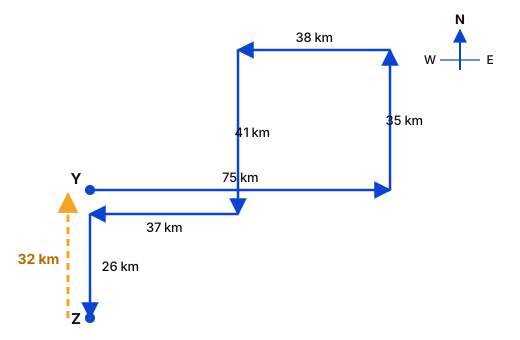
- East–West: → Z is directly in line with Y (north–south).
- North–South: → Z is 32 km south of Y.
- Turns: E → left N → left W → left S → right W → left S.
- To return to Y he must drive 32 km towards north.
Trick: Add E/W and N/S separately; a zero in one means a straight-line answer.
Answer: (A) 32 km towards north
अवधारणा: Y से कुल पूर्व–पश्चिम और उत्तर–दक्षिण गति निकालें।
- पूर्व–पश्चिम: → Z, Y की सीध में (उत्तर–दक्षिण रेखा पर)।
- उत्तर–दक्षिण: → Z, Y से 32 km दक्षिण में।
- मोड़: पूर्व → बाएँ उत्तर → बाएँ पश्चिम → बाएँ दक्षिण → दाएँ पश्चिम → बाएँ दक्षिण।
- Y पर लौटने के लिए 32 km उत्तर की ओर जाना होगा।
ट्रिक: E/W और N/S अलग जोड़ें; एक का योग शून्य हो तो सीधी रेखा वाला उत्तर।
उत्तर: (A) 32 km उत्तर की ओर
RRB NTPC Undergraduate CBT 1General Intelligence and ReasoningDirection and distanceRRB NTPC Undergraduate CBT 1 2025 · 18 Jun Shift 3
Q203.Based on the English alphabetical order, three of the following four letter-cluster pairs are alike in a certain way and thus form a group. Which is the one that does not belong to that group?
(Note: The odd one out is not based on the number of consonants/vowels or their position in the letter-cluster pairs.)
अंग्रेज़ी वर्णमाला क्रम के आधार पर, निम्नलिखित चार अक्षर-समूह युग्मों में से तीन किसी निश्चित प्रकार से एकसमान हैं और इस प्रकार एक समूह बनाते हैं। कौन-सा युग्म उस समूह से संबंधित नहीं है?
(ध्यान दें: असंगत युग्म, व्यंजनों/स्वरों की संख्या या अक्षर-समूह युग्मों में उनके स्थान पर आधारित नहीं है।)
- AVT – LE
- BXV-NH
- CBZ-RL
- DOM – EY
Show answer
Concept: Use letter positions: inside each cluster and from cluster to cluster.
- XV – NH: , , ✓
- BZ – RL: , , ✓; OM – EY: , , ✓
- VT – LE: and , but (not ) ✗
Trick: Check the second cluster's gap (): only LE gives .
Answer: (A) VT – LE
अवधारणा: अक्षर स्थान लें: हर क्लस्टर के अंदर और एक क्लस्टर से दूसरे तक।
- XV – NH: , , ✓
- BZ – RL: , , ✓; OM – EY: , , ✓
- VT – LE: और , पर ( नहीं) ✗
ट्रिक: दूसरे क्लस्टर का अंतर () जाँचें: केवल LE में ।
उत्तर: (A) VT – LE
RRB NTPC Undergraduate CBT 1General Intelligence and ReasoningOdd one out – letter pairsRRB NTPC Undergraduate CBT 1 2025 · 18 Jun Shift 3
Q204.Eight people, S, T, U, V, W, X, Y and Z, are sitting around a circular table, facing the centre. T sits third to the left of W. T sits third to the right of V. X is an immediate neighbour of U and V. Z sits second to the left of S. How many people sit between X and W, when counted from the left of X?
आठ व्यक्ति, S, T, U, V, W, X, Y और Z, एक वृत्ताकार मेज़ के चारों ओर केंद्र की ओर मुख करके बैठे हैं। T, W के बाईं ओर तीसरे स्थान पर बैठा है। T, V के दाईं ओर तीसरे स्थान पर बैठा है। X, U और V दोनों का निकटतम पड़ोसी है। Z, S के बाईं ओर दूसरे स्थान पर बैठा है। X के बाईं ओर से गिनने पर X और W के बीच कितने व्यक्ति बैठे हैं?
- AThreeतीन
- BOneएक
- CTwoदो
- DFourचार
Show answer
Concept: Facing the centre, left = clockwise and right = anticlockwise.
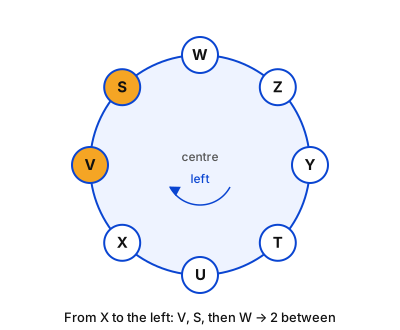
- Fix W. T is third to the left of W; V is third to the left of T (since T is third to the right of V).
- X is a neighbour of both U and V → X sits between U and V, on the side between T and V (the other side of V is next to W).
- Z is second to the left of S → S sits between V and W, Z next to W, Y next to T.
- From X going left: V, S, then W → 2 people.
Trick: “A is third to the right of B” = “B is third to the left of A”.
Answer: (C) Two
अवधारणा: केंद्र की ओर मुख: बायाँ = दक्षिणावर्त, दायाँ = वामावर्त।
- W को स्थिर करें। T, W के बाएँ तीसरा; V, T के बाएँ तीसरा (क्योंकि T, V के दाएँ तीसरा है)।
- X, U और V दोनों का पड़ोसी → X, U और V के बीच, T और V के बीच वाली तरफ़ (V की दूसरी तरफ़ W के पास जगह)।
- Z, S के बाएँ दूसरा → S, V और W के बीच; Z, W के पास; Y, T के पास।
- X से बाईं ओर: V, S, फिर W → 2 व्यक्ति।
ट्रिक: “A, B के दाएँ तीसरा” = “B, A के बाएँ तीसरा”।
उत्तर: (C) दो (Two)
RRB NTPC Undergraduate CBT 1General Intelligence and ReasoningCircular seating arrangementRRB NTPC Undergraduate CBT 1 2025 · 18 Jun Shift 3
Q205.What should come in place of the ‘?’ in the given series?
5 9 20 40 67 103 ?
दी गई शृंखला में ‘?’ के स्थान पर क्या आना चाहिए?
5 9 20 40 67 103 ?
- A146
- B148
- C184
- D164
Show answer
Concept: When first differences are irregular, check the second differences.
- First differences: .
- Second differences: → next , so next first difference .
- Next term: .
Trick: Alternating , in the gaps.
Answer: (A) 146
अवधारणा: जब प्रथम अंतर अनियमित हों, तो द्वितीय अंतर जाँचें।
- प्रथम अंतर: ।
- द्वितीय अंतर: → अगला , अतः अगला प्रथम अंतर ।
- अगला पद: ।
ट्रिक: अंतरों में बारी-बारी , ।
उत्तर: (A) 146
RRB NTPC Undergraduate CBT 1General Intelligence and ReasoningNumber series – second differencesRRB NTPC Undergraduate CBT 1 2025 · 18 Jun Shift 3
Q206.Based on the English alphabetical order, three of the following four letter-cluster pairs are alike in a certain way and thus form a group. Which is the one that does not belong to that group?
(Note: The odd man out is not based on the number of consonants/vowels or their position in the letter-cluster.)
अंग्रेज़ी वर्णमाला क्रम के आधार पर, निम्नलिखित चार अक्षर-समूह युग्मों में से तीन किसी निश्चित प्रकार से एकसमान हैं और इस प्रकार एक समूह बनाते हैं। कौन-सा युग्म उस समूह से संबंधित नहीं है?
(ध्यान दें: असंगत युग्म, व्यंजनों/स्वरों की संख्या या अक्षर-समूह में उनके स्थान पर आधारित नहीं है।)
- ALX – HT
- BQE – MA
- CBK – XF
- DNV – JR
Show answer
Concept: Compare each letter of the first cluster with the matching letter of the second.
- LX – HT: , ✓
- QE – MA: , ✓; NV – JR: , ✓
- BK – XF: but ✗
Trick: Every pair should be the first cluster moved back by 4; one letter breaks it.
Answer: (C) BK – XF
अवधारणा: पहले क्लस्टर के हर अक्षर की दूसरे क्लस्टर के संगत अक्षर से तुलना करें।
- LX – HT: , ✓
- QE – MA: , ✓; NV – JR: , ✓
- BK – XF: पर ✗
ट्रिक: हर युग्म = पहला क्लस्टर 4 पीछे; एक अक्षर नियम तोड़ता है।
उत्तर: (C) BK – XF
RRB NTPC Undergraduate CBT 1General Intelligence and ReasoningOdd one out – letter pairsRRB NTPC Undergraduate CBT 1 2025 · 18 Jun Shift 3
Q207.What should come in place of '?' in the given series based on the English alphabetical order?
KFP SNX AVF IDN ?
अंग्रेज़ी वर्णमाला क्रम के आधार पर दी गई शृंखला में '?' के स्थान पर क्या आना चाहिए?
KFP SNX AVF IDN ?
- AKDF
- BIAK
- CQLV
- DLFP
Show answer
Concept: Track each position; here every letter moves .
- 1st: K, S, A, I, Q (, wrapping S → A).
- 2nd: F, N, V, D, L.
- 3rd: P, X, F, N, V.
Trick: Inside each term letters are 5 apart (K→F is , F→P is ); QLV keeps that.
Answer: (C) QLV
अवधारणा: हर स्थान को ट्रैक करें; यहाँ हर अक्षर बढ़ता है।
- पहला: K, S, A, I, Q (, S के बाद A पर लौटकर)।
- दूसरा: F, N, V, D, L।
- तीसरा: P, X, F, N, V।
ट्रिक: हर पद के अंदर अंतर समान (K→F , F→P ); QLV में भी यही।
उत्तर: (C) QLV
RRB NTPC Undergraduate CBT 1General Intelligence and ReasoningLetter seriesRRB NTPC Undergraduate CBT 1 2025 · 18 Jun Shift 3
Q208.In a certain code language,
A ÷ B means ‘A is the mother of B’,
A x B means ‘A is the husband of B’,
A – B means ‘A is the sister of B’ and
A + B means ‘A is the father of B’.
Based on the above, how is M related to R if ‘M + N ÷ O – P x Q ÷ R’?
एक निश्चित कूट भाषा में,
A ÷ B का अर्थ है ‘A, B की माता है’,
A x B का अर्थ है ‘A, B का पति है’,
A – B का अर्थ है ‘A, B की बहन है’ और
A + B का अर्थ है ‘A, B का पिता है’।
उपर्युक्त के आधार पर, यदि ‘M + N ÷ O – P x Q ÷ R’ है, तो M का R से क्या संबंध है?
- AFather's father's fatherपिता के पिता के पिता
- BFather's father's brotherपिता के पिता का भाई
- CMother's brotherमाता का भाई
- DFather's mother's fatherपिता की माता के पिता
Show answer
Concept: Decode the chain and build the tree from M down to R.
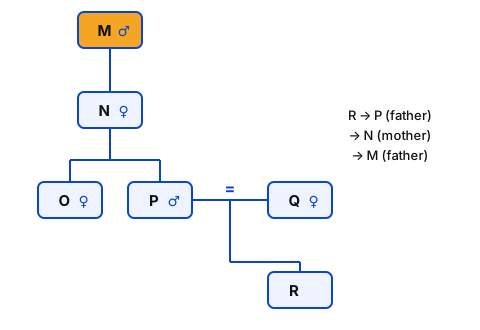
- M + N: M is father of N. N ÷ O: N is mother of O (N female).
- O – P: O is sister of P, so N is mother of P too.
- P × Q: P is husband of Q. Q ÷ R: Q is mother of R, so P is R's father.
- From R: father P → his mother N → her father M. M is R's father's mother's father.
Trick: Write the path from R upward: father → mother → father.
Answer: (D) Father's mother's father
अवधारणा: कूट खोलें और M से R तक वंश-वृक्ष बनाएँ।
- M + N: M, N का पिता। N ÷ O: N, O की माता (N महिला)।
- O – P: O, P की बहन, अतः N, P की भी माता।
- P × Q: P, Q का पति। Q ÷ R: Q, R की माता, अतः P, R का पिता।
- R से: पिता P → उसकी माता N → उसके पिता M। M, R के पिता की माता के पिता हैं।
ट्रिक: R से ऊपर का रास्ता लिखें: पिता → माता → पिता।
उत्तर: (D) पिता की माता के पिता (Father's mother's father)
RRB NTPC Undergraduate CBT 1General Intelligence and ReasoningCoded blood relationsRRB NTPC Undergraduate CBT 1 2025 · 18 Jun Shift 3
Q209.Read the given statement(s) and conclusions carefully. Assuming that the information given in the statements is true, even if it appears to be at variance with commonly known facts, decide which of the given conclusions logically follow(s) from the statement(s).
Statements:
All hats are carpets.
No carpet is a locket.
Conclusions:
(I) No hat is a locket.
(II) Some lockets are carpets.
दिए गए कथन(नों) और निष्कर्षों को ध्यानपूर्वक पढ़िए। यह मानते हुए कि कथनों में दी गई जानकारी सत्य है, भले ही वह सामान्य रूप से ज्ञात तथ्यों से भिन्न प्रतीत होती हो, निर्णय कीजिए कि दिए गए निष्कर्षों में से कौन-सा/से निष्कर्ष कथन(नों) का तार्किक रूप से अनुसरण करता है/करते हैं।
कथन:
सभी टोपियाँ, कालीन हैं।
कोई कालीन, लॉकेट नहीं है।
निष्कर्ष:
(I) कोई टोपी, लॉकेट नहीं है।
(II) कुछ लॉकेट, कालीन हैं।
- ANeither conclusion (I) nor (II) followsन तो निष्कर्ष (I) और न ही (II) अनुसरण करता है
- BOnly conclusion (I) followsकेवल निष्कर्ष (I) अनुसरण करता है
- COnly conclusion (II) followsकेवल निष्कर्ष (II) अनुसरण करता है
- DBoth conclusions (I) and (II) followनिष्कर्ष (I) और (II) दोनों अनुसरण करते हैं
Show answer
Concept: “All A are B” + “No B is C” ⇒ “No A is C”.
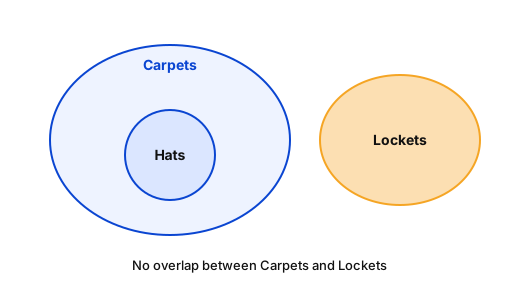
- All hats are carpets → Hats circle inside Carpets.
- No carpet is a locket → Lockets lie completely outside Carpets, hence outside Hats → (I) ‘No hat is a locket’ follows.
- (II) ‘Some lockets are carpets’ directly contradicts ‘No carpet is a locket’ → does not follow.
Trick: All + No ⇒ No (in the same order of terms).
Answer: (B) Only conclusion (I) follows
अवधारणा: “सभी A, B हैं” + “कोई B, C नहीं” ⇒ “कोई A, C नहीं”।
- सभी hats carpets हैं → Hats वृत्त Carpets के अंदर।
- कोई carpet locket नहीं → Lockets पूरी तरह Carpets के बाहर, अतः Hats के भी बाहर → (I) ‘कोई hat locket नहीं’ अनुसरण करता है।
- (II) ‘कुछ lockets carpets हैं’ सीधे ‘कोई carpet locket नहीं’ के विपरीत है → अनुसरण नहीं करता।
ट्रिक: All + No ⇒ No (पदों के उसी क्रम में)।
उत्तर: (B) केवल निष्कर्ष (I) अनुसरण करता है
RRB NTPC Undergraduate CBT 1General Intelligence and ReasoningSyllogismRRB NTPC Undergraduate CBT 1 2025 · 18 Jun Shift 3
Q210.Vimal ranked 28th from the top and 65th from the bottom in his class. How many students are there in his class?
विमल अपनी कक्षा में ऊपर से 28वें और नीचे से 65वें स्थान पर है। उसकी कक्षा में कितने छात्र हैं?
- A93
- B90
- C92
- D91
Show answer
Concept: Total rank from top rank from bottom (the person is counted twice).
- Rank from top , from bottom .
- Total
- students.
Trick: Never forget the ; is the trap option.
Answer: (C) 92
अवधारणा: कुल ऊपर से रैंक नीचे से रैंक (व्यक्ति दो बार गिना जाता है)।
- ऊपर से रैंक , नीचे से ।
- कुल
- छात्र।
ट्रिक: कभी न भूलें; जाल वाला विकल्प है।
उत्तर: (C) 92
RRB NTPC Undergraduate CBT 1General Intelligence and ReasoningRankingRRB NTPC Undergraduate CBT 1 2025 · 18 Jun Shift 3
Q211.In a row of 38 people facing the north, Keerthi is 13th from the right end. If Tanvi sits 7th to the left of Keerthi, what is Tanvi’s position from the left end of the row?
उत्तर की ओर मुख करके बैठे 38 व्यक्तियों की एक पंक्ति में, कीर्ति दाएँ छोर से 13th स्थान पर है। यदि तन्वी, कीर्ति के बाईं ओर 7th स्थान पर बैठी है, तो पंक्ति के बाएँ छोर से तन्वी का स्थान क्या है?
- A19th
- B20th
- C17th
- D18th
Show answer
Concept: Position from left Total Position from right . Facing north, left of a person is towards the left end.
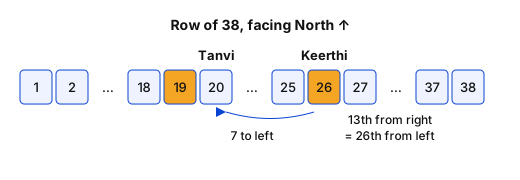
- Keerthi from left th.
- Tanvi is 7 places to the left of Keerthi: th from the left.
Trick: Moving left reduces the position from the left end – just subtract.
Answer: (A) 19th
अवधारणा: बाएँ से स्थान कुल दाएँ से स्थान । उत्तर की ओर मुख होने पर व्यक्ति का बायाँ, पंक्ति का बायाँ सिरा है।
- कीर्ति बाएँ से वाँ।
- तन्वी, कीर्ति के 7 स्थान बाएँ है: वाँ बाएँ से।
ट्रिक: बाईं ओर खिसकने पर बाएँ से स्थान घटता है – सीधा घटाइए।
उत्तर: (A) 19वाँ
RRB NTPC Undergraduate CBT 1General Intelligence and ReasoningRanking & PositionRRB NTPC Undergraduate CBT 1 2025 · 18 Jun Shift 2
Q212.Based on the English alphabetical order, three of the following four are alike in a certain way and thus form a group. Which is the one that does not belong to that group? (Note: The odd man out is not based on the number of consonants/vowels or their position in the letter cluster.)
अंग्रेज़ी वर्णमाला क्रम के आधार पर, निम्नलिखित चार में से तीन किसी निश्चित प्रकार से समान हैं और इस प्रकार एक समूह बनाते हैं। वह कौन-सा है जो उस समूह से संबंधित नहीं है? (ध्यान दें: असंगत का निर्धारण व्यंजनों/स्वरों की संख्या या अक्षर-समूह में उनके स्थान पर आधारित नहीं है।)
- ACDB
- BGHE
- CLMJ
- DSTQ
Show answer
Concept: Compare each letter with the first letter using alphabet positions.
- GHE: G(7), H(8) , E(5) .
- LMJ: L(12), M , J(10) . STQ: S(19), T , Q(17) .
- CDB: C(3), D , but B(2) – pattern breaks.
Trick: Write the pattern as “, ” from the first letter; the option that does not fit is odd.
Answer: (A) CDB
अवधारणा: वर्णमाला स्थान लेकर हर अक्षर की तुलना पहले अक्षर से करें।
- GHE: G(7), H(8) , E(5) ।
- LMJ: L(12), M , J(10) । STQ: S(19), T , Q(17) ।
- CDB: C(3), D , पर B(2) – पैटर्न टूटता है।
ट्रिक: पहले अक्षर से पैटर्न “, ” लिखें; जो विकल्प न बैठे वही विषम है।
उत्तर: (A) CDB
RRB NTPC Undergraduate CBT 1General Intelligence and ReasoningOdd One Out (Letter Clusters)RRB NTPC Undergraduate CBT 1 2025 · 18 Jun Shift 2
Q213.Which letter cluster will replace the question mark (?) to complete the given series? CDX DFU EHR ? GLL
दी गई श्रृंखला को पूर्ण करने के लिए कौन-सा अक्षर-समूह प्रश्न चिह्न (?) का स्थान लेगा? CDX DFU EHR ? GLL
- AFTR
- BFGY
- CFDR
- DFJO
Show answer
Concept: Treat the 1st, 2nd and 3rd letters of the clusters as three separate series.
- 1st letters: C, D, E, ?, G → → F.
- 2nd letters: D, F, H, ?, L → → J.
- 3rd letters: X, U, R, ?, L → → O.
Trick: Check only the letter that differs among options: here the 2nd letter J alone decides.
Answer: (D) FJO
अवधारणा: समूहों के पहले, दूसरे और तीसरे अक्षर को तीन अलग श्रेणियाँ मानें।
- पहले अक्षर: C, D, E, ?, G → → F।
- दूसरे अक्षर: D, F, H, ?, L → → J।
- तीसरे अक्षर: X, U, R, ?, L → → O।
ट्रिक: विकल्पों में जो अक्षर अलग है केवल उसे जाँचें: यहाँ दूसरा अक्षर J ही निर्णय कर देता है।
उत्तर: (D) FJO
RRB NTPC Undergraduate CBT 1General Intelligence and ReasoningLetter SeriesRRB NTPC Undergraduate CBT 1 2025 · 18 Jun Shift 2
Q214.Refer to the following letter series and answer the question that follows.
(Left) H U N V Y M L N D M Q M B E M N Z W M J I N F Q N (Right)
How many letters are there in the English alphabetical series between the letter which is fifth from the right end and eighth from the left end of the series?
निम्नलिखित अक्षर श्रृंखला को देखिए और नीचे दिए गए प्रश्न का उत्तर दीजिए।
(बाएँ) H U N V Y M L N D M Q M B E M N Z W M J I N F Q N (दाएँ)
श्रृंखला के दाएँ छोर से पाँचवें और बाएँ छोर से आठवें अक्षर के बीच अंग्रेज़ी वर्णमाला क्रम में कितने अक्षर हैं?
- AThreeतीन
- BFiveपाँच
- CTwoदो
- DFourचार
Show answer
Concept: Count the letters from the given end, then count letters between them in the alphabet.
- The series has 25 letters. 8th from the left: H U N V Y M L N → N.
- 5th from the right = st from left: …N Z W M J I N F Q N → I.
- Between I(9) and N(14) in the alphabet: J, K, L, M → letters.
Trick: Letters between two letters difference of positions .
Answer: (D) Four
अवधारणा: दिए गए सिरे से अक्षर गिनें, फिर वर्णमाला में उनके बीच के अक्षर गिनें।
- श्रेणी में 25 अक्षर हैं। बाएँ से 8वाँ: H U N V Y M L N → N।
- दाएँ से 5वाँ = बाएँ से वाँ: …N Z W M J I N F Q N → I।
- वर्णमाला में I(9) और N(14) के बीच: J, K, L, M → अक्षर।
ट्रिक: दो अक्षरों के बीच के अक्षर स्थानों का अंतर ।
उत्तर: (D) चार
RRB NTPC Undergraduate CBT 1General Intelligence and ReasoningLetter Position SeriesRRB NTPC Undergraduate CBT 1 2025 · 18 Jun Shift 2
Q215.Seven boxes, G, H, I, J, Q, R and S, are kept one over the other, but not necessarily in the same order.
Only two boxes are kept between I and R. Only J is kept above S. Only three boxes are kept below I. H is kept at some place below G but at some place above Q.
Which box is kept third above Q?
सात बक्से, G, H, I, J, Q, R और S, एक के ऊपर एक रखे गए हैं, लेकिन आवश्यक नहीं कि इसी क्रम में हों।
I और R के बीच केवल दो बक्से रखे गए हैं। S के ऊपर केवल J रखा गया है। I के नीचे केवल तीन बक्से रखे गए हैं। H, G के नीचे किसी स्थान पर, लेकिन Q के ऊपर किसी स्थान पर रखा गया है।
Q के ठीक तीसरे ऊपर कौन-सा बक्सा रखा गया है?
- AJ
- BR
- CS
- DG
Show answer
Concept: Number positions 1 (bottom) to 7 (top) and fix the definite clues first.
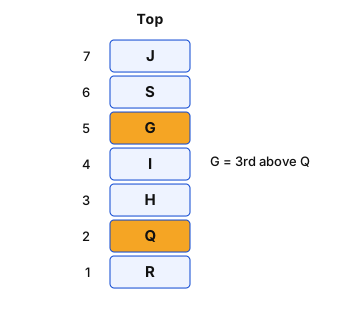
- Only J above S → J = 7, S = 6. Only three boxes below I → I = 4.
- Two boxes between I and R → R = 1 (7 is taken).
- G, H, Q fill 2, 3, 5 with G above H above Q → Q = 2, H = 3, G = 5.
- Third above Q (2) is position 5 = G.
Trick: “Only X above Y” instantly fixes the top two places.
Answer: (D) G
अवधारणा: स्थान 1 (नीचे) से 7 (ऊपर) तक संख्या दें और पहले निश्चित संकेत लगाएँ।
- केवल J, S के ऊपर → J = 7, S = 6। I के नीचे केवल तीन बॉक्स → I = 4।
- I और R के बीच दो बॉक्स → R = 1 (7 भरा है)।
- G, H, Q स्थान 2, 3, 5 में, G के नीचे H और H के नीचे Q → Q = 2, H = 3, G = 5।
- Q (2) से तीसरा ऊपर स्थान 5 = G।
ट्रिक: “केवल X, Y के ऊपर” से ऊपर के दो स्थान तुरंत तय हो जाते हैं।
उत्तर: (D) G
RRB NTPC Undergraduate CBT 1General Intelligence and ReasoningBox ArrangementRRB NTPC Undergraduate CBT 1 2025 · 18 Jun Shift 2
Q216.Which of the following letter-number clusters will replace the question mark (?) in the given series to make it logically complete?
RHE 53, WMC 61, BRA 69, GWY 77, ?
निम्नलिखित में से कौन-सा अक्षर-संख्या समूह दी गई श्रृंखला में प्रश्न चिह्न (?) का स्थान लेकर उसे तार्किक रूप से पूर्ण करेगा?
RHE 53, WMC 61, BRA 69, GWY 77, ?
- AKBV 83
- BMAX 85
- CLBW 85
- DKCU 83
Show answer
Concept: Check each letter position and the number separately.
- 1st letter: R, W, B, G → → L.
- 2nd letter: H, M, R, W → → B.
- 3rd letter: E, C, A, Y → → W.
- Number: 53, 61, 69, 77 → → 85.
Trick: Numbers end in 85 for two options; the first letter L settles it.
Answer: (C) LBW 85
अवधारणा: हर अक्षर स्थान और संख्या को अलग-अलग जाँचें।
- पहला अक्षर: R, W, B, G → → L।
- दूसरा अक्षर: H, M, R, W → → B।
- तीसरा अक्षर: E, C, A, Y → → W।
- संख्या: 53, 61, 69, 77 → → 85।
ट्रिक: दो विकल्पों में 85 है; पहला अक्षर L निर्णय कर देता है।
उत्तर: (C) LBW 85
RRB NTPC Undergraduate CBT 1General Intelligence and ReasoningAlphanumeric SeriesRRB NTPC Undergraduate CBT 1 2025 · 18 Jun Shift 2
Q217.What should come in place of ‘?’ in the given series?
135 146 168 201 245 ?
दी गई श्रृंखला में ‘?’ के स्थान पर क्या आना चाहिए?
135 146 168 201 245 ?
- A300
- B310
- C290
- D280
Show answer
Concept: Look at the differences between consecutive terms.
- Differences: , , , .
- Next difference : .
Trick: Differences are multiples of 11 ().
Answer: (A) 300
अवधारणा: लगातार पदों के अंतर देखें।
- अंतर: , , , ।
- अगला अंतर : ।
ट्रिक: अंतर 11 के गुणज हैं ()।
उत्तर: (A) 300
RRB NTPC Undergraduate CBT 1General Intelligence and ReasoningNumber SeriesRRB NTPC Undergraduate CBT 1 2025 · 18 Jun Shift 2
Q218.Abhinav starts from Point A and drives 16 km towards the west. He then takes a right turn, drives 8 km, turns right and drives 19 km. He then takes a right turn and drives 14 km. He takes a final right turn, drives 3 km and stops at Point P. How far (shortest distance) and towards which direction should he drive in order to reach Point A again? (All turns are 90-degree turns only unless specified.)
अभिनव बिंदु A से आरंभ करता है और पश्चिम की ओर 16 km गाड़ी चलाता है। फिर वह दाएँ मुड़ता है, 8 km गाड़ी चलाता है, दाएँ मुड़ता है और 19 km गाड़ी चलाता है। फिर वह दाएँ मुड़ता है और 14 km गाड़ी चलाता है। वह अंतिम बार दाएँ मुड़ता है, 3 km गाड़ी चलाता है और बिंदु P पर रुक जाता है। पुनः बिंदु A तक पहुँचने के लिए उसे कितनी दूरी (न्यूनतम दूरी) और किस दिशा में गाड़ी चलानी चाहिए? (जब तक निर्दिष्ट न हो, सभी मोड़ केवल 90 डिग्री के हैं।)
- A5 km to the southदक्षिण की ओर 5 km
- B6 km to the northउत्तर की ओर 6 km
- C5 km to the northउत्तर की ओर 5 km
- D6 km to the southदक्षिण की ओर 6 km
Show answer
Concept: Take A as origin (0, 0); east and north positive. Right turns go W → N → E → S → W.
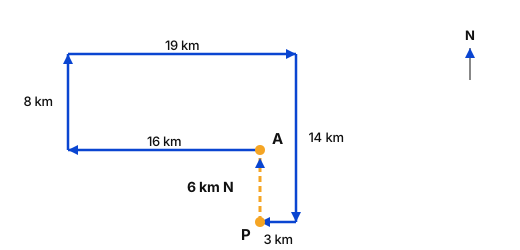
- West 16 → ; right (north) 8 → .
- Right (east) 19 → ; right (south) 14 → .
- Right (west) 3 → .
- P is 6 km directly south of A, so he must drive 6 km towards the north.
Trick: Net E–W: ; net N–S: → straight back 6 km north.
Answer: (B) 6 km to the north
अवधारणा: A को मूल बिंदु (0, 0) लें; पूर्व और उत्तर धनात्मक। दाएँ मुड़ने का क्रम: पश्चिम → उत्तर → पूर्व → दक्षिण → पश्चिम।
- पश्चिम 16 → ; दाएँ (उत्तर) 8 → ।
- दाएँ (पूर्व) 19 → ; दाएँ (दक्षिण) 14 → ।
- दाएँ (पश्चिम) 3 → ।
- P, A से ठीक 6 km दक्षिण है, इसलिए उसे 6 km उत्तर की ओर जाना होगा।
ट्रिक: कुल पूर्व–पश्चिम: ; कुल उत्तर–दक्षिण: → सीधे 6 km उत्तर।
उत्तर: (B) 6 km उत्तर की ओर
RRB NTPC Undergraduate CBT 1General Intelligence and ReasoningDirection & DistanceRRB NTPC Undergraduate CBT 1 2025 · 18 Jun Shift 2
Q219.Each of the digits in the number 7632198 is arranged in ascending order from left to right. The position(s) of how many digits will remain unchanged as compared to that in the original number?
संख्या 7632198 के प्रत्येक अंक को बाएँ से दाएँ आरोही क्रम में व्यवस्थित किया जाता है। मूल संख्या की तुलना में कितने अंकों का/के स्थान अपरिवर्तित रहेगा/रहेंगे?
- AONEएक
- BNONEकोई नहीं
- CTHREEतीन
- DTWOदो
Show answer
Concept: Write the original and rearranged numbers one below the other and compare place by place.
- Original: 7 6 3 2 1 9 8.
- Ascending: 1 2 3 6 7 8 9.
- Compare: 7–1, 6–2, 3–3, 2–6, 1–7, 9–8, 8–9 → only the 3rd digit (3) is unchanged.
Trick: In ascending order a digit stays only if exactly (its rank ) digits are smaller and all of them lie to its left.
Answer: (A) ONE
अवधारणा: मूल और पुनर्व्यवस्थित संख्याओं को एक के नीचे एक लिखकर स्थानवार तुलना करें।
- मूल: 7 6 3 2 1 9 8।
- आरोही: 1 2 3 6 7 8 9।
- तुलना: 7–1, 6–2, 3–3, 2–6, 1–7, 9–8, 8–9 → केवल तीसरा अंक (3) अपरिवर्तित।
ट्रिक: आरोही क्रम में कोई अंक तभी अपनी जगह रहता है जब उससे छोटे सभी अंक उसके बाईं ओर हों और संख्या ठीक उसकी जगह के अनुसार हो।
उत्तर: (A) एक
RRB NTPC Undergraduate CBT 1General Intelligence and ReasoningDigit RearrangementRRB NTPC Undergraduate CBT 1 2025 · 18 Jun Shift 2
Q220.Based on the English alphabetical order, three of the following four letter-cluster pairs are alike in a certain way and thus form a group. Which is the one that does not belong to that group?
(Note: The odd one out is not based on the number of consonants/vowels or their position in the letter-cluster pairs.)
अंग्रेज़ी वर्णमाला क्रम के आधार पर, निम्नलिखित चार अक्षर-समूह युग्मों में से तीन किसी निश्चित प्रकार से समान हैं और इस प्रकार एक समूह बनाते हैं। वह कौन-सा है जो उस समूह से संबंधित नहीं है?
(ध्यान दें: असंगत का निर्धारण व्यंजनों/स्वरों की संख्या या अक्षर-समूह युग्मों में उनके स्थान पर आधारित नहीं है।)
- AKJ-PZ
- BHG – NW
- CFE-KU
- DPO – UE
Show answer
Concept: Find the relation between the letters of each pair using alphabet positions.
- KJ-PZ: K→J , K(11)→P(16) , J(10)→Z(26) .
- FE-KU: , , E(5)→U(21) . PO-UE: , P→U , O(15)→E (looping past Z).
- HG-NW: , but H(8)→N(14) – pattern breaks.
Trick: Check the first letters of the two clusters: only H→N is , all others .
Answer: (B) HG – NW
अवधारणा: वर्णमाला स्थानों से हर युग्म के अक्षरों का संबंध खोजें।
- KJ-PZ: K→J , K(11)→P(16) , J(10)→Z(26) ।
- FE-KU: , , E(5)→U(21) । PO-UE: , P→U , O(15)→E (Z के बाद फिर A से)।
- HG-NW: , पर H(8)→N(14) – पैटर्न टूटता है।
ट्रिक: दोनों समूहों के पहले अक्षर देखें: केवल H→N में है, बाकी सब में ।
उत्तर: (B) HG – NW
RRB NTPC Undergraduate CBT 1General Intelligence and ReasoningOdd One Out (Letter Pairs)RRB NTPC Undergraduate CBT 1 2025 · 18 Jun Shift 2

