Q281.Which two numbers should be interchanged to make the given equation correct? (21 × 2) ÷ 3 + 15 × 5 − 19 × 4 + 36 + 7 × 6 = 57
दिए गए समीकरण को सही बनाने के लिए किन दो संख्याओं को आपस में बदला जाना चाहिए? (21 × 2) ÷ 3 + 15 × 5 − 19 × 4 + 36 + 7 × 6 = 57
- A2 and 42 और 4
- B5 and 65 और 6
- C36 and 2136 और 21
- D4 and 54 और 5
Show answer
Concept: Interchange the numbers in each option and test the equation with BODMAS.
- Interchange 4 and 5:
- ✓
Trick: Original value: ; need 34 less – swapping 4, 5 changes to (34 less).
Answer: (D) 4 and 5
अवधारणा: हर विकल्प की संख्याओं को आपस में बदलकर BODMAS से जाँचें।
- 4 और 5 बदलने पर:
- ✓
ट्रिक: मूल मान: ; 34 कम चाहिए – 4, 5 बदलने से बनता है (34 कम)।
उत्तर: (D) 4 and 5
RRB NTPC Undergraduate CBT 1General Intelligence and ReasoningInterchange of numbersRRB NTPC Undergraduate CBT 1 2025 · 17 Jun Shift 3
Q282.Seven people A, B, C, D, E, F and G are sitting around a circular table facing towards the centre of the table. E sits second to the left of F. A is sitting immediately between B and C. D sits to the immediate right of C. Who is sitting immediately between E and F?
सात व्यक्ति A, B, C, D, E, F और G एक वृत्ताकार मेज़ के चारों ओर मेज़ के केंद्र की ओर मुख करके बैठे हैं। E, F के बाएँ से दूसरे स्थान पर बैठा है। A, B और C के ठीक बीच में बैठा है। D, C के ठीक दाएँ बैठा है। E और F के ठीक बीच में कौन बैठा है?
- AB
- BD
- CG
- DC
Show answer
Concept: Facing the centre: left = clockwise, right = anticlockwise.
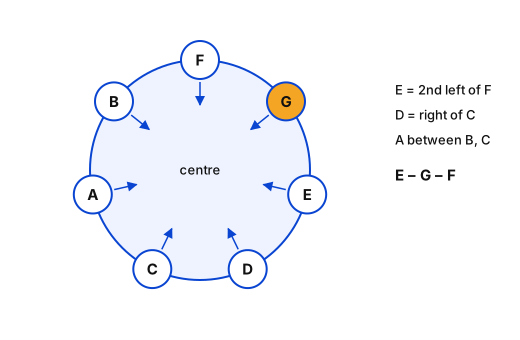
- E is second to the left of F → one seat lies between F and E.
- D is immediately right of C and A sits between B and C → D, C, A, B form a block of four consecutive seats.
- This block cannot fit in the single gap between F and E, so it takes the other four seats; the gap gets G.
- Order (clockwise): F, G, E, D, C, A, B.
Trick: Place the biggest block first – the leftover seat is the answer.
Answer: (C) G
अवधारणा: केंद्र की ओर मुख: बायाँ = दक्षिणावर्त (clockwise), दायाँ = वामावर्त।
- E, F के बाएँ से दूसरे स्थान पर → F और E के बीच एक सीट।
- D, C के ठीक दाएँ और A, B व C के बीच → D, C, A, B चार लगातार सीटों का ब्लॉक।
- यह ब्लॉक F और E के बीच की एक सीट में नहीं आ सकता, अतः बाकी चार सीटें लेता है; बीच की सीट पर G।
- क्रम (दक्षिणावर्त): F, G, E, D, C, A, B।
ट्रिक: पहले सबसे बड़ा ब्लॉक रखें – बची हुई सीट ही उत्तर है।
उत्तर: (C) G
RRB NTPC Undergraduate CBT 1General Intelligence and ReasoningCircular arrangementRRB NTPC Undergraduate CBT 1 2025 · 17 Jun Shift 3
Q283.In a certain code language, ‘SOAP’ is coded as ‘5279’ and ‘ATOP’ is coded as ‘4527’. What is the code for ‘T’ in the given code language?
एक निश्चित कूट भाषा में, ‘SOAP’ को ‘5279’ के रूप में और ‘ATOP’ को ‘4527’ के रूप में कूटबद्ध किया जाता है। दी गई कूट भाषा में ‘T’ के लिए कूट क्या है?
- A5
- B4
- C7
- D2
Show answer
Concept: Letters common to both words share the common digits.
- SOAP = 5279, ATOP = 4527
- Common letters O, A, P ↔ common digits 5, 2, 7
- Left over: S = 9 and T = 4
Trick: Cancel the common part – the unique letter gets the unique digit.
Answer: (B)
अवधारणा: दोनों शब्दों के समान अक्षरों के कोड भी समान अंक होंगे।
- SOAP = 5279, ATOP = 4527
- समान अक्षर O, A, P ↔ समान अंक 5, 2, 7
- शेष: S = 9 और T = 4
ट्रिक: समान भाग हटाएँ – अलग अक्षर को अलग अंक मिलेगा।
उत्तर: (B)
RRB NTPC Undergraduate CBT 1General Intelligence and ReasoningCoding-decodingRRB NTPC Undergraduate CBT 1 2025 · 17 Jun Shift 3
Q284.Refer to the following series and answer the question. (Counting to be done from left to right only.) (All numbers are single-digit numbers only.)
(Left) 9 3 1 2 6 8 4 5 3 9 7 2 4 5 1 8 2 3 5 9 8 5 7 3 5 6 (Right)
How many such odd digits are there, each of which is immediately preceded by an even digit and also immediately followed by an odd digit?
निम्नलिखित श्रृंखला को देखिए और प्रश्न का उत्तर दीजिए। (गिनती केवल बाएँ से दाएँ की जानी है।) (सभी संख्याएँ केवल एक अंक वाली संख्याएँ हैं।)
(बाएँ) 9 3 1 2 6 8 4 5 3 9 7 2 4 5 1 8 2 3 5 9 8 5 7 3 5 6 (दाएँ)
ऐसे कितने विषम अंक हैं, जिनमें से प्रत्येक के ठीक पहले एक सम अंक है और ठीक बाद भी एक विषम अंक है?
- AOneएक
- BNoneकोई नहीं
- CMore than twoदो से अधिक
- DTwoदो
Show answer
Concept: Look for the pattern Even – Odd – Odd and count the middle digits.
- … 4 5 3 … ✓
- … 4 5 1 … ✓
- … 2 3 5 … ✓
- … 8 5 7 … ✓ → total 4 such digits
Trick: First mark every even digit, then check only the next two digits.
Answer: (C) More than two
अवधारणा: सम – विषम – विषम पैटर्न खोजें और बीच वाले अंक गिनें।
- … 4 5 3 … ✓
- … 4 5 1 … ✓
- … 2 3 5 … ✓
- … 8 5 7 … ✓ → कुल 4 अंक
ट्रिक: पहले हर सम अंक पर निशान लगाएँ, फिर केवल अगले दो अंक जाँचें।
उत्तर: (C) More than two
RRB NTPC Undergraduate CBT 1General Intelligence and ReasoningNumber sequence analysisRRB NTPC Undergraduate CBT 1 2025 · 17 Jun Shift 3
Q285.Refer to the following letter series and answer the question that follows. Counting to be done from left to right only.
(Left) U N E H W Y B X P E L Q R C G R U A Z R U (Right)
How many such vowels are there, each of which is immediately preceded by a vowel and also immediately followed by a consonant?
निम्नलिखित अक्षर श्रृंखला को देखिए और उसके बाद आने वाले प्रश्न का उत्तर दीजिए। गिनती केवल बाएँ से दाएँ की जानी है।
(बाएँ) U N E H W Y B X P E L Q R C G R U A Z R U (दाएँ)
ऐसे कितने स्वर हैं, जिनमें से प्रत्येक के ठीक पहले एक स्वर है और ठीक बाद एक व्यंजन है?
- AThreeतीन
- BTwoदो
- CNoneकोई नहीं
- DOneएक
Show answer
Concept: Look for Vowel – Vowel – Consonant.
- Vowels in the series: U (1st), E, E, U, A, U (last).
- Only A has a vowel before it (U) and a consonant after it (Z): U A Z ✓
- Other vowels are preceded by consonants (N E, P E, R U, R U).
Trick: Find adjacent vowel pairs first – they are rare.
Answer: (D) One
अवधारणा: स्वर – स्वर – व्यंजन पैटर्न खोजें।
- श्रृंखला के स्वर: U (पहला), E, E, U, A, U (अंतिम)।
- केवल A से पहले स्वर (U) और बाद में व्यंजन (Z) है: U A Z ✓
- बाकी स्वरों से पहले व्यंजन हैं (N E, P E, R U, R U)।
ट्रिक: पहले लगातार दो स्वर खोजें – ऐसे जोड़े कम होते हैं।
उत्तर: (D) One
RRB NTPC Undergraduate CBT 1General Intelligence and ReasoningLetter sequence analysisRRB NTPC Undergraduate CBT 1 2025 · 17 Jun Shift 3
Q286.In the following triad, each group of letters is related to the subsequent one following a certain logic. Select, from the given options, the one which follows the same logic. MEGA - EAGM - AGEM
TONS - OSNT - SNOT
निम्नलिखित त्रय में, अक्षरों का प्रत्येक समूह एक निश्चित तर्क का अनुसरण करते हुए अगले समूह से संबंधित है। दिए गए विकल्पों में से उसका चयन कीजिए जो समान तर्क का अनुसरण करता है। MEGA - EAGM - AGEM
TONS - OSNT - SNOT
- AWEAR - WAER - RAEW
- BPOND - OPND - DONP
- CKITE - IETK - ETIK
- DLEGS - ELGS - SEGL
Show answer
Concept: Track the positions: word 1234 → 2nd word, then 2nd word → 3rd word.
- MEGA (1234) → EAGM = 2, 4, 3, 1; EAGM → AGEM = its letters 2, 3, 1, 4
- Check TONS → OSNT → SNOT ✓
- KITE → IETK (2, 4, 3, 1) → ETIK (2, 3, 1, 4) ✓
Trick: Write numbers 1–4 under the first word; test only one option fully.
Answer: (C) KITE - IETK - ETIK
अवधारणा: स्थान ट्रैक करें: शब्द 1234 → दूसरा शब्द, फिर दूसरा → तीसरा।
- MEGA (1234) → EAGM = 2, 4, 3, 1; EAGM → AGEM = उसके अक्षर 2, 3, 1, 4
- जाँच: TONS → OSNT → SNOT ✓
- KITE → IETK (2, 4, 3, 1) → ETIK (2, 3, 1, 4) ✓
ट्रिक: पहले शब्द के नीचे 1–4 लिखें; केवल एक विकल्प पूरा जाँचें।
उत्तर: (C) KITE - IETK - ETIK
RRB NTPC Undergraduate CBT 1General Intelligence and ReasoningLetter triadsRRB NTPC Undergraduate CBT 1 2025 · 17 Jun Shift 3
Q287.Seven boxes, M, N, O, P, Q, R and S, are kept one over the other, but not necessarily in the same order.
N is kept fourth from the top. Only two boxes are kept between N and S. Only P is kept above M. O is kept immediately above S. Q is kept on one of the positions after M but on one of the positions before N.
Which box is kept third from the bottom?
सात डिब्बे M, N, O, P, Q, R और S एक के ऊपर एक रखे गए हैं, लेकिन आवश्यक नहीं कि इसी क्रम में हों।
N को ऊपर से चौथे स्थान पर रखा गया है। N और S के बीच केवल दो डिब्बे रखे गए हैं। M के ऊपर केवल P रखा गया है। O को S के ठीक ऊपर रखा गया है। Q को M के बाद वाले किसी एक स्थान पर लेकिन N से पहले वाले किसी एक स्थान पर रखा गया है।
नीचे से तीसरे स्थान पर कौन-सा डिब्बा रखा गया है?
- AQ
- BR
- CO
- DS
Show answer
Concept: Number positions 1 (top) to 7 (bottom) and fix definite clues first.
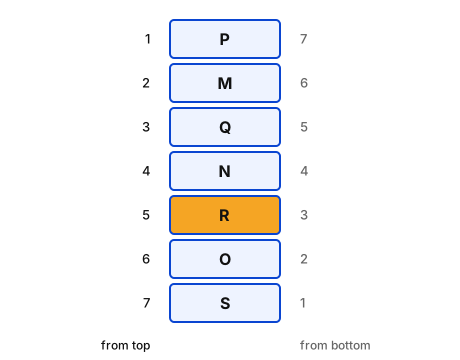
- N = 4. Only P above M → P = 1, M = 2.
- Two boxes between N and S → S = 7 (1 is taken). O immediately above S → O = 6.
- Q between M and N → Q = 3; remaining R = 5.
- Third from bottom = position 5 = R.
Trick: nth from bottom from top for 7 boxes.
Answer: (B) R
अवधारणा: स्थान 1 (ऊपर) से 7 (नीचे) तक मानें और निश्चित सुराग पहले लगाएँ।
- N = 4। M के ऊपर केवल P → P = 1, M = 2।
- N और S के बीच दो बॉक्स → S = 7 (1 भरा है)। O, S के ठीक ऊपर → O = 6।
- Q, M और N के बीच → Q = 3; शेष R = 5।
- नीचे से तीसरा = स्थान 5 = R।
ट्रिक: 7 बॉक्स में नीचे से n-वाँ ऊपर से।
उत्तर: (B) R
RRB NTPC Undergraduate CBT 1General Intelligence and ReasoningBox arrangementRRB NTPC Undergraduate CBT 1 2025 · 17 Jun Shift 3
Q288.In a certain code language, ‘SAFE’ is coded as ‘3698’ and ‘FACE’ is coded as ‘5398’. What is the code for ‘S’ in the given code language?
एक निश्चित कूट भाषा में, ‘SAFE’ को ‘3698’ के रूप में और ‘FACE’ को ‘5398’ के रूप में कूटबद्ध किया जाता है। दी गई कूट भाषा में ‘S’ के लिए कूट क्या है?
- A3
- B9
- C8
- D6
Show answer
Concept: Letters common to both words share the common digits.
- SAFE = 3698, FACE = 5398
- Common letters A, F, E ↔ common digits 3, 9, 8
- Left over: S = 6, C = 5
Trick: Remove common letters and digits – what remains pairs up.
Answer: (D)
अवधारणा: दोनों शब्दों के समान अक्षरों के कोड भी समान अंक होंगे।
- SAFE = 3698, FACE = 5398
- समान अक्षर A, F, E ↔ समान अंक 3, 9, 8
- शेष: S = 6, C = 5
ट्रिक: समान अक्षर व अंक हटाएँ – जो बचे वही जोड़ी है।
उत्तर: (D)
RRB NTPC Undergraduate CBT 1General Intelligence and ReasoningCoding-decodingRRB NTPC Undergraduate CBT 1 2025 · 17 Jun Shift 3
Q289.Read the given statements and conclusions carefully. Assuming that the information given in the statements is true, even if it appears to be at variance with commonly known facts, decide which of the given conclusions logically follow(s) from the statements.
Statement: All Cobalt is Silver. No Silver is Vanadium.
Conclusion I: No Vanadium is Cobalt.
Conclusion II: Some Vanadium is Cobalt.
दिए गए कथनों और निष्कर्षों को ध्यानपूर्वक पढ़िए। यह मानते हुए कि कथनों में दी गई जानकारी सत्य है, भले ही वह सामान्यतः ज्ञात तथ्यों से भिन्न प्रतीत होती हो, निर्णय कीजिए कि दिए गए निष्कर्षों में से कौन-सा/कौन-से निष्कर्ष कथनों का तार्किक रूप से अनुसरण करता है/करते हैं।
कथन: सभी कोबाल्ट, सिल्वर हैं। कोई सिल्वर, वैनेडियम नहीं है।
निष्कर्ष I: कोई वैनेडियम, कोबाल्ट नहीं है।
निष्कर्ष II: कुछ वैनेडियम, कोबाल्ट हैं।
- ABoth conclusions (I) and (II) followनिष्कर्ष (I) और (II) दोनों अनुसरण करते हैं
- BOnly conclusion (I) followsकेवल निष्कर्ष (I) अनुसरण करता है
- CNeither conclusion (I) nor (II) followsन तो निष्कर्ष (I) और न ही (II) अनुसरण करता है
- DOnly conclusion (II) followsकेवल निष्कर्ष (II) अनुसरण करता है
Show answer
Concept: Draw the Venn diagram: Cobalt lies inside Silver; Silver and Vanadium do not touch.
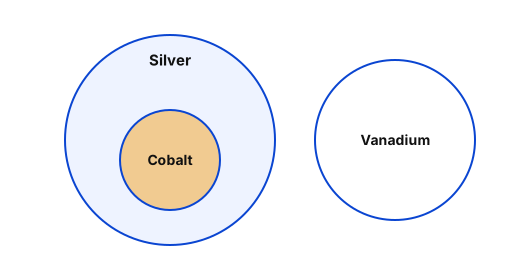
- Since all Cobalt is inside Silver and Silver is completely away from Vanadium, Cobalt can never touch Vanadium.
- Conclusion I: No Vanadium is Cobalt → definitely true ✓
- Conclusion II: Some Vanadium is Cobalt → impossible ✗
Trick: All A are B + No B is C ⇒ No A is C (and No C is A).
Answer: (B) Only conclusion (I) follows
अवधारणा: वेन आरेख बनाएँ: Cobalt, Silver के अंदर; Silver और Vanadium अलग।
- सारा Cobalt, Silver में है और Silver, Vanadium से पूरी तरह अलग है – अतः Cobalt कभी Vanadium को नहीं छू सकता।
- निष्कर्ष I: कोई Vanadium, Cobalt नहीं → निश्चित सत्य ✓
- निष्कर्ष II: कुछ Vanadium, Cobalt हैं → असंभव ✗
ट्रिक: सभी A, B हैं + कोई B, C नहीं ⇒ कोई A, C नहीं (और कोई C, A नहीं)।
उत्तर: (B) Only conclusion (I) follows
RRB NTPC Undergraduate CBT 1General Intelligence and ReasoningSyllogismRRB NTPC Undergraduate CBT 1 2025 · 17 Jun Shift 3
Q290.Tanmay starts from Point Y and drives 23 km towards West. He then takes a right turn, drives 63 km, turns right and drives 31 km. He then takes a right turn and drives 27 km. He takes a right turn, drives 79 km. He then turns left, drives 36 km to stop at Point Z. How far (shortest distance) and towards which direction should he drive in order to reach Point Y again? (All turns are 90° turns only unless specified.)
तन्मय बिंदु Y से चलना शुरू करता है और पश्चिम की ओर 23 km गाड़ी चलाता है। फिर वह दाएँ मुड़ता है, 63 km गाड़ी चलाता है, दाएँ मुड़ता है और 31 km गाड़ी चलाता है। फिर वह दाएँ मुड़ता है और 27 km गाड़ी चलाता है। वह दाएँ मुड़ता है, 79 km गाड़ी चलाता है। फिर वह बाएँ मुड़ता है, 36 km गाड़ी चलाकर बिंदु Z पर रुकता है। बिंदु Y पर फिर से पहुँचने के लिए उसे कितनी दूरी (न्यूनतम दूरी) और किस दिशा में गाड़ी चलानी चाहिए? (जब तक निर्दिष्ट न किया जाए, सभी मोड़ केवल 90° के मोड़ हैं।)
- A73 km towards westपश्चिम की ओर 73 km
- B75 km towards eastपूर्व की ओर 75 km
- C71 km towards westपश्चिम की ओर 71 km
- D71 km towards eastपूर्व की ओर 71 km
Show answer
Concept: Take Y as origin; East and North positive.
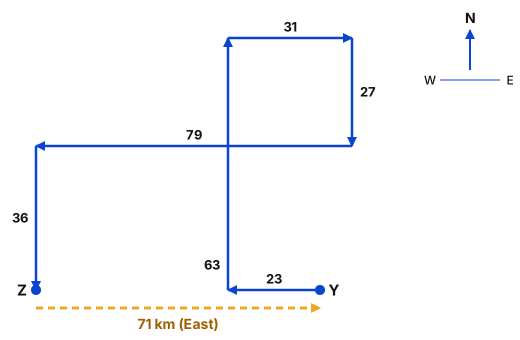
- West 23 → ; right (North) 63 → ; right (East) 31 →
- Right (South) 27 → ; right (West) 79 →
- Left (South) 36 → Z , on the same horizontal line as Y
- Y is to the East of Z.
Trick: Net E–W: ; net N–S: .
Answer: (D) 71 km towards east
अवधारणा: Y को मूल बिंदु मानें; पूर्व और उत्तर धनात्मक।
- पश्चिम 23 → ; दाएँ (उत्तर) 63 → ; दाएँ (पूर्व) 31 →
- दाएँ (दक्षिण) 27 → ; दाएँ (पश्चिम) 79 →
- बाएँ (दक्षिण) 36 → Z , Y की ही क्षैतिज रेखा पर
- Y, Z से पूर्व में है।
ट्रिक: कुल पूर्व–पश्चिम: ; उत्तर–दक्षिण: ।
उत्तर: (D) 71 km towards east
RRB NTPC Undergraduate CBT 1General Intelligence and ReasoningDirection and distanceRRB NTPC Undergraduate CBT 1 2025 · 17 Jun Shift 3
Q291.Which of the following letter-number clusters will replace the question mark (?) in the given series to make it logically complete?
KE64, MC27, PZ8, ?
निम्नलिखित में से कौन-सा अक्षर-संख्या समूह दी गई श्रृंखला में प्रश्न चिह्न (?) को प्रतिस्थापित करके उसे तार्किक रूप से पूर्ण करेगा?
KE64, MC27, PZ8, ?
- ATW1
- BSV1
- CTV1
- DTV8
Show answer
Concept: Check each part separately.
- 1st letter: K → M → P → T ()
- 2nd letter: E → C → Z → V ()
- Numbers: → next
Trick: The two letters move by the same steps in opposite directions.
Answer: (C) TV1
अवधारणा: हर भाग को अलग-अलग जाँचें।
- पहला अक्षर: K → M → P → T ()
- दूसरा अक्षर: E → C → Z → V ()
- संख्याएँ: → अगला
ट्रिक: दोनों अक्षर समान कदमों से उल्टी दिशाओं में चलते हैं।
उत्तर: (C) TV1
RRB NTPC Undergraduate CBT 1General Intelligence and ReasoningLetter-number seriesRRB NTPC Undergraduate CBT 1 2025 · 17 Jun Shift 3
Q292.Select the set in which the numbers are related in the same way as are the numbers of the following sets.
(NOTE: Operations should be performed on the whole numbers, without breaking down the numbers into their constituent digits. E.g. 13 – Operations on 13 such as
adding/subtracting/multiplying etc. to 13 can be performed. Breaking down 13 into 1 and 3 and then performing mathematical operations on 1 and 3 is not allowed.) (53, 47, 35)
(117, 111, 99)
उस समुच्चय का चयन कीजिए जिसमें संख्याएँ उसी प्रकार संबंधित हैं जिस प्रकार निम्नलिखित समुच्चयों की संख्याएँ संबंधित हैं।
(ध्यान दें: संक्रियाएँ संख्याओं को उनके घटक अंकों में तोड़े बिना, पूर्ण संख्याओं पर की जानी चाहिए। उदाहरण के लिए, 13 – 13 पर संक्रियाएँ जैसे 13 में
जोड़ना/घटाना/गुणा करना आदि की जा सकती हैं। 13 को 1 और 3 में तोड़कर फिर 1 और 3 पर गणितीय संक्रियाएँ करने की अनुमति नहीं है।) (53, 47, 35)
(117, 111, 99)
- A(212, 206, 194)
- B(74, 68, 55)
- C(33, 27, 14)
- D(85, 76, 64)
Show answer
Concept: Find how the 2nd and 3rd numbers come from the 1st.
- : ,
- : , ✓
- : , ✓
Trick: Rule: then . Others fail: , , .
Answer: (A)
अवधारणा: देखें कि दूसरी और तीसरी संख्या पहली से कैसे बनती है।
- : ,
- : , ✓
- : , ✓
ट्रिक: नियम: फिर । बाकी विफल: , , ।
उत्तर: (A)
RRB NTPC Undergraduate CBT 1General Intelligence and ReasoningNumber analogy – setsRRB NTPC Undergraduate CBT 1 2025 · 17 Jun Shift 3
Q293.Read the given statement(s) and conclusions carefully. Assuming that the information given in the statements is true, even if it appears to be at variance with commonly known facts, decide which of the given conclusions logically follow(s) from the statement(s).
Statements: Some phones are irons. Some irons are vaults.
Conclusions (I) : No iron is a phone.
Conclusions (II) : Some phones are vaults.
दिए गए कथन/कथनों और निष्कर्षों को ध्यानपूर्वक पढ़िए। यह मानते हुए कि कथनों में दी गई जानकारी सत्य है, भले ही वह सामान्यतः ज्ञात तथ्यों से भिन्न प्रतीत होती हो, निर्णय कीजिए कि दिए गए निष्कर्षों में से कौन-सा/कौन-से निष्कर्ष कथन/कथनों का तार्किक रूप से अनुसरण करता है/करते हैं।
कथन: कुछ फ़ोन, इस्त्री हैं। कुछ इस्त्री, तिजोरी हैं।
निष्कर्ष (I) : कोई इस्त्री, फ़ोन नहीं है।
निष्कर्ष (II) : कुछ फ़ोन, तिजोरी हैं।
- ANeither conclusion (I) nor (II) followsन तो निष्कर्ष (I) और न ही (II) अनुसरण करता है
- BBoth conclusions (I) and (II) followनिष्कर्ष (I) और (II) दोनों अनुसरण करते हैं
- COnly conclusion (I) followsकेवल निष्कर्ष (I) अनुसरण करता है
- DOnly conclusion (II) followsकेवल निष्कर्ष (II) अनुसरण करता है
Show answer
Concept: Draw the minimum Venn diagram: Phones overlap Irons, Irons overlap Vaults.
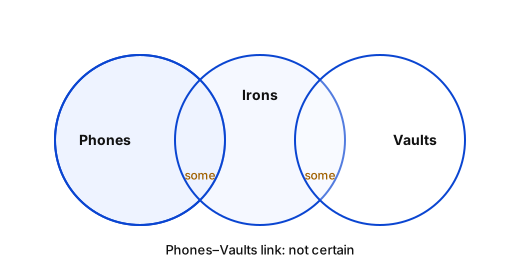
- Conclusion I 'No iron is a phone' directly contradicts 'Some phones are irons' ✗
- Conclusion II: Phones and Vaults are linked only through Irons by two 'some' statements – no definite relation ✗
- So neither conclusion follows.
Trick: Some + Some = no conclusion.
Answer: (A) Neither conclusion (I) nor (II) follows
अवधारणा: न्यूनतम वेन आरेख बनाएँ: Phones–Irons में कुछ भाग साझा, Irons–Vaults में कुछ भाग साझा।
- निष्कर्ष I 'कोई iron, phone नहीं' सीधे 'कुछ phones, irons हैं' का खंडन करता है ✗
- निष्कर्ष II: Phones और Vaults केवल Irons के माध्यम से दो 'कुछ' कथनों से जुड़े हैं – निश्चित संबंध नहीं ✗
- अतः कोई निष्कर्ष नहीं निकलता।
ट्रिक: कुछ + कुछ = कोई निष्कर्ष नहीं।
उत्तर: (A) Neither conclusion (I) nor (II) follows
RRB NTPC Undergraduate CBT 1General Intelligence and ReasoningSyllogismRRB NTPC Undergraduate CBT 1 2025 · 17 Jun Shift 3
Q294.Seven boxes, G, H, I, J, K, L and M, are kept one over the other, but not necessarily in the same order.
Only three boxes are kept between M and J. I is kept third from the top. Only M is kept between H and I. Only K is kept below J. G is kept at one of the positions below M but not immediately above J.
Which box is kept third from the bottom?
सात डिब्बे G, H, I, J, K, L और M एक के ऊपर एक रखे गए हैं, लेकिन आवश्यक नहीं कि इसी क्रम में हों।
M और J के बीच केवल तीन डिब्बे रखे गए हैं। I को ऊपर से तीसरे स्थान पर रखा गया है। H और I के बीच केवल M रखा गया है। J के नीचे केवल K रखा गया है। G को M के नीचे वाले किसी एक स्थान पर रखा गया है, लेकिन J के ठीक ऊपर नहीं।
नीचे से तीसरे स्थान पर कौन-सा डिब्बा रखा गया है?
- AH
- BK
- CG
- DL
Show answer
Concept: Number positions 1 (top) to 7 (bottom).
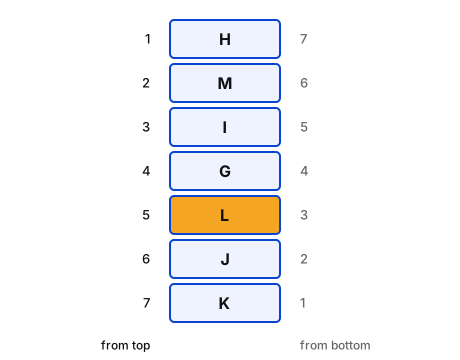
- I = 3. Only K below J → J = 6, K = 7.
- Only M between H and I → M = 2 or 4; three boxes between M and J (6) → M = 2, so H = 1.
- G below M but not immediately above J → G ≠ 5, so G = 4 and L = 5.
- Order: H, M, I, G, L, J, K → third from bottom = L.
Trick: 'Only K below J' fixes the bottom two at once.
Answer: (D) L
अवधारणा: स्थान 1 (ऊपर) से 7 (नीचे) तक मानें।
- I = 3। J के नीचे केवल K → J = 6, K = 7।
- H और I के बीच केवल M → M = 2 या 4; M और J (6) के बीच तीन बॉक्स → M = 2, अतः H = 1।
- G, M के नीचे पर J के ठीक ऊपर नहीं → G ≠ 5, अतः G = 4 और L = 5।
- क्रम: H, M, I, G, L, J, K → नीचे से तीसरा = L।
ट्रिक: 'J के नीचे केवल K' से नीचे के दो स्थान तुरंत तय।
उत्तर: (D) L
RRB NTPC Undergraduate CBT 1General Intelligence and ReasoningBox arrangementRRB NTPC Undergraduate CBT 1 2025 · 17 Jun Shift 3
Q295.Based on the alphabetical order, three of the following four are alike in a certain way and thus form a group. Which is the one that does not belong to that group?
(Note: The odd man out is not based on the number of consonants/vowels or their position in the letter cluster.)
वर्णमाला क्रम के आधार पर, निम्नलिखित चार में से तीन किसी निश्चित प्रकार से समान हैं और इस प्रकार एक समूह बनाते हैं। वह कौन-सा है जो उस समूह से संबंधित नहीं है?
(ध्यान दें: असंगत अक्षर-समूह, उस अक्षर-समूह में व्यंजनों/स्वरों की संख्या या उनके स्थान पर आधारित नहीं है।)
- AROS
- BXUY
- CNKO
- DLJM
Show answer
Concept: Write letter positions and check the gaps.
- ROS: → ; XUY: →
- NKO: →
- LJM: → ✗
Trick: Shortcut: in the group, 3rd letter = 1st letter and 2nd = 1st .
Answer: (D) LJM
अवधारणा: अक्षरों के स्थानीय मान लिखकर अंतर जाँचें।
- ROS: → ; XUY: →
- NKO: →
- LJM: → ✗
ट्रिक: शॉर्टकट: समूह में तीसरा अक्षर = पहला और दूसरा = पहला ।
उत्तर: (D) LJM
RRB NTPC Undergraduate CBT 1General Intelligence and ReasoningOdd one out – lettersRRB NTPC Undergraduate CBT 1 2025 · 17 Jun Shift 3
Q296.SF 19 is related to VA 6 in a certain way. In the same way, GG 16 is related to JB 3. To which of the following is KL 2 related, following the same logic?
SF 19 एक निश्चित प्रकार से VA 6 से संबंधित है। उसी प्रकार, GG 16, JB 3 से संबंधित है। समान तर्क का अनुसरण करते हुए, KL 2 निम्नलिखित में से किससे संबंधित है?
- AJI −12
- BKL −10
- CNG −11
- DHY −9
Show answer
Concept: Find the rule for each part of the pair.
- SF 19 → VA 6: S=V, F=A,
- GG 16 → JB 3: G=J, G=B, ✓
- KL 2: K=N, L=G, → NG
Trick: Letters: , ; number: .
Answer: (C) NG
अवधारणा: जोड़े के हर भाग का नियम निकालें।
- SF 19 → VA 6: S=V, F=A,
- GG 16 → JB 3: G=J, G=B, ✓
- KL 2: K=N, L=G, → NG
ट्रिक: अक्षर: , ; संख्या: ।
उत्तर: (C) NG
RRB NTPC Undergraduate CBT 1General Intelligence and ReasoningLetter-number analogyRRB NTPC Undergraduate CBT 1 2025 · 17 Jun Shift 3
Q297.Seven people, U, T, E, N, S, I and L, are sitting in a row, facing the north.
Only two people sit to the left of N. Only three people sit between N and S. Only one person sits between S and E. I sits to the immediate left of L. U is not an immediate neighbor of S.
How many people sit to the right of T?
सात व्यक्ति U, T, E, N, S, I और L एक पंक्ति में उत्तर की ओर मुख करके बैठे हैं।
N के बाईं ओर केवल दो व्यक्ति बैठे हैं। N और S के बीच केवल तीन व्यक्ति बैठे हैं। S और E के बीच केवल एक व्यक्ति बैठा है। I, L के ठीक बाएँ बैठा है। U, S का निकटतम पड़ोसी नहीं है।
T के दाईं ओर कितने व्यक्ति बैठे हैं?
- AFourचार
- BThreeतीन
- COneएक
- DTwoदो
Show answer
Concept: Facing north: left end = position 1, right end = position 7.
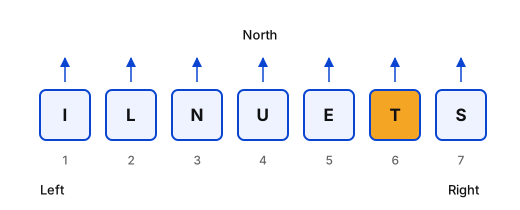
- Two people left of N → N = 3. Three between N and S → S = 7.
- One between S and E → E = 5.
- I immediately left of L: only free adjacent pair is 1–2 → I = 1, L = 2.
- U not next to S → U = 4, T = 6. Row: I L N U E T S → only S is right of T.
Trick: Fix the person with an exact count first (N), then build outward.
Answer: (C) One
अवधारणा: उत्तर की ओर मुख: बायाँ सिरा = स्थान 1, दायाँ सिरा = स्थान 7।
- N के बाएँ दो लोग → N = 3। N और S के बीच तीन → S = 7।
- S और E के बीच एक → E = 5।
- I, L के ठीक बाएँ: खाली लगातार जोड़ी केवल 1–2 → I = 1, L = 2।
- U, S का पड़ोसी नहीं → U = 4, T = 6। पंक्ति: I L N U E T S → T के दाएँ केवल S।
ट्रिक: पहले उस व्यक्ति को रखें जिसकी स्थिति निश्चित है (N), फिर आगे बढ़ें।
उत्तर: (C) One
RRB NTPC Undergraduate CBT 1General Intelligence and ReasoningLinear arrangementRRB NTPC Undergraduate CBT 1 2025 · 17 Jun Shift 3
Q298.G is the father of Y. Y is the brother of J. M is the father of W. W is the son of J. How is M related to G?
G, Y का पिता है। Y, J का भाई है। M, W का पिता है। W, J का पुत्र है। M का G से क्या संबंध है?
- ADaughter's husbandपुत्री का पति
- BFatherपिता
- CBrotherभाई
- DDaughter's sonपुत्री का पुत्र
Show answer
Concept: Build the family tree step by step.
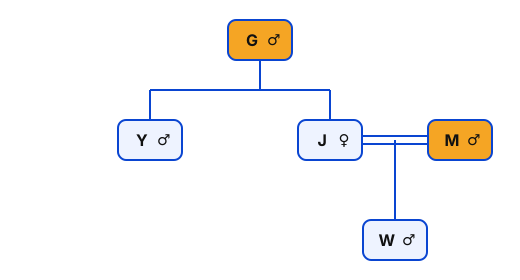
- G is the father of Y, and Y is the brother of J → J is also G's child.
- W is the son of J and M is the father of W → J is W's mother, so J is female and M is J's husband.
- J is G's daughter → M is G's daughter's husband (son-in-law).
Trick: Two people who are 'father' and 'parent' of the same child form a couple.
Answer: (A) Daughter's husband
अवधारणा: चरण-दर-चरण वंश-वृक्ष बनाएँ।
- G, Y का पिता है और Y, J का भाई है → J भी G की संतान है।
- W, J का पुत्र है और M, W का पिता है → J, W की माँ है (स्त्री) और M, J का पति है।
- J, G की पुत्री है → M, G की पुत्री का पति (दामाद) है।
ट्रिक: एक ही संतान के 'पिता' और 'माता-पिता' आपस में दंपति होते हैं।
उत्तर: (A) Daughter's husband
RRB NTPC Undergraduate CBT 1General Intelligence and ReasoningBlood relationsRRB NTPC Undergraduate CBT 1 2025 · 17 Jun Shift 3
Q299.Each letter in the word HARMFUL is arranged in the English alphabetical order. How many letters are there in the English alphabetical order between the letter which is second from the left and the one which is first from the right in the new letter cluster thus formed?
शब्द HARMFUL के प्रत्येक अक्षर को अंग्रेज़ी वर्णमाला क्रम में व्यवस्थित किया जाता है। इस प्रकार बने नए अक्षर-समूह में बाएँ से दूसरे अक्षर और दाएँ से पहले अक्षर के बीच अंग्रेज़ी वर्णमाला क्रम में कितने अक्षर हैं?
- A15
- B17
- C14
- D13
Show answer
Concept: Rearrange the letters alphabetically, then count letters between the chosen two.
- HARMFUL → A F H L M R U
- 2nd from left = F (); 1st from right = U ()
- Letters between
Trick: Letters between two letters = difference of positions .
Answer: (C)
अवधारणा: अक्षरों को वर्णमाला क्रम में लगाएँ, फिर दोनों के बीच के अक्षर गिनें।
- HARMFUL → A F H L M R U
- बाएँ से दूसरा = F (); दाएँ से पहला = U ()
- बीच के अक्षर
ट्रिक: दो अक्षरों के बीच अक्षर = स्थानों का अंतर ।
उत्तर: (C)
RRB NTPC Undergraduate CBT 1General Intelligence and ReasoningAlphabet arrangementRRB NTPC Undergraduate CBT 1 2025 · 17 Jun Shift 3
Q300.In a certain code language,
A ? B means ‘A is the wife of B’,
A @ B means ‘A is the mother of B’,
A : B means ‘A is the father of B’ and
A + B means ‘A is the daughter of B’.
How is M related to H if ‘M + A @ R ? C : H’?
एक निश्चित कूट भाषा में,
A ? B का अर्थ है ‘A, B की पत्नी है’,
A @ B का अर्थ है ‘A, B की माँ है’,
A : B का अर्थ है ‘A, B का पिता है’ और
A + B का अर्थ है ‘A, B की पुत्री है’।
यदि ‘M + A @ R ? C : H’ है, तो M का H से क्या संबंध है?
- AMother's brotherमाँ का भाई
- BMother's fatherमाँ का पिता
- CMother's daughterमाँ की पुत्री
- DMother's sisterमाँ की बहन
Show answer
Concept: Decode one symbol at a time: M + A @ R ? C : H.
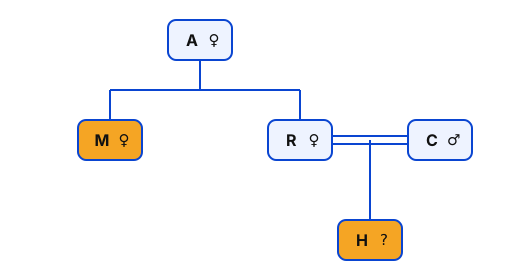
- M + A → M is the daughter of A; A @ R → A is the mother of R.
- R ? C → R is the wife of C; C : H → C is the father of H, so R is H's mother.
- M and R are both daughters of A → M is the sister of H's mother.
Trick: Read the chain left to right and keep genders: '+' and '?' make M and R female.
Answer: (D) Mother's sister
अवधारणा: एक-एक चिह्न डिकोड करें: M + A @ R ? C : H।
- M + A → M, A की पुत्री है; A @ R → A, R की माँ है।
- R ? C → R, C की पत्नी है; C : H → C, H का पिता है, अतः R, H की माँ है।
- M और R दोनों A की पुत्रियाँ हैं → M, H की माँ की बहन (मौसी) है।
ट्रिक: शृंखला बाएँ से दाएँ पढ़ें और लिंग ध्यान रखें: '+' व '?' से M और R स्त्री हैं।
उत्तर: (D) Mother's sister
RRB NTPC Undergraduate CBT 1General Intelligence and ReasoningCoded blood relationsRRB NTPC Undergraduate CBT 1 2025 · 17 Jun Shift 3

