Q341.To make a juice, 5 litres of water is added to 2 litres of orange juice. If 5 litres of orange juice is used, how much water is required?
एक जूस बनाने के लिए 2 लीटर संतरे के रस में 5 लीटर पानी मिलाया जाता है। यदि 5 लीटर संतरे के रस का उपयोग किया जाए, तो कितने पानी की आवश्यकता होगी?
- A12.5 litres12.5 लीटर
- B15.5 litres15.5 लीटर
- C10 litres10 लीटर
- D18 litres18 लीटर
Show answer
Concept: Orange juice : water stays in the same ratio .
- Water for 1 L juice L.
- Water for 5 L juice L.
Trick: .
Answer: (A) 12.5 litres
अवधारणा: संतरे का रस : पानी का अनुपात समान रहता है।
- 1 L रस के लिए पानी L।
- 5 L रस के लिए पानी L।
ट्रिक: ।
उत्तर: (A) 12.5 लीटर
RRB NTPC Undergraduate CBT 1MathematicsRatio and ProportionRRB NTPC Undergraduate CBT 1 2025 · 19 Jun Shift 3
Q342.If the wages of 9 workers for 8 days are ₹2,880, what will be the wages of 15 workers for 9 days at the same rate?
यदि 9 श्रमिकों की 8 दिनों की मज़दूरी ₹2,880 है, तो उसी दर से 15 श्रमिकों की 9 दिनों की मज़दूरी कितनी होगी?
- A₹3,600
- B₹3,520
- C₹3,880
- D₹5,400
Show answer
Concept: Wages are proportional to (workers days).
- Wage per worker-day .
- For 15 workers, 9 days: .
Trick: .
Answer: (D) ₹5,400
अवधारणा: मजदूरी (श्रमिक दिन) के समानुपाती होती है।
- प्रति श्रमिक-दिन मजदूरी ।
- 15 श्रमिक, 9 दिन: ।
ट्रिक: ।
उत्तर: (D) ₹5,400
RRB NTPC Undergraduate CBT 1MathematicsWork and WagesRRB NTPC Undergraduate CBT 1 2025 · 19 Jun Shift 3
Q343.The LCM of 3, 7.2 and 0.64 is _________.
3, 7.2 और 0.64 का लघुत्तम समापवर्त्य (LCM) _________ है।
- A96
- B153
- C144
- D72
Show answer
Concept: Make the decimal places equal, find the LCM of the whole numbers, then put the decimal back.
- → work with .
- , , .
- LCM → .
Trick: Check: , , – all whole numbers.
Answer: (C) 144
अवधारणा: दशमलव स्थान बराबर करें, पूर्णांकों का LCM लें, फिर दशमलव वापस लगाएँ।
- → लें।
- , , ।
- LCM → ।
ट्रिक: जाँच: , , – सभी पूर्णांक।
उत्तर: (C) 144
RRB NTPC Undergraduate CBT 1MathematicsLCM of DecimalsRRB NTPC Undergraduate CBT 1 2025 · 19 Jun Shift 3
Q344.The average of 7 consecutive even numbers is 32. Find the sum of the smallest and the largest numbers.
7 क्रमागत सम संख्याओं का औसत 32 है। सबसे छोटी और सबसे बड़ी संख्या का योग ज्ञात कीजिए।
- A66
- B64
- C68
- D62
Show answer
Concept: In an odd count of consecutive even numbers, the average is the middle (4th) number.
- Middle number ; numbers: .
- Smallest + largest .
Trick: Smallest + largest .
Answer: (B) 64
अवधारणा: विषम संख्या में क्रमागत सम संख्याओं का औसत बीच वाली (चौथी) संख्या होती है।
- बीच की संख्या ; संख्याएँ: ।
- सबसे छोटी + सबसे बड़ी ।
ट्रिक: सबसे छोटी + सबसे बड़ी ।
उत्तर: (B) 64
RRB NTPC Undergraduate CBT 1MathematicsAverageRRB NTPC Undergraduate CBT 1 2025 · 19 Jun Shift 3
Q345.The monthly income of a family increases by 10% but its monthly expenditure rises by 20%. If the initial monthly income was ₹45,000 and the monthly expenditure was ₹36,000, what is the new monthly saving after the increase?
एक परिवार की मासिक आय में 10% की वृद्धि होती है, परंतु उसके मासिक व्यय में 20% की वृद्धि होती है। यदि प्रारंभिक मासिक आय ₹45,000 और मासिक व्यय ₹36,000 था, तो वृद्धि के बाद नई मासिक बचत कितनी है?
- A₹6,200
- B₹6,300
- C₹6,400
- D₹6,500
Show answer
Concept: Savings Income Expenditure.
- New income .
- New expenditure .
- New savings .
Trick: Change in savings ; old savings .
Answer: (B) ₹6,300
अवधारणा: बचत आय व्यय।
- नई आय ।
- नया व्यय ।
- नई बचत ।
ट्रिक: बचत में बदलाव ; पुरानी बचत ।
उत्तर: (B) ₹6,300
RRB NTPC Undergraduate CBT 1MathematicsIncome, Expenditure and SavingsRRB NTPC Undergraduate CBT 1 2025 · 19 Jun Shift 3
Q346.ABCD is a quadrilateral in which AB || DC, and E and F are the midpoints of the diagonals AC and BD respectively. If AB = 23 cm, BC = 91 cm, DC = 35 cm and AD = 62 cm, what is the length of EF (in cm)?
ABCD एक चतुर्भुज है जिसमें AB || DC है, और E तथा F क्रमशः विकर्णों AC और BD के मध्य-बिंदु हैं। यदि AB = 23 cm, BC = 91 cm, DC = 35 cm और AD = 62 cm है, तो EF की लंबाई (cm में) क्या है?
- A9
- B8
- C6
- D7
Show answer
Concept: In a trapezium, the segment joining the midpoints of the diagonals is parallel to the bases and equals half their difference.
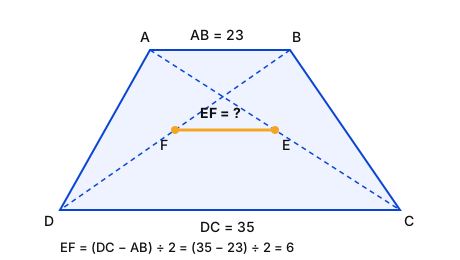
- (legs BC, AD are not needed).
- cm.
Yaad rakhein: Midline of trapezium ; joining midpoints of diagonals .
Answer: (C) 6
अवधारणा: समलंब में विकर्णों के मध्य बिंदुओं को मिलाने वाला रेखाखंड आधारों के समांतर होता है और उनके अंतर का आधा होता है।
- (BC, AD की ज़रूरत नहीं)।
- cm।
याद रखें: मध्य रेखा ; विकर्णों के मध्य बिंदुओं वाली रेखा ।
उत्तर: (C) 6
RRB NTPC Undergraduate CBT 1MathematicsTrapezium – Midpoints of DiagonalsRRB NTPC Undergraduate CBT 1 2025 · 19 Jun Shift 3
Q347.The total surface area of a cube having side 64 cm is:
64 cm भुजा वाले घन का संपूर्ण पृष्ठीय क्षेत्रफल है:
- A24,528 cm2
- B24,576 cm2
- C24,548 cm2
- D24,589 cm2
Show answer
Concept: Total surface area of a cube .
- .
- TSA .
Trick: Last digit check: ends in 6 – only 24,576 fits.
Answer: (B)
अवधारणा: घन का संपूर्ण पृष्ठीय क्षेत्रफल ।
- ।
- TSA ।
ट्रिक: अंतिम अंक: का अंत 6 – केवल 24,576 मेल खाता है।
उत्तर: (B)
RRB NTPC Undergraduate CBT 1MathematicsCube – Surface AreaRRB NTPC Undergraduate CBT 1 2025 · 19 Jun Shift 3
Q348.A certain sum is invested for 9 months at a simple interest rate of 8% per annum. If the interest earned is ₹18,000, what is the principal invested?
एक निश्चित धनराशि 8% वार्षिक साधारण ब्याज की दर पर 9 महीनों के लिए निवेश की जाती है। यदि अर्जित ब्याज ₹18,000 है, तो निवेश किया गया मूलधन कितना है?
- A₹3,50,000
- B₹4,00,000
- C₹3,00,000
- D₹2,50,000
Show answer
Concept: , with in years.
- months year.
- .
- .
Trick: Effective rate for 9 months ; .
Answer: (C) ₹3,00,000
अवधारणा: , वर्षों में।
- महीने वर्ष।
- ।
- ।
ट्रिक: 9 महीने की प्रभावी दर ; ।
उत्तर: (C) ₹3,00,000
RRB NTPC Undergraduate CBT 1MathematicsSimple InterestRRB NTPC Undergraduate CBT 1 2025 · 19 Jun Shift 3
Q349.The ratio of land to water on the whole Earth is 1 : 3. In the northern hemisphere this ratio is 2 : 5. If the northern and southern hemispheres have equal areas, find the ratio of land to water in the southern hemisphere.
संपूर्ण पृथ्वी पर स्थल और जल का अनुपात 1 : 3 है। उत्तरी गोलार्ध में यह अनुपात 2 : 5 है। यदि उत्तरी और दक्षिणी गोलार्धों का क्षेत्रफल समान है, तो दक्षिणी गोलार्ध में स्थल और जल का अनुपात ज्ञात कीजिए।
- A11:7
- B7:5
- C1:5
- D3:11
Show answer
Concept: Take a convenient total area so that each hemisphere's ratio fits: whole Earth units, each hemisphere .
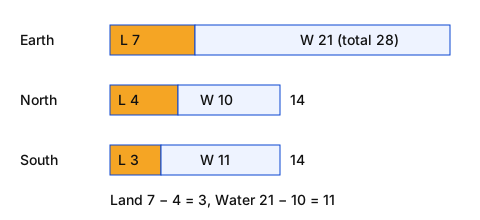
- Earth → land , water .
- North (of 14) → land , water .
- South: land , water → .
Trick: LCM of and = 28 makes all parts whole numbers.
Answer: (D) 3 : 11
अवधारणा: सुविधाजनक कुल क्षेत्रफल लें: पूरी पृथ्वी इकाई, प्रत्येक गोलार्ध ।
- पृथ्वी → भूमि , जल ।
- उत्तरी (14 में) → भूमि , जल ।
- दक्षिणी: भूमि , जल → ।
ट्रिक: और का LCM = 28 लेने से सभी भाग पूर्णांक बनते हैं।
उत्तर: (D) 3 : 11
RRB NTPC Undergraduate CBT 1MathematicsRatio – Mixtures of PartsRRB NTPC Undergraduate CBT 1 2025 · 19 Jun Shift 3
Q350.An article is sold at a profit of 38%. If its cost price increases by ₹20 and the selling price decreases by ₹45, the profit becomes 37.5%. What is the original cost price of the article (in ₹)?
एक वस्तु 38% लाभ पर बेची जाती है। यदि इसके क्रय मूल्य में ₹20 की वृद्धि हो जाए और विक्रय मूल्य में ₹45 की कमी हो जाए, तो लाभ 37.5% हो जाता है। वस्तु का मूल क्रय मूल्य (₹ में) क्या है?
- A14,300
- B14,400
- C14,700
- D14,500
Show answer
Concept: Write old and new SP in terms of CP and equate.
- SP .
- New CP , new SP with profit: .
- → → .
Trick: Verify: and ✓.
Answer: (D) 14,500
अवधारणा: पुराने और नए SP को CP में लिखकर बराबर करें।
- SP ।
- नया CP , नया SP , लाभ : ।
- → ।
ट्रिक: जाँच: और ✓।
उत्तर: (D) 14,500
RRB NTPC Undergraduate CBT 1MathematicsProfit and LossRRB NTPC Undergraduate CBT 1 2025 · 19 Jun Shift 3
Q351.Find the smallest positive integer which leaves remainder 2 when divided by 3, remainder 3 when divided by 4, and remainder 4 when divided by 5.
वह सबसे छोटा धनात्मक पूर्णांक ज्ञात कीजिए जिसे 3 से विभाजित करने पर शेषफल 2, 4 से विभाजित करने पर शेषफल 3 और 5 से विभाजित करने पर शेषफल 4 प्राप्त होता है।
- A53
- B50
- C69
- D59
Show answer
Concept: When (divisor remainder) is the same for every divisor, .
- .
- LCM → .
Trick: Constant gap of 1 below each divisor → LCM .
Answer: (D) 59
अवधारणा: जब (भाजक शेषफल) सभी के लिए समान हो, तो ।
- ।
- LCM → ।
ट्रिक: हर भाजक से 1 कम शेष → LCM ।
उत्तर: (D) 59
RRB NTPC Undergraduate CBT 1MathematicsRemainders – LCMRRB NTPC Undergraduate CBT 1 2025 · 19 Jun Shift 3
Q352.Four years ago, Ravi's age was three times Kaviraj's age. At present, Ravi's age is twice Kaviraj's age. Find Ravi's present age.
चार वर्ष पहले, रवि की आयु कविराज की आयु की तीन गुनी थी। वर्तमान में, रवि की आयु कविराज की आयु की दोगुनी है। रवि की वर्तमान आयु ज्ञात कीजिए।
- A8 years8 वर्ष
- B16 years16 वर्ष
- C14 years14 वर्ष
- D10 years10 वर्ष
Show answer
Concept: Let Kaviraj's present age , Ravi's .
- Four years ago: .
- → .
- Ravi years.
Trick: Check options: Ravi 16, Kaviraj 8; 4 years ago 12 and 4 → times ✓.
Answer: (B) 16 years
अवधारणा: कविराज की वर्तमान आयु , रवि की ।
- 4 वर्ष पहले: ।
- → ।
- रवि वर्ष।
ट्रिक: विकल्प जाँच: रवि 16, कविराज 8; 4 वर्ष पहले 12 और 4 → 3 गुना ✓।
उत्तर: (B) 16 वर्ष
RRB NTPC Undergraduate CBT 1MathematicsProblems on AgesRRB NTPC Undergraduate CBT 1 2025 · 19 Jun Shift 3
Q353.Pipes C and D can fill a tank of capacity 3,000 litres in 6 hours and 4 hours respectively. If both pipes work together, how many hours will it take to fill a tank of capacity 6,000 litres?
पाइप C और D, 3,000 लीटर क्षमता वाली एक टंकी को क्रमशः 6 घंटे और 4 घंटे में भर सकते हैं। यदि दोनों पाइप एक साथ कार्य करें, तो 6,000 लीटर क्षमता वाली टंकी को भरने में कितने घंटे लगेंगे?
- A4.44 hours4.44 घंटे
- B4.8 hours4.8 घंटे
- C3.5 hours3.5 घंटे
- D6 hours6 घंटे
Show answer
Concept: Find litres filled per hour by each pipe and add.
- C: L/h; D: L/h.
- Together L/h.
- Time hours.
Trick: For the 3000 L tank together: h; double capacity → h.
Answer: (B) 4.8 hours
अवधारणा: प्रत्येक पाइप प्रति घंटे कितने लीटर भरता है, जोड़ें।
- C: L/h; D: L/h।
- मिलकर L/h।
- समय घंटे।
ट्रिक: 3000 L टंकी साथ में: घंटे; दोगुनी क्षमता → घंटे।
उत्तर: (B) 4.8 घंटे
RRB NTPC Undergraduate CBT 1MathematicsPipes and CisternsRRB NTPC Undergraduate CBT 1 2025 · 19 Jun Shift 3
Q354.If , what is the value of y?
यदि है, तो y का मान क्या है?
- A1765
- B1665
- C1965
- D1865
Show answer
Concept: Multiply first, then add/subtract (BODMAS).
- .
- .
- .
Trick: Take 86 common: .
Answer: (D) 1865
अवधारणा: पहले गुणा, फिर जोड़/घटाव (BODMAS)।
- ।
- ।
- ।
ट्रिक: 86 उभयनिष्ठ लें: ।
उत्तर: (D) 1865
RRB NTPC Undergraduate CBT 1MathematicsSimplificationRRB NTPC Undergraduate CBT 1 2025 · 19 Jun Shift 3
Q355.A number is divided into two parts such that one part is 10 more than the other. If their ratio is 6 : 4, what are the two parts?
एक संख्या को दो भागों में इस प्रकार विभाजित किया जाता है कि एक भाग दूसरे से 10 अधिक है। यदि उनका अनुपात 6 : 4 है, तो दोनों भाग क्या हैं?
- A34 and 2434 और 24
- B32 and 2232 और 22
- C32 and 2032 और 20
- D30 and 2030 और 20
Show answer
Concept: Difference of ratio parts corresponds to the actual difference.
- Ratio , difference parts → 1 part .
- Parts and .
Trick: Check: and ✓.
Answer: (D) 30 and 20
अवधारणा: अनुपात भागों का अंतर वास्तविक अंतर के बराबर होता है।
- अनुपात , अंतर भाग → 1 भाग ।
- भाग और ।
ट्रिक: जाँच: और ✓।
उत्तर: (D) 30 और 20
RRB NTPC Undergraduate CBT 1MathematicsRatio – Dividing a NumberRRB NTPC Undergraduate CBT 1 2025 · 19 Jun Shift 3
Q356.The length of the shadow of a tower increases by 20 m when the angle of elevation of the Sun changes from 60° to 45°. Find the height of the tower (in m, rounded to one decimal place). (Use )
जब सूर्य का उन्नयन कोण 60° से 45° हो जाता है, तो एक मीनार की छाया की लंबाई 20 m बढ़ जाती है। मीनार की ऊँचाई (m में, एक दशमलव स्थान तक पूर्णांकित) ज्ञात कीजिए। ( का प्रयोग कीजिए)
- A48.6
- B17.4
- C24.7
- D27.5
Show answer
Concept: Shadow length ; it increases when the Sun's elevation falls.
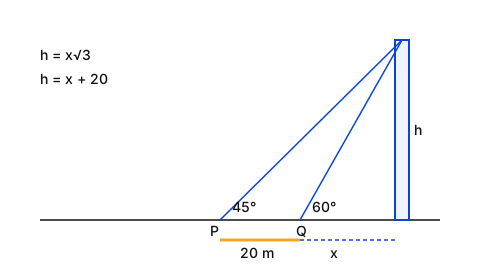
- At : ; at : .
- → .
- With : m.
Trick: for shadow change .
Answer: (A) 48.6
अवधारणा: छाया की लंबाई ; सूर्य का उन्नयन कोण घटने पर छाया बढ़ती है।
- पर: ; पर: ।
- → ।
- लेकर: m।
ट्रिक: पर छाया का अंतर हो तो ।
उत्तर: (A) 48.6
RRB NTPC Undergraduate CBT 1MathematicsHeights and DistancesRRB NTPC Undergraduate CBT 1 2025 · 19 Jun Shift 3
Q357.A and B can complete a piece of work in 12 days and 20 days respectively. After both work together for 3 days, A leaves. How many days will B take to finish the remaining work?
A और B किसी कार्य को क्रमशः 12 दिन और 20 दिन में पूरा कर सकते हैं। दोनों के 3 दिन तक एक साथ कार्य करने के बाद A कार्य छोड़ देता है। शेष कार्य को पूरा करने में B को कितने दिन लगेंगे?
- A12
- B13
- C11
- D14
Show answer
Concept: Take total work = LCM of days and use units per day.
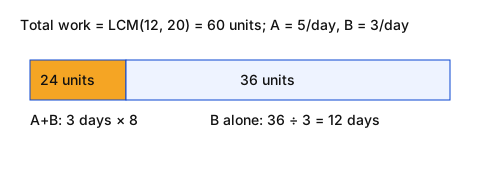
- Work units; A /day, B /day.
- In 3 days together: units.
- Remaining units by B: days.
Trick: Fraction done ; B does .
Answer: (A) 12
अवधारणा: कुल कार्य = दिनों का LCM लें और प्रति दिन इकाइयाँ निकालें।
- कार्य इकाई; A /दिन, B /दिन।
- 3 दिन साथ: इकाई।
- शेष इकाई B: दिन।
ट्रिक: किया गया भाग ; B करेगा ।
उत्तर: (A) 12
RRB NTPC Undergraduate CBT 1MathematicsTime and WorkRRB NTPC Undergraduate CBT 1 2025 · 19 Jun Shift 3
Q358.An article is sold at a profit of 20%. If its selling price is reduced by 10%, what will be the profit percentage?
एक वस्तु 20% लाभ पर बेची जाती है। यदि इसके विक्रय मूल्य में 10% की कमी कर दी जाए, तो लाभ प्रतिशत क्या होगा?
- A6%
- B12%
- C8%
- D20%
Show answer
Concept: Take CP .
- SP at profit .
- New SP .
- Profit .
Trick: → profit.
Answer: (C) 8%
अवधारणा: CP मानें।
- लाभ पर SP ।
- नया SP ।
- लाभ ।
ट्रिक: → लाभ।
उत्तर: (C) 8%
RRB NTPC Undergraduate CBT 1MathematicsProfit and LossRRB NTPC Undergraduate CBT 1 2025 · 19 Jun Shift 3
Q359.A regular polygon has 45 sides and the length of each side is 2 cm. What is the area of the polygon (in cm²)?
एक सम बहुभुज की 45 भुजाएँ हैं और प्रत्येक भुजा की लंबाई 2 cm है। बहुभुज का क्षेत्रफल (cm² में) क्या है?
- A
- B
- C
- D
Show answer
Concept: Area of a regular -gon of side .
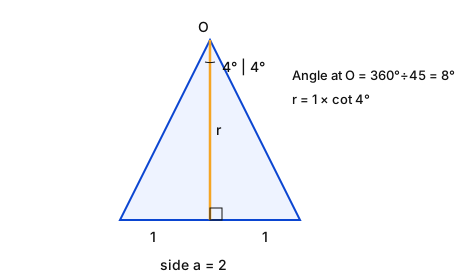
- Split into 45 isosceles triangles; angle at centre , half-angle .
- Apothem .
- Area .
Trick: Apothem is large (polygon is nearly a circle), so area must be much bigger than 45 – it needs , not ().
Answer: (D)
अवधारणा: भुजा वाले सम -भुज का क्षेत्रफल ।
- 45 समद्विबाहु त्रिभुजों में बाँटें; केंद्र पर कोण , आधा ।
- केंद्र से भुजा की दूरी ।
- क्षेत्रफल ।
ट्रिक: बहुभुज लगभग वृत्त जैसा है, इसलिए क्षेत्रफल 45 से बहुत बड़ा होगा – आएगा, नहीं ()।
उत्तर: (D)
RRB NTPC Undergraduate CBT 1MathematicsRegular Polygon – AreaRRB NTPC Undergraduate CBT 1 2025 · 19 Jun Shift 3
Q360.A person covers a certain distance by train. If the train had travelled 14 km/hr faster than its usual speed, the journey would have taken 35 minutes less. If it had travelled 10 km/hr slower, the journey would have taken 30 minutes more. Find the total distance covered by the train.
एक व्यक्ति रेलगाड़ी द्वारा एक निश्चित दूरी तय करता है। यदि रेलगाड़ी अपनी सामान्य चाल से 14 km/hr अधिक तेज़ चलती, तो यात्रा में 35 मिनट कम लगते। यदि वह 10 km/hr धीमी चलती, तो यात्रा में 30 मिनट अधिक लगते। रेलगाड़ी द्वारा तय की गई कुल दूरी ज्ञात कीजिए।
- A780 km
- B480 km
- C720 km
- D560 km
Show answer
Concept: Write two time-difference equations for distance and usual speed .
- → .
- → .
- → ; km.
Trick: Verify: h, h (35 min less), h ✓.
Answer: (A) 780 km
अवधारणा: दूरी और सामान्य चाल के लिए समय-अंतर के दो समीकरण बनाएँ।
- → ।
- → ।
- → ; km।
ट्रिक: जाँच: घंटे, घंटे (35 मिनट कम), घंटे ✓।
उत्तर: (A) 780 km
RRB NTPC Undergraduate CBT 1MathematicsSpeed, Time and DistanceRRB NTPC Undergraduate CBT 1 2025 · 19 Jun Shift 3

