Q381.A shopkeeper sells an article to A at a profit of 20%. A sells it to B at a profit of 25%. If B pays ₹3,000, what is the cost price of the article for the shopkeeper?
एक दुकानदार एक वस्तु A को 20% लाभ पर बेचता है। A इसे B को 25% लाभ पर बेचता है। यदि B ₹3,000 का भुगतान करता है, तो दुकानदार के लिए वस्तु का क्रय मूल्य क्या है?
- A₹2,080
- B₹2,100
- C₹2,200
- D₹2,000
Show answer
Concept: Final price .
- .
- .
Trick: ⇒ CP .
Answer: (D) ₹2,000
अवधारणा: अंतिम मूल्य ।
- ।
- ।
ट्रिक: ⇒ CP ।
उत्तर: (D) ₹2,000
RRB NTPC Undergraduate CBT 1MathematicsSuccessive ProfitRRB NTPC Undergraduate CBT 1 2025 · 16 Jun Shift 3
Q382.A shopkeeper buys two types of notebooks. The cost of 3 notebooks of the first type and 5 notebooks of the second type together is ₹420. The cost of one notebook of the second type is ₹20 more than the cost of one notebook of the first type. What is the cost of one notebook of the first type?
एक दुकानदार दो प्रकार की नोटबुक खरीदता है। पहले प्रकार की 3 नोटबुक और दूसरे प्रकार की 5 नोटबुक का कुल मूल्य ₹420 है। दूसरे प्रकार की एक नोटबुक का मूल्य पहले प्रकार की एक नोटबुक के मूल्य से ₹20 अधिक है। पहले प्रकार की एक नोटबुक का मूल्य क्या है?
- A₹40
- B₹45
- C₹42
- D₹48
Show answer
Concept: Let first type cost ; second costs .
- .
- .
- .
Trick: Option check: ⇒ ✓.
Answer: (A) ₹40
अवधारणा: पहली प्रकार की कीमत , दूसरी ।
- ।
- ।
- ।
ट्रिक: विकल्प से जाँच: ✓।
उत्तर: (A) ₹40
RRB NTPC Undergraduate CBT 1MathematicsLinear EquationsRRB NTPC Undergraduate CBT 1 2025 · 16 Jun Shift 3
Q383.Three friends, Amit, Bala, and Chetan, have savings in the ratio 5:7:9. If Bala's savings exceed Amit's by ₹3,600, what are Chetan's total savings?
तीन मित्रों, अमित, बाला और चेतन की बचत का अनुपात 5:7:9 है। यदि बाला की बचत अमित की बचत से ₹3,600 अधिक है, तो चेतन की कुल बचत कितनी है?
- A₹16,800
- B₹16,200
- C₹16,600
- D₹16,400
Show answer
Concept: Difference of ratio parts corresponds to the given difference.
- Bala − Amit parts .
- 1 part .
- Chetan .
Trick: Unit method: find value of one part, multiply.
Answer: (B) ₹16,200
अवधारणा: अनुपात के भागों का अंतर दिए गए अंतर के बराबर।
- बाला − अमित भाग ।
- 1 भाग ।
- चेतन ।
ट्रिक: एक भाग का मान निकालें और गुणा करें।
उत्तर: (B) ₹16,200
RRB NTPC Undergraduate CBT 1MathematicsRatioRRB NTPC Undergraduate CBT 1 2025 · 16 Jun Shift 3
Q384.The sum of two positive numbers is 44 and their product is 228. The positive difference between them is:
दो धनात्मक संख्याओं का योग 44 है और उनका गुणनफल 228 है। उनके बीच धनात्मक अंतर है:
- A36
- B32
- C37
- D33
Show answer
Concept: .
- .
- .
- (Numbers are 38 and 6.)
Trick: Check: , ✓.
Answer: (B) 32
अवधारणा: ।
- ।
- ।
- (संख्याएँ 38 और 6)।
ट्रिक: जाँच: , ✓।
उत्तर: (B) 32
RRB NTPC Undergraduate CBT 1MathematicsAlgebraic IdentitiesRRB NTPC Undergraduate CBT 1 2025 · 16 Jun Shift 3
Q385.The average of five numbers is 24. If four of the numbers are 18, 20, 25 and 27, what is the fifth number?
पाँच संख्याओं का औसत 24 है। यदि इनमें से चार संख्याएँ 18, 20, 25 और 27 हैं, तो पाँचवीं संख्या क्या है?
- A28
- B30
- C35
- D32
Show answer
Concept: Sum = average × count.
- Sum of 5 numbers .
- Given four: .
- Fifth .
Trick: Deviations from 24: total ⇒ fifth .
Answer: (B) 30
अवधारणा: योग = औसत × संख्या।
- 5 संख्याओं का योग ।
- चार का योग ।
- पाँचवीं ।
ट्रिक: 24 से विचलन: = ⇒ पाँचवीं ।
उत्तर: (B) 30
RRB NTPC Undergraduate CBT 1MathematicsAverageRRB NTPC Undergraduate CBT 1 2025 · 16 Jun Shift 3
Q386.A company’s revenue increases by 20% in the first year, decreases by 10% in the second year, and increases by 15% in the third year. What is the overall percentage change in revenue over the three years?
एक कंपनी का राजस्व पहले वर्ष में 20% बढ़ता है, दूसरे वर्ष में 10% घटता है, और तीसरे वर्ष में 15% बढ़ता है। तीन वर्षों में राजस्व में कुल प्रतिशत परिवर्तन कितना है?
- A25.2% increase25.2% वृद्धि
- B24.2% increase24.2% वृद्धि
- C23.2% increase23.2% वृद्धि
- D26.2% increase26.2% वृद्धि
Show answer
Concept: Multiply the growth factors of each year.
- .
- .
- Change increase.
Trick: Base 100: .
Answer: (B) 24.2% increase
अवधारणा: हर वर्ष के गुणकों का गुणा करें।
- ।
- ।
- वृद्धि।
ट्रिक: आधार 100: ।
उत्तर: (B) 24.2% वृद्धि
RRB NTPC Undergraduate CBT 1MathematicsSuccessive Percentage ChangeRRB NTPC Undergraduate CBT 1 2025 · 16 Jun Shift 3
Q387.If and , what is the value of ?
यदि और है, तो का मान क्या है?
- A1.4
- B1.6
- C1
- D1.5
Show answer
Concept: Write all terms with base 2 and equate powers.
- .
- .
- .
Trick: and — same base turns it into a linear equation.
Answer: (B) 1.6
अवधारणा: सभी पदों का आधार 2 बनाकर घातें बराबर करें।
- ।
- ।
- ।
ट्रिक: , ।
उत्तर: (B) 1.6
RRB NTPC Undergraduate CBT 1MathematicsIndicesRRB NTPC Undergraduate CBT 1 2025 · 16 Jun Shift 3
Q388.The present ages of A and B are in the ratio 4:5. If after 8 years from now, A will be 32 years old, what is B’s present age?
A और B की वर्तमान आयु का अनुपात 4:5 है। यदि अब से 8 वर्ष बाद A की आयु 32 वर्ष होगी, तो B की वर्तमान आयु क्या है?
- A30 years30 वर्ष
- B34 years34 वर्ष
- C32 years32 वर्ष
- D28 years28 वर्ष
Show answer
Concept: Find A's present age, then use the ratio.
- A now .
- 4 parts part .
- B years.
Trick: B .
Answer: (A) 30 years
अवधारणा: A की वर्तमान आयु निकालकर अनुपात लगाएँ।
- A अभी ।
- 4 भाग भाग ।
- B वर्ष।
ट्रिक: B ।
उत्तर: (A) 30 वर्ष
RRB NTPC Undergraduate CBT 1MathematicsAges – RatioRRB NTPC Undergraduate CBT 1 2025 · 16 Jun Shift 3
Q389.The arithmetic mean of 3, 7, 11, ..., 51 is ______.
3, 7, 11, ..., 51 का समांतर माध्य ______ है।
- A35
- B23
- C31
- D27
Show answer
Concept: Mean of an AP .
- AP 3, 7, 11, …, 51 (common difference 4, 13 terms).
- Mean .
Trick: In any AP the average equals the middle term (7th term ).
Answer: (D) 27
अवधारणा: समांतर श्रेणी का माध्य ।
- 3, 7, …, 51 (सार्व अंतर 4, 13 पद)।
- माध्य ।
ट्रिक: AP में औसत = मध्य पद (7वाँ पद = 27)।
उत्तर: (D) 27
RRB NTPC Undergraduate CBT 1MathematicsArithmetic ProgressionRRB NTPC Undergraduate CBT 1 2025 · 16 Jun Shift 3
Q390.The LCM of the numbers 7, 12.4 and 1 is:
संख्याओं 7, 12.4 और 1 का LCM है:
- A440
- B441
- C434
- D442
Show answer
Concept: Write decimals as reduced fractions: .
- ; , .
- LCM .
- Check: , ✓.
Trick: Always reduce the fraction () before taking LCM.
Answer: (C) 434
अवधारणा: दशमलव को सरल भिन्न लिखें: ।
- ।
- LCM ।
- जाँच: , ✓।
ट्रिक: LCM लेने से पहले भिन्न को सरलतम रूप में लाएँ।
उत्तर: (C) 434
RRB NTPC Undergraduate CBT 1MathematicsLCM of DecimalsRRB NTPC Undergraduate CBT 1 2025 · 16 Jun Shift 3
Q391.Find the volume of a cylinder whose height is 21 cm and its radius is of the radius of another cylinder with a volume of 317900 cm3 and a height of 14 cm. (Use )
उस बेलन का आयतन ज्ञात कीजिए जिसकी ऊँचाई 21 cm है और जिसकी त्रिज्या, 317900 cm3 आयतन और 14 cm ऊँचाई वाले एक अन्य बेलन की त्रिज्या का है। ( का प्रयोग कीजिए)
- A171656 cm3
- B161666 cm3
- C171660 cm3
- D171666 cm3
Show answer
Concept: Volume of a cylinder . First find the radius of the second cylinder, then scale it by .
- Second cylinder: , so cm.
- Required radius cm.
- Volume cm.
Trick: cancels the 7 neatly: , so just compute .
Answer: (D) 171666 cm
अवधारणा: बेलन का आयतन । पहले दूसरे बेलन की त्रिज्या निकालें, फिर उसका लें।
- दूसरा बेलन: , अतः cm।
- अभीष्ट त्रिज्या cm।
- आयतन cm।
ट्रिक: से 7 कट जाता है: , बस निकालें।
उत्तर: (D) 171666 cm
RRB NTPC Undergraduate CBT 1MathematicsMensuration – CylinderRRB NTPC Undergraduate CBT 1 2025 · 16 Jun Shift 2
Q392.A recipe uses 2 cups of rice for every 3 cups of water. If you want to cook using 6 cups of rice, how much water will you need?
एक व्यंजन विधि में प्रत्येक 3 कप पानी के लिए 2 कप चावल का उपयोग होता है। यदि आप 6 कप चावल पकाना चाहते हैं, तो आपको कितने पानी की आवश्यकता होगी?
- A7 cups7 कप
- B9 cups9 कप
- C3 cups3 कप
- D6 cups6 कप
Show answer
Concept: Rice : water stays in the fixed ratio (direct proportion).
- .
- cups.
Trick: Rice is tripled (), so triple the water too: .
Answer: (B) 9 cups
अवधारणा: चावल : पानी का अनुपात स्थिर रहता है (सीधा समानुपात)।
- ।
- कप।
ट्रिक: चावल तीन गुना हुआ (), पानी भी तीन गुना: ।
उत्तर: (B) 9 cups
RRB NTPC Undergraduate CBT 1MathematicsRatio and ProportionRRB NTPC Undergraduate CBT 1 2025 · 16 Jun Shift 2
Q393.The sum of two positive numbers is 36 and their product is 180. The positive difference between them is:
दो धनात्मक संख्याओं का योग 36 है और उनका गुणनफल 180 है। उनके बीच का धनात्मक अंतर है:
- A24
- B34
- C37
- D32
Show answer
Concept: .
- .
- .
Trick: Check: the numbers are 30 and 6 (), difference 24.
Answer: (A) 24
अवधारणा: ।
- ।
- ।
ट्रिक: जाँच: संख्याएँ 30 और 6 हैं (), अंतर 24।
उत्तर: (A) 24
RRB NTPC Undergraduate CBT 1MathematicsAlgebraic IdentitiesRRB NTPC Undergraduate CBT 1 2025 · 16 Jun Shift 2
Q394.Simplify:
सरल कीजिए:
- A3
- B2
- C4
- D1
Show answer
Concept: Take LCM; use .
- .
- .
Trick: – a standard pair worth remembering.
Answer: (B) 2
अवधारणा: LCM लें; का प्रयोग करें।
- ।
- ।
ट्रिक: – यह जोड़ी याद रखें।
उत्तर: (B) 2
RRB NTPC Undergraduate CBT 1MathematicsTrigonometric IdentitiesRRB NTPC Undergraduate CBT 1 2025 · 16 Jun Shift 2
Q395.The sides of a triangle are 75 cm, 21 cm, and 72 cm. What is the length (in cm) of its altitude corresponding to the side with a length of 21 cm?
एक त्रिभुज की भुजाएँ 75 cm, 21 cm और 72 cm हैं। 21 cm लंबाई वाली भुजा के संगत उसके शीर्षलंब की लंबाई (cm में) क्या है?
- A107
- B65
- C90
- D72
Show answer
Concept: Check whether the triangle is right-angled; in a right triangle each leg is the altitude on the other leg.
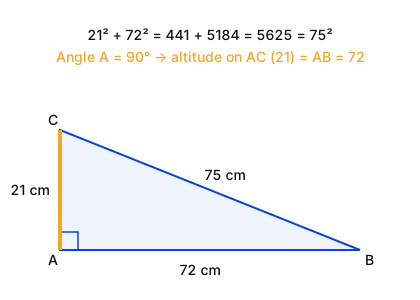
- , so the triangle is right-angled with hypotenuse 75.
- The legs 21 and 72 are perpendicular, so the altitude on the side of 21 cm is the other leg cm.
- Check via area: .
Trick: – a Pythagorean triplet. Spotting it saves all the work.
Answer: (D) 72
अवधारणा: जाँचें कि त्रिभुज समकोण है या नहीं; समकोण त्रिभुज में एक भुजा दूसरी भुजा पर शीर्षलंब (altitude) होती है।
- , अतः त्रिभुज समकोण है, कर्ण 75।
- भुजाएँ 21 और 72 परस्पर लंब हैं, अतः 21 cm वाली भुजा पर शीर्षलंब cm।
- क्षेत्रफल से जाँच: ।
ट्रिक: – पाइथागोरस त्रिक। इसे पहचानते ही उत्तर मिल जाता है।
उत्तर: (D) 72
RRB NTPC Undergraduate CBT 1MathematicsTriangles – AltitudeRRB NTPC Undergraduate CBT 1 2025 · 16 Jun Shift 2
Q396.A, B and C started a business, investing amounts of ₹1,960, ₹1,660, and ₹1,130 respectively. If B's share in the profit earned by them is ₹968, what is the difference in the profit (in ₹) earned by A and C?
A, B और C ने क्रमशः ₹1,960, ₹1,660 और ₹1,130 की राशि निवेश करके एक व्यवसाय शुरू किया। यदि उनके द्वारा अर्जित लाभ में B का हिस्सा ₹968 है, तो A और C द्वारा अर्जित लाभ (₹ में) का अंतर क्या है?
- A₹487
- B₹486
- C₹482
- D₹484
Show answer
Concept: Profit is shared in the ratio of investments (same time).
- Ratio .
- B's 166 parts ₹968, so 1 part .
- A C parts .
Trick: is exactly half of , so the answer is simply half of B's share: .
Answer: (D) ₹484
अवधारणा: समान समय पर लाभ निवेश के अनुपात में बँटता है।
- अनुपात ।
- B के 166 भाग ₹968, अतः 1 भाग ।
- A C भाग ।
ट्रिक: , का ठीक आधा है, इसलिए उत्तर B के हिस्से का आधा: ।
उत्तर: (D) ₹484
RRB NTPC Undergraduate CBT 1MathematicsPartnershipRRB NTPC Undergraduate CBT 1 2025 · 16 Jun Shift 2
Q397.What will be the total amount payable after 3 years on a principal of ₹4,000 at 5% per annum, compounded annually?
₹4,000 के मूलधन पर 5% वार्षिक दर से, वार्षिक रूप से चक्रवृद्धि होने पर, 3 वर्ष बाद देय कुल राशि कितनी होगी?
- A₹4,550.50
- B₹4,050.50
- C₹4,600.50
- D₹4,630.50
Show answer
Concept: .
- .
- .
Trick: Effective 3-year rate at 5% ; , add to 4000.
Answer: (D) ₹4,630.50
अवधारणा: ।
- ।
- ।
ट्रिक: 5% पर 3 वर्ष की प्रभावी दर ; , इसे 4000 में जोड़ें।
उत्तर: (D) ₹4,630.50
RRB NTPC Undergraduate CBT 1MathematicsCompound InterestRRB NTPC Undergraduate CBT 1 2025 · 16 Jun Shift 2
Q398.What is the simplified value of the following expression?
निम्नलिखित व्यंजक का सरलीकृत मान क्या है?
- A88
- B95
- C44
- D84
Show answer
Concept: Solve brackets first, powers before and .
- ; .
- .
- .
Trick: Keep small cubes handy: .
Answer: (A) 88
अवधारणा: पहले कोष्ठक, फिर घात, फिर और ।
- ; ।
- ।
- ।
ट्रिक: छोटे घन याद रखें: ।
उत्तर: (A) 88
RRB NTPC Undergraduate CBT 1MathematicsSimplification (BODMAS)RRB NTPC Undergraduate CBT 1 2025 · 16 Jun Shift 2
Q399.Chetan’s salary is ₹17,000 per month. He spends ₹4,000 on house rent, ₹2,500 on bills, and the rest of the amount is his monthly savings. Find his savings (in ₹) in a year, if in the month of his birthday, he spent his complete monthly savings for a birthday celebration.
चेतन का वेतन ₹17,000 प्रति माह है। वह ₹4,000 मकान किराए पर, ₹2,500 बिलों पर खर्च करता है, और शेष राशि उसकी मासिक बचत है। एक वर्ष में उसकी बचत (₹ में) ज्ञात कीजिए, यदि अपने जन्मदिन वाले महीने में उसने अपनी पूरी मासिक बचत जन्मदिन के उत्सव पर खर्च कर दी।
- A94,500
- B1,26,000
- C1,15,500
- D1,05,000
Show answer
Concept: Monthly savings salary expenses; count only the months he actually saved.
- Savings per month .
- In the birthday month the whole saving is spent, so savings happen in 11 months.
- Yearly savings .
Trick: is the trap (option B); subtract one month's 10500.
Answer: (C) 1,15,500
अवधारणा: मासिक बचत वेतन खर्च; केवल उन महीनों को गिनें जिनमें बचत हुई।
- मासिक बचत ।
- जन्मदिन वाले महीने में पूरी बचत खर्च हो गई, अतः 11 महीनों की बचत।
- वार्षिक बचत ।
ट्रिक: जाल है (विकल्प B); एक महीने का 10500 घटाएँ।
उत्तर: (C) 1,15,500
RRB NTPC Undergraduate CBT 1MathematicsArithmetic – SavingsRRB NTPC Undergraduate CBT 1 2025 · 16 Jun Shift 2
Q400.A trader buys 20 kg of rice for ₹1,000. He sells the rice at the rate of ₹60 per kg. What is the percentage profit made by the trader?
एक व्यापारी ₹1,000 में 20 kg चावल खरीदता है। वह चावल को ₹60 प्रति kg की दर से बेचता है। व्यापारी द्वारा अर्जित लाभ प्रतिशत कितना है?
- A20%
- B18%
- C15%
- D22%
Show answer
Concept: Profit% .
- CP ₹1000; SP ₹1200.
- Profit ; Profit% .
Trick: Per kg: CP ₹50, SP ₹60 → ₹10 on ₹50 .
Answer: (A) 20%
अवधारणा: लाभ% ।
- CP ₹1000; SP ₹1200।
- लाभ ; लाभ% ।
ट्रिक: प्रति kg: CP ₹50, SP ₹60 → ₹50 पर ₹10 ।
उत्तर: (A) 20%
RRB NTPC Undergraduate CBT 1MathematicsProfit and LossRRB NTPC Undergraduate CBT 1 2025 · 16 Jun Shift 2

