Q421.A shopkeeper offers the following schemes on toys of the same marked price. (A) Successive discounts of 50% and 16% on any number of toys bought.
(B) Successive discounts of 49%, 8% and 13% on any number of toys bought. (C) 35% discount on the first 6 toys and 45% discount on each toy thereon.
(D) On buying eight items, the customer is billed for only four items.
A customer wants to buy 8 toys. Which of the above schemes is the least beneficial to her?
एक दुकानदार समान अंकित मूल्य वाले खिलौनों पर निम्नलिखित योजनाएँ प्रदान करता है। (A) कितने भी खिलौने खरीदने पर 50% और 16% की क्रमिक छूट।
(B) कितने भी खिलौने खरीदने पर 49%, 8% और 13% की क्रमिक छूट। (C) पहले 6 खिलौनों पर 35% छूट और उसके बाद प्रत्येक खिलौने पर 45% छूट।
(D) आठ वस्तुएँ खरीदने पर ग्राहक से केवल चार वस्तुओं का मूल्य लिया जाता है।
एक ग्राहक 8 खिलौने खरीदना चाहती है। उपर्युक्त में से कौन-सी योजना उसके लिए सबसे कम लाभदायक है?
- AB
- BD
- CC
- DA
Show answer
Concept: Compare what the customer actually pays for 8 toys under each scheme (marked price of one toy ). The scheme with the highest bill is the least beneficial.
- (A): → pays .
- (B): → pays .
- (C): .
- (D): pays for 4 of 8 → .
Trick: Successive discounts then equal a single discount of ; here (A) , far more than the of (C).
Answer: (C) C
अवधारणा: हर स्कीम में 8 खिलौनों के लिए ग्राहक वास्तव में कितना देती है, यह निकालें (एक खिलौने का अंकित मूल्य )। जिसमें बिल सबसे ज़्यादा हो, वही सबसे कम लाभदायक है।
- (A): → भुगतान ।
- (B): → भुगतान ।
- (C): ।
- (D): 8 में से 4 का भुगतान → ।
ट्रिक: फिर की क्रमिक छूट = एकल छूट ; (A) में यह है जबकि (C) में लगभग ही।
उत्तर: (C) C
RRB NTPC Undergraduate CBT 1MathematicsSuccessive DiscountRRB NTPC Undergraduate CBT 1 2025 · 16 Jun Shift 1
Q422.A shopkeeper buys two types of rice costing ₹32 per kg and ₹40 per kg. He buys a total of 45 kg of rice for ₹1600. The ratio of the quantity (in kg) of rice costing ₹32 per kg to that costing ₹40 per kg is
एक दुकानदार ₹32 प्रति kg और ₹40 प्रति kg मूल्य वाले दो प्रकार के चावल खरीदता है। वह ₹1600 में कुल 45 kg चावल खरीदता है। ₹32 प्रति kg वाले चावल की मात्रा (kg में) और ₹40 प्रति kg वाले चावल की मात्रा का अनुपात है
- A3:2
- B5:4
- C4:5
- D2:3
Show answer
Concept: Form two equations from total quantity and total cost, or use alligation with the mean price.
- Mean price ₹/kg.
- Ratio (₹32 : ₹40) .
- Check: ✓.
Trick: Alligation: cheaper quantity : dearer quantity .
Answer: (B)
अवधारणा: कुल मात्रा और कुल लागत से दो समीकरण बनाएँ, या औसत मूल्य लेकर पृथक्करण (alligation) लगाएँ।
- औसत मूल्य ₹/kg।
- अनुपात (₹32 : ₹40) ।
- जाँच: ✓।
ट्रिक: सस्ती : महँगी मात्रा ।
उत्तर: (B)
RRB NTPC Undergraduate CBT 1MathematicsMixture & AlligationRRB NTPC Undergraduate CBT 1 2025 · 16 Jun Shift 1
Q423.The value of the expression is ______.
व्यंजक का मान ______ है।
- A2
- B16
- C4
- D8
Show answer
Concept: Write every factor as a power of 2 and add the exponents.
- , , , .
- Product .
Yaad rakhein: — decimal powers of 2 appear often.
Answer: (C) 4
अवधारणा: हर गुणनखंड को 2 की घात में लिखें और घातांक जोड़ दें।
- , , , ।
- गुणनफल ।
याद रखें: — ये दशमलव 2 की घातें हैं।
उत्तर: (C) 4
RRB NTPC Undergraduate CBT 1MathematicsIndicesRRB NTPC Undergraduate CBT 1 2025 · 16 Jun Shift 1
Q424.Two taps can fill a cistern in 4 hours and 12 hours, respectively. A third tap can empty it in 12 hours. How long (in hours) will it take to fill one-fourth of the empty cistern if all the taps are opened together?
दो नल एक टंकी को क्रमशः 4 घंटे और 12 घंटे में भर सकते हैं। एक तीसरा नल उसे 12 घंटे में खाली कर सकता है। यदि सभी नल एक साथ खोल दिए जाएँ, तो खाली टंकी के एक-चौथाई भाग को भरने में कितना समय (घंटों में) लगेगा?
- A4
- B2
- C3
- D1
Show answer
Concept: Take the cistern as LCM units and add the per-hour rates (emptying tap negative).
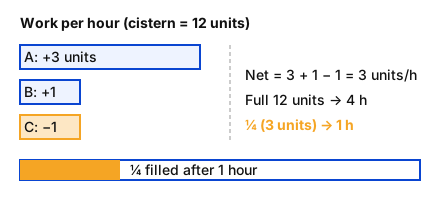
- Cistern units.
- Rates: units/h → net units/h.
- One-fourth units → time hour.
Trick: B and C cancel each other, so only tap A works effectively: full in 4 h, quarter in 1 h.
Answer: (D) 1
अवधारणा: टंकी को LCM इकाइयों में लें और प्रति घंटा दरें जोड़ें (खाली करने वाला नल ऋणात्मक)।
- टंकी इकाई।
- दरें: इकाई/घंटा → शुद्ध इकाई/घंटा।
- एक-चौथाई इकाई → समय घंटा।
ट्रिक: B और C एक-दूसरे को काट देते हैं, असल में केवल A काम करता है: पूरी 4 घंटे में, चौथाई 1 घंटे में।
उत्तर: (D) 1
RRB NTPC Undergraduate CBT 1MathematicsPipes & CisternsRRB NTPC Undergraduate CBT 1 2025 · 16 Jun Shift 1
Q425.A total of money is split among E, F, G and H in the ratio 9:7:5:3. If G gets ₹4000 less than F, how much does E receive?
एक धनराशि E, F, G और H के बीच 9:7:5:3 के अनुपात में बाँटी जाती है। यदि G को F से ₹4000 कम मिलते हैं, तो E को कितनी राशि मिलती है?
- A₹16000
- B₹20000
- C₹18000
- D₹17000
Show answer
Concept: The difference between two shares equals the difference of their ratio parts times the value of one part.
- F − G parts ₹4000 → 1 part ₹2000.
- E parts ₹18000.
Trick: Always find the value of one part first; every share then comes by simple multiplication.
Answer: (C) ₹18000
अवधारणा: दो हिस्सों का अंतर = उनके अनुपात-भागों का अंतर × एक भाग का मान।
- F − G भाग ₹4000 → 1 भाग ₹2000।
- E भाग ₹18000।
ट्रिक: पहले एक भाग का मान निकालें; फिर हर हिस्सा सीधे गुणा से मिल जाता है।
उत्तर: (C) ₹18000
RRB NTPC Undergraduate CBT 1MathematicsRatio & ProportionRRB NTPC Undergraduate CBT 1 2025 · 16 Jun Shift 1
Q426.A car travels from City A to City B at a speed of 60 km/h. After reaching City B, the driver increases the speed by 20 km/h for the return journey. Due to road repairs on the way back, the car is forced to slow down for 30 minutes, during which it travels at only 30 km/h instead of the increased speed. If the total time for the round trip is 7 hours, find the distance between City A and City B.
एक कार शहर A से शहर B तक 60 km/h की चाल से यात्रा करती है। शहर B पहुँचने के बाद, चालक वापसी यात्रा के लिए चाल 20 km/h बढ़ा देता है। वापसी के रास्ते में सड़क की मरम्मत के कारण कार को 30 मिनट के लिए धीमा होना पड़ता है, जिसके दौरान वह बढ़ी हुई चाल के बजाय केवल 30 km/h की चाल से चलती है। यदि आने-जाने की यात्रा का कुल समय 7 घंटे है, तो शहर A और शहर B के बीच की दूरी ज्ञात कीजिए।
- A km
- B km
- C km
- D km
Show answer
Concept: Total time sum of times of each stretch. In the 30-minute slow stretch the car covers km.
- Let distance km. Onward time .
- Return: h at 30 km/h (15 km) h at 80 km/h.
- .
- km.
Trick: Convert the slow stretch into a fixed distance (15 km) first; the rest is a plain two-speed equation.
Answer: (A) km
अवधारणा: कुल समय हर हिस्से के समय का योग। 30 मिनट की धीमी चाल में कार km चलती है।
- दूरी km मानें। जाने का समय ।
- वापसी: घंटा 30 km/h पर (15 km) घंटा 80 km/h पर।
- ।
- km।
ट्रिक: धीमे हिस्से को पहले निश्चित दूरी (15 km) में बदल लें; बाकी साधारण दो-चाल वाला समीकरण है।
उत्तर: (A) km
RRB NTPC Undergraduate CBT 1MathematicsSpeed, Time & DistanceRRB NTPC Undergraduate CBT 1 2025 · 16 Jun Shift 1
Q427.The arithmetic mean of 10 observations is 42. Three of the observations are 30, 38, and 50. The remaining six observations have an average of 45. Find the missing
observation.
10 प्रेक्षणों का समांतर माध्य 42 है। इनमें से तीन प्रेक्षण 30, 38 और 50 हैं। शेष छह प्रेक्षणों का औसत 45 है। लुप्त
प्रेक्षण ज्ञात कीजिए।
- A31
- B33
- C32
- D34
Show answer
Concept: Sum mean count; the missing value is total minus the known parts.
- Total of 10 .
- Known three: ; six others: .
- Missing .
Trick: Work with totals, never with averages directly.
Answer: (C) 32
अवधारणा: योग औसत संख्या; लुप्त मान = कुल − ज्ञात भाग।
- 10 का योग ।
- तीन ज्ञात: ; बाकी छह: ।
- लुप्त ।
ट्रिक: हमेशा योग पर काम करें, औसत पर सीधे नहीं।
उत्तर: (C) 32
RRB NTPC Undergraduate CBT 1MathematicsAverageRRB NTPC Undergraduate CBT 1 2025 · 16 Jun Shift 1
Q428.A sum of ₹20,000 amounts to ₹21,218 in 2 years under compound interest, compounded annually. Find the rate of interest per annum.
₹20,000 की राशि वार्षिक रूप से संयोजित चक्रवृद्धि ब्याज पर 2 वर्षों में ₹21,218 हो जाती है। वार्षिक ब्याज दर ज्ञात कीजिए।
- A3%
- B5%
- C8%
- D4%
Show answer
Concept: .
- .
- → .
Trick: 2-year CI ; for : of 20000 ✓.
Answer: (A)
अवधारणा: ।
- ।
- → ।
ट्रिक: 2 वर्ष का प्रभावी CI ; पर → 20000 का ✓।
उत्तर: (A)
RRB NTPC Undergraduate CBT 1MathematicsCompound InterestRRB NTPC Undergraduate CBT 1 2025 · 16 Jun Shift 1
Q429.Find the value of .
का मान ज्ञात कीजिए।
- A7
- B7.4
- C6
- D6.8
Show answer
Concept: Convert mixed fractions to decimals and add step by step.
- , .
- ; .
- .
Trick: Pair decimals that complete each other: and → .
Answer: (C) 6
अवधारणा: मिश्र भिन्नों को दशमलव में बदलकर क्रम से जोड़ें।
- , ।
- ; ।
- ।
ट्रिक: पूरक दशमलव जोड़ें: और → ।
उत्तर: (C) 6
RRB NTPC Undergraduate CBT 1MathematicsSimplificationRRB NTPC Undergraduate CBT 1 2025 · 16 Jun Shift 1
Q430.A sum of ₹8,000 is borrowed at a simple interest rate of 5% per annum for 3 years. What is the simple interest payable?
₹8,000 की राशि 5% वार्षिक साधारण ब्याज दर पर 3 वर्षों के लिए उधार ली जाती है। देय साधारण ब्याज कितना है?
- A₹1,200
- B₹1,600
- C₹1,400
- D₹1,000
Show answer
Concept: .
- .
Trick: for 3 years of principal; of 8000 .
Answer: (A) ₹1,200
अवधारणा: ।
- ।
ट्रिक: 3 वर्ष का = मूलधन का ; 8000 का ।
उत्तर: (A) ₹1,200
RRB NTPC Undergraduate CBT 1MathematicsSimple InterestRRB NTPC Undergraduate CBT 1 2025 · 16 Jun Shift 1
Q431.The angle of elevation of the top of a building from a point 40 m away is 45°. What is the height of the building?
40 m दूर स्थित एक बिंदु से एक भवन के शिखर का उन्नयन कोण 45° है। भवन की ऊँचाई कितनी है?
- A20 m
- B40 m
- C36 m
- D30 m
Show answer
Concept: .
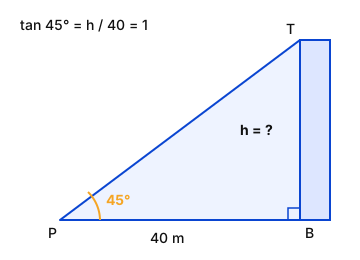
- .
- m.
Yaad rakhein: At elevation, height = distance (isosceles right triangle).
Answer: (B) 40 m
अवधारणा: ।
- ।
- m।
याद रखें: उन्नयन कोण पर ऊँचाई = दूरी (समद्विबाहु समकोण त्रिभुज)।
उत्तर: (B) 40 m
RRB NTPC Undergraduate CBT 1MathematicsHeights & DistancesRRB NTPC Undergraduate CBT 1 2025 · 16 Jun Shift 1
Q432.How many sides does a regular polygon have if each interior angle measures 150°?
यदि किसी सम बहुभुज का प्रत्येक अंतः कोण 150° है, तो उसकी कितनी भुजाएँ हैं?
- A15 sides15 भुजाएँ
- B10 sides10 भुजाएँ
- C8 sides8 भुजाएँ
- D12 sides12 भुजाएँ
Show answer
Concept: Exterior angle interior angle, and .
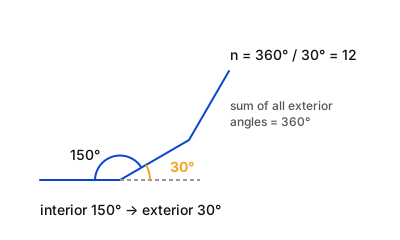
- Exterior angle .
- .
Yaad rakhein: , , , , sides.
Answer: (D) 12 sides
अवधारणा: बाह्य कोण अंतः कोण, और ।
- बाह्य कोण ।
- ।
याद रखें: , , , , भुजाएँ।
उत्तर: (D) 12 sides
RRB NTPC Undergraduate CBT 1MathematicsPolygon AnglesRRB NTPC Undergraduate CBT 1 2025 · 16 Jun Shift 1
Q433.Simplify √[1624+√{3225+√(419+157)}].
√[1624+√{3225+√(419+157)}] को सरल कीजिए।
- A43
- B45
- C47
- D41
Show answer
Concept: Simplify nested radicals from the innermost bracket outward.
- , .
- , .
- , .
Yaad rakhein: , , — memorise squares up to 60.
Answer: (D) 41
अवधारणा: सबसे अंदर वाले कोष्ठक से बाहर की ओर करणी हल करें।
- , ।
- , ।
- , ।
याद रखें: , , — 60 तक के वर्ग याद रखें।
उत्तर: (D) 41
RRB NTPC Undergraduate CBT 1MathematicsSquare RootsRRB NTPC Undergraduate CBT 1 2025 · 16 Jun Shift 1
Q434.A closed cylindrical reservoir features a radius of 14 cm and a height of 10 cm. If 20% of the total surface area of this reservoir is coated in blue paint and the remaining surface is coated in red, determine the total area in square centimeters that is painted red. [Use π = 22/7]
एक बंद बेलनाकार जलाशय की त्रिज्या 14 cm और ऊँचाई 10 cm है। यदि इस जलाशय के कुल पृष्ठीय क्षेत्रफल के 20% भाग पर नीला पेंट किया गया है और शेष पृष्ठ पर लाल पेंट किया गया है, तो लाल रंग से पेंट किया गया कुल क्षेत्रफल वर्ग सेंटीमीटर में ज्ञात कीजिए। [π = 22/7 का प्रयोग कीजिए]
- A
- B
- C
- D
Show answer
Concept: Total surface area of a closed cylinder ; red part of it.
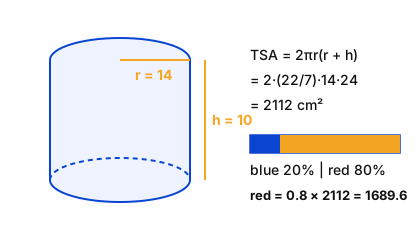
- TSA .
- Red of .
Trick: With , exactly — then just multiply by .
Answer: (C)
अवधारणा: बंद बेलन का कुल पृष्ठीय क्षेत्रफल ; लाल भाग इसका ।
- TSA ।
- लाल का ।
ट्रिक: पर ठीक-ठीक आता है — फिर बस से गुणा करें।
उत्तर: (C)
RRB NTPC Undergraduate CBT 1MathematicsMensuration – CylinderRRB NTPC Undergraduate CBT 1 2025 · 16 Jun Shift 1
Q435.A company has 10 officers and 30 clerks. The average monthly salary of an officer is ₹45,000 and that of a clerk is ₹25,000. What is the average salary of the entire staff?
एक कंपनी में 10 अधिकारी और 30 लिपिक हैं। एक अधिकारी का औसत मासिक वेतन ₹45,000 और एक लिपिक का ₹25,000 है। संपूर्ण कर्मचारियों का औसत वेतन कितना है?
- A₹35,000
- B₹30,000
- C₹28,000
- D₹32,000
Show answer
Concept: Average salary .
- Total .
- Average .
Trick: Ratio 1:3 → average lies of the gap (20000) above 25000 → .
Answer: (B) ₹30,000
अवधारणा: औसत वेतन ।
- कुल ।
- औसत ।
ट्रिक: अनुपात 1:3 → औसत, अंतर (20000) के भाग जितना 25000 से ऊपर → ।
उत्तर: (B) ₹30,000
RRB NTPC Undergraduate CBT 1MathematicsWeighted AverageRRB NTPC Undergraduate CBT 1 2025 · 16 Jun Shift 1
Q436.The largest four-digit number which when divided by 12, 13 and 7 leaves remainder 3 in each case is:
चार अंकों की वह सबसे बड़ी संख्या, जिसे 12, 13 और 7 से विभाजित करने पर प्रत्येक स्थिति में 3 शेषफल प्राप्त होता है, है:
- A9934
- B9618
- C9438
- D9831
Show answer
Concept: Required number (largest 4-digit multiple of LCM) .
- .
- rem → largest multiple .
- Number .
Trick: Options check: ✓ (divisible by 7, 12 and 13).
Answer: (D) 9831
अवधारणा: अभीष्ट संख्या (LCM का सबसे बड़ा 4-अंकीय गुणज) ।
- ।
- शेष → सबसे बड़ा गुणज ।
- संख्या ।
ट्रिक: विकल्प जाँच: ✓ (7, 12, 13 से विभाज्य)।
उत्तर: (D) 9831
RRB NTPC Undergraduate CBT 1MathematicsLCM & RemaindersRRB NTPC Undergraduate CBT 1 2025 · 16 Jun Shift 1
Q437.A cyclist travels 40 meters in 8 seconds. What is his speed?
एक साइकिल चालक 8 सेकंड में 40 मीटर की दूरी तय करता है। उसकी चाल कितनी है?
- A18 km/hr
- B21 km/hr
- C16 km/hr
- D24 km/hr
Show answer
Concept: Speed ; m/s to km/h multiply by .
- Speed m/s.
- km/h.
Yaad rakhein: m/s km/h, m/s km/h.
Answer: (A) 18 km/hr
अवधारणा: चाल ; m/s से km/h के लिए से गुणा करें।
- चाल m/s।
- km/h।
याद रखें: m/s km/h, m/s km/h।
उत्तर: (A) 18 km/hr
RRB NTPC Undergraduate CBT 1MathematicsSpeed ConversionRRB NTPC Undergraduate CBT 1 2025 · 16 Jun Shift 1
Q438.The HCF and LCM of two positive integers are 36 and 7,560, respectively. If one of the numbers is 540, what is the other number?
दो धनात्मक पूर्णांकों का HCF और LCM क्रमशः 36 और 7,560 है। यदि इनमें से एक संख्या 540 है, तो दूसरी संख्या क्या है?
- A396
- B468
- C432
- D504
Show answer
Concept: For two numbers, .
- .
- → .
Trick: The other number must be a multiple of the HCF 36 — only 396, 432 and 504 are; check with LCM ✓.
Answer: (D) 504
अवधारणा: दो संख्याओं के लिए ।
- ।
- → ।
ट्रिक: दूसरी संख्या HCF 36 का गुणज होनी चाहिए; और LCM से मेल ✓।
उत्तर: (D) 504
RRB NTPC Undergraduate CBT 1MathematicsHCF & LCMRRB NTPC Undergraduate CBT 1 2025 · 16 Jun Shift 1
Q439.The diagonals of a rhombus are 19 cm and 29 cm. Find its area.
एक समचतुर्भुज के विकर्ण 19 cm और 29 cm हैं। उसका क्षेत्रफल ज्ञात कीजिए।
- A255.5 cm²
- B265.5 cm²
- C275.5 cm²
- D285.5 cm²
Show answer
Concept: Area of a rhombus (diagonals bisect each other at right angles).
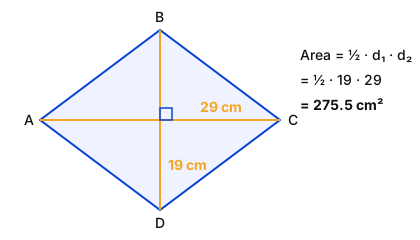
- Area .
- → area .
Trick: .
Answer: (C)
अवधारणा: समचतुर्भुज का क्षेत्रफल (विकर्ण एक-दूसरे को समकोण पर समद्विभाजित करते हैं)।
- क्षेत्रफल ।
- → क्षेत्रफल ।
ट्रिक: ।
उत्तर: (C)
RRB NTPC Undergraduate CBT 1MathematicsArea of RhombusRRB NTPC Undergraduate CBT 1 2025 · 16 Jun Shift 1
Q440.If a:b = 12:13 and b:c = 4:5, what is a:c?
यदि a:b = 12:13 और b:c = 4:5 है, तो a:c क्या है?
- A12:5
- B4:5
- C4:13
- D48:65
Show answer
Concept: .
- .
- → .
Trick: Multiply the first terms and the last terms: .
Answer: (D)
अवधारणा: ।
- ।
- → ।
ट्रिक: पहले पद आपस में और अंतिम पद आपस में गुणा करें: ।
उत्तर: (D)
RRB NTPC Undergraduate CBT 1MathematicsRatioRRB NTPC Undergraduate CBT 1 2025 · 16 Jun Shift 1

