Q441.The price of a jacket is first increased by 20% and then decreased by 25%. If the original price was ₹600, what is the final price of the jacket?
एक जैकेट का मूल्य पहले 20% बढ़ाया जाता है और फिर 25% घटाया जाता है। यदि मूल मूल्य ₹600 था, तो जैकेट का अंतिम मूल्य क्या है?
- A₹570
- B₹600
- C₹480
- D₹540
Show answer
Concept: Apply the multipliers one after another.
- .
- .
Trick: Net change → .
Answer: (D) ₹540
अवधारणा: गुणकों को एक के बाद एक लगाएँ।
- ।
- ।
ट्रिक: शुद्ध परिवर्तन → ।
उत्तर: (D) ₹540
RRB NTPC Undergraduate CBT 1MathematicsSuccessive Percentage ChangeRRB NTPC Undergraduate CBT 1 2025 · 16 Jun Shift 1
Q442.Evaluate 243 + (-5)3 + (-19)3
243 + (-5)3 + (-19)3 का मान ज्ञात कीजिए।
- A6840
- B6763
- C6572
- D6783
Show answer
Concept: If then .
- .
- Sum .
Trick: Whenever three cubes are asked, first check if the bases add to zero.
Answer: (A) 6840
अवधारणा: यदि तो ।
- ।
- योग ।
ट्रिक: तीन घनों का योग पूछा जाए तो पहले देखें कि आधारों का योग शून्य है या नहीं।
उत्तर: (A) 6840
RRB NTPC Undergraduate CBT 1MathematicsAlgebraic IdentityRRB NTPC Undergraduate CBT 1 2025 · 16 Jun Shift 1
Q443.A shopkeeper purchases rice at ₹60 per kg. While selling, he uses a weighing scale that shows 1 kg when only 900 g is actually weighed. He marks the price 20% above the cost price. Later, he gives a 10% discount on the marked price but continues using the same faulty scale. Find his profit (in ₹) on each transaction where the buyer pays for 1 kg.
एक दुकानदार ₹60 प्रति kg की दर से चावल खरीदता है। बेचते समय वह ऐसे तराजू का उपयोग करता है जो वास्तव में केवल 900 g तौलने पर 1 kg दर्शाता है। वह क्रय मूल्य से 20% अधिक मूल्य अंकित करता है। बाद में, वह अंकित मूल्य पर 10% की छूट देता है, परंतु उसी दोषपूर्ण तराजू का उपयोग जारी रखता है। प्रत्येक लेन-देन, जिसमें क्रेता 1 kg का भुगतान करता है, पर उसका लाभ (₹ में) ज्ञात कीजिए।
- A₹10.80
- B₹9.80
- C₹10.20
- D₹9.20
Show answer
Concept: The buyer pays for 1 kg at the discounted marked price but receives only 900 g; profit amount received cost of 900 g.
- Marked price of 1 kg ; after discount .
- Cost of 900 g actually given .
- Profit .
Trick: Profit on cost 54 → .
Answer: (A) ₹10.80
अवधारणा: ग्राहक छूट वाले अंकित मूल्य पर 1 kg का पैसा देता है पर पाता केवल 900 g; लाभ प्राप्त राशि 900 g की लागत।
- 1 kg का अंकित मूल्य ; छूट के बाद ।
- वास्तव में दिए 900 g की लागत ।
- लाभ ।
ट्रिक: लाभ , लागत 54 पर → ।
उत्तर: (A) ₹10.80
RRB NTPC Undergraduate CBT 1MathematicsProfit & Loss – False WeightRRB NTPC Undergraduate CBT 1 2025 · 16 Jun Shift 1
Q444.Mary is 3 years older than her sister. If their combined age is 27 years, what is Mary's age (in years)?
मैरी अपनी बहन से 3 वर्ष बड़ी है। यदि उनकी आयु का योग 27 वर्ष है, तो मैरी की आयु (वर्षों में) क्या है?
- A15
- B14
- C13
- D12
Show answer
Concept: Form a linear equation.
- Sister , Mary ; .
- Mary years.
Trick: Sum 27, difference 3 → larger .
Answer: (A) 15
अवधारणा: रैखिक समीकरण बनाएँ।
- बहन , Mary ; ।
- Mary वर्ष।
ट्रिक: योग 27, अंतर 3 → बड़ी ।
उत्तर: (A) 15
RRB NTPC Undergraduate CBT 1MathematicsAgesRRB NTPC Undergraduate CBT 1 2025 · 16 Jun Shift 1
Q445.A swimming pool is fitted with three pipes. The first two pipes working simultaneously, fill the pool in the same time as the third pipe alone. The second pipe alone fills the pool 5 hours faster than the first pipe and 4 hours slower than the third pipe. In what time will the second and third pipes together fill the pool?
एक स्विमिंग पूल में तीन पाइप लगे हैं। पहले दो पाइप एक साथ कार्य करते हुए पूल को उतने ही समय में भरते हैं जितने समय में अकेला तीसरा पाइप भरता है। दूसरा पाइप अकेले पूल को पहले पाइप से 5 घंटे जल्दी और तीसरे पाइप से 4 घंटे देर से भरता है। दूसरा और तीसरा पाइप मिलकर पूल को कितने समय में भरेंगे?
- A4 hours4 घंटे
- B hours घंटे
- C hours घंटे
- D6 hours6 घंटे
Show answer
Concept: Let the first pipe take h; then second , third and .
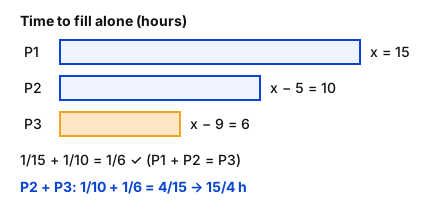
- (reject 3).
- Times: h.
- Second + third: → h.
Trick: The classic triple : — remember it.
Answer: (B) hours
अवधारणा: पहला पाइप घंटे ले; दूसरा , तीसरा और ।
- (3 अमान्य)।
- समय: घंटे।
- दूसरा + तीसरा: → घंटे।
ट्रिक: प्रसिद्ध त्रिक : — याद रखें।
उत्तर: (B) hours
RRB NTPC Undergraduate CBT 1MathematicsPipes & CisternsRRB NTPC Undergraduate CBT 1 2025 · 16 Jun Shift 1
Q446.A smart city metro line had an average of 4,500 daily riders last month. This month, it averaged 4,860 riders per day. What is the percentage growth in ridership?
एक स्मार्ट सिटी मेट्रो लाइन पर पिछले महीने औसतन 4,500 दैनिक यात्री थे। इस महीने, प्रतिदिन औसतन 4,860 यात्री रहे। यात्री संख्या में प्रतिशत वृद्धि कितनी है?
- A6.4%
- B8%
- C4.5%
- D10.2%
Show answer
Concept: Growth .
- Increase .
- .
Trick: of 4500 , so 360 is .
Answer: (B)
अवधारणा: वृद्धि ।
- वृद्धि ।
- ।
ट्रिक: 4500 का , इसलिए 360 ।
उत्तर: (B)
RRB NTPC Undergraduate CBT 1MathematicsPercentageRRB NTPC Undergraduate CBT 1 2025 · 16 Jun Shift 1
Q447.Find the mean proportional between (x + y)2 and (x - y)2, (x and y are natural number and x > y).
(x + y)2 और (x - y)2 का मध्यानुपाती ज्ञात कीजिए, (x और y प्राकृत संख्याएँ हैं और x > y)।
- Axy + x2
- Bx2 + y2
- Cxy + y2
- Dx2– y2
Show answer
Concept: Mean proportional of and is .
- (positive since ).
- .
Yaad rakhein: .
Answer: (D)
अवधारणा: और का मध्यानुपाती होता है।
- ( से धनात्मक)।
- ।
याद रखें: ।
उत्तर: (D)
RRB NTPC Undergraduate CBT 1MathematicsMean ProportionalRRB NTPC Undergraduate CBT 1 2025 · 16 Jun Shift 1
Q448.If , what is the value of ?
यदि है, तो का मान क्या है?
- A
- B
- C
- D
Show answer
Concept: Square both sides to get , then simplify the surd.
- .
- .
Yaad rakhein: , , , .
Answer: (C)
अवधारणा: दोनों पक्षों का वर्ग करके निकालें, फिर करणी सरल करें।
- ।
- ।
याद रखें: , , , ।
उत्तर: (C)
RRB NTPC Undergraduate CBT 1MathematicsSurdsRRB NTPC Undergraduate CBT 1 2025 · 16 Jun Shift 1
Q449.The marked price of a sweater is ₹600. The wholesaler offers a 20% discount to a retailer for up to 20 sweaters and a 25% discount if the order exceeds 20 sweaters. Find the amount paid by the retailer if he orders 22 such sweaters.
एक स्वेटर का अंकित मूल्य ₹600 है। थोक विक्रेता एक खुदरा विक्रेता को 20 स्वेटर तक के लिए 20% छूट और ऑर्डर 20 स्वेटर से अधिक होने पर 25% छूट देता है। यदि खुदरा विक्रेता ऐसे 22 स्वेटर का ऑर्डर देता है, तो उसके द्वारा भुगतान की गई राशि ज्ञात कीजिए।
- A₹9,250
- B₹9,500
- C₹9,850
- D₹9,900
Show answer
Concept: 22 sweaters exceed 20, so the discount applies to the whole order.
- Price per sweater .
- Amount .
Trick: .
Answer: (D) ₹9,900
अवधारणा: 22 स्वेटर 20 से अधिक हैं, अतः पूरे ऑर्डर पर छूट लगेगी।
- प्रति स्वेटर मूल्य ।
- राशि ।
ट्रिक: ।
उत्तर: (D) ₹9,900
RRB NTPC Undergraduate CBT 1MathematicsDiscountRRB NTPC Undergraduate CBT 1 2025 · 16 Jun Shift 1
Q450.Ritu gets a discount of 40% on an oven whose marked price is ₹1000. Since she pays by credit card, she gets an additional 22% discount. How much does she pay (in ₹)?
ऋतु को एक ओवन पर 40% की छूट मिलती है, जिसका अंकित मूल्य ₹1000 है। चूँकि वह क्रेडिट कार्ड से भुगतान करती है, इसलिए उसे 22% की अतिरिक्त छूट मिलती है। वह कितना भुगतान (₹ में) करती है?
- A469
- B468
- C467
- D465
Show answer
Concept: The second discount applies on the already reduced price.
- After : .
- After : .
Trick: of 600 ; .
Answer: (B) 468
अवधारणा: दूसरी छूट पहले से घटे मूल्य पर लगती है।
- के बाद: ।
- के बाद: ।
ट्रिक: 600 का ; ।
उत्तर: (B) 468
RRB NTPC Undergraduate CBT 1MathematicsSuccessive DiscountRRB NTPC Undergraduate CBT 1 2025 · 16 Jun Shift 1
Q451.The difference in simple interest on a sum of money invested at 4% per annum for five years and for three years is ₹784. Find the simple interest (in ₹) on the same sum invested at the same rate of interest for eight years.
किसी धनराशि पर 4% वार्षिक दर से पाँच वर्ष और तीन वर्ष के लिए निवेश करने पर साधारण ब्याज का अंतर ₹784 है। उसी धनराशि पर उसी ब्याज दर से आठ वर्ष के लिए साधारण ब्याज (₹ में) ज्ञात कीजिए।
- A3136
- B2352
- C3920
- D4144
Show answer
Concept: Simple interest is directly proportional to time: .
- SI for 5 years SI for 3 years SI for 2 years ₹784.
- SI for 1 year ₹392.
- SI for 8 years ₹3136.
Trick: In SI, the interest for each year is the same, so the difference for two periods is just the interest for the difference of years. No need to find the principal!
Answer: (A) 3136
अवधारणा: साधारण ब्याज समय के समानुपाती होता है: .
- 5 वर्ष का SI 3 वर्ष का SI 2 वर्ष का SI ₹784.
- 1 वर्ष का SI ₹392.
- 8 वर्ष का SI ₹3136.
ट्रिक: SI में हर वर्ष का ब्याज बराबर होता है, इसलिए दो अवधियों का अंतर सिर्फ वर्षों के अंतर का ब्याज है। मूलधन निकालने की ज़रूरत ही नहीं!
उत्तर: (A) 3136
RRB NTPC Undergraduate CBT 1MathematicsSimple InterestRRB NTPC Undergraduate CBT 1 2025 · 15 Jun Shift 3
Q452.ABCD is a quadrilateral in which AB DC, and E and F are the mid points of the diagonals AC and BD, respectively. If AB = 60 cm, BC = 65 cm, DC = 18 cm, and AD = 10 cm, then what is the length (in cm) of EF?
ABCD एक चतुर्भुज है जिसमें AB DC है, और E तथा F क्रमशः विकर्णों AC और BD के मध्य-बिंदु हैं। यदि AB = 60 cm, BC = 65 cm, DC = 18 cm और AD = 10 cm है, तो EF की लंबाई (cm में) कितनी है?
- A23
- B21
- C25
- D22
Show answer
Concept: In a trapezium, the segment joining the mid-points of the diagonals is parallel to the parallel sides and equals half their difference: .
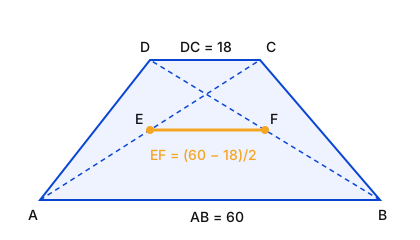
- Here , cm, cm.
- cm.
- The lengths and are extra information and are not needed.
Yaad rakhein: Mid-points of the non-parallel sides → half the sum (median); mid-points of the diagonals → half the difference.
Answer: (B) 21
अवधारणा: समलंब में विकर्णों के मध्य-बिंदुओं को मिलाने वाला रेखाखंड समांतर भुजाओं के समांतर होता है और उनके अंतर का आधा होता है: .
- यहाँ , cm, cm.
- cm.
- और अतिरिक्त जानकारी है, इनकी ज़रूरत नहीं।
याद रखें: असमांतर भुजाओं के मध्य-बिंदु → योग का आधा (मध्यिका); विकर्णों के मध्य-बिंदु → अंतर का आधा।
उत्तर: (B) 21
RRB NTPC Undergraduate CBT 1MathematicsGeometry – TrapeziumRRB NTPC Undergraduate CBT 1 2025 · 15 Jun Shift 3
Q453.Simplify:
सरल कीजिए:
- A45
- B58
- C50
- D57
Show answer
Concept: Evaluate powers and square roots first, then add/subtract left to right (BODMAS).
- , , so .
- .
Trick: for positive – do not expand and then take the root; just cancel.
Answer: (C) 50
अवधारणा: पहले घात और वर्गमूल हल करें, फिर बाएँ से दाएँ जोड़-घटाव (BODMAS)।
- , , अतः .
- .
ट्रिक: धनात्मक के लिए – वर्ग करके फिर मूल निकालने की ज़रूरत नहीं, सीधे काट दें।
उत्तर: (C) 50
RRB NTPC Undergraduate CBT 1MathematicsSimplificationRRB NTPC Undergraduate CBT 1 2025 · 15 Jun Shift 3
Q454.A, B, and C can complete a work in 10, 12, and 15 days, respectively. A and B work together for 3 days, after which A withdraws. B and C then work together. Find the number of days required by B and C to complete the remaining work.
A, B और C किसी कार्य को क्रमशः 10, 12 और 15 दिनों में पूरा कर सकते हैं। A और B मिलकर 3 दिन कार्य करते हैं, जिसके बाद A कार्य छोड़ देता है। इसके बाद B और C मिलकर कार्य करते हैं। शेष कार्य को पूरा करने के लिए B और C द्वारा लिए गए दिनों की संख्या ज्ञात कीजिए।
- A5 days5 दिन
- B3 days3 दिन
- C4 days4 दिन
- D6 days6 दिन
Show answer
Concept: Take total work = LCM of the days and convert to units/day.
- Total work units. A , B , C units/day.
- A and B for 3 days: units. Remaining .
- B and C do units/day days.
Trick: LCM method turns every work problem into simple whole-number counting.
Answer: (B) 3 days
अवधारणा: कुल कार्य = दिनों का LCM लें और प्रति दिन इकाइयाँ निकालें।
- कुल कार्य इकाई। A , B , C इकाई/दिन।
- A और B 3 दिन: इकाई। शेष .
- B और C इकाई/दिन दिन।
ट्रिक: LCM विधि से हर कार्य-प्रश्न साधारण पूर्णांकों की गिनती बन जाता है।
उत्तर: (B) 3 days
RRB NTPC Undergraduate CBT 1MathematicsTime and WorkRRB NTPC Undergraduate CBT 1 2025 · 15 Jun Shift 3
Q455.A hollow spherical shell is made of a metal of density 39 g/cm3. Its internal and external radii are 12 cm and 13 cm, respectively. What is the weight (in kg) of the shell?
एक खोखला गोलीय कोश 39 g/cm3 घनत्व वाली धातु से बना है। इसकी आंतरिक और बाह्य त्रिज्याएँ क्रमशः 12 cm और 13 cm हैं। कोश का भार (kg में) कितना है?
- A76.648
- B77.7
- C77.9
- D73.648
Show answer
Concept: Volume of a spherical shell ; mass density volume.
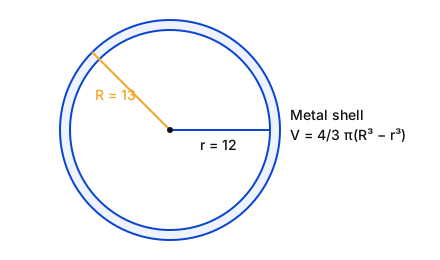
- .
- Volume (since ).
- Mass g kg.
Trick: Cancel before multiplying: and – the whole thing reduces to .
Answer: (A) 76.648
अवधारणा: खोखले गोले का आयतन ; द्रव्यमान घनत्व आयतन।
- .
- आयतन (क्योंकि )।
- द्रव्यमान g kg.
ट्रिक: गुणा से पहले काटें: और – पूरा प्रश्न रह जाता है।
उत्तर: (A) 76.648
RRB NTPC Undergraduate CBT 1MathematicsMensuration – Hollow SphereRRB NTPC Undergraduate CBT 1 2025 · 15 Jun Shift 3
Q456.A train passes two persons walking in the same direction in which the train is going. These persons are walking at the rates of 2 km/hr and 4 km/hr, respectively, and are completely crossed by the train in 9 seconds and 10 seconds, respectively. What is the length of the train?
एक ट्रेन उसी दिशा में चल रहे दो व्यक्तियों को पार करती है जिस दिशा में ट्रेन जा रही है। ये व्यक्ति क्रमशः 2 km/hr और 4 km/hr की दर से चल रहे हैं, और ट्रेन इन्हें क्रमशः 9 सेकंड और 10 सेकंड में पूरी तरह पार कर लेती है। ट्रेन की लंबाई कितनी है?
- A75 meters75 मीटर
- B50 meters50 मीटर
- C45 meters45 मीटर
- D55 meters55 मीटर
Show answer
Concept: To cross a walking person the train covers its own length at relative speed (same direction subtract).
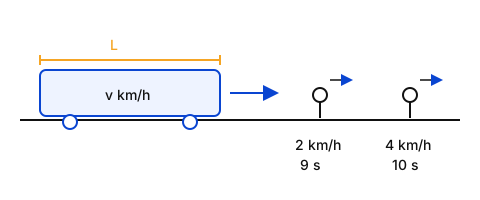
- Let train speed km/h. Length .
- km/h.
- m.
Trick: The length is the same both times, so just equate – the cancels.
Answer: (B) 50 meters
अवधारणा: चलते व्यक्ति को पार करने में रेलगाड़ी सापेक्ष चाल से अपनी लंबाई तय करती है (एक ही दिशा घटाएँ)।
- माना रेलगाड़ी की चाल km/h. लंबाई .
- km/h.
- m.
ट्रिक: दोनों बार लंबाई समान है, इसलिए सीधे रखें – कट जाता है।
उत्तर: (B) 50 meters
RRB NTPC Undergraduate CBT 1MathematicsTrains – Relative SpeedRRB NTPC Undergraduate CBT 1 2025 · 15 Jun Shift 3
Q457.The fourth proportional to the first number, the second number, and 20 is 36. If the sum of the first two numbers is 14, find the geometric mean of the first two numbers.
पहली संख्या, दूसरी संख्या और 20 का चतुर्थानुपाती 36 है। यदि पहली दो संख्याओं का योग 14 है, तो पहली दो संख्याओं का गुणोत्तर माध्य ज्ञात कीजिए।
- A
- B
- C
- D
Show answer
Concept: If (fourth proportional), then . Geometric mean .
- .
- .
- GM .
Trick: Fourth proportional of is – so directly gives the ratio.
Answer: (B)
अवधारणा: यदि (चतुर्थानुपाती), तो . गुणोत्तर माध्य (Geometric Mean) .
- .
- .
- GM .
ट्रिक: का चतुर्थानुपाती होता है – अतः से अनुपात सीधे मिल जाता है।
उत्तर: (B)
RRB NTPC Undergraduate CBT 1MathematicsProportion & Geometric MeanRRB NTPC Undergraduate CBT 1 2025 · 15 Jun Shift 3
Q458.The sum of two positive numbers is 67 and their product is 1012. The positive difference between them is:
दो धनात्मक संख्याओं का योग 67 है और उनका गुणनफल 1012 है। उनके बीच का धनात्मक अंतर कितना है?
- A21
- B30
- C13
- D24
Show answer
Concept: .
- .
- .
- Check: numbers are 44 and 23 ().
Trick: Never solve the quadratic – the identity gives the difference in one line.
Answer: (A) 21
अवधारणा: .
- .
- .
- जाँच: संख्याएँ 44 और 23 हैं ()।
ट्रिक: द्विघात समीकरण हल न करें – सर्वसमिका से अंतर एक पंक्ति में मिल जाता है।
उत्तर: (A) 21
RRB NTPC Undergraduate CBT 1MathematicsAlgebra – IdentitiesRRB NTPC Undergraduate CBT 1 2025 · 15 Jun Shift 3
Q459.In a class, there are 10 boys more than girls. Each girl has 3 pencils and each boy has 2 pencils with them. The total number of pencils in the class is 170. The ratio of girls to boys in the class is _____.
एक कक्षा में लड़कियों की तुलना में 10 लड़के अधिक हैं। प्रत्येक लड़की के पास 3 पेंसिलें और प्रत्येक लड़के के पास 2 पेंसिलें हैं। कक्षा में पेंसिलों की कुल संख्या 170 है। कक्षा में लड़कियों और लड़कों का अनुपात _____ है।
- A5:6
- B2:3
- C3:4
- D4:5
Show answer
Concept: Form one equation in the number of girls.
- Girls , boys .
- Pencils: , boys .
- Girls : boys .
Trick: Check options: only gives a difference of 10 with totals that produce pencils.
Answer: (C) 3:4
अवधारणा: लड़कियों की संख्या में एक समीकरण बनाएँ।
- लड़कियाँ , लड़के .
- पेंसिल: , लड़के .
- लड़कियाँ : लड़के .
ट्रिक: विकल्प जाँचें: केवल में का अंतर 10 है और पेंसिल बनती हैं।
उत्तर: (C) 3:4
RRB NTPC Undergraduate CBT 1MathematicsLinear Equations – RatioRRB NTPC Undergraduate CBT 1 2025 · 15 Jun Shift 3
Q460.A and B can do a piece of work in 12 days and 15 days, respectively. Both work for 4 days and then A leaves. How long (in days) will B take to complete the remaining work?
A और B किसी कार्य को क्रमशः 12 दिन और 15 दिन में कर सकते हैं। दोनों 4 दिन तक कार्य करते हैं और फिर A कार्य छोड़ देता है। शेष कार्य को पूरा करने में B को कितना समय (दिनों में) लगेगा?
- A8
- B6
- C7
- D5
Show answer
Concept: LCM method: total work units.
- A units/day, B units/day.
- 4 days together: units; remaining .
- B alone: days.
Trick: Alternatively, work done in 4 days ; B finishes days.
Answer: (B) 6
अवधारणा: LCM विधि: कुल कार्य इकाई।
- A इकाई/दिन, B इकाई/दिन।
- 4 दिन साथ: इकाई; शेष .
- B अकेला: दिन।
ट्रिक: वैकल्पिक: 4 दिन में कार्य ; B शेष दिन में।
उत्तर: (B) 6
RRB NTPC Undergraduate CBT 1MathematicsTime and WorkRRB NTPC Undergraduate CBT 1 2025 · 15 Jun Shift 3

