RRB NTPC Undergraduate CBT 1 · 2,900 questions

RRB NTPC Undergraduate CBT 1 2025 PYQs

Real previous year questions, subject-wise. Try the question, then open the answer and the explanation in Hindi & English – free, no login.

Courses – airGurukul

870 questions in Mathematics.

Q461.
Which of the following numbers is divisible by 11?
निम्नलिखित में से कौन-सी संख्या 11 से विभाज्य है?
  1. A5281
  2. B4735
  3. C2145
  4. D3522
Show answer

Concept: A number is divisible by 11 if (sum of digits at odd places) − (sum at even places) is 0 or a multiple of 11.

  1. 2145: (2+4)−(1+5)=6−6=0 ✓ divisible.
  2. 5281: (5+8)−(2+1)=10 ✗; 4735: (4+3)−(7+5)=−5 ✗; 3522: (3+2)−(5+2)=−2 ✗.
  3. 2145=11×195.

Trick: Alternate-sum test is fastest; do it mentally from the right.

Answer: (C) 2145

अवधारणा: कोई संख्या 11 से विभाज्य है यदि (विषम स्थानों के अंकों का योग) − (सम स्थानों का योग) 0 या 11 का गुणज हो।

  1. 2145: (2+4)−(1+5)=6−6=0 ✓ विभाज्य।
  2. 5281: (5+8)−(2+1)=10 ✗; 4735: (4+3)−(7+5)=−5 ✗; 3522: (3+2)−(5+2)=−2 ✗.
  3. 2145=11×195.

ट्रिक: एकांतर-योग की जाँच सबसे तेज़ है; दाएँ से मन में करें।

उत्तर: (C) 2145
RRB NTPC Undergraduate CBT 1MathematicsDivisibility RulesRRB NTPC Undergraduate CBT 1 2025 · 15 Jun Shift 3
Q462.
Let both a and b be prime numbers such that (a2+b) is also a prime number less than 20. What is the number of possible values of b?
मान लीजिए a और b दोनों ऐसी अभाज्य संख्याएँ हैं कि (a2+b) भी 20 से कम एक अभाज्य संख्या है। b के संभावित मानों की संख्या कितनी है?
  1. A6
  2. B3
  3. C5
  4. D4
Show answer

Concept: List primes a,b with a2+b prime and less than 20.

  1. a=2: 4+b<20⇒b<16; 4+b prime for b=3(7), 7(11), 13(17).
  2. a=3: 9+b<20⇒b<11; 9+b prime only for b=2(11) (b=3,5,7 give 12, 14, 16).
  3. a≥5: a2≥25>20, impossible. So b∈{2,3,7,13} – 4 values.

Trick: Parity check: a2+b must be odd, so exactly one of a,b is 2 – this cuts the search to two short lists.

Answer: (D) 4

अवधारणा: ऐसे अभाज्य a,b सूचीबद्ध करें जिनके लिए a2+b अभाज्य और 20 से कम हो।

  1. a=2: 4+b<20⇒b<16; 4+b अभाज्य: b=3(7), 7(11), 13(17).
  2. a=3: 9+b<20⇒b<11; 9+b अभाज्य केवल b=2(11) के लिए (b=3,5,7 से 12, 14, 16)।
  3. a≥5: a2≥25>20, असंभव। अतः b∈{2,3,7,13} – 4 मान।

ट्रिक: सम-विषम जाँच: a2+b विषम होना चाहिए, इसलिए a,b में से ठीक एक 2 है – खोज दो छोटी सूचियों तक सिमट जाती है।

उत्तर: (D) 4

RRB NTPC Undergraduate CBT 1MathematicsPrime NumbersRRB NTPC Undergraduate CBT 1 2025 · 15 Jun Shift 3
Q463.
What is the mode of the following data?
40, 47, 54, 45, 50, 43, 53, 52, 53, 49, 40, 50, 42, 52, 44, 52, 47, 55
निम्नलिखित आँकड़ों का बहुलक (mode) क्या है?
40, 47, 54, 45, 50, 43, 53, 52, 53, 49, 40, 50, 42, 52, 44, 52, 47, 55
  1. A40
  2. B52
  3. C47
  4. D54
Show answer

Concept: Mode is the value that occurs most often.

  1. Frequencies: 40 → 2, 47 → 2, 50 → 2, 52 → 3, 53 → 2, others once.
  2. 52 appears 3 times – the highest frequency.

Trick: Put a tick above each value as you scan the list once; the value with most ticks is the mode.

Answer: (B) 52

अवधारणा: बहुलक (Mode) वह मान है जो सबसे अधिक बार आता है।

  1. बारंबारता: 40 → 2, 47 → 2, 50 → 2, 52 → 3, 53 → 2, बाकी एक बार।
  2. 52 तीन बार आया है – सबसे अधिक।

ट्रिक: सूची एक बार पढ़ते हुए हर मान पर टिक लगाएँ; सबसे ज़्यादा टिक वाला मान बहुलक है।

उत्तर: (B) 52

RRB NTPC Undergraduate CBT 1MathematicsStatistics – ModeRRB NTPC Undergraduate CBT 1 2025 · 15 Jun Shift 3
Q464.
What is the greatest length of a measuring rod that can exactly measure three fabric pieces of lengths 7 m 35 cm, 9 m 45 cm, and 10 m 50 cm?
उस मापक छड़ की अधिकतम लंबाई क्या है जो 7 m 35 cm, 9 m 45 cm और 10 m 50 cm लंबाई वाले कपड़े के तीन टुकड़ों को ठीक-ठीक माप सके?
  1. A1 m 25 cm
  2. B1 m 15 cm
  3. C1 m 5 cm
  4. D1 m 35 cm
Show answer

Concept: Greatest length that measures all pieces exactly = HCF of the lengths (in cm).

  1. Lengths: 735 cm, 945 cm, 1050 cm.
  2. 735=3×5×72, 945=33×5×7, 1050=2×3×52×7.
  3. HCF =3×5×7=105 cm =1 m 5 cm.

Trick: Differences 945−735=210, 1050−945=105; HCF must divide 105, and 105 divides all three – done.

Answer: (C) 1 m 5 cm

अवधारणा: सभी टुकड़ों को पूरा-पूरा मापने वाली सबसे बड़ी लंबाई = लंबाइयों का HCF (cm में)।

  1. लंबाइयाँ: 735 cm, 945 cm, 1050 cm.
  2. 735=3×5×72, 945=33×5×7, 1050=2×3×52×7.
  3. HCF =3×5×7=105 cm =1 m 5 cm.

ट्रिक: अंतर 945−735=210, 1050−945=105; HCF 105 का भाजक होगा, और 105 तीनों को विभाजित करता है – हो गया।

उत्तर: (C) 1 m 5 cm

RRB NTPC Undergraduate CBT 1MathematicsHCF – ApplicationRRB NTPC Undergraduate CBT 1 2025 · 15 Jun Shift 3
Q465.
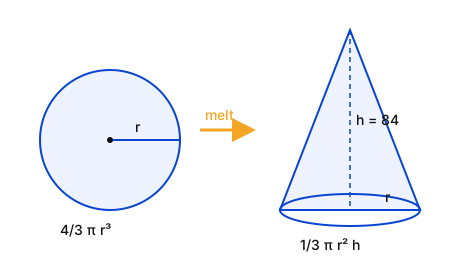
A solid metallic sphere is melted and recast into a cone whose radius is equal to the radius of the sphere. If the height of the cone is 84 cm, what was the volume of the original sphere?
(Use π=227)
धातु के एक ठोस गोले को पिघलाकर एक शंकु में ढाला जाता है जिसकी त्रिज्या गोले की त्रिज्या के बराबर है। यदि शंकु की ऊँचाई 84 cm है, तो मूल गोले का आयतन कितना था?
(Use π=227)
  1. A49808cm3
  2. B38808cm3
  3. C27808cm3
  4. D16808cm3
Show answer

Concept: Melting keeps volume constant: 43πr3=13πr2h.

  1. Same radius cancels: 4r=h=84⇒r=21 cm.
  2. Volume of sphere =43×227×213=43×227×9261.
  3. =4×22×441=38808cm3.

Yaad rakhein: Sphere recast into a cone of the same radius always has h=4r.

Answer: (B) 38808cm3

अवधारणा: पिघलाने पर आयतन समान रहता है: 43πr3=13πr2h.

  1. समान त्रिज्या कटने पर: 4r=h=84⇒r=21 cm.
  2. गोले का आयतन =43×227×213=43×227×9261.
  3. =4×22×441=38808cm3.

याद रखें: समान त्रिज्या के शंकु में ढाले गए गोले के लिए हमेशा h=4r.

उत्तर: (B) 38808cm3

RRB NTPC Undergraduate CBT 1MathematicsMensuration – Sphere & ConeRRB NTPC Undergraduate CBT 1 2025 · 15 Jun Shift 3
Q466.
If p is the third proportional to 6 and 18, and q is the third proportional to p and 54, find the value of q.
यदि p, 6 और 18 का तृतीयानुपाती है, और q, p और 54 का तृतीयानुपाती है, तो q का मान ज्ञात कीजिए।
  1. A36
  2. B72
  3. C18
  4. D54
Show answer

Concept: Third proportional to a and b is b2a.

  1. p=1826=3246=54.
  2. q=542p=54254=54.

Trick: Since p came out equal to 54, q=54×5454=54 – no multiplication needed.

Answer: (D) 54

अवधारणा: a और b का तृतीयानुपाती b2a होता है।

  1. p=1826=3246=54.
  2. q=542p=54254=54.

ट्रिक: p=54 निकला, इसलिए q=54×5454=54 – गुणा की ज़रूरत ही नहीं।

उत्तर: (D) 54

RRB NTPC Undergraduate CBT 1MathematicsThird ProportionalRRB NTPC Undergraduate CBT 1 2025 · 15 Jun Shift 3
Q467.
The marked price of a refrigerator is ₹4,884. The shopkeeper allows a discount of 10% and gains 8%. If no discount is allowed, his gain percentage would be:
एक रेफ्रिजरेटर का अंकित मूल्य ₹4,884 है। दुकानदार 10% की छूट देता है और 8% का लाभ प्राप्त करता है। यदि कोई छूट नहीं दी जाती, तो उसका लाभ प्रतिशत कितना होता?
  1. A20%
  2. B40%
  3. C30%
  4. D10%
Show answer

Concept: SP=MP×(1−d%) and CP=SP1+gain%.

  1. SP=4884×0.9=4395.6; CP=4395.61.08=4070.
  2. Without discount SP=MP=4884; gain =4884−4070=814.
  3. Gain%=8144070×100=20%.

Trick: MPCP=1+g1−d=1.080.9=1.2⇒20% – the price ₹4,884 is not even needed.

Answer: (A) 20%

अवधारणा: SP=MP×(1−d%) और CP=SP1+लाभ%.

  1. SP=4884×0.9=4395.6; CP=4395.61.08=4070.
  2. बिना छूट SP=MP=4884; लाभ =4884−4070=814.
  3. लाभ%=8144070×100=20%.

ट्रिक: MPCP=1+g1−d=1.080.9=1.2⇒20% – ₹4,884 की ज़रूरत ही नहीं पड़ती।

उत्तर: (A) 20%

RRB NTPC Undergraduate CBT 1MathematicsProfit, Loss & DiscountRRB NTPC Undergraduate CBT 1 2025 · 15 Jun Shift 3
Q468.
A student scores an average of 72 marks in 5 subjects and 84 marks in 3 additional subjects. The overall average marks is
एक छात्र 5 विषयों में औसतन 72 अंक और 3 अतिरिक्त विषयों में औसतन 84 अंक प्राप्त करता है। कुल औसत अंक कितने हैं?
  1. A75.25
  2. B76.25
  3. C76.5
  4. D75.5
Show answer

Concept: Overall average =total markstotal subjects.

  1. Total =72×5+84×3=360+252=612.
  2. Average =6128=76.5.

Trick: Weighted shift: 72+38(84−72)=72+4.5=76.5.

Answer: (C) 76.5

अवधारणा: कुल औसत =कुल अंककुल विषय.

  1. कुल =72×5+84×3=360+252=612.
  2. औसत =6128=76.5.

ट्रिक: भारित विचलन: 72+38(84−72)=72+4.5=76.5.

उत्तर: (C) 76.5

RRB NTPC Undergraduate CBT 1MathematicsAverageRRB NTPC Undergraduate CBT 1 2025 · 15 Jun Shift 3
Q469.
The following ratios are given:
a : b = 2 : 3
b : c = 4 : 5
c : d = 3 : 2
d : e = 5 : 4
What is the value of the ratio a : e?
निम्नलिखित अनुपात दिए गए हैं:
a : b = 2 : 3
b : c = 4 : 5
c : d = 3 : 2
d : e = 5 : 4
अनुपात a : e का मान क्या है?
  1. A3 : 4
  2. B3 : 5
  3. C1 : 1
  4. D4 : 7
Show answer

Concept: ae=ab×bc×cd×de.

  1. ae=23×45×32×54.
  2. Cancel: 23×32=1, 45×54=1 ⇒ae=1.
  3. a:e=1:1.

Trick: Multiply all antecedents and all consequents: 2·4·3·53·5·2·4=1.

Answer: (C) 1 : 1

अवधारणा: ae=ab×bc×cd×de.

  1. ae=23×45×32×54.
  2. काटें: 23×32=1, 45×54=1 ⇒ae=1.
  3. a:e=1:1.

ट्रिक: सभी पूर्वपदों और सभी उत्तरपदों का गुणा करें: 2·4·3·53·5·2·4=1.

उत्तर: (C) 1 : 1

RRB NTPC Undergraduate CBT 1MathematicsChain RatioRRB NTPC Undergraduate CBT 1 2025 · 15 Jun Shift 3
Q470.
If a trader purchases 50 notebooks for ₹1000 and sells all at a gain of 20%, what is the selling price of each notebook?
यदि एक व्यापारी 50 नोटबुक ₹1000 में खरीदता है और सभी को 20% के लाभ पर बेचता है, तो प्रत्येक नोटबुक का विक्रय मूल्य क्या है?
  1. A₹20
  2. B₹24
  3. C₹22
  4. D₹18
Show answer

Concept: SP=CP×(1+gain%).

  1. CP per notebook =100050= ₹20.
  2. SP =20×1.2= ₹24.

Trick: 20% gain means multiply by 65: 20×65=24.

Answer: (B) ₹24

अवधारणा: SP=CP×(1+लाभ%).

  1. प्रति नोटबुक CP =100050= ₹20.
  2. SP =20×1.2= ₹24.

ट्रिक: 20% लाभ यानी 65 से गुणा: 20×65=24.

उत्तर: (B) ₹24

RRB NTPC Undergraduate CBT 1MathematicsProfit and LossRRB NTPC Undergraduate CBT 1 2025 · 15 Jun Shift 3
Q471.
A marker costs ₹43. A store offers “Buy 5, Get 2 Free”. What is the effective price per marker? [Give your answer in ₹, correct to two places after decimal.]
एक मार्कर का मूल्य ₹43 है। एक स्टोर “5 खरीदें, 2 मुफ्त पाएँ” का प्रस्ताव देता है। प्रति मार्कर प्रभावी मूल्य क्या है? [अपना उत्तर ₹ में, दशमलव के बाद दो स्थानों तक सही दीजिए।]
  1. A₹32.71
  2. B₹33.71
  3. C₹31.71
  4. D₹30.71
Show answer

Concept: Effective price =amount paiditems received.

  1. Pay for 5, get 7: amount =5×43= ₹215.
  2. Effective price =2157=30.714…≈ ₹30.71.

Trick: "Buy 5 get 2 free" is a discount of 27≈28.57% on the price: 43×57.

Answer: (D) ₹30.71

अवधारणा: प्रभावी मूल्य =चुकाई गई राशिप्राप्त वस्तुएँ.

  1. 5 के पैसे, 7 मिले: राशि =5×43= ₹215.
  2. प्रभावी मूल्य =2157=30.714…≈ ₹30.71.

ट्रिक: "5 खरीदो 2 मुफ़्त" का मतलब मूल्य पर 27≈28.57% छूट: 43×57.

उत्तर: (D) ₹30.71

RRB NTPC Undergraduate CBT 1MathematicsDiscount – Effective PriceRRB NTPC Undergraduate CBT 1 2025 · 15 Jun Shift 3
Q472.
The sum of the present ages of a father and his son is 50 years. Five years ago, the father’s age was three times the son’s age. By how many years is the father older than his son?
एक पिता और उसके पुत्र की वर्तमान आयु का योग 50 वर्ष है। पाँच वर्ष पहले, पिता की आयु पुत्र की आयु की तीन गुनी थी। पिता अपने पुत्र से कितने वर्ष बड़ा है?
  1. A18
  2. B21
  3. C19
  4. D20
Show answer

Concept: Form equations for present ages; the age difference never changes.

  1. F+S=50; five years ago F−5=3(S−5)⇒F=3S−10.
  2. 3S−10+S=50⇒S=15, F=35.
  3. Difference =35−15=20 years.

Trick: Five years ago the sum was 40 and ratio 3:1, so ages were 30 and 10 – difference 20 (same today).

Answer: (D) 20

अवधारणा: वर्तमान आयु के समीकरण बनाएँ; आयु का अंतर कभी नहीं बदलता।

  1. F+S=50; पाँच वर्ष पहले F−5=3(S−5)⇒F=3S−10.
  2. 3S−10+S=50⇒S=15, F=35.
  3. अंतर =35−15=20 वर्ष।

ट्रिक: पाँच वर्ष पहले योग 40 और अनुपात 3:1, अतः आयु 30 और 10 – अंतर 20 (आज भी वही)।

उत्तर: (D) 20

RRB NTPC Undergraduate CBT 1MathematicsProblems on AgesRRB NTPC Undergraduate CBT 1 2025 · 15 Jun Shift 3
Q473.
A scooter travels 40 km at 20 km/hr and returns 60 km at the same speed. What is the average speed?
एक स्कूटर 20 km/hr की चाल से 40 km यात्रा करता है और उसी चाल से 60 km वापस आता है। औसत चाल क्या है?
  1. A25 km/hr
  2. B20 km/hr
  3. C22 km/hr
  4. D24 km/hr
Show answer

Concept: Average speed =total distancetotal time.

  1. Time =4020+6020=2+3=5 h.
  2. Average speed =40+605=20 km/h.

Trick: If the speed is the same throughout, the average speed is that speed itself, whatever the distances.

Answer: (B) 20 km/hr

अवधारणा: औसत चाल =कुल दूरीकुल समय.

  1. समय =4020+6020=2+3=5 h.
  2. औसत चाल =40+605=20 km/h.

ट्रिक: यदि पूरे सफ़र में चाल समान है, तो औसत चाल वही चाल होती है, दूरियाँ कुछ भी हों।

उत्तर: (B) 20 km/hr

RRB NTPC Undergraduate CBT 1MathematicsAverage SpeedRRB NTPC Undergraduate CBT 1 2025 · 15 Jun Shift 3
Q474.
A tech firm's revenue decreased from ₹2,50,000 to ₹2,12,500. What is the percentage decrease in the revenue?
एक टेक फर्म का राजस्व ₹2,50,000 से घटकर ₹2,12,500 हो गया। राजस्व में प्रतिशत कमी कितनी है?
  1. A10%
  2. B20%
  3. C12%
  4. D15%
Show answer

Concept: % decrease=decreaseoriginal×100.

  1. Decrease =250000−212500=37500.
  2. 37500250000×100=15%.

Trick: 10% of 2,50,000 is 25,000 and 5% is 12,500; together 37,500 ⇒15%.

Answer: (D) 15%

अवधारणा: % कमी=कमीमूल×100.

  1. कमी =250000−212500=37500.
  2. 37500250000×100=15%.

ट्रिक: 2,50,000 का 10% = 25,000 और 5% = 12,500; कुल 37,500 ⇒15%.

उत्तर: (D) 15%

RRB NTPC Undergraduate CBT 1MathematicsPercentage ChangeRRB NTPC Undergraduate CBT 1 2025 · 15 Jun Shift 3
Q475.
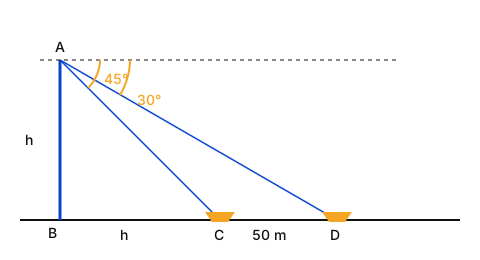
The angles of depression of two ships from the top of a light house are 45∘ and 30∘ towards east. If the ships are 50 m apart, the height of the light house is
एक प्रकाश स्तंभ के शिखर से पूर्व दिशा में दो जहाज़ों के अवनमन कोण 45∘ और 30∘ हैं। यदि जहाज़ों के बीच की दूरी 50 m है, तो प्रकाश स्तंभ की ऊँचाई कितनी है?
  1. A50(3+1) m
  2. B253+1 m
  3. C503+1 m
  4. D25(3+1) m
Show answer

Concept: Angle of depression equals the angle of elevation from the ship; use tan in the two right triangles.

  1. Let height AB=h. For the nearer ship C: tan45∘=1⇒BC=h.
  2. For the farther ship D: tan30∘=hBD⇒BD=h3.
  3. CD=BD−BC=h(3−1)=50⇒h=503−1=50(3+1)2=25(3+1) m.

Trick: Rationalise: 13−1=3+12. Options with 3+1 in the denominator are the common trap.

Answer: (D) 25(3+1) m

अवधारणा: अवनमन कोण (angle of depression) = जहाज़ से उन्नयन कोण; दोनों समकोण त्रिभुजों में tan लगाएँ।

  1. माना ऊँचाई AB=h. पास वाले जहाज़ C के लिए: tan45∘=1⇒BC=h.
  2. दूर वाले जहाज़ D के लिए: tan30∘=hBD⇒BD=h3.
  3. CD=BD−BC=h(3−1)=50⇒h=503−1=50(3+1)2=25(3+1) m.

ट्रिक: परिमेयकरण: 13−1=3+12. हर में 3+1 वाले विकल्प आम जाल हैं।

उत्तर: (D) 25(3+1) m

RRB NTPC Undergraduate CBT 1MathematicsHeights and DistancesRRB NTPC Undergraduate CBT 1 2025 · 15 Jun Shift 3
Q476.
The LCM of the numbers 5, 3.2 and 0.03 is:
संख्याओं 5, 3.2 और 0.03 का LCM कितना है?
  1. A120
  2. B185
  3. C215
  4. D240
Show answer

Concept: Make all numbers have the same number of decimal places, take LCM of the integers, then restore the decimal.

  1. 5=5.00, 3.2=3.20, 0.03 → integers 500, 320, 3.
  2. LCM(500,320)=8000 (500=2253, 320=265 → 2653); with 3 → 24000.
  3. Divide by 100: LCM =240.

Trick: LCM of decimals =LCM of numeratorsHCF of denominators when written as fractions over 100.

Answer: (D) 240

अवधारणा: सभी संख्याओं में दशमलव के बाद समान अंक रखें, पूर्णांकों का LCM लें, फिर दशमलव वापस रखें।

  1. 5=5.00, 3.2=3.20, 0.03 → पूर्णांक 500, 320, 3.
  2. LCM(500,320)=8000 (500=2253, 320=265 → 2653); 3 के साथ → 24000.
  3. 100 से भाग: LCM =240.

ट्रिक: 100 के हर वाली भिन्नों में लिखने पर दशमलवों का LCM =अंशों का LCMहरों का HCF.

उत्तर: (D) 240

RRB NTPC Undergraduate CBT 1MathematicsLCM of DecimalsRRB NTPC Undergraduate CBT 1 2025 · 15 Jun Shift 3
Q477.
If the income tax is increased by 18%, the net income is reduced by 2%. Find the original rate of income tax.
यदि आयकर में 18% की वृद्धि की जाती है, तो शुद्ध आय में 2% की कमी हो जाती है। आयकर की मूल दर ज्ञात कीजिए।
  1. A10%
  2. B12%
  3. C5%
  4. D8%
Show answer

Concept: Net income = income − tax. The extra tax equals the fall in net income.

  1. Let income =100 and tax rate =t%; net =100−t.
  2. Tax rises by 18% of t: extra tax =0.18t. Net falls by 2% of (100−t).
  3. 0.18t=0.02(100−t)⇒0.2t=2⇒t=10%.

Trick: Test the options: at 10%, tax goes 10→11.8; net goes 90→88.2, a fall of 1.8=2% of 90 ✓.

Answer: (A) 10%

अवधारणा: शुद्ध आय = आय − कर। अतिरिक्त कर = शुद्ध आय में कमी।

  1. माना आय =100 और कर दर =t%; शुद्ध =100−t.
  2. कर t का 18% बढ़ा: अतिरिक्त कर =0.18t. शुद्ध आय (100−t) का 2% घटी।
  3. 0.18t=0.02(100−t)⇒0.2t=2⇒t=10%.

ट्रिक: विकल्प जाँचें: 10% पर कर 10→11.8; शुद्ध 90→88.2, कमी 1.8 = 90 का 2% ✓.

उत्तर: (A) 10%

RRB NTPC Undergraduate CBT 1MathematicsPercentage – Income TaxRRB NTPC Undergraduate CBT 1 2025 · 15 Jun Shift 3
Q478.
An article is sold at a profit of 58%. If the cost price is increased by ₹20 and the selling price is reduced by ₹74, then the profit would be 52.5%. What is the original cost price (in ₹) of the article?
एक वस्तु को 58% के लाभ पर बेचा जाता है। यदि क्रय मूल्य में ₹20 की वृद्धि की जाए और विक्रय मूल्य में ₹74 की कमी की जाए, तो लाभ 52.5% होगा। वस्तु का मूल क्रय मूल्य (₹ में) क्या है?
  1. A1,900
  2. B2,100
  3. C2,000
  4. D2,200
Show answer

Concept: Write SP in terms of CP for both situations and equate.

  1. Let CP =x. Original SP =1.58x.
  2. New: CP =x+20, SP =1.58x−74, profit 52.5%: 1.58x−74=1.525(x+20).
  3. 1.58x−1.525x=30.5+74⇒0.055x=104.5⇒x=1900.

Trick: Check: CP 1900, SP 3002; new CP 1920, SP 2928; 10081920=52.5% ✓.

Answer: (A) 1,900

अवधारणा: दोनों स्थितियों में SP को CP के रूप में लिखकर बराबर करें।

  1. माना CP =x. मूल SP =1.58x.
  2. नया: CP =x+20, SP =1.58x−74, लाभ 52.5%: 1.58x−74=1.525(x+20).
  3. 1.58x−1.525x=30.5+74⇒0.055x=104.5⇒x=1900.

ट्रिक: जाँच: CP 1900, SP 3002; नया CP 1920, SP 2928; 10081920=52.5% ✓.

उत्तर: (A) 1,900

RRB NTPC Undergraduate CBT 1MathematicsProfit and LossRRB NTPC Undergraduate CBT 1 2025 · 15 Jun Shift 3
Q479.
What sum (in ₹) will earn a simple interest of ₹1,440 in 3 years at 8% per year rate of interest?
कौन-सी धनराशि (₹ में) 8% वार्षिक ब्याज दर पर 3 वर्ष में ₹1,440 का साधारण ब्याज अर्जित करेगी?
  1. A6,000
  2. B3,000
  3. C345.6
  4. D12,000
Show answer

Concept: P=SI×100R×T.

  1. P=1440×1008×3=14400024.
  2. P= ₹6,000.

Trick: 8%×3=24% of the sum =1440⇒ sum =1440÷0.24=6000.

Answer: (A) 6,000

अवधारणा: P=SI×100R×T.

  1. P=1440×1008×3=14400024.
  2. P= ₹6,000.

ट्रिक: 8%×3=24% राशि का =1440⇒ राशि =1440÷0.24=6000.

उत्तर: (A) 6,000

RRB NTPC Undergraduate CBT 1MathematicsSimple InterestRRB NTPC Undergraduate CBT 1 2025 · 15 Jun Shift 3
Q480.
Simplify: {2033÷207}÷(35×109+211)+74÷2823 of 234
सरल कीजिए: {2033÷207}÷(35×109+211)+74÷2823 of 234
  1. A1929
  2. B2331
  3. C12
  4. D619
Show answer

Concept: Solve brackets first, treat "of" as multiplication before ÷, then ÷, then +.

  1. 2033÷207=2033×720=733.
  2. 35×109+211=23+211=22+633=2833; so 733÷2833=14.
  3. 2823 of 234=7; 74÷7=14.
  4. Total =14+14=12.

Trick: "of" binds tighter than ÷: compute 2823 of 234 first – it collapses to 7.

Answer: (C) 12

अवधारणा: पहले कोष्ठक, "of" को ÷ से पहले गुणा मानें, फिर ÷, फिर +.

  1. 2033÷207=2033×720=733.
  2. 35×109+211=23+211=22+633=2833; अतः 733÷2833=14.
  3. 2823 of 234=7; 74÷7=14.
  4. कुल =14+14=12.

ट्रिक: "of" की प्राथमिकता ÷ से ऊपर है: पहले 2823 of 234 करें – यह सीधे 7 बन जाता है।

उत्तर: (C) 12

RRB NTPC Undergraduate CBT 1MathematicsSimplification – BODMASRRB NTPC Undergraduate CBT 1 2025 · 15 Jun Shift 3