Q481.Based on the alphabetical order, three of the following four are alike in a certain way and thus form a group. Which is the one that does not belong to that group?
(Note: The odd man out is not based on the number of consonants/vowels or their position in the letter cluster.)
अंग्रेज़ी वर्णमाला क्रम के आधार पर, निम्नलिखित चार में से तीन किसी निश्चित प्रकार से एक समान हैं और इस प्रकार एक समूह बनाते हैं। वह कौन-सा है जो उस समूह से संबंधित नहीं है?
(ध्यान दें: असंगत का निर्धारण व्यंजनों/स्वरों की संख्या या अक्षर-समूह में उनके स्थान के आधार पर नहीं किया गया है।)
- AAWY
- BCYA
- COLM
- DEAC
Show answer
Concept: Find the letter gaps inside each cluster (A=1 … Z=26, wrap-around allowed).
- AWY: ,
- CYA: , ; EAC: ,
- OLM: , but the second letter is L () → breaks the pattern.
Trick: Check the first gap of every option first – OLM fails at once.
Answer: (C) OLM
अवधारणा: हर समूह में अक्षरों का अंतर देखें (A=1 … Z=26, Z के बाद फिर A)।
- AWY: ,
- CYA: , ; EAC: ,
- OLM: होना चाहिए, पर दूसरा अक्षर L () है → नियम टूटा।
ट्रिक: सबसे पहले हर विकल्प का पहला अंतर जाँचें – OLM तुरंत अलग।
उत्तर: (C) OLM
RRB NTPC Undergraduate CBT 1General Intelligence and ReasoningOdd one out – letter clustersRRB NTPC Undergraduate CBT 1 2025 · 15 Jun Shift 2
Q482.What should come in place of the question mark (?) in the given series based on the English alphabetical order?
CIF IOL OUR UAX ?
अंग्रेज़ी वर्णमाला क्रम के आधार पर दी गई श्रृंखला में प्रश्न चिह्न (?) के स्थान पर क्या आना चाहिए?
CIF IOL OUR UAX ?
- ASTH
- BAGD
- CFYH
- DMFY
Show answer
Concept: Track each letter position separately.
- 1st letters: C, I, O, U → each → next .
- 2nd letters: I, O, U, A → → next .
- 3rd letters: F, L, R, X → → next . So the term is AGD.
Trick: All three positions move by the same – find one, apply to all.
Answer: (B) AGD
अवधारणा: हर स्थान के अक्षर को अलग-अलग देखें।
- पहले अक्षर: C, I, O, U → हर बार → अगला ।
- दूसरे अक्षर: I, O, U, A → → अगला ।
- तीसरे अक्षर: F, L, R, X → → अगला । अतः पद AGD।
ट्रिक: तीनों स्थान समान से चलते हैं – एक खोजें, सब पर लगाएँ।
उत्तर: (B) AGD
RRB NTPC Undergraduate CBT 1General Intelligence and ReasoningLetter seriesRRB NTPC Undergraduate CBT 1 2025 · 15 Jun Shift 2
Q483.The position(s) of how many letters will remain unchanged if each letter in the word COMBINE is arranged in the English alphabetical order?
यदि शब्द COMBINE के प्रत्येक अक्षर को अंग्रेज़ी वर्णमाला क्रम में व्यवस्थित किया जाए, तो कितने अक्षरों का स्थान अपरिवर्तित रहेगा?
- A1
- B3
- C0
- D2
Show answer
Concept: Write the word and its alphabetical arrangement one below the other and compare position by position.
- COMBINE: C O M B I N E
- Alphabetical: B C E I M N O
- Only position 6 (N) matches; all other positions differ. So 1 letter stays unchanged.
Trick: Alphabetical order of COMBINE: B C E I M N O – compare column-wise.
Answer: (A) 1
अवधारणा: शब्द और उसका वर्णानुक्रम एक के नीचे एक लिखकर स्थान-दर-स्थान मिलाएँ।
- COMBINE: C O M B I N E
- वर्णानुक्रम: B C E I M N O
- केवल छठे स्थान (N) पर मेल है; बाकी सब बदलते हैं। अतः 1 अक्षर अपरिवर्तित।
ट्रिक: COMBINE का वर्णानुक्रम: B C E I M N O – स्तंभ-वार मिलाएँ।
उत्तर: (A) 1
RRB NTPC Undergraduate CBT 1General Intelligence and ReasoningLetter arrangementRRB NTPC Undergraduate CBT 1 2025 · 15 Jun Shift 2
Q484.DVUK is related to GZZQ in a certain way based on the English alphabetical order. In the same way, PLOI is related to SPTO. To which of the following options is YXDA related, following the same logic?
अंग्रेज़ी वर्णमाला क्रम के आधार पर DVUK एक निश्चित प्रकार से GZZQ से संबंधित है। उसी प्रकार, PLOI, SPTO से संबंधित है। समान तर्क का अनुसरण करते हुए, YXDA निम्नलिखित में से किस विकल्प से संबंधित है?
- ABGIG
- BBBIG
- CGBBI
- DBGIB
Show answer
Concept: Find the shift applied to each letter.
- DVUK → GZZQ:
- PLOI → SPTO: (same rule)
- YXDA: , , , → BBIG
Trick: Increasing shifts ; remember wrap-around after Z.
Answer: (B) BBIG
अवधारणा: हर अक्षर पर लगा अंतर खोजें।
- DVUK → GZZQ:
- PLOI → SPTO: (समान नियम)
- YXDA: , , , → BBIG
ट्रिक: बढ़ते अंतर ; Z के बाद फिर A से गिनें।
उत्तर: (B) BBIG
RRB NTPC Undergraduate CBT 1General Intelligence and ReasoningAnalogy – letter codingRRB NTPC Undergraduate CBT 1 2025 · 15 Jun Shift 2
Q485.Seven boxes, A, B, C, D, E, F and G, are kept one over the other but not necessarily in the same order. Only two boxes are kept above F. Only three boxes are kept below C. B is kept above G but below D. E is kept immediately above F but below A. How many boxes are kept between A and C?
सात बक्से, A, B, C, D, E, F और G, एक के ऊपर एक रखे गए हैं, लेकिन आवश्यक नहीं कि इसी क्रम में हों। F के ऊपर केवल दो बक्से रखे गए हैं। C के नीचे केवल तीन बक्से रखे गए हैं। B, G के ऊपर लेकिन D के नीचे रखा गया है। E, F के ठीक ऊपर लेकिन A के नीचे रखा गया है। A और C के बीच कितने बक्से रखे गए हैं?
- AOneएक
- BTwoदो
- CThreeतीन
- DNoneकोई नहीं
Show answer
Concept: Fix boxes with exact positions first (1 = top, 7 = bottom).
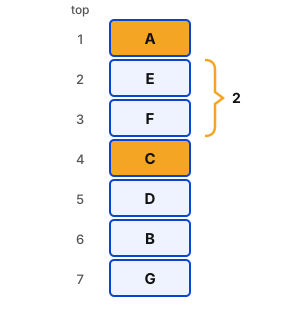
- Two boxes above F → F = 3. Three boxes below C → C = 4.
- E immediately above F → E = 2; E below A → A = 1.
- B above G, below D, in 5–7 → D = 5, B = 6, G = 7.
- Between A (1) and C (4): E and F → two boxes.
Trick: Count 'above' clues from the top and 'below' clues from the bottom.
Answer: (B) Two
अवधारणा: पहले निश्चित स्थान वाले बॉक्स रखें (1 = सबसे ऊपर, 7 = सबसे नीचे)।
- F के ऊपर दो बॉक्स → F = 3। C के नीचे तीन → C = 4।
- E, F के ठीक ऊपर → E = 2; E, A के नीचे → A = 1।
- B, G के ऊपर और D के नीचे, स्थान 5–7 में → D = 5, B = 6, G = 7।
- A (1) और C (4) के बीच: E और F → दो बॉक्स।
ट्रिक: 'ऊपर' वाले सुराग ऊपर से, 'नीचे' वाले नीचे से गिनें।
उत्तर: (B) दो
RRB NTPC Undergraduate CBT 1General Intelligence and ReasoningBox stacking puzzleRRB NTPC Undergraduate CBT 1 2025 · 15 Jun Shift 2
Q486.All 195 people are standing in a row facing north. Rt is 143rd from the left end while Kl is 36th from the right end. How many people are there between Rt and Kl?
सभी 195 व्यक्ति उत्तर की ओर मुख करके एक पंक्ति में खड़े हैं। Rt बाएँ छोर से 143वें स्थान पर है जबकि Kl दाएँ छोर से 36वें स्थान पर है। Rt और Kl के बीच कितने व्यक्ति हैं?
- A14
- B12
- C13
- D16
Show answer
Concept: Convert both positions to the same end, then subtract.
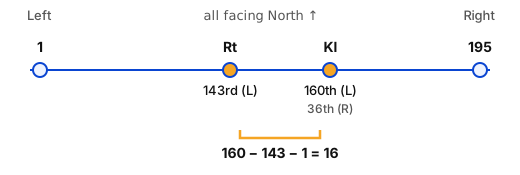
- Kl from the left th.
- Rt is 143rd from the left.
- People between .
Trick: Between two ranks from the same end difference .
Answer: (D) 16
अवधारणा: दोनों स्थानों को एक ही छोर से बदलें, फिर घटाएँ।
- Kl बाएँ से वाँ।
- Rt बाएँ से 143वाँ।
- बीच के लोग ।
ट्रिक: एक ही छोर से दो क्रमों के बीच अंतर ।
उत्तर: (D) 16
RRB NTPC Undergraduate CBT 1General Intelligence and ReasoningRanking in a rowRRB NTPC Undergraduate CBT 1 2025 · 15 Jun Shift 2
Q487.Based on the English alphabetical order, three of the following four letter-cluster pairs are alike in a certain way and thus form a group. Which is the one that does not belong to that group?
(Note: The odd one out is not based on the number of consonants/vowels or their position in the letter cluster.)
अंग्रेज़ी वर्णमाला क्रम के आधार पर, निम्नलिखित चार अक्षर-समूह युग्मों में से तीन किसी निश्चित प्रकार से एक समान हैं और इस प्रकार एक समूह बनाते हैं। वह कौन-सा है जो उस समूह से संबंधित नहीं है?
(ध्यान दें: असंगत का निर्धारण व्यंजनों/स्वरों की संख्या या अक्षर-समूह में उनके स्थान के आधार पर नहीं किया गया है।)
- AGY - FV
- BTL - SI
- CAI - ZF
- DQC - PY
Show answer
Concept: Compare each letter of the first cluster with the matching letter of the second.
- GY–FV: , ; TL–SI: ,
- AI–ZF: , (wrap-around)
- QC–PY: , but , not Y () → odd one.
Trick: Pattern ; only QC–PY breaks it at the second letter.
Answer: (D) QC - PY
अवधारणा: पहले समूह के हर अक्षर की तुलना दूसरे समूह के संगत अक्षर से करें।
- GY–FV: , ; TL–SI: ,
- AI–ZF: , (Z के बाद चक्र)
- QC–PY: , पर होना चाहिए, Y () है → विषम।
ट्रिक: नियम ; केवल QC–PY दूसरे अक्षर पर टूटता है।
उत्तर: (D) QC - PY
RRB NTPC Undergraduate CBT 1General Intelligence and ReasoningOdd pair – letter shiftsRRB NTPC Undergraduate CBT 1 2025 · 15 Jun Shift 2
Q488.In a certain code language, ‘MOPS’ is coded as ‘5863’ and ‘POEM’ is coded as ‘8765’. What is the code for ‘E’ in the given code language?
एक निश्चित कूट भाषा में, ‘MOPS’ को ‘5863’ और ‘POEM’ को ‘8765’ के रूप में कूटबद्ध किया जाता है। दी गई कूट भाषा में ‘E’ का कूट क्या है?
- A6
- B8
- C7
- D5
Show answer
Concept: Letters common to both words share the codes common to both codes.
- MOPS → 5863; POEM → 8765.
- Common letters M, O, P ↔ common digits 5, 6, 8.
- Leftover: S ↔ 3 in the first word, E ↔ 7 in the second.
Trick: Remove common letters/digits – the leftover pairs are fixed.
Answer: (C) 7
अवधारणा: दोनों शब्दों के उभयनिष्ठ अक्षरों के कोड भी दोनों कोडों में उभयनिष्ठ होते हैं।
- MOPS → 5863; POEM → 8765।
- उभयनिष्ठ अक्षर M, O, P ↔ उभयनिष्ठ अंक 5, 6, 8।
- बचे हुए: पहले में S ↔ 3, दूसरे में E ↔ 7।
ट्रिक: उभयनिष्ठ अक्षर/अंक हटाएँ – बचे हुए जोड़े तय हो जाते हैं।
उत्तर: (C) 7
RRB NTPC Undergraduate CBT 1General Intelligence and ReasoningCoding–decoding (common letters)RRB NTPC Undergraduate CBT 1 2025 · 15 Jun Shift 2
Q489.Each vowel in the word 'VOLUNTARY' is changed to the second letter immediately following it in the English alphabetical order and each consonant is changed to the letter immediately preceding it in the English alphabetical order. Which letter will appear exactly twice in the group of letters thus formed?
शब्द 'VOLUNTARY' के प्रत्येक स्वर को अंग्रेज़ी वर्णमाला क्रम में उसके ठीक बाद आने वाले दूसरे अक्षर से बदल दिया जाता है और प्रत्येक व्यंजन को अंग्रेज़ी वर्णमाला क्रम में उसके ठीक पहले आने वाले अक्षर से बदल दिया जाता है। इस प्रकार बने अक्षर-समूह में कौन-सा अक्षर ठीक दो बार आएगा?
- AM
- BQ
- CW
- DK
Show answer
Concept: Vowels → , consonants → .
- V O L U N T A R Y
- → U Q K W M S C Q X (, )
- Q appears twice; M, W, K appear once each.
Trick: Watch for a vowel and a consonant landing on the same letter (O and R both → Q).
Answer: (B) Q
अवधारणा: स्वर → , व्यंजन → ।
- V O L U N T A R Y
- → U Q K W M S C Q X (, )
- Q दो बार आता है; M, W, K एक-एक बार।
ट्रिक: देखें कि कोई स्वर और व्यंजन एक ही अक्षर पर पहुँचें (O और R दोनों → Q)।
उत्तर: (B) Q
RRB NTPC Undergraduate CBT 1General Intelligence and ReasoningLetter transformationRRB NTPC Undergraduate CBT 1 2025 · 15 Jun Shift 2
Q490.What should come in place of '?' in the given series based on the English alphabetical order?
MAI PEN SIS VMX ?
अंग्रेज़ी वर्णमाला क्रम के आधार पर दी गई श्रृंखला में '?' के स्थान पर क्या आना चाहिए?
MAI PEN SIS VMX ?
- AYQC
- BZRD
- CZRC
- DAPD
Show answer
Concept: Each letter position follows its own constant jump.
- 1st: M, P, S, V → → Y
- 2nd: A, E, I, M → → Q
- 3rd: I, N, S, X → → (wrap-around). Term: YQC.
Trick: Jumps , , for the three positions.
Answer: (A) YQC
अवधारणा: हर स्थान का अक्षर अपने स्थिर अंतर से चलता है।
- पहला: M, P, S, V → → Y
- दूसरा: A, E, I, M → → Q
- तीसरा: I, N, S, X → → (चक्र)। पद: YQC।
ट्रिक: तीनों स्थानों पर अंतर , , ।
उत्तर: (A) YQC
RRB NTPC Undergraduate CBT 1General Intelligence and ReasoningLetter seriesRRB NTPC Undergraduate CBT 1 2025 · 15 Jun Shift 2
Q491.If + means −, − means ×, × means ÷, and ÷ means +, then what will come in place of the question mark (?) in the following equation?
9 − 4 + 45 × 5 ÷ 3 = ?
यदि + का अर्थ −, − का अर्थ ×, × का अर्थ ÷ और ÷ का अर्थ + है, तो निम्नलिखित समीकरण में प्रश्न चिह्न (?) के स्थान पर क्या आएगा?
9 − 4 + 45 × 5 ÷ 3 = ?
- A35
- B30
- C20
- D25
Show answer
Concept: Replace the symbols first, then apply BODMAS.
- becomes
Trick: Write the new expression fully before calculating – avoids mixing old and new signs.
Answer: (B)
अवधारणा: पहले चिह्न बदलें, फिर BODMAS लगाएँ।
- बनता है
ट्रिक: गणना से पहले नया व्यंजक पूरा लिख लें – पुराने/नए चिह्न नहीं मिलेंगे।
उत्तर: (B)
RRB NTPC Undergraduate CBT 1General Intelligence and ReasoningMathematical operationsRRB NTPC Undergraduate CBT 1 2025 · 15 Jun Shift 2
Q492.In a certain code language, ‘FAME’ is coded as ‘8341’ and ‘FEAL’ is coded as ‘6438’. What is the code for ‘L’ in the given code language?
एक निश्चित कूट भाषा में, ‘FAME’ को ‘8341’ और ‘FEAL’ को ‘6438’ के रूप में कूटबद्ध किया जाता है। दी गई कूट भाषा में ‘L’ का कूट क्या है?
- A6
- B8
- C3
- D4
Show answer
Concept: Common letters ↔ common digits.
- FAME → 8341; FEAL → 6438.
- Common letters F, A, E ↔ common digits 3, 4, 8.
- Leftover: M ↔ 1 and L ↔ 6.
Trick: Strike out the common part; the remaining letter takes the remaining digit.
Answer: (A) 6
अवधारणा: उभयनिष्ठ अक्षर ↔ उभयनिष्ठ अंक।
- FAME → 8341; FEAL → 6438।
- उभयनिष्ठ अक्षर F, A, E ↔ उभयनिष्ठ अंक 3, 4, 8।
- बचे: M ↔ 1 और L ↔ 6।
ट्रिक: उभयनिष्ठ भाग काट दें; बचा अक्षर बचा अंक लेता है।
उत्तर: (A) 6
RRB NTPC Undergraduate CBT 1General Intelligence and ReasoningCoding–decoding (common letters)RRB NTPC Undergraduate CBT 1 2025 · 15 Jun Shift 2
Q493.In a certain code language,
A × B means ‘A is the mother of B’,
A – B means ‘A is the brother of B’,
A + B means ‘A is the wife of B’ and
A * B means ‘A is the father of B’.
How is H related to J if ‘H – I + O * D × J’?
एक निश्चित कूट भाषा में,
A × B का अर्थ है ‘A, B की माता है’,
A – B का अर्थ है ‘A, B का भाई है’,
A + B का अर्थ है ‘A, B की पत्नी है’ और
A * B का अर्थ है ‘A, B का पिता है’।
यदि ‘H – I + O * D × J’ है, तो H, J से किस प्रकार संबंधित है?
- AMother's mother's brotherमाता की माता का भाई
- BMother's mother's fatherमाता की माता का पिता
- CSonपुत्र
- DHusbandपति
Show answer
Concept: Decode each symbol and draw the family tree.
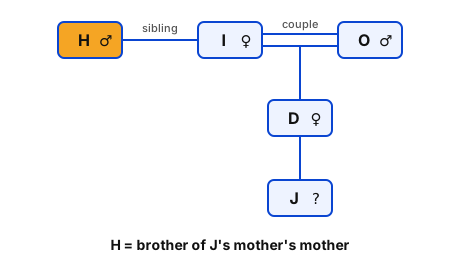
- H – I: H is the brother of I. I + O: I is the wife of O.
- O * D: O is the father of D, so I is D's mother. D × J: D is the mother of J.
- So I is J's mother's mother, and H (her brother) is J's mother's mother's brother.
Trick: Go from J upwards: mother (D) → her mother (I) → her brother (H).
Answer: (A) Mother's mother's brother
अवधारणा: हर चिह्न का अर्थ लिखकर वंश-वृक्ष बनाएँ।
- H – I: H, I का भाई है। I + O: I, O की पत्नी है।
- O * D: O, D का पिता है, अतः I, D की माँ है। D × J: D, J की माँ है।
- अतः I, J की माँ की माँ है, और H (उसका भाई) J की माँ की माँ का भाई है।
ट्रिक: J से ऊपर चलें: माँ (D) → उसकी माँ (I) → उसका भाई (H)।
उत्तर: (A) माँ की माँ का भाई (Mother's mother's brother)
RRB NTPC Undergraduate CBT 1General Intelligence and ReasoningCoded blood relationRRB NTPC Undergraduate CBT 1 2025 · 15 Jun Shift 2
Q494.Based on the English alphabetical order, three of the following four letter-cluster pairs are alike in a certain way and thus form a group. Which letter-cluster pair DOES NOT belong to that group?
(Note: The odd one out is not based on the number of consonants/vowels or their position in the letter-cluster.)
अंग्रेज़ी वर्णमाला क्रम के आधार पर, निम्नलिखित चार अक्षर-समूह युग्मों में से तीन किसी निश्चित प्रकार से एक समान हैं और इस प्रकार एक समूह बनाते हैं। कौन-सा अक्षर-समूह युग्म उस समूह से संबंधित नहीं है?
(ध्यान दें: असंगत का निर्धारण व्यंजनों/स्वरों की संख्या या अक्षर-समूह में उनके स्थान के आधार पर नहीं किया गया है।)
- AOP - EA
- BUV - KG
- CJK - WV
- DMN - CY
Show answer
Concept: Find the backward shift from each letter of the first cluster to the second.
- OP–EA: , ; UV–KG: ,
- MN–CY: , (wrap-around)
- JK–WV: , → does not follow .
Trick: First clusters are consecutive letters; the shifts and are fixed.
Answer: (C) JK - WV
अवधारणा: पहले समूह के हर अक्षर से दूसरे समूह तक का पीछे का अंतर खोजें।
- OP–EA: , ; UV–KG: ,
- MN–CY: , (चक्र)
- JK–WV: , → नियम नहीं।
ट्रिक: पहले समूह क्रमागत अक्षर हैं; अंतर और स्थिर हैं।
उत्तर: (C) JK - WV
RRB NTPC Undergraduate CBT 1General Intelligence and ReasoningOdd pair – letter shiftsRRB NTPC Undergraduate CBT 1 2025 · 15 Jun Shift 2
Q495.If + means -, - means ×, × means ÷, and ÷ means +, then what will come in place of the question mark (?) in the following equation?
38 - 25 ÷ 133 + 703 × 19 = ?
यदि + का अर्थ -, - का अर्थ ×, × का अर्थ ÷ और ÷ का अर्थ + है, तो निम्नलिखित समीकरण में प्रश्न चिह्न (?) के स्थान पर क्या आएगा?
38 - 25 ÷ 133 + 703 × 19 = ?
- A1046
- B1052
- C1191
- D1156
Show answer
Concept: Interchange symbols as told, then use BODMAS.
- becomes
- ,
Trick: – quick mental shortcut.
Answer: (A)
अवधारणा: बताए अनुसार चिह्न बदलें, फिर BODMAS लगाएँ।
- बनता है
- ,
ट्रिक: – त्वरित मानसिक गणना।
उत्तर: (A)
RRB NTPC Undergraduate CBT 1General Intelligence and ReasoningMathematical operationsRRB NTPC Undergraduate CBT 1 2025 · 15 Jun Shift 2
Q496.Read the given statement(s) and conclusions carefully. Assuming that the information given in the statements is true, even if it appears to be at variance with commonly known facts, decide which of the given conclusions logically follow(s) from the statement(s).
Statements:
Some cameras are pictures.
Some pictures are monkeys.
Conclusions:
(I) Some cameras are monkeys.
(II) All monkeys are pictures.
दिए गए कथन(नों) और निष्कर्षों को ध्यानपूर्वक पढ़िए। यह मानते हुए कि कथनों में दी गई जानकारी सत्य है, भले ही वह सामान्यतः ज्ञात तथ्यों से भिन्न प्रतीत होती हो, निर्णय लीजिए कि दिए गए निष्कर्षों में से कौन-सा/से निष्कर्ष तार्किक रूप से कथन(नों) का अनुसरण करता है/करते हैं।
कथन:
कुछ कैमरे, चित्र हैं।
कुछ चित्र, बंदर हैं।
निष्कर्ष:
(I) कुछ कैमरे, बंदर हैं।
(II) सभी बंदर, चित्र हैं।
- ABoth conclusions (I) and (II) followनिष्कर्ष (I) और (II) दोनों अनुसरण करते हैं
- BOnly conclusion (II) followsकेवल निष्कर्ष (II) अनुसरण करता है
- CNeither conclusion (I) nor (II) followsन तो निष्कर्ष (I) और न ही (II) अनुसरण करता है
- DOnly conclusion (I) followsकेवल निष्कर्ष (I) अनुसरण करता है
Show answer
Concept: Draw the least-overlap Venn diagram; a conclusion follows only if it is true in every possible case.
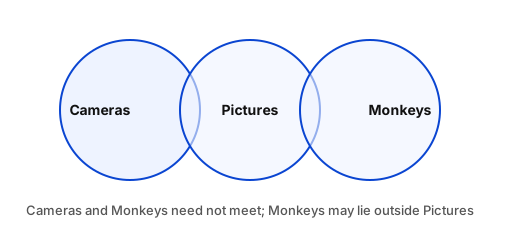
- Cameras meet Pictures and Pictures meet Monkeys, but Cameras and Monkeys can be drawn apart → (I) 'Some cameras are monkeys' is not certain.
- Only 'some' monkeys are pictures; the rest can lie outside → (II) 'All monkeys are pictures' does not follow.
- Hence neither conclusion follows.
Trick: Some + Some → no definite conclusion between the end terms.
Answer: (C) Neither conclusion (I) nor (II) follows
अवधारणा: न्यूनतम ओवरलैप वाला वेन आरेख बनाएँ; निष्कर्ष तभी सही है जब हर संभावित स्थिति में सही हो।
- कैमरे-चित्र और चित्र-बंदर मिलते हैं, पर कैमरे और बंदर अलग रखे जा सकते हैं → (I) 'कुछ कैमरे बंदर हैं' निश्चित नहीं।
- केवल 'कुछ' बंदर चित्र हैं; बाकी बाहर हो सकते हैं → (II) 'सभी बंदर चित्र हैं' नहीं निकलता।
- अतः कोई निष्कर्ष नहीं निकलता।
ट्रिक: कुछ + कुछ → अंतिम पदों के बीच कोई निश्चित निष्कर्ष नहीं।
उत्तर: (C) न तो (I) न ही (II) निकलता है
RRB NTPC Undergraduate CBT 1General Intelligence and ReasoningSyllogismRRB NTPC Undergraduate CBT 1 2025 · 15 Jun Shift 2
Q497.Read the given statement(s) and conclusions carefully. Assuming that the information given in the statements is true, even if it appears to be at variance with commonly known facts, decide which of the given conclusions logically follow(s) from the statement(s).
Statements: All kings are buttons. No pants are kings.
Conclusion (I): All buttons are kings.
Conclusion (II): Some buttons are not pants.
दिए गए कथन(नों) और निष्कर्षों को ध्यानपूर्वक पढ़िए। यह मानते हुए कि कथनों में दी गई जानकारी सत्य है, भले ही वह सामान्यतः ज्ञात तथ्यों से भिन्न प्रतीत होती हो, निर्णय लीजिए कि दिए गए निष्कर्षों में से कौन-सा/से निष्कर्ष तार्किक रूप से कथन(नों) का अनुसरण करता है/करते हैं।
कथन: सभी राजा, बटन हैं। कोई भी पैंट, राजा नहीं है।
निष्कर्ष (I): सभी बटन, राजा हैं।
निष्कर्ष (II): कुछ बटन, पैंट नहीं हैं।
- ABoth conclusions (I) and (II) followनिष्कर्ष (I) और (II) दोनों अनुसरण करते हैं
- BOnly conclusion (I) followsकेवल निष्कर्ष (I) अनुसरण करता है
- COnly conclusion (II) followsकेवल निष्कर्ष (II) अनुसरण करता है
- DNeither conclusion (I) nor (II) followsन तो निष्कर्ष (I) और न ही (II) अनुसरण करता है
Show answer
Concept: Place Kings inside Buttons and keep Pants away from Kings.
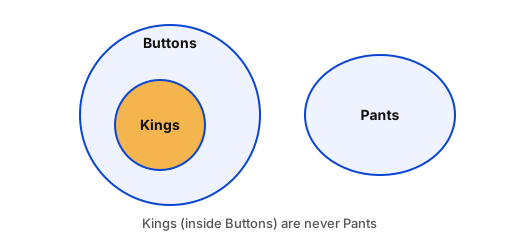
- (I) 'All buttons are kings' – Buttons may be larger than Kings, so it is not certain.
- (II) Every king is a button and no king is a pant, so those buttons that are kings are certainly not pants → 'Some buttons are not pants' follows.
- Hence only conclusion (II) follows.
Trick: All A are B + No C are A ⇒ Some B are not C (always).
Answer: (C) Only conclusion (II) follows
अवधारणा: राजाओं (Kings) को बटनों (Buttons) के अंदर रखें और पैंट (Pants) को राजाओं से अलग।
- (I) 'सभी बटन राजा हैं' – बटन, राजाओं से बड़े हो सकते हैं, अतः निश्चित नहीं।
- (II) हर राजा बटन है और कोई राजा पैंट नहीं, तो जो बटन राजा हैं वे निश्चित रूप से पैंट नहीं → 'कुछ बटन पैंट नहीं हैं' निकलता है।
- अतः केवल निष्कर्ष (II) निकलता है।
ट्रिक: सभी A, B हैं + कोई C, A नहीं ⇒ कुछ B, C नहीं (हमेशा)।
उत्तर: (C) केवल निष्कर्ष (II) निकलता है
RRB NTPC Undergraduate CBT 1General Intelligence and ReasoningSyllogismRRB NTPC Undergraduate CBT 1 2025 · 15 Jun Shift 2
Q498.What should come in place of ‘?’ in the given series?
486 441 401 366 336 ?
दी गई श्रृंखला में ‘?’ के स्थान पर क्या आना चाहिए?
486 441 401 366 336 ?
- A313
- B310
- C311
- D312
Show answer
Concept: Look at the differences between consecutive terms.
- , , ,
- The differences fall by 5 each time, so the next is 25.
Trick: Differences – a simple arithmetic pattern.
Answer: (C)
अवधारणा: क्रमागत पदों के अंतर देखें।
- , , ,
- अंतर हर बार 5 घटता है, अतः अगला 25।
ट्रिक: अंतर – सरल समांतर पैटर्न।
उत्तर: (C)
RRB NTPC Undergraduate CBT 1General Intelligence and ReasoningNumber seriesRRB NTPC Undergraduate CBT 1 2025 · 15 Jun Shift 2
Q499.A, B, C, D, S, T and U are sitting around a circular table, facing the centre of the table. Only three people sit between B and C, when counted from the left of B. Only three people sit between U and T, when counted from the right of T. D sits to the immediate right of U. A is an immediate neighbor of T as well as C. Who sits second to the left of S?
A, B, C, D, S, T और U एक वृत्ताकार मेज़ के चारों ओर मेज़ के केंद्र की ओर मुख करके बैठे हैं। B के बाएँ से गिनने पर B और C के बीच केवल तीन व्यक्ति बैठे हैं। T के दाएँ से गिनने पर U और T के बीच केवल तीन व्यक्ति बैठे हैं। D, U के ठीक दाएँ बैठा है। A, T और C दोनों का निकटतम पड़ोसी है। S के बाएँ से दूसरे स्थान पर कौन बैठा है?
- AA
- BC
- CT
- DU
Show answer
Concept: Facing the centre: left = clockwise, right = anticlockwise.
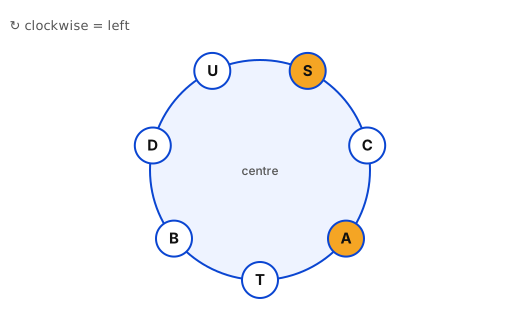
- Fix T. U is 4th to the right of T (three people between), and D is immediately right of U.
- A must touch both T and C; the only free pair of seats gives A next to T and C next to A.
- C is 4th to the left of B (three people between, counted from B's left) → B sits between T and D; S takes the last seat (between U and C).
- Clockwise order: T, B, D, U, S, C, A → second to the left of S is A.
Trick: Count 'left' clockwise when everyone faces the centre.
Answer: (A) A
अवधारणा: केंद्र की ओर मुख: बायाँ = दक्षिणावर्त (clockwise), दायाँ = वामावर्त।
- T को स्थिर करें। U, T के दाएँ चौथा है (बीच में तीन), D, U के ठीक दाएँ।
- A, T और C दोनों का पड़ोसी है; खाली सीटों में A, T के बगल और C, A के बगल ही बैठ सकते हैं।
- B के बाएँ से गिनने पर तीन लोगों के बाद C है → B, T और D के बीच; S बची सीट (U और C के बीच) लेता है।
- दक्षिणावर्त क्रम: T, B, D, U, S, C, A → S के बाएँ दूसरा A।
ट्रिक: केंद्र की ओर मुख हो तो 'बायाँ' दक्षिणावर्त गिनें।
उत्तर: (A) A
RRB NTPC Undergraduate CBT 1General Intelligence and ReasoningCircular seating arrangementRRB NTPC Undergraduate CBT 1 2025 · 15 Jun Shift 2
Q500.What will come in place of the question mark (?) in the following equation, if ‘+’ and ‘÷' are interchanged and ‘−’ and ‘×’ are interchanged?
14 − 2 × 48 + 3 ÷ 7 = ?
यदि ‘+’ और ‘÷' को आपस में बदल दिया जाए तथा ‘−’ और ‘×’ को आपस में बदल दिया जाए, तो निम्नलिखित समीकरण में प्रश्न चिह्न (?) के स्थान पर क्या आएगा?
14 − 2 × 48 + 3 ÷ 7 = ?
- A23
- B19
- C14
- D7
Show answer
Concept: Swap the signs as told, then use BODMAS.
- '+'↔'÷' and '−'↔'×': becomes
Trick: Do the swap on paper sign by sign; then division and multiplication first.
Answer: (B)
अवधारणा: बताए अनुसार चिह्न बदलें, फिर BODMAS लगाएँ।
- '+'↔'÷' और '−'↔'×': बनता है
ट्रिक: हर चिह्न एक-एक कर बदलें; फिर पहले भाग और गुणा।
उत्तर: (B)
RRB NTPC Undergraduate CBT 1General Intelligence and ReasoningMathematical operations (interchange)RRB NTPC Undergraduate CBT 1 2025 · 15 Jun Shift 2

