Q41.A car travels 120 km at 40 km/h, 120 km at 60 km/h, and 100 km at 80 km/h. What is the average speed of the car for the whole journey?
एक कार 120 km की दूरी 40 km/h से, 120 km की दूरी 60 km/h से और 100 km की दूरी 80 km/h से तय करती है। पूरी यात्रा के लिए कार की औसत चाल क्या है?
- A54.4 km/h
- B62.5 km/h
- C55.6 km/h
- D65 km/h
Show answer
Concept: (never the average of the speeds).
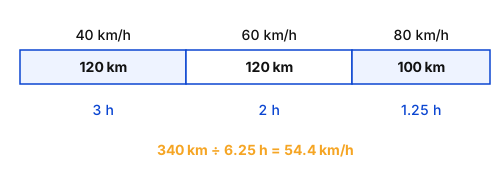
- Times: h, h, h.
- Total time h; total distance km.
- Average speed .
Trick: Simple average of speeds is a trap – always divide total distance by total time.
Answer: (A)
अवधारणा: (चालों का साधारण औसत नहीं)।
- समय: h, h, h।
- कुल समय h; कुल दूरी km।
- औसत चाल ।
ट्रिक: चालों का साधारण औसत एक जाल है – हमेशा कुल दूरी ÷ कुल समय करें।
उत्तर: (A)
RRB NTPC Undergraduate CBT 1MathematicsAverage speedRRB NTPC Undergraduate CBT 1 2025 · 20 Jun Shift 2
Q42.The HCF of two numbers is 8, and their LCM is 240. If the sum of the two numbers is 88, what are the numbers?
दो संख्याओं का HCF 8 है, और उनका LCM 240 है। यदि दोनों संख्याओं का योग 88 है, तो संख्याएँ कौन-सी हैं?
- A16 and 7216 और 72
- B32 and 5632 और 56
- C40 and 4840 और 48
- D24 and 6424 और 64
Show answer
Concept: Numbers and with co-prime; product.
- .
- LCM .
- .
- Numbers and .
Trick: Check options: product must be ; only with sum .
Answer: (C) 40 and 48
अवधारणा: संख्याएँ और , जहाँ सह-अभाज्य; गुणनफल।
- ।
- LCM ।
- ।
- संख्याएँ और ।
ट्रिक: विकल्प जाँचें: गुणनफल होना चाहिए; केवल और योग है।
उत्तर: (C) 40 और 48
RRB NTPC Undergraduate CBT 1MathematicsHCF and LCMRRB NTPC Undergraduate CBT 1 2025 · 20 Jun Shift 2
Q43.ABC is an equilateral triangle with side 24 cm and AD is the median. If G is the centroid of the triangle ABC, find the length (in cm) of GD.
ABC एक समबाहु त्रिभुज है जिसकी भुजा 24 cm है और AD माध्यिका है। यदि G त्रिभुज ABC का केंद्रक है, तो GD की लंबाई (cm में) ज्ञात कीजिए।
- A
- B
- C
- D
Show answer
Concept: The centroid divides each median in the ratio from the vertex; median of equilateral triangle .
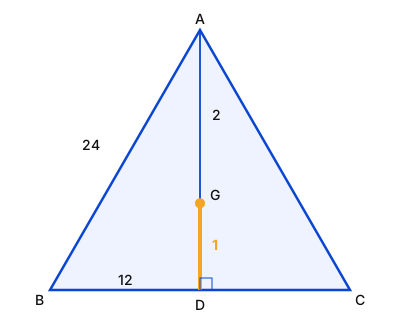
- AD cm.
- GD .
- GD cm.
Trick: In an equilateral triangle, GD equals the inradius .
Answer: (A)
अवधारणा: केन्द्रक प्रत्येक माध्यिका को शीर्ष से में बाँटता है; समबाहु त्रिभुज की माध्यिका ।
- AD cm।
- GD ।
- GD cm।
ट्रिक: समबाहु त्रिभुज में GD = अंतःत्रिज्या ।
उत्तर: (A)
RRB NTPC Undergraduate CBT 1MathematicsCentroid of triangleRRB NTPC Undergraduate CBT 1 2025 · 20 Jun Shift 2
Q44.If the interest on a sum of ₹y at 10% per annum compounded annually for 2 years is ₹630, then the total amount payable at the end of the two-year period will be _________.
यदि ₹y की राशि पर 10% वार्षिक दर से, वार्षिक रूप से संयोजित होने वाला 2 वर्षों का ब्याज ₹630 है, तो दो वर्ष की अवधि के अंत में देय कुल राशि _________ होगी।
- A₹3,540
- B₹3,950
- C₹4,100
- D₹3,630
Show answer
Concept: At for 2 years, CI of the principal ().
- of .
- .
- Amount .
Trick: Effective rate for 2 years at : .
Answer: (D) ₹3,630
अवधारणा: पर 2 वर्ष का चक्रवृद्धि ब्याज मूलधन का होता है ()।
- का ।
- ।
- मिश्रधन ।
ट्रिक: 2 वर्ष के लिए की प्रभावी दर: ।
उत्तर: (D) ₹3,630
RRB NTPC Undergraduate CBT 1MathematicsCompound interestRRB NTPC Undergraduate CBT 1 2025 · 20 Jun Shift 2
Q45.If the 8-digit number 79243p25 is divisible by 11, then the minimum value of p is:
यदि 8 अंकों की संख्या 79243p25, 11 से विभाज्य है, तो p का न्यूनतम मान है:
- A7
- B2
- C8
- D4
Show answer
Concept: A number is divisible by 11 if (sum of digits at odd places) − (sum at even places) is or a multiple of 11.
- Digits from the right: .
- Odd places: ; even places: .
- Difference must be or → .
Trick: Pair the alternate digits quickly; since is a single digit, only is possible.
Answer: (A)
अवधारणा: कोई संख्या 11 से विभाज्य है यदि (विषम स्थानों के अंकों का योग) − (सम स्थानों का योग) या 11 का गुणज हो।
- दाएँ से अंक: ।
- विषम स्थान: ; सम स्थान: ।
- अंतर को या होना चाहिए → ।
ट्रिक: एकांतर अंकों को जल्दी जोड़ें; एक अंक है, इसलिए केवल संभव है।
उत्तर: (A)
RRB NTPC Undergraduate CBT 1MathematicsDivisibility by 11RRB NTPC Undergraduate CBT 1 2025 · 20 Jun Shift 2
Q46.In a smart city, the number of electric vehicles increased by 18% in 2021 and 22% in 2022. What is the total percentage increase in electric vehicles over the two years?
एक स्मार्ट सिटी में, इलेक्ट्रिक वाहनों की संख्या में 2021 में 18% और 2022 में 22% की वृद्धि हुई। दोनों वर्षों में इलेक्ट्रिक वाहनों में कुल प्रतिशत वृद्धि कितनी है?
- A46%
- B43.96%
- C40%
- D41.6%
Show answer
Concept: Net change for successive increases and .
- .
- Net .
- Total increase .
Trick: Multiplying factors works too: .
Answer: (B)
अवधारणा: क्रमागत वृद्धि और का कुल परिवर्तन ।
- ।
- कुल ।
- कुल वृद्धि ।
ट्रिक: गुणक विधि भी: ।
उत्तर: (B)
RRB NTPC Undergraduate CBT 1MathematicsSuccessive percentage changeRRB NTPC Undergraduate CBT 1 2025 · 20 Jun Shift 2
Q47.If the arithmetic mean of five numbers is 20 and one number is changed from 10 to 20, what happens to the mean?
यदि पाँच संख्याओं का समांतर माध्य 20 है और एक संख्या को 10 से बदलकर 20 कर दिया जाता है, तो माध्य पर क्या प्रभाव पड़ता है?
- AIt decreases by 5यह 5 कम हो जाता है
- BIt decreases by 2यह 2 कम हो जाता है
- CIt stays the sameयह अपरिवर्तित रहता है
- DIt increases by 2यह 2 बढ़ जाता है
Show answer
Concept: Change in mean .
- Total increases by .
- Number of values .
- Mean increases by (from to ).
Trick: Only the change matters – you never need the other four numbers.
Answer: (D) It increases by 2
अवधारणा: माध्य में परिवर्तन ।
- योग में वृद्धि ।
- संख्याएँ ।
- माध्य बढ़ता है ( से )।
ट्रिक: केवल परिवर्तन मायने रखता है – बाकी चार संख्याएँ जानने की ज़रूरत नहीं।
उत्तर: (D) यह 2 बढ़ जाता है
RRB NTPC Undergraduate CBT 1MathematicsAverageRRB NTPC Undergraduate CBT 1 2025 · 20 Jun Shift 2
Q48.A wholesaler offers a discount of 10% on a commodity, marked at ₹3,000, on an order of less than 20 items. Also, on an order of more than 20 items, an additional discount of 5% is offered on the commodity. What amount does a retailer have to pay to purchase 25 items of the commodity whose marked price is ₹3,000?
एक थोक विक्रेता ₹3,000 अंकित मूल्य वाली एक वस्तु पर, 20 से कम वस्तुओं के ऑर्डर पर 10% की छूट देता है। साथ ही, 20 से अधिक वस्तुओं के ऑर्डर पर वस्तु पर 5% की अतिरिक्त छूट दी जाती है। ₹3,000 अंकित मूल्य वाली उस वस्तु की 25 इकाइयाँ खरीदने के लिए एक खुदरा विक्रेता को कितनी राशि का भुगतान करना होगा?
- A₹72,543
- B₹25,650
- C₹64,125
- D₹26,125
Show answer
Concept: Successive discounts multiply: .
- 25 items , so both and extra apply.
- Price per item .
- For 25 items: .
Trick: then = single discount ; .
Answer: (C) ₹64,125
अवधारणा: क्रमागत छूट गुणा होती है: ।
- 25 वस्तुएँ , अतः और अतिरिक्त दोनों लागू।
- प्रति वस्तु मूल्य ।
- 25 वस्तुओं का: ।
ट्रिक: फिर = एकल छूट ; ।
उत्तर: (C) ₹64,125
RRB NTPC Undergraduate CBT 1MathematicsSuccessive discountRRB NTPC Undergraduate CBT 1 2025 · 20 Jun Shift 2
Q49.Riya, Kabir, and Sana start a business together. Riya invests ₹13500 for 8 months, Kabir invests ₹21000 for 6 months, and Sana invests ₹18000 for 12 months. At the end of the year, they earn a total profit of ₹12,600. What is Kabir's share of the profit (in ₹)?
रिया, कबीर और सना मिलकर एक व्यवसाय शुरू करते हैं। रिया 8 महीने के लिए ₹13500, कबीर 6 महीने के लिए ₹21000 और सना 12 महीने के लिए ₹18000 का निवेश करती है। वर्ष के अंत में, उन्हें कुल ₹12,600 का लाभ होता है। लाभ में कबीर का हिस्सा (₹ में) कितना है?
- A₹3,528
- B₹4,030
- C₹4,285
- D₹3,722
Show answer
Concept: Profit share capital time.
- Riya ; Kabir ; Sana .
- Ratio (divide by ); total .
- Kabir .
Trick: Reduce the products to the smallest ratio first – here – before dividing the profit.
Answer: (A) ₹3,528
अवधारणा: लाभ का हिस्सा पूँजी समय।
- रिया ; कबीर ; सना ।
- अनुपात ( से भाग); कुल ।
- कबीर ।
ट्रिक: लाभ बाँटने से पहले गुणनफलों को सबसे छोटे अनुपात () में बदलें।
उत्तर: (A) ₹3,528
RRB NTPC Undergraduate CBT 1MathematicsPartnership (capital × time)RRB NTPC Undergraduate CBT 1 2025 · 20 Jun Shift 2
Q50.The weighted average marks of a student in Physics, Chemistry and Mathematics are 68. The weightages of the subjects Physics, Chemistry and Mathematics are in the ratio 3 : 2 : 5. If the student scored 60 in Physics and 70 in Chemistry, then find the marks in Mathematics.
भौतिकी, रसायन विज्ञान और गणित में एक छात्र के भारित औसत अंक 68 हैं। भौतिकी, रसायन विज्ञान और गणित विषयों के भार (weightage) 3 : 2 : 5 के अनुपात में हैं। यदि छात्र ने भौतिकी में 60 और रसायन विज्ञान में 70 अंक प्राप्त किए, तो गणित में प्राप्त अंक ज्ञात कीजिए।
- A68
- B66
- C72
- D74
Show answer
Concept: .
- .
- .
- .
Trick: Deviation method: Physics , Chemistry ; Maths must give , i.e. each → .
Answer: (C)
अवधारणा: ।
- ।
- ।
- ।
ट्रिक: विचलन विधि: भौतिकी , रसायन ; गणित को देना है, यानी प्रति भार → ।
उत्तर: (C)
RRB NTPC Undergraduate CBT 1MathematicsWeighted averageRRB NTPC Undergraduate CBT 1 2025 · 20 Jun Shift 2
Q51.The present ages of P and Q are in the ratio 4 : 5. Eight years ago, the ratio of their ages was 2 : 3. The harmonic mean of their present ages is
P और Q की वर्तमान आयु 4 : 5 के अनुपात में है। आठ वर्ष पहले, उनकी आयु का अनुपात 2 : 3 था। उनकी वर्तमान आयु का हरात्मक माध्य है
- A years वर्ष
- B years वर्ष
- C years वर्ष
- D years वर्ष
Show answer
Concept: HM of two numbers .
- Ages ; .
- Present ages and .
- HM .
- years.
Trick: HM is always less than AM – so only an option below 18 can be right.
Answer: (A) years
अवधारणा: दो संख्याओं का हरात्मक माध्य ।
- आयु ; ।
- वर्तमान आयु और ।
- HM ।
- वर्ष।
ट्रिक: HM हमेशा AM से कम होता है – इसलिए 18 से कम वाला विकल्प ही सही हो सकता है।
उत्तर: (A) वर्ष
RRB NTPC Undergraduate CBT 1MathematicsAges and harmonic meanRRB NTPC Undergraduate CBT 1 2025 · 20 Jun Shift 2
Q52.Given that , and , then the value of is close to:
दिया गया है कि , और , तो का मान लगभग है:
- A6.63
- B6.55
- C9.75
- D7.59
Show answer
Concept: ; equal bases → equal exponents.
- .
- .
- .
Trick: : , remainder , and .
Answer: (D)
अवधारणा: ; आधार समान हों तो घात भी समान।
- ।
- ।
- ।
ट्रिक: : , शेष , और ।
उत्तर: (D)
RRB NTPC Undergraduate CBT 1MathematicsLaws of exponentsRRB NTPC Undergraduate CBT 1 2025 · 20 Jun Shift 2
Q53.Three numbers are in the ratio 3 : 2 : 11, and their LCM is 3564. Their HCF is:
तीन संख्याएँ 3 : 2 : 11 के अनुपात में हैं, और उनका LCM 3564 है। उनका HCF है:
- A88
- B54
- C67
- D38
Show answer
Concept: Numbers (HCF ); LCM .
- LCM.
- .
- = HCF.
Trick: Ratio terms are co-prime, so HCF .
Answer: (B)
अवधारणा: संख्याएँ (म.स. ); ल.स. ।
- LCM।
- ।
- = म.स.।
ट्रिक: अनुपात के पद सह-अभाज्य हैं, अतः म.स. ।
उत्तर: (B)
RRB NTPC Undergraduate CBT 1MathematicsHCF and LCM of ratiosRRB NTPC Undergraduate CBT 1 2025 · 20 Jun Shift 2
Q54.A car travels a distance of 540 km. For the first 3 hours, it travels at a speed of 80 km/h, and for the remaining hours, it reduces its speed to 60 km/h. Find the total time taken by the car to cover the entire distance.
एक कार 540 km की दूरी तय करती है। पहले 3 घंटों तक, यह 80 km/h की चाल से चलती है, और शेष घंटों के लिए यह अपनी चाल घटाकर 60 km/h कर देती है। पूरी दूरी तय करने में कार द्वारा लिया गया कुल समय ज्ञात कीजिए।
- A4 hours4 घंटे
- B6 hours6 घंटे
- C8 hours8 घंटे
- D2 hours2 घंटे
Show answer
Concept: , applied to each part separately.
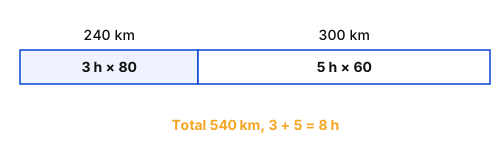
- First part: km.
- Remaining km at → h.
- Total time hours.
Trick: Break the journey into pieces; never use an average speed here.
Answer: (C) 8 hours
अवधारणा: , हर भाग पर अलग से।
- पहला भाग: km।
- शेष km, पर → h।
- कुल समय घंटे।
ट्रिक: यात्रा को टुकड़ों में बाँटें; यहाँ औसत चाल का प्रयोग न करें।
उत्तर: (C) 8 घंटे
RRB NTPC Undergraduate CBT 1MathematicsSpeed, time and distanceRRB NTPC Undergraduate CBT 1 2025 · 20 Jun Shift 2
Q55.The sum of two digits of a 2-digit number is 9. If the number obtained by interchanging the digits exceeds the original number by 27, find the number.
एक 2-अंकीय संख्या के दोनों अंकों का योग 9 है। यदि अंकों को आपस में बदलने पर प्राप्त संख्या मूल संख्या से 27 अधिक है, तो संख्या ज्ञात कीजिए।
- A45
- B27
- C36
- D63
Show answer
Concept: Number ; reversed − original .
- .
- .
- → number .
Trick: Option check: and .
Answer: (C)
अवधारणा: संख्या ; उलटी − मूल ।
- ।
- ।
- → संख्या ।
ट्रिक: विकल्प जाँच: और ।
उत्तर: (C)
RRB NTPC Undergraduate CBT 1MathematicsTwo-digit numbersRRB NTPC Undergraduate CBT 1 2025 · 20 Jun Shift 2
Q56.Priya lent ₹920 to her friend at 5% per annum simple interest for 3 years. How much simple interest does she earn in this period?
प्रिया ने अपनी मित्र को 3 वर्षों के लिए 5% वार्षिक साधारण ब्याज पर ₹920 उधार दिए। इस अवधि में उसे कितना साधारण ब्याज प्राप्त होता है?
- A₹145
- B₹127
- C₹150
- D₹138
Show answer
Concept: .
- .
- SI .
- SI .
Trick: ; of , → .
Answer: (D) ₹138
अवधारणा: ।
- ।
- ब्याज ।
- ब्याज ।
ट्रिक: ; का , → ।
उत्तर: (D) ₹138
RRB NTPC Undergraduate CBT 1MathematicsSimple interestRRB NTPC Undergraduate CBT 1 2025 · 20 Jun Shift 2
Q57.Which single digit should replace the blank in the number 1_36 so that the number is divisible by 9?
संख्या 1_36 में रिक्त स्थान पर कौन-सा एकल अंक रखा जाना चाहिए ताकि संख्या 9 से विभाज्य हो?
- A3
- B8
- C1
- D5
Show answer
Concept: A number is divisible by 9 if the sum of its digits is divisible by 9.
- Digit sum .
- Next multiple of 9 after 10 is 18 → .
- Number .
Trick: Digit-sum remainder: leaves , so add to reach .
Answer: (B)
अवधारणा: कोई संख्या 9 से विभाज्य है यदि उसके अंकों का योग 9 से विभाज्य हो।
- अंकों का योग ।
- 10 के बाद 9 का अगला गुणज 18 → ।
- संख्या ।
ट्रिक: अंक-योग है, तक पहुँचने के लिए जोड़ें।
उत्तर: (B)
RRB NTPC Undergraduate CBT 1MathematicsDivisibility by 9RRB NTPC Undergraduate CBT 1 2025 · 20 Jun Shift 2
Q58.The population of a town decreased from 8,000 to 7,200 in one year. What is the percentage decrease?
एक कस्बे की जनसंख्या एक वर्ष में 8,000 से घटकर 7,200 हो गई। प्रतिशत कमी कितनी है?
- A10%
- B12%
- C15%
- D8%
Show answer
Concept: .
- Decrease .
- .
Trick: Always divide by the original (old) value, not the new one.
Answer: (A)
अवधारणा: ।
- कमी ।
- ।
ट्रिक: हमेशा मूल (पुराने) मान से भाग दें, नए से नहीं।
उत्तर: (A)
RRB NTPC Undergraduate CBT 1MathematicsPercentage changeRRB NTPC Undergraduate CBT 1 2025 · 20 Jun Shift 2
Q59.X can finish a job in 20 days. Y can complete the same job in 15 days. If X and Y work together for 5 days and X leaves, how long will Y take to finish the remaining work?
X एक कार्य को 20 दिनों में पूरा कर सकता है। Y उसी कार्य को 15 दिनों में पूरा कर सकता है। यदि X और Y 5 दिनों तक एक साथ कार्य करते हैं और फिर X कार्य छोड़ देता है, तो शेष कार्य को पूरा करने में Y को कितना समय लगेगा?
- A6.25 days6.25 दिन
- B7 days7 दिन
- C4.5 days4.5 दिन
- D5 days5 दिन
Show answer
Concept: Take total work as LCM of the days and find per-day efficiency.
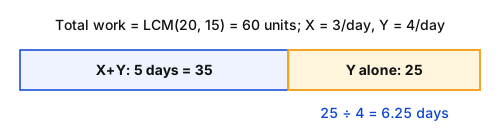
- Work units; X /day, Y /day.
- Together 5 days: units.
- Remaining units.
- Y alone: days.
Trick: LCM method avoids fractions – work in whole units.
Answer: (A) days
अवधारणा: कुल कार्य को दिनों का LCM मानें और प्रति दिन क्षमता निकालें।
- कार्य इकाई; X /दिन, Y /दिन।
- 5 दिन साथ: इकाई।
- शेष इकाई।
- Y अकेले: दिन।
ट्रिक: LCM विधि से भिन्नें नहीं आतीं – पूर्ण इकाइयों में काम करें।
उत्तर: (A) दिन
RRB NTPC Undergraduate CBT 1MathematicsTime and workRRB NTPC Undergraduate CBT 1 2025 · 20 Jun Shift 2
Q60.A vendor uses a 50 g stone in place of a 60 g weight while selling salt. If he sells the salt at the cost price per kilogram, what is his profit percentage on the transaction?
एक विक्रेता नमक बेचते समय 60 g के बाट के स्थान पर 50 g के पत्थर का उपयोग करता है। यदि वह नमक को प्रति किलोग्राम क्रय मूल्य पर बेचता है, तो इस लेन-देन पर उसका लाभ प्रतिशत क्या है?
- A20%
- B18%
- C15%
- D16.67%
Show answer
Concept: .
- He charges for g but gives only g.
- Gain g on g actually given.
- Gain .
Trick: Divide by what the customer actually receives (), not by – is the trap.
Answer: (A)
अवधारणा: ।
- वह g का पैसा लेता है पर देता केवल g है।
- वास्तव में दिए गए g पर लाभ g।
- लाभ ।
ट्रिक: ग्राहक को वास्तव में मिली मात्रा () से भाग दें, से नहीं – जाल है।
उत्तर: (A)
RRB NTPC Undergraduate CBT 1MathematicsFaulty weightsRRB NTPC Undergraduate CBT 1 2025 · 20 Jun Shift 2

