Q581.The ratio of the age of a father and his son at present is 6:1. After 5 years from now, the ratio will become 7:2. Find the present age of the son.
वर्तमान में एक पिता और उसके पुत्र की आयु का अनुपात 6:1 है। अब से 5 वर्ष बाद, यह अनुपात 7:2 हो जाएगा। पुत्र की वर्तमान आयु ज्ञात कीजिए।
- A4 years4 वर्ष
- B8 years8 वर्ष
- C7 years7 वर्ष
- D5 years5 वर्ष
Show answer
Concept: Let present ages be and ; form the equation for the future ratio.
- After 5 years: .
- .
- Son's present age years (father 30; after 5 years ✓).
Trick: Test options: son 5, father 30 35 and 10 instantly.
Answer: (D) 5 years
अवधारणा: वर्तमान आयु और मानकर भविष्य के अनुपात का समीकरण बनाइए।
- 5 वर्ष बाद: ।
- ।
- पुत्र की वर्तमान आयु वर्ष (पिता 30; 5 वर्ष बाद ✓)।
ट्रिक: विकल्प जाँचें: पुत्र 5, पिता 30 35 और 10 ।
उत्तर: (D) 5 years
RRB NTPC Undergraduate CBT 1MathematicsAgesRRB NTPC Undergraduate CBT 1 2025 · 14 Jun Shift 1
Q582.After successive discounts of 15% and 10%, a customer pays ₹3,672. What was the marked price?
15% और 10% की क्रमिक छूट के बाद, एक ग्राहक ₹3,672 का भुगतान करता है। अंकित मूल्य क्या था?
- A₹4,750
- B₹4,700
- C₹4,800
- D₹4,850
Show answer
Concept: .
- Net multiplier .
- .
Trick: Successive and = single discount ; of 4800 .
Answer: (C) ₹4,800
अवधारणा: ।
- शुद्ध गुणक ।
- ।
ट्रिक: क्रमिक व = एकल छूट ; 4800 का ।
उत्तर: (C) ₹4,800
RRB NTPC Undergraduate CBT 1MathematicsSuccessive discountsRRB NTPC Undergraduate CBT 1 2025 · 14 Jun Shift 1
Q583.If 27 and 81 are the first two terms of a proportion and the third proportional to these numbers is used as the length of a rectangle whose width is 4 units, what is the numeric value of the area of the rectangle?
यदि 27 और 81 एक समानुपात के पहले दो पद हैं और इन संख्याओं के तृतीयानुपाती को एक आयत की लंबाई के रूप में उपयोग किया जाता है जिसकी चौड़ाई 4 इकाई है, तो आयत के क्षेत्रफल का संख्यात्मक मान क्या है?
- A972
- B6561
- C729
- D486
Show answer
Concept: Third proportional to and is (since ).
- .
- Area .
Trick: – powers of 3 make it instant.
Answer: (A) 972
अवधारणा: और का तृतीयानुपाती ()।
- ।
- क्षेत्रफल ।
ट्रिक: ।
उत्तर: (A) 972
RRB NTPC Undergraduate CBT 1MathematicsThird proportionalRRB NTPC Undergraduate CBT 1 2025 · 14 Jun Shift 1
Q584.If and , then the value of is
यदि और है, तो का मान है
- A
- B
- C
- D
Show answer
Concept: (divide numerator and denominator by ).
- .
- .
Trick: Both and equal .
Answer: (B)
अवधारणा: (अंश-हर को से भाग दें)।
- ।
- ।
ट्रिक: और दोनों ।
उत्तर: (B)
RRB NTPC Undergraduate CBT 1MathematicsTrigonometric identitiesRRB NTPC Undergraduate CBT 1 2025 · 14 Jun Shift 1
Q585.A new cuboid is formed by placing three cuboids of length 10.5 cm, breadth 6.4 cm, and height 2 cm, one on top of the other. What is the volume of the new cuboid?
10.5 cm लंबाई, 6.4 cm चौड़ाई और 2 cm ऊँचाई वाले तीन घनाभों को एक के ऊपर एक रखकर एक नया घनाभ बनाया जाता है। नए घनाभ का आयतन क्या है?
- A403.2 cm3
- B303.2 cm3
- C503.2 cm3
- D413.2 cm3
Show answer
Concept: Stacking one on top of another adds heights; length and breadth stay the same. .
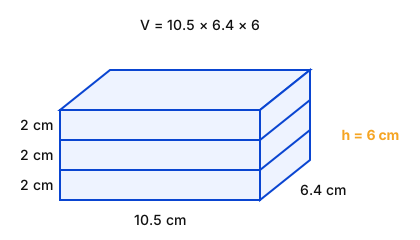
- New height cm.
- .
Trick: Volume of stack volume of one – volumes simply add.
Answer: (A) 403.2 cm3
अवधारणा: एक के ऊपर एक रखने से ऊँचाइयाँ जुड़ती हैं; लंबाई-चौड़ाई वही रहती है। ।
- नई ऊँचाई cm।
- ।
ट्रिक: ढेर का आयतन एक का आयतन – आयतन सीधे जुड़ते हैं।
उत्तर: (A) 403.2 cm3
RRB NTPC Undergraduate CBT 1MathematicsMensuration – cuboidRRB NTPC Undergraduate CBT 1 2025 · 14 Jun Shift 1
Q586.The simple interest on a sum is 25% of the sum in 5 years. Find the rate of interest.
किसी राशि पर 5 वर्षों में साधारण ब्याज उस राशि का 25% है। ब्याज की दर ज्ञात कीजिए।
- A3%
- B5%
- C25%
- D4%
Show answer
Concept: .
- SI of in 5 years .
- per annum.
Trick: In SI, total interest ; so .
Answer: (B) 5%
अवधारणा: ।
- 5 वर्ष में SI का ।
- वार्षिक।
ट्रिक: SI में कुल ब्याज ; अतः ।
उत्तर: (B) 5%
RRB NTPC Undergraduate CBT 1MathematicsSimple interestRRB NTPC Undergraduate CBT 1 2025 · 14 Jun Shift 1
Q587.A person sold an article at a loss of 10%. Had he sold it for ₹60 more, he would have gained 5%. Find the cost price of the article.
एक व्यक्ति ने एक वस्तु को 10% की हानि पर बेचा। यदि उसने इसे ₹60 अधिक में बेचा होता, तो उसे 5% का लाभ होता। वस्तु का क्रय मूल्य ज्ञात कीजिए।
- A₹400
- B₹480
- C₹420
- D₹440
Show answer
Concept: The difference between the two selling prices equals the difference in percentages of CP.
- Loss SP of CP; gain SP of CP.
- Difference of CP .
- CP .
Trick: .
Answer: (A) ₹400
अवधारणा: दोनों विक्रय मूल्यों का अंतर CP के प्रतिशतों का अंतर।
- हानि SP CP; लाभ SP CP।
- अंतर CP ।
- CP ।
ट्रिक: ।
उत्तर: (A) ₹400
RRB NTPC Undergraduate CBT 1MathematicsProfit and lossRRB NTPC Undergraduate CBT 1 2025 · 14 Jun Shift 1
Q588.A shopkeeper offers the following schemes on toys of the same marked price. (A) Successive discounts of 45% and 44% on any number of toys bought.
(B) Successive discounts of 36%, 41% and 45% on any number of toys bought. (C) 49% discount on the first 4 toys and 19% discount on each toy thereon.
(D) 7 toys free of cost on buying 10 toys.
A customer wants to buy 10 toys. Which of the above schemes is the least beneficial to her?
एक दुकानदार समान अंकित मूल्य वाले खिलौनों पर निम्नलिखित योजनाएँ प्रदान करता है। (A) कितने भी खिलौने खरीदने पर 45% और 44% की क्रमिक छूट।
(B) कितने भी खिलौने खरीदने पर 36%, 41% और 45% की क्रमिक छूट। (C) पहले 4 खिलौनों पर 49% छूट और उसके बाद प्रत्येक खिलौने पर 19% छूट।
(D) 10 खिलौने खरीदने पर 7 खिलौने निःशुल्क।
एक ग्राहक 10 खिलौने खरीदना चाहती है। उपर्युक्त में से कौन-सी योजना उसके लिए सबसे कम लाभदायक है?
- AB
- BD
- CC
- DA
Show answer
Concept: Compare the effective price paid per toy (MP ) under each scheme; the highest is the least beneficial.
- (A) per toy.
- (B) per toy.
- (C) 10 toys: per toy.
- (D) Pay for 10, get 17: per toy.
- Highest cost per toy is scheme C.
Trick: Big successive discounts (45% then 44%) are far stronger than one 49% on only a few items – always compute per-unit cost.
Answer: (C) C
अवधारणा: हर योजना में प्रति खिलौना प्रभावी कीमत (MP ) निकालें; सबसे अधिक वाली योजना सबसे कम लाभकारी।
- (A) प्रति खिलौना।
- (B) ।
- (C) 10 खिलौने: प्रति खिलौना।
- (D) 10 का भुगतान, 17 मिले: ।
- सबसे अधिक प्रति-खिलौना कीमत योजना C में।
ट्रिक: बड़ी क्रमिक छूट (45% फिर 44%) केवल कुछ वस्तुओं पर 49% से कहीं अधिक प्रभावी – हमेशा प्रति-इकाई कीमत निकालें।
उत्तर: (C) C
RRB NTPC Undergraduate CBT 1MathematicsDiscount schemes comparisonRRB NTPC Undergraduate CBT 1 2025 · 14 Jun Shift 1
Q589.What is the smallest number that must be added to 45873 so that the sum is divisible by 11?
45873 में कौन-सी सबसे छोटी संख्या जोड़ी जानी चाहिए ताकि योगफल 11 से विभाज्य हो?
- A4
- B6
- C8
- D9
Show answer
Concept: A number is divisible by 11 if (sum of digits at odd places) (sum at even places) is 0 or a multiple of 11.
- 45873 from the right: .
- So (check: , remainder 3).
- Add to reach the next multiple: .
Trick: Number to add ; number to subtract remainder.
Answer: (C) 8
अवधारणा: विषम स्थानों के अंकों का योग सम स्थानों का योग, 0 या 11 का गुणज हो तो संख्या 11 से विभाज्य।
- 45873 दाएँ से: ।
- अतः शेषफल 3 (जाँच: )।
- जोड़ें : ।
ट्रिक: जोड़ने वाली संख्या ; घटाने वाली शेष।
उत्तर: (C) 8
RRB NTPC Undergraduate CBT 1MathematicsDivisibility by 11RRB NTPC Undergraduate CBT 1 2025 · 14 Jun Shift 1
Q590.Two inlet pipes A and B can fill a cistern in 15 hours and 20 hours respectively. An outlet pipe C can empty the cistern in 30 hours. All three pipes are opened together, but the outlet pipe is closed after 5 hours. The total time (in hours) required to fill the cistern completely is
दो इनलेट पाइप A और B एक टंकी को क्रमशः 15 घंटे और 20 घंटे में भर सकते हैं। एक आउटलेट पाइप C टंकी को 30 घंटे में खाली कर सकता है। तीनों पाइप एक साथ खोले जाते हैं, लेकिन आउटलेट पाइप को 5 घंटे बाद बंद कर दिया जाता है। टंकी को पूरी तरह भरने में लगने वाला कुल समय (घंटों में) है
- A
- B9
- C10
- D
Show answer
Concept: Take capacity units; inlets add, outlet subtracts.
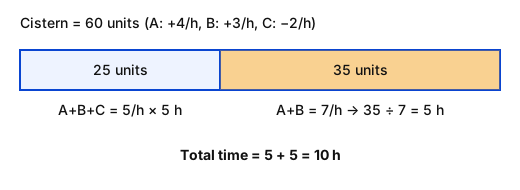
- A , B , C units/h.
- First 5 h: units filled.
- Remaining units with A+B /h: h.
- Total h.
Trick: Work in units of LCM – fractions vanish and the two phases become simple subtraction.
Answer: (C) 10
अवधारणा: क्षमता इकाई; इनलेट जोड़ते हैं, आउटलेट घटाता है।
- A , B , C इकाई/घंटा।
- पहले 5 h: इकाई।
- शेष इकाई A+B /h से: h।
- कुल h।
ट्रिक: LCM इकाइयों में काम करें – भिन्न गायब, दोनों चरण सरल घटाव बन जाते हैं।
उत्तर: (C) 10
RRB NTPC Undergraduate CBT 1MathematicsPipes and cisternsRRB NTPC Undergraduate CBT 1 2025 · 14 Jun Shift 1
Q591.The sum of the digits of a two digit number is 11. If 27 is added to the number its digits are reversed. Find the ratio between the original number to the number obtained on reversing the digits.
दो अंकों वाली एक संख्या के अंकों का योग 11 है। यदि संख्या में 27 जोड़ दिया जाए, तो उसके अंक उलट जाते हैं। मूल संख्या और अंकों को उलटने पर प्राप्त संख्या का अनुपात ज्ञात कीजिए।
- A36:59
- B47:74
- C13:17
- D23:29
Show answer
Concept: Number ; reversing gives ; their difference .
- and .
- : number , reversed .
- Ratio .
Trick: Adding 27 reverses digits digits differ by ; with sum 11 the digits are 4 and 7.
Answer: (B) 47:74
अवधारणा: संख्या ; उलटने पर ; अंतर ।
- और ।
- : संख्या , उलटी ।
- अनुपात ।
ट्रिक: 27 जोड़ने पर अंक उलटें अंकों का अंतर ; योग 11 से अंक 4 और 7।
उत्तर: (B) 47:74
RRB NTPC Undergraduate CBT 1MathematicsTwo-digit numbersRRB NTPC Undergraduate CBT 1 2025 · 14 Jun Shift 1
Q592.ABCD is a quadrilateral in which AB ∥ DC, and E and F are the mid points of the diagonals AC and BD, respectively. If AB = 24 cm, BC = 62 cm, DC = 92 cm, and AD = 95 cm, then what is the length (in cm) of EF?
ABCD एक चतुर्भुज है जिसमें AB ∥ DC है, और E तथा F क्रमशः विकर्णों AC और BD के मध्य-बिंदु हैं। यदि AB = 24 cm, BC = 62 cm, DC = 92 cm और AD = 95 cm है, तो EF की लंबाई (cm में) क्या है?
- A34
- B29
- C39
- D36
Show answer
Concept: In a trapezium, the segment joining the midpoints of the diagonals is parallel to the parallel sides and equals half their difference.
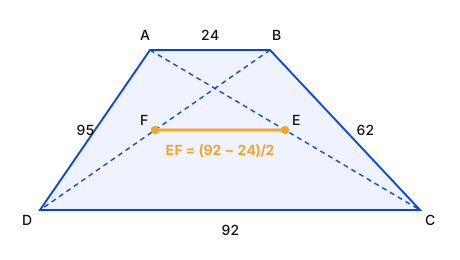
- .
- cm.
- The lengths and are not needed.
Trick: Midpoints of non-parallel sides ; midpoints of diagonals .
Answer: (A) 34
अवधारणा: समलंब में विकर्णों के मध्य-बिंदुओं को मिलाने वाला खंड समांतर भुजाओं के समांतर होता है और उनके अंतर का आधा होता है।
- ।
- cm।
- और की आवश्यकता नहीं।
ट्रिक: असमांतर भुजाओं के मध्य-बिंदु ; विकर्णों के मध्य-बिंदु ।
उत्तर: (A) 34
RRB NTPC Undergraduate CBT 1MathematicsGeometry – trapezium midpointsRRB NTPC Undergraduate CBT 1 2025 · 14 Jun Shift 1
Q593.The simplified value of the expression is 1, then the value of is ______.
व्यंजक का सरलीकृत मान 1 है, तो का मान ______ है।
- A12.5
- B25
- C6.25
- D50
Show answer
Concept: Write every term as powers of 2 and 5, then simplify.
- , , , , .
- Product .
- .
Trick: In powers: .
Answer: (A) 12.5
अवधारणा: हर पद को 2 और 5 की घातों में लिखकर सरल करें।
- , , , , ।
- गुणनफल ।
- ।
ट्रिक: घातों में: ।
उत्तर: (A) 12.5
RRB NTPC Undergraduate CBT 1MathematicsIndices (exponents)RRB NTPC Undergraduate CBT 1 2025 · 14 Jun Shift 1
Q594.Find the value of m which satisfies
m का वह मान ज्ञात कीजिए जो निम्नलिखित को संतुष्ट करता है
- A
- B
- C
- D
Show answer
Concept: ; with the same base, equate exponents.
- LHS .
- .
Trick: Flip the fraction change the sign of the exponent; then just add exponents.
Answer: (D)
अवधारणा: ; समान आधार पर घातांक बराबर करें।
- LHS ।
- ।
ट्रिक: भिन्न पलटें घातांक का चिह्न बदलें; फिर घातांक जोड़ दें।
उत्तर: (D)
RRB NTPC Undergraduate CBT 1MathematicsLaws of exponentsRRB NTPC Undergraduate CBT 1 2025 · 14 Jun Shift 1
Q595.Three numbers are in the ratio 11 : 3 : 2, and their LCM is 2706. Their HCF is:
तीन संख्याएँ 11 : 3 : 2 के अनुपात में हैं, और उनका LCM 2706 है। उनका HCF है:
- A41
- B30
- C50
- D82
Show answer
Concept: Numbers in ratio (co-prime) are ; HCF and LCM .
- Numbers ; .
- .
- HCF .
Trick: .
Answer: (A) 41
अवधारणा: अनुपात (सह-अभाज्य) वाली संख्याएँ ; HCF , LCM ।
- संख्याएँ ; ।
- ।
- HCF ।
ट्रिक: ।
उत्तर: (A) 41
RRB NTPC Undergraduate CBT 1MathematicsLCM and HCF with ratioRRB NTPC Undergraduate CBT 1 2025 · 14 Jun Shift 1
Q596.A and B can do a piece of work in 12 days and 18 days, respectively. Both work for 2 days and then A leaves. How long (in days) will B take to complete the remaining work?
A और B किसी कार्य को क्रमशः 12 दिन और 18 दिन में कर सकते हैं। दोनों 2 दिन तक कार्य करते हैं और फिर A चला जाता है। शेष कार्य को पूरा करने में B कितना समय (दिनों में) लेगा?
- A15
- B14
- C13
- D12
Show answer
Concept: Total work units; efficiency work per day.
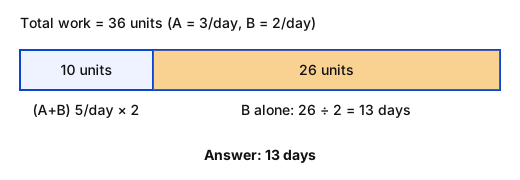
- A units/day, B units/day.
- In 2 days together: units; remaining .
- B alone: days.
Trick: Fractions: done ; left days.
Answer: (C) 13
अवधारणा: कुल कार्य इकाई; दक्षता प्रतिदिन कार्य।
- A , B इकाई/दिन।
- 2 दिन साथ: इकाई; शेष ।
- B अकेला: दिन।
ट्रिक: भिन्न से: हुआ ; शेष दिन।
उत्तर: (C) 13
RRB NTPC Undergraduate CBT 1MathematicsTime and workRRB NTPC Undergraduate CBT 1 2025 · 14 Jun Shift 1
Q597.What is the correct ascending order of the following ratios?
11:15, 23:55, 32:33, 4:11, 26:35
निम्नलिखित अनुपातों का सही आरोही क्रम क्या है?
11:15, 23:55, 32:33, 4:11, 26:35
- A4:11, 23:55, 11:15, 26:35, 32:33
- B4:11, 26:35, 11:15, 23:55, 32:33
- C4:11, 11:15, 23:55, 26:35, 32:33
- D4:11, 23:55, 26:35, 11:15, 32:33
Show answer
Concept: Convert each ratio to a decimal and arrange.
- , , , , .
- Ascending: .
Trick: Only vs is close – cross-multiply: , so is smaller.
Answer: (A) 4:11, 23:55, 11:15, 26:35, 32:33
अवधारणा: हर अनुपात को दशमलव में बदलकर क्रम लगाएँ।
- , , , , ।
- आरोही: ।
ट्रिक: केवल और पास हैं – वज्र-गुणन: , अतः छोटा।
उत्तर: (A) 4:11, 23:55, 11:15, 26:35, 32:33
RRB NTPC Undergraduate CBT 1MathematicsComparing ratiosRRB NTPC Undergraduate CBT 1 2025 · 14 Jun Shift 1
Q598.A sum of ₹10,000 is invested at a compound interest rate of 10% per annum for 2 years, compounded annually. What is the compound interest earned?
₹10,000 की राशि को 2 वर्षों के लिए 10% वार्षिक चक्रवृद्धि ब्याज दर पर निवेश किया जाता है, ब्याज वार्षिक रूप से संयोजित होता है। अर्जित चक्रवृद्धि ब्याज क्या है?
- A₹1,900
- B₹2,000
- C₹2,200
- D₹2,100
Show answer
Concept: ; CI .
- .
- CI .
Trick: 2-year CI rate of 10,000 .
Answer: (D) ₹2,100
अवधारणा: ; CI ।
- ।
- CI ।
ट्रिक: 2 वर्ष की प्रभावी CI दर ; 10,000 का ।
उत्तर: (D) ₹2,100
RRB NTPC Undergraduate CBT 1MathematicsCompound interestRRB NTPC Undergraduate CBT 1 2025 · 14 Jun Shift 1
Q599.Evaluate 253 + (-20)3 + (-5)3
253 + (-20)3 + (-5)3 का मान ज्ञात कीजिए।
- A7244
- B7467
- C7500
- D7360
Show answer
Concept: If , then .
- ✓.
- .
Trick: Whenever three numbers sum to zero, skip the cubes and use .
Answer: (C) 7500
अवधारणा: यदि , तो ।
- ✓।
- ।
ट्रिक: तीन संख्याओं का योग शून्य हो तो घन निकालने की जगह सीधे लगाएँ।
उत्तर: (C) 7500
RRB NTPC Undergraduate CBT 1MathematicsAlgebraic identity a³+b³+c³RRB NTPC Undergraduate CBT 1 2025 · 14 Jun Shift 1
Q600.Meena and her mother visit a shop. The shopkeeper tells them that the price of 5 identical dresses is ₹4,955. Meena buys 9 such dresses. Find the total cost of the 9 dresses.
मीना और उसकी माँ एक दुकान पर जाती हैं। दुकानदार उन्हें बताता है कि 5 एक जैसी पोशाकों का मूल्य ₹4,955 है। मीना ऐसी 9 पोशाकें खरीदती है। 9 पोशाकों का कुल मूल्य ज्ञात कीजिए।
- A₹8,919
- B₹8,199
- C₹8,099
- D₹8,991
Show answer
Concept: Find the cost of one unit, then multiply.
- Cost of 1 dress .
- Cost of 9 dresses .
Trick: .
Answer: (A) ₹8,919
अवधारणा: एक इकाई की कीमत निकालकर गुणा करें।
- 1 ड्रेस ।
- 9 ड्रेस ।
ट्रिक: ।
उत्तर: (A) ₹8,919
RRB NTPC Undergraduate CBT 1MathematicsUnitary methodRRB NTPC Undergraduate CBT 1 2025 · 14 Jun Shift 1

