Q601.An amount of ₹120 is paid using coins of ₹10, ₹5 and ₹2. If the numbers of ₹10 and ₹2 coins are interchanged, the amount will become ₹304. If the numbers of ₹5 and ₹2 coins are interchanged, the amount will become ₹165. How many ₹2 coins must have been used in the payment of ₹120?
₹10, ₹5 और ₹2 के सिक्कों का उपयोग करके ₹120 की राशि का भुगतान किया जाता है। यदि ₹10 और ₹2 के सिक्कों की संख्या आपस में बदल दी जाए, तो राशि ₹304 हो जाएगी। यदि ₹5 और ₹2 के सिक्कों की संख्या आपस में बदल दी जाए, तो राशि ₹165 हो जाएगी। तो ₹120 के भुगतान में ₹2 के कितने सिक्कों का उपयोग किया गया होगा?
- A20
- B10
- C25
- D15
Show answer
Concept: Form equations from the three situations and subtract them pairwise.
- Let the numbers of ₹10, ₹5, ₹2 coins be : …(1)
- Swapping ₹10 and ₹2 counts: …(2); swapping ₹5 and ₹2: …(3)
- (2)−(1): . (1)−(3): .
- Put in (1): .
Trick: When counts are swapped, subtracting the equations removes the unchanged coin at once — the difference depends only on the two swapped counts.
Answer: (C) 25
अवधारणा: तीनों स्थितियों से समीकरण बनाकर उन्हें जोड़े में घटाएँ।
- ₹10, ₹5, ₹2 के सिक्कों की संख्या मानें: …(1)
- ₹10 और ₹2 की संख्या बदलने पर: …(2); ₹5 और ₹2 बदलने पर: …(3)
- (2)−(1): । (1)−(3): ।
- को (1) में रखें: ।
ट्रिक: संख्याएँ अदला-बदली होने पर समीकरण घटाने से बिना बदला सिक्का तुरंत कट जाता है — अंतर केवल बदले गए दो सिक्कों पर निर्भर करता है।
उत्तर: (C) 25
RRB NTPC Undergraduate CBT 1MathematicsLinear equations (coins)RRB NTPC Undergraduate CBT 1 2025 · 9 May Shift 3
Q602.If , then find the value of .
यदि हो, तो का मान ज्ञात कीजिए।
- A
- B
- C
- D
Show answer
Concept: From (base 4, hypotenuse 5, perpendicular 3) write every ratio, then substitute.
- , so .
- Numerator: .
- Divide by : .
Trick: The 3-4-5 triple gives all six ratios instantly; keep denominators 25 and 16 separate and combine only at the end (LCM 400).
Answer: (B)
अवधारणा: (आधार 4, कर्ण 5, लम्ब 3) से सभी अनुपात लिखकर मान रखें।
- , अतः ।
- अंश: ।
- से भाग: ।
ट्रिक: 3-4-5 त्रिक से छहों अनुपात तुरंत मिल जाते हैं; हर 25 और 16 को अलग रखें और अंत में LCM 400 पर जोड़ें।
उत्तर: (B)
RRB NTPC Undergraduate CBT 1MathematicsTrigonometric ratiosRRB NTPC Undergraduate CBT 1 2025 · 9 May Shift 3
Q603.A dishonest shopkeeper claims to sell his goods at a 35% loss, but earns an 85% profit by using a false weighing scale (balance). Find the actual weight (correct to one decimal place) that he uses for 1 kg.
एक बेईमान दुकानदार अपने माल को 35% हानि पर बेचने का दावा करता है, परंतु गलत तौल वाले तराज़ू का उपयोग करके 85% लाभ कमाता है। 1 kg के लिए वह जिस वास्तविक भार (एक दशमलव स्थान तक) का उपयोग करता है, उसे ज्ञात कीजिए।
- A349.4 gm
- B347.2 gm
- C348.5 gm
- D351.4 gm
Show answer
Concept: Price charged of the cost of 1 kg, yet the actual profit on goods given is .
- Let cost of 1000 g ₹1000 (₹1 per g). Selling price of a "kg" ₹650.
- Let the true weight given be g, costing ₹. Profit : .
- g.
Trick: .
Answer: (D) 351.4 gm
अवधारणा: वसूली गई कीमत 1 kg की लागत का है, फिर भी दिए गए माल पर वास्तविक लाभ है।
- 1000 g की लागत ₹1000 मानें (₹1 प्रति g)। एक "kg" का विक्रय मूल्य ₹650।
- वास्तविक वज़न g (लागत ₹)। लाभ: ।
- g।
ट्रिक: ।
उत्तर: (D) 351.4 gm
RRB NTPC Undergraduate CBT 1MathematicsDishonest dealer (false weight)RRB NTPC Undergraduate CBT 1 2025 · 9 May Shift 3
Q604.On what sum (in ₹) will a simple interest of ₹1,440 be obtained in 2 years at an interest rate of 12% per annum?
कितनी राशि (₹ में) पर 12% वार्षिक ब्याज दर से 2 वर्षों में ₹1,440 साधारण ब्याज प्राप्त होगा?
- A12,000
- B345.6
- C3,000
- D6,000
Show answer
Concept: .
- .
- .
Trick: for 2 years of the sum; , so and .
Answer: (D) 6,000
अवधारणा: ।
- ।
- ।
ट्रिक: 2 वर्ष का = मूलधन का ; तो और ।
उत्तर: (D) 6,000
RRB NTPC Undergraduate CBT 1MathematicsSimple interestRRB NTPC Undergraduate CBT 1 2025 · 9 May Shift 3
Q605.The ratio of three numbers is 4 : 3 : 13 and their LCM is 4524. Find their HCF.
तीन संख्याओं का अनुपात 4 : 3 : 13 है और उनका ल.स. 4524 है, तो उनका म.स. ज्ञात कीजिए।
- A21
- B29
- C45
- D49
Show answer
Concept: If numbers are with co-prime, then HCF and LCM .
- .
- HCF .
Trick: For co-prime ratio terms, .
Answer: (B) 29
अवधारणा: संख्याएँ हों और सह-अभाज्य हों, तो HCF और LCM ।
- ।
- HCF ।
ट्रिक: सह-अभाज्य अनुपात पदों के लिए ।
उत्तर: (B) 29
RRB NTPC Undergraduate CBT 1MathematicsLCM and HCF with ratioRRB NTPC Undergraduate CBT 1 2025 · 9 May Shift 3
Q606.A shopkeeper marks the price of an article 40% above its cost price and gives a discount of 25% on it. What will be his profit or loss percentage?
एक दुकानदार एक वस्तु पर उसके क्रय मूल्य से 40% अधिक मूल्य अंकित करता है और उस पर 25% की छूट देता है। तो उसे कितने प्रतिशत लाभ या हानि होगी?
- A15% loss15% हानि
- B15% profit15% लाभ
- C5% profit5% लाभ
- D5% loss5% हानि
Show answer
Concept: .
- Let . Marked price .
- .
- Profit .
Trick: Net profit.
Answer: (C) 5% profit
अवधारणा: ।
- मानें। अंकित मूल्य ।
- ।
- लाभ ।
ट्रिक: शुद्ध लाभ।
उत्तर: (C) 5% लाभ
RRB NTPC Undergraduate CBT 1MathematicsMark-up and discountRRB NTPC Undergraduate CBT 1 2025 · 9 May Shift 3
Q607.A shopkeeper offers the following schemes on toys of the same marked price.
(A) Successive discounts of 34% and 37% on toys bought in any quantity.
(B) Successive discounts of 36%, 15% and 14% on toys bought in any quantity.
(C) 33% discount on the first 6 toys and thereafter 9% discount on each toy.
(D) 3 toys free on the purchase of 9 toys.
A customer wants to buy 9 toys. Which of the above schemes is the least beneficial for him?
एक दुकानदार समान अंकित मूल्य वाले खिलौनों पर निम्नलिखित योजनाएँ प्रस्तुत करता है।
(A) किसी भी संख्या में खरीदे गए खिलौनों पर 34% और 37% की क्रमिक छूट।
(B) किसी भी संख्या में खरीदे गए खिलौनों पर 36%, 15% और 14% की क्रमिक छूट।
(C) पहले 6 खिलौनों पर 33% की छूट और उसके बाद प्रत्येक खिलौने पर 9% की छूट।
(D) 9 खिलौने खरीदने पर 3 खिलौने मुफ़्त।
एक ग्राहक 9 खिलौने खरीदना चाहता है। उपर्युक्त में से कौन-सी योजना उसके लिए सबसे कम लाभदायक है?
- AC
- BA
- CB
- DD
Show answer
Concept: Find what fraction of the marked price is actually paid for 9 toys under each scheme; the scheme with the highest payment is least beneficial.
- A: pays .
- B: pays .
- C: toys' price for 9 pays and gets exactly 9 toys.
- D: pay for 9, get 12 — effective price per toy plus 3 extra toys, so D is at least as good as C. Hence C is the least beneficial.
Trick: Convert every offer to "paid fraction of MP"; successive discounts multiply .
Answer: (A) C
अवधारणा: हर स्कीम में 9 खिलौनों के लिए अंकित मूल्य का कितना भाग देना पड़ता है, निकालें; सबसे अधिक भुगतान वाली स्कीम सबसे कम लाभदायक है।
- A: भुगतान।
- B: भुगतान।
- C: खिलौनों की कीमत में 9 खिलौने भुगतान।
- D: 9 का भुगतान, 12 खिलौने — प्रति खिलौना प्रभावी और 3 अतिरिक्त खिलौने भी, अतः D कम-से-कम C जितनी अच्छी है। इसलिए C सबसे कम लाभदायक।
ट्रिक: हर ऑफ़र को "MP का भुगतान-अंश" में बदलें; क्रमिक छूट गुणा होती है ।
उत्तर: (A) C
RRB NTPC Undergraduate CBT 1MathematicsSuccessive discounts (schemes)RRB NTPC Undergraduate CBT 1 2025 · 9 May Shift 3
Q608.Two pipes can fill a tank in 4 hours and 16 hours, respectively. A third pipe can empty it in 4 hours. If all three pipes are opened together, how much time (in hours) will it take to fill one-fourth of the empty tank?
दो नल एक टंकी को क्रमशः 4 घंटे और 16 घंटे में भर सकते हैं। तीसरा नल उसे 4 घंटे में खाली कर सकता है। यदि तीनों नल एक साथ खोल दिए जाएँ, तो खाली टंकी का एक-चौथाई भाग भरने में कितना समय (घंटों में) लगेगा?
- A16
- B12
- C8
- D4
Show answer
Concept: Take tank units (LCM of 4, 16, 4) and add the hourly rates with sign.
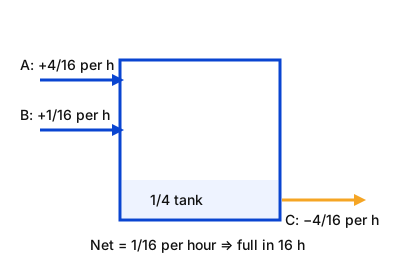
- Rates: , , units/hour.
- Net unit/hour.
- One-fourth of tank units hours.
Trick: Here the emptying pipe exactly cancels the faster filler, so only the 16-hour pipe effectively works: h.
Answer: (D) 4
अवधारणा: टंकी इकाई (4, 16, 4 का LCM) मानकर प्रति घंटा दरें चिह्न सहित जोड़ें।
- दरें: , , इकाई/घंटा।
- शुद्ध इकाई/घंटा।
- टंकी का चौथाई इकाई घंटे।
ट्रिक: खाली करने वाला नल तेज़ भरने वाले नल को पूरी तरह काट देता है, अतः केवल 16-घंटे वाला नल प्रभावी है: घंटे।
उत्तर: (D) 4
RRB NTPC Undergraduate CBT 1MathematicsPipes and cisternsRRB NTPC Undergraduate CBT 1 2025 · 9 May Shift 3
Q609.A shopkeeper keeps the marked price of a jacket at ₹2,000. He gives a 20% discount on it, but charges 5% GST on the price after discount. What is the final price the customer has to pay for the jacket?
एक दुकानदार एक जैकेट का अंकित मूल्य ₹2,000 रखता है। वह उस पर 20% की छूट देता है, परंतु छूट के बाद के मूल्य पर 5% GST लगाता है। तो ग्राहक को जैकेट के लिए अंततः कितना मूल्य चुकाना होगा?
- A₹1,596
- B₹1,680
- C₹1,880
- D₹1,700
Show answer
Concept: Apply the discount first, then the tax on the discounted price.
- After discount: .
- Add GST: .
Trick: Net multiplier ; .
Answer: (B) ₹1,680
अवधारणा: पहले छूट लगाएँ, फिर छूट वाले मूल्य पर कर जोड़ें।
- छूट के बाद: ।
- GST जोड़ें: ।
ट्रिक: शुद्ध गुणक ; ।
उत्तर: (B) ₹1,680
RRB NTPC Undergraduate CBT 1MathematicsDiscount and GSTRRB NTPC Undergraduate CBT 1 2025 · 9 May Shift 3
Q610.If the expression x3- 3x2- 7x - k is divisible by (x - 5), then find the value of k.
यदि व्यंजक x3- 3x2- 7x - k, (x - 5) से विभाज्य हो, तो k का मान ज्ञात कीजिए।
- A-5
- B15
- C-15
- D5
Show answer
Concept: If divides , then .
- .
- .
Trick: Never divide — just substitute the root and solve for the unknown.
Answer: (B) 15
अवधारणा: यदि , को विभाजित करे तो ।
- ।
- ।
ट्रिक: भाग देने की ज़रूरत नहीं — मूल रखकर अज्ञात निकालें।
उत्तर: (B) 15
RRB NTPC Undergraduate CBT 1MathematicsFactor theoremRRB NTPC Undergraduate CBT 1 2025 · 9 May Shift 3
Q611.The arithmetic mean of 25 observations is 32.6. If the arithmetic mean of the first 24 observations is 30, then find the 25th observation.
25 प्रेक्षणों का समांतर माध्य 32.6 है। यदि पहले 24 प्रेक्षणों का समांतर माध्य 30 हो, तो 25वाँ प्रेक्षण ज्ञात कीजिए।
- A80
- B90
- C95
- D85
Show answer
Concept: Sum mean count.
- Sum of 25 .
- Sum of first 24 .
- 25th .
Trick: 25th observation (it lifts all 25 by 2.6 above 30).
Answer: (C) 95
अवधारणा: योग माध्य संख्या।
- 25 का योग ।
- पहले 24 का योग ।
- 25वाँ ।
ट्रिक: 25वाँ अवलोकन (यह सभी 25 को 30 से 2.6 ऊपर उठाता है)।
उत्तर: (C) 95
RRB NTPC Undergraduate CBT 1MathematicsArithmetic meanRRB NTPC Undergraduate CBT 1 2025 · 9 May Shift 3
Q612.What is the third proportional to 0.25 and 0.15?
0.25 और 0.15 का तृतीयानुपाती क्या है?
- A0.02
- B0.09
- C0.15
- D0.04
Show answer
Concept: Third proportional of and is .
- .
Trick: , so .
Answer: (B) 0.09
अवधारणा: और का तृतीयानुपाती ।
- ।
ट्रिक: , अतः ।
उत्तर: (B) 0.09
RRB NTPC Undergraduate CBT 1MathematicsThird proportionalRRB NTPC Undergraduate CBT 1 2025 · 9 May Shift 3
Q613.The circumradius of a regular octagonal fountain is 10 m. Find the approximate length of each of its sides.
एक सम अष्टभुजाकार फव्वारे की परित्रिज्या 10 m है। तो उसकी प्रत्येक भुजा की लगभग लंबाई ज्ञात कीजिए।
- A6.13 m
- B8.71 m
- C7.65 m
- D9.27 m
Show answer
Concept: Each side of a regular -gon subtends at the centre; side .
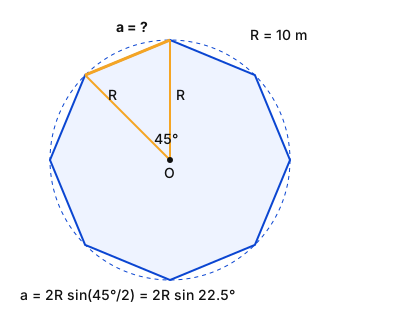
- For an octagon the central angle is , so side .
- side m.
Yaad rakhein: Regular octagon: ; regular hexagon: side .
Answer: (C) 7.65 m
अवधारणा: सम -भुज की हर भुजा केंद्र पर कोण बनाती है; भुजा ।
- अष्टभुज में केंद्रीय कोण , अतः भुजा ।
- भुजा m।
याद रखें: सम अष्टभुज: ; सम षट्भुज: भुजा ।
उत्तर: (C) 7.65 m
RRB NTPC Undergraduate CBT 1MathematicsRegular octagon (circumradius)RRB NTPC Undergraduate CBT 1 2025 · 9 May Shift 3
Q614.Simplify:
सरल कीजिए:
- A
- B
- C
- D
Show answer
Concept: Brackets first, then "of", then and , finally .
- .
- ; so .
- ; .
- Total .
Trick: "of" binds tighter than — compute before dividing.
Answer: (A)
अवधारणा: पहले कोष्ठक, फिर "of", फिर व , अंत में ।
- ।
- ; अतः ।
- ; ।
- योग ।
ट्रिक: "of" को से पहले हल करें — पहले निकालें।
उत्तर: (A)
RRB NTPC Undergraduate CBT 1MathematicsSimplification (BODMAS)RRB NTPC Undergraduate CBT 1 2025 · 9 May Shift 3
Q615.The HCF and LCM of two numbers are 25 and 500, respectively. If the first number is divided by 2, the quotient is 50 and the remainder is zero. Find the second number.
दो संख्याओं का म.स. और ल.स. क्रमशः 25 और 500 है। यदि पहली संख्या को 2 से भाग दिया जाए, तो भागफल 50 और शेषफल शून्य प्राप्त होता है। तो दूसरी संख्या ज्ञात कीजिए।
- A50
- B125
- C250
- D100
Show answer
Concept: For two numbers, .
- First number .
- Second .
Trick: Check: HCF(100,125)=25 and LCM=500 ✓.
Answer: (B) 125
अवधारणा: दो संख्याओं के लिए ।
- पहली संख्या ।
- दूसरी ।
ट्रिक: जाँच: HCF(100,125)=25 और LCM=500 ✓।
उत्तर: (B) 125
RRB NTPC Undergraduate CBT 1MathematicsHCF × LCM = productRRB NTPC Undergraduate CBT 1 2025 · 9 May Shift 3
Q616.The fourth proportional to 4, 6 and 8 is m. The third proportional to 8 and m is n. Then, what is the value of n?
4, 6 और 8 का चतुर्थानुपाती m है। 8 और m का तृतीयानुपाती n है। तो, n का मान क्या है?
- A20
- B18
- C24
- D16
Show answer
Concept: Fourth proportional of is ; third proportional of is .
- .
- .
Trick: , so .
Answer: (B) 18
अवधारणा: का चतुर्थानुपाती ; का तृतीयानुपाती ।
- ।
- ।
ट्रिक: , अतः ।
उत्तर: (B) 18
RRB NTPC Undergraduate CBT 1MathematicsFourth and third proportionalRRB NTPC Undergraduate CBT 1 2025 · 9 May Shift 3
Q617.A square is drawn inside another square in such a way that each vertex of the inner square lies on the midpoint of a side of the outer square. If the perimeter of the inner square is 40 cm, find the perimeter of the outer square.
एक वर्ग के अंदर दूसरा वर्ग इस प्रकार बनाया जाता है कि अंदर वाले वर्ग का प्रत्येक शीर्ष बाहरी वर्ग की भुजा के मध्य-बिंदु पर स्थित हो। यदि अंदर वाले वर्ग का परिमाप 40 cm हो, तो बाहरी वर्ग का परिमाप ज्ञात कीजिए।
- A cm
- B40 cm
- C cm
- D cm
Show answer
Concept: Joining the midpoints of a square's sides gives an inner square whose side is the hypotenuse of a right triangle with legs .
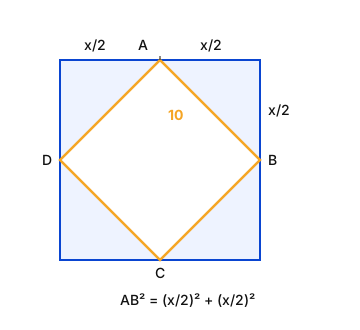
- Inner perimeter 40 cm inner side cm.
- cm.
- Outer perimeter cm.
Yaad rakhein: Midpoint square has half the area of the outer square, so its side is of the outer side — outer perimeter inner perimeter.
Answer: (A) cm
अवधारणा: वर्ग की भुजाओं के मध्यबिंदु जोड़ने पर बना भीतरी वर्ग, भुजाओं वाले समकोण त्रिभुज का कर्ण होता है।
- भीतरी परिमाप 40 cm भीतरी भुजा cm।
- cm।
- बाहरी परिमाप cm।
याद रखें: मध्यबिंदु वर्ग का क्षेत्रफल बाहरी वर्ग का आधा होता है, अतः बाहरी परिमाप भीतरी परिमाप।
उत्तर: (A) cm
RRB NTPC Undergraduate CBT 1MathematicsSquare inscribed in a squareRRB NTPC Undergraduate CBT 1 2025 · 9 May Shift 3
Q618.Five friends participated in a cooking contest and scored 6, 8, 7, 9 and 5 marks out of 10, respectively. What is the arithmetic mean of their marks?
पाँच मित्रों ने एक पाक-कला प्रतियोगिता (Cooking contest) में भाग लिया और 10 में से क्रमशः 6, 8, 7, 9 और 5 अंक प्राप्त किए। तो उनके अंकों का समांतर माध्य क्या है?
- A6.5
- B7
- C8.5
- D8
Show answer
Concept: Mean .
- Sum .
- Mean .
Trick: Deviations from 7 are , which cancel — so the mean is 7.
Answer: (B) 7
अवधारणा: माध्य ।
- योग ।
- माध्य ।
ट्रिक: 7 से विचलन आपस में कट जाते हैं — अतः माध्य 7।
उत्तर: (B) 7
RRB NTPC Undergraduate CBT 1MathematicsArithmetic meanRRB NTPC Undergraduate CBT 1 2025 · 9 May Shift 3
Q619.A can complete a work in 9 days, while each of B and C can complete it in 18 days. All three start working together and work for x days. Then A leaves the work, and B and C together complete the remaining work in x days. Find the value of x.
A एक कार्य को 9 दिनों में पूरा कर सकता है, जबकि B और C में से प्रत्येक उस कार्य को 18 दिनों में पूरा कर सकता है। तीनों मिलकर कार्य करना शुरू करते हैं और x दिनों तक कार्य करते हैं। उसके बाद A कार्य छोड़ देता है, B और C मिलकर शेष कार्य x दिनों में पूरा करते हैं। तो x का मान ज्ञात कीजिए।
- A4.5
- B4
- C3
- D3.5
Show answer
Concept: Take total work units (LCM of 9 and 18) and count units done in each phase.
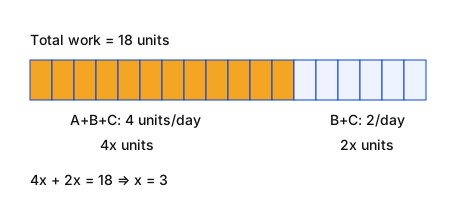
- Rates: , , units/day.
- All three for days: units; B and C for days: units.
- .
Trick: Both phases last days, so the average rate is units/day over days: .
Answer: (C) 3
अवधारणा: कुल कार्य इकाई (9 और 18 का LCM) मानकर हर चरण की इकाइयाँ गिनें।
- दरें: , , इकाई/दिन।
- तीनों दिन: इकाई; B और C दिन: इकाई।
- ।
ट्रिक: दोनों चरण दिन के हैं, अतः औसत दर इकाई/दिन, दिनों में: ।
उत्तर: (C) 3
RRB NTPC Undergraduate CBT 1MathematicsTime and workRRB NTPC Undergraduate CBT 1 2025 · 9 May Shift 3
Q620.The price of fuel decreases by 55%, 35% and 45%, respectively, in three consecutive months, but increases by 40% in the fourth month. By what percentage will the price of fuel have decreased in the fourth month compared to its original price? (Round off the answer to 2 decimal places.)
ईंधन के मूल्य में लगातार तीन महीनों में क्रमशः 55%, 35% और 45% की कमी होती है, परंतु चौथे महीने में 40% की वृद्धि होती है। चौथे महीने में ईंधन के मूल्य में उसके मूल मूल्य की तुलना में कितने प्रतिशत की कमी हुई होगी? (उत्तर 2 दशमलव स्थानों तक दीजिए।)
- A81.67%
- B73.05%
- C77.48%
- D76.52%
Show answer
Concept: Multiply the successive multipliers: .
- .
- .
- price is of original.
- Decrease .
Trick: Pair them: and ; .
Answer: (C) 77.48%
अवधारणा: क्रमिक गुणक गुणा करें: ।
- ।
- ।
- मूल्य मूल का ।
- कमी ।
ट्रिक: जोड़े बनाएँ: और ; ।
उत्तर: (C) 77.48%
RRB NTPC Undergraduate CBT 1MathematicsSuccessive percentage changeRRB NTPC Undergraduate CBT 1 2025 · 9 May Shift 3

