Q621.A bus travels at a uniform speed of 54 km/hr. How many metres of distance will it cover in 1 minute?
एक बस 54 km/hr की एकसमान चाल से यात्रा करती है। तो वह 1 मिनट में कितने मीटर की दूरी तय करेगी?
- A800 metres800 मीटर
- B900 metres900 मीटर
- C600 metres600 मीटर
- D750 metres750 मीटर
Show answer
Concept: .
- .
- In 60 s: m.
Trick: 54 km in 60 min m per minute.
Answer: (B) 900 m
अवधारणा: ।
- ।
- 60 s में: m।
ट्रिक: 60 मिनट में 54 km m प्रति मिनट।
उत्तर: (B) 900 मीटर
RRB NTPC Undergraduate CBT 1MathematicsSpeed unit conversionRRB NTPC Undergraduate CBT 1 2025 · 9 May Shift 3
Q622.Evaluate: 223 + (-15)3 + (-7)3
मान ज्ञात कीजिए: 223 + (-15)3 + (-7)3
- A6981
- B6930
- C6929
- D6826
Show answer
Concept: If then .
- .
- Value .
Trick: Always check whether the three bases add to zero before cubing anything.
Answer: (B) 6930
अवधारणा: यदि तो ।
- ।
- मान ।
ट्रिक: घन निकालने से पहले देखें कि तीनों आधारों का योग शून्य है या नहीं।
उत्तर: (B) 6930
RRB NTPC Undergraduate CBT 1MathematicsSum of cubes identityRRB NTPC Undergraduate CBT 1 2025 · 9 May Shift 3
Q623.If ₹2000 is invested for 2 years at a compound interest rate of 20% per annum and the interest is compounded annually, how much compound interest will be received at the end of 2 years?
₹2000 का निवेश 2 वर्षों के लिए 20% वार्षिक चक्रवृद्धि ब्याज की दर से किया जाता है और यदि ब्याज वार्षिक रूप से संयोजित होता है, तो 2 वर्षों के अंत में कितना चक्रवृद्धि ब्याज प्राप्त होगा?
- A₹1000
- B₹800
- C₹900
- D₹880
Show answer
Concept: .
- .
- .
Trick: 2-year CI rate ; of 2000 .
Answer: (D) ₹880
अवधारणा: ।
- ।
- ।
ट्रिक: 2 वर्ष की CI दर ; 2000 का ।
उत्तर: (D) ₹880
RRB NTPC Undergraduate CBT 1MathematicsCompound interestRRB NTPC Undergraduate CBT 1 2025 · 9 May Shift 3
Q624.If the height at which a ladder touches a wall is the mean proportional between 6 metres and 24 metres, at what height does the ladder touch the wall?
यदि एक सीढ़ी दीवार को जिस ऊँचाई पर छूती है, वह 6 मीटर और 24 मीटर के बीच का मध्यानुपाती (mean proportional) हो, तो सीढ़ी दीवार को कितनी ऊँचाई पर छूती है?
- A18 metres18 मीटर
- B16 metres16 मीटर
- C14 metres14 मीटर
- D12 metres12 मीटर
Show answer
Concept: Mean proportional of and is .
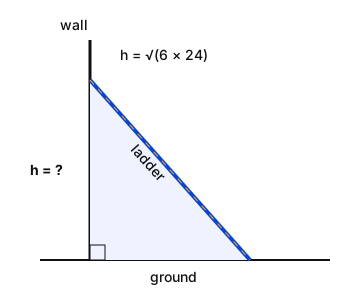
- m.
Trick: — spot the perfect square.
Answer: (D) 12 m
अवधारणा: और का मध्यानुपाती ।
- m।
ट्रिक: — पूर्ण वर्ग पहचानें।
उत्तर: (D) 12 मीटर
RRB NTPC Undergraduate CBT 1MathematicsMean proportionalRRB NTPC Undergraduate CBT 1 2025 · 9 May Shift 3
Q625.Amit's present age is twice the age of his brother Sumit. Five years ago, the ratio of their ages was 5:2. What will be Sumit's present age?
अमित की वर्तमान आयु उसके भाई सुमित की आयु की दोगुनी है। पाँच वर्ष पहले, उनकी आयु का अनुपात 5:2 था। तो सुमित की वर्तमान आयु कितनी होगी?
- A8 years8 वर्ष
- B15 years15 वर्ष
- C10 years10 वर्ष
- D20 years20 वर्ष
Show answer
Concept: Let Sumit , Amit ; use the ratio five years ago.
- .
- .
Trick: Check: 5 years ago ages 25 and 10 ✓.
Answer: (B) 15 years
अवधारणा: सुमित , अमित ; पाँच वर्ष पहले का अनुपात लगाएँ।
- ।
- ।
ट्रिक: जाँच: 5 वर्ष पहले आयु 25 और 10 ✓।
उत्तर: (B) 15 वर्ष
RRB NTPC Undergraduate CBT 1MathematicsAgesRRB NTPC Undergraduate CBT 1 2025 · 9 May Shift 3
Q626.A motorist makes a certain journey in two stages. In the first stage, he travels at a speed of 30 km/hr for one-third of the total time. In the second stage, he travels at a speed of 60 km/hr for the remaining time. He returns to the starting point at a uniform speed of 75 km/hr. Find the average speed of the motorist during the entire onward and return journey.
एक मोटर चालक एक निश्चित यात्रा दो चरणों में करता है। पहले चरण में, वह कुल समय के एक-तिहाई समय में 30 km/hr की चाल से यात्रा करता है। दूसरे चरण में, वह शेष समय में 60 km/hr की चाल से यात्रा करता है। वह 75 km/hr की एकसमान चाल से प्रारंभिक स्थान पर वापस लौटता है। तो आने-जाने की संपूर्ण यात्रा के दौरान मोटर चालक की औसत चाल ज्ञात कीजिए।
- A58 km/hr
- B55 km/hr
- C60 km/hr
- D62 km/hr
Show answer
Concept: Average speed .
- Let onward time . Distance .
- Return time .
- Average .
Trick: Onward average is ; for equal distances at 50 and 75, average .
Answer: (C) 60 km/hr
अवधारणा: औसत चाल ।
- जाने का समय । दूरी ।
- लौटने का समय ।
- औसत ।
ट्रिक: जाने की औसत चाल ; समान दूरी 50 और 75 पर, औसत ।
उत्तर: (C) 60 km/hr
RRB NTPC Undergraduate CBT 1MathematicsAverage speedRRB NTPC Undergraduate CBT 1 2025 · 9 May Shift 3
Q627.The base of a triangle is 18 cm and its height is 20 cm. Find the height of another triangle having twice its area and a base of 24 cm.
एक त्रिभुज का आधार 18 cm और ऊँचाई 20 cm है। उससे दोगुना क्षेत्रफल वाले और 24 cm आधार वाले दूसरे त्रिभुज की ऊँचाई ज्ञात कीजिए।
- A22 cm
- B20 cm
- C30 cm
- D24 cm
Show answer
Concept: Area .
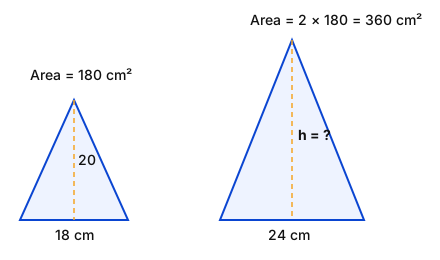
- First area ; required area .
- cm.
Trick: must double: ; .
Answer: (C) 30 cm
अवधारणा: क्षेत्रफल ।
- पहला क्षेत्रफल ; अभीष्ट ।
- cm।
ट्रिक: दोगुना होना चाहिए: ; ।
उत्तर: (C) 30 cm
RRB NTPC Undergraduate CBT 1MathematicsArea of triangleRRB NTPC Undergraduate CBT 1 2025 · 9 May Shift 3
Q628.The price of a shirt decreases from ₹200 to ₹180. What is the percentage decrease?
एक शर्ट का मूल्य ₹200 से घटकर ₹180 हो जाता है, तो कितने प्रतिशत की कमी होती है?
- A10%
- B20%
- C5%
- D15%
Show answer
Concept: .
- Decrease .
- .
Trick: Always divide by the original (₹200), not the new price.
Answer: (A) 10%
अवधारणा: ।
- कमी ।
- ।
ट्रिक: हमेशा मूल मूल्य (₹200) से भाग दें, नए मूल्य से नहीं।
उत्तर: (A) 10%
RRB NTPC Undergraduate CBT 1MathematicsPercentage decreaseRRB NTPC Undergraduate CBT 1 2025 · 9 May Shift 3
Q629.Add and . What will this sum be in decimal form?
और का योग कीजिए। दशमलव रूप में यह योग कितना होगा?
- A0.958
- B0.975
- C1.125
- D1.208
Show answer
Concept: Convert the fraction to a decimal (denominator 16 terminates) and add.
- .
- .
Trick: , so the sum is .
Answer: (C) 1.125
अवधारणा: भिन्न को दशमलव में बदलें (हर 16 सांत दशमलव देता है) और जोड़ें।
- ।
- ।
ट्रिक: , अतः योग ।
उत्तर: (C) 1.125
RRB NTPC Undergraduate CBT 1MathematicsFractions and decimalsRRB NTPC Undergraduate CBT 1 2025 · 9 May Shift 3
Q630.Simplify 30 + [{-9 × (26 - 13 + 5)}].
30 + [{-9 × (26 - 13 + 5)}] को सरल कीजिए।
- A-133
- B-132
- C-134
- D-135
Show answer
Concept: Solve the innermost bracket first.
- .
- .
- .
Trick: Keep the sign of with the product; only one sign change is needed.
Answer: (B) −132
अवधारणा: सबसे भीतरी कोष्ठक पहले हल करें।
- ।
- ।
- ।
ट्रिक: का चिह्न गुणनफल के साथ रखें; केवल एक बार चिह्न बदलना है।
उत्तर: (B) −132
RRB NTPC Undergraduate CBT 1MathematicsSimplification (brackets)RRB NTPC Undergraduate CBT 1 2025 · 9 May Shift 3
Q631.A sum of money amounts to ₹19,360 in 3 years at 10% per annum, compounded annually. The compound interest (in ₹) earned is
(Round off your answer to the nearest paise.)
एक धनराशि 10% वार्षिक दर से, वार्षिक रूप से चक्रवृद्धि होने पर, 3 वर्षों में ₹19,360 हो जाती है। अर्जित चक्रवृद्धि ब्याज (₹ में) है
(अपने उत्तर को निकटतम पैसे तक पूर्णांकित कीजिए।)
- A₹4914.55
- B₹4714.55
- C₹4614.55
- D₹4814.55
Show answer
Concept: Amount and CI .
- .
- (nearest paise).
- CI .
Trick: At 10% for 3 years, amount is ; so CI . ; .
Answer: (D) ₹4814.55
अवधारणा: मिश्रधन और चक्रवृद्धि ब्याज ।
- ।
- (निकटतम पैसे तक)।
- CI ।
ट्रिक: 10% पर 3 वर्ष में मिश्रधन होता है, इसलिए CI । ; ।
उत्तर: (D) ₹4814.55
RRB NTPC Undergraduate CBT 1MathematicsCompound InterestRRB NTPC Undergraduate CBT 1 2025 · 9 May Shift 2
Q632.Three automatic doors in a metro station undergo system checks at regular intervals of 14 minutes, 18 minutes, and 21 minutes, respectively. If all three doors are checked together at the start, after how many minutes will they be checked together again for the first time?
एक मेट्रो स्टेशन में तीन स्वचालित दरवाज़ों की सिस्टम जाँच क्रमशः 14 मिनट, 18 मिनट और 21 मिनट के नियमित अंतराल पर होती है। यदि शुरुआत में तीनों दरवाज़ों की जाँच एक साथ की जाती है, तो कितने मिनट बाद उनकी जाँच पहली बार फिर से एक साथ होगी?
- A132 minutes132 मिनट
- B126 minutes126 मिनट
- C142 minutes142 मिनट
- D136 minutes136 मिनट
Show answer
Concept: Events repeating together again after the LCM of their intervals.
- , , .
- LCM .
- All three doors are checked together again after 126 minutes.
Trick: "Together again" always means LCM; "largest equal pieces/groups" means HCF.
Answer: (B) 126 minutes
अवधारणा: घटनाएँ दोबारा एक साथ उनके अंतरालों के LCM के बाद होती हैं।
- , , ।
- LCM ।
- तीनों दरवाज़े 126 मिनट बाद फिर एक साथ जाँचे जाएँगे।
ट्रिक: "फिर से एक साथ" = LCM; "सबसे बड़े बराबर टुकड़े/समूह" = HCF।
उत्तर: (B) 126 मिनट
RRB NTPC Undergraduate CBT 1MathematicsLCMRRB NTPC Undergraduate CBT 1 2025 · 9 May Shift 2
Q633.Aman and Raj invested ₹12,000 and ₹18,000, respectively, in a business. After one year, they earned a profit of ₹15,000. How much profit will each get?
अमन और राज ने एक व्यवसाय में क्रमशः ₹12,000 और ₹18,000 का निवेश किया। एक वर्ष बाद, उन्हें ₹15,000 का लाभ हुआ। प्रत्येक को कितना लाभ मिलेगा?
- AAman: ₹8,000, Raj: ₹7,000अमन: ₹8,000, राज: ₹7,000
- BAman: ₹7,500, Raj: ₹7,500अमन: ₹7,500, राज: ₹7,500
- CAman: ₹6,000, Raj: ₹9,000अमन: ₹6,000, राज: ₹9,000
- DAman: ₹5,000, Raj: ₹10,000अमन: ₹5,000, राज: ₹10,000
Show answer
Concept: For equal time, profit is shared in the ratio of capitals.
- Ratio .
- Aman ; Raj .
Trick: Total parts , one part ; just multiply by 2 and 3.
Answer: (C) Aman: ₹6,000, Raj: ₹9,000
अवधारणा: समान समय के लिए लाभ पूँजी के अनुपात में बँटता है।
- अनुपात ।
- अमन ; राज ।
ट्रिक: कुल भाग , एक भाग ; बस 2 और 3 से गुणा करें।
उत्तर: (C) अमन: ₹6,000, राज: ₹9,000
RRB NTPC Undergraduate CBT 1MathematicsPartnershipRRB NTPC Undergraduate CBT 1 2025 · 9 May Shift 2
Q634.Two trains, X and Y, start at the same time from Delhi and Mumbai towards each other. After meeting, train X takes 6 hours to reach Mumbai, and train Y takes 8 hours to reach Delhi. If train X’s speed is 60 km/h, what is the speed of train Y?
दो रेलगाड़ियाँ X और Y एक ही समय पर क्रमशः दिल्ली और मुंबई से एक-दूसरे की ओर चलना शुरू करती हैं। मिलने के बाद, रेलगाड़ी X को मुंबई पहुँचने में 6 घंटे लगते हैं और रेलगाड़ी Y को दिल्ली पहुँचने में 8 घंटे लगते हैं। यदि रेलगाड़ी X की चाल 60 km/h है, तो रेलगाड़ी Y की चाल क्या है?
- A
- B
- C
- D
Show answer
Concept: If two trains start together towards each other and after meeting take and hours, then .
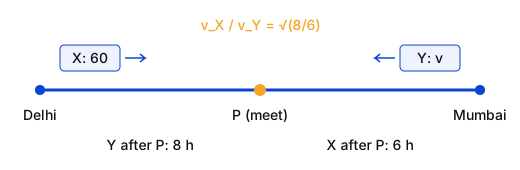
- .
- .
- Check: , slower train takes longer (8 h) ✓.
Trick: Speed ratio = square root of the inverse ratio of the times after meeting.
Answer: (D)
अवधारणा: आमने-सामने चलीं दो ट्रेनें मिलने के बाद और घंटे लें, तो ।
- ।
- ।
- जाँच: , धीमी ट्रेन अधिक समय (8 h) लेती है ✓।
ट्रिक: चाल का अनुपात = मिलने के बाद के समयों के उल्टे अनुपात का वर्गमूल।
उत्तर: (D)
RRB NTPC Undergraduate CBT 1MathematicsTrains meetingRRB NTPC Undergraduate CBT 1 2025 · 9 May Shift 2
Q635.The value of is:
का मान है:
- A
- B
- C
- D
Show answer
Concept: , so .
- .
- .
- Total .
Trick: Angles adding to () – swap sin/cos and the bracket vanishes.
Answer: (A)
अवधारणा: , अतः ।
- ।
- ।
- कुल ।
ट्रिक: जिन कोणों का योग हो (), उनमें sin/cos बदल दें – कोष्ठक शून्य हो जाता है।
उत्तर: (A)
RRB NTPC Undergraduate CBT 1MathematicsTrigonometry – complementary anglesRRB NTPC Undergraduate CBT 1 2025 · 9 May Shift 2
Q636.Find the median of the following data (correct to two places of decimal).
| Class interval | 0-6 | 6-12 | 12-18 | 18-24 | 24-30 | 30-36 |
|---|
| Frequency | 5 | 7 | 10 | 13 | 9 | 8 |
|---|
निम्नलिखित आँकड़ों की माध्यिका ज्ञात कीजिए (दशमलव के दो स्थानों तक सही)।
| वर्ग अंतराल | 0-6 | 6-12 | 12-18 | 18-24 | 24-30 | 30-36 |
|---|
| बारंबारता | 5 | 7 | 10 | 13 | 9 | 8 |
|---|
- A29.73
- B21.23
- C19.85
- D26.48
Show answer
Concept: Median .
- , .
- Cumulative frequencies: 5, 12, 22, 35, … → 26 lies in class 18–24 (, , ).
- Median .
Trick: Find the first cumulative frequency that crosses – that is the median class; is the one before it.
Answer: (C) 19.85
अवधारणा: माध्यिका ।
- , ।
- संचयी बारंबारता: 5, 12, 22, 35, … → 26 वर्ग 18–24 में है (, , )।
- माध्यिका ।
ट्रिक: जो संचयी बारंबारता पहली बार को पार करे, वही माध्यिका वर्ग; उससे पहले वाली लें।
उत्तर: (C) 19.85
RRB NTPC Undergraduate CBT 1MathematicsStatistics – MedianRRB NTPC Undergraduate CBT 1 2025 · 9 May Shift 2
Q637.A cylindrical tank has a radius of 7 m and a height of 11 m. How many litres of water can it hold? (Use π = 22/7)
एक बेलनाकार टंकी की त्रिज्या 7 m और ऊँचाई 11 m है। इसमें कितने लीटर पानी आ सकता है? (π = 22/7 का प्रयोग कीजिए)
- A16,94,000
- B16,74,000
- C16,64,000
- D16,84,000
Show answer
Concept: Volume of cylinder ; litres.
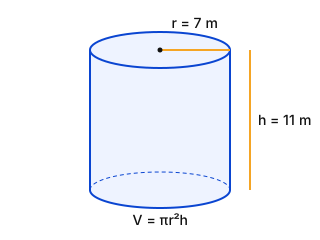
- .
- Litres .
Trick: With , ; then .
Answer: (A) 16,94,000
अवधारणा: बेलन का आयतन ; लीटर।
- ।
- लीटर ।
ट्रिक: हो तो ; फिर ।
उत्तर: (A) 16,94,000
RRB NTPC Undergraduate CBT 1MathematicsMensuration – CylinderRRB NTPC Undergraduate CBT 1 2025 · 9 May Shift 2
Q638.A shopkeeper bought 7 decorative lamps for ₹2,850. Due to damage, 2 lamps could not be sold. He sold the remaining lamps at ₹360 each. What is his total loss (in ₹)?
एक दुकानदार ने ₹2,850 में 7 सजावटी लैंप खरीदे। क्षतिग्रस्त होने के कारण 2 लैंप बेचे नहीं जा सके। उसने शेष लैंप ₹360 प्रति लैंप की दर से बेच दिए। उसकी कुल हानि (₹ में) कितनी है?
- A₹960
- B₹1,050
- C₹840
- D₹1,100
Show answer
Concept: Loss = Total cost − Total selling price.
- Cost of 7 lamps .
- Sold lamps: .
- Loss .
Trick: Unsold items earn nothing – compare the whole cost with the money actually received.
Answer: (B) ₹1,050
अवधारणा: हानि = कुल लागत − कुल विक्रय मूल्य।
- 7 लैंप की लागत ।
- बेचे लैंप: ।
- हानि ।
ट्रिक: बिना बिके सामान से कुछ नहीं मिलता – पूरी लागत की तुलना वास्तव में मिली राशि से करें।
उत्तर: (B) ₹1,050
RRB NTPC Undergraduate CBT 1MathematicsProfit and LossRRB NTPC Undergraduate CBT 1 2025 · 9 May Shift 2
Q639.The cost of a certain fabric is directly proportional to its length for a given width. If the cost of 8 meters of the fabric is ₹3,200, what will be the cost of 25 meters of the same fabric?
एक निश्चित कपड़े की लागत, दी गई चौड़ाई के लिए, उसकी लंबाई के अनुक्रमानुपाती होती है। यदि 8 मीटर कपड़े की लागत ₹3,200 है, तो उसी कपड़े के 25 मीटर की लागत क्या होगी?
- A₹9,800
- B₹9,400
- C₹10,000
- D₹9,600
Show answer
Concept: Direct proportion: .
- Cost per metre .
- Cost of 25 m .
Trick: Unitary method – find the price of 1 unit first.
Answer: (C) ₹10,000
अवधारणा: अनुक्रमानुपात: ।
- प्रति मीटर मूल्य ।
- 25 m का मूल्य ।
ट्रिक: ऐकिक नियम – पहले 1 इकाई का मूल्य निकालें।
उत्तर: (C) ₹10,000
RRB NTPC Undergraduate CBT 1MathematicsDirect ProportionRRB NTPC Undergraduate CBT 1 2025 · 9 May Shift 2
Q640.Find the mode of the following distribution:
| Class | 5-15 | 15-25 | 25-35 | 35-45 |
|---|
| Frequency | 6 | 14 | 18 | 12 |
|---|
निम्नलिखित बंटन का बहुलक ज्ञात कीजिए:
| वर्ग | 5-15 | 15-25 | 25-35 | 35-45 |
|---|
| बारंबारता | 6 | 14 | 18 | 12 |
|---|
- A29
- B30
- C28
- D26
Show answer
Concept: Mode .
- Highest frequency 18 → modal class 25–35; , , , , .
- Mode .
Trick: Denominator – write it as .
Answer: (A) 29
अवधारणा: बहुलक ।
- सबसे अधिक बारंबारता 18 → बहुलक वर्ग 25–35; , , , , ।
- बहुलक ।
ट्रिक: हर को लिखें।
उत्तर: (A) 29
RRB NTPC Undergraduate CBT 1MathematicsStatistics – ModeRRB NTPC Undergraduate CBT 1 2025 · 9 May Shift 2

