Q641.In a certain code language,
A × B means ‘A is the son of B’,
A = B means ‘A is the brother of B’,
A + B means ‘A is the wife of B’ and
A − B means ‘A is the father of B’.
How is S related to Z if ‘S = W × R + T − Z’?
एक निश्चित कूट भाषा में,
A × B का अर्थ है ‘A, B का पुत्र है’,
A = B का अर्थ है ‘A, B का भाई है’,
A + B का अर्थ है ‘A, B की पत्नी है’ और
A − B का अर्थ है ‘A, B का पिता है’।
यदि ‘S = W × R + T − Z’ है, तो S, Z से किस प्रकार संबंधित है?
- AFatherपिता
- BSonपुत्र
- CBrotherभाई
- DHusbandपति
Show answer
Concept: Decode pairwise from left to right and build the family tree.
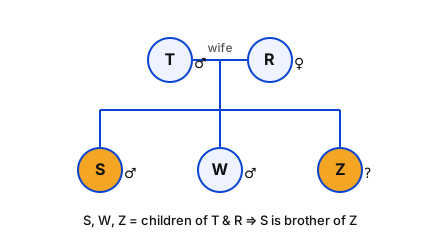
- S = W → S is brother of W; W × R → W is son of R; R + T → R is wife of T; T − Z → T is father of Z.
- So T and R are the parents; S, W and Z are their children.
- S is male (brother), hence S is the brother of Z.
Trick: Symbols between consecutive letters each give one relation – chain them, do not skip.
Answer: (C) Brother
अवधारणा: बाएँ से दाएँ जोड़ी-जोड़ी कोड खोलें और वंश-वृक्ष बनाएँ।
- S = W → S, W का भाई; W × R → W, R का पुत्र; R + T → R, T की पत्नी; T − Z → T, Z का पिता।
- अतः T और R माता-पिता हैं; S, W और Z उनकी संतानें।
- S पुरुष है (भाई), इसलिए S, Z का भाई है।
ट्रिक: लगातार अक्षरों के बीच का हर चिह्न एक संबंध देता है – श्रृंखला बनाएँ, कोई छोड़ें नहीं।
उत्तर: (C) Brother
RRB NTPC Undergraduate CBT 1General Intelligence and ReasoningBlood relations (coded)RRB NTPC Undergraduate CBT 1 2025 · 9 May Shift 2
Q642.Based on the English alphabetical order, three of the following four letter-cluster pairs are alike in a certain way and thus form a group. Which is the one that does not belong to that group? (Note: The odd one out is not based on the number of
consonants/vowels or their position in the letter cluster.)
अंग्रेज़ी वर्णमाला क्रम के आधार पर, निम्नलिखित चार अक्षर-समूह युग्मों में से तीन किसी निश्चित प्रकार से एक समान हैं और इस प्रकार एक समूह बनाते हैं। वह कौन-सा है जो उस समूह से संबंधित नहीं है? (नोट: असंगत युग्म व्यंजनों/स्वरों की संख्या या अक्षर-समूह में उनकी स्थिति पर आधारित
नहीं है।)
- AOL-JQ
- BUR-PW
- CXU-SY
- DRO-MT
Show answer
Concept: Compare the position differences between corresponding letters of each pair.
- OL–JQ: O−5 = J, L+5 = Q. UR–PW: U−5 = P, R+5 = W. RO–MT: R−5 = M, O+5 = T.
- XU–SY: X−5 = S but U+4 = Y (U+5 would be Z) → pattern broken.
Trick: Pattern (−5, +5) – check the second letter of each pair quickly.
Answer: (C) XU-SY
अवधारणा: हर युग्म के संगत अक्षरों के स्थान-अंतर की तुलना करें।
- OL–JQ: O−5 = J, L+5 = Q। UR–PW: U−5 = P, R+5 = W। RO–MT: R−5 = M, O+5 = T।
- XU–SY: X−5 = S पर U+4 = Y (U+5 होता Z) → पैटर्न टूटा।
ट्रिक: पैटर्न (−5, +5) – हर युग्म का दूसरा अक्षर जल्दी जाँचें।
उत्तर: (C) XU-SY
RRB NTPC Undergraduate CBT 1General Intelligence and ReasoningOdd one out (letter pairs)RRB NTPC Undergraduate CBT 1 2025 · 9 May Shift 2
Q643.In the following triad, each group of letters is related to the subsequent one following a certain logic. Select, from the given options, the one which follows the same logic. SAID - AISD - DIAS
MODE - ODME - EDOM
निम्नलिखित त्रिक में, अक्षरों का प्रत्येक समूह एक निश्चित तर्क के अनुसार अपने बाद वाले समूह से संबंधित है। दिए गए विकल्पों में से उस विकल्प का चयन कीजिए जो समान तर्क का अनुसरण करता है। SAID - AISD - DIAS
MODE - ODME - EDOM
- AHOGS - OHGS - SOGH
- BTONG - ONTG - GNOT
- CUGLY - GLUY - GLYU
- DMIND - MNID - DNIM
Show answer
Concept: Find how positions 1-2-3-4 are shuffled in each step.
- SAID → AISD: order 2-3-1-4; AISD → DIAS = reverse of SAID (4-3-2-1). MODE → ODME (2-3-1-4) → EDOM (reverse) confirms.
- TONG → 2-3-1-4 gives ONTG ✓; reverse of TONG = GNOT ✓.
- HOGS→OHGS swaps only first two; UGLY→GLYU is not the reverse; MIND→MNID fails the first step.
Trick: Third word = first word written backwards – test that first, it eliminates fast.
Answer: (B) TONG - ONTG - GNOT
अवधारणा: देखें कि हर चरण में स्थान 1-2-3-4 कैसे बदलते हैं।
- SAID → AISD: क्रम 2-3-1-4; AISD → DIAS = SAID का उल्टा (4-3-2-1)। MODE → ODME (2-3-1-4) → EDOM (उल्टा) से पुष्टि।
- TONG → 2-3-1-4 से ONTG ✓; TONG का उल्टा = GNOT ✓।
- HOGS→OHGS में केवल पहले दो बदले; UGLY→GLYU उल्टा नहीं; MIND→MNID पहला चरण ही गलत।
ट्रिक: तीसरा शब्द = पहला शब्द उल्टा – इसे पहले जाँचें, विकल्प जल्दी कटते हैं।
उत्तर: (B) TONG - ONTG - GNOT
RRB NTPC Undergraduate CBT 1General Intelligence and ReasoningLetter cluster analogyRRB NTPC Undergraduate CBT 1 2025 · 9 May Shift 2
Q644.Seven people H, I, J, K, W, Y and Z are sitting in a row facing north. Only J sits to the left of W. Only four people sit between J and Y. Only I sits between K and H and K is not an immediate neighbor of Y. How many people sit to the right of Z?
सात व्यक्ति H, I, J, K, W, Y और Z उत्तर की ओर मुख करके एक पंक्ति में बैठे हैं। W के बाएँ केवल J बैठा है। J और Y के बीच केवल चार व्यक्ति बैठे हैं। K और H के बीच केवल I बैठा है और K, Y का निकटतम पड़ोसी नहीं है। Z के दाएँ कितने व्यक्ति बैठे हैं?
- AThreeतीन
- BOneएक
- CNoneकोई नहीं
- DTwoदो
Show answer
Concept: "Only J sits to the left of W" fixes both ends of the row at once.
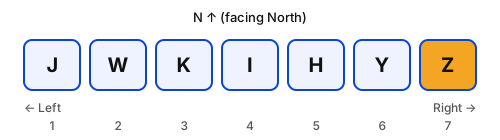
- J is at position 1 (extreme left) and W at 2. Four people between J and Y → Y at 6.
- K–I–H (or H–I–K) must be consecutive in seats 3-4-5; K cannot be next to Y (seat 6), so K3, I4, H5.
- Z takes the last seat 7 → none sit to the right of Z.
Trick: "Only X sits to the left of Y" ⇒ X is at the extreme left, Y second.
Answer: (C) None
अवधारणा: "W के बाएँ केवल J बैठा है" – इससे पंक्ति के दोनों छोर एक साथ तय हो जाते हैं।
- J स्थान 1 (बाएँ छोर) पर और W 2 पर। J और Y के बीच चार लोग → Y 6 पर।
- K–I–H (या H–I–K) सीट 3-4-5 पर लगातार; K, Y (सीट 6) का पड़ोसी नहीं, अतः K3, I4, H5।
- Z अंतिम सीट 7 पर → Z के दाएँ कोई नहीं।
ट्रिक: "Y के बाएँ केवल X" ⇒ X बाएँ छोर पर, Y दूसरे स्थान पर।
उत्तर: (C) None
RRB NTPC Undergraduate CBT 1General Intelligence and ReasoningLinear seating arrangementRRB NTPC Undergraduate CBT 1 2025 · 9 May Shift 2
Q645.What should come in place of ‘?’ in the given series?
38 55 74 95 118 ?
दी गई शृंखला में ‘?’ के स्थान पर क्या आना चाहिए?
38 55 74 95 118 ?
- A161
- B143
- C155
- D152
Show answer
Concept: Take successive differences and look for a pattern.
- – differences are consecutive odd numbers.
- Next difference = 25 → .
Trick: Equal second differences (2, 2, 2…) → next term is just previous + (last difference + 2).
Answer: (B) 143
अवधारणा: क्रमागत अंतर निकालें और पैटर्न देखें।
- – अंतर क्रमागत विषम संख्याएँ हैं।
- अगला अंतर = 25 → ।
ट्रिक: द्वितीय अंतर समान (2, 2, 2…) → अगला पद = पिछला + (अंतिम अंतर + 2)।
उत्तर: (B) 143
RRB NTPC Undergraduate CBT 1General Intelligence and ReasoningNumber seriesRRB NTPC Undergraduate CBT 1 2025 · 9 May Shift 2
Q646.WT 16 is related to XW -1 in a certain way. In the same way, DE 9 is related to EH -8. To which of the following is NK 19 related, following the same logic?
WT 16, XW -1 से एक निश्चित प्रकार से संबंधित है। उसी प्रकार, DE 9, EH -8 से संबंधित है। समान तर्क का अनुसरण करते हुए, NK 19 निम्नलिखित में से किससे संबंधित है?
- AUY 1
- BNJ 7
- CON 2
- DTY 5
Show answer
Concept: Find the shift of each letter and the change in the number from the two given pairs.
- WT 16 → XW −1: W+1 = X, T+3 = W, 16−17 = −1. DE 9 → EH −8: D+1 = E, E+3 = H, 9−17 = −8.
- Apply to NK 19: N+1 = O, K+3 = N, 19−17 = 2 → ON 2.
Trick: Rule: (+1, +3, −17); the number part alone (19−17 = 2) picks the option.
Answer: (C) ON 2
अवधारणा: दिए गए दो युग्मों से हर अक्षर का शिफ्ट और संख्या का परिवर्तन निकालें।
- WT 16 → XW −1: W+1 = X, T+3 = W, 16−17 = −1। DE 9 → EH −8: D+1 = E, E+3 = H, 9−17 = −8।
- NK 19 पर लगाएँ: N+1 = O, K+3 = N, 19−17 = 2 → ON 2।
ट्रिक: नियम: (+1, +3, −17); अकेला संख्या भाग (19−17 = 2) ही विकल्प चुन देता है।
उत्तर: (C) ON 2
RRB NTPC Undergraduate CBT 1General Intelligence and ReasoningLetter-number analogyRRB NTPC Undergraduate CBT 1 2025 · 9 May Shift 2
Q647.Tus ranked 56th from the bottom and 51st from the top in his class. How many students are there in his class?
तुस अपनी कक्षा में नीचे से 56वें और ऊपर से 51वें स्थान पर है। उसकी कक्षा में कितने विद्यार्थी हैं?
- A107
- B106
- C105
- D108
Show answer
Concept: When one person's rank is given from both ends, total = (rank from top) + (rank from bottom) − 1, since the person is counted twice.
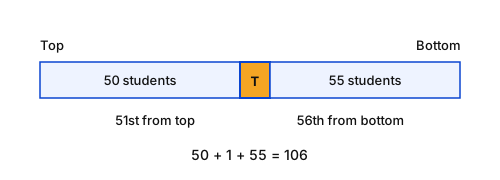
- 51st from top → 50 students above; 56th from bottom → 55 students below.
- Total = .
Trick: Top + Bottom − 1 (same person counted in both).
Answer: (B) 106
अवधारणा: जब एक व्यक्ति का स्थान दोनों ओर से दिया हो, कुल = (ऊपर से स्थान) + (नीचे से स्थान) − 1, क्योंकि वह दो बार गिना गया है।
- ऊपर से 51वाँ → ऊपर 50 छात्र; नीचे से 56वाँ → नीचे 55 छात्र।
- कुल = ।
ट्रिक: ऊपर + नीचे − 1 (एक ही व्यक्ति दोनों में गिना गया)।
उत्तर: (B) 106
RRB NTPC Undergraduate CBT 1General Intelligence and ReasoningRankingRRB NTPC Undergraduate CBT 1 2025 · 9 May Shift 2
Q648.QQ 5 is related to VR -6 in a certain way. In the same way, LV 12 is related to QW 1. To which of the following is ES 16 related, following the same logic?
QQ 5, VR -6 से एक निश्चित प्रकार से संबंधित है। उसी प्रकार, LV 12, QW 1 से संबंधित है। समान तर्क का अनुसरण करते हुए, ES 16 निम्नलिखित में से किससे संबंधित है?
- AYT 4
- BJT 5
- CUG 3
- DRW 1
Show answer
Concept: Work out the letter shifts and the number change from the given pairs.
- QQ 5 → VR −6: Q+5 = V, Q+1 = R, 5−11 = −6. LV 12 → QW 1: L+5 = Q, V+1 = W, 12−11 = 1.
- ES 16: E+5 = J, S+1 = T, 16−11 = 5 → JT 5.
Trick: Rule (+5, +1, −11); "16−11 = 5" alone separates JT 5 from the rest.
Answer: (B) JT 5
अवधारणा: दिए गए युग्मों से अक्षर शिफ्ट और संख्या परिवर्तन निकालें।
- QQ 5 → VR −6: Q+5 = V, Q+1 = R, 5−11 = −6। LV 12 → QW 1: L+5 = Q, V+1 = W, 12−11 = 1।
- ES 16: E+5 = J, S+1 = T, 16−11 = 5 → JT 5।
ट्रिक: नियम (+5, +1, −11); अकेला "16−11 = 5" ही JT 5 को अलग कर देता है।
उत्तर: (B) JT 5
RRB NTPC Undergraduate CBT 1General Intelligence and ReasoningLetter-number analogyRRB NTPC Undergraduate CBT 1 2025 · 9 May Shift 2
Q649.In a certain code language, "EUOA" is coded as "53" and "YFMP" is coded as "71". What is the code for "RIZB" in that given language?
एक निश्चित कूट भाषा में, "EUOA" को "53" के रूप में कूटबद्ध किया जाता है और "YFMP" को "71" के रूप में कूटबद्ध किया जाता है। उस कूट भाषा में "RIZB" का कूट क्या है?
- A56
- B66
- C60
- D58
Show answer
Concept: Try the sum of alphabetical positions and see what constant links it to the code.
- EUOA: ; code 53 → . YFMP: ; code 71 → .
- RIZB: ; code = .
Trick: Code = (sum of positions) + 11 – always test "sum + constant" first in 4-letter number codes.
Answer: (B) 66
अवधारणा: वर्णमाला स्थानों का योग लें और देखें कोड से कौन-सा स्थिरांक जोड़ता है।
- EUOA: ; कोड 53 → । YFMP: ; कोड 71 → ।
- RIZB: ; कोड = ।
ट्रिक: कोड = (स्थानों का योग) + 11 – 4-अक्षरी संख्या कोड में पहले "योग + स्थिरांक" जाँचें।
उत्तर: (B) 66
RRB NTPC Undergraduate CBT 1General Intelligence and ReasoningCoding–Decoding (number code)RRB NTPC Undergraduate CBT 1 2025 · 9 May Shift 2
Q650.What should come in place of '?' in the given series based on the English alphabetical order?
TGA WJD ZMG CPJ ?
अंग्रेज़ी वर्णमाला क्रम के आधार पर दी गई शृंखला में '?' के स्थान पर क्या आना चाहिए?
TGA WJD ZMG CPJ ?
- AFSM
- BERL
- CDPN
- DGTC
Show answer
Concept: Compare the same position across consecutive clusters.
- First letters: T→W→Z→C (+3); second: G→J→M→P (+3); third: A→D→G→J (+3).
- Next: C+3 = F, P+3 = S, J+3 = M → FSM.
Trick: Every letter +3; within a cluster the letters also drop by 13 and 6 (T−13 = G, G−6 = A) – a quick double check.
Answer: (A) FSM
अवधारणा: लगातार समूहों में समान स्थान के अक्षरों की तुलना करें।
- पहले अक्षर: T→W→Z→C (+3); दूसरे: G→J→M→P (+3); तीसरे: A→D→G→J (+3)।
- अगला: C+3 = F, P+3 = S, J+3 = M → FSM।
ट्रिक: हर अक्षर +3; समूह के भीतर भी अक्षर 13 और 6 घटते हैं (T−13 = G, G−6 = A) – त्वरित जाँच।
उत्तर: (A) FSM
RRB NTPC Undergraduate CBT 1General Intelligence and ReasoningLetter seriesRRB NTPC Undergraduate CBT 1 2025 · 9 May Shift 2
Q651.Select the set in which the numbers are related in the same way as are the numbers of the following sets.
(Note: Operations should be performed on the whole numbers, without breaking down the numbers into their constituent digits. E.g. 13 – Operations on 13 such as
adding/subtracting/multiplying to 13 can be performed. Breaking down 13 into 1 and 3 and then performing mathematical operations on 1 and 3 is not allowed.)
(163, 186, 23)
(144, 200, 56)
उस समुच्चय का चयन कीजिए जिसमें संख्याएँ उसी प्रकार संबंधित हैं जिस प्रकार निम्नलिखित समुच्चयों की संख्याएँ संबंधित हैं।
(नोट: संक्रियाएँ पूर्ण संख्याओं पर की जानी चाहिए, संख्याओं को उनके घटक अंकों में तोड़े बिना। उदाहरण के लिए 13 – 13 पर संक्रियाएँ जैसे
13 में जोड़ना/घटाना/गुणा करना किया जा सकता है। 13 को 1 और 3 में तोड़कर फिर 1 और 3 पर गणितीय संक्रियाएँ करने की अनुमति नहीं है।)
(163, 186, 23)
(144, 200, 56)
- A(141, 229, 98)
- B(113, 178, 65)
- C(135, 187, 62)
- D(201, 243, 43)
Show answer
Concept: Test simple relations among the three numbers – here the third is the difference of the first two.
- ✓ and ✓, so (second − first) = third.
- Options: ✗, ✓, ✗, ✗.
Trick: In (a, b, c) sets always check b − a, a + b and a × b first.
Answer: (B) (113, 178, 65)
अवधारणा: तीनों संख्याओं में सरल संबंध जाँचें – यहाँ तीसरी = पहली दो का अंतर।
- ✓ और ✓, अतः (दूसरी − पहली) = तीसरी।
- विकल्प: ✗, ✓, ✗, ✗।
ट्रिक: (a, b, c) समुच्चय में हमेशा पहले b − a, a + b और a × b जाँचें।
उत्तर: (B) (113, 178, 65)
RRB NTPC Undergraduate CBT 1General Intelligence and ReasoningNumber analogy (triplets)RRB NTPC Undergraduate CBT 1 2025 · 9 May Shift 2
Q652.Based on the English alphabetical order, three of the following four are alike in a certain way and thus form a group. Which is the one that does not belong to that group? (Note: The odd man out is not based on the number of consonants/vowels or their position in the letter cluster.)
अंग्रेज़ी वर्णमाला क्रम के आधार पर, निम्नलिखित चार में से तीन किसी निश्चित प्रकार से एक समान हैं और इस प्रकार एक समूह बनाते हैं। वह कौन-सा है जो उस समूह से संबंधित नहीं है? (नोट: असंगत विकल्प व्यंजनों/स्वरों की संख्या या अक्षर-समूह में उनकी स्थिति पर आधारित नहीं है।)
- AFGC
- BBCY
- CLNI
- DNOK
Show answer
Concept: Write the alphabetical positions and compare the gaps.
- FGC: 6, 7, 3 → +1, −4. BCY: 2, 3, 25 → +1, −4 (3−4 = −1 → wraps to 25 = Y). NOK: 14, 15, 11 → +1, −4.
- LNI: 12, 14, 9 → +2, −5 → different pattern.
Trick: Three options share "+1, −4"; LNI is the only one whose first two letters are not consecutive.
Answer: (C) LNI
अवधारणा: वर्णमाला स्थान लिखकर अंतर तुलना करें।
- FGC: 6, 7, 3 → +1, −4। BCY: 2, 3, 25 → +1, −4 (3−4 = −1 → घूमकर 25 = Y)। NOK: 14, 15, 11 → +1, −4।
- LNI: 12, 14, 9 → +2, −5 → अलग पैटर्न।
ट्रिक: तीन विकल्पों में "+1, −4"; केवल LNI के पहले दो अक्षर लगातार नहीं हैं।
उत्तर: (C) LNI
RRB NTPC Undergraduate CBT 1General Intelligence and ReasoningOdd one out (letter clusters)RRB NTPC Undergraduate CBT 1 2025 · 9 May Shift 2
Q653.Refer to the following letter series and answer the question that follows. Counting to be done from left to right only.
(Left) U L Y M R D E L C D A E H R O H F X L D W H (Right)
How many such vowels are there, each of which is immediately preceded by a consonant and also immediately followed by a consonant?
निम्नलिखित अक्षर शृंखला को देखिए और उसके बाद दिए गए प्रश्न का उत्तर दीजिए। गिनती केवल बाएँ से दाएँ की ओर की जानी है।
(बाएँ) U L Y M R D E L C D A E H R O H F X L D W H (दाएँ)
ऐसे कितने स्वर हैं, जिनमें से प्रत्येक के ठीक पहले एक व्यंजन है और ठीक बाद भी एक व्यंजन है?
- AFourचार
- BTwoदो
- COneएक
- DThreeतीन
Show answer
Concept: Mark each vowel and inspect its immediate neighbours; Y is treated as a consonant.
- Series: U L Y M R D E L C D A E H R O H F X L D W H. Vowels: U, E, A, E, O.
- U has no letter before it; A is followed by vowel E; E (12th) is preceded by vowel A – all fail.
- E (7th): D–E–L ✓ and O (15th): R–O–H ✓ → Two.
Trick: Circle the vowels first, then check only their two neighbours.
Answer: (B) Two
अवधारणा: हर स्वर पर निशान लगाएँ और उसके दोनों पड़ोसी देखें; Y व्यंजन माना जाता है।
- श्रृंखला: U L Y M R D E L C D A E H R O H F X L D W H। स्वर: U, E, A, E, O।
- U से पहले कोई अक्षर नहीं; A के बाद स्वर E; E (12वाँ) से पहले स्वर A – तीनों अयोग्य।
- E (7वाँ): D–E–L ✓ और O (15वाँ): R–O–H ✓ → दो।
ट्रिक: पहले स्वरों पर गोला लगाएँ, फिर केवल उनके दो पड़ोसी जाँचें।
उत्तर: (B) Two
RRB NTPC Undergraduate CBT 1General Intelligence and ReasoningLetter series countingRRB NTPC Undergraduate CBT 1 2025 · 9 May Shift 2
Q654.Seven boxes M, N, O, P, X, Y and Z are kept one over the other but not necessarily in the same order. Y is kept second from the bottom. Only three boxes are kept between Y and O. X is kept at one of the positions below Y. Only N is kept between O and P. M is kept at one of the positions above O. How many boxes are kept between X and M?
सात बक्से M, N, O, P, X, Y और Z एक के ऊपर एक रखे गए हैं, लेकिन आवश्यक नहीं कि इसी क्रम में हों। Y नीचे से दूसरे स्थान पर रखा गया है। Y और O के बीच केवल तीन बक्से रखे गए हैं। X, Y के नीचे किसी एक स्थान पर रखा गया है। O और P के बीच केवल N रखा गया है। M, O के ऊपर किसी एक स्थान पर रखा गया है। X और M के बीच कितने बक्से रखे गए हैं?
- AThreeतीन
- BOneएक
- CFourचार
- DFiveपाँच
Show answer
Concept: Number the positions 1 (bottom) to 7 (top) and place the fixed boxes first.
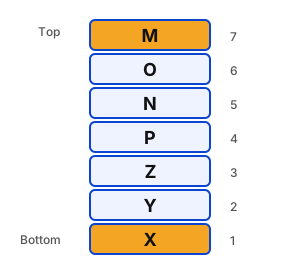
- Y = 2. Three boxes between Y and O → O = 6. X below Y → X = 1.
- Only N between O and P → P = 4, N = 5 (position 8 does not exist). M above O → M = 7; Z takes 3.
- Order (bottom→top): X Y Z P N O M. Between X (1) and M (7): Y, Z, P, N, O = Five.
Trick: "k boxes between A and B" means the positions differ by k + 1.
Answer: (D) Five
अवधारणा: स्थान 1 (नीचे) से 7 (ऊपर) तक गिनें और पहले निश्चित बॉक्स रखें।
- Y = 2। Y और O के बीच तीन बॉक्स → O = 6। X, Y से नीचे → X = 1।
- O और P के बीच केवल N → P = 4, N = 5 (स्थान 8 नहीं है)। M, O से ऊपर → M = 7; Z 3 पर।
- क्रम (नीचे→ऊपर): X Y Z P N O M। X (1) और M (7) के बीच: Y, Z, P, N, O = पाँच।
ट्रिक: "A और B के बीच k बॉक्स" = स्थानों का अंतर k + 1।
उत्तर: (D) Five
RRB NTPC Undergraduate CBT 1General Intelligence and ReasoningBox arrangement (stacking)RRB NTPC Undergraduate CBT 1 2025 · 9 May Shift 2
Q655.Based on the English alphabetical order, three of the following four letter-clusters are alike in a certain way and thus form a group. Which is the one that DOES NOT belong to that group?
(Note: The odd one out is not based on the number of consonants/vowels or their position in the letter-cluster.)
अंग्रेज़ी वर्णमाला क्रम के आधार पर, निम्नलिखित चार अक्षर-समूहों में से तीन किसी निश्चित प्रकार से एक समान हैं और इस प्रकार एक समूह बनाते हैं। वह कौन-सा है जो उस समूह से संबंधित नहीं है?
(नोट: असंगत विकल्प व्यंजनों/स्वरों की संख्या या अक्षर-समूह में उनकी स्थिति पर आधारित नहीं है।)
- ATPR
- BNJK
- CPLN
- DVRT
Show answer
Concept: Convert to positions and compare the two gaps.
- TPR: 20, 16, 18 → −4, +2. PLN: 16, 12, 14 → −4, +2. VRT: 22, 18, 20 → −4, +2.
- NJK: 14, 10, 11 → −4, +1 → odd one.
Trick: Third letter = first − 2 in the group (T→R, P→N, V→T) but N→K is −3.
Answer: (B) NJK
अवधारणा: स्थानों में बदलकर दोनों अंतर तुलना करें।
- TPR: 20, 16, 18 → −4, +2। PLN: 16, 12, 14 → −4, +2। VRT: 22, 18, 20 → −4, +2।
- NJK: 14, 10, 11 → −4, +1 → असंगत।
ट्रिक: समूह में तीसरा अक्षर = पहला − 2 (T→R, P→N, V→T) पर N→K में −3 है।
उत्तर: (B) NJK
RRB NTPC Undergraduate CBT 1General Intelligence and ReasoningOdd one out (letter clusters)RRB NTPC Undergraduate CBT 1 2025 · 9 May Shift 2
Q656.What should come in place of ‘?’ in the given series?
90 91 ? 126 190 315
दी गई शृंखला में ‘?’ के स्थान पर क्या आना चाहिए?
90 91 ? 126 190 315
- A101
- B91
- C99
- D111
Show answer
Concept: Look at the differences – they are perfect cubes.
- , , . So the differences are .
- Missing term = ; check: ✓.
Trick: Differences 1, 8, 27, 64, 125 – memorise cubes up to 10.
Answer: (C) 99
अवधारणा: अंतर देखें – वे पूर्ण घन हैं।
- , , । अतः अंतर हैं।
- लुप्त पद = ; जाँच: ✓।
ट्रिक: अंतर 1, 8, 27, 64, 125 – 10 तक के घन याद रखें।
उत्तर: (C) 99
RRB NTPC Undergraduate CBT 1General Intelligence and ReasoningNumber seriesRRB NTPC Undergraduate CBT 1 2025 · 9 May Shift 2
Q657.Read the given statements and conclusions carefully. You have to take the given statements to be true even if they seem to be at variance from commonly known facts. You have to decide which conclusions logically follow/s from the given statements. Statements: All routers are dongles. All routers are phones.
Conclusion (I) : Some dongles are phones
Conclusion (II) : All phones are routers
दिए गए कथनों और निष्कर्षों को ध्यानपूर्वक पढ़िए। आपको दिए गए कथनों को सत्य मानना है, भले ही वे सामान्यतः ज्ञात तथ्यों से भिन्न प्रतीत होते हों। आपको निर्णय करना है कि दिए गए कथनों का कौन-सा/कौन-से निष्कर्ष तार्किक रूप से अनुसरण करता है/करते हैं। कथन: सभी राउटर, डोंगल हैं। सभी राउटर, फ़ोन हैं।
निष्कर्ष (I) : कुछ डोंगल, फ़ोन हैं
निष्कर्ष (II) : सभी फ़ोन, राउटर हैं
- ANeither conclusion (I) nor (II) followsन तो निष्कर्ष (I) और न ही (II) अनुसरण करता है
- BOnly conclusion (I) followsकेवल निष्कर्ष (I) अनुसरण करता है
- CBoth conclusions (I) and (II) followनिष्कर्ष (I) और (II) दोनों अनुसरण करते हैं
- DOnly conclusion (II) followsकेवल निष्कर्ष (II) अनुसरण करता है
Show answer
Concept: Draw the diagram: "All routers are dongles" and "All routers are phones" put the routers circle inside both dongles and phones.
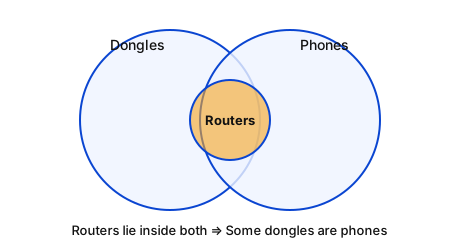
- Since routers lie in both sets, dongles and phones must overlap at least there → Conclusion I "Some dongles are phones" follows.
- Conclusion II "All phones are routers" reverses an "All" statement – phones may extend far beyond routers → does not follow.
Trick: All A are B + All A are C ⇒ Some B are C (A is the common part); "All" never converts to "All".
Answer: (B) Only conclusion (I) follows
अवधारणा: आरेख बनाएँ: "सभी routers, dongles हैं" और "सभी routers, phones हैं" – routers का वृत्त dongles और phones दोनों के अंदर।
- routers दोनों समुच्चयों में हैं, अतः dongles और phones कम से कम वहाँ साझा → निष्कर्ष I "कुछ dongles, phones हैं" मान्य।
- निष्कर्ष II "सभी phones, routers हैं" – "सभी" कथन का उल्टा; phones, routers से बहुत बड़े हो सकते हैं → मान्य नहीं।
ट्रिक: सभी A, B हैं + सभी A, C हैं ⇒ कुछ B, C हैं (A साझा भाग); "सभी" कभी उल्टा "सभी" नहीं बनता।
उत्तर: (B) Only conclusion (I) follows
RRB NTPC Undergraduate CBT 1General Intelligence and ReasoningSyllogismRRB NTPC Undergraduate CBT 1 2025 · 9 May Shift 2
Q658.In a certain code language,
A x B means ‘A is the mother of B’,
A ≠ B means ‘A is the wife of B’,
A ÷ B means ‘A is the daughter of B’ and
A ₹ B means ‘A is the father of B’.
Based on the above, how is C related to M if 'C ÷ D ≠ E ₹ L x M'?
एक निश्चित कूट भाषा में,
A x B का अर्थ है ‘A, B की माता है’,
A ≠ B का अर्थ है ‘A, B की पत्नी है’,
A ÷ B का अर्थ है ‘A, B की पुत्री है’ और
A ₹ B का अर्थ है ‘A, B का पिता है’।
उपरोक्त के आधार पर, यदि 'C ÷ D ≠ E ₹ L x M' है, तो C, M से किस प्रकार संबंधित है?
- ASon's wife's sisterपुत्र की पत्नी की बहन
- BSon's wifeपुत्र की पत्नी
- CWife's sisterपत्नी की बहन
- DMother's sisterमाता की बहन
Show answer
Concept: Decode each adjacent pair and draw the tree.
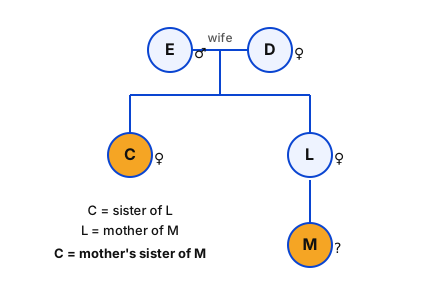
- C ÷ D → C is daughter of D; D ≠ E → D is wife of E; E ₹ L → E is father of L; L x M → L is mother of M.
- D and E are a couple; their children are C and L (both female). L is M's mother.
- C is the sister of M's mother → mother's sister (maternal aunt).
Trick: Daughter of D, who is wife of E, father of L ⇒ C and L are siblings; then go one level down to M.
Answer: (D) Mother's sister
अवधारणा: हर पड़ोसी जोड़ी को खोलें और वृक्ष बनाएँ।
- C ÷ D → C, D की पुत्री; D ≠ E → D, E की पत्नी; E ₹ L → E, L का पिता; L x M → L, M की माता।
- D और E दंपति हैं; उनकी संतानें C और L (दोनों स्त्री)। L, M की माता है।
- C, M की माता की बहन → माता की बहन (मौसी)।
ट्रिक: C, D की पुत्री; D, E की पत्नी; E, L का पिता ⇒ C और L बहनें; फिर एक स्तर नीचे M।
उत्तर: (D) Mother's sister
RRB NTPC Undergraduate CBT 1General Intelligence and ReasoningBlood relations (coded)RRB NTPC Undergraduate CBT 1 2025 · 9 May Shift 2
Q659.Seven boxes B, C, D, E, Q, R and S are kept one over the other but not necessarily in the same order. Only one box is kept above R. Only two boxes are kept between R and S. Only three boxes are kept between D and S. Only Q is kept below C. B is not kept immediately above S. How many boxes are kept between E and Q?
सात बक्से B, C, D, E, Q, R और S एक के ऊपर एक रखे गए हैं, लेकिन आवश्यक नहीं कि इसी क्रम में हों। R के ऊपर केवल एक बक्सा रखा गया है। R और S के बीच केवल दो बक्से रखे गए हैं। D और S के बीच केवल तीन बक्से रखे गए हैं। C के नीचे केवल Q रखा गया है। B, S के ठीक ऊपर नहीं रखा गया है। E और Q के बीच कितने बक्से रखे गए हैं?
- AThreeतीन
- BOneएक
- CTwoदो
- DFourचार
Show answer
Concept: Number positions 1 (bottom) to 7 (top) and place fixed boxes first.
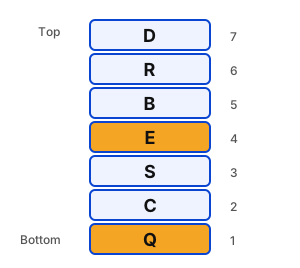
- Only one box above R → R = 6. Two boxes between R and S → S = 3. Three boxes between D and S → D = 7.
- Only Q below C → Q = 1, C = 2. Remaining B and E go to 4 and 5; B is not immediately above S (not 4) → B = 5, E = 4.
- Order (bottom→top): Q C S E B R D. Between E (4) and Q (1): C and S = Two.
Trick: Clues like "only one above" / "only X below" fix the ends instantly – start there.
Answer: (C) Two
अवधारणा: स्थान 1 (नीचे) से 7 (ऊपर) तक गिनें और निश्चित बॉक्स पहले रखें।
- R के ऊपर केवल एक → R = 6। R और S के बीच दो → S = 3। D और S के बीच तीन → D = 7।
- C के नीचे केवल Q → Q = 1, C = 2। बचे B, E स्थान 4, 5 पर; B, S के ठीक ऊपर नहीं (4 नहीं) → B = 5, E = 4।
- क्रम (नीचे→ऊपर): Q C S E B R D। E (4) और Q (1) के बीच: C और S = दो।
ट्रिक: "ऊपर केवल एक" / "नीचे केवल X" जैसी सूचनाएँ छोर तुरंत तय करती हैं – वहीं से शुरू करें।
उत्तर: (C) Two
RRB NTPC Undergraduate CBT 1General Intelligence and ReasoningBox arrangement (stacking)RRB NTPC Undergraduate CBT 1 2025 · 9 May Shift 2
Q660.If 2 is added to each even digit and 1 is subtracted from each odd digit in the number 63145729, then how many digits will appear more than once in the new number thus formed?
यदि संख्या 63145729 में प्रत्येक सम अंक में 2 जोड़ा जाए और प्रत्येक विषम अंक में से 1 घटाया जाए, तो इस प्रकार बनी नई संख्या में कितने अंक एक से अधिक बार आएँगे?
- AThreeतीन
- BTwoदो
- COneएक
- DFourचार
Show answer
Concept: Apply the rule digit by digit, then count repeated digits.
- 6 3 1 4 5 7 2 9: even +2 → 6→8, 4→6, 2→4; odd −1 → 3→2, 1→0, 5→4, 7→6, 9→8.
- New number: 8 2 0 6 4 6 4 8. Digits 8, 6 and 4 each appear twice → Three digits appear more than once.
Trick: Write new digits below the old ones; 0 counts as a digit but here it appears once.
Answer: (A) Three
अवधारणा: नियम अंक-दर-अंक लगाएँ, फिर दोहराए गए अंक गिनें।
- 6 3 1 4 5 7 2 9: सम +2 → 6→8, 4→6, 2→4; विषम −1 → 3→2, 1→0, 5→4, 7→6, 9→8।
- नई संख्या: 8 2 0 6 4 6 4 8। अंक 8, 6 और 4 दो-दो बार → तीन अंक एक से अधिक बार।
ट्रिक: नए अंक पुराने के नीचे लिखें; 0 भी अंक है पर यहाँ एक बार ही आया।
उत्तर: (A) Three
RRB NTPC Undergraduate CBT 1General Intelligence and ReasoningNumber operationsRRB NTPC Undergraduate CBT 1 2025 · 9 May Shift 2

