Q701.In , and , what is the measure of ?
में, और है, तो का माप क्या है?
- A
- B
- C
- D
Show answer
Concept: Angles opposite equal sides are equal; angle sum of a triangle .
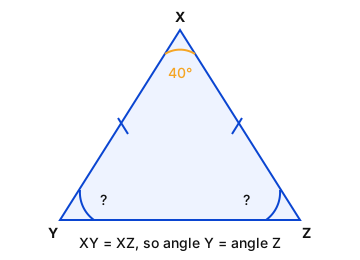
Trick: Base angle of an isosceles triangle .
Answer: (B)
अवधारणा: बराबर भुजाओं के सामने के कोण बराबर होते हैं; त्रिभुज के कोणों का योग ।
ट्रिक: समद्विबाहु त्रिभुज का आधार कोण ।
उत्तर: (B)
RRB NTPC Undergraduate CBT 1MathematicsGeometry – Isosceles TriangleRRB NTPC Undergraduate CBT 1 2025 · 8 May Shift 3
Q702.The mean of the following data is 12.5. Find the missing frequency p.
Data Values (x): 10, 15
Frequency (f): 5, p
निम्नलिखित आँकड़ों का माध्य 12.5 है। लुप्त बारंबारता p ज्ञात कीजिए।
आँकड़ों के मान (x): 10, 15
बारंबारता (f): 5, p
- A6
- B5
- C4
- D3
Show answer
Concept: Mean .
Trick: Mean 12.5 is exactly midway between 10 and 15, so the frequencies must be equal: .
Answer: (B) 5
अवधारणा: माध्य ।
ट्रिक: माध्य 12.5, 10 और 15 के ठीक बीच में है, अतः दोनों बारंबारताएँ बराबर होंगी: ।
उत्तर: (B) 5
RRB NTPC Undergraduate CBT 1MathematicsStatistics – MeanRRB NTPC Undergraduate CBT 1 2025 · 8 May Shift 3
Q703.A delivery van covers the first 100 km at 50 km/h, the next 150 km at 60 km/h, and the last 50 km at 40 km/h. What is the average speed for the entire journey (correct to two places of decimal)?
एक डिलीवरी वैन पहले 100 km की दूरी 50 km/h की चाल से, अगले 150 km की दूरी 60 km/h की चाल से और अंतिम 50 km की दूरी 40 km/h की चाल से तय करती है। पूरी यात्रा के लिए औसत चाल क्या है (दशमलव के दो स्थानों तक सही)?
- A50.05 km/h
- B52.17 km/h
- C48.29 km/h
- D54.54 km/h
Show answer
Concept: Average speed (never the average of speeds).
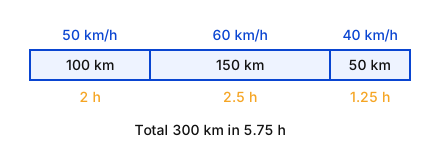
- Times: h, h, h
- Total: 300 km in h
- Average speed
Trick: – only option B lies between 50 and 60 close to this value.
Answer: (B) 52.17 km/h
अवधारणा: औसत चाल (चालों का औसत नहीं)।
- समय: h, h, h
- कुल: 300 km, h में
- औसत चाल
ट्रिक: – यही मान विकल्प B से मेल खाता है।
उत्तर: (B) 52.17 km/h
RRB NTPC Undergraduate CBT 1MathematicsAverage SpeedRRB NTPC Undergraduate CBT 1 2025 · 8 May Shift 3
Q704.The population of a town increases by 10% in the year 2015 and decreases by 15% in the year 2016. If the population of the town at the end of the year 2016 is 1,87,000, find the population of the town in the beginning of the year 2015.
एक कस्बे की जनसंख्या वर्ष 2015 में 10% बढ़ती है और वर्ष 2016 में 15% घटती है। यदि वर्ष 2016 के अंत में कस्बे की जनसंख्या 1,87,000 है, तो वर्ष 2015 के प्रारंभ में कस्बे की जनसंख्या ज्ञात कीजिए।
- A2,00,000
- B2,10,000
- C2,15,000
- D1,95,000
Show answer
Concept: Successive changes multiply: .
Trick: Net change , so of .
Answer: (A) 2,00,000
अवधारणा: क्रमिक परिवर्तन गुणा होते हैं: ।
ट्रिक: शुद्ध परिवर्तन , अतः का ।
उत्तर: (A) 2,00,000
RRB NTPC Undergraduate CBT 1MathematicsPercentage – PopulationRRB NTPC Undergraduate CBT 1 2025 · 8 May Shift 3
Q705.Which of the following numbers is divisible by 11?
निम्नलिखित में से कौन-सी संख्या 11 से विभाज्य है?
- A3,762
- B6,184
- C4,915
- D7,393
Show answer
Concept: A number is divisible by 11 if (sum of digits at odd places) − (sum at even places) is 0 or a multiple of 11.
- 3762: ✓ divisible
- 6184: ✗; 4915: ✗; 7393: ✗
Trick: – alternate-digit difference zero means divisible.
Answer: (A) 3,762
अवधारणा: संख्या 11 से विभाज्य है यदि (विषम स्थानों के अंकों का योग) − (सम स्थानों का योग) 0 या 11 का गुणज हो।
- 3762: ✓ विभाज्य
- 6184: ✗; 4915: ✗; 7393: ✗
ट्रिक: – एकांतर अंकों का अंतर शून्य = विभाज्य।
उत्तर: (A) 3,762
RRB NTPC Undergraduate CBT 1MathematicsDivisibility Rule of 11RRB NTPC Undergraduate CBT 1 2025 · 8 May Shift 3
Q706.In a division sum, the divisor is 14 times the quotient and 5 times the remainder. If the remainder is 56, what is the dividend?
एक भाग के प्रश्न में, भाजक भागफल का 14 गुना और शेषफल का 5 गुना है। यदि शेषफल 56 है, तो भाज्य क्या है?
- A5655
- B5656
- C5651
- D5653
Show answer
Concept: Dividend .
- Divisor
- Quotient
- Dividend
Trick: Find the divisor from the remainder first – it links both given relations.
Answer: (B) 5656
अवधारणा: भाज्य ।
- भाजक
- भागफल
- भाज्य
ट्रिक: पहले शेषफल से भाजक निकालें – यही दोनों संबंधों को जोड़ता है।
उत्तर: (B) 5656
RRB NTPC Undergraduate CBT 1MathematicsDivision AlgorithmRRB NTPC Undergraduate CBT 1 2025 · 8 May Shift 3
Q707.Sangeeta’s salary is revised twice in two consecutive years. In the first year, the salary is increased by 12%. In the second year, it is decreased by 10%. Despite this, her salary after the second revision is ₹1,584 more than the original salary. What is Sangeeta’s original monthly salary (in ₹)?
संगीता के वेतन में लगातार दो वर्षों में दो बार संशोधन किया जाता है। पहले वर्ष में वेतन में 12% की वृद्धि की जाती है। दूसरे वर्ष में इसमें 10% की कमी की जाती है। इसके बावजूद, दूसरे संशोधन के बाद उसका वेतन मूल वेतन से ₹1,584 अधिक है। संगीता का मूल मासिक वेतन (₹ में) कितना है?
- A1,75,000
- B1,89,000
- C2,00,000
- D1,98,000
Show answer
Concept: Net change for then .
- Net
- of salary salary ₹1,98,000
Trick: ; the extra part equals ₹1,584, so salary .
Answer: (D) 1,98,000
अवधारणा: फिर का शुद्ध परिवर्तन ।
- शुद्ध
- वेतन का वेतन ₹1,98,000
ट्रिक: ; अतिरिक्त भाग = ₹1,584, अतः वेतन ।
उत्तर: (D) 1,98,000
RRB NTPC Undergraduate CBT 1MathematicsSuccessive Percentage ChangeRRB NTPC Undergraduate CBT 1 2025 · 8 May Shift 3
Q708.A train covers a distance of 300 kilometers in 5 hours. If the same train takes 6 hours to cover the same distance, what is the change in its speed?
एक रेलगाड़ी 300 किलोमीटर की दूरी 5 घंटे में तय करती है। यदि वही रेलगाड़ी उतनी ही दूरी तय करने में 6 घंटे लेती है, तो उसकी चाल में क्या परिवर्तन होगा?
- A15 km/h decrease15 km/h की कमी
- B10 km/h increase10 km/h की वृद्धि
- C15 km/h increase15 km/h की वृद्धि
- D10 km/h decrease10 km/h की कमी
Show answer
Concept: Speed .
- Original speed
- New speed
- Change decrease
Trick: More time for the same distance always means lower speed – so only "decrease" options qualify.
Answer: (D) 10 km/h decrease
अवधारणा: चाल ।
- मूल चाल
- नई चाल
- परिवर्तन की कमी
ट्रिक: समान दूरी में अधिक समय = कम चाल, अतः केवल "कमी" वाले विकल्प संभव हैं।
उत्तर: (D) 10 km/h की कमी
RRB NTPC Undergraduate CBT 1MathematicsSpeed, Time and DistanceRRB NTPC Undergraduate CBT 1 2025 · 8 May Shift 3
Q709.Simplify: (0.25 × 1.6) ÷ (0.04 × 0.5)
सरल कीजिए: (0.25 × 1.6) ÷ (0.04 × 0.5)
- A20
- B2
- C10
- D8
Show answer
Concept: Multiply inside each bracket, then divide.
Trick: Remove decimals: … or simply note and , product 20.
Answer: (A) 20
अवधारणा: पहले हर कोष्ठक में गुणा करें, फिर भाग दें।
ट्रिक: जोड़ी बनाकर देखें: और , गुणनफल 20।
उत्तर: (A) 20
RRB NTPC Undergraduate CBT 1MathematicsDecimal SimplificationRRB NTPC Undergraduate CBT 1 2025 · 8 May Shift 3
Q710.A and B can do a piece of work in 12 days and 39 days, respectively. Both work for 4 days and then A leaves. How long (in days) will B take to complete the remaining work?
A और B एक कार्य को क्रमशः 12 दिनों और 39 दिनों में कर सकते हैं। दोनों 4 दिन कार्य करते हैं और फिर A कार्य छोड़ देता है। शेष कार्य पूरा करने में B को कितने दिन लगेंगे?
- A24
- B21
- C23
- D22
Show answer
Concept: Total work = LCM of days; efficiency = work per day.
- LCM(12,39) units; A , B units/day
- 4 days together: units; remaining
- B alone: days
Trick: In 4 days A does of the work; B must do the rest alone, so B's remaining time .
Answer: (D) 22
अवधारणा: कुल कार्य = दिनों का LCM; दक्षता = प्रतिदिन कार्य।
- LCM(12,39) इकाई; A , B इकाई/दिन
- 4 दिन साथ: इकाई; शेष
- B अकेला: दिन
ट्रिक: 4 दिनों में A काम करता है; B का शेष समय ।
उत्तर: (D) 22
RRB NTPC Undergraduate CBT 1MathematicsTime and WorkRRB NTPC Undergraduate CBT 1 2025 · 8 May Shift 3
Q711.The amount under simple interest on a sum of ₹8,000 for 3 years at an interest rate of 7.5% per annum is
₹8,000 की राशि पर 7.5% वार्षिक ब्याज दर से 3 वर्षों के लिए साधारण ब्याज पर मिश्रधन है
- A₹9800
- B₹10000
- C₹9600
- D₹9400
Show answer
Concept: ; Amount .
- Amount ₹9,800
Trick: of 8000 in one step.
Answer: (A) ₹9800
अवधारणा: ; मिश्रधन ।
- मिश्रधन ₹9,800
ट्रिक: of 8000 एक ही चरण में।
उत्तर: (A) ₹9800
RRB NTPC Undergraduate CBT 1MathematicsSimple InterestRRB NTPC Undergraduate CBT 1 2025 · 8 May Shift 3
Q712.If a man bought an article at 20% less than its marked price and sold it for ₹10 more than its marked price, his profit was 40%. What was the marked price (in ₹) of the article (correct to two decimal places)?
यदि एक व्यक्ति ने एक वस्तु को उसके अंकित मूल्य से 20% कम पर खरीदा और उसे अंकित मूल्य से ₹10 अधिक पर बेच दिया, तो उसका लाभ 40% था। वस्तु का अंकित मूल्य (₹ में) क्या था (दशमलव के दो स्थानों तक सही)?
- A₹83.33
- B₹76.66
- C₹86.66
- D₹73.33
Show answer
Concept: . Let marked price .
- ,
Trick: , so the ₹10 above MP is exactly of MP.
Answer: (A) ₹83.33
अवधारणा: । अंकित मूल्य मानें।
- ,
ट्रिक: , अतः MP से ऊपर के ₹10 ठीक MP का हैं।
उत्तर: (A) ₹83.33
RRB NTPC Undergraduate CBT 1MathematicsProfit and LossRRB NTPC Undergraduate CBT 1 2025 · 8 May Shift 3
Q713.Evaluate 233 + (-14)3 + (-9)3
233 + (-14)3 + (-9)3 का मान ज्ञात कीजिए
- A8502
- B8694
- C8498
- D8581
Show answer
Concept: If , then .
- Sum
Trick: Whenever three cubes are added and the bases sum to zero, skip cubing – just use .
Answer: (B) 8694
अवधारणा: यदि तो ।
- योग
ट्रिक: तीन घनों का योग हो और आधार का योग शून्य हो तो घन न निकालें – सीधे ।
उत्तर: (B) 8694
RRB NTPC Undergraduate CBT 1MathematicsAlgebraic IdentityRRB NTPC Undergraduate CBT 1 2025 · 8 May Shift 3
Q714.The present age of Person A is 5 years more than twice the age of Person B. If Person B is 15 years old, what is the present age (in years) of Person A?
व्यक्ति A की वर्तमान आयु व्यक्ति B की आयु के दोगुने से 5 वर्ष अधिक है। यदि व्यक्ति B की आयु 15 वर्ष है, तो व्यक्ति A की वर्तमान आयु (वर्षों में) क्या है?
- A35
- B33
- C34
- D32
Show answer
Concept: Translate words into an equation: .
- years
Trick: "5 more than twice" = double first, then add 5.
Answer: (A) 35
अवधारणा: शब्दों को समीकरण में बदलें: ।
- वर्ष
ट्रिक: "दोगुने से 5 अधिक" = पहले दोगुना, फिर 5 जोड़ें।
उत्तर: (A) 35
RRB NTPC Undergraduate CBT 1MathematicsAgesRRB NTPC Undergraduate CBT 1 2025 · 8 May Shift 3
Q715.A trader buys a consignment of goods for ₹2400. He sells one-third of the goods at a 20% profit, and one-fourth of the goods at a 10% loss, and the remaining goods at cost price. What is the overall profit or loss percentage?
एक व्यापारी ₹2400 में माल की एक खेप खरीदता है। वह एक-तिहाई माल 20% लाभ पर, एक-चौथाई माल 10% हानि पर और शेष माल क्रय मूल्य पर बेचता है। कुल लाभ या हानि प्रतिशत क्या है?
- A profit लाभ
- B loss हानि
- C profit लाभ
- D loss हानि
Show answer
Concept: Overall .
- One-third: CP ₹800, profit
- One-fourth: CP ₹600, loss
- Rest at cost: . Net gain
- profit
Trick: Weighted profit – no need to use ₹2400 at all.
Answer: (A) profit
अवधारणा: कुल ।
- एक-तिहाई: CP ₹800, लाभ
- एक-चौथाई: CP ₹600, हानि
- शेष क्रय मूल्य पर: । शुद्ध लाभ
- लाभ
ट्रिक: भारित लाभ – ₹2400 की ज़रूरत ही नहीं।
उत्तर: (A) लाभ
RRB NTPC Undergraduate CBT 1MathematicsProfit and Loss – Mixed SaleRRB NTPC Undergraduate CBT 1 2025 · 8 May Shift 3
Q716.A shopkeeper offers the following schemes on toys of the same marked price. (A) Successive discounts of 21% and 8% on any number of toys bought.
(B) Successive discounts of 38%, 42% and 30% on any number of toys bought. (C) 17% discount on the first 8 toys and 20% discount on each toy thereon.
(D) 7 toys free of cost on buying 10 toys.
A customer wants to buy 10 toys. Which of the above schemes is the least beneficial to her?
एक दुकानदार समान अंकित मूल्य वाले खिलौनों पर निम्नलिखित योजनाएँ प्रस्तुत करता है। (A) खरीदे गए किसी भी संख्या के खिलौनों पर 21% और 8% की क्रमिक छूट।
(B) खरीदे गए किसी भी संख्या के खिलौनों पर 38%, 42% और 30% की क्रमिक छूट। (C) पहले 8 खिलौनों पर 17% छूट और उसके बाद प्रत्येक खिलौने पर 20% छूट।
(D) 10 खिलौने खरीदने पर 7 खिलौने निःशुल्क।
एक ग्राहक 10 खिलौने खरीदना चाहती है। उपरोक्त में से कौन-सी योजना उसके लिए सबसे कम लाभदायक है?
- AA
- BD
- CC
- DB
Show answer
Concept: Compare the effective price paid per toy (take MP = ₹100 each).
- (A) ₹72.68 per toy
- (B) ₹25.17 per toy
- (C) for 10, i.e. ₹82.40 per toy
- (D) Pay for 10, get 17: ₹58.82 per toy
- Highest effective price = scheme C → least beneficial.
Trick: Successive discounts always beat the plain sum; a scheme with only – off can never compete with or three big discounts.
Answer: (C) C
अवधारणा: प्रति खिलौना प्रभावी मूल्य की तुलना करें (MP = ₹100 मानें)।
- (A) ₹72.68 प्रति खिलौना
- (B) ₹25.17 प्रति खिलौना
- (C) (10 के लिए), यानी ₹82.40 प्रति खिलौना
- (D) 10 का भुगतान, 17 मिले: ₹58.82 प्रति खिलौना
- सबसे अधिक प्रभावी मूल्य = योजना C → सबसे कम लाभकारी।
ट्रिक: केवल – छूट वाली योजना या तीन बड़ी छूटों का मुकाबला नहीं कर सकती।
उत्तर: (C) C
RRB NTPC Undergraduate CBT 1MathematicsSuccessive Discounts – ComparisonRRB NTPC Undergraduate CBT 1 2025 · 8 May Shift 3
Q717.Eight mangoes and five oranges cost ₹164, while five mangoes and eight oranges cost ₹148. Determine the cost of three mangoes and three oranges.
आठ आमों और पाँच संतरों की कीमत ₹164 है, जबकि पाँच आमों और आठ संतरों की कीमत ₹148 है। तीन आमों और तीन संतरों की कीमत ज्ञात कीजिए।
- A₹74
- B₹76
- C₹72
- D₹70
Show answer
Concept: Symmetric equations – add them to get directly.
- ,
- Adding:
Trick: When coefficients are swapped, adding gives the sum and subtracting gives the difference – no need to solve for each item.
Answer: (C) ₹72
अवधारणा: सममित समीकरण – जोड़कर सीधे निकालें।
- ,
- जोड़ने पर:
ट्रिक: गुणांक आपस में बदले हों तो जोड़ने से योग और घटाने से अंतर मिलता है – अलग-अलग हल करने की ज़रूरत नहीं।
उत्तर: (C) ₹72
RRB NTPC Undergraduate CBT 1MathematicsLinear EquationsRRB NTPC Undergraduate CBT 1 2025 · 8 May Shift 3
Q718.A ladder leans against a wall, making an angle of 60° with the ground. If the foot of the ladder is 15 metres from the wall, what is the length of the ladder?
एक सीढ़ी एक दीवार के सहारे टिकी है और ज़मीन के साथ 60° का कोण बनाती है। यदि सीढ़ी का पाद दीवार से 15 मीटर दूर है, तो सीढ़ी की लंबाई कितनी है?
- A32 m
- B30 m
- C42 m
- D36 m
Show answer
Concept: In the right triangle, .
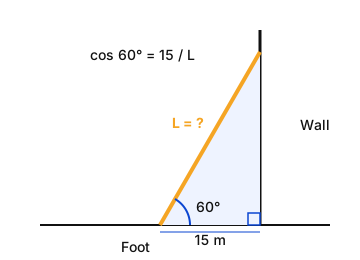
- m
Trick: In a -- triangle the hypotenuse is twice the side opposite (the base here).
Answer: (B) 30 m
अवधारणा: समकोण त्रिभुज में ।
- m
ट्रिक: -- त्रिभुज में कर्ण, के सामने वाली भुजा (यहाँ आधार) का दोगुना होता है।
उत्तर: (B) 30 m
RRB NTPC Undergraduate CBT 1MathematicsHeights and DistancesRRB NTPC Undergraduate CBT 1 2025 · 8 May Shift 3
Q719.Simplify:
सरल कीजिए:
- A
- B
- C
- D
Show answer
Concept: , , .
- Numerator:
- Divide:
Trick: Put : expression ; only gives .
Answer: (A)
अवधारणा: , , ।
- अंश:
- भाग:
ट्रिक: रखें: व्यंजक ; केवल से मिलता है।
उत्तर: (A)
RRB NTPC Undergraduate CBT 1MathematicsLaws of ExponentsRRB NTPC Undergraduate CBT 1 2025 · 8 May Shift 3
Q720.Sphere A has a radius of 6 cm and Sphere B has a radius of 3 cm. What is the ratio of the surface area of A to that of B?
गोले A की त्रिज्या 6 cm और गोले B की त्रिज्या 3 cm है। A के पृष्ठीय क्षेत्रफल का B के पृष्ठीय क्षेत्रफल से अनुपात क्या है?
- A4:1
- B3:1
- C2:1
- D6:1
Show answer
Concept: Surface area , so the ratio of areas .
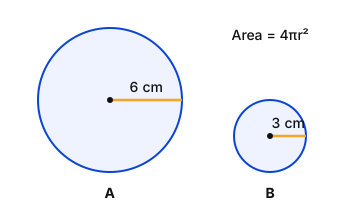
- Area ratio
Trick: Double the radius → area , volume .
Answer: (A) 4:1
अवधारणा: पृष्ठीय क्षेत्रफल , अतः क्षेत्रफलों का अनुपात ।
- क्षेत्रफल अनुपात
ट्रिक: त्रिज्या दोगुनी → क्षेत्रफल , आयतन ।
उत्तर: (A) 4:1
RRB NTPC Undergraduate CBT 1MathematicsMensuration – SphereRRB NTPC Undergraduate CBT 1 2025 · 8 May Shift 3

