Q741.What is a unitary feature of the Constitution of India?
भारत के संविधान की एकात्मक विशेषता क्या है?
- ABicameral legislatureद्विसदनीय विधायिका
- BIntegrated judiciaryएकीकृत न्यायपालिका
- CSupremacy of the Constitutionसंविधान की सर्वोच्चता
- DDual governmentदोहरी सरकार
Show answer
Concept: India is a federation with a strong unitary bias. Unitary features include a single Constitution, single citizenship, integrated judiciary, all-India services, emergency provisions and a strong Centre.
- Integrated judiciary: one hierarchy of courts (Supreme Court at the top) enforces both Central and State laws – a unitary feature.
- Bicameral legislature, supremacy of the Constitution and dual government (Centre + States) are federal features.
Yaad rakhein: Federal = "division" (two governments, two sets of laws); Unitary = "single" (one judiciary, one citizenship, one Constitution).
Answer: (B) Integrated judiciary
अवधारणा: भारत एक सशक्त एकात्मक झुकाव वाला संघ है। एकात्मक लक्षणों में एकल संविधान, एकल नागरिकता, एकीकृत न्यायपालिका, अखिल भारतीय सेवाएँ, आपातकालीन प्रावधान और शक्तिशाली केंद्र शामिल हैं।
- एकीकृत न्यायपालिका (Integrated judiciary): न्यायालयों का एक ही क्रम (शीर्ष पर सर्वोच्च न्यायालय) केंद्र और राज्य दोनों के कानून लागू करता है – यह एकात्मक लक्षण है।
- द्विसदनीय विधायिका, संविधान की सर्वोच्चता और दोहरी सरकार (केंद्र + राज्य) संघीय लक्षण हैं।
याद रखें: संघीय = "विभाजन" (दो सरकारें, दो तरह के कानून); एकात्मक = "एकल" (एक न्यायपालिका, एक नागरिकता, एक संविधान)।
उत्तर: (B) Integrated judiciary (एकीकृत न्यायपालिका)
RRB NTPC Undergraduate CBT 1General AwarenessIndian Constitution – Unitary featuresRRB NTPC Undergraduate CBT 1 2025 · 14 Jun Shift 2
Q742.Population density is defined as the number of people per:
जनसंख्या घनत्व को प्रति ______ लोगों की संख्या के रूप में परिभाषित किया जाता है।
- AUnit of land areaभूमि क्षेत्रफल की इकाई
- BTotal populationकुल जनसंख्या
- CArable landकृषि योग्य भूमि
- DUrban centerशहरी केंद्र
Show answer
Concept: Population density = number of people living per unit area of land (usually per square kilometre).
- ; e.g. India (2011) ≈ 382 persons per .
- Density measured only over arable land is called physiological density – a different concept; "urban centre" and "total population" are not denominators.
Yaad rakhein: Density means "how crowded" – persons per of land.
Answer: (A) Unit of land area
अवधारणा: जनसंख्या घनत्व = भूमि के प्रति इकाई क्षेत्रफल (प्रायः प्रति वर्ग किमी) में रहने वाले लोगों की संख्या।
- ; जैसे भारत (2011) ≈ 382 व्यक्ति प्रति ।
- केवल कृषि योग्य भूमि पर मापा गया घनत्व "physiological density" कहलाता है – अलग अवधारणा; "शहरी केंद्र" या "कुल जनसंख्या" हर (denominator) नहीं हैं।
याद रखें: घनत्व = "कितनी भीड़" – प्रति भूमि पर व्यक्ति।
उत्तर: (A) Unit of land area (भूमि क्षेत्रफल की इकाई)
RRB NTPC Undergraduate CBT 1General AwarenessGeography – Population densityRRB NTPC Undergraduate CBT 1 2025 · 14 Jun Shift 2
Q743.What is the approximate speed of sound in air at room temperature (approximately 20°C)?
कमरे के तापमान (लगभग 20°C) पर वायु में ध्वनि की अनुमानित चाल कितनी होती है?
- A343 m/s
- B5000 m/s
- C1500 m/s
- D300 m/s
Show answer
Concept: Speed of sound in air depends on temperature; at it is about (≈ 1235 km/h).
- At it is about ; it rises by roughly per , so at : .
- is the speed in water and in steel/iron, not in air.
Yaad rakhein: Air 343, water ~1500, steel ~5000 (all in m/s) – solids fastest, gases slowest.
Answer: (A) 343 m/s
अवधारणा: वायु में ध्वनि की चाल तापमान पर निर्भर करती है; पर यह लगभग (≈ 1235 km/h) होती है।
- पर लगभग ; प्रति लगभग बढ़ती है, अतः पर ।
- जल में और स्टील/लोहे में चाल है, वायु में नहीं।
याद रखें: वायु 343, जल ~1500, स्टील ~5000 (सब m/s में) – ठोस में सबसे तेज़, गैस में सबसे धीमी।
उत्तर: (A) 343 m/s
RRB NTPC Undergraduate CBT 1General AwarenessPhysics – Speed of soundRRB NTPC Undergraduate CBT 1 2025 · 14 Jun Shift 2
Q744.In which of the following media does sound move the fastest at a particular
temperature?
किसी विशेष
तापमान पर निम्नलिखित में से किस माध्यम में ध्वनि सबसे तीव्र गति से चलती है?
- AAirवायु
- BWaterजल
- CVaccumनिर्वात
- DIronलोहा
Show answer
Concept: Sound is a mechanical wave: it needs a medium and travels fastest in solids, slower in liquids and slowest in gases, because particles in solids are most tightly bound (high elasticity).
- Order of speed: Solid (iron ≈ 5000 m/s) Liquid (water ≈ 1500 m/s) Gas (air ≈ 343 m/s).
- Vacuum has no particles, so sound cannot travel at all – it is the trap option.
Yaad rakhein: "Solid-Liquid-Gas" = fast to slow for sound; vacuum = no sound (that is why space is silent).
Answer: (D) Iron
अवधारणा: ध्वनि एक यांत्रिक तरंग है: इसे माध्यम चाहिए और यह ठोस में सबसे तेज़, द्रव में धीमी और गैस में सबसे धीमी चलती है, क्योंकि ठोस के कण सबसे कसकर बंधे (उच्च प्रत्यास्थता) होते हैं।
- चाल का क्रम: ठोस (लोहा ≈ 5000 m/s) द्रव (जल ≈ 1500 m/s) गैस (वायु ≈ 343 m/s)।
- निर्वात (vacuum) में कण नहीं होते, अतः ध्वनि चल ही नहीं सकती – यह भ्रमित करने वाला विकल्प है।
याद रखें: ध्वनि के लिए "ठोस-द्रव-गैस" = तेज़ से धीमा; निर्वात = ध्वनि नहीं (इसीलिए अंतरिक्ष मौन है)।
उत्तर: (D) Iron (लोहा)
RRB NTPC Undergraduate CBT 1General AwarenessPhysics – Sound in different mediaRRB NTPC Undergraduate CBT 1 2025 · 14 Jun Shift 2
Q745.What is the meaning of globalisation?
वैश्वीकरण का क्या अर्थ है?
- AIntegration of a country’s economy with the world economyकिसी देश की अर्थव्यवस्था का विश्व अर्थव्यवस्था के साथ एकीकरण
- BExpansion of state ownership across major industriesप्रमुख उद्योगों में राज्य के स्वामित्व का विस्तार
- CReduction in the volume of international tradeअंतर्राष्ट्रीय व्यापार की मात्रा में कमी
- DEconomic isolation of countries from global marketsवैश्विक बाज़ारों से देशों का आर्थिक अलगाव
Show answer
Concept: Globalisation means integrating a country's economy with the world economy through free flow of goods, services, capital, technology and people.
- India adopted globalisation in the 1991 LPG reforms (Liberalisation, Privatisation, Globalisation) – lowering tariffs, inviting FDI, opening trade.
- Options B, C and D describe the opposite: state control, shrinking trade and isolation.
Yaad rakhein: LPG 1991 → "G" = Globalisation = joining the world market.
Answer: (A) Integration of a country’s economy with the world economy
अवधारणा: वैश्वीकरण का अर्थ है वस्तुओं, सेवाओं, पूँजी, तकनीक और लोगों के मुक्त प्रवाह के माध्यम से किसी देश की अर्थव्यवस्था को विश्व अर्थव्यवस्था से जोड़ना।
- भारत ने 1991 के LPG सुधारों (उदारीकरण, निजीकरण, वैश्वीकरण) में वैश्वीकरण अपनाया – टैरिफ घटाना, FDI आमंत्रित करना, व्यापार खोलना।
- विकल्प B, C और D इसका उल्टा बताते हैं: राज्य नियंत्रण, घटता व्यापार और अलगाव।
याद रखें: LPG 1991 → "G" = Globalisation = विश्व बाज़ार से जुड़ना।
उत्तर: (A) देश की अर्थव्यवस्था का विश्व अर्थव्यवस्था से एकीकरण
RRB NTPC Undergraduate CBT 1General AwarenessEconomics – GlobalisationRRB NTPC Undergraduate CBT 1 2025 · 14 Jun Shift 2
Q746.A solution is prepared by dissolving 15 g of salt in 585 g of water. Calculate the mass percent (w/w) of the solution.
585 g जल में 15 g लवण घोलकर एक विलयन तैयार किया जाता है। विलयन का द्रव्यमान प्रतिशत (w/w) ज्ञात कीजिए।
- A2.5%
- B2.1%
- C0.5%
- D1.5%
Show answer
Concept: Mass percent (w/w) , where mass of solution = solute + solvent.
- Mass of solution .
- Mass .
Trick: Always divide by the total (solute + solvent), not by the solvent alone – would be a wrong 2.56%.
Answer: (A) 2.5%
अवधारणा: द्रव्यमान प्रतिशत (w/w) , जहाँ विलयन का द्रव्यमान = विलेय + विलायक।
- विलयन का द्रव्यमान ।
- द्रव्यमान ।
ट्रिक: हमेशा कुल (विलेय + विलायक) से भाग दें, केवल विलायक से नहीं – से गलत 2.56% आएगा।
उत्तर: (A) 2.5%
RRB NTPC Undergraduate CBT 1General AwarenessChemistry – Mass percent of solutionRRB NTPC Undergraduate CBT 1 2025 · 14 Jun Shift 2
Q747.Which union ministry primarily organized the national-level celebration for the 150th anniversary of ‘Vande Mataram’?
'वंदे मातरम्' की 150वीं वर्षगांठ के राष्ट्रीय स्तर के समारोह का आयोजन मुख्य रूप से किस केंद्रीय मंत्रालय ने किया?
- AMinistry of Educationशिक्षा मंत्रालय
- BMinistry of Youth Affairs and Sportsयुवा कार्यक्रम और खेल मंत्रालय
- CMinistry of Cultureसंस्कृति मंत्रालय
- DMinistry of Home Affairsगृह मंत्रालय
Show answer
Concept: "Vande Mataram" was composed by Bankim Chandra Chattopadhyay on 7 November 1875. Its 150th anniversary (7 Nov 2025) was marked by a year-long national celebration.
- The Prime Minister launched the year-long commemoration at Indira Gandhi Indoor Stadium, New Delhi, on 7 November 2025; the event was organised by the Ministry of Culture.
- The Ministry of Culture handles such national commemorations (e.g. Azadi Ka Amrit Mahotsav) – not Education, Sports or Home.
Yaad rakhein: National commemorations of songs, leaders and heritage = Ministry of Culture.
Answer: (C) Ministry of Culture
अवधारणा: "वंदे मातरम्" की रचना बंकिम चंद्र चट्टोपाध्याय ने 7 नवंबर 1875 को की थी। इसकी 150वीं वर्षगाँठ (7 नवंबर 2025) पर वर्ष भर चलने वाला राष्ट्रीय समारोह शुरू हुआ।
- प्रधानमंत्री ने 7 नवंबर 2025 को इंदिरा गांधी इंडोर स्टेडियम, नई दिल्ली में वर्ष भर के स्मरणोत्सव का शुभारंभ किया; आयोजन संस्कृति मंत्रालय ने किया।
- ऐसे राष्ट्रीय स्मरणोत्सव (जैसे आज़ादी का अमृत महोत्सव) संस्कृति मंत्रालय संभालता है – शिक्षा, खेल या गृह मंत्रालय नहीं।
याद रखें: गीतों, नेताओं और विरासत के राष्ट्रीय स्मरणोत्सव = संस्कृति मंत्रालय (Ministry of Culture)।
उत्तर: (C) Ministry of Culture (संस्कृति मंत्रालय)
RRB NTPC Undergraduate CBT 1General AwarenessCurrent affairs – Vande Mataram 150 yearsRRB NTPC Undergraduate CBT 1 2025 · 14 Jun Shift 2
Q748.In March 2026, Jose Antonio Kast took oath as the President of which of the following countries?
मार्च 2026 में, जोस एंटोनियो कास्ट ने निम्नलिखित में से किस देश के राष्ट्रपति के रूप में शपथ ली?
- AArgentinaअर्जेंटीना
- BBrazilब्राज़ील
- CChileचिली
- DPeruपेरू
Show answer
Concept: José Antonio Kast, leader of Chile's Republican Party, won the December 2025 run-off and was sworn in as President of Chile on 11 March 2026, succeeding Gabriel Boric.
- Chile's capital is Santiago; presidential terms there run four years with the oath taken in March.
- Argentina's president is Javier Milei and Brazil's is Lula da Silva – not Kast.
Yaad rakhein: Kast → Chile (both have the "Santiago" link: Kast took oath in Valparaíso, seat of Chile's Congress).
Answer: (C) Chile
अवधारणा: चिली की रिपब्लिकन पार्टी के नेता होज़े अंतोनियो कास्ट ने दिसंबर 2025 के रन-ऑफ में जीत हासिल की और 11 मार्च 2026 को गैब्रियल बोरिच के उत्तराधिकारी के रूप में चिली के राष्ट्रपति पद की शपथ ली।
- चिली की राजधानी सैंटियागो है; वहाँ राष्ट्रपति का कार्यकाल चार वर्ष का होता है और शपथ मार्च में होती है।
- अर्जेंटीना के राष्ट्रपति हावियर मिलेई और ब्राज़ील के लूला दा सिल्वा हैं – कास्ट नहीं।
याद रखें: Kast → Chile (शपथ वालपराइसो में, जहाँ चिली की कांग्रेस है)।
उत्तर: (C) Chile (चिली)
RRB NTPC Undergraduate CBT 1General AwarenessCurrent affairs – World leadersRRB NTPC Undergraduate CBT 1 2025 · 14 Jun Shift 2
Q749.Which term in the Preamble indicates that India has an elected head of state, NOT hereditary?
उद्देशिका (Preamble) में कौन-सा शब्द इंगित करता है कि भारत का राष्ट्राध्यक्ष निर्वाचित होता है, वंशानुगत नहीं?
- ASovereignसंप्रभु
- BRepublicगणराज्य
- CSecularपंथनिरपेक्ष
- DSocialistसमाजवादी
Show answer
Concept: The Preamble declares India a Sovereign, Socialist, Secular, Democratic Republic. "Republic" means the head of state (President) is elected, not a hereditary monarch.
- The President of India is indirectly elected for five years (Article 54) – hence a republic, unlike Britain where the monarch is hereditary.
- Sovereign = free from external control; Secular = no state religion; Socialist = social and economic justice.
Yaad rakhein: Republic = "elected head"; Democratic = "elected government". Both together = elected at every level.
Answer: (B) Republic
अवधारणा: प्रस्तावना भारत को संप्रभु, समाजवादी, पंथनिरपेक्ष, लोकतांत्रिक गणराज्य घोषित करती है। "गणराज्य" (Republic) का अर्थ है राज्य का प्रमुख (राष्ट्रपति) निर्वाचित है, वंशानुगत राजा नहीं।
- भारत का राष्ट्रपति पाँच वर्ष के लिए अप्रत्यक्ष रूप से निर्वाचित होता है (अनुच्छेद 54) – इसलिए गणराज्य; ब्रिटेन में राजा वंशानुगत है।
- संप्रभु = बाहरी नियंत्रण से मुक्त; पंथनिरपेक्ष = कोई राज्य-धर्म नहीं; समाजवादी = सामाजिक-आर्थिक न्याय।
याद रखें: Republic = "निर्वाचित प्रमुख"; Democratic = "निर्वाचित सरकार"।
उत्तर: (B) Republic (गणराज्य)
RRB NTPC Undergraduate CBT 1General AwarenessIndian Constitution – PreambleRRB NTPC Undergraduate CBT 1 2025 · 14 Jun Shift 2
Q750.In a population pyramid, a narrow base and a wider top are most likely to indicate which of the following?
जनसंख्या पिरामिड में, संकीर्ण आधार और चौड़ा शीर्ष निम्नलिखित में से किसे इंगित करने की सबसे अधिक संभावना है?
- AHigh birth rates and high death ratesउच्च जन्म दर और उच्च मृत्यु दर
- BLow birth rates and low life expectancyनिम्न जन्म दर और निम्न जीवन प्रत्याशा
- CHigh birth rates and low death ratesउच्च जन्म दर और निम्न मृत्यु दर
- DLow birth rates and high life expectancyनिम्न जन्म दर और उच्च जीवन प्रत्याशा
Show answer
Concept: A population pyramid shows age groups (young at the bottom, old at the top). The width of the base reflects birth rate; the width of the top reflects how many people survive to old age (life expectancy).
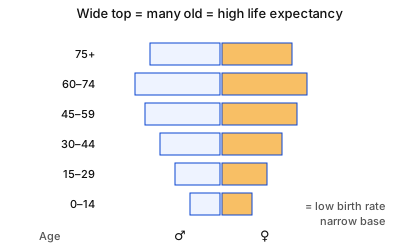
- Narrow base → few children being born → low birth rate.
- Wide top → a large share of elderly people → high life expectancy (low death rate). Example: Japan.
- A wide base with a narrow top (option C) is the expanding pyramid of a developing country.
Yaad rakhein: Base = births, Top = old-age survival. "Upside-down" pyramid = ageing, developed country.
Answer: (D) Low birth rates and high life expectancy
अवधारणा: जनसंख्या पिरामिड आयु समूह दिखाता है (नीचे युवा, ऊपर वृद्ध)। आधार की चौड़ाई जन्म दर और शीर्ष की चौड़ाई वृद्धावस्था तक जीवित रहने वालों (जीवन प्रत्याशा) को दर्शाती है।
- संकरा आधार → कम बच्चे जन्म ले रहे → निम्न जन्म दर।
- चौड़ा शीर्ष → वृद्धों का बड़ा हिस्सा → उच्च जीवन प्रत्याशा (निम्न मृत्यु दर)। उदाहरण: जापान।
- चौड़ा आधार और संकरा शीर्ष (विकल्प C) विकासशील देश का विस्तारशील पिरामिड है।
याद रखें: आधार = जन्म, शीर्ष = वृद्धावस्था तक जीवन। "उल्टा" पिरामिड = बूढ़ा होता विकसित देश।
उत्तर: (D) निम्न जन्म दर और उच्च जीवन प्रत्याशा
RRB NTPC Undergraduate CBT 1General AwarenessGeography – Population pyramidRRB NTPC Undergraduate CBT 1 2025 · 14 Jun Shift 2
Q751.Starch, a major component of flour and potatoes, is a polysaccharide. What chemical process occurs when starch is heated with water?
स्टार्च, जो आटे और आलू का एक प्रमुख घटक है, एक पॉलीसैकेराइड है। जब स्टार्च को जल के साथ गर्म किया जाता है, तो कौन-सी रासायनिक प्रक्रिया होती है?
- AGelatinizationजिलेटिनीकरण (Gelatinization)
- BSaponificationसाबुनीकरण (Saponification)
- CCaramelizationकैरामेलीकरण (Caramelization)
- DFermentationकिण्वन (Fermentation)
Show answer
Concept: Gelatinization is the process in which starch granules absorb water on heating, swell and burst, turning the mixture into a thick gel – this is how rice, potatoes and flour-based sauces soften/thicken.
- Heating starch with water (about –) breaks the granule structure → gelatinization.
- Caramelization is browning of sugar on dry heat; saponification is fat + alkali → soap; fermentation is microbial action on sugars.
Yaad rakhein: Starch + water + heat = "Gel" → Gelatinization (think of thick gravy or kheer).
Answer: (A) Gelatinization
अवधारणा: जिलेटिनाइज़ेशन वह प्रक्रिया है जिसमें गर्म करने पर स्टार्च के कण पानी सोखकर फूलते और फटते हैं और मिश्रण गाढ़ा जेल बन जाता है – इसी से चावल, आलू और आटे की ग्रेवी नरम/गाढ़ी होती है।
- स्टार्च को पानी के साथ (लगभग –) गर्म करने पर कणों की संरचना टूटती है → gelatinization।
- Caramelization = सूखी गर्मी पर चीनी का भूरा होना; saponification = वसा + क्षार → साबुन; fermentation = शर्करा पर सूक्ष्मजीवों की क्रिया।
याद रखें: स्टार्च + पानी + गर्मी = "जेल" → Gelatinization (गाढ़ी ग्रेवी या खीर याद करें)।
उत्तर: (A) Gelatinization (जिलेटिनाइज़ेशन)
RRB NTPC Undergraduate CBT 1General AwarenessChemistry – Starch and cookingRRB NTPC Undergraduate CBT 1 2025 · 14 Jun Shift 2
Q752.How did Sayyid Ahmad Khan’s Aligarh Movement differ from the Arya Samaj?
सैयद अहमद खान का अलीगढ़ आंदोलन आर्य समाज से किस प्रकार भिन्न था?
- AAligarh Movement opposed science, while Arya Samaj rejected old scriptures.अलीगढ़ आंदोलन ने विज्ञान का विरोध किया, जबकि आर्य समाज ने प्राचीन धर्मग्रंथों को अस्वीकार किया।
- BAligarh Movement supported Western-style education, while Arya Samaj promoted Vedic studies.अलीगढ़ आंदोलन ने पाश्चात्य शैली की शिक्षा का समर्थन किया, जबकि आर्य समाज ने वैदिक अध्ययन को बढ़ावा दिया।
- CAligarh Movement encouraged priestly control, while Arya Samaj rejected monotheism.अलीगढ़ आंदोलन ने पुरोहित नियंत्रण को प्रोत्साहित किया, जबकि आर्य समाज ने एकेश्वरवाद को अस्वीकार किया।
- DAligarh Movement rejected modern learning, while Arya Samaj discouraged rational thinking.अलीगढ़ आंदोलन ने आधुनिक शिक्षा को अस्वीकार किया, जबकि आर्य समाज ने तर्कसंगत चिंतन को हतोत्साहित किया।
Show answer
Concept: Sir Syed Ahmad Khan's Aligarh Movement (MAO College, 1875) promoted modern Western-style scientific education among Muslims, while Swami Dayananda's Arya Samaj (1875) called for a return to the Vedas ("Back to the Vedas").
- Aligarh Movement: Scientific Society (1864), MAO College Aligarh – embraced English education and rational outlook.
- Arya Samaj: rejected idol worship and caste rigidity, ran gurukuls and DAV schools for Vedic plus modern learning.
- Options A, C and D wrongly say Aligarh opposed science/modern learning – the opposite of its aim.
Yaad rakhein: Aligarh = "Western education"; Arya Samaj = "Back to the Vedas". Both founded in 1875.
Answer: (B) Aligarh Movement supported Western-style education, while Arya Samaj promoted Vedic studies.
अवधारणा: सर सैयद अहमद खान का अलीगढ़ आंदोलन (MAO कॉलेज, 1875) मुसलमानों में आधुनिक पश्चिमी वैज्ञानिक शिक्षा का प्रसार करता था, जबकि स्वामी दयानंद का आर्य समाज (1875) "वेदों की ओर लौटो" का आह्वान करता था।
- अलीगढ़ आंदोलन: साइंटिफिक सोसाइटी (1864), MAO कॉलेज अलीगढ़ – अंग्रेज़ी शिक्षा और तर्कसंगत दृष्टिकोण अपनाया।
- आर्य समाज: मूर्ति पूजा और जातिगत कठोरता का विरोध, वैदिक + आधुनिक शिक्षा के लिए गुरुकुल और DAV स्कूल।
- विकल्प A, C और D गलत कहते हैं कि अलीगढ़ ने विज्ञान/आधुनिक शिक्षा का विरोध किया – यह उसके उद्देश्य का उल्टा है।
याद रखें: अलीगढ़ = "पश्चिमी शिक्षा"; आर्य समाज = "वेदों की ओर लौटो"। दोनों 1875 में स्थापित।
उत्तर: (B) अलीगढ़ आंदोलन ने पश्चिमी शैली की शिक्षा का समर्थन किया, जबकि आर्य समाज ने वैदिक अध्ययन को बढ़ावा दिया।
RRB NTPC Undergraduate CBT 1General AwarenessModern history – Socio-religious reform movementsRRB NTPC Undergraduate CBT 1 2025 · 14 Jun Shift 2
Q753.The zone on Earth where no S-waves are detected is known as:
पृथ्वी पर वह क्षेत्र जहाँ कोई S-तरंगें संसूचित नहीं होतीं, क्या कहलाता है?
- ASeismic beltभूकंपीय पेटी
- BEpicentral gapअधिकेंद्रीय अंतराल
- CShadow zoneछाया क्षेत्र (Shadow zone)
- DActive zoneसक्रिय क्षेत्र
Show answer
Concept: Seismic shadow zone is the region on Earth's surface where seismographs do not record a particular wave after an earthquake. S-waves (transverse) cannot pass through liquids, so they are absent beyond from the epicentre.
- S-wave shadow zone: beyond on the opposite side – covers more than 40% of the surface; proves the outer core is liquid.
- P-wave shadow zone: between and (P-waves refract through the core).
Yaad rakhein: S = "Shear/Secondary" – Stops in liquid → big Shadow zone. P = Primary – Passes through all media.
Answer: (C) Shadow zone
अवधारणा: भूकंपीय छाया क्षेत्र (shadow zone) पृथ्वी की सतह का वह भाग है जहाँ भूकंप के बाद सीस्मोग्राफ किसी विशेष तरंग को दर्ज नहीं करते। S-तरंगें (अनुप्रस्थ) द्रव से नहीं गुज़र सकतीं, इसलिए अधिकेंद्र से के आगे अनुपस्थित रहती हैं।
- S-तरंग छाया क्षेत्र: विपरीत ओर के आगे – सतह के 40% से अधिक भाग; यह सिद्ध करता है कि बाह्य क्रोड द्रव है।
- P-तरंग छाया क्षेत्र: से के बीच (P-तरंगें क्रोड में अपवर्तित होती हैं)।
याद रखें: S = Secondary – द्रव में रुकती है → बड़ा Shadow zone। P = Primary – सभी माध्यमों से गुज़रती है।
उत्तर: (C) Shadow zone (छाया क्षेत्र)
RRB NTPC Undergraduate CBT 1General AwarenessGeography – Earthquake wavesRRB NTPC Undergraduate CBT 1 2025 · 14 Jun Shift 2
Q754.The Fundamental Duties suggested by the Swaran Singh Committee were incorporated through which Constitutional Amendment?
स्वर्ण सिंह समिति द्वारा सुझाए गए मौलिक कर्तव्यों को किस संविधान संशोधन द्वारा शामिल किया गया था?
- A42nd Amendment42वाँ संशोधन
- B48th Amendment48वाँ संशोधन
- C44th Amendment44वाँ संशोधन
- D40th Amendment40वाँ संशोधन
Show answer
Concept: Fundamental Duties (Part IV-A, Article 51A) were added on the recommendation of the Swaran Singh Committee (1976) by the 42nd Constitutional Amendment Act, 1976, borrowing the idea from the USSR.
- Originally 10 duties were added in 1976; the 11th (education of children aged 6–14) came by the 86th Amendment, 2002.
- 44th Amendment (1978) undid parts of the 42nd; 40th and 48th are unrelated.
Yaad rakhein: "42 = Mini Constitution" – added Fundamental Duties, and the words Socialist, Secular, Integrity to the Preamble.
Answer: (A) 42nd Amendment
अवधारणा: मौलिक कर्तव्य (भाग IV-A, अनुच्छेद 51A) स्वर्ण सिंह समिति (1976) की सिफ़ारिश पर 42वें संविधान संशोधन अधिनियम, 1976 द्वारा जोड़े गए; यह विचार USSR से लिया गया।
- 1976 में मूलतः 10 कर्तव्य जोड़े गए; 11वाँ (6–14 वर्ष के बच्चों की शिक्षा) 86वें संशोधन, 2002 से आया।
- 44वाँ संशोधन (1978) 42वें के कुछ भाग निरस्त करता है; 40वाँ और 48वाँ असंबंधित हैं।
याद रखें: "42 = लघु संविधान" – इसने मौलिक कर्तव्य और प्रस्तावना में समाजवादी, पंथनिरपेक्ष, अखंडता शब्द जोड़े।
उत्तर: (A) 42वाँ संशोधन
RRB NTPC Undergraduate CBT 1General AwarenessIndian Constitution – Fundamental DutiesRRB NTPC Undergraduate CBT 1 2025 · 14 Jun Shift 2
Q755.Through which two Indian states will the newly approved Greenfield High-Speed Corridor, sanctioned in April 2025, pass?
अप्रैल 2025 में स्वीकृत नया ग्रीनफ़ील्ड हाई-स्पीड कॉरिडोर किन दो भारतीय राज्यों से होकर गुज़रेगा?
- AArunachal Pradesh and Sikkimअरुणाचल प्रदेश और सिक्किम
- BManipur and Nagalandमणिपुर और नागालैंड
- CMeghalaya and Assamमेघालय और असम
- DTripura and Mizoramत्रिपुरा और मिज़ोरम
Show answer
Concept: In April 2025 the Union Cabinet approved the 166.8 km Shillong–Silchar 4-lane greenfield high-speed access-controlled corridor (part of NH-6) at a cost of about ₹22,864 crore.
- The corridor runs from Mawlyngkhung near Shillong (Meghalaya) to Panchgram near Silchar (Assam), so it passes through Meghalaya and Assam.
- It is built on hybrid annuity mode and will cut travel time, also improving access to Tripura, Mizoram and Manipur via Silchar.
Yaad rakhein: Shillong (Meghalaya) → Silchar (Assam): the two end-cities tell you the two states.
Answer: (C) Meghalaya and Assam
अवधारणा: अप्रैल 2025 में केंद्रीय मंत्रिमंडल ने लगभग ₹22,864 करोड़ की लागत से 166.8 किमी लंबे शिलांग–सिलचर 4-लेन ग्रीनफ़ील्ड हाई-स्पीड पहुँच-नियंत्रित कॉरिडोर (NH-6 का भाग) को मंज़ूरी दी।
- यह कॉरिडोर शिलांग के पास मावलिंगखुंग (मेघालय) से सिलचर के पास पंचग्राम (असम) तक है, अतः मेघालय और असम से गुज़रता है।
- यह हाइब्रिड एन्युटी मोड पर बनेगा और यात्रा समय घटाएगा; सिलचर के रास्ते त्रिपुरा, मिज़ोरम व मणिपुर की पहुँच भी सुधरेगी।
याद रखें: शिलांग (मेघालय) → सिलचर (असम): दोनों छोर के शहर ही दोनों राज्य बता देते हैं।
उत्तर: (C) Meghalaya and Assam (मेघालय और असम)
RRB NTPC Undergraduate CBT 1General AwarenessCurrent affairs – InfrastructureRRB NTPC Undergraduate CBT 1 2025 · 14 Jun Shift 2
Q756.Where did the Prime Minister of India chair the 7th National Board for Wildlife meeting in March 2025?
मार्च 2025 में भारत के प्रधानमंत्री ने राष्ट्रीय वन्यजीव बोर्ड की 7वीं बैठक की अध्यक्षता कहाँ की?
- APench National Parkपेंच राष्ट्रीय उद्यान
- BGir National Parkगिर राष्ट्रीय उद्यान
- CSatpura Tiger Reserveसतपुड़ा टाइगर रिज़र्व
- DSariska Tiger Reserveसरिस्का टाइगर रिज़र्व
Show answer
Concept: The 7th meeting of the National Board for Wildlife (NBWL), chaired by PM Narendra Modi, was held on 3 March 2025 (World Wildlife Day) at Gir National Park, Junagadh, Gujarat.
- At Gir the PM also announced a new National Referral Centre for Wildlife (Junagadh) and extension of Project Cheetah to Gandhi Sagar (MP) and Banni (Gujarat).
- Gir is the only natural home of the Asiatic lion – the previous (6th) NBWL meeting was at Pench in 2012.
Yaad rakhein: 2025 NBWL meet = Gir (lions), announced on World Wildlife Day, 3 March.
Answer: (B) Gir National Park
अवधारणा: प्रधानमंत्री नरेंद्र मोदी की अध्यक्षता में राष्ट्रीय वन्यजीव बोर्ड (NBWL) की 7वीं बैठक 3 मार्च 2025 (विश्व वन्यजीव दिवस) को गिर राष्ट्रीय उद्यान, जूनागढ़, गुजरात में हुई।
- गिर में PM ने जूनागढ़ में नए राष्ट्रीय वन्यजीव रेफ़रल केंद्र और प्रोजेक्ट चीता के गांधी सागर (MP) व बन्नी (गुजरात) तक विस्तार की घोषणा भी की।
- गिर एशियाई शेर का एकमात्र प्राकृतिक आवास है – पिछली (6वीं) NBWL बैठक 2012 में पेंच में हुई थी।
याद रखें: 2025 NBWL बैठक = गिर (शेर), विश्व वन्यजीव दिवस 3 मार्च को।
उत्तर: (B) Gir National Park (गिर राष्ट्रीय उद्यान)
RRB NTPC Undergraduate CBT 1General AwarenessCurrent affairs – EnvironmentRRB NTPC Undergraduate CBT 1 2025 · 14 Jun Shift 2
Q757.Who commissioned the Konark Sun Temple?
कोणार्क सूर्य मंदिर का निर्माण किसने करवाया था?
- AChandragupta IIचंद्रगुप्त द्वितीय
- BAshokaअशोक
- CNarasimhadeva Iनरसिंहदेव प्रथम
- DHarshavardhanaहर्षवर्धन
Show answer
Concept: The Konark Sun Temple (Odisha), a UNESCO World Heritage Site, was built around 1250 CE by King Narasimhadeva I of the Eastern Ganga dynasty.
- It is designed as a giant chariot of the Sun god with 24 carved wheels and seven horses; Europeans called it the "Black Pagoda".
- Chandragupta II and Harshavardhana are ancient rulers unrelated to Konark; Ashoka is linked to Kalinga war and stupas.
Yaad rakhein: Konark = Narasimhadeva I (Ganga dynasty); Lingaraj temple (Bhubaneswar) = Somavamshi kings.
Answer: (C) Narasimhadeva I
अवधारणा: कोणार्क सूर्य मंदिर (ओडिशा), एक UNESCO विश्व धरोहर स्थल, लगभग 1250 ई. में पूर्वी गंग वंश के राजा नरसिंहदेव प्रथम ने बनवाया।
- यह सूर्य देव के विशाल रथ के रूप में बना है जिसमें 24 नक्काशीदार पहिए और सात घोड़े हैं; यूरोपीय इसे "ब्लैक पैगोडा" कहते थे।
- चंद्रगुप्त द्वितीय और हर्षवर्धन प्राचीन शासक हैं, कोणार्क से असंबंधित; अशोक कलिंग युद्ध और स्तूपों से जुड़े हैं।
याद रखें: कोणार्क = नरसिंहदेव प्रथम (गंग वंश); लिंगराज मंदिर (भुवनेश्वर) = सोमवंशी राजा।
उत्तर: (C) Narasimhadeva I (नरसिंहदेव प्रथम)
RRB NTPC Undergraduate CBT 1General AwarenessMedieval history – TemplesRRB NTPC Undergraduate CBT 1 2025 · 14 Jun Shift 2
Q758.The First War of Independence (1857) began at which place?
प्रथम स्वतंत्रता संग्राम (1857) किस स्थान से आरंभ हुआ था?
- ADelhiदिल्ली
- BMeerutमेरठ
- CKanpurकानपुर
- DLucknowलखनऊ
Show answer
Concept: The Revolt of 1857 began at Meerut on 10 May 1857 when sepoys of the Bengal Army mutinied over the greased cartridges, then marched to Delhi and proclaimed Bahadur Shah Zafar as emperor.
- Mangal Pandey had fired at officers in Barrackpore on 29 March 1857, but the organised outbreak started at Meerut.
- Delhi was the centre the rebels captured next; Kanpur (Nana Saheb) and Lucknow (Begum Hazrat Mahal) rose later.
Yaad rakhein: "10 May, Meerut" – start; Barrackpore = Mangal Pandey (spark), Delhi = capital of revolt.
Answer: (B) Meerut
अवधारणा: 1857 का विद्रोह 10 मई 1857 को मेरठ से शुरू हुआ जब बंगाल सेना के सिपाहियों ने चर्बी वाले कारतूसों के विरोध में विद्रोह किया, फिर दिल्ली जाकर बहादुर शाह ज़फ़र को सम्राट घोषित किया।
- मंगल पांडे ने 29 मार्च 1857 को बैरकपुर में अधिकारियों पर गोली चलाई थी, पर संगठित विद्रोह मेरठ से शुरू हुआ।
- दिल्ली वह केंद्र था जिसे विद्रोहियों ने अगले दिन जीता; कानपुर (नाना साहेब) और लखनऊ (बेगम हज़रत महल) बाद में उठे।
याद रखें: "10 मई, मेरठ" – शुरुआत; बैरकपुर = मंगल पांडे (चिंगारी), दिल्ली = विद्रोह की राजधानी।
उत्तर: (B) Meerut (मेरठ)
RRB NTPC Undergraduate CBT 1General AwarenessModern history – Revolt of 1857RRB NTPC Undergraduate CBT 1 2025 · 14 Jun Shift 2
Q759.Which of the following is the most important port-based industrial region in India?
निम्नलिखित में से कौन-सा भारत का सबसे महत्वपूर्ण बंदरगाह-आधारित औद्योगिक क्षेत्र है?
- AChotanagpur plateau regionछोटानागपुर पठार क्षेत्र
- BAhmedabad–Vadodara regionअहमदाबाद–वडोदरा क्षेत्र
- CHooghly industrial beltहुगली औद्योगिक पेटी
- DHyderabad–Bengaluru corridorहैदराबाद–बेंगलुरु गलियारा
Show answer
Concept: The Hooghly industrial belt (West Bengal), stretching from Bansberia to Birlanagar along the Hooghly river, grew around the port of Kolkata and is India's most important port-based industrial region (jute, engineering, chemicals).
- Kolkata port + Hooghly navigation + coal from Raniganj and jute from the delta made this belt flourish from the 19th century.
- Chotanagpur is mineral-based (iron and steel); Ahmedabad–Vadodara is textile/petrochemical and inland; Hyderabad–Bengaluru is a modern IT/electronics corridor.
Yaad rakhein: Hooghly = "port + jute"; Chotanagpur = "coal + iron"; Mumbai–Pune = cotton textiles.
Answer: (C) Hooghly industrial belt
अवधारणा: हुगली औद्योगिक पट्टी (पश्चिम बंगाल), हुगली नदी के किनारे बांसबेड़िया से बिड़लानगर तक, कोलकाता बंदरगाह के चारों ओर विकसित हुई और भारत का सबसे महत्वपूर्ण बंदरगाह-आधारित औद्योगिक प्रदेश है (जूट, इंजीनियरिंग, रसायन)।
- कोलकाता बंदरगाह + हुगली जल-परिवहन + रानीगंज का कोयला + डेल्टा का जूट – इनसे यह पट्टी 19वीं सदी से फली-फूली।
- छोटानागपुर खनिज-आधारित (लोहा-इस्पात) है; अहमदाबाद–वडोदरा वस्त्र/पेट्रोरसायन और अंतर्देशीय है; हैदराबाद–बेंगलुरु आधुनिक IT/इलेक्ट्रॉनिक्स गलियारा है।
याद रखें: हुगली = "बंदरगाह + जूट"; छोटानागपुर = "कोयला + लोहा"; मुंबई–पुणे = सूती वस्त्र।
उत्तर: (C) Hooghly industrial belt (हुगली औद्योगिक पट्टी)
RRB NTPC Undergraduate CBT 1General AwarenessGeography – Industrial regions of IndiaRRB NTPC Undergraduate CBT 1 2025 · 14 Jun Shift 2
Q760.What is the first phase of Kerala's Motor Vehicle Department (MVD) child safety rule implementation conducted in October 2024?
अक्टूबर 2024 में संचालित केरल के मोटर वाहन विभाग (MVD) के बाल सुरक्षा नियम के कार्यान्वयन का पहला चरण क्या है?
- ASocial media awareness campaignसोशल मीडिया जागरूकता अभियान
- BEnforcement with penaltiesदंड सहित प्रवर्तन
- CDistribution of child restraint systemsबाल अवरोधक प्रणालियों (child restraint systems) का वितरण
- DStopping and warning violatorsउल्लंघनकर्ताओं को रोकना और चेतावनी देना
Show answer
Concept: In October 2024 Kerala's Motor Vehicles Department began enforcing child-safety rules (child restraint systems/seat-belts in cars, helmets for children on two-wheelers) in phases.
- Phase 1 (October 2024) was a social-media awareness campaign explaining the rules to parents.
- Only after awareness did later phases move to stopping and warning violators and then to penalties – so enforcement with fines (option B) was not the first step.
Yaad rakhein: Kerala MVD style: "first educate, then warn, then fine" – awareness always comes first.
Answer: (A) Social media awareness campaign
अवधारणा: अक्टूबर 2024 में केरल के मोटर वाहन विभाग ने बाल-सुरक्षा नियम (कारों में child restraint system/सीट-बेल्ट, दोपहिया पर बच्चों के लिए हेलमेट) चरणबद्ध रूप से लागू करना शुरू किया।
- चरण 1 (अक्टूबर 2024) सोशल मीडिया जागरूकता अभियान था जिसमें माता-पिता को नियम समझाए गए।
- जागरूकता के बाद ही अगले चरणों में उल्लंघनकर्ताओं को रोककर चेतावनी और फिर जुर्माना आया – अतः जुर्माने के साथ प्रवर्तन (विकल्प B) पहला कदम नहीं था।
याद रखें: केरल MVD का तरीका: "पहले शिक्षित करो, फिर चेतावनी, फिर जुर्माना" – जागरूकता हमेशा पहले।
उत्तर: (A) Social media awareness campaign (सोशल मीडिया जागरूकता अभियान)
RRB NTPC Undergraduate CBT 1General AwarenessCurrent affairs – Road safetyRRB NTPC Undergraduate CBT 1 2025 · 14 Jun Shift 2

