Q741.A keg is fitted with three taps A, B and C. If opened together, all the three taps will drain the full keg in minutes. Taps A and B together take 3 minutes to drain the keg while taps B and C together take minutes to drain it. How long (in minutes) taps A and C together take to drain the keg?
एक पीपे (keg) में तीन नल A, B और C लगे हैं। यदि एक साथ खोले जाएँ, तो तीनों नल भरे हुए पीपे को मिनट में खाली कर देंगे। नल A और B एक साथ पीपे को खाली करने में 3 मिनट लेते हैं जबकि नल B और C एक साथ इसे खाली करने में मिनट लेते हैं। नल A और C एक साथ पीपे को खाली करने में कितना समय (मिनट में) लेंगे?
- A
- B
- C
- D
Show answer
Concept: in terms of per-minute rates.
- , , .
- keg/min.
- Time minutes.
Trick: Take LCM 9 units: all three drain 6/min, A+B 3/min, B+C 2/min ⇒ A+C /min ⇒ min.
Answer: (C)
अवधारणा: प्रति मिनट दरों में .
- , , .
- केग/मिनट।
- समय मिनट।
ट्रिक: LCM 9 इकाई लें: तीनों 6/मिनट, A+B 3/मिनट, B+C 2/मिनट ⇒ A+C /मिनट ⇒ मिनट।
उत्तर: (C)
RRB NTPC Undergraduate CBT 1MathematicsPipes and cisterns (pair rates)RRB NTPC Undergraduate CBT 1 2025 · 8 May Shift 2
Q742.What is the arithmetic mean of the dataset {12, 25, 37, 48, 56, 61, 73, 85, 92, 104}?
डेटासेट {12, 25, 37, 48, 56, 61, 73, 85, 92, 104} का समांतर माध्य क्या है?
- A59.3
- B56.3
- C57.3
- D58.3
Show answer
Concept: Mean .
- Sum .
- Mean .
Trick: Pair for quick adding: .
Answer: (A) 59.3
अवधारणा: माध्य .
- योग .
- माध्य .
ट्रिक: जोड़ी बनाकर जोड़ें: .
उत्तर: (A) 59.3
RRB NTPC Undergraduate CBT 1MathematicsArithmetic meanRRB NTPC Undergraduate CBT 1 2025 · 8 May Shift 2
Q743.A shopkeeper offers the following schemes on toys of the same marked price. (A) Successive discounts of 35% and 4% on any number of toys bought.
(B) Successive discounts of 45%, 46% and 50% on any number of toys bought. (C) 15% discount on the first 3 toys and 5% discount on each toy thereon.
(D) 2 toys free of cost on buying 9 toys.
A customer wants to buy 9 toys. Which of the above schemes is the least beneficial to her?
एक दुकानदार समान अंकित मूल्य वाले खिलौनों पर निम्नलिखित योजनाएँ प्रस्तुत करता है। (A) खरीदे गए किसी भी संख्या के खिलौनों पर 35% और 4% की क्रमिक छूट।
(B) खरीदे गए किसी भी संख्या के खिलौनों पर 45%, 46% और 50% की क्रमिक छूट। (C) पहले 3 खिलौनों पर 15% छूट और उसके बाद प्रत्येक खिलौने पर 5% छूट।
(D) 9 खिलौने खरीदने पर 2 खिलौने निःशुल्क।
एक ग्राहक 9 खिलौने खरीदना चाहती है। उपरोक्त योजनाओं में से कौन-सी उसके लिए सबसे कम लाभदायक है?
- AC
- BD
- CA
- DB
Show answer
Concept: Take MP = ₹100 per toy (₹900 for 9) and compute the amount paid under each scheme; the least beneficial is the one costing the most.
- (A) .
- (B) .
- (C) .
- (D) pay for 7 only .
- Highest payment is scheme C ⇒ least beneficial.
Trick: "2 free on 9" off; scheme C is barely 8.3% off overall.
Answer: (A) C
अवधारणा: प्रति खिलौना MP = ₹100 (9 के ₹900) मानकर हर योजना में भुगतान निकालें; सबसे कम लाभकारी वह है जिसमें भुगतान सबसे अधिक हो।
- (A) .
- (B) .
- (C) .
- (D) केवल 7 का भुगतान .
- सबसे अधिक भुगतान योजना C में ⇒ सबसे कम लाभकारी।
ट्रिक: "9 पर 2 मुफ़्त" छूट; योजना C में कुल छूट मात्र 8.3% है।
उत्तर: (A) C
RRB NTPC Undergraduate CBT 1MathematicsComparing discount schemesRRB NTPC Undergraduate CBT 1 2025 · 8 May Shift 2
Q744.Two solid hemispheres are joined together to make a sphere. The total surface area of solids reduced by approximately ___%.
दो ठोस अर्धगोलों को जोड़कर एक गोला बनाया जाता है। ठोसों का कुल पृष्ठीय क्षेत्रफल लगभग ___% कम हो जाता है।
- A33.33
- B66.67
- C50
- D25
Show answer
Concept: TSA of a solid hemisphere ; surface area of sphere .
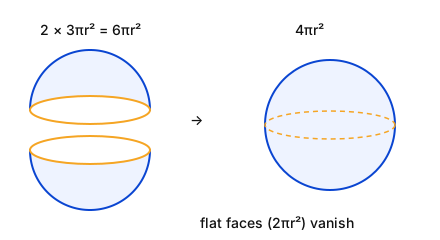
- Two hemispheres: .
- Sphere formed: ; reduction (the two flat faces).
- Percentage .
Trick: Joining hides of the units of area ⇒ reduction.
Answer: (A) 33.33
अवधारणा: ठोस अर्धगोले का TSA ; गोले का पृष्ठीय क्षेत्रफल .
- दो अर्धगोले: .
- बना गोला: ; कमी (दोनों समतल फलक)।
- प्रतिशत .
ट्रिक: जोड़ने पर 6 में से 2 इकाई क्षेत्रफल छिप जाता है ⇒ कमी।
उत्तर: (A) 33.33
RRB NTPC Undergraduate CBT 1MathematicsSurface area (hemisphere, sphere)RRB NTPC Undergraduate CBT 1 2025 · 8 May Shift 2
Q745.Two trains, A and B, start simultaneously from stations Delhi and Mumbai respectively towards each other on parallel tracks. After meeting, train A takes 16 hours to reach Mumbai, and train B takes 9 hours to reach Delhi. If train A’s speed is 60 km/h, what is the length of train B (in meters), given that it crosses a pole in 18 seconds?
दो रेलगाड़ियाँ, A और B, क्रमशः दिल्ली और मुंबई स्टेशनों से एक साथ समांतर पटरियों पर एक-दूसरे की ओर चलना शुरू करती हैं। मिलने के बाद, रेलगाड़ी A को मुंबई पहुँचने में 16 घंटे और रेलगाड़ी B को दिल्ली पहुँचने में 9 घंटे लगते हैं। यदि रेलगाड़ी A की चाल 60 km/h है, तो रेलगाड़ी B की लंबाई (मीटर में) क्या है, यदि यह एक खंभे को 18 सेकंड में पार करती है?
- A420
- B400
- C300
- D280
Show answer
Concept: If after meeting the trains take and hours to finish, .
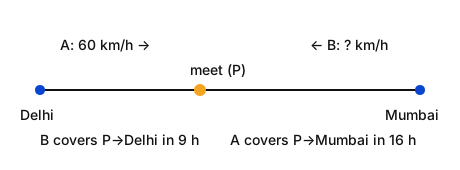
- .
- .
- Length .
Yaad rakhein: Speed ratio is the inverse square root of the post-meeting times: .
Answer: (B) 400
अवधारणा: मिलने के बाद यदि ट्रेनें और घंटे लें, तो .
- .
- .
- लंबाई .
याद रखें: चाल का अनुपात = मिलने के बाद के समयों का व्युत्क्रम वर्गमूल: .
उत्तर: (B) 400
RRB NTPC Undergraduate CBT 1MathematicsTrains meeting (speed ratio)RRB NTPC Undergraduate CBT 1 2025 · 8 May Shift 2
Q746.The expenditures of R are 65% of his salary. If his salary increased by 10% and his savings are ₹3,150 more than previous savings, his expenditures are now 60% of his salary. His present salary is ₹______.
R का व्यय उसके वेतन का 65% है। यदि उसका वेतन 10% बढ़ जाता है और उसकी बचत पिछली बचत से ₹3,150 अधिक है, तो उसका व्यय अब उसके वेतन का 60% है। उसका वर्तमान वेतन ₹______ है।
- A39,000
- B37,500
- C38,500
- D35,000
Show answer
Concept: Savings = salary − expenditure; write both savings in terms of the old salary .
- Old savings of .
- New salary , savings of .
- .
- Present salary ₹38,500.
Trick: The question asks the present salary – not the old ₹35,000 (option D is the trap).
Answer: (C) 38,500
अवधारणा: बचत = वेतन − व्यय; दोनों बचतों को पुराने वेतन में लिखें।
- पुरानी बचत का .
- नया वेतन , बचत का .
- .
- वर्तमान वेतन ₹38,500.
ट्रिक: प्रश्न वर्तमान वेतन पूछता है – पुराना ₹35,000 नहीं (विकल्प D जाल है)।
उत्तर: (C) 38,500
RRB NTPC Undergraduate CBT 1MathematicsPercentage (income and savings)RRB NTPC Undergraduate CBT 1 2025 · 8 May Shift 2
Q747.The 5-digit number 7a35b is divisible by 45, where a and b are positive integers. What is the value of (a + b)?
5-अंकीय संख्या 7a35b, 45 से विभाज्य है, जहाँ a और b धनात्मक पूर्णांक हैं। (a + b) का मान क्या है?
- A7
- B5
- C12
- D14
Show answer
Concept: Divisible by 45 ⇔ divisible by both 5 (last digit 0 or 5) and 9 (digit sum multiple of 9).
- is a positive integer ⇒ (not 0).
- Digit sum ⇒ (sum 27).
- .
Trick: "Positive" rules out ; then only one in 0–9 makes the sum a multiple of 9.
Answer: (C) 12
अवधारणा: 45 से विभाज्य ⇔ 5 (अंतिम अंक 0 या 5) और 9 (अंकों का योग 9 का गुणज) दोनों से विभाज्य।
- धनात्मक पूर्णांक ⇒ (0 नहीं)।
- अंकों का योग ⇒ (योग 27)।
- .
ट्रिक: "धनात्मक" से बाहर; फिर 0–9 में केवल एक योग को 9 का गुणज बनाता है।
उत्तर: (C) 12
RRB NTPC Undergraduate CBT 1MathematicsDivisibility (45 = 5 × 9)RRB NTPC Undergraduate CBT 1 2025 · 8 May Shift 2
Q748.Lekhraj sells an article at a profit of 25%. If the cost price is increased by 20% and the selling price is reduced by 10%, what percentage loss will Lekhraj incur?
लेखराज एक वस्तु को 25% लाभ पर बेचता है। यदि क्रय मूल्य 20% बढ़ा दिया जाए और विक्रय मूल्य 10% घटा दिया जाए, तो लेखराज को कितने प्रतिशत हानि होगी?
- A6.25%
- B7.5%
- C6.5%
- D7.25%
Show answer
Concept: Assume CP = 100; loss% is always on the (new) cost price.
- CP , SP .
- New CP , new SP .
- Loss ; loss% .
Trick: New SP/CP ⇒ loss.
Answer: (A) 6.25%
अवधारणा: CP = 100 मानें; हानि% हमेशा (नए) क्रय मूल्य पर निकलता है।
- CP , SP .
- नया CP , नया SP .
- हानि ; हानि% .
ट्रिक: नया SP/CP ⇒ हानि।
उत्तर: (A) 6.25%
RRB NTPC Undergraduate CBT 1MathematicsProfit and lossRRB NTPC Undergraduate CBT 1 2025 · 8 May Shift 2
Q749.The average of 5 consecutive integers is 10. What is the smallest integer?
5 क्रमागत पूर्णांकों का औसत 10 है। सबसे छोटा पूर्णांक क्या है?
- A9
- B6
- C8
- D7
Show answer
Concept: For an odd count of consecutive integers the average is the middle term.
- Middle (3rd) integer ⇒ numbers are .
- Smallest .
Trick: Smallest .
Answer: (C) 8
अवधारणा: विषम संख्या में क्रमागत पूर्णांकों का औसत बीच वाला पद होता है।
- बीच का (तीसरा) पूर्णांक ⇒ संख्याएँ .
- सबसे छोटा .
ट्रिक: सबसे छोटा .
उत्तर: (C) 8
RRB NTPC Undergraduate CBT 1MathematicsAverage of consecutive integersRRB NTPC Undergraduate CBT 1 2025 · 8 May Shift 2
Q750.If x is the mean proportional between (a+b) and (a-b), then find the value of x.
यदि x, (a+b) और (a-b) के बीच मध्यानुपाती (mean proportional) है, तो x का मान ज्ञात कीजिए।
- A
- B
- C
- D
Show answer
Concept: Mean proportional between and is .
- .
- .
Yaad rakhein: – never (option B is the trap).
Answer: (D)
अवधारणा: और का मध्यानुपाती (mean proportional) .
- .
- .
याद रखें: – कभी नहीं (विकल्प B जाल है)।
उत्तर: (D)
RRB NTPC Undergraduate CBT 1MathematicsMean proportionalRRB NTPC Undergraduate CBT 1 2025 · 8 May Shift 2
Q751.If the salary of a person is first increased by 15% and thereafter decreased by 12%, what is the net change in his salary?
यदि किसी व्यक्ति के वेतन में पहले 15% की वृद्धि की जाती है और उसके बाद 12% की कमी की जाती है, तो उसके वेतन में कुल (शुद्ध) परिवर्तन क्या है?
- A1.4% decrease1.4% कमी
- B1.2% increase1.2% वृद्धि
- C1.32% decrease1.32% कमी
- D1.2% decrease1.2% कमी
Show answer
Concept: Net change for successive changes and is .
- .
- Net .
- Positive sign means an increase of .
Trick: Multiply factors: , i.e. .
Answer: (B) 1.2% increase
अवधारणा: क्रमिक परिवर्तन और का शुद्ध परिवर्तन होता है।
- ।
- शुद्ध ।
- धनात्मक चिह्न यानी की वृद्धि।
ट्रिक: गुणनखंड गुणा करें: , यानी ।
उत्तर: (B) 1.2% वृद्धि
RRB NTPC Undergraduate CBT 1MathematicsSuccessive percentage changeRRB NTPC Undergraduate CBT 1 2025 · 8 May Shift 1
Q752.Evaluate 213 + (-2)3 + (-19)3
213 + (-2)3 + (-19)3 का मान ज्ञात कीजिए।
- A2397
- B2468
- C2394
- D2354
Show answer
Concept: If then .
- , so the identity applies.
- .
- .
Trick: Whenever the three bases add to zero, never cube them – just find .
Answer: (C) 2394
अवधारणा: यदि तो ।
- , अतः सर्वसमिका लागू होगी।
- ।
- ।
ट्रिक: जब तीनों आधारों का योग शून्य हो, घन मत निकालिए – सीधे निकालें।
उत्तर: (C) 2394
RRB NTPC Undergraduate CBT 1MathematicsAlgebraic identity (a³+b³+c³)RRB NTPC Undergraduate CBT 1 2025 · 8 May Shift 1
Q753.Which of the following numbers is not divisible by 88?
निम्नलिखित में से कौन-सी संख्या 88 से विभाज्य नहीं है?
- A1232
- B1144
- C968
- D1058
Show answer
Concept: ; a number divisible by 88 must be divisible by both 8 and 11.
- , , – all divisible.
- 1058: last three digits 058 → leaves remainder 2, so not divisible by 8.
- Hence 1058 is not divisible by 88.
Trick: Check divisibility by 8 (last 3 digits) first – it eliminates quickly.
Answer: (D) 1058
अवधारणा: ; 88 से विभाज्य संख्या 8 और 11 दोनों से विभाज्य होनी चाहिए।
- , , – सभी विभाज्य।
- 1058: अंतिम तीन अंक 058 → में शेष 2, अतः 8 से विभाज्य नहीं।
- इसलिए 1058, 88 से विभाज्य नहीं है।
ट्रिक: पहले 8 की विभाज्यता (अंतिम 3 अंक) जाँचें – जल्दी छँटनी हो जाती है।
उत्तर: (D) 1058
RRB NTPC Undergraduate CBT 1MathematicsDivisibilityRRB NTPC Undergraduate CBT 1 2025 · 8 May Shift 1
Q754.The average of 5 numbers is 18.5. If one number is removed, the average of the remaining 4 numbers becomes 16. Find the number that was removed.
5 संख्याओं का औसत 18.5 है। यदि एक संख्या हटा दी जाए, तो शेष 4 संख्याओं का औसत 16 हो जाता है। हटाई गई संख्या ज्ञात कीजिए।
- A28
- B29.5
- C28.5
- D29
Show answer
Concept: Sum average count; removed number old sum new sum.
- Sum of 5 numbers .
- Sum of remaining 4 .
- Removed number .
Trick: Removed number new average (drop in average) old count .
Answer: (C) 28.5
अवधारणा: योग औसत संख्या; हटाई गई संख्या पुराना योग नया योग।
- 5 संख्याओं का योग ।
- शेष 4 का योग ।
- हटाई गई संख्या ।
ट्रिक: हटाई संख्या नया औसत (औसत में गिरावट) पुरानी संख्या ।
उत्तर: (C) 28.5
RRB NTPC Undergraduate CBT 1MathematicsAverageRRB NTPC Undergraduate CBT 1 2025 · 8 May Shift 1
Q755.The ages of a mother and daughter are 36 years and 12 years, respectively. In how many years will the mother be twice the age of the daughter?
एक माँ और बेटी की आयु क्रमशः 36 वर्ष और 12 वर्ष है। कितने वर्षों में माँ की आयु बेटी की आयु की दोगुनी हो जाएगी?
- A15 years15 वर्ष
- B8 years8 वर्ष
- C10 years10 वर्ष
- D12 years12 वर्ष
Show answer
Concept: Add the same years to both ages and form the equation.
- .
- .
- Check: after 12 years, mother 48, daughter 24 – exactly double.
Trick: Difference of ages (24) is constant; when mother is twice, difference daughter's age, so daughter must be 24 → after 12 years.
Answer: (D) 12 years
अवधारणा: दोनों आयु में समान वर्ष जोड़कर समीकरण बनाएँ।
- ।
- ।
- जाँच: 12 वर्ष बाद माँ 48, बेटी 24 – ठीक दोगुना।
ट्रिक: आयु का अंतर (24) स्थिर है; जब माँ दोगुनी होगी, अंतर बेटी की आयु, अतः बेटी 24 की होगी → 12 वर्ष बाद।
उत्तर: (D) 12 वर्ष
RRB NTPC Undergraduate CBT 1MathematicsAgesRRB NTPC Undergraduate CBT 1 2025 · 8 May Shift 1
Q756.The length of each edge of a cube is 10 cm. If a sphere is inscribed inside the cube, what is the ratio of the surface area of the sphere to the outer surface area of the cube?
एक घन के प्रत्येक किनारे की लंबाई 10 cm है। यदि घन के अंदर एक गोला अंतर्निहित किया जाए, तो गोले के पृष्ठीय क्षेत्रफल और घन के बाह्य पृष्ठीय क्षेत्रफल का अनुपात क्या है?
- A
- B
- C
- D
Show answer
Concept: A sphere inscribed in a cube of edge has diameter , so radius .
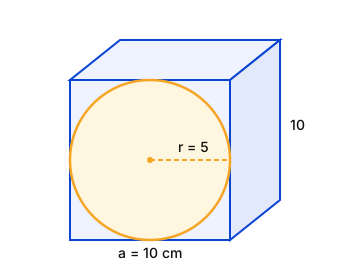
- .
- Surface area of sphere .
- Surface area of cube .
- Ratio .
Trick: For any inscribed sphere, – independent of the edge length.
Answer: (B)
अवधारणा: भुजा के घन में अंतर्गत गोले का व्यास होता है, अतः त्रिज्या ।
- ।
- गोले का पृष्ठीय क्षेत्रफल ।
- घन का पृष्ठीय क्षेत्रफल ।
- अनुपात ।
ट्रिक: किसी भी अंतर्गत गोले के लिए – भुजा पर निर्भर नहीं।
उत्तर: (B)
RRB NTPC Undergraduate CBT 1MathematicsSphere inscribed in cubeRRB NTPC Undergraduate CBT 1 2025 · 8 May Shift 1
Q757.Pipe A can fill a cistern in 12 hours and another pipe B can empty it in 18 hours. Pipe A is opened first and after 4 hours, pipe B is also opened. In how much total time will the cistern be filled?
पाइप A एक टंकी को 12 घंटे में भर सकता है और दूसरा पाइप B उसे 18 घंटे में खाली कर सकता है। पहले पाइप A खोला जाता है और 4 घंटे बाद पाइप B भी खोल दिया जाता है। टंकी कुल कितने समय में भर जाएगी?
- A36 hours36 घंटे
- B32 hours32 घंटे
- C28 hours28 घंटे
- D24 hours24 घंटे
Show answer
Concept: Take capacity units. A fills units/h, B empties units/h.
- First 4 hours (only A): units filled.
- Remaining units; net rate with both unit/h.
- Time for remaining h; total hours.
Trick: Fractions: A alone does ; remaining at net /h takes 24 h.
Answer: (C) 28 hours
अवधारणा: क्षमता इकाई लें। A भरता है इकाई/घंटा, B खाली करता है इकाई/घंटा।
- पहले 4 घंटे (केवल A): इकाई भरी।
- शेष इकाई; दोनों के साथ शुद्ध दर इकाई/घंटा।
- शेष का समय घंटे; कुल घंटे।
ट्रिक: भिन्न से: A अकेले भरता है; शेष शुद्ध दर /घंटा से 24 घंटे में।
उत्तर: (C) 28 घंटे
RRB NTPC Undergraduate CBT 1MathematicsPipes and cisternsRRB NTPC Undergraduate CBT 1 2025 · 8 May Shift 1
Q758.Which of the following ratios is the greatest?
a) 7 : 11
b) 9 : 14
c) 11 : 18
d) 13 : 21
निम्नलिखित में से कौन-सा अनुपात सबसे बड़ा है?
a) 7 : 11
b) 9 : 14
c) 11 : 18
d) 13 : 21
- A9 : 14
- B11 : 18
- C7 : 11
- D13 : 21
Show answer
Concept: Convert each ratio to a decimal (or compare with a common benchmark) to find the greatest.
- , .
- , .
- Greatest is , i.e. .
Trick: Compare with : is short of it by only , the smallest gap among all four.
Answer: (A) 9 : 14
अवधारणा: प्रत्येक अनुपात को दशमलव में बदलकर (या एक साझा मानक से तुलना कर) सबसे बड़ा ज्ञात करें।
- , ।
- , ।
- सबसे बड़ा है, यानी ।
ट्रिक: से तुलना करें: उससे केवल कम है – चारों में सबसे छोटा अंतर।
उत्तर: (A) 9 : 14
RRB NTPC Undergraduate CBT 1MathematicsComparison of ratiosRRB NTPC Undergraduate CBT 1 2025 · 8 May Shift 1
Q759.Find the value of m which satisfies
.
m का वह मान ज्ञात कीजिए जो
को संतुष्ट करता है।
- A
- B
- C
- D
Show answer
Concept: ; with equal bases, equate the exponents.
- LHS .
- RHS .
- .
Trick: Flip every reciprocal base to a single base first, then just add the powers.
Answer: (C)
अवधारणा: ; आधार समान होने पर घातांक बराबर रखें।
- LHS ।
- RHS ।
- ।
ट्रिक: पहले हर व्युत्क्रम आधार को एक ही आधार में बदलें, फिर केवल घात जोड़ें।
उत्तर: (C)
RRB NTPC Undergraduate CBT 1MathematicsLaws of exponentsRRB NTPC Undergraduate CBT 1 2025 · 8 May Shift 1
Q760.If , find the value of .
यदि है, तो का मान ज्ञात कीजिए।
- A
- B
- C
- D
Show answer
Concept: From : , , .
- Numerator: .
- Denominator: .
- Value .
Trick: The coefficients are chosen so that and become whole numbers (7 each) – look for such cancellations.
Answer: (B)
अवधारणा: से: , , ।
- अंश: ।
- हर: ।
- मान ।
ट्रिक: गुणांक ऐसे चुने हैं कि और पूर्ण संख्या (7-7) बन जाएँ – ऐसे कटान पहचानें।
उत्तर: (B)
RRB NTPC Undergraduate CBT 1MathematicsTrigonometric ratiosRRB NTPC Undergraduate CBT 1 2025 · 8 May Shift 1

