Q801.What should come in place of the question mark (?) in the given series to make it logically complete?
MU1, NQ4, PN16, SL64, ?
दी गई श्रृंखला को तार्किक रूप से पूर्ण करने के लिए प्रश्नचिह्न (?) के स्थान पर क्या आना चाहिए?
MU1, NQ4, PN16, SL64, ?
- ARJ256
- BSJ258
- CSK256
- DWK256
Show answer
Concept: Treat the first letter, second letter and number as three separate series.
- First letters M, N, P, S: → next : S + 4 = W.
- Second letters U, Q, N, L: → next : L − 1 = K.
- Numbers : → . Term = WK256.
Trick: Only option D starts with W – the first-letter series alone settles it.
Answer: (D) WK256
अवधारणा: पहला अक्षर, दूसरा अक्षर और संख्या – तीन अलग श्रृंखलाएँ मानें।
- पहले अक्षर M, N, P, S: → अगला : S + 4 = W।
- दूसरे अक्षर U, Q, N, L: → अगला : L − 1 = K।
- संख्याएँ : → । पद = WK256।
ट्रिक: केवल विकल्प D W से शुरू होता है – पहले अक्षर की श्रृंखला ही फैसला कर देती है।
उत्तर: (D) WK256
RRB NTPC Undergraduate CBT 1General Intelligence and ReasoningAlphanumeric SeriesRRB NTPC Undergraduate CBT 1 2025 · 7 May Shift 3
Q802.Each vowel in the word CURRENT is changed to the letter immediately following it in the English alphabetical order and each consonant is changed to the letter immediately preceding it in the English alphabetical order. Which of the following letters will be fourth from the left in the new group of letters thus formed?
शब्द CURRENT के प्रत्येक स्वर को अंग्रेज़ी वर्णमाला क्रम में उसके ठीक बाद वाले अक्षर में बदल दिया जाता है और प्रत्येक व्यंजन को अंग्रेज़ी वर्णमाला क्रम में उसके ठीक पहले वाले अक्षर में बदल दिया जाता है। इस प्रकार बने नए अक्षर-समूह में बाएँ से चौथा अक्षर निम्नलिखित में से कौन-सा होगा?
- AP
- BQ
- CR
- DS
Show answer
Concept: Vowels move one step forward, consonants one step back; then read the required position.
- CURRENT: C→B, U→V, R→Q, R→Q, E→F, N→M, T→S.
- New group: B V Q Q F M S.
- Fourth from the left = Q.
Trick: Only the 4th letter is asked – the 4th letter of CURRENT is R (consonant) → R − 1 = Q. No need to convert the whole word.
Answer: (B) Q
अवधारणा: स्वर एक कदम आगे, व्यंजन एक कदम पीछे; फिर माँगा गया स्थान पढ़ें।
- CURRENT: C→B, U→V, R→Q, R→Q, E→F, N→M, T→S।
- नया समूह: B V Q Q F M S।
- बाएँ से चौथा = Q।
ट्रिक: केवल चौथा अक्षर पूछा है – CURRENT का चौथा अक्षर R (व्यंजन) → R − 1 = Q। पूरा शब्द बदलने की ज़रूरत नहीं।
उत्तर: (B) Q
RRB NTPC Undergraduate CBT 1General Intelligence and ReasoningLetter CodingRRB NTPC Undergraduate CBT 1 2025 · 7 May Shift 3
Q803.Seven people, S, T, I, C, K, E and R, are sitting in a row, facing north. Only E sits to the left of K. Only four people sit between E and T. Only C sits between I and R, and I is not an immediate neighbor of T. Who sits at the extreme right of the line?
सात व्यक्ति S, T, I, C, K, E और R एक पंक्ति में उत्तर की ओर मुख करके बैठे हैं। K के बाएँ केवल E बैठा है। E और T के बीच केवल चार व्यक्ति बैठे हैं। I और R के बीच केवल C बैठा है, और I, T का निकटतम पड़ोसी नहीं है। पंक्ति के सबसे दाएँ छोर पर कौन बैठा है?
- AS
- BE
- CK
- DI
Show answer
Concept: Number seats 1–7 from the left (all face north, so right = higher number).
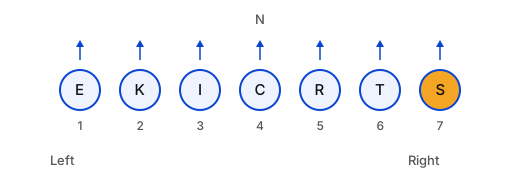
- 'Only E sits to the left of K' → E = 1, K = 2. Four people between E and T → T = 6.
- I, C, R are consecutive with C in the middle; free seats 3, 4, 5, 7 → they take 3, 4, 5. I is not next to T (6) → I = 3, C = 4, R = 5.
- S takes the last seat, 7 – the extreme right.
Trick: 'Only X sits to the left of Y' pins X and Y to seats 1 and 2 – the strongest clue, start there.
Answer: (A) S
अवधारणा: बाएँ से सीटें 1–7 क्रमांकित करें (सब उत्तर की ओर, अतः दाएँ = बड़ी संख्या)।
- 'K के बाएँ केवल E बैठा है' → E = 1, K = 2। E और T के बीच चार लोग → T = 6।
- I, C, R लगातार हैं, C बीच में; खाली सीटें 3, 4, 5, 7 → वे 3, 4, 5 लेते हैं। I T (6) का पड़ोसी नहीं → I = 3, C = 4, R = 5।
- S अंतिम सीट 7 पर – दाएँ छोर।
ट्रिक: 'Y के बाएँ केवल X' X और Y को सीट 1 और 2 पर जड़ देता है – सबसे मज़बूत संकेत, वहीं से शुरू करें।
उत्तर: (A) S
RRB NTPC Undergraduate CBT 1General Intelligence and ReasoningLinear Seating ArrangementRRB NTPC Undergraduate CBT 1 2025 · 7 May Shift 3
Q804.Seven boxes B, C, D, E, Q, R and S are kept one over the other but not necessarily in the same order. Only five boxes are kept above D. Only three boxes are kept between D and C. Only four boxes are kept between C and S. Only E is kept between C and B. R is kept at one of the positions above C. How many boxes are kept between Q and S?
सात बक्से B, C, D, E, Q, R और S एक के ऊपर एक रखे गए हैं, लेकिन आवश्यक नहीं कि इसी क्रम में हों। D के ऊपर केवल पाँच बक्से रखे हैं। D और C के बीच केवल तीन बक्से रखे हैं। C और S के बीच केवल चार बक्से रखे हैं। C और B के बीच केवल E रखा है। R, C के ऊपर किसी एक स्थान पर रखा है। Q और S के बीच कितने बक्से रखे हैं?
- AThreeतीन
- BOneएक
- CFourचार
- DTwoदो
Show answer
Concept: Number positions 1 (bottom) to 7 (top) and convert each 'between' clue into a distance.
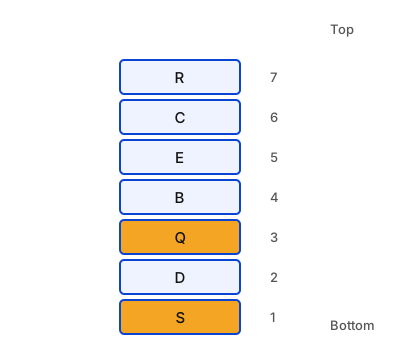
- Five boxes above D → D = 2. Three between D and C → C = 6. Four between C and S → S = 1.
- Only E between C and B → B = 4, E = 5 (B = 8 is impossible). R above C → R = 7.
- Q takes the last place, 3. Between Q (3) and S (1) there is only D → one box.
Trick: 'n boxes between' distance ; choose the side that stays within 1–7.
Answer: (B) One
अवधारणा: स्थान 1 (नीचे) से 7 (ऊपर) तक क्रमांकित करें और हर 'बीच में' संकेत को दूरी में बदलें।
- D के ऊपर पाँच बॉक्स → D = 2। D और C के बीच तीन → C = 6। C और S के बीच चार → S = 1।
- C और B के बीच केवल E → B = 4, E = 5 (B = 8 संभव नहीं)। R C के ऊपर → R = 7।
- Q अंतिम स्थान 3 पर। Q (3) और S (1) के बीच केवल D → एक बॉक्स।
ट्रिक: 'n बॉक्स बीच में' दूरी ; वही दिशा चुनें जो 1–7 के भीतर रहे।
उत्तर: (B) One
RRB NTPC Undergraduate CBT 1General Intelligence and ReasoningBox ArrangementRRB NTPC Undergraduate CBT 1 2025 · 7 May Shift 3
Q805.In a certain code language,
A + B means ‘A is the son of B’,
A – B means ‘A is the brother of B’,
A x B means ‘A is the wife of B’ and
A ÷ B means ‘A is the father of B’.
Based on the above, how is S related to K if ‘S + D ÷ F – H x K’?
एक निश्चित कूट भाषा में,
A + B का अर्थ है 'A, B का पुत्र है',
A – B का अर्थ है 'A, B का भाई है',
A x B का अर्थ है 'A, B की पत्नी है' और
A ÷ B का अर्थ है 'A, B का पिता है'।
उपरोक्त के आधार पर, यदि 'S + D ÷ F – H x K' है, तो S, K से किस प्रकार संबंधित है?
- AWife's brotherपत्नी का भाई
- BFatherपिता
- CBrotherभाई
- DWife's fatherपत्नी का पिता
Show answer
Concept: Decode the expression pair by pair, then build the family tree.
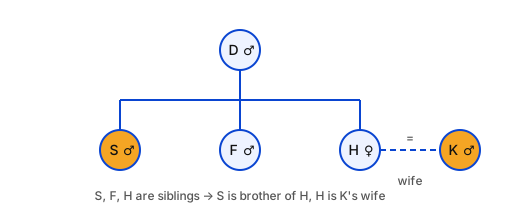
- S + D: S is the son of D. D ÷ F: D is the father of F → S and F are siblings. F – H: F is the brother of H → H is also D's child, so S is H's brother.
- H × K: H is the wife of K.
- So S is the brother of K's wife → K's wife's brother (brother-in-law).
Trick: Gender from the code: 'son', 'brother' make S, F male; 'wife' makes H female – then the relation reads off the tree.
Answer: (A) Wife's brother
अवधारणा: व्यंजक को जोड़ी-जोड़ी खोलें, फिर वंश-वृक्ष बनाएँ।
- S + D: S, D का पुत्र। D ÷ F: D, F का पिता → S और F भाई-बहन। F – H: F, H का भाई → H भी D की संतान, अतः S, H का भाई।
- H × K: H, K की पत्नी।
- अतः S, K की पत्नी का भाई → साला (wife's brother)।
ट्रिक: कोड से लिंग: 'पुत्र', 'भाई' से S, F पुरुष; 'पत्नी' से H स्त्री – फिर संबंध वृक्ष से सीधे पढ़ें।
उत्तर: (A) Wife's brother
RRB NTPC Undergraduate CBT 1General Intelligence and ReasoningBlood RelationsRRB NTPC Undergraduate CBT 1 2025 · 7 May Shift 3
Q806.Refer to the following letter series and answer the question that follows. Counting to be done from left to right only.
(Left) Z Q M H J E K D E L K Z V N E A T Q R Z U (Right)
How many such consonants are there, each of which is immediately preceded by a consonant and also immediately followed by a vowel?
निम्नलिखित अक्षर श्रृंखला को देखिए और उसके बाद दिए गए प्रश्न का उत्तर दीजिए। गिनती केवल बाएँ से दाएँ की जानी है।
(बायाँ) Z Q M H J E K D E L K Z V N E A T Q R Z U (दायाँ)
ऐसे कितने व्यंजन हैं, जिनमें से प्रत्येक के ठीक पहले एक व्यंजन है और ठीक बाद एक स्वर है?
- AFourचार
- BTwoदो
- CThreeतीन
- DOneएक
Show answer
Concept: Look for the pattern consonant–consonant–vowel and count the middle letter.
- Vowels present: E (positions 6, 9, 15), A (16), U (21). Check the letter just before each vowel and the one before that.
- H J E (4–6) ✓; K D E (7–9) ✓; V N E (13–15) ✓; R Z U (19–21) ✓. Before A (16) is E (a vowel) – not counted.
- Total = 4.
Trick: Start from each vowel and look two letters back – far faster than scanning every consonant.
Answer: (A) Four
अवधारणा: व्यंजन–व्यंजन–स्वर पैटर्न खोजें और बीच वाला अक्षर गिनें।
- स्वर: E (स्थान 6, 9, 15), A (16), U (21)। हर स्वर से ठीक पहले और उससे पहले का अक्षर देखें।
- H J E (4–6) ✓; K D E (7–9) ✓; V N E (13–15) ✓; R Z U (19–21) ✓। A (16) से पहले E (स्वर) है – नहीं गिना।
- कुल = 4।
ट्रिक: हर स्वर से दो अक्षर पीछे देखें – हर व्यंजन जाँचने से कहीं तेज़।
उत्तर: (A) Four
RRB NTPC Undergraduate CBT 1General Intelligence and ReasoningLetter Series CountingRRB NTPC Undergraduate CBT 1 2025 · 7 May Shift 3
Q807.Which of the following letter-number clusters will replace the question mark (?) in the given series to make it logically complete?
NFG 49, PIK 36, RLO 25, TOS 16, ?
दी गई श्रृंखला को तार्किक रूप से पूर्ण करने के लिए निम्नलिखित में से कौन-सा अक्षर-संख्या समूह प्रश्नचिह्न (?) के स्थान पर आएगा?
NFG 49, PIK 36, RLO 25, TOS 16, ?
- AVRW 9
- BUSV 10
- CUSW 9
- DVRV 10
Show answer
Concept: Split into three letter series and one number series.
- 1st letters N, P, R, T () → V; 2nd letters F, I, L, O () → R; 3rd letters G, K, O, S () → W.
- Numbers → .
- Next term: VRW 9.
Trick: Perfect squares counting down → next is 9; this alone leaves A and C, and the first letter V picks A.
Answer: (A) VRW 9
अवधारणा: तीन अक्षर-श्रृंखलाओं और एक संख्या-श्रृंखला में बाँटें।
- पहले अक्षर N, P, R, T () → V; दूसरे F, I, L, O () → R; तीसरे G, K, O, S () → W।
- संख्याएँ → ।
- अगला पद: VRW 9।
ट्रिक: घटते पूर्ण वर्ग → अगला 9; इससे A और C बचते हैं, पहला अक्षर V से A चुनें।
उत्तर: (A) VRW 9
RRB NTPC Undergraduate CBT 1General Intelligence and ReasoningAlphanumeric SeriesRRB NTPC Undergraduate CBT 1 2025 · 7 May Shift 3
Q808.In a certain code language,
J × Q means ‘J is the sister of Q’,
J ÷ Q means ‘J is the father of Q’,
J + Q means ‘J is the husband of Q’ and
J – Q means ‘J is the mother of Q’.
Based on the above, how is S related to W if ‘S + T – U ÷ V × W × Y’?
एक निश्चित कूट भाषा में,
J × Q का अर्थ है 'J, Q की बहन है',
J ÷ Q का अर्थ है 'J, Q का पिता है',
J + Q का अर्थ है 'J, Q का पति है' और
J – Q का अर्थ है 'J, Q की माता है'।
उपरोक्त के आधार पर, यदि 'S + T – U ÷ V × W × Y' है, तो S, W से किस प्रकार संबंधित है?
- AMother's brotherमाता का भाई
- BFather's fatherपिता का पिता
- CWife's brotherपत्नी का भाई
- DMother's fatherमाता का पिता
Show answer
Concept: Decode each symbol, note genders, and climb the family tree from W to S.
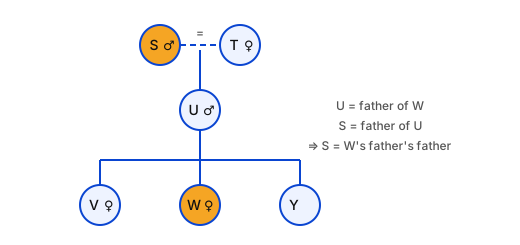
- S + T: S is the husband of T. T – U: T is the mother of U → S is U's father.
- U ÷ V: U is the father of V. V × W: V is the sister of W → U is also W's father.
- So S is the father of W's father → father's father (paternal grandfather). W × Y only tells that W is female.
Trick: 'Husband of the mother' = father; stack two father-steps and you get the grandfather.
Answer: (B) Father's father
अवधारणा: हर चिह्न खोलें, लिंग नोट करें और W से S तक वंश-वृक्ष में ऊपर चढ़ें।
- S + T: S, T का पति। T – U: T, U की माँ → S, U का पिता।
- U ÷ V: U, V का पिता। V × W: V, W की बहन → U, W का भी पिता।
- अतः S, W के पिता का पिता → दादा (father's father)। W × Y केवल बताता है कि W स्त्री है।
ट्रिक: 'माँ का पति' = पिता; दो पिता-चरण जोड़ने पर दादा मिलता है।
उत्तर: (B) Father's father
RRB NTPC Undergraduate CBT 1General Intelligence and ReasoningBlood RelationsRRB NTPC Undergraduate CBT 1 2025 · 7 May Shift 3
Q809.Which of the following letter-number clusters will replace the question mark (?) in the given series to make it logically complete?
EAW 91 XTP 98 QMI 105 JFB 112 ?
दी गई श्रृंखला को तार्किक रूप से पूर्ण करने के लिए निम्नलिखित में से कौन-सा अक्षर-संख्या समूह प्रश्नचिह्न (?) के स्थान पर आएगा?
EAW 91 XTP 98 QMI 105 JFB 112 ?
- ACYU 119
- BCXT 118
- CCZT 119
- DCLV 118
Show answer
Concept: Each letter moves by a fixed step (wrapping Z → A) and the number changes by a constant.
- E → X → Q → J: each (E(5) − 7 = −2 → X(24)). Next: J(10) − 7 = C(3).
- A → T → M → F: → F(6) − 7 = −1 → Y(25). W → P → I → B: → B(2) − 7 = −5 → U(21).
- Numbers : → . Term: CYU 119.
Trick: Every letter and number – one step for all; when the count goes below 1, add 26.
Answer: (A) CYU 119
अवधारणा: हर अक्षर एक निश्चित कदम चलता है (Z के बाद A) और संख्या स्थिर अंतर से बदलती है।
- E → X → Q → J: हर बार (E(5) − 7 = −2 → X(24))। अगला: J(10) − 7 = C(3)।
- A → T → M → F: → F(6) − 7 = −1 → Y(25)। W → P → I → B: → B(2) − 7 = −5 → U(21)।
- संख्याएँ : → । पद: CYU 119।
ट्रिक: हर अक्षर और संख्या – सबके लिए एक ही कदम; गिनती 1 से नीचे जाए तो 26 जोड़ें।
उत्तर: (A) CYU 119
RRB NTPC Undergraduate CBT 1General Intelligence and ReasoningAlphanumeric SeriesRRB NTPC Undergraduate CBT 1 2025 · 7 May Shift 3
Q810.In a certain code language, ‘van elf sand’ is coded as 'ld ii ne' and ‘elf poem desk’ is coded as ‘ir le ii’. How is ‘elf’ coded in the given language? (All codes are two-letter codes.)
एक निश्चित कूट भाषा में, 'van elf sand' को 'ld ii ne' लिखा जाता है और 'elf poem desk' को 'ir le ii' लिखा जाता है। दी गई भाषा में 'elf' को कैसे लिखा जाएगा? (सभी कूट दो-अक्षर वाले कूट हैं।)
- Ane
- Bir
- Cii
- Dld
Show answer
Concept: A word common to two sentences has the code common to both coded sentences.
- 'van elf sand' = ld ii ne and 'elf poem desk' = ir le ii.
- The only common word is 'elf'; the only common code is 'ii'.
- Hence elf = ii.
Trick: Match common words with common codes first – one glance solves most sentence-coding questions.
Answer: (C) ii
अवधारणा: दो वाक्यों में साझा शब्द का कोड दोनों कूट-वाक्यों में साझा कोड होता है।
- 'van elf sand' = ld ii ne और 'elf poem desk' = ir le ii।
- एकमात्र साझा शब्द 'elf'; एकमात्र साझा कोड 'ii'।
- अतः elf = ii।
ट्रिक: पहले साझा शब्दों को साझा कोड से मिलाएँ – एक नज़र में अधिकांश वाक्य-कूट प्रश्न हल।
उत्तर: (C) ii
RRB NTPC Undergraduate CBT 1General Intelligence and ReasoningCoding-DecodingRRB NTPC Undergraduate CBT 1 2025 · 7 May Shift 3
Q811.Study the given diagram carefully and answer the question. The numbers in different sections indicate the number of persons. (NOTE: You have to take the given data to be true even if it seems to be at variance from commonly known facts.)
How many such Teachers are there who are also Dentists but not Surgeons?
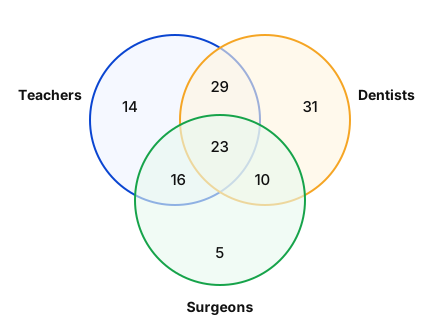
दिए गए आरेख का ध्यानपूर्वक अध्ययन कीजिए और प्रश्न का उत्तर दीजिए। विभिन्न भागों में दी गई संख्याएँ व्यक्तियों की संख्या दर्शाती हैं। (नोट: आपको दिए गए आँकड़ों को सत्य मानना है, भले ही वे सामान्यतः ज्ञात तथ्यों से भिन्न प्रतीत होते हों।)
ऐसे कितने शिक्षक (Teachers) हैं जो दंत चिकित्सक (Dentists) भी हैं परंतु शल्य चिकित्सक (Surgeons) नहीं हैं?
- A14
- B5
- C29
- D16
Show answer
Concept: In a three-circle Venn diagram, "Teachers who are also Dentists but not Surgeons" is the part of the Teacher–Dentist overlap that lies outside the Surgeons circle.
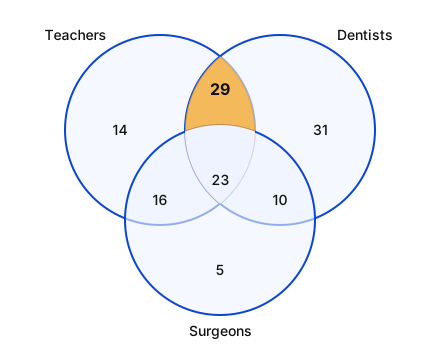
- The Teachers and Dentists circles overlap in two regions: one inside Surgeons (23) and one outside Surgeons (29).
- We need only the region outside the Surgeons circle → 29.
- 14 = only Teachers, 16 = Teachers and Surgeons only, 5 = only Surgeons – none of these fit the condition.
Trick: "A and B but not C" → take the A∩B lens and drop the central (all-three) number.
Answer: (C) 29
अवधारणा: तीन वृत्तों के वेन आरेख में "ऐसे Teachers जो Dentists भी हैं पर Surgeons नहीं" = Teacher–Dentist के उभयनिष्ठ भाग का वह हिस्सा जो Surgeons वृत्त के बाहर है।
- Teachers और Dentists वृत्त दो क्षेत्रों में मिलते हैं: एक Surgeons के अंदर (23) और एक Surgeons के बाहर (29)।
- हमें केवल Surgeons वृत्त से बाहर वाला क्षेत्र चाहिए → 29।
- 14 = केवल Teachers, 16 = Teachers और Surgeons, 5 = केवल Surgeons – ये शर्त पूरी नहीं करते।
ट्रिक: "A और B पर C नहीं" → A∩B वाला हिस्सा लें और बीच वाली (तीनों की) संख्या छोड़ दें।
उत्तर: (C) 29
RRB NTPC Undergraduate CBT 1General Intelligence and ReasoningVenn diagram – reading regionsRRB NTPC Undergraduate CBT 1 2025 · 7 May Shift 2
Q812.What should come in place of '?' in the given series based on the English alphabetical order?
MFJ JCG GZD DWA ?
अंग्रेज़ी वर्णमाला क्रम के आधार पर दी गई शृंखला में '?' के स्थान पर क्या आना चाहिए?
MFJ JCG GZD DWA ?
- AAKR
- BATZ
- CATX
- DASY
Show answer
Concept: Write the alphabet positions and check how each letter of a cluster moves to the next cluster.
- 1st letters: M(13) → J(10) → G(7) → D(4) → ? : each time , so next = A(1).
- 2nd letters: F(6) → C(3) → Z(26) → W(23) → ? : each, so next = T(20).
- 3rd letters: J(10) → G(7) → D(4) → A(1) → ? : , so next = X(24).
- Required cluster = ATX.
Trick: All three letters fall by 3 – check only one letter of each option: the first letter must be A and the last must be X.
Answer: (C) ATX
अवधारणा: अक्षरों के स्थान (position) लिखें और देखें कि हर अक्षर अगले समूह में कितना बदलता है।
- पहले अक्षर: M(13) → J(10) → G(7) → D(4) → ? : हर बार , अतः अगला A(1)।
- दूसरे अक्षर: F(6) → C(3) → Z(26) → W(23) → ? : , अतः T(20)।
- तीसरे अक्षर: J(10) → G(7) → D(4) → A(1) → ? : , अतः X(24)।
- अभीष्ट समूह = ATX।
ट्रिक: तीनों अक्षर 3 घटते हैं – विकल्पों में केवल पहला अक्षर A और अंतिम X जाँचें।
उत्तर: (C) ATX
RRB NTPC Undergraduate CBT 1General Intelligence and ReasoningLetter-cluster seriesRRB NTPC Undergraduate CBT 1 2025 · 7 May Shift 2
Q813.Each of the digits in the number 52178436 is arranged in ascending order from left to right. What will be the sum of the digits that are third from the left and third from the right in the number thus formed?
संख्या 52178436 के प्रत्येक अंक को बाएँ से दाएँ आरोही क्रम में व्यवस्थित किया जाता है। इस प्रकार बनी संख्या में बाएँ से तीसरे और दाएँ से तीसरे अंकों का योग क्या होगा?
- A11
- B8
- C9
- D10
Show answer
Concept: Rearrange the digits in increasing order and then count positions from both ends.
- Digits of 52178436 in ascending order: 1 2 3 4 5 6 7 8.
- Third from the left = 3; third from the right = 6.
- Sum .
Trick: The eight digits here are exactly 1–8, so the ascending number is simply 12345678 – no sorting effort needed.
Answer: (C) 9
अवधारणा: अंकों को बढ़ते क्रम में लिखें और फिर दोनों सिरों से स्थान गिनें।
- 52178436 के अंक आरोही क्रम में: 1 2 3 4 5 6 7 8।
- बाएँ से तीसरा = 3; दाएँ से तीसरा = 6।
- योग ।
ट्रिक: यहाँ आठों अंक ठीक 1–8 हैं, इसलिए आरोही संख्या सीधे 12345678 है – छाँटने की ज़रूरत नहीं।
उत्तर: (C) 9
RRB NTPC Undergraduate CBT 1General Intelligence and ReasoningDigit arrangementRRB NTPC Undergraduate CBT 1 2025 · 7 May Shift 2
Q814.Each of the digits in the number 36857219 is arranged in the ascending order from left to right. What will be the sum of the digits which are second from the left and third from the right in the new number thus formed?
संख्या 36857219 के प्रत्येक अंक को बाएँ से दाएँ आरोही क्रम में व्यवस्थित किया जाता है। इस प्रकार बनी नई संख्या में बाएँ से दूसरे और दाएँ से तीसरे अंकों का योग क्या होगा?
- A11
- B9
- C10
- D8
Show answer
Concept: Sort the digits in ascending order, then read the required positions.
- Digits of 36857219 in ascending order: 1 2 3 5 6 7 8 9 (note: no 4).
- Second from the left = 2; third from the right = 7.
- Sum .
Trick: Write the sorted digits in a line and count from the right by pointing with a finger – most errors come from miscounting "third from the right".
Answer: (B) 9
अवधारणा: अंकों को आरोही क्रम में लगाएँ और फिर माँगे गए स्थान पढ़ें।
- 36857219 के अंक आरोही क्रम में: 1 2 3 5 6 7 8 9 (ध्यान दें: 4 नहीं है)।
- बाएँ से दूसरा = 2; दाएँ से तीसरा = 7।
- योग ।
ट्रिक: छाँटे हुए अंक एक पंक्ति में लिखकर दाएँ से उँगली रखकर गिनें – ज़्यादातर गलती "दाएँ से तीसरा" गिनने में होती है।
उत्तर: (B) 9
RRB NTPC Undergraduate CBT 1General Intelligence and ReasoningDigit arrangementRRB NTPC Undergraduate CBT 1 2025 · 7 May Shift 2
Q815.Refer to the following letter series and answer the question that follows. Counting to be done from left to right only.
(Left) K D D U R V U D E C Q D V A D R D G D E D Z D J (Right)
How many such D’s are there, each of which is immediately preceded by a vowel and also immediately followed by a consonant?
निम्नलिखित अक्षर शृंखला को देखिए और उसके बाद दिए गए प्रश्न का उत्तर दीजिए। गिनती केवल बाएँ से दाएँ की जानी है।
(बाएँ) K D D U R V U D E C Q D V A D R D G D E D Z D J (दाएँ)
ऐसे कितने D हैं, जिनमें से प्रत्येक के ठीक पहले एक स्वर और ठीक बाद एक व्यंजन है?
- AFourचार
- BTwoदो
- CThreeतीन
- DFiveपाँच
Show answer
Concept: Check every D in the series: the letter just before it must be a vowel (A, E, I, O, U) and the letter just after it must be a consonant.
- Series: K D D U R V U D E C Q D V A D R D G D E D Z D J.
- D's with a vowel before them: UDE (after it is E, a vowel – rejected), ADR (R is a consonant – accepted), EDZ (Z is a consonant – accepted).
- All other D's have a consonant before them (K, D, Q, R, G, Z) – rejected.
- Count = 2.
Trick: First underline the vowels (U, U, E, A, E) – only the D's right after a vowel need checking.
Answer: (B) Two
अवधारणा: श्रृंखला के हर D को जाँचें: ठीक पहले का अक्षर स्वर (A, E, I, O, U) और ठीक बाद का अक्षर व्यंजन होना चाहिए।
- श्रृंखला: K D D U R V U D E C Q D V A D R D G D E D Z D J।
- जिन D से पहले स्वर है: UDE (बाद में E स्वर – अस्वीकृत), ADR (R व्यंजन – स्वीकृत), EDZ (Z व्यंजन – स्वीकृत)।
- बाकी सभी D से पहले व्यंजन (K, D, Q, R, G, Z) हैं – अस्वीकृत।
- संख्या = 2।
ट्रिक: पहले स्वरों (U, U, E, A, E) को रेखांकित करें – केवल स्वर के ठीक बाद वाले D जाँचने हैं।
उत्तर: (B) दो (Two)
RRB NTPC Undergraduate CBT 1General Intelligence and ReasoningLetter series – counting with conditionsRRB NTPC Undergraduate CBT 1 2025 · 7 May Shift 2
Q816.Select the pair which follows the same pattern as that followed by the two sets of pairs given below. Both pairs follow the same pattern.
DIP : GLS
BST : EVW
उस युग्म का चयन कीजिए जो नीचे दिए गए दो युग्मों के समान पैटर्न का अनुसरण करता है। दोनों युग्म समान पैटर्न का अनुसरण करते हैं।
DIP : GLS
BST : EVW
- ATEL : VHP
- BHKD : KNG
- CCIG : FKJ
- DEHL : IFP
Show answer
Concept: Find the shift applied to each letter of the first cluster to get the second cluster.
- DIP → GLS: D+3 = G, I+3 = L, P+3 = S. BST → EVW: B+3 = E, S+3 = V, T+3 = W. Rule: every letter .
- HKD → KNG: H+3 = K, K+3 = N, D+3 = G ✓.
- TEL → VHP is (+2, +3, +4); CIG → FKJ is (+3, +2, +3); EHL → IFP is (+4, −2, +4) – none follow the rule.
Trick: Test only the first letter of each option for "+3": T→V (+2 ✗), H→K ✓, C→F ✓, E→I ✗; then check the second letter of the two survivors.
Answer: (B) HKD : KNG
अवधारणा: पहले समूह के हर अक्षर पर लगे बदलाव (shift) से दूसरा समूह मिलता है – वही नियम विकल्पों में खोजें।
- DIP → GLS: D+3 = G, I+3 = L, P+3 = S। BST → EVW: B+3 = E, S+3 = V, T+3 = W। नियम: हर अक्षर ।
- HKD → KNG: H+3 = K, K+3 = N, D+3 = G ✓।
- TEL → VHP में (+2, +3, +4); CIG → FKJ में (+3, +2, +3); EHL → IFP में (+4, −2, +4) – कोई नियम पर खरा नहीं।
ट्रिक: हर विकल्प के केवल पहले अक्षर पर "+3" जाँचें: T→V (+2 ✗), H→K ✓, C→F ✓, E→I ✗; फिर बचे दो में दूसरा अक्षर देखें।
उत्तर: (B) HKD : KNG
RRB NTPC Undergraduate CBT 1General Intelligence and ReasoningLetter analogyRRB NTPC Undergraduate CBT 1 2025 · 7 May Shift 2
Q817.In a certain code language,
A + B means ‘A is the son of B’,
A – B means ‘A is the brother of B’,
A x B means ‘A is the wife of B’ and
A ÷ B means ‘A is the father of B’.
Based on the above, how is S related to K if ‘S – D + F ÷ H x K’?
एक निश्चित कूट भाषा में,
A + B का अर्थ है 'A, B का पुत्र है',
A – B का अर्थ है 'A, B का भाई है',
A x B का अर्थ है 'A, B की पत्नी है' और
A ÷ B का अर्थ है 'A, B का पिता है'।
उपरोक्त के आधार पर, यदि 'S – D + F ÷ H x K' है, तो S, K से किस प्रकार संबंधित है?
- ABrotherभाई
- BWife's fatherपत्नी का पिता
- CWife's brotherपत्नी का भाई
- DFatherपिता
Show answer
Concept: Decode each symbol from left to right and build the family tree.
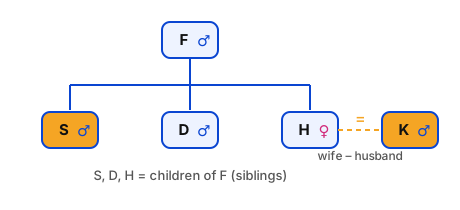
- S – D: S is the brother of D. D + F: D is the son of F. So S is also a son of F.
- F ÷ H: F is the father of H. H × K: H is the wife of K, so H is female and K is her husband.
- S and H are children of the same father F, so S is H's brother; H is K's wife.
- Hence S is K's wife's brother.
Trick: Draw one generation line for all children of F (S, D, H); the person at the far end (K) is only connected by marriage, so the answer must contain "wife's".
Answer: (C) Wife's brother
अवधारणा: हर चिह्न को बाएँ से दाएँ डिकोड करें और वंश-वृक्ष बनाएँ।
- S – D: S, D का भाई है। D + F: D, F का पुत्र है। अतः S भी F का पुत्र है।
- F ÷ H: F, H का पिता है। H × K: H, K की पत्नी है, अतः H स्त्री है और K उसका पति।
- S और H एक ही पिता F की संतानें हैं, अतः S, H का भाई है; H, K की पत्नी है।
- इसलिए S, K की पत्नी का भाई है।
ट्रिक: F की सभी संतानों (S, D, H) को एक ही पीढ़ी-रेखा में रखें; अंतिम व्यक्ति (K) केवल विवाह से जुड़ा है, इसलिए उत्तर में "पत्नी का" आना ही है।
उत्तर: (C) पत्नी का भाई (Wife's brother)
RRB NTPC Undergraduate CBT 1General Intelligence and ReasoningBlood relations – codedRRB NTPC Undergraduate CBT 1 2025 · 7 May Shift 2
Q818.What should come in place of ‘?’ in the given series?
67 70 ? 85 97 112
दी गई शृंखला में '?' के स्थान पर क्या आना चाहिए?
67 70 ? 85 97 112
- A82
- B78
- C76
- D80
Show answer
Concept: Find the differences between consecutive terms; they often form a simple pattern.
- , , → differences are multiples of 3: 3, 6, 9, 12, 15.
- So ? , and check: ✓.
Trick: When the last two differences are 12 and 15, go backwards in steps of 3 (9, 6, 3) to fill the gap.
Answer: (C) 76
अवधारणा: लगातार पदों के अंतर निकालें; वे प्रायः एक सरल पैटर्न बनाते हैं।
- , , → अंतर 3 के गुणज हैं: 3, 6, 9, 12, 15।
- अतः ? ; जाँच: ✓।
ट्रिक: अंतिम दो अंतर 12 और 15 हों तो 3-3 घटाते हुए पीछे चलें (9, 6, 3) और खाली जगह भरें।
उत्तर: (C) 76
RRB NTPC Undergraduate CBT 1General Intelligence and ReasoningNumber series – differencesRRB NTPC Undergraduate CBT 1 2025 · 7 May Shift 2
Q819.Each vowel in the word CURRENT is changed to the letter immediately following it in the English alphabetical order and each consonant is changed to the letter immediately preceding it in the English alphabetical order. Which of the following letters will be third from the right in the new group of letters thus formed?
शब्द CURRENT के प्रत्येक स्वर को अंग्रेज़ी वर्णमाला क्रम में उसके ठीक बाद वाले अक्षर में और प्रत्येक व्यंजन को अंग्रेज़ी वर्णमाला क्रम में उसके ठीक पहले वाले अक्षर में बदल दिया जाता है। इस प्रकार बने नए अक्षर-समूह में निम्नलिखित में से कौन-सा अक्षर दाएँ से तीसरा होगा?
- AG
- BE
- CF
- DH
Show answer
Concept: Apply the rule letter by letter: vowel → next letter, consonant → previous letter.
- C U R R E N T → C−1 = B, U+1 = V, R−1 = Q, R−1 = Q, E+1 = F, N−1 = M, T−1 = S.
- New group: B V Q Q F M S.
- Third from the right: S (1st), M (2nd), F (3rd).
Trick: Only the vowels U and E move forward; every other letter steps back one – write the new letters directly under the word.
Answer: (C) F
अवधारणा: नियम हर अक्षर पर लगाएँ: स्वर → अगला अक्षर, व्यंजन → पिछला अक्षर।
- C U R R E N T → C−1 = B, U+1 = V, R−1 = Q, R−1 = Q, E+1 = F, N−1 = M, T−1 = S।
- नया समूह: B V Q Q F M S।
- दाएँ से तीसरा: S (पहला), M (दूसरा), F (तीसरा)।
ट्रिक: केवल स्वर U और E आगे बढ़ते हैं; बाकी हर अक्षर एक पीछे – नए अक्षर सीधे शब्द के नीचे लिखें।
उत्तर: (C) F
RRB NTPC Undergraduate CBT 1General Intelligence and ReasoningLetter operations on a wordRRB NTPC Undergraduate CBT 1 2025 · 7 May Shift 2
Q820.Select the set in which the numbers are related in the same way as are the numbers of the following sets.
(NOTE: Operations should be performed on the whole numbers, without breaking down the numbers into their constituent digits. E.g. 13 – Operations on 13 such as
adding/subtracting/multiplying to 13 can be performed. Breaking down 13 into 1 and 3 and then performing mathematical operations on 1 and 3 is not allowed.)
(2, 7, 14)
(3, 16, 48)
उस समुच्चय का चयन कीजिए जिसमें संख्याएँ उसी प्रकार संबंधित हैं जिस प्रकार निम्नलिखित समुच्चयों की संख्याएँ संबंधित हैं।
(नोट: संक्रियाएँ पूर्ण संख्याओं पर की जानी चाहिए, संख्याओं को उनके घटक अंकों में तोड़े बिना। उदाहरण के लिए 13 – 13 पर संक्रियाएँ जैसे
13 में जोड़ना/घटाना/गुणा करना किया जा सकता है। 13 को 1 और 3 में तोड़कर फिर 1 और 3 पर गणितीय संक्रियाएँ करने की अनुमति नहीं है।)
(2, 7, 14)
(3, 16, 48)
- A(4, 6, 20)
- B(5, 3, 15)
- C(8, 6, 56)
- D(6, 7, 48)
Show answer
Concept: Find one operation that links the three numbers of each given set.
- (2, 7, 14): . (3, 16, 48): . Rule: third number = product of the first two.
- (5, 3, 15): ✓.
- (4, 6, 20): ; (8, 6, 56): ; (6, 7, 48): .
Trick: When the third number is clearly bigger, test multiplication of the first two before anything else.
Answer: (B) (5, 3, 15)
अवधारणा: ऐसी एक संक्रिया खोजें जो हर समुच्चय की तीनों संख्याओं को जोड़ती हो।
- (2, 7, 14): । (3, 16, 48): । नियम: तीसरी संख्या = पहली दो का गुणनफल।
- (5, 3, 15): ✓।
- (4, 6, 20): ; (8, 6, 56): ; (6, 7, 48): ।
ट्रिक: तीसरी संख्या स्पष्ट रूप से बड़ी हो तो सबसे पहले पहली दो का गुणा जाँचें।
उत्तर: (B) (5, 3, 15)
RRB NTPC Undergraduate CBT 1General Intelligence and ReasoningNumber set analogyRRB NTPC Undergraduate CBT 1 2025 · 7 May Shift 2

