RRB NTPC Undergraduate CBT 1 · 2,900 questions

RRB NTPC Undergraduate CBT 1 2025 PYQs

Real previous year questions, subject-wise. Try the question, then open the answer and the explanation in Hindi & English – free, no login.

Courses – airGurukul

870 questions in Mathematics.

Q801.
Simplify: (1.5×0.2)0.3
सरल कीजिए: (1.5×0.2)0.3
  1. A10
  2. B1
  3. C0.1
  4. D0.01
Show answer

Concept: Multiply the numerator first, then divide.

  1. 1.5×0.2=0.30.
  2. 0.30.3=1.

Trick: 1.5×0.2: 15×2=30 with two decimal places → 0.30.

Answer: (B) 1

अवधारणा: पहले अंश का गुणा करें, फिर भाग दें।

  1. 1.5×0.2=0.30।
  2. 0.30.3=1।

ट्रिक: 1.5×0.2: 15×2=30, दो दशमलव स्थान → 0.30।

उत्तर: (B) 1

RRB NTPC Undergraduate CBT 1MathematicsDecimalsRRB NTPC Undergraduate CBT 1 2025 · 7 May Shift 3
Q802.
The cost price of 25 articles is the same as the selling price of x articles. If the profit is 25%, then the value of x is:
25 वस्तुओं का क्रय मूल्य x वस्तुओं के विक्रय मूल्य के बराबर है। यदि लाभ 25% है, तो x का मान है:
  1. A23
  2. B18
  3. C20
  4. D16
Show answer

Concept: If CP of a articles = SP of b articles, profit%=a−bb×100.

  1. Let CP of each article be ₹1: 25=x×SP.
  2. Profit 25%⇒SP=1.25.
  3. x=251.25=20.

Trick: 25−xx=14⇒100−4x=x⇒x=20.

Answer: (C) 20

अवधारणा: यदि a वस्तुओं का CP = b वस्तुओं का SP, तो लाभ%=a−bb×100।

  1. प्रत्येक वस्तु का CP ₹1 मानें: 25=x×SP।
  2. लाभ 25%⇒SP=1.25।
  3. x=251.25=20।

ट्रिक: 25−xx=14⇒100−4x=x⇒x=20।

उत्तर: (C) 20

RRB NTPC Undergraduate CBT 1MathematicsProfit & loss – articlesRRB NTPC Undergraduate CBT 1 2025 · 7 May Shift 3
Q803.
What is the mode of the following data?
40, 41, 42, 51, 45, 43, 45, 43, 51, 40, 51, 54, 46, 50, 55, 47, 42, 46
निम्नलिखित आँकड़ों का बहुलक (mode) क्या है?
40, 41, 42, 51, 45, 43, 45, 43, 51, 40, 51, 54, 46, 50, 55, 47, 42, 46
  1. A41
  2. B51
  3. C40
  4. D42
Show answer

Concept: Mode is the value that occurs most often.

  1. Frequencies: 40 → 2, 41 → 1, 42 → 2, 43 → 2, 45 → 2, 46 → 2, 51 → 3, others → 1.
  2. 51 appears 3 times, the maximum.

Trick: Tally only the values that repeat; one value with 3 occurrences stands out quickly.

Answer: (B) 51

अवधारणा: बहुलक (mode) वह मान है जो सबसे अधिक बार आता है।

  1. बारंबारता: 40 → 2, 41 → 1, 42 → 2, 43 → 2, 45 → 2, 46 → 2, 51 → 3, शेष → 1।
  2. 51 तीन बार आता है, जो अधिकतम है।

ट्रिक: केवल दोहराए गए मानों की गिनती करें; 3 बार वाला मान तुरंत दिख जाता है।

उत्तर: (B) 51

RRB NTPC Undergraduate CBT 1MathematicsStatistics – modeRRB NTPC Undergraduate CBT 1 2025 · 7 May Shift 3
Q804.
Simplify: 30 + [{-9 × (26 - 11 + 6)}]
सरल कीजिए: 30 + [{-9 × (26 - 11 + 6)}]
  1. A-160
  2. B-162
  3. C-159
  4. D-161
Show answer

Concept: Solve the innermost bracket first, then multiply, then add.

  1. (26−11+6)=21.
  2. −9×21=−189.
  3. 30+(−189)=−159.

Trick: Left-to-right inside the bracket: 26−11=15, then +6=21 – do not subtract 17 from 26.

Answer: (C) -159

अवधारणा: सबसे भीतरी कोष्ठक पहले, फिर गुणा, फिर जोड़।

  1. (26−11+6)=21।
  2. −9×21=−189।
  3. 30+(−189)=−159।

ट्रिक: कोष्ठक में बाएँ से दाएँ: 26−11=15, फिर +6=21 – 26 में से 17 न घटाएँ।

उत्तर: (C) -159

RRB NTPC Undergraduate CBT 1MathematicsSimplification – BODMASRRB NTPC Undergraduate CBT 1 2025 · 7 May Shift 3
Q805.
A tank is normally filled by pipe A in 10 hours. Due to a leak, the tank takes 12 hours to fill. Find the time taken by the leak alone to empty a full tank.
एक टंकी सामान्यतः पाइप A द्वारा 10 घंटे में भर जाती है। एक रिसाव के कारण टंकी को भरने में 12 घंटे लगते हैं। अकेले रिसाव द्वारा भरी हुई टंकी को खाली करने में लगने वाला समय ज्ञात कीजिए।
  1. A60 hours60 घंटे
  2. B40 hours40 घंटे
  3. C30 hours30 घंटे
  4. D80 hours80 घंटे
Show answer

Concept: Leak's rate = filling rate of A − net filling rate.

  1. A fills 110 per hour; with leak net is 112 per hour.
  2. Leak empties 110−112=6−560=160 per hour.
  3. Leak alone empties the tank in 60 hours.

Trick: Leak time =10×1212−10=60.

Answer: (A) 60 hours

अवधारणा: रिसाव की दर = A की भरने की दर − शुद्ध भरने की दर।

  1. A प्रति घंटा 110 भरता है; रिसाव के साथ शुद्ध 112 प्रति घंटा।
  2. रिसाव 110−112=6−560=160 प्रति घंटा खाली करता है।
  3. रिसाव अकेले 60 घंटे में टंकी खाली करेगा।

ट्रिक: रिसाव समय =10×1212−10=60।

उत्तर: (A) 60 hours

RRB NTPC Undergraduate CBT 1MathematicsPipes & cisternsRRB NTPC Undergraduate CBT 1 2025 · 7 May Shift 3
Q806.
The mean proportional between two positive numbers is 30. If the difference between the two numbers is 45, what is the smaller of the two numbers?
दो धनात्मक संख्याओं के बीच मध्यानुपाती 30 है। यदि दोनों संख्याओं का अंतर 45 है, तो दोनों में से छोटी संख्या क्या है?
  1. A12
  2. B15
  3. C18
  4. D21
Show answer

Concept: Mean proportional m between a and b: m2=ab.

  1. ab=900 and a−b=45.
  2. (a+b)2=(a−b)2+4ab=2025+3600=5625⇒a+b=75.
  3. b=75−452=15 (and a=60; 60×15=900 ✓).

Trick: Factor pairs of 900 with difference 45: 60×15 – spot it directly.

Answer: (B) 15

अवधारणा: a और b का मध्यानुपाती (mean proportional) m: m2=ab।

  1. ab=900 तथा a−b=45।
  2. (a+b)2=(a−b)2+4ab=2025+3600=5625⇒a+b=75।
  3. b=75−452=15 (और a=60; 60×15=900 ✓)।

ट्रिक: 900 के गुणनखंड युग्म जिनका अंतर 45 हो: 60×15 – सीधे पहचानें।

उत्तर: (B) 15

RRB NTPC Undergraduate CBT 1MathematicsMean proportionalRRB NTPC Undergraduate CBT 1 2025 · 7 May Shift 3
Q807.
If a sum of ₹70,000 amounts to ₹74,263 in X years under compound interest,
compounded annually at 3% per annum, find X.
यदि ₹70,000 की राशि 3% वार्षिक दर से वार्षिक रूप से संयोजित चक्रवृद्धि ब्याज पर X वर्षों में ₹74,263 हो जाती है,
तो X ज्ञात कीजिए।
  1. A5
  2. B2
  3. C4
  4. D3
Show answer

Concept: A=P(1+r100)n.

  1. 7426370000=1.0609.
  2. 1.032=1.0609, so n=2.

Trick: 1.032=1.0609, 1.033≈1.0927 – the amount barely exceeds 6%, so 2 years.

Answer: (B) 2

अवधारणा: A=P(1+r100)n।

  1. 7426370000=1.0609।
  2. 1.032=1.0609, अतः n=2।

ट्रिक: 1.032=1.0609, 1.033≈1.0927 – राशि 6% से थोड़ी ही अधिक है, अतः 2 वर्ष।

उत्तर: (B) 2

RRB NTPC Undergraduate CBT 1MathematicsCompound interestRRB NTPC Undergraduate CBT 1 2025 · 7 May Shift 3
Q808.
If ₹25,200 is invested at a simple interest rate of 6% per annum for 4 years, find the interest earned.
यदि ₹25,200 को 6% वार्षिक साधारण ब्याज की दर से 4 वर्षों के लिए निवेश किया जाता है, तो अर्जित ब्याज ज्ञात कीजिए।
  1. A₹6,070
  2. B₹6,025
  3. C₹6,048
  4. D₹8,021
Show answer

Concept: SI=P×R×T100.

  1. SI=25200×6×4100.
  2. =252×24=6048.

Trick: 6%×4 years =24% of 25200 =24100×25200=6048.

Answer: (C) ₹6,048

अवधारणा: SI=P×R×T100।

  1. SI=25200×6×4100।
  2. =252×24=6048।

ट्रिक: 6%×4 वर्ष =24% of 25200 =24100×25200=6048।

उत्तर: (C) ₹6,048

RRB NTPC Undergraduate CBT 1MathematicsSimple interestRRB NTPC Undergraduate CBT 1 2025 · 7 May Shift 3
Q809.
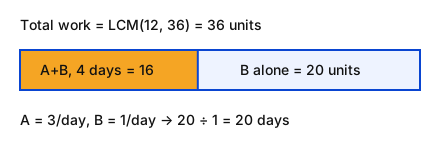
A and B can do a piece of work in 12 days and 36 days, respectively. Both work for 4 days and then A leaves. How long (in days) will B take to complete the remaining work?
A और B एक काम को क्रमशः 12 दिन और 36 दिन में कर सकते हैं। दोनों 4 दिन काम करते हैं और फिर A काम छोड़ देता है। शेष काम पूरा करने में B को कितना समय (दिनों में) लगेगा?
  1. A20
  2. B22
  3. C19
  4. D21
Show answer

Concept: Take total work = LCM of days; work per day = total ÷ days.

  1. Total work =36 units; A =3 units/day, B =1 unit/day.
  2. In 4 days together: 4×(3+1)=16 units done; 20 remain.
  3. B alone: 201=20 days.

Trick: Fraction left =1−4(112+136)=1−1636=2036 → B takes 2036×36=20 days.

Answer: (A) 20

अवधारणा: कुल कार्य = दिनों का LCM; प्रतिदिन कार्य = कुल ÷ दिन।

  1. कुल कार्य =36 इकाई; A =3 इकाई/दिन, B =1 इकाई/दिन।
  2. 4 दिन साथ: 4×(3+1)=16 इकाई पूर्ण; 20 शेष।
  3. B अकेले: 201=20 दिन।

ट्रिक: शेष भाग =1−4(112+136)=2036 → B को 2036×36=20 दिन।

उत्तर: (A) 20

RRB NTPC Undergraduate CBT 1MathematicsTime & workRRB NTPC Undergraduate CBT 1 2025 · 7 May Shift 3
Q810.
Three numbers are in the ratio 3 : 2 : 13, and their LCM is 6318. Their HCF is:
तीन संख्याएँ 3 : 2 : 13 के अनुपात में हैं, और उनका LCM 6318 है। उनका HCF है:
  1. A80
  2. B128
  3. C124
  4. D81
Show answer

Concept: For numbers 3x,2x,13x with co-prime ratio terms, HCF =x and LCM =3×2×13×x=78x.

  1. 78x=6318⇒x=631878=81.
  2. HCF =x=81.

Trick: 78×80=6240, 6318−6240=78 → one more, so x=81.

Answer: (D) 81

अवधारणा: सह-अभाज्य अनुपात पदों वाली संख्याएँ 3x,2x,13x: HCF =x और LCM =3×2×13×x=78x।

  1. 78x=6318⇒x=631878=81।
  2. HCF =x=81।

ट्रिक: 78×80=6240, 6318−6240=78 → एक और, अतः x=81।

उत्तर: (D) 81

RRB NTPC Undergraduate CBT 1MathematicsLCM & HCF – ratioRRB NTPC Undergraduate CBT 1 2025 · 7 May Shift 3
Q811.
A student scores 75, 80 and 90 in three tests with weights 2,3 and 5 respectively. What is the weighted average score?
एक छात्र तीन परीक्षाओं में 75, 80 और 90 अंक प्राप्त करता है, जिनके भार क्रमशः 2, 3 और 5 हैं। भारित औसत अंक क्या है?
  1. A82
  2. B83
  3. C85
  4. D84
Show answer

Concept: Weighted average =∑(score×weight)∑weights.

  1. 75×2+80×3+90×5=150+240+450=840
  2. Total weight =2+3+5=10
  3. Weighted average =84010=84

Trick: Take 80 as base: deviations −5×2+0×3+10×5=40; 40÷10=4, so 80+4=84.

Answer: (D) 84

अवधारणा: भारित औसत =∑(अंक×भार)∑भार।

  1. 75×2+80×3+90×5=150+240+450=840
  2. कुल भार =2+3+5=10
  3. भारित औसत =84010=84

ट्रिक: 80 को आधार मानें: विचलन −5×2+0×3+10×5=40; 40÷10=4, अतः 80+4=84।

उत्तर: (D) 84

RRB NTPC Undergraduate CBT 1MathematicsWeighted AverageRRB NTPC Undergraduate CBT 1 2025 · 7 May Shift 2
Q812.
The largest four-digit number which when divided by 7, 6 and 10 leaves the remainder 5 in each case, is:
चार अंकों की वह सबसे बड़ी संख्या, जिसे 7, 6 और 10 से विभाजित करने पर प्रत्येक स्थिति में शेषफल 5 बचता है, है:
  1. A9909
  2. B9875
  3. C9964
  4. D9793
Show answer

Concept: A number leaving the same remainder r on division by several numbers is of the form k×LCM+r.

  1. LCM(7,6,10)=210
  2. Largest 4-digit multiple of 210: 9999÷210=47 rem 129, so 9999−129=9870
  3. Required number =9870+5=9875

Trick: Check options: 9875−5=9870=210×47 – only this one works.

Answer: (B) 9875

अवधारणा: कई संख्याओं से भाग देने पर समान शेष r देने वाली संख्या k×ल.स.+r रूप की होती है।

  1. ल.स.(7,6,10)=210
  2. 210 का सबसे बड़ा 4-अंकीय गुणज: 9999÷210=47 शेष 129, अतः 9999−129=9870
  3. अभीष्ट संख्या =9870+5=9875

ट्रिक: विकल्प जाँचें: 9875−5=9870=210×47 – केवल यही सही बैठता है।

उत्तर: (B) 9875

RRB NTPC Undergraduate CBT 1MathematicsLCM – Remainder ProblemsRRB NTPC Undergraduate CBT 1 2025 · 7 May Shift 2
Q813.
Calculate the total amount when ₹4000 is invested at 10% compound interest per annum, compounded annually for 2 years.
₹4000 को 10% वार्षिक चक्रवृद्धि ब्याज की दर पर, वार्षिक रूप से संयोजित, 2 वर्षों के लिए निवेश करने पर कुल मिश्रधन की गणना कीजिए।
  1. A₹4400
  2. B₹4800
  3. C₹4080
  4. D₹4840
Show answer

Concept: Amount A=P(1+R100)T.

  1. A=4000×(1110)2=4000×121100
  2. A=40×121=4840

Trick: 10% for 2 years = effective 21%; 4000+840=4840.

Answer: (D) ₹4840

अवधारणा: मिश्रधन A=P(1+R100)T।

  1. A=4000×(1110)2=4000×121100
  2. A=40×121=4840

ट्रिक: 10% दो वर्ष के लिए = प्रभावी 21%; 4000+840=4840।

उत्तर: (D) ₹4840

RRB NTPC Undergraduate CBT 1MathematicsCompound InterestRRB NTPC Undergraduate CBT 1 2025 · 7 May Shift 2
Q814.
Two taps can fill a cistern in 4 hours and 11 hours, respectively. A third tap can empty it in 11 hours. How long (in hours) will it take to fill one-fourth of the empty cistern if all the taps are opened together?
दो नल एक टंकी को क्रमशः 4 घंटे और 11 घंटे में भर सकते हैं। एक तीसरा नल इसे 11 घंटे में खाली कर सकता है। यदि सभी नल एक साथ खोल दिए जाएँ, तो खाली टंकी के एक-चौथाई भाग को भरने में कितना समय (घंटों में) लगेगा?
  1. A4
  2. B3
  3. C1
  4. D2
Show answer

Concept: Work per hour of each tap is 1time; an emptying tap is negative.

  1. Net part filled per hour =14+111−111=14
  2. The second tap and the emptying tap cancel each other exactly.
  3. Full cistern in 4 h, so one-fourth in 4×14=1 hour.

Trick: Equal fill and empty times (11 h each) cancel – only the 4-hour tap matters.

Answer: (C) 1

अवधारणा: प्रत्येक नल का प्रति घंटा कार्य 1समय; खाली करने वाला नल ऋणात्मक।

  1. प्रति घंटा शुद्ध भराव =14+111−111=14
  2. दूसरा नल और खाली करने वाला नल एक-दूसरे को पूरी तरह काट देते हैं।
  3. पूरी टंकी 4 घंटे में, अतः एक-चौथाई 4×14=1 घंटे में।

ट्रिक: भरने और खाली करने का समय बराबर (11 घंटे) हो तो वे रद्द – केवल 4 घंटे वाला नल गिनें।

उत्तर: (C) 1

RRB NTPC Undergraduate CBT 1MathematicsPipes and CisternsRRB NTPC Undergraduate CBT 1 2025 · 7 May Shift 2
Q815.
Find the single discount equivalent to three successive discounts of 10% on a commodity.
किसी वस्तु पर 10% की तीन क्रमिक छूटों के समतुल्य एकल छूट ज्ञात कीजिए।
  1. A28.2%
  2. B26.9%
  3. C27.1%
  4. D25.8%
Show answer

Concept: Three successive discounts of d% leave (1−d100)3 of the price.

  1. Remaining fraction =0.9×0.9×0.9=0.729
  2. Price paid =72.9%
  3. Single equivalent discount =100−72.9=27.1%

Trick: Two 10% discounts =19%; then 19+10−19×10100=27.1%.

Answer: (C) 27.1%

अवधारणा: d% की तीन क्रमिक छूट के बाद मूल्य का (1−d100)3 भाग बचता है।

  1. शेष भाग =0.9×0.9×0.9=0.729
  2. चुकाया मूल्य =72.9%
  3. समतुल्य एकल छूट =100−72.9=27.1%

ट्रिक: दो 10% छूट =19%; फिर 19+10−19×10100=27.1%।

उत्तर: (C) 27.1%

RRB NTPC Undergraduate CBT 1MathematicsSuccessive DiscountsRRB NTPC Undergraduate CBT 1 2025 · 7 May Shift 2
Q816.
If 9x−9x−1=72, then the value of 2x−12x+3 is:
यदि 9x−9x−1=72 है, तो 2x−12x+3 का मान है:
  1. A34
  2. B35
  3. C38
  4. D37
Show answer

Concept: 9x−1=9x9; take 9x common.

  1. 9x−9x9=72⇒9x·89=72
  2. 9x=81=92⇒x=2
  3. 2x−12x+3=4−14+3=37

Trick: an−an−1=an−1(a−1); here 9x−1×8=72⇒9x−1=9, so x=2 at once.

Answer: (D) 37

अवधारणा: 9x−1=9x9; 9x उभयनिष्ठ लें।

  1. 9x−9x9=72⇒9x·89=72
  2. 9x=81=92⇒x=2
  3. 2x−12x+3=4−14+3=37

ट्रिक: an−an−1=an−1(a−1); यहाँ 9x−1×8=72⇒9x−1=9, अतः तुरंत x=2।

उत्तर: (D) 37

RRB NTPC Undergraduate CBT 1MathematicsIndices (Exponents)RRB NTPC Undergraduate CBT 1 2025 · 7 May Shift 2
Q817.
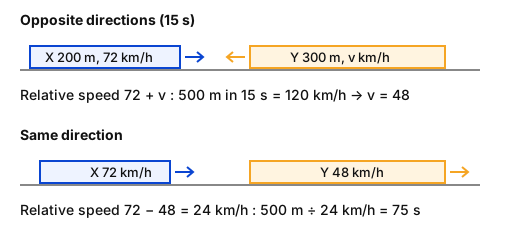
Two trains, X and Y, are running on parallel tracks. Train X is 200 m long and travels at 72 km/hr. Train Y is 300 m long. If the trains are traveling in opposite directions, they pass each other completely in 15 seconds. If the trains were traveling in the same direction, how long would it take for the faster train to overtake the slower one?
दो रेलगाड़ियाँ, X और Y, समानांतर पटरियों पर चल रही हैं। रेलगाड़ी X 200 m लंबी है और 72 km/hr की चाल से चलती है। रेलगाड़ी Y 300 m लंबी है। यदि रेलगाड़ियाँ विपरीत दिशाओं में चल रही हों, तो वे एक-दूसरे को 15 सेकंड में पूरी तरह पार कर लेती हैं। यदि रेलगाड़ियाँ एक ही दिशा में चल रही होतीं, तो तेज़ रेलगाड़ी को धीमी रेलगाड़ी को पार करने में कितना समय लगता?
  1. A75 seconds75 सेकंड
  2. B78 seconds78 सेकंड
  3. C67.5 seconds67.5 सेकंड
  4. D72 seconds72 सेकंड
Show answer

Concept: Opposite directions: relative speed = sum; same direction: difference. Distance to cross = sum of lengths.

  1. Total length =200+300=500 m; crossing in 15 s ⇒ relative speed =50015=1003 m/s =120 km/h
  2. Speed of Y =120−72=48 km/h
  3. Same direction: relative speed =72−48=24 km/h =203 m/s
  4. Time =500÷203=75 s

Trick: Relative speeds are 120 and 24 (ratio 5:1), so time becomes 15×5=75 s.

Answer: (A) 75 seconds

अवधारणा: विपरीत दिशा: सापेक्ष चाल = योग; समान दिशा: अंतर। पार करने की दूरी = लंबाइयों का योग।

  1. कुल लंबाई =200+300=500 m; 15 s में पार ⇒ सापेक्ष चाल =50015=1003 m/s =120 km/h
  2. Y की चाल =120−72=48 km/h
  3. समान दिशा: सापेक्ष चाल =72−48=24 km/h =203 m/s
  4. समय =500÷203=75 s

ट्रिक: सापेक्ष चालें 120 और 24 (अनुपात 5:1), अतः समय 15×5=75 s।

उत्तर: (A) 75 seconds

RRB NTPC Undergraduate CBT 1MathematicsTrains – Relative SpeedRRB NTPC Undergraduate CBT 1 2025 · 7 May Shift 2
Q818.
The ages of two siblings add up to 44 years. If one sibling is 4 years younger than twice the other's age, what is the difference between their ages?
दो भाई-बहनों की आयु का योग 44 वर्ष है। यदि एक की आयु दूसरे की आयु के दोगुने से 4 वर्ष कम है, तो उनकी आयु में कितना अंतर है?
  1. A14 years14 वर्ष
  2. B10 years10 वर्ष
  3. C12 years12 वर्ष
  4. D8 years8 वर्ष
Show answer

Concept: Form a linear equation from the given relation.

  1. Let the younger be x; the other =2x−4
  2. x+2x−4=44⇒3x=48⇒x=16
  3. Ages 16 and 28; difference =12 years

Trick: Difference =(2x−4)−x=x−4; with x=16 it is 12.

Answer: (C) 12 years

अवधारणा: दिए संबंध से रैखिक समीकरण बनाएँ।

  1. छोटे की आयु x; दूसरे की =2x−4
  2. x+2x−4=44⇒3x=48⇒x=16
  3. आयु 16 और 28; अंतर =12 वर्ष

ट्रिक: अंतर =(2x−4)−x=x−4; x=16 पर यह 12 है।

उत्तर: (C) 12 years

RRB NTPC Undergraduate CBT 1MathematicsProblems on AgesRRB NTPC Undergraduate CBT 1 2025 · 7 May Shift 2
Q819.
A shopkeeper marks an item at ₹4,000. During a festival, he first offers a discount of 25% on the marked price. After a week, he increases the discounted price by 20% to earn more profit. What is the final selling price of the item after these successive changes?
एक दुकानदार एक वस्तु का अंकित मूल्य ₹4,000 रखता है। एक त्योहार के दौरान, वह पहले अंकित मूल्य पर 25% की छूट देता है। एक सप्ताह बाद, अधिक लाभ कमाने के लिए वह छूट वाले मूल्य को 20% बढ़ा देता है। इन क्रमिक परिवर्तनों के बाद वस्तु का अंतिम विक्रय मूल्य क्या है?
  1. A₹3,500
  2. B₹3,600
  3. C₹3,700
  4. D₹3,400
Show answer

Concept: Apply each change on the latest price: −25% then +20%.

  1. After 25% discount: 4000×34=3000
  2. After 20% increase: 3000×65=3600

Trick: Net change =−25+20−25×20100=−10%; 4000×0.9=3600.

Answer: (B) ₹3,600

अवधारणा: हर परिवर्तन नवीनतम मूल्य पर लगाएँ: पहले −25% फिर +20%।

  1. 25% छूट के बाद: 4000×34=3000
  2. 20% वृद्धि के बाद: 3000×65=3600

ट्रिक: शुद्ध परिवर्तन =−25+20−25×20100=−10%; 4000×0.9=3600।

उत्तर: (B) ₹3,600

RRB NTPC Undergraduate CBT 1MathematicsSuccessive Percentage ChangeRRB NTPC Undergraduate CBT 1 2025 · 7 May Shift 2
Q820.
Simplify
10.5−[6.5−{3.3−(3.2−2.2−1.8―)}]
सरल कीजिए
10.5−[6.5−{3.3−(3.2−2.2−1.8―)}]
  1. A0
  2. B4.5
  3. C10.5
  4. D1
Show answer

Concept: Order: bar (vinculum) → ( ) → { } → [ ].

  1. Bar: 2.2−1.8=0.4; so (3.2−0.4)=2.8
  2. {3.3−2.8}=0.5
  3. [6.5−0.5]=6
  4. 10.5−6=4.5

Trick: Solve the bar first – treating 3.2−2.2−1.8 left to right gives a wrong value.

Answer: (B) 4.5

अवधारणा: क्रम: रेखा (bar) → ( ) → { } → [ ]।

  1. रेखा: 2.2−1.8=0.4; अतः (3.2−0.4)=2.8
  2. {3.3−2.8}=0.5
  3. [6.5−0.5]=6
  4. 10.5−6=4.5

ट्रिक: पहले रेखा हल करें – 3.2−2.2−1.8 को बाएँ से दाएँ करने पर उत्तर गलत आता है।

उत्तर: (B) 4.5

RRB NTPC Undergraduate CBT 1MathematicsSimplification (BODMAS)RRB NTPC Undergraduate CBT 1 2025 · 7 May Shift 2