Q81.What should come in place of ? in the given series based on the English alphabetical order?
MQS QUW UYA YCE ?
अंग्रेज़ी वर्णमाला क्रम के आधार पर दी गई श्रृंखला में ? के स्थान पर क्या आना चाहिए?
MQS QUW UYA YCE ?
- ACGI
- BCFH
- CCHH
- DCDF
Show answer
Concept: Each letter moves forward by 4 in every term.
- 1st letters: M → Q → U → Y → C.
- 2nd letters: Q → U → Y → C → G.
- 3rd letters: S → W → A → E → I.
Trick: Y : C.
Answer: (A) CGI
अवधारणा: हर पद में प्रत्येक अक्षर 4 आगे बढ़ता है।
- पहले अक्षर: M → Q → U → Y → C।
- दूसरे: Q → U → Y → C → G।
- तीसरे: S → W → A → E → I।
ट्रिक: Y : C।
उत्तर: (A) CGI
RRB NTPC Undergraduate CBT 1General Intelligence and ReasoningAlphabet seriesRRB NTPC Undergraduate CBT 1 2025 · 20 Jun Shift 1
Q82.Read the given statement(s) and conclusions carefully. Assuming that the information given in the statements is true, even if it appears to be at variance with commonly known facts, decide which of the given conclusions logically follow(s) from the statement(s).
Statements:
All tables are boxes.
Some boxes are desktops.
Conclusions:
(I) Some tables are desktops.
(II) Some boxes are tables.
दिए गए कथन(नों) और निष्कर्षों को ध्यानपूर्वक पढ़िए। यह मानते हुए कि कथनों में दी गई जानकारी सत्य है, भले ही वह सामान्यतः ज्ञात तथ्यों से भिन्न प्रतीत होती हो, निर्णय कीजिए कि दिए गए निष्कर्षों में से कौन-सा/से निष्कर्ष तार्किक रूप से कथन(नों) का अनुसरण करता है/करते हैं।
कथन:
सभी मेज़ें बक्से हैं।
कुछ बक्से डेस्कटॉप हैं।
निष्कर्ष:
(I) कुछ मेज़ें डेस्कटॉप हैं।
(II) कुछ बक्से मेज़ें हैं।
- ABoth conclusions (I) and (II) followनिष्कर्ष (I) और (II) दोनों अनुसरण करते हैं
- BOnly conclusion (I) followsकेवल निष्कर्ष (I) अनुसरण करता है
- COnly conclusion (II) followsकेवल निष्कर्ष (II) अनुसरण करता है
- DNeither conclusion (I) nor (II) followsन तो निष्कर्ष (I) और न ही (II) अनुसरण करता है
Show answer
Concept: Draw Tables inside Boxes; Desktops overlap Boxes but need not touch Tables.
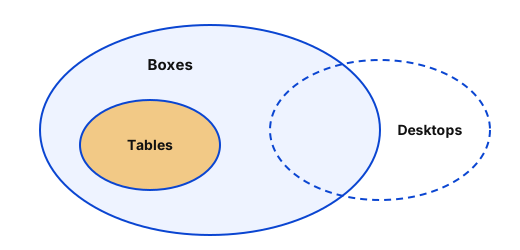
- (I) Desktops may meet Boxes outside the Tables region, so 'Some tables are desktops' is not certain → does not follow.
- (II) All tables are boxes ⇒ some boxes are tables (conversion) → follows.
Trick: 'All A are B' always gives 'Some B are A'.
Answer: (C) Only conclusion (II) follows
अवधारणा: Tables को Boxes के अंदर बनाएँ; Desktops, Boxes से मिलते हैं पर Tables को छूना ज़रूरी नहीं।
- (I) Desktops, Tables के बाहर वाले Boxes भाग से मिल सकते हैं, इसलिए 'कुछ tables, desktops हैं' निश्चित नहीं → अनुसरण नहीं करता।
- (II) सभी tables, boxes हैं ⇒ कुछ boxes, tables हैं (परिवर्तन) → अनुसरण करता है।
ट्रिक: 'सभी A, B हैं' से हमेशा 'कुछ B, A हैं' मिलता है।
उत्तर: (C) केवल निष्कर्ष (II) अनुसरण करता है
RRB NTPC Undergraduate CBT 1General Intelligence and ReasoningSyllogismRRB NTPC Undergraduate CBT 1 2025 · 20 Jun Shift 1
Q83.SMAL is related to PIVF in a certain way based on the English alphabetical order. In the same way, GWGN is related to DSBH. To which of the following options is XKRV related, following the same logic?
अंग्रेज़ी वर्णमाला क्रम के आधार पर SMAL एक निश्चित प्रकार से PIVF से संबंधित है। उसी प्रकार, GWGN, DSBH से संबंधित है। समान तर्क का अनुसरण करते हुए, XKRV निम्नलिखित में से किस विकल्प से संबंधित है?
- AUGPM
- BUPLO
- CUGMP
- DUMPG
Show answer
Concept: Find the backward shift of each letter.
- S → P (), M → I (), A → V (), L → F (). Check G → D, W → S, G → B, N → H: ✓.
- XKRV: X−3 = U, K−4 = G, R−5 = M, V−6 = P → UGMP.
Trick: Increasing backward steps .
Answer: (C) UGMP
अवधारणा: हर अक्षर का पीछे की ओर खिसकाव देखें।
- S → P (), M → I (), A → V (), L → F ()। जाँच: G → D, W → S, G → B, N → H: ✓।
- XKRV: X−3 = U, K−4 = G, R−5 = M, V−6 = P → UGMP।
ट्रिक: पीछे के कदम बढ़ते हैं: ।
उत्तर: (C) UGMP
RRB NTPC Undergraduate CBT 1General Intelligence and ReasoningLetter analogyRRB NTPC Undergraduate CBT 1 2025 · 20 Jun Shift 1
Q84.Based on the English alphabetical order, three of the following four letter-cluster pairs are alike in a certain way and thus form a group. Which is the one that does not belong to that group?
(Note: The odd one out is not based on the number of consonants/vowels or their position in the letter cluster.)
अंग्रेज़ी वर्णमाला क्रम के आधार पर, निम्नलिखित चार अक्षर-समूह युग्मों में से तीन किसी निश्चित प्रकार से एकसमान हैं और इस प्रकार एक समूह बनाते हैं। वह कौन-सा युग्म है जो उस समूह से संबंधित नहीं है?
(ध्यान दें: असंगत का चयन व्यंजनों/स्वरों की संख्या या अक्षर-समूह में उनके स्थान पर आधारित नहीं है।)
- AWE - ZJ
- BSZ - VD
- CBM - EQ
- DOA - RE
Show answer
Concept: Compare the shift of the 1st and 2nd letters from left cluster to right cluster.
- SZ – VD: S+3 = V, Z+4 = D (wrap). BM – EQ: B+3 = E, M+4 = Q. OA – RE: O+3 = R, A+4 = E.
- WE – ZJ: W+3 = Z, but E+5 = J → different.
Trick: Pattern ; the pair breaking it is the odd one.
Answer: (A) WE - ZJ
अवधारणा: बाएँ समूह से दाएँ समूह तक पहले और दूसरे अक्षर का खिसकाव देखें।
- SZ – VD: S+3 = V, Z+4 = D (चक्र)। BM – EQ: B+3 = E, M+4 = Q। OA – RE: O+3 = R, A+4 = E।
- WE – ZJ: W+3 = Z, पर E+5 = J → भिन्न।
ट्रिक: क्रम ; जो जोड़ा इसे तोड़े वही विषम।
उत्तर: (A) WE - ZJ
RRB NTPC Undergraduate CBT 1General Intelligence and ReasoningOdd one out – letter pairsRRB NTPC Undergraduate CBT 1 2025 · 20 Jun Shift 1
Q85.Refer to the following letter series and answer the question that follows. Counting to be done from left to right only.
(Left) D E I V D I J Y T Z A K F Z S M U I Y E Q (Right)
How many such vowels are there, each of which is immediately preceded by a consonant and also immediately followed by a vowel?
निम्नलिखित अक्षर श्रृंखला को देखिए और उसके बाद दिए गए प्रश्न का उत्तर दीजिए। गिनती केवल बाएँ से दाएँ की जानी है।
(बाएँ) D E I V D I J Y T Z A K F Z S M U I Y E Q (दाएँ)
ऐसे कितने स्वर हैं, जिनमें से प्रत्येक के ठीक पहले एक व्यंजन है और ठीक बाद एक स्वर है?
- AFourचार
- BOneएक
- CTwoदो
- DThreeतीन
Show answer
Concept: Need the pattern Consonant–Vowel–Vowel. Vowels in the series: E, I, I, A, U, I, E.
- D E I → E is preceded by consonant D and followed by vowel I ✓.
- M U I → U is preceded by M and followed by I ✓.
- Others fail: I (after E), D I J, Z A K, U I Y, Y E Q.
Trick: Look for two vowels together, then check the letter before the first one.
Answer: (C) Two
अवधारणा: व्यंजन–स्वर–स्वर का क्रम चाहिए। श्रृंखला में स्वर: E, I, I, A, U, I, E।
- D E I → E से पहले व्यंजन D और बाद में स्वर I ✓।
- M U I → U से पहले M और बाद में I ✓।
- बाकी असफल: I (E के बाद), D I J, Z A K, U I Y, Y E Q।
ट्रिक: दो साथ-साथ स्वर ढूँढें, फिर पहले स्वर से पहले का अक्षर जाँचें।
उत्तर: (C) दो
RRB NTPC Undergraduate CBT 1General Intelligence and ReasoningLetter series – positionsRRB NTPC Undergraduate CBT 1 2025 · 20 Jun Shift 1
Q86.In a certain code language,
A = B means ‘A is the sister of B’,
A $ B means ‘A is the brother of B’,
A @ B means ‘A is the wife of B’ and
A * B means ‘A is the father of B’.
How is W related to G if ‘W * F = K $ L @ G’?
एक निश्चित कूट भाषा में,
A = B का अर्थ है ‘A, B की बहन है’,
A $ B का अर्थ है ‘A, B का भाई है’,
A @ B का अर्थ है ‘A, B की पत्नी है’ और
A * B का अर्थ है ‘A, B का पिता है’।
यदि ‘W * F = K $ L @ G’ है, तो W का G से क्या संबंध है?
- AWife's brotherपत्नी का भाई
- BFatherपिता
- CBrotherभाई
- DWife's fatherपत्नी का पिता
Show answer
Concept: Decode: = sister, $ brother, @ wife, * father.
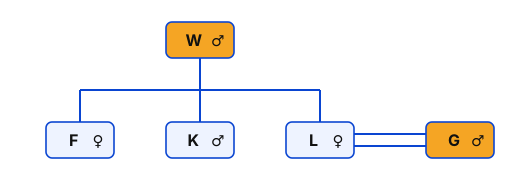
- W * F: W is the father of F. F = K: F is K's sister.
- K $ L: K is L's brother → F, K, L are siblings, all children of W.
- L @ G: L is G's wife → W is the father of G's wife.
Trick: Father of wife = father-in-law.
Answer: (D) Wife's father
अवधारणा: अर्थ: = बहन, $ भाई, @ पत्नी, * पिता।
- W * F: W, F का पिता है। F = K: F, K की बहन है।
- K $ L: K, L का भाई है → F, K, L भाई-बहन हैं, सभी W की संतान।
- L @ G: L, G की पत्नी है → W, G की पत्नी का पिता है।
ट्रिक: पत्नी के पिता = ससुर।
उत्तर: (D) Wife's father (पत्नी के पिता)
RRB NTPC Undergraduate CBT 1General Intelligence and ReasoningBlood relations (coded)RRB NTPC Undergraduate CBT 1 2025 · 20 Jun Shift 1
Q87.Which of the following two numbers should be interchanged to make the given equation correct?
(12 × 8) ÷ 6 + 4 × 13 − (36 ÷ 9) × 15 + 25 = 49
दिए गए समीकरण को सही बनाने के लिए निम्नलिखित में से किन दो संख्याओं को आपस में बदला जाना चाहिए?
(12 × 8) ÷ 6 + 4 × 13 − (36 ÷ 9) × 15 + 25 = 49
- A12 and 3612 और 36
- B13 and 1513 और 15
- C4 and 64 और 6
- D4 and 84 और 8
Show answer
Concept: Try the option swaps and evaluate using BODMAS.
- As given: .
- Swap 13 and 15:
- ✓
Trick: Needed change ; swapping 13 and 15 changes into , a gain of 16.
Answer: (B) 13 and 15
अवधारणा: विकल्पों की अदला-बदली करके BODMAS से जाँचें।
- दिया गया: ।
- 13 और 15 बदलें:
- ✓
ट्रिक: आवश्यक बदलाव ; 13 और 15 बदलने से , बनता है – 16 की बढ़त।
उत्तर: (B) 13 और 15
RRB NTPC Undergraduate CBT 1General Intelligence and ReasoningInterchanging numbersRRB NTPC Undergraduate CBT 1 2025 · 20 Jun Shift 1
Q88.Based on the English alphabetical order, three of the following four letter-cluster pairs are alike in a certain way and thus form a group. Which is the one that does not belong to that group?
(Note: The odd one out is not based on the number of consonants/vowels or their position in the letter-cluster.)
अंग्रेज़ी वर्णमाला क्रम के आधार पर, निम्नलिखित चार अक्षर-समूह युग्मों में से तीन किसी निश्चित प्रकार से एकसमान हैं और इस प्रकार एक समूह बनाते हैं। वह कौन-सा युग्म है जो उस समूह से संबंधित नहीं है?
(ध्यान दें: असंगत का चयन व्यंजनों/स्वरों की संख्या या अक्षर-समूह में उनके स्थान पर आधारित नहीं है।)
- ABD - HJ
- BEH - KM
- CLN - RT
- DHJ - NP
Show answer
Concept: Check the gap inside each cluster and between the clusters.
- BD – HJ: B+2 = D, H+2 = J, B+6 = H.
- LN – RT and HJ – NP: same .
- EH – KM: E+3 = H but K+2 = M → different.
Trick: First spot the inner gap – only EH has a gap of 3.
Answer: (B) EH - KM
अवधारणा: हर समूह के अंदर और समूहों के बीच का अंतर देखें।
- BD – HJ: B+2 = D, H+2 = J, B+6 = H।
- LN – RT और HJ – NP: वही ।
- EH – KM: E+3 = H पर K+2 = M → भिन्न।
ट्रिक: पहले अंदर का अंतर देखें – केवल EH में अंतर 3 है।
उत्तर: (B) EH - KM
RRB NTPC Undergraduate CBT 1General Intelligence and ReasoningOdd one out – letter pairsRRB NTPC Undergraduate CBT 1 2025 · 20 Jun Shift 1
Q89.In a certain code language, ‘yak lock zip’ is coded as ' je tc ly' and ‘zip shirt cake’ is coded as ‘rl jg tc’. How is ‘zip’ coded in the given language?
एक निश्चित कूट भाषा में, ‘yak lock zip’ को ' je tc ly' लिखा जाता है और ‘zip shirt cake’ को ‘rl jg tc’ लिखा जाता है। दी गई भाषा में ‘zip’ को कैसे लिखा जाता है?
- Arl
- Bje
- Ctc
- Dly
Show answer
Concept: A word common to two sentences has the code common to both coded sentences.
- 'yak lock zip' → je tc ly; 'zip shirt cake' → rl jg tc.
- Common word: zip; common code: tc → zip = tc.
Trick: Common word ↔ common code.
Answer: (C) tc
अवधारणा: दो वाक्यों में समान शब्द का कोड दोनों कोडित वाक्यों में समान होता है।
- 'yak lock zip' → je tc ly; 'zip shirt cake' → rl jg tc।
- समान शब्द: zip; समान कोड: tc → zip = tc।
ट्रिक: समान शब्द ↔ समान कोड।
उत्तर: (C) tc
RRB NTPC Undergraduate CBT 1General Intelligence and ReasoningCoding-decoding (words)RRB NTPC Undergraduate CBT 1 2025 · 20 Jun Shift 1
Q90.What should come in place of the ‘?’ in the given series?
3 ? 90 360 1080 2160 2160
दी गई श्रृंखला में ‘?’ के स्थान पर क्या आना चाहिए?
3 ? 90 360 1080 2160 2160
- A18
- B21
- C36
- D15
Show answer
Concept: Look at the ratio of consecutive terms.
- So the multipliers go .
- ; check ✓.
Trick: Same number repeated at the end () hints at – a falling multiplier.
Answer: (A) 18
अवधारणा: क्रमागत पदों का अनुपात देखें।
- अतः गुणक हैं।
- ; जाँच ✓।
ट्रिक: अंत में एक ही संख्या दोहराना () का संकेत – घटता गुणक।
उत्तर: (A) 18
RRB NTPC Undergraduate CBT 1General Intelligence and ReasoningNumber seriesRRB NTPC Undergraduate CBT 1 2025 · 20 Jun Shift 1
Q91.Which letter-cluster will replace the question mark (?) in the following series based on the English alphabetical order?
HKS GMP FOM EQJ ?
अंग्रेज़ी वर्णमाला क्रम के आधार पर निम्नलिखित श्रृंखला में प्रश्न चिह्न (?) के स्थान पर कौन-सा अक्षर-समूह आएगा?
HKS GMP FOM EQJ ?
- AMTC
- BVTF
- CPVE
- DDSG
Show answer
Concept: Split each term into its 1st, 2nd and 3rd letters and find the step for each position.
- 1st letters: H, G, F, E → each → D.
- 2nd letters: K, M, O, Q → each → S.
- 3rd letters: S, P, M, J → each → G.
Trick: Read column-wise – each position usually has its own constant jump.
Answer: (D) DSG
अवधारणा: प्रत्येक पद के पहले, दूसरे और तीसरे अक्षर को अलग कर हर स्थान का अंतर ज्ञात करें।
- पहले अक्षर: H, G, F, E → प्रत्येक → D।
- दूसरे अक्षर: K, M, O, Q → प्रत्येक → S।
- तीसरे अक्षर: S, P, M, J → प्रत्येक → G।
ट्रिक: कॉलम-वार पढ़ें – प्रायः हर स्थान का अपना स्थिर अंतर होता है।
उत्तर: (D) DSG
RRB NTPC Undergraduate CBT 1General Intelligence and ReasoningAlphabet seriesRRB NTPC Undergraduate CBT 1 2025 · 19 Jun Shift 3
Q92.Based on the English alphabetical order, three of the following four letter-cluster pairs are alike in a certain way and thus form a group. Which is the one that does NOT belong to that group?
(Note: The odd one out is not based on the number of consonants/vowels or their position in the letter-cluster.)
अंग्रेज़ी वर्णमाला क्रम के आधार पर, निम्नलिखित चार अक्षर-समूह युग्मों में से तीन किसी निश्चित प्रकार से एकसमान हैं और इस प्रकार एक समूह बनाते हैं। वह कौन-सा युग्म है जो उस समूह से संबंधित नहीं है?
(नोट: असंगत अक्षर-समूह, उस अक्षर-समूह में व्यंजनों/स्वरों की संख्या या उनके स्थान पर आधारित नहीं है।)
- AIB-DG
- BKD-FI
- CNG-IL
- DPI-KM
Show answer
Concept: Use letter positions (A = 1 … Z = 26) and compare the first letter of each half and the second letter of each half.
- IB-DG: I(9) = D(4); B(2) = G(7).
- KD-FI: K(11) = F; D(4) = I ✓. NG-IL: N(14) = I; G(7) = L ✓.
- PI-KM: P(16) = K ✓, but I(9) = N(14), not M(13) ✗.
Trick: Check both rules in every option; the one that breaks either rule is the odd one.
Answer: (D) PI-KM
अवधारणा: अक्षरों की स्थिति (A = 1 … Z = 26) लें और दोनों भागों के पहले-पहले तथा दूसरे-दूसरे अक्षर की तुलना करें।
- IB-DG: I(9) = D(4); B(2) = G(7)।
- KD-FI: K(11) = F; D(4) = I ✓। NG-IL: N(14) = I; G(7) = L ✓।
- PI-KM: P(16) = K ✓, पर I(9) = N(14), M(13) नहीं ✗।
ट्रिक: हर विकल्प में दोनों नियम जाँचें; जो कोई भी नियम तोड़े वही विषम है।
उत्तर: (D) PI-KM
RRB NTPC Undergraduate CBT 1General Intelligence and ReasoningOdd one out – letter pairsRRB NTPC Undergraduate CBT 1 2025 · 19 Jun Shift 3
Q93.If 'A' stands for '÷', 'B' stands for '×', 'C' stands for '+' and 'D' stands for '−', what will come in place of the question mark (?) in the following equation?
10 B 3 D 45 A 9 C 2 = ? D 18
यदि 'A' का अर्थ '÷', 'B' का अर्थ '×', 'C' का अर्थ '+' और 'D' का अर्थ '−' है, तो निम्नलिखित समीकरण में प्रश्न चिह्न (?) के स्थान पर क्या आएगा?
10 B 3 D 45 A 9 C 2 = ? D 18
- A50
- B45
- C55
- D40
Show answer
Concept: Replace the letters by signs (A , B , C , D ) and apply BODMAS.
- LHS: .
- .
- RHS: .
Trick: Do the division and multiplication first, then addition/subtraction from left to right.
Answer: (B)
अवधारणा: अक्षरों के स्थान पर चिह्न रखें (A , B , C , D ) और BODMAS लगाएँ।
- बायाँ पक्ष: ।
- ।
- दायाँ पक्ष: ।
ट्रिक: पहले भाग व गुणा, फिर बाएँ से दाएँ जोड़-घटाव।
उत्तर: (B)
RRB NTPC Undergraduate CBT 1General Intelligence and ReasoningMathematical operations – symbol substitutionRRB NTPC Undergraduate CBT 1 2025 · 19 Jun Shift 3
Q94.Which of the following letter-number clusters will replace the question mark (?) to complete the given series logically?
HDZM 42 BYFR 36 VTLW 30 PORB 24 ?
दी गई श्रृंखला को तार्किक रूप से पूर्ण करने के लिए निम्नलिखित में से कौन-सा अक्षर-संख्या समूह प्रश्न चिह्न (?) का स्थान लेगा?
HDZM 42 BYFR 36 VTLW 30 PORB 24 ?
- AJKYH 16
- BKKXG 16
- CKJYH 18
- DJJXG 18
Show answer
Concept: Treat each letter position and the number separately.
- 1st letters H, B, V, P: each → J.
- 2nd letters D, Y, T, O: each → J.
- 3rd letters Z, F, L, R: each → X; 4th letters M, R, W, B: each → G.
- Numbers 42, 36, 30, 24: each → 18.
Trick: Use backward wrap: P = J, Z = F (after Z go to A).
Answer: (D) JJXG 18
अवधारणा: हर अक्षर-स्थान और संख्या को अलग-अलग देखें।
- पहले अक्षर H, B, V, P: प्रत्येक → J।
- दूसरे अक्षर D, Y, T, O: प्रत्येक → J।
- तीसरे अक्षर Z, F, L, R: प्रत्येक → X; चौथे अक्षर M, R, W, B: प्रत्येक → G।
- संख्याएँ 42, 36, 30, 24: प्रत्येक → 18।
ट्रिक: चक्रीय क्रम याद रखें: Z के बाद A आता है (Z = F)।
उत्तर: (D) JJXG 18
RRB NTPC Undergraduate CBT 1General Intelligence and ReasoningAlpha-numeric seriesRRB NTPC Undergraduate CBT 1 2025 · 19 Jun Shift 3
Q95.In a certain code language, 'PACK' is coded as '1376' and 'CAKE' is coded as '7615'. What is the code for 'E' in the given code language?
एक निश्चित कूट भाषा में, 'PACK' को '1376' और 'CAKE' को '7615' के रूप में कूटबद्ध किया जाता है। दी गई कूट भाषा में 'E' के लिए कूट क्या है?
- A7
- B6
- C1
- D5
Show answer
Concept: Letters common to two words share the common digits; the leftover letter takes the leftover digit.
- PACK → 1376 and CAKE → 7615.
- Common letters A, C, K ↔ common digits 1, 7, 6.
- Leftover: P → 3 and E → 5.
Trick: Match the 'extra' letter with the 'extra' digit – no need to decode A, C, K individually.
Answer: (D) 5
अवधारणा: दो शब्दों के उभयनिष्ठ अक्षरों को उभयनिष्ठ अंक मिलते हैं; बचे अक्षर को बचा अंक मिलता है।
- PACK → 1376 और CAKE → 7615।
- उभयनिष्ठ अक्षर A, C, K ↔ उभयनिष्ठ अंक 1, 7, 6।
- बचे हुए: P → 3 और E → 5।
ट्रिक: 'अतिरिक्त' अक्षर को 'अतिरिक्त' अंक से मिलाएँ – A, C, K अलग से निकालने की ज़रूरत नहीं।
उत्तर: (D) 5
RRB NTPC Undergraduate CBT 1General Intelligence and ReasoningCoding–decodingRRB NTPC Undergraduate CBT 1 2025 · 19 Jun Shift 3
Q96.What will come in place of the '?' in the following series?
184 164 146 130 116 104 ?
निम्नलिखित श्रृंखला में '?' के स्थान पर क्या आएगा?
184 164 146 130 116 104 ?
- A94
- B91
- C96
- D89
Show answer
Concept: Find the differences between consecutive terms.
- , , , , .
- Differences fall by 2, so next difference .
- .
Trick: Differences 20, 18, 16, 14, 12, 10 – an even-number countdown.
Answer: (A)
अवधारणा: क्रमागत पदों का अंतर निकालें।
- , , , , ।
- अंतर 2-2 घट रहे हैं, अतः अगला अंतर ।
- ।
ट्रिक: अंतर 20, 18, 16, 14, 12, 10 – सम संख्याओं की उलटी गिनती।
उत्तर: (A)
RRB NTPC Undergraduate CBT 1General Intelligence and ReasoningNumber seriesRRB NTPC Undergraduate CBT 1 2025 · 19 Jun Shift 3
Q97.Read the given statements and conclusions carefully. Assuming that the information given in the statements is true, even if it appears to be at variance with commonly known facts, decide which of the given conclusion(s) logically follow(s) from the statements.
Statements: No orange is an apricot. All apricots are apples.
Conclusion I: No apple is an orange.
Conclusion II: Some oranges are apples.
दिए गए कथनों और निष्कर्षों को ध्यानपूर्वक पढ़िए। यह मानते हुए कि कथनों में दी गई जानकारी सत्य है, भले ही वह सामान्य रूप से ज्ञात तथ्यों से भिन्न प्रतीत होती हो, निर्णय कीजिए कि दिए गए निष्कर्षों में से कौन-सा/कौन-से निष्कर्ष कथनों का तार्किक रूप से अनुसरण करता है/करते हैं।
कथन: कोई संतरा, खुबानी नहीं है। सभी खुबानियाँ, सेब हैं।
निष्कर्ष I: कोई सेब, संतरा नहीं है।
निष्कर्ष II: कुछ संतरे, सेब हैं।
- ABoth conclusions (I) and (II) follow.दोनों निष्कर्ष (I) और (II) अनुसरण करते हैं।
- BNeither conclusion (I) nor (II) follows.न तो निष्कर्ष (I) और न ही (II) अनुसरण करता है।
- COnly conclusion (I) follows.केवल निष्कर्ष (I) अनुसरण करता है।
- DOnly conclusion (II) follows.केवल निष्कर्ष (II) अनुसरण करता है।
Show answer
Concept: Draw the least-overlap Venn diagram; a conclusion follows only if it is true in every possible diagram.
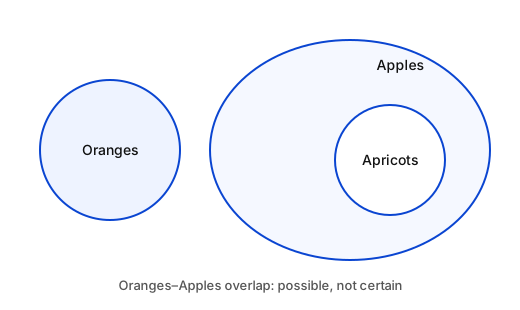
- All apricots are inside apples; no orange touches apricots.
- Oranges may or may not overlap the apple region outside apricots.
- So 'No apple is an orange' (I) and 'Some oranges are apples' (II) are both only possibilities – neither is certain.
Trick: 'No A is B' with 'All B are C' gives no definite relation between A and C.
Answer: (B) Neither conclusion (I) nor (II) follows
अवधारणा: न्यूनतम-अतिव्यापन वाला वेन आरेख बनाएँ; निष्कर्ष तभी अनुसरित है जब वह हर संभव आरेख में सत्य हो।
- सभी खुबानी (apricots) सेब के भीतर हैं; कोई संतरा खुबानी को नहीं छूता।
- संतरे, खुबानी के बाहर वाले सेब क्षेत्र से मिल भी सकते हैं और नहीं भी।
- अतः 'कोई सेब संतरा नहीं है' (I) और 'कुछ संतरे सेब हैं' (II) दोनों केवल संभावनाएँ हैं – कोई भी निश्चित नहीं।
ट्रिक: 'कोई A, B नहीं' और 'सभी B, C हैं' से A व C के बीच कोई निश्चित संबंध नहीं निकलता।
उत्तर: (B) न तो निष्कर्ष (I) और न ही (II) अनुसरण करता है
RRB NTPC Undergraduate CBT 1General Intelligence and ReasoningSyllogismRRB NTPC Undergraduate CBT 1 2025 · 19 Jun Shift 3
Q98.Read the given statements and conclusions carefully. Assuming that the information given in the statements is true, even if it appears to be at variance with commonly known facts, decide which of the given conclusion(s) logically follow(s) from the statements.
Statements: Some hairs are wires. All ropes are wires.
Conclusion (I): Some hairs are ropes.
Conclusion (II): All wires are ropes.
दिए गए कथनों और निष्कर्षों को ध्यानपूर्वक पढ़िए। यह मानते हुए कि कथनों में दी गई जानकारी सत्य है, भले ही वह सामान्य रूप से ज्ञात तथ्यों से भिन्न प्रतीत होती हो, निर्णय कीजिए कि दिए गए निष्कर्षों में से कौन-सा/कौन-से निष्कर्ष कथनों का तार्किक रूप से अनुसरण करता है/करते हैं।
कथन: कुछ बाल, तार हैं। सभी रस्सियाँ, तार हैं।
निष्कर्ष (I): कुछ बाल, रस्सियाँ हैं।
निष्कर्ष (II): सभी तार, रस्सियाँ हैं।
- ABoth conclusions (I) and (II) followदोनों निष्कर्ष (I) और (II) अनुसरण करते हैं
- BNeither conclusion (I) nor (II) followsन तो निष्कर्ष (I) और न ही (II) अनुसरण करता है
- COnly conclusion (I) followsकेवल निष्कर्ष (I) अनुसरण करता है
- DOnly conclusion (II) followsकेवल निष्कर्ष (II) अनुसरण करता है
Show answer
Concept: Draw a Venn diagram; accept a conclusion only if it holds in every possible case.
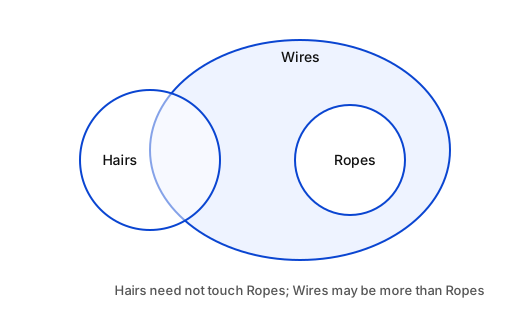
- Ropes lie inside Wires; Hairs overlap Wires.
- Hairs can overlap the part of Wires that has no Ropes, so 'Some hairs are ropes' (I) is not certain.
- 'All ropes are wires' cannot be reversed to 'All wires are ropes' (II) ✗.
Trick: 'All A are B' never gives 'All B are A'.
Answer: (B) Neither conclusion (I) nor (II) follows
अवधारणा: वेन आरेख बनाएँ; निष्कर्ष तभी मानें जब वह हर संभव स्थिति में सत्य हो।
- रस्सियाँ (Ropes) तारों (Wires) के भीतर हैं; बाल (Hairs) तारों से अतिव्यापित हैं।
- बाल तारों के उस भाग से मिल सकते हैं जहाँ रस्सियाँ नहीं हैं, अतः 'कुछ बाल रस्सियाँ हैं' (I) निश्चित नहीं।
- 'सभी रस्सियाँ तार हैं' को उलटकर 'सभी तार रस्सियाँ हैं' (II) नहीं कह सकते ✗।
ट्रिक: 'सभी A, B हैं' से कभी 'सभी B, A हैं' नहीं निकलता।
उत्तर: (B) न तो निष्कर्ष (I) और न ही (II) अनुसरण करता है
RRB NTPC Undergraduate CBT 1General Intelligence and ReasoningSyllogismRRB NTPC Undergraduate CBT 1 2025 · 19 Jun Shift 3
Q99.Based on the English alphabetical order, three of the following four letter-clusters are alike in a certain way and thus form a group. Which letter-cluster does NOT belong to that group?
(Note: The odd one out is not based on the number of consonants/vowels or their position in the letter-cluster.)
अंग्रेज़ी वर्णमाला क्रम के आधार पर, निम्नलिखित चार अक्षर-समूहों में से तीन किसी निश्चित प्रकार से एकसमान हैं और इस प्रकार एक समूह बनाते हैं। कौन-सा अक्षर-समूह उस समूह से संबंधित नहीं है?
(नोट: असंगत अक्षर-समूह, उस अक्षर-समूह में व्यंजनों/स्वरों की संख्या या उनके स्थान पर आधारित नहीं है।)
- AWOK
- BRLF
- CYSM
- DTNH
Show answer
Concept: Write the positions of the letters and find the gaps.
- RLF: R(18) → L(12) → F(6): .
- YSM: 25 → 19 → 13: . TNH: 20 → 14 → 8: .
- WOK: 23 → 15 → 11: ✗.
Trick: Learn EJOTY (5, 10, 15, 20, 25) to get positions quickly.
Answer: (A) WOK
अवधारणा: अक्षरों की स्थिति लिखें और अंतर निकालें।
- RLF: R(18) → L(12) → F(6): ।
- YSM: 25 → 19 → 13: । TNH: 20 → 14 → 8: ।
- WOK: 23 → 15 → 11: ✗।
ट्रिक: स्थान जल्दी निकालने के लिए EJOTY (5, 10, 15, 20, 25) याद रखें।
उत्तर: (A) WOK
RRB NTPC Undergraduate CBT 1General Intelligence and ReasoningOdd one out – letter clustersRRB NTPC Undergraduate CBT 1 2025 · 19 Jun Shift 3
Q100.Seven boxes M, N, O, P, X, Y and Z are kept one over the other but not necessarily in the same order. Y is kept second from the bottom. Only three boxes are kept between Y and O. X is kept at one of the positions below Y. Only N is kept between O and P. M is kept at one of the positions above O.
How many boxes are kept between X and M?
सात डिब्बे M, N, O, P, X, Y और Z एक के ऊपर एक रखे गए हैं, परंतु आवश्यक नहीं कि इसी क्रम में हों। Y नीचे से दूसरे स्थान पर रखा गया है। Y और O के बीच केवल तीन डिब्बे रखे गए हैं। X, Y से नीचे के किसी एक स्थान पर रखा गया है। O और P के बीच केवल N रखा गया है। M, O से ऊपर के किसी एक स्थान पर रखा गया है।
X और M के बीच कितने डिब्बे रखे गए हैं?
- AOneएक
- BFiveपाँच
- CThreeतीन
- DFourचार
Show answer
Concept: Number the positions 1 (bottom) to 7 (top) and place the fixed boxes first.
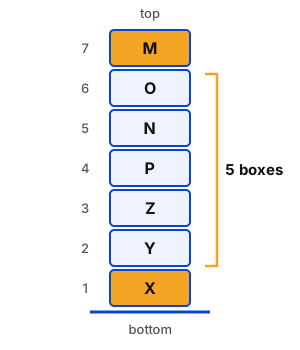
- Y is 2nd from the bottom; three boxes between Y and O → O at 6.
- X is below Y → X at 1. M is above O → M at 7.
- Only N between O and P → N at 5, P at 4; Z takes 3.
- Between X (1) and M (7): Y, Z, P, N, O = 5 boxes.
Trick: Fill the definite positions first (Y, O), then the 'below/above' clues.
Answer: (B) Five
अवधारणा: स्थानों को 1 (नीचे) से 7 (ऊपर) तक क्रमांकित करें और पहले निश्चित बॉक्स रखें।
- Y नीचे से दूसरा; Y और O के बीच तीन बॉक्स → O स्थान 6 पर।
- X, Y के नीचे → X स्थान 1 पर। M, O के ऊपर → M स्थान 7 पर।
- O और P के बीच केवल N → N स्थान 5, P स्थान 4; Z स्थान 3।
- X (1) और M (7) के बीच: Y, Z, P, N, O = 5 बॉक्स।
ट्रिक: पहले निश्चित स्थान (Y, O) भरें, फिर 'नीचे/ऊपर' वाले संकेत।
उत्तर: (B) पाँच
RRB NTPC Undergraduate CBT 1General Intelligence and ReasoningBox stackingRRB NTPC Undergraduate CBT 1 2025 · 19 Jun Shift 3

