Q101.P is the sister of Q. Q is the brother of S. T is the father of X. X is the son of S. How is P related to X?
P, Q की बहन है। Q, S का भाई है। T, X का पिता है। X, S का पुत्र है। P का X से क्या संबंध है?
- AFather's motherपिता की माता
- BMotherमाता
- CSisterबहन
- DMother's sisterमाता की बहन
Show answer
Concept: Draw the family tree from the given links.
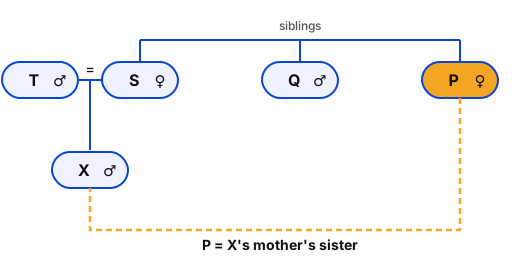
- P, Q and S are siblings (P is a sister, Q a brother).
- X is the son of S and T is X's father, so S is X's mother.
- P is the sister of X's mother → mother's sister (maternal aunt).
Trick: If the father is already named, the other parent (S) must be the mother.
Answer: (D) Mother's sister
अवधारणा: दिए गए संबंधों से वंश-वृक्ष बनाएँ।
- P, Q और S भाई-बहन हैं (P बहन, Q भाई)।
- X, S का पुत्र है और T, X का पिता है, अतः S, X की माता है।
- P, X की माता की बहन है → मौसी।
ट्रिक: पिता पहले से दिया हो तो दूसरा अभिभावक (S) माता ही होगी।
उत्तर: (D) माता की बहन
RRB NTPC Undergraduate CBT 1General Intelligence and ReasoningBlood relationsRRB NTPC Undergraduate CBT 1 2025 · 19 Jun Shift 3
Q102.Which letter-cluster will replace the question mark (?) in the following series based on the English alphabetical order?
BIRD FMVH JQZL NUDP ?
अंग्रेज़ी वर्णमाला क्रम के आधार पर निम्नलिखित श्रृंखला में प्रश्न चिह्न (?) के स्थान पर कौन-सा अक्षर-समूह आएगा?
BIRD FMVH JQZL NUDP ?
- ARYHT
- BRZHS
- CSYGT
- DSZGS
Show answer
Concept: Compare letters in the same position of successive terms.
- 1st: B, F, J, N → → R. 2nd: I, M, Q, U → → Y.
- 3rd: R, V, Z, D → → H. 4th: D, H, L, P → → T.
- Next term: RYHT.
Trick: Every letter of the cluster moves ; after Z wrap round to A.
Answer: (A) RYHT
अवधारणा: क्रमागत पदों में समान स्थान के अक्षरों की तुलना करें।
- पहला: B, F, J, N → → R। दूसरा: I, M, Q, U → → Y।
- तीसरा: R, V, Z, D → → H। चौथा: D, H, L, P → → T।
- अगला पद: RYHT।
ट्रिक: समूह का हर अक्षर चलता है; Z के बाद फिर A।
उत्तर: (A) RYHT
RRB NTPC Undergraduate CBT 1General Intelligence and ReasoningAlphabet seriesRRB NTPC Undergraduate CBT 1 2025 · 19 Jun Shift 3
Q103.Study the following letter series and answer the question.
(Left) Z K J H G F D S T U I A W Q P L M N B X (Right)
In the English alphabetical series, how many letters are there between the letter which is fifth from the right end and the letter which is fourth from the left end?
निम्नलिखित अक्षर श्रृंखला का अध्ययन कीजिए और प्रश्न का उत्तर दीजिए।
(बाएँ) Z K J H G F D S T U I A W Q P L M N B X (दाएँ)
अंग्रेज़ी वर्णमाला श्रृंखला में, दाएँ छोर से पाँचवें अक्षर और बाएँ छोर से चौथे अक्षर के बीच कितने अक्षर हैं?
- AThreeतीन
- BOneएक
- CTwoदो
- DMore than threeतीन से अधिक
Show answer
Concept: Pick the two letters from the given series, then count the letters between them in the English alphabet.
- The series has 20 letters; 5th from the right th from the left → L.
- 4th from the left → H.
- In the English alphabet, between H and L lie I, J, K → 3 letters.
Trick: Position from left total position from right .
Answer: (A) Three
अवधारणा: दी गई शृंखला से दोनों अक्षर चुनें, फिर अंग्रेज़ी वर्णमाला में उनके बीच के अक्षर गिनें।
- शृंखला में 20 अक्षर हैं; दाएँ से 5वाँ वाँ बाएँ से → L।
- बाएँ से 4था → H।
- अंग्रेज़ी वर्णमाला में H और L के बीच I, J, K → 3 अक्षर।
ट्रिक: बाएँ से स्थान कुल दाएँ से स्थान ।
उत्तर: (A) तीन
RRB NTPC Undergraduate CBT 1General Intelligence and ReasoningLetter series – positionRRB NTPC Undergraduate CBT 1 2025 · 19 Jun Shift 3
Q104.Based on the alphabetical order, three of the following four are alike in a certain way and thus form a group. Which is the one that does NOT belong to that group?
(Note: The odd one out is not based on the number of consonants/vowels or their position in the letter-cluster.)
वर्णमाला क्रम के आधार पर, निम्नलिखित चार में से तीन किसी निश्चित प्रकार से एकसमान हैं और इस प्रकार एक समूह बनाते हैं। वह कौन-सा है जो उस समूह से संबंधित नहीं है?
(नोट: असंगत अक्षर-समूह, उस अक्षर-समूह में व्यंजनों/स्वरों की संख्या या उनके स्थान पर आधारित नहीं है।)
- ALOQ
- BKNQ
- CSVX
- DNQS
Show answer
Concept: Find the gaps between consecutive letters of each cluster.
- LOQ: L(12) → O(15) → Q(17): .
- SVX: 19 → 22 → 24: . NQS: 14 → 17 → 19: .
- KNQ: 11 → 14 → 17: ✗.
Trick: Write the gap pattern under each option – the odd pattern stands out.
Answer: (B) KNQ
अवधारणा: प्रत्येक समूह के क्रमागत अक्षरों का अंतर निकालें।
- LOQ: L(12) → O(15) → Q(17): ।
- SVX: 19 → 22 → 24: । NQS: 14 → 17 → 19: ।
- KNQ: 11 → 14 → 17: ✗।
ट्रिक: हर विकल्प के नीचे अंतर-पैटर्न लिखें – अलग पैटर्न तुरंत दिखेगा।
उत्तर: (B) KNQ
RRB NTPC Undergraduate CBT 1General Intelligence and ReasoningOdd one out – letter clustersRRB NTPC Undergraduate CBT 1 2025 · 19 Jun Shift 3
Q105.Palash starts from point Y and drives 25 km towards the west. He then takes a left turn and drives 23 km, turns right and drives 51 km. He then takes a left turn and drives 16 km. He takes another left turn and drives 31 km. He then turns right and drives 35 km, turns left, drives 45 km and stops at point Z. How far (shortest distance) and in which direction should he drive in order to reach point Y again? (All turns are 90° turns only unless specified.)
पलाश बिंदु Y से चलना शुरू करता है और पश्चिम की ओर 25 km गाड़ी चलाता है। फिर वह बाएँ मुड़ता है और 23 km गाड़ी चलाता है, दाएँ मुड़ता है और 51 km गाड़ी चलाता है। फिर वह बाएँ मुड़ता है और 16 km गाड़ी चलाता है। वह फिर से बाएँ मुड़ता है और 31 km गाड़ी चलाता है। फिर वह दाएँ मुड़ता है और 35 km गाड़ी चलाता है, बाएँ मुड़ता है, 45 km गाड़ी चलाता है और बिंदु Z पर रुक जाता है। पुनः बिंदु Y पर पहुँचने के लिए उसे कितनी दूरी (न्यूनतम दूरी) और किस दिशा में गाड़ी चलानी चाहिए? (जब तक निर्दिष्ट न किया जाए, सभी मोड़ केवल 90° के मोड़ हैं।)
- A77 km towards Northउत्तर की ओर 77 km
- B71 km towards Southदक्षिण की ओर 71 km
- C73 km towards Southदक्षिण की ओर 73 km
- D74 km towards Northउत्तर की ओर 74 km
Show answer
Concept: Track the direction after every turn and add up the east–west and north–south moves separately.
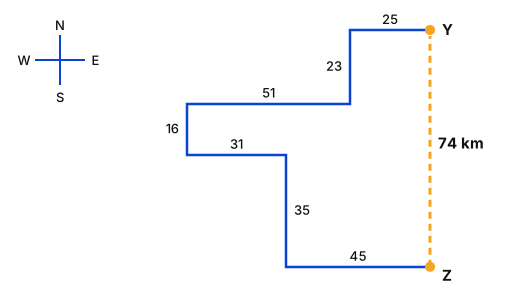
- West 25 → left = South 23 → right = West 51 → left = South 16.
- Left = East 31 → right = South 35 → left = East 45 → Z.
- East–west: .
- North–south: km south of Y. So drive 74 km north.
Trick: When the horizontal moves cancel, the answer is just the vertical total.
Answer: (D) 74 km towards North
अवधारणा: हर मोड़ के बाद दिशा लिखें और पूर्व–पश्चिम तथा उत्तर–दक्षिण की दूरियाँ अलग-अलग जोड़ें।
- पश्चिम 25 → बाएँ = दक्षिण 23 → दाएँ = पश्चिम 51 → बाएँ = दक्षिण 16।
- बाएँ = पूर्व 31 → दाएँ = दक्षिण 35 → बाएँ = पूर्व 45 → Z।
- पूर्व–पश्चिम: ।
- उत्तर–दक्षिण: km, Y के दक्षिण में। अतः 74 km उत्तर की ओर जाना होगा।
ट्रिक: क्षैतिज दूरियाँ शून्य हों तो उत्तर केवल ऊर्ध्वाधर कुल है।
उत्तर: (D) 74 km उत्तर की ओर
RRB NTPC Undergraduate CBT 1General Intelligence and ReasoningDirection & distanceRRB NTPC Undergraduate CBT 1 2025 · 19 Jun Shift 3
Q106.Based on the English alphabetical order, NQTM is related to ILOH in a certain way. In the same way, UOLG is related to PJGB. Following the same logic, HRPW is related to which of the given options?
अंग्रेज़ी वर्णमाला क्रम के आधार पर, NQTM एक निश्चित प्रकार से ILOH से संबंधित है। उसी प्रकार, UOLG, PJGB से संबंधित है। समान तर्क का अनुसरण करते हुए, HRPW दिए गए विकल्पों में से किससे संबंधित है?
- ALFTS
- BCMKR
- CPDRT
- DNTGY
Show answer
Concept: Compare each letter with the letter in the same place of the answer.
- NQTM → ILOH: each letter (N→I, Q→L, T→O, M→H).
- UOLG → PJGB: again each .
- HRPW: H→C, R→M, P→K, W→R → CMKR.
Trick: Moving back 5 = moving forward 21 – use whichever is faster for you.
Answer: (B) CMKR
अवधारणा: हर अक्षर की तुलना उत्तर में उसी स्थान के अक्षर से करें।
- NQTM → ILOH: प्रत्येक अक्षर (N→I, Q→L, T→O, M→H)।
- UOLG → PJGB: फिर से प्रत्येक ।
- HRPW: H→C, R→M, P→K, W→R → CMKR।
ट्रिक: 5 पीछे जाना = 21 आगे जाना – जो आसान लगे वही अपनाएँ।
उत्तर: (B) CMKR
RRB NTPC Undergraduate CBT 1General Intelligence and ReasoningLetter analogyRRB NTPC Undergraduate CBT 1 2025 · 19 Jun Shift 3
Q107.What should come in place of the '?' in the given series?
17 30 56 95 147 ?
दी गई श्रृंखला में '?' के स्थान पर क्या आना चाहिए?
17 30 56 95 147 ?
- A252
- B221
- C225
- D212
Show answer
Concept: Look at the differences of consecutive terms.
- , , , .
- Differences are multiples of 13: → next .
- .
Trick: Differences in a table of a number (13, 26, 39 …) – continue the table.
Answer: (D)
अवधारणा: क्रमागत पदों के अंतर देखें।
- , , , ।
- अंतर 13 के गुणज हैं: → अगला ।
- ।
ट्रिक: अंतर किसी संख्या का पहाड़ा (13, 26, 39 …) हो तो उसे आगे बढ़ाएँ।
उत्तर: (D)
RRB NTPC Undergraduate CBT 1General Intelligence and ReasoningNumber seriesRRB NTPC Undergraduate CBT 1 2025 · 19 Jun Shift 3
Q108.Seven people, A, B, D, J, O, T and Z, are sitting in a row, facing north. Only D sits to the left of T. Only four people sit between D and A. Only O sits between Z and B, and Z is not an immediate neighbour of A. Who sits to the immediate left of T?
सात व्यक्ति A, B, D, J, O, T और Z एक पंक्ति में उत्तर की ओर मुख करके बैठे हैं। केवल D, T के बाईं ओर बैठा है। D और A के बीच केवल चार व्यक्ति बैठे हैं। Z और B के बीच केवल O बैठा है, और Z, A का निकटतम पड़ोसी नहीं है। T के ठीक बाईं ओर कौन बैठा है?
- AZ
- BD
- CA
- DB
Show answer
Concept: Facing North, left is the left end of the row. Number seats 1 (left) to 7 (right).
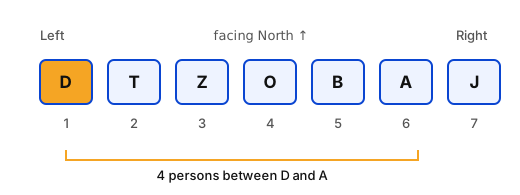
- Only D is to the left of T → D at 1, T at 2.
- Four people between D and A → A at 6.
- Z, O, B need three adjacent seats with O in the middle → seats 3, 4, 5; Z is not next to A → Z at 3, O at 4, B at 5, J at 7.
- Immediate left of T is D.
Trick: Clue 'only D to the left of T' fixes both at the left end at once.
Answer: (B) D
अवधारणा: उत्तर की ओर मुख होने पर बायाँ = पंक्ति का बायाँ छोर। सीटें 1 (बाएँ) से 7 (दाएँ) क्रमांकित करें।
- T के बाएँ केवल D → D स्थान 1, T स्थान 2।
- D और A के बीच चार लोग → A स्थान 6।
- Z, O, B को तीन लगातार सीटें चाहिए, O बीच में → सीटें 3, 4, 5; Z, A के पास नहीं → Z 3, O 4, B 5, J 7।
- T के ठीक बाएँ D है।
ट्रिक: 'T के बाएँ केवल D' से दोनों एक साथ बाएँ छोर पर तय हो जाते हैं।
उत्तर: (B) D
RRB NTPC Undergraduate CBT 1General Intelligence and ReasoningLinear seating arrangementRRB NTPC Undergraduate CBT 1 2025 · 19 Jun Shift 3
Q109.JK 9 is related to MJ −7 in a certain way. In the same way, PQ 4 is related to SP −12. Following the same logic, QR 13 is related to which of the following?
JK 9 एक निश्चित प्रकार से MJ −7 से संबंधित है। उसी प्रकार, PQ 4, SP −12 से संबंधित है। समान तर्क का अनुसरण करते हुए, QR 13 निम्नलिखित में से किससे संबंधित है?
- ATQ −3
- BTM −6
- CGH −4
- DYT −1
Show answer
Concept: Find separate rules for the two letters and the number.
- JK 9 → MJ : 1st letter (J→M), 2nd letter (K→J), number .
- PQ 4 → SP : P→S (), Q→P (), ✓.
- QR 13 → Q = T, R = Q, → TQ .
Trick: Note that the 2nd letter of the answer equals the 1st letter of the question pair.
Answer: (A) TQ
अवधारणा: दोनों अक्षरों और संख्या के लिए अलग-अलग नियम खोजें।
- JK 9 → MJ : पहला अक्षर (J→M), दूसरा (K→J), संख्या ।
- PQ 4 → SP : P→S (), Q→P (), ✓।
- QR 13 → Q = T, R = Q, → TQ ।
ट्रिक: ध्यान दें – उत्तर का दूसरा अक्षर प्रश्न-युग्म का पहला अक्षर ही है।
उत्तर: (A) TQ
RRB NTPC Undergraduate CBT 1General Intelligence and ReasoningAlpha-numeric analogyRRB NTPC Undergraduate CBT 1 2025 · 19 Jun Shift 3
Q110.Seven boxes A, B, C, D, E, F and G are kept one over the other but not necessarily in the same order. Only four boxes are kept between C and A. Only F is kept above C. Only two boxes are kept between D and B. G is kept immediately above E. B is not kept immediately above G. Which box is kept immediately below E?
सात डिब्बे A, B, C, D, E, F और G एक के ऊपर एक रखे गए हैं, परंतु आवश्यक नहीं कि इसी क्रम में हों। C और A के बीच केवल चार डिब्बे रखे गए हैं। C के ऊपर केवल F रखा गया है। D और B के बीच केवल दो डिब्बे रखे गए हैं। G, E के ठीक ऊपर रखा गया है। B, G के ठीक ऊपर नहीं रखा गया है। E के ठीक नीचे कौन-सा डिब्बा रखा गया है?
- AB
- BF
- CA
- DG
Show answer
Concept: Number positions 1 (bottom) to 7 (top) and fix the definite boxes first.
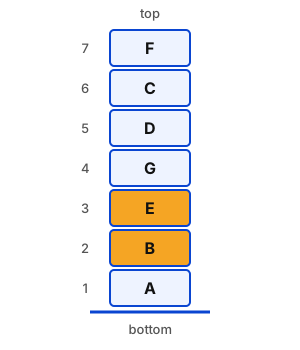
- Only F is above C → F at 7, C at 6.
- Four boxes between C and A → A at 1.
- D and B have two boxes between them, so they take 2 and 5; G–E (G just above E) take 3–4 → E at 3, G at 4.
- B is not just above G → B not at 5 → B at 2, D at 5. Box just below E is B.
Trick: 'Only X above Y' always puts X at the top and Y second from the top.
Answer: (A) B
अवधारणा: स्थान 1 (नीचे) से 7 (ऊपर) क्रमांकित करें और पहले निश्चित बॉक्स रखें।
- C के ऊपर केवल F → F स्थान 7, C स्थान 6।
- C और A के बीच चार बॉक्स → A स्थान 1।
- D और B के बीच दो बॉक्स, अतः वे 2 और 5 पर; G–E (G, E के ठीक ऊपर) 3–4 पर → E 3, G 4।
- B, G के ठीक ऊपर नहीं → B 5 पर नहीं → B 2, D 5। E के ठीक नीचे B है।
ट्रिक: 'Y के ऊपर केवल X' का अर्थ है X सबसे ऊपर और Y ऊपर से दूसरा।
उत्तर: (A) B
RRB NTPC Undergraduate CBT 1General Intelligence and ReasoningBox stackingRRB NTPC Undergraduate CBT 1 2025 · 19 Jun Shift 3
Q111.If '+' and '−' are interchanged and '×' and '÷' are interchanged in the following equation, what will come in place of the question mark (?)?
24 ÷ 5 − 11 + 70 × 14 = ?
यदि निम्नलिखित समीकरण में '+' और '−' को आपस में बदल दिया जाए तथा '×' और '÷' को आपस में बदल दिया जाए, तो प्रश्न चिह्न (?) के स्थान पर क्या आएगा?
24 ÷ 5 − 11 + 70 × 14 = ?
- A126
- B120
- C122
- D123
Show answer
Concept: Interchange the signs first, then solve by BODMAS.
- After swapping: .
- .
- .
Trick: Rewrite the whole expression with new signs before calculating – avoids sign mistakes.
Answer: (A)
अवधारणा: पहले चिह्न बदलें, फिर BODMAS से हल करें।
- बदलने के बाद: ।
- ।
- ।
ट्रिक: गणना से पहले पूरा व्यंजक नए चिह्नों के साथ दोबारा लिखें – चिह्न की गलती नहीं होगी।
उत्तर: (A)
RRB NTPC Undergraduate CBT 1General Intelligence and ReasoningMathematical operations – interchange of signsRRB NTPC Undergraduate CBT 1 2025 · 19 Jun Shift 3
Q112.In each of the following number-pairs, the second number is obtained by performing certain mathematical operations on the first number. Select the set in which the numbers are related in the same way as are the numbers of the following sets.
(NOTE: Operations should be performed on the whole numbers, without breaking down the numbers into their constituent digits. E.g. 13 – Operations on 13 such as adding/subtracting/multiplying etc. to 13 can be performed. Breaking down 13 into 1 and 3 and then performing mathematical operations on 1 and 3 is not allowed.)
7 - 14
45 - 90
निम्नलिखित प्रत्येक संख्या-युग्म में, पहली संख्या पर कुछ गणितीय संक्रियाएँ करके दूसरी संख्या प्राप्त की जाती है। वह समुच्चय चुनिए जिसमें संख्याएँ उसी प्रकार संबंधित हैं जिस प्रकार निम्नलिखित समुच्चयों की संख्याएँ संबंधित हैं।
(नोट: संख्याओं को उनके घटक अंकों में विभक्त किए बिना, संपूर्ण संख्याओं पर संक्रियाएँ की जानी चाहिए। उदाहरण: 13 – 13 पर संक्रियाएँ जैसे 13 में जोड़ना/घटाना/गुणा करना आदि किया जा सकता है। 13 को 1 और 3 में विभक्त करके फिर 1 और 3 पर गणितीय संक्रियाएँ करने की अनुमति नहीं है।)
7 - 14
45 - 90
- A42 - 82
- B12 - 34
- C8 - 17
- D70 - 140
Show answer
Concept: Find the operation that turns the first number into the second.
- and → second number = first .
- Check options: ; ; .
- ✓.
Trick: Test the simplest relation (double, square, constant) first.
Answer: (D) 70 - 140
अवधारणा: वह संक्रिया खोजें जो पहली संख्या को दूसरी में बदलती है।
- और → दूसरी संख्या = पहली ।
- विकल्प जाँचें: ; ; ।
- ✓।
ट्रिक: पहले सबसे सरल संबंध (दोगुना, वर्ग, स्थिरांक) जाँचें।
उत्तर: (D) 70 - 140
RRB NTPC Undergraduate CBT 1General Intelligence and ReasoningNumber pair analogyRRB NTPC Undergraduate CBT 1 2025 · 19 Jun Shift 3
Q113.In a certain code language, 'rain calms storms' is coded as 'gl ot fr' and 'patience gently calms' is coded as 'ot mi zp'. How is 'calms' coded in the given language?
एक निश्चित कूट भाषा में, 'rain calms storms' को 'gl ot fr' के रूप में और 'patience gently calms' को 'ot mi zp' के रूप में कूटबद्ध किया जाता है। दी गई भाषा में 'calms' को किस प्रकार कूटबद्ध किया जाता है?
- Azp
- Bot
- Cgl
- Dfr
Show answer
Concept: A word common to two sentences gets the code common to both.
- 'rain calms storms' → 'gl ot fr'.
- 'patience gently calms' → 'ot mi zp'.
- Common word: calms; common code: ot.
Trick: Common word ↔ common code.
Answer: (B) ot
अवधारणा: दो वाक्यों में उभयनिष्ठ शब्द को दोनों का उभयनिष्ठ कोड मिलता है।
- 'rain calms storms' → 'gl ot fr'।
- 'patience gently calms' → 'ot mi zp'।
- उभयनिष्ठ शब्द: calms; उभयनिष्ठ कोड: ot।
ट्रिक: उभयनिष्ठ शब्द ↔ उभयनिष्ठ कोड।
उत्तर: (B) ot
RRB NTPC Undergraduate CBT 1General Intelligence and ReasoningCoding–decoding – wordsRRB NTPC Undergraduate CBT 1 2025 · 19 Jun Shift 3
Q114.If each of the digits in the number 8945317 is arranged in ascending order from left to right, the position(s) of how many digits will remain unchanged as compared to the original number?
यदि संख्या 8945317 के प्रत्येक अंक को बाएँ से दाएँ आरोही क्रम में व्यवस्थित किया जाए, तो मूल संख्या की तुलना में कितने अंकों का/के स्थान अपरिवर्तित रहेगा/रहेंगे?
- AOneएक
- BNoneकोई नहीं
- CTwoदो
- DThreeतीन
Show answer
Concept: Write the digits in ascending order under the original number and compare place by place.
- Original: 8 9 4 5 3 1 7.
- Ascending: 1 3 4 5 7 8 9.
- Same place: 4 (3rd) and 5 (4th) → two digits.
Trick: Compare column-wise; only digits already in their sorted place stay.
Answer: (C) Two
अवधारणा: मूल संख्या के नीचे अंक आरोही क्रम में लिखें और स्थान-दर-स्थान तुलना करें।
- मूल: 8 9 4 5 3 1 7।
- आरोही: 1 3 4 5 7 8 9।
- समान स्थान: 4 (तीसरा) और 5 (चौथा) → दो अंक।
ट्रिक: कॉलम-वार मिलाएँ; जो अंक पहले से क्रमित स्थान पर हैं वही नहीं बदलते।
उत्तर: (C) दो
RRB NTPC Undergraduate CBT 1General Intelligence and ReasoningDigit arrangementRRB NTPC Undergraduate CBT 1 2025 · 19 Jun Shift 3
Q115.In a certain code language,
A ≤ B means 'A is the father of B',
A ≠ B means 'A is the wife of B',
A @ B means 'A is the son of B' and
A ~ B means 'A is the sister of B'.
Based on the above, if 'R ≠ A @ N ≤ C ~ O', how is R related to O?
एक निश्चित कूट भाषा में,
A ≤ B का अर्थ है 'A, B का पिता है',
A ≠ B का अर्थ है 'A, B की पत्नी है',
A @ B का अर्थ है 'A, B का पुत्र है' और
A ~ B का अर्थ है 'A, B की बहन है'।
उपरोक्त के आधार पर, यदि 'R ≠ A @ N ≤ C ~ O' है, तो R का O से क्या संबंध है?
- AWifeपत्नी
- BBrother's wifeभाई की पत्नी
- CFather's motherपिता की माता
- DWife's sisterपत्नी की बहन
Show answer
Concept: Decode each symbol step by step and draw the tree.
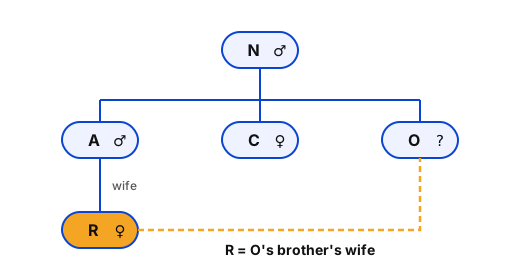
- R ≠ A: R is the wife of A. A @ N: A is the son of N.
- N ≤ C: N is the father of C. C ~ O: C is the sister of O.
- So A, C and O are children of N → A is O's brother.
- R, wife of A, is O's brother's wife.
Trick: Read the chain left to right and place each new person beside the previous one.
Answer: (B) Brother's wife
अवधारणा: हर चिह्न को क्रम से डिकोड करें और वंश-वृक्ष बनाएँ।
- R ≠ A: R, A की पत्नी है। A @ N: A, N का पुत्र है।
- N ≤ C: N, C का पिता है। C ~ O: C, O की बहन है।
- अतः A, C और O, N की संतानें हैं → A, O का भाई है।
- R, जो A की पत्नी है, O के भाई की पत्नी (भाभी) है।
ट्रिक: शृंखला बाएँ से दाएँ पढ़ें और हर नए व्यक्ति को पिछले के साथ जोड़ते जाएँ।
उत्तर: (B) भाई की पत्नी
RRB NTPC Undergraduate CBT 1General Intelligence and ReasoningCoded blood relationsRRB NTPC Undergraduate CBT 1 2025 · 19 Jun Shift 3
Q116.Refer to the given number series and answer the question that follows. Counting to be done from left to right only. All numbers are single-digit numbers only.
(Left) 9 2 3 1 4 5 6 8 5 4 3 2 1 9 3 4 5 6 7 8 1 2 9 8 3 4 5 2 6 8 2 (Right)
How many such odd digits are there, each of which is immediately preceded by an even digit and also immediately followed by an odd digit?
दी गई संख्या श्रृंखला को देखिए और उसके बाद आने वाले प्रश्न का उत्तर दीजिए। गिनती केवल बाएँ से दाएँ की जानी है। सभी संख्याएँ केवल एक-अंकीय संख्याएँ हैं।
(बाएँ) 9 2 3 1 4 5 6 8 5 4 3 2 1 9 3 4 5 6 7 8 1 2 9 8 3 4 5 2 6 8 2 (दाएँ)
ऐसे कितने विषम अंक हैं, जिनमें से प्रत्येक के ठीक पहले एक सम अंक है और ठीक बाद भी एक विषम अंक है?
- AThreeतीन
- BNoneकोई नहीं
- COneएक
- DTwoदो
Show answer
Concept: Look for the pattern Even – Odd – Odd and count the middle digit.
- Position 3: 2 3 1 → before 2 (even), after 1 (odd) ✓.
- Position 13: 2 1 9 → before 2 (even), after 9 (odd) ✓.
- Other odd digits after an even digit (5 after 4, 3 after 4, 7 after 6, 9 after 2 …) are followed by an even digit ✗.
Trick: First mark every even digit, then check only the two digits right after it.
Answer: (D) Two
अवधारणा: सम – विषम – विषम पैटर्न खोजें और बीच का अंक गिनें।
- स्थान 3: 2 3 1 → पहले 2 (सम), बाद में 1 (विषम) ✓।
- स्थान 13: 2 1 9 → पहले 2 (सम), बाद में 9 (विषम) ✓।
- सम अंक के बाद आने वाले अन्य विषम अंकों (4 के बाद 5, 4 के बाद 3, 6 के बाद 7, 2 के बाद 9 …) के बाद सम अंक है ✗।
ट्रिक: पहले सभी सम अंक चिह्नित करें, फिर केवल उनके ठीक बाद वाले दो अंक देखें।
उत्तर: (D) दो
RRB NTPC Undergraduate CBT 1General Intelligence and ReasoningNumber series – digit conditionsRRB NTPC Undergraduate CBT 1 2025 · 19 Jun Shift 3
Q117.J, U, N, I, O, R and S are sitting around a circular table, facing the centre of the table. S sits fourth to the left of R. O sits fourth to the right of U. Only two people sit between R and U when counted from the left of R. N is not an immediate neighbour of O or R. J is not an immediate neighbour of N. Who sits third to the right of I?
सात व्यक्ति J, U, N, I, O, R और S एक वृत्ताकार मेज़ के चारों ओर मेज़ के केंद्र की ओर मुख करके बैठे हैं। S, R के बाईं ओर चौथे स्थान पर बैठा है। O, U के दाईं ओर चौथे स्थान पर बैठा है। R के बाईं ओर से गिनने पर R और U के बीच केवल दो व्यक्ति बैठे हैं। N, O या R का निकटतम पड़ोसी नहीं है। J, N का निकटतम पड़ोसी नहीं है। I के दाईं ओर तीसरे स्थान पर कौन बैठा है?
- AR
- BJ
- CU
- DS
Show answer
Concept: Facing the centre: left = clockwise, right = anticlockwise.
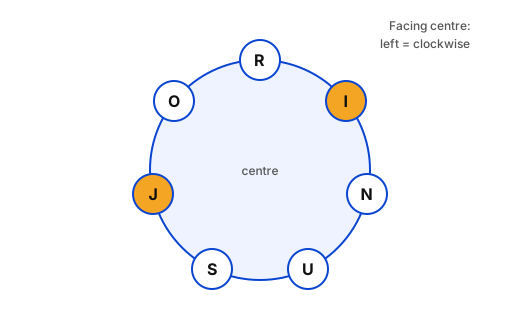
- Fix R. S is 4th to the left of R. Going left from R, two people then U → U is 3rd to the left of R; S sits next to U.
- O is 4th to the right of U → O is R's immediate right neighbour.
- Seats left: R's left neighbour, the seat between it and U, and the seat between S and O. N is not next to O or R → N sits just before U; J is not next to N → J sits between S and O; I is R's left neighbour.
- From I, moving right: R, O, J → J is 3rd to the right of I.
Trick: Fix one person first and write the others as 'k-th to the left' of him to avoid confusion.
Answer: (B) J
अवधारणा: केंद्र की ओर मुख होने पर: बायाँ = दक्षिणावर्त, दायाँ = वामावर्त।
- R को स्थिर करें। S, R के बाएँ चौथा है। R के बाएँ से गिनने पर दो व्यक्ति फिर U → U, R के बाएँ तीसरा; S, U के बगल में।
- O, U के दाएँ चौथा है → O, R का ठीक दायाँ पड़ोसी है।
- बची सीटें: R का बायाँ पड़ोसी, उसके और U के बीच की सीट, और S व O के बीच की सीट। N, O या R के पास नहीं → N, U के ठीक पहले; J, N के पास नहीं → J, S और O के बीच; I, R का बायाँ पड़ोसी।
- I से दाएँ चलें: R, O, J → J, I के दाएँ तीसरा है।
ट्रिक: पहले एक व्यक्ति को स्थिर करें और बाकी को उसके 'बाएँ k-वाँ' के रूप में लिखें।
उत्तर: (B) J
RRB NTPC Undergraduate CBT 1General Intelligence and ReasoningCircular seating arrangementRRB NTPC Undergraduate CBT 1 2025 · 19 Jun Shift 3
Q118.Refer to the following series and answer the question. (Counting to be done from left to right only.) (All numbers are single-digit numbers only.)
(Left) 7 3 5 2 3 5 3 5 2 2 5 2 5 2 5 6 5 4 6 5 4 9 9 8 5 5 2 (Right)
How many such even digits are there, each of which is immediately preceded by a perfect square and immediately followed by an even digit? (NOTE: 1 is also a perfect square.)
निम्नलिखित श्रृंखला को देखिए और प्रश्न का उत्तर दीजिए। (गिनती केवल बाएँ से दाएँ की जानी है।) (सभी संख्याएँ केवल एक-अंकीय संख्याएँ हैं।)
(बाएँ) 7 3 5 2 3 5 3 5 2 2 5 2 5 2 5 6 5 4 6 5 4 9 9 8 5 5 2 (दाएँ)
ऐसे कितने सम अंक हैं, जिनमें से प्रत्येक के ठीक पहले एक पूर्ण वर्ग है और ठीक बाद एक सम अंक है? (नोट: 1 भी एक पूर्ण वर्ग है।)
- ATwoदो
- BOneएक
- CNoneकोई नहीं
- DThreeतीन
Show answer
Concept: Perfect-square digits: 0, 1, 4, 9. Look for the pattern Square – Even – Even.
- Even digits preceded by a perfect square: 6 (after 4, position 19) and 8 (after 9, position 24).
- 6 is followed by 5 (odd) ✗; 8 is followed by 5 (odd) ✗.
- No even digit satisfies both conditions.
Trick: Start from the rarer condition (perfect square before) – fewer cases to check.
Answer: (C) None
अवधारणा: पूर्ण वर्ग अंक: 0, 1, 4, 9। पैटर्न पूर्ण वर्ग – सम – सम खोजें।
- पूर्ण वर्ग के बाद आने वाले सम अंक: 6 (4 के बाद, स्थान 19) और 8 (9 के बाद, स्थान 24)।
- 6 के बाद 5 (विषम) ✗; 8 के बाद 5 (विषम) ✗।
- कोई भी सम अंक दोनों शर्तें पूरी नहीं करता।
ट्रिक: दुर्लभ शर्त (पहले पूर्ण वर्ग) से शुरू करें – कम स्थितियाँ जाँचनी पड़ेंगी।
उत्तर: (C) कोई नहीं
RRB NTPC Undergraduate CBT 1General Intelligence and ReasoningNumber series – digit conditionsRRB NTPC Undergraduate CBT 1 2025 · 19 Jun Shift 3
Q119.NJ 9 is related to QN −9 in a certain way. In the same way, OR 13 is related to RV −5. Following the same logic, VR 19 is related to which of the given options?
NJ 9 एक निश्चित प्रकार से QN −9 से संबंधित है। उसी प्रकार, OR 13, RV −5 से संबंधित है। समान तर्क का अनुसरण करते हुए, VR 19 दिए गए विकल्पों में से किससे संबंधित है?
- AVZ 3
- BYX 6
- CCX 5
- DYV 1
Show answer
Concept: Find separate rules for the two letters and the number.
- NJ 9 → QN : N = Q, J = N, .
- OR 13 → RV : O = R, R = V, ✓.
- VR 19 → V = Y, R = V, → YV 1.
Trick: Number rule: subtract 18 every time.
Answer: (D) YV 1
अवधारणा: दोनों अक्षरों और संख्या के लिए अलग नियम खोजें।
- NJ 9 → QN : N = Q, J = N, ।
- OR 13 → RV : O = R, R = V, ✓।
- VR 19 → V = Y, R = V, → YV 1।
ट्रिक: संख्या का नियम: हर बार 18 घटाएँ।
उत्तर: (D) YV 1
RRB NTPC Undergraduate CBT 1General Intelligence and ReasoningAlpha-numeric analogyRRB NTPC Undergraduate CBT 1 2025 · 19 Jun Shift 3
Q120.Seven boxes A, B, J, E, C, T and S are kept one over the other but not necessarily in the same order. Only T is kept below E. Only A is kept above J. Only C is kept between J and S. How many boxes are kept between B and T?
सात डिब्बे A, B, J, E, C, T और S एक के ऊपर एक रखे गए हैं, परंतु आवश्यक नहीं कि इसी क्रम में हों। E के नीचे केवल T रखा गया है। J के ऊपर केवल A रखा गया है। J और S के बीच केवल C रखा गया है। B और T के बीच कितने डिब्बे रखे गए हैं?
- AOneएक
- BTwoदो
- CThreeतीन
- DZeroशून्य
Show answer
Concept: Number positions 1 (bottom) to 7 (top).
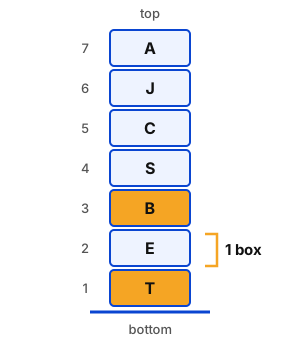
- Only T is below E → T at 1, E at 2.
- Only A is above J → A at 7, J at 6.
- Only C between J and S → C at 5, S at 4; B takes 3.
- Between B (3) and T (1): only E → one box.
Trick: 'Only X below Y' = X at the bottom, Y second from the bottom.
Answer: (A) One
अवधारणा: स्थान 1 (नीचे) से 7 (ऊपर) क्रमांकित करें।
- E के नीचे केवल T → T स्थान 1, E स्थान 2।
- J के ऊपर केवल A → A स्थान 7, J स्थान 6।
- J और S के बीच केवल C → C 5, S 4; B स्थान 3।
- B (3) और T (1) के बीच: केवल E → एक बॉक्स।
ट्रिक: 'Y के नीचे केवल X' = X सबसे नीचे, Y नीचे से दूसरा।
उत्तर: (A) एक
RRB NTPC Undergraduate CBT 1General Intelligence and ReasoningBox stackingRRB NTPC Undergraduate CBT 1 2025 · 19 Jun Shift 3

