Q101.Find the smallest positive integer which leaves remainder 2 when divided by 3, remainder 3 when divided by 4, and remainder 4 when divided by 5.
वह सबसे छोटा धनात्मक पूर्णांक ज्ञात कीजिए जिसे 3 से विभाजित करने पर शेषफल 2, 4 से विभाजित करने पर शेषफल 3 और 5 से विभाजित करने पर शेषफल 4 प्राप्त होता है।
- A53
- B50
- C69
- D59
Show answer
Concept: When (divisor remainder) is the same for every divisor, .
- .
- LCM → .
Trick: Constant gap of 1 below each divisor → LCM .
Answer: (D) 59
अवधारणा: जब (भाजक शेषफल) सभी के लिए समान हो, तो ।
- ।
- LCM → ।
ट्रिक: हर भाजक से 1 कम शेष → LCM ।
उत्तर: (D) 59
RRB NTPC Undergraduate CBT 1MathematicsRemainders – LCMRRB NTPC Undergraduate CBT 1 2025 · 19 Jun Shift 3
Q102.Four years ago, Ravi's age was three times Kaviraj's age. At present, Ravi's age is twice Kaviraj's age. Find Ravi's present age.
चार वर्ष पहले, रवि की आयु कविराज की आयु की तीन गुनी थी। वर्तमान में, रवि की आयु कविराज की आयु की दोगुनी है। रवि की वर्तमान आयु ज्ञात कीजिए।
- A8 years8 वर्ष
- B16 years16 वर्ष
- C14 years14 वर्ष
- D10 years10 वर्ष
Show answer
Concept: Let Kaviraj's present age , Ravi's .
- Four years ago: .
- → .
- Ravi years.
Trick: Check options: Ravi 16, Kaviraj 8; 4 years ago 12 and 4 → times ✓.
Answer: (B) 16 years
अवधारणा: कविराज की वर्तमान आयु , रवि की ।
- 4 वर्ष पहले: ।
- → ।
- रवि वर्ष।
ट्रिक: विकल्प जाँच: रवि 16, कविराज 8; 4 वर्ष पहले 12 और 4 → 3 गुना ✓।
उत्तर: (B) 16 वर्ष
RRB NTPC Undergraduate CBT 1MathematicsProblems on AgesRRB NTPC Undergraduate CBT 1 2025 · 19 Jun Shift 3
Q103.Pipes C and D can fill a tank of capacity 3,000 litres in 6 hours and 4 hours respectively. If both pipes work together, how many hours will it take to fill a tank of capacity 6,000 litres?
पाइप C और D, 3,000 लीटर क्षमता वाली एक टंकी को क्रमशः 6 घंटे और 4 घंटे में भर सकते हैं। यदि दोनों पाइप एक साथ कार्य करें, तो 6,000 लीटर क्षमता वाली टंकी को भरने में कितने घंटे लगेंगे?
- A4.44 hours4.44 घंटे
- B4.8 hours4.8 घंटे
- C3.5 hours3.5 घंटे
- D6 hours6 घंटे
Show answer
Concept: Find litres filled per hour by each pipe and add.
- C: L/h; D: L/h.
- Together L/h.
- Time hours.
Trick: For the 3000 L tank together: h; double capacity → h.
Answer: (B) 4.8 hours
अवधारणा: प्रत्येक पाइप प्रति घंटे कितने लीटर भरता है, जोड़ें।
- C: L/h; D: L/h।
- मिलकर L/h।
- समय घंटे।
ट्रिक: 3000 L टंकी साथ में: घंटे; दोगुनी क्षमता → घंटे।
उत्तर: (B) 4.8 घंटे
RRB NTPC Undergraduate CBT 1MathematicsPipes and CisternsRRB NTPC Undergraduate CBT 1 2025 · 19 Jun Shift 3
Q104.If , what is the value of y?
यदि है, तो y का मान क्या है?
- A1765
- B1665
- C1965
- D1865
Show answer
Concept: Multiply first, then add/subtract (BODMAS).
- .
- .
- .
Trick: Take 86 common: .
Answer: (D) 1865
अवधारणा: पहले गुणा, फिर जोड़/घटाव (BODMAS)।
- ।
- ।
- ।
ट्रिक: 86 उभयनिष्ठ लें: ।
उत्तर: (D) 1865
RRB NTPC Undergraduate CBT 1MathematicsSimplificationRRB NTPC Undergraduate CBT 1 2025 · 19 Jun Shift 3
Q105.A number is divided into two parts such that one part is 10 more than the other. If their ratio is 6 : 4, what are the two parts?
एक संख्या को दो भागों में इस प्रकार विभाजित किया जाता है कि एक भाग दूसरे से 10 अधिक है। यदि उनका अनुपात 6 : 4 है, तो दोनों भाग क्या हैं?
- A34 and 2434 और 24
- B32 and 2232 और 22
- C32 and 2032 और 20
- D30 and 2030 और 20
Show answer
Concept: Difference of ratio parts corresponds to the actual difference.
- Ratio , difference parts → 1 part .
- Parts and .
Trick: Check: and ✓.
Answer: (D) 30 and 20
अवधारणा: अनुपात भागों का अंतर वास्तविक अंतर के बराबर होता है।
- अनुपात , अंतर भाग → 1 भाग ।
- भाग और ।
ट्रिक: जाँच: और ✓।
उत्तर: (D) 30 और 20
RRB NTPC Undergraduate CBT 1MathematicsRatio – Dividing a NumberRRB NTPC Undergraduate CBT 1 2025 · 19 Jun Shift 3
Q106.The length of the shadow of a tower increases by 20 m when the angle of elevation of the Sun changes from 60° to 45°. Find the height of the tower (in m, rounded to one decimal place). (Use )
जब सूर्य का उन्नयन कोण 60° से 45° हो जाता है, तो एक मीनार की छाया की लंबाई 20 m बढ़ जाती है। मीनार की ऊँचाई (m में, एक दशमलव स्थान तक पूर्णांकित) ज्ञात कीजिए। ( का प्रयोग कीजिए)
- A48.6
- B17.4
- C24.7
- D27.5
Show answer
Concept: Shadow length ; it increases when the Sun's elevation falls.
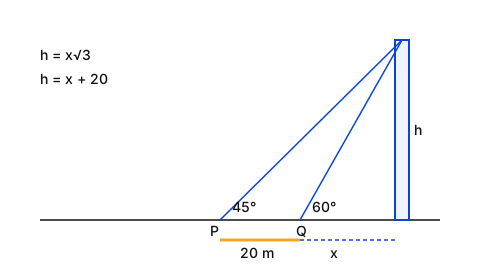
- At : ; at : .
- → .
- With : m.
Trick: for shadow change .
Answer: (A) 48.6
अवधारणा: छाया की लंबाई ; सूर्य का उन्नयन कोण घटने पर छाया बढ़ती है।
- पर: ; पर: ।
- → ।
- लेकर: m।
ट्रिक: पर छाया का अंतर हो तो ।
उत्तर: (A) 48.6
RRB NTPC Undergraduate CBT 1MathematicsHeights and DistancesRRB NTPC Undergraduate CBT 1 2025 · 19 Jun Shift 3
Q107.A and B can complete a piece of work in 12 days and 20 days respectively. After both work together for 3 days, A leaves. How many days will B take to finish the remaining work?
A और B किसी कार्य को क्रमशः 12 दिन और 20 दिन में पूरा कर सकते हैं। दोनों के 3 दिन तक एक साथ कार्य करने के बाद A कार्य छोड़ देता है। शेष कार्य को पूरा करने में B को कितने दिन लगेंगे?
- A12
- B13
- C11
- D14
Show answer
Concept: Take total work = LCM of days and use units per day.
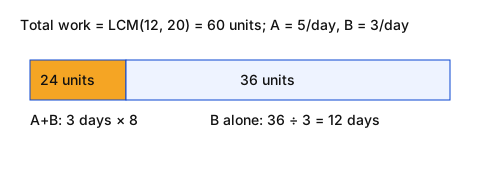
- Work units; A /day, B /day.
- In 3 days together: units.
- Remaining units by B: days.
Trick: Fraction done ; B does .
Answer: (A) 12
अवधारणा: कुल कार्य = दिनों का LCM लें और प्रति दिन इकाइयाँ निकालें।
- कार्य इकाई; A /दिन, B /दिन।
- 3 दिन साथ: इकाई।
- शेष इकाई B: दिन।
ट्रिक: किया गया भाग ; B करेगा ।
उत्तर: (A) 12
RRB NTPC Undergraduate CBT 1MathematicsTime and WorkRRB NTPC Undergraduate CBT 1 2025 · 19 Jun Shift 3
Q108.An article is sold at a profit of 20%. If its selling price is reduced by 10%, what will be the profit percentage?
एक वस्तु 20% लाभ पर बेची जाती है। यदि इसके विक्रय मूल्य में 10% की कमी कर दी जाए, तो लाभ प्रतिशत क्या होगा?
- A6%
- B12%
- C8%
- D20%
Show answer
Concept: Take CP .
- SP at profit .
- New SP .
- Profit .
Trick: → profit.
Answer: (C) 8%
अवधारणा: CP मानें।
- लाभ पर SP ।
- नया SP ।
- लाभ ।
ट्रिक: → लाभ।
उत्तर: (C) 8%
RRB NTPC Undergraduate CBT 1MathematicsProfit and LossRRB NTPC Undergraduate CBT 1 2025 · 19 Jun Shift 3
Q109.A regular polygon has 45 sides and the length of each side is 2 cm. What is the area of the polygon (in cm²)?
एक सम बहुभुज की 45 भुजाएँ हैं और प्रत्येक भुजा की लंबाई 2 cm है। बहुभुज का क्षेत्रफल (cm² में) क्या है?
- A
- B
- C
- D
Show answer
Concept: Area of a regular -gon of side .
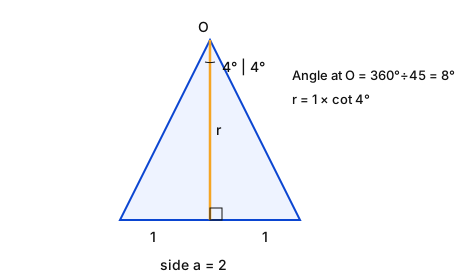
- Split into 45 isosceles triangles; angle at centre , half-angle .
- Apothem .
- Area .
Trick: Apothem is large (polygon is nearly a circle), so area must be much bigger than 45 – it needs , not ().
Answer: (D)
अवधारणा: भुजा वाले सम -भुज का क्षेत्रफल ।
- 45 समद्विबाहु त्रिभुजों में बाँटें; केंद्र पर कोण , आधा ।
- केंद्र से भुजा की दूरी ।
- क्षेत्रफल ।
ट्रिक: बहुभुज लगभग वृत्त जैसा है, इसलिए क्षेत्रफल 45 से बहुत बड़ा होगा – आएगा, नहीं ()।
उत्तर: (D)
RRB NTPC Undergraduate CBT 1MathematicsRegular Polygon – AreaRRB NTPC Undergraduate CBT 1 2025 · 19 Jun Shift 3
Q110.A person covers a certain distance by train. If the train had travelled 14 km/hr faster than its usual speed, the journey would have taken 35 minutes less. If it had travelled 10 km/hr slower, the journey would have taken 30 minutes more. Find the total distance covered by the train.
एक व्यक्ति रेलगाड़ी द्वारा एक निश्चित दूरी तय करता है। यदि रेलगाड़ी अपनी सामान्य चाल से 14 km/hr अधिक तेज़ चलती, तो यात्रा में 35 मिनट कम लगते। यदि वह 10 km/hr धीमी चलती, तो यात्रा में 30 मिनट अधिक लगते। रेलगाड़ी द्वारा तय की गई कुल दूरी ज्ञात कीजिए।
- A780 km
- B480 km
- C720 km
- D560 km
Show answer
Concept: Write two time-difference equations for distance and usual speed .
- → .
- → .
- → ; km.
Trick: Verify: h, h (35 min less), h ✓.
Answer: (A) 780 km
अवधारणा: दूरी और सामान्य चाल के लिए समय-अंतर के दो समीकरण बनाएँ।
- → ।
- → ।
- → ; km।
ट्रिक: जाँच: घंटे, घंटे (35 मिनट कम), घंटे ✓।
उत्तर: (A) 780 km
RRB NTPC Undergraduate CBT 1MathematicsSpeed, Time and DistanceRRB NTPC Undergraduate CBT 1 2025 · 19 Jun Shift 3
Q111.The price of a machine increases by 20%. Due to a fall in demand, the increased price is reduced by 25%. Finally, the price increases again by 10%. What is the overall percentage change in the price of the machine?
एक मशीन के मूल्य में 20% की वृद्धि होती है। माँग में गिरावट के कारण, बढ़े हुए मूल्य में 25% की कमी की जाती है। अंत में, मूल्य में पुनः 10% की वृद्धि होती है। मशीन के मूल्य में कुल प्रतिशत परिवर्तन क्या है?
- A1% decrease1% कमी
- B1.1% decrease1.1% कमी
- C1% increase1% वृद्धि
- D1.1% increase1.1% वृद्धि
Show answer
Concept: Multiply the successive factors.
- Factors: .
- ; .
- Net change → 1% decrease.
Trick: Take price 100: .
Answer: (A) 1% decrease
अवधारणा: क्रमिक गुणकों को गुणा करें।
- गुणक: ।
- ; ।
- कुल परिवर्तन → 1% कमी।
ट्रिक: मूल्य 100 लें: ।
उत्तर: (A) 1% कमी
RRB NTPC Undergraduate CBT 1MathematicsSuccessive Percentage ChangeRRB NTPC Undergraduate CBT 1 2025 · 19 Jun Shift 3
Q112.A factory produces three types of widgets A, B and C. In a week, 12 units of A (average weight 47 kg each), 8 units of B (average weight 62 kg each) and 15 units of C (average weight 53 kg each) are produced. Find the weighted average weight of the widgets produced in that week.
एक कारखाना तीन प्रकार के विजेट (widgets) A, B और C का उत्पादन करता है। एक सप्ताह में A की 12 इकाइयाँ (प्रत्येक का औसत भार 47 kg), B की 8 इकाइयाँ (प्रत्येक का औसत भार 62 kg) और C की 15 इकाइयाँ (प्रत्येक का औसत भार 53 kg) उत्पादित की जाती हैं। उस सप्ताह उत्पादित विजेटों का भारित औसत भार ज्ञात कीजिए।
- A54 kg
- B53 kg
- C51 kg
- D52.5 kg
Show answer
Concept: Weighted average .
- , , .
- Total kg for units.
- Average kg.
Trick: Deviations from 53: → average is exactly 53.
Answer: (B) 53 kg
अवधारणा: भारित औसत ।
- , , ।
- कुल kg, इकाइयाँ।
- औसत kg।
ट्रिक: 53 से विचलन: → औसत ठीक 53।
उत्तर: (B) 53 kg
RRB NTPC Undergraduate CBT 1MathematicsWeighted AverageRRB NTPC Undergraduate CBT 1 2025 · 19 Jun Shift 3
Q113.A customer orders food worth ₹1,000 online. The food delivery app gives a flat promotional discount of 20% on the bill. After this discount, if the bill amount is between ₹650 and ₹800 (both inclusive), an additional 5% discount is applied on the bill. If all orders include a fixed delivery charge of ₹80, what is the final amount the customer has to pay?
एक ग्राहक ऑनलाइन ₹1,000 का भोजन ऑर्डर करता है। फ़ूड डिलीवरी ऐप बिल पर 20% की एकमुश्त प्रचारात्मक छूट देता है। इस छूट के बाद, यदि बिल राशि ₹650 और ₹800 (दोनों सम्मिलित) के बीच है, तो बिल पर 5% की अतिरिक्त छूट लागू होती है। यदि सभी ऑर्डरों में ₹80 का निश्चित डिलीवरी शुल्क शामिल है, तो ग्राहक को अंतिम रूप से कितनी राशि का भुगतान करना होगा?
- A₹760
- B₹900
- C₹800
- D₹840
Show answer
Concept: Apply the discounts in order, check the slab, then add the fixed delivery charge.
- After : – lies in ₹650–₹800 (inclusive).
- Extra : .
- Add delivery: .
Trick: Watch 'inclusive' – ₹800 qualifies for the extra 5%.
Answer: (D) ₹840
अवधारणा: छूट क्रम से लगाएँ, स्लैब जाँचें, फिर निश्चित डिलीवरी शुल्क जोड़ें।
- के बाद: – ₹650–₹800 (सम्मिलित) में है।
- अतिरिक्त : ।
- डिलीवरी जोड़ें: ।
ट्रिक: 'सम्मिलित' पर ध्यान दें – ₹800 पर भी 5% अतिरिक्त छूट मिलेगी।
उत्तर: (D) ₹840
RRB NTPC Undergraduate CBT 1MathematicsDiscountRRB NTPC Undergraduate CBT 1 2025 · 19 Jun Shift 3
Q114.A student adds 3/5 unit of a solution, then adds 0.4 unit of the same solution, and finally removes 1/10 unit. What is the net change in the quantity of the solution?
एक विद्यार्थी किसी विलयन की 3/5 इकाई मिलाता है, फिर उसी विलयन की 0.4 इकाई मिलाता है, और अंत में 1/10 इकाई निकाल देता है। विलयन की मात्रा में निवल परिवर्तन क्या है?
- Adecrease of 1.5 unit1.5 इकाई की कमी
- Bincrease of 0.9 unit0.9 इकाई की वृद्धि
- Cdecrease of 0.8 unit0.8 इकाई की कमी
- Dincrease of 1.0 unit1.0 इकाई की वृद्धि
Show answer
Concept: Additions are positive, removals negative; convert all to decimals.
- , .
- Net .
- Positive → increase of 0.9 unit.
Trick: Positive net = increase; negative net = decrease.
Answer: (B) increase of 0.9 unit
अवधारणा: जोड़ना धनात्मक, निकालना ऋणात्मक; सबको दशमलव में बदलें।
- , ।
- शुद्ध ।
- धनात्मक → 0.9 इकाई की वृद्धि।
ट्रिक: शुद्ध धनात्मक = वृद्धि; ऋणात्मक = कमी।
उत्तर: (B) 0.9 इकाई की वृद्धि
RRB NTPC Undergraduate CBT 1MathematicsFractions and DecimalsRRB NTPC Undergraduate CBT 1 2025 · 19 Jun Shift 3
Q115.Find the compound interest on ₹25,600 for 2 years 3 months at per annum, compounded annually.
₹25,600 पर 2 वर्ष 3 महीने के लिए वार्षिक दर से, वार्षिक रूप से संयोजित होने वाला चक्रवृद्धि ब्याज ज्ञात कीजिए।
- A₹8,650.50
- B₹10,580.50
- C₹7,812.50
- D₹9,750.50
Show answer
Concept: For a fractional year with annual compounding, the extra 3 months earn simple interest on the amount after 2 years.
- : after 2 years .
- 3 months: rate → .
- Amount ; CI .
Trick: – use fraction multipliers .
Answer: (C) ₹7,812.50
अवधारणा: वार्षिक चक्रवृद्धि में बचे 3 महीनों पर 2 वर्ष के मिश्रधन पर साधारण ब्याज लगता है।
- : 2 वर्ष बाद ।
- 3 महीने: दर → ।
- मिश्रधन ; CI ।
ट्रिक: – गुणक लें।
उत्तर: (C) ₹7,812.50
RRB NTPC Undergraduate CBT 1MathematicsCompound Interest – Fractional PeriodRRB NTPC Undergraduate CBT 1 2025 · 19 Jun Shift 3
Q116.A, B and C are partners in a business. A, who invested for 4 months, claims of the total profit. B, who invested for 6 months, claims of the total profit. C invested ₹1560 for 8 months. How much did A contribute?
A, B और C एक व्यवसाय में साझेदार हैं। A, जिसने 4 महीने के लिए निवेश किया, कुल लाभ के का दावा करता है। B, जिसने 6 महीने के लिए निवेश किया, कुल लाभ के का दावा करता है। C ने 8 महीने के लिए ₹1560 का निवेश किया। A ने कितना योगदान दिया?
- A₹690
- B₹794
- C₹810
- D₹720
Show answer
Concept: Profit share ∝ capital × time. Find C's share, then the total "capital-months", then A's capital.
- As printed, A and B each claim , so C gets . C's capital-months , so total ; A's capital – not among the options, so the printed fraction for B is a printing error.
- In the original exam version B claims : C gets .
- Total capital-months .
- A's capital-months , so A's capital .
Trick: Share ÷ time gives capital: A of the total capital-months.
Answer: (D) ₹720
अवधारणा: लाभ का हिस्सा ∝ पूँजी × समय। पहले C का हिस्सा, फिर कुल "पूँजी-माह", फिर A की पूँजी निकालें।
- छपे प्रश्न में A और B दोनों लेते हैं, तो C को मिलेगा। C के पूँजी-माह , कुल ; A की पूँजी – यह किसी विकल्प में नहीं है, अतः B का छपा भिन्न मुद्रण-त्रुटि है।
- मूल परीक्षा में B का हिस्सा है: C को मिलता है।
- कुल पूँजी-माह ।
- A के पूँजी-माह , अतः A की पूँजी ।
ट्रिक: हिस्सा ÷ समय = पूँजी का अनुपात।
उत्तर: (D) ₹720
RRB NTPC Undergraduate CBT 1MathematicsPartnershipRRB NTPC Undergraduate CBT 1 2025 · 19 Jun Shift 3
Q117.A car covers a distance of 360 km in 8 hours at a uniform speed. Find its speed in metres per second.
एक कार एकसमान चाल से 8 घंटे में 360 km की दूरी तय करती है। उसकी चाल मीटर प्रति सेकंड में ज्ञात कीजिए।
- A13 m/s
- B12 m/s
- C12.5 m/s
- D13.5 m/s
Show answer
Concept: Speed ; km/h to m/s multiply by .
- Speed km/h.
- m/s.
Trick: directly.
Answer: (C) 12.5 m/s
अवधारणा: चाल ; km/h को m/s में बदलने हेतु से गुणा।
- चाल km/h।
- m/s।
ट्रिक: सीधे ।
उत्तर: (C) 12.5 m/s
RRB NTPC Undergraduate CBT 1MathematicsSpeed ConversionRRB NTPC Undergraduate CBT 1 2025 · 19 Jun Shift 3
Q118.Simplify:
सरल कीजिए:
- A
- B
- C
- D
Show answer
Concept: Order: brackets, then 'of', then / left to right, then .
- ; .
- First part .
- 'of': ; .
- Total .
Trick: 'of' is done before – that is what makes the second term .
Answer: (D)
अवधारणा: क्रम: कोष्ठक, फिर 'का (of)', फिर बाएँ से दाएँ /, फिर ।
- ; ।
- पहला भाग ।
- 'of': ; ।
- कुल ।
ट्रिक: 'of' को से पहले हल करें – तभी दूसरा पद बनता है।
उत्तर: (D)
RRB NTPC Undergraduate CBT 1MathematicsSimplification – Fractions (BODMAS)RRB NTPC Undergraduate CBT 1 2025 · 19 Jun Shift 3
Q119.The sum of two positive numbers is 13 and their product is 30. The positive difference between them is ________.
दो धनात्मक संख्याओं का योग 13 है और उनका गुणनफल 30 है। उनके बीच का धनात्मक अंतर ________ है।
- A8
- B7
- C12
- D9
Show answer
Concept: .
- .
- (numbers 10 and 3).
Trick: Two numbers with sum 13, product 30: and at sight.
Answer: (B) 7
अवधारणा: ।
- ।
- (संख्याएँ 10 और 3)।
ट्रिक: योग 13, गुणनफल 30 → तुरंत और ।
उत्तर: (B) 7
RRB NTPC Undergraduate CBT 1MathematicsAlgebra – Sum and ProductRRB NTPC Undergraduate CBT 1 2025 · 19 Jun Shift 3
Q120.A trader offers 'buy two, get one free' on a certain type of trousers. The marked price of one trouser is ₹2,700. If the trader still earns a 20% profit after this offer, find the cost price of one trouser.
एक व्यापारी एक निश्चित प्रकार की पतलून पर 'दो खरीदें, एक मुफ़्त पाएँ' का प्रस्ताव देता है। एक पतलून का अंकित मूल्य ₹2,700 है। यदि इस प्रस्ताव के बाद भी व्यापारी 20% लाभ अर्जित करता है, तो एक पतलून का क्रय मूल्य ज्ञात कीजिए।
- A₹ 1,500
- B₹ 1,450
- C₹ 1,600
- D₹ 1,550
Show answer
Concept: 'Buy 2 get 1 free' – customer pays for 2 but takes 3.
- Money received for 3 trousers → SP per trouser .
- profit: CP .
Trick: Effective discount : .
Answer: (A) ₹1,500
अवधारणा: '2 खरीदें 1 मुफ़्त' – ग्राहक 2 का भुगतान कर 3 लेता है।
- 3 पतलून के लिए प्राप्त राशि → प्रति पतलून SP ।
- लाभ: CP ।
ट्रिक: प्रभावी छूट : ।
उत्तर: (A) ₹1,500
RRB NTPC Undergraduate CBT 1MathematicsOffers and ProfitRRB NTPC Undergraduate CBT 1 2025 · 19 Jun Shift 3

