Q1741.Two friends, P and Q, started a business by investing ₹2,300 and ₹4,600, respectively. At the end of one year, the business earned a total profit of ₹37,272. What is the share (in ₹) of P in the profit?
दो मित्रों, P और Q, ने क्रमशः ₹2,300 और ₹4,600 का निवेश करके एक व्यवसाय शुरू किया। एक वर्ष के अंत में, व्यवसाय ने कुल ₹37,272 का लाभ अर्जित किया। लाभ में P का हिस्सा (₹ में) कितना है?
- A12,424
- B12,274
- C12,524
- D12,374
Show answer
Concept: When capitals are invested for the same time, profit is divided in the ratio of capitals.
- Ratio of investments .
- Total parts ; one part .
- P has 1 part, so P's share = ₹12,424.
Trick: Q invested exactly double, so P gets one-third of the profit – just divide by 3.
Answer: (A) 12,424
अवधारणा: जब पूँजी समान समय के लिए लगी हो, तो लाभ पूँजी के अनुपात में बँटता है।
- निवेश का अनुपात ।
- कुल भाग ; एक भाग ।
- P का 1 भाग है, अतः P का हिस्सा = ₹12,424।
ट्रिक: Q ने ठीक दोगुना लगाया, इसलिए P को लाभ का एक-तिहाई मिलेगा – सीधे 3 से भाग दें।
उत्तर: (A) 12,424
RRB NTPC Undergraduate CBT 1MathematicsPartnershipRRB NTPC Undergraduate CBT 1 2025 · 14 Jun Shift 3
Q1742.The sides of a rectangular field are 77 m and 98 m long. Its area is equal to the area of a circular field. What is the perimeter (in m) of the circular field?
(Take )
एक आयताकार मैदान की भुजाएँ 77 m और 98 m लंबी हैं। इसका क्षेत्रफल एक वृत्ताकार मैदान के क्षेत्रफल के बराबर है। वृत्ताकार मैदान का परिमाप (m में) कितना है?
( लीजिए)
- A304
- B308
- C353
- D330
Show answer
Concept: Area of rectangle ; area of circle ; circumference .
- Area of field .
- m.
- Perimeter m.
Trick: and – the 11 cancels the 22 and 7s pair up nicely; the answer must be a multiple of 44 (), and only 308 is.
Answer: (B) 308
अवधारणा: आयत का क्षेत्रफल ; वृत्त का क्षेत्रफल ; परिधि ।
- खेत का क्षेत्रफल ।
- m।
- परिधि m।
ट्रिक: होने पर परिधि ; उत्तर का गुणज होना चाहिए – केवल 308 है।
उत्तर: (B) 308
RRB NTPC Undergraduate CBT 1MathematicsMensuration – circleRRB NTPC Undergraduate CBT 1 2025 · 14 Jun Shift 3
Q1743.A car travels from Gwalior to Jhansi at 60 km/hr and returns at 80 km/hr. If the total travel time is 3.5 hours, what is the one-way distance?
एक कार ग्वालियर से झाँसी तक 60 km/hr की चाल से जाती है और 80 km/hr की चाल से लौटती है। यदि कुल यात्रा समय 3.5 घंटे है, तो एक ओर की दूरी कितनी है?
- A125 km
- B120 km
- C112 km
- D110 km
Show answer
Concept: Time ; add the times of the two legs.
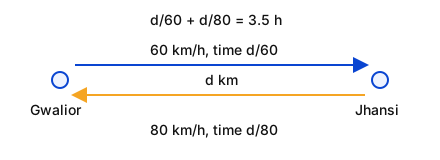
- Let one-way distance be km. .
- LCM 240: km.
- Check: h.
Trick: Same distance both ways – average speed km/h; total distance , so one way km.
Answer: (B) 120 km
अवधारणा: समय ; दोनों ओर के समय जोड़ें।
- एक ओर की दूरी km मानें: ।
- LCM 240: km।
- जाँच: घंटे।
ट्रिक: समान दूरी के लिए औसत चाल ; कुल दूरी km, एक ओर 120 km।
उत्तर: (B) 120 km
RRB NTPC Undergraduate CBT 1MathematicsSpeed, time and distanceRRB NTPC Undergraduate CBT 1 2025 · 14 Jun Shift 3
Q1744.A certain sum amounts to ₹5,200 in 2 years and ₹6,400 in 4 years at simple interest. What is the rate of interest per annum?
एक निश्चित धनराशि साधारण ब्याज पर 2 वर्षों में ₹5,200 और 4 वर्षों में ₹6,400 हो जाती है। वार्षिक ब्याज दर कितनी है?
- A10 percent10 प्रतिशत
- B12 percent12 प्रतिशत
- C18 percent18 प्रतिशत
- D15 percent15 प्रतिशत
Show answer
Concept: In SI the amount grows by the same interest every year.
- Interest for 2 years (from year 2 to year 4) , so yearly SI .
- Principal .
- Rate .
Trick: Difference of amounts ÷ difference of years = SI per year; subtract it back to reach P.
Answer: (D) 15 percent
अवधारणा: साधारण ब्याज में मिश्रधन हर वर्ष समान ब्याज से बढ़ता है।
- 2 वर्ष (वर्ष 2 से 4) का ब्याज , अतः वार्षिक ब्याज ।
- मूलधन ।
- दर ।
ट्रिक: मिश्रधनों का अंतर ÷ वर्षों का अंतर = प्रति वर्ष SI; इसे घटाकर मूलधन निकालें।
उत्तर: (D) 15 percent
RRB NTPC Undergraduate CBT 1MathematicsSimple interestRRB NTPC Undergraduate CBT 1 2025 · 14 Jun Shift 3
Q1745.The sum of the ages of two siblings is 28 years and the difference of their ages is 8 years. What is the present age of the elder sibling?
दो भाई-बहनों की आयु का योग 28 वर्ष है और उनकी आयु का अंतर 8 वर्ष है। बड़े भाई/बहन की वर्तमान आयु कितनी है?
- A20 years20 वर्ष
- B14 years14 वर्ष
- C18 years18 वर्ष
- D16 years16 वर्ष
Show answer
Concept: If sum and difference , larger , smaller .
- Elder years.
- Younger years; check , .
Trick: Larger number is always half of (sum + difference).
Answer: (C) 18 years
अवधारणा: योग और अंतर हो तो बड़ी संख्या , छोटी ।
- बड़ा भाई/बहन वर्ष।
- छोटा वर्ष; जाँच: , ।
ट्रिक: बड़ी संख्या = (योग + अंतर) का आधा।
उत्तर: (C) 18 years
RRB NTPC Undergraduate CBT 1MathematicsAgesRRB NTPC Undergraduate CBT 1 2025 · 14 Jun Shift 3
Q1746.A and B can do a piece of work in 12 days and 24 days, respectively. Both work for 2 days and then A leaves. How long (in days) will B take to complete the remaining work?
A और B किसी कार्य को क्रमशः 12 दिन और 24 दिन में कर सकते हैं। दोनों 2 दिन तक कार्य करते हैं और फिर A कार्य छोड़ देता है। B को शेष कार्य पूरा करने में कितना समय (दिनों में) लगेगा?
- A17
- B19
- C20
- D18
Show answer
Concept: Take total work = LCM of days and work in units per day.
- Total work units; A does units/day, B does unit/day.
- In 2 days together: units. Remaining units.
- B alone: days.
Trick: 2 days of both = 6 days of B alone; so B needs days more.
Answer: (D) 18
अवधारणा: कुल कार्य = दिनों का LCM लें और प्रतिदिन की इकाइयों में काम करें।
- कुल कार्य इकाई; A इकाई/दिन, B इकाई/दिन।
- 2 दिन में दोनों: इकाई; शेष ।
- B अकेले: दिन।
ट्रिक: दोनों के 2 दिन = B के अकेले 6 दिन के बराबर; अतः B को दिन और लगेंगे।
उत्तर: (D) 18
RRB NTPC Undergraduate CBT 1MathematicsTime and workRRB NTPC Undergraduate CBT 1 2025 · 14 Jun Shift 3
Q1747.The sum of two positive numbers is 40 and their product is 175. The positive difference between them is:
दो धनात्मक संख्याओं का योग 40 है और उनका गुणनफल 175 है। उनके बीच का धनात्मक अंतर कितना है?
- A32
- B36
- C34
- D30
Show answer
Concept: .
- .
- .
- Check: numbers are 35 and 5 ().
Trick: Product 175 and – spot the pair directly.
Answer: (D) 30
अवधारणा: ।
- ।
- ।
- जाँच: संख्याएँ 35 और 5 हैं।
ट्रिक: और – जोड़ा सीधे पहचानें।
उत्तर: (D) 30
RRB NTPC Undergraduate CBT 1MathematicsAlgebraic identitiesRRB NTPC Undergraduate CBT 1 2025 · 14 Jun Shift 3
Q1748.At what annual interest rate will a principal amount of ₹1,000 become ₹1,728 in a period of 1 year and 6 months, assuming that the interest is compounded semi-annually?
किस वार्षिक ब्याज दर पर ₹1,000 की मूलधनराशि 1 वर्ष 6 महीने की अवधि में ₹1,728 हो जाएगी, यदि ब्याज अर्धवार्षिक रूप से संयोजित होता है?
- A41%
- B40%
- C35%
- D32%
Show answer
Concept: Semi-annual compounding: rate per half-year , periods years.
- 1 year 6 months half-years.
- , so growth per half-year , i.e. .
- Annual rate .
Yaad rakhein: and – a cube means three periods of 20%.
Answer: (B) 40%
अवधारणा: अर्धवार्षिक चक्रवृद्धि में दर प्रति छमाही और अवधि वर्ष।
- 1 वर्ष 6 माह छमाही।
- , अतः प्रति छमाही वृद्धि।
- वार्षिक दर ।
याद रखें: , – घन का मतलब 20% की तीन अवधियाँ।
उत्तर: (B) 40%
RRB NTPC Undergraduate CBT 1MathematicsCompound interestRRB NTPC Undergraduate CBT 1 2025 · 14 Jun Shift 3
Q1749.The largest four-digit number which when divided by 12, 8 and 11 leaves the remainder 3 in each case, is:
चार अंकों की वह सबसे बड़ी संख्या कौन-सी है, जिसे 12, 8 और 11 से विभाजित करने पर प्रत्येक स्थिति में शेषफल 3 प्राप्त होता है?
- A9928
- B9771
- C9821
- D9535
Show answer
Concept: Numbers leaving the same remainder on division by several divisors are of the form (multiple of LCM) .
- LCM of 12, 8, 11 .
- Largest 4-digit multiple of 264: remainder , so .
- Required number .
Trick: Subtract 3 from each option and test divisibility by 8 and 11: ends in 768 (divisible by 8) and (divisible by 11).
Answer: (B) 9771
अवधारणा: कई भाजकों से समान शेष देने वाली संख्या = (LCM का गुणज) ।
- 12, 8, 11 का LCM ।
- 264 का सबसे बड़ा 4-अंकीय गुणज ।
- अभीष्ट संख्या ।
ट्रिक: विकल्पों में से 3 घटाकर 8 और 11 से विभाज्यता जाँचें: 9768 ही दोनों से विभाज्य है।
उत्तर: (B) 9771
RRB NTPC Undergraduate CBT 1MathematicsLCM – remaindersRRB NTPC Undergraduate CBT 1 2025 · 14 Jun Shift 3
Q1750.Four identical cubes are placed one after another and the length of the cuboid so formed is 256 cm. Find the volume of a single cube.
चार सर्वसम घनों को एक के बाद एक रखा जाता है और इस प्रकार बने घनाभ की लंबाई 256 cm है। एक घन का आयतन ज्ञात कीजिए।
- A265144 cm3
- B262154 cm3
- C362144 cm3
- D262144 cm3
Show answer
Concept: Placing identical cubes in a row gives a cuboid of length side.
- Side of each cube cm.
- Volume .
Yaad rakhein: ; the options differ only in digit order, so compute the last digits: ends in 4 and , .
Answer: (D)
अवधारणा: समान घनों को एक पंक्ति में रखने से बनी घनाभ की लंबाई भुजा।
- प्रत्येक घन की भुजा cm।
- आयतन ।
याद रखें: , ; विकल्पों में अंक उलट-पुलट हैं, इसलिए सावधानी से गुणा करें।
उत्तर: (D)
RRB NTPC Undergraduate CBT 1MathematicsMensuration – cubeRRB NTPC Undergraduate CBT 1 2025 · 14 Jun Shift 3
Q1751.Two trains are moving in opposite directions at speeds of 8 m/s and 10 m/s. If they completely pass each other in 8 seconds, find the combined length of both trains.
दो रेलगाड़ियाँ 8 m/s और 10 m/s की चाल से विपरीत दिशाओं में चल रही हैं। यदि वे 8 सेकंड में एक-दूसरे को पूरी तरह पार कर लेती हैं, तो दोनों रेलगाड़ियों की संयुक्त लंबाई ज्ञात कीजिए।
- A156 meters156 मीटर
- B150 meters150 मीटर
- C152 meters152 मीटर
- D144 meters144 मीटर
Show answer
Concept: Opposite directions – relative speed = sum of speeds; distance covered while crossing = sum of lengths.
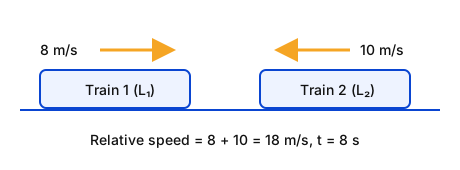
- Relative speed m/s.
- Combined length m.
Trick: Opposite → add speeds; same direction → subtract. Then length = speed × time.
Answer: (D) 144 meters
अवधारणा: विपरीत दिशा में सापेक्ष चाल = चालों का योग; पार करने में तय दूरी = लंबाइयों का योग।
- सापेक्ष चाल m/s।
- कुल लंबाई m।
ट्रिक: विपरीत दिशा → चालें जोड़ें; समान दिशा → घटाएँ। फिर लंबाई = चाल × समय।
उत्तर: (D) 144 meters
RRB NTPC Undergraduate CBT 1MathematicsTrainsRRB NTPC Undergraduate CBT 1 2025 · 14 Jun Shift 3
Q1752.If the fourth proportional to 5, 15, and 25 is k, then find k.
यदि 5, 15 और 25 का चतुर्थानुपाती k है, तो k ज्ञात कीजिए।
- Ak = 60
- Bk = 75
- Ck = 90
- Dk = 125
Show answer
Concept: Fourth proportional to is with , so .
- .
- Check: and .
Trick: Second term is 3 times the first, so the fourth is 3 times the third: .
Answer: (B) k = 75
अवधारणा: का चतुर्थानुपाती है जहाँ , अतः ।
- ।
- जाँच: ।
ट्रिक: दूसरा पद पहले का 3 गुना है, अतः चौथा तीसरे का 3 गुना: ।
उत्तर: (B) k = 75
RRB NTPC Undergraduate CBT 1MathematicsProportionRRB NTPC Undergraduate CBT 1 2025 · 14 Jun Shift 3
Q1753.In a triangle, the ratio of three angles is 3 : 3 : 4. Find the measure of the largest angle.
एक त्रिभुज में, तीनों कोणों का अनुपात 3 : 3 : 4 है। सबसे बड़े कोण का माप ज्ञात कीजिए।
- A84°
- B72°
- C62°
- D40°
Show answer
Concept: Angles of a triangle add to .
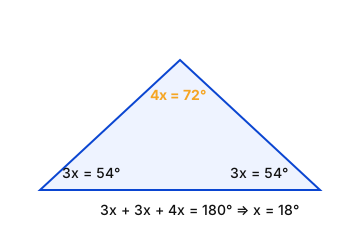
- Let angles be : .
- Largest angle .
Trick: Largest angle .
Answer: (B)
अवधारणा: त्रिभुज के कोणों का योग होता है।
- कोण मानें: ।
- सबसे बड़ा कोण ।
ट्रिक: सबसे बड़ा कोण ।
उत्तर: (B)
RRB NTPC Undergraduate CBT 1MathematicsAngles of a triangleRRB NTPC Undergraduate CBT 1 2025 · 14 Jun Shift 3
Q1754.The average of 8 numbers is 45. If each number is decreased by 3, what will the new average be?
8 संख्याओं का औसत 45 है। यदि प्रत्येक संख्या में 3 की कमी की जाए, तो नया औसत क्या होगा?
- A42
- B8
- C39
- D45
Show answer
Concept: If every observation changes by the same amount, the average changes by exactly that amount.
- Each of 8 numbers decreases by 3 → total decreases by .
- New average .
Trick: Add/subtract the same number from all → average shifts by that number; no need to touch the total.
Answer: (A) 42
अवधारणा: यदि हर संख्या में समान परिवर्तन हो, तो औसत में भी उतना ही परिवर्तन होता है।
- 8 संख्याओं में 3-3 घटे → योग में की कमी।
- नया औसत ।
ट्रिक: सबमें समान संख्या जोड़ें/घटाएँ → औसत उतना ही खिसकता है।
उत्तर: (A) 42
RRB NTPC Undergraduate CBT 1MathematicsAverageRRB NTPC Undergraduate CBT 1 2025 · 14 Jun Shift 3
Q1755.Find the greatest number that divides 75, 105 and 150 exactly.
वह सबसे बड़ी संख्या ज्ञात कीजिए जो 75, 105 और 150 को पूर्णतः विभाजित करती है।
- A10
- B25
- C5
- D15
Show answer
Concept: The greatest number dividing given numbers exactly is their HCF.
- , , .
- Common factors: .
Trick: 25 does not divide 105, 10 does not divide 75 – eliminate; 15 divides all three.
Answer: (D) 15
अवधारणा: दी गई संख्याओं को पूर्णतः विभाजित करने वाली सबसे बड़ी संख्या उनका HCF है।
- , , ।
- उभयनिष्ठ गुणनखंड ।
ट्रिक: 25 से 105 और 10 से 75 विभाजित नहीं होते – हटाएँ; 15 तीनों को काटता है।
उत्तर: (D) 15
RRB NTPC Undergraduate CBT 1MathematicsHCFRRB NTPC Undergraduate CBT 1 2025 · 14 Jun Shift 3
Q1756.A team of 3 workers, P, Q, and R, is assigned to paint a large wall. P alone can finish the work in 14 days, Q alone in 21 days, and R alone in 42 days. If they start together but P leaves after 4 days, and the remaining work is completed by Q and R together, in how many total days is the wall completely painted?
3 श्रमिकों, P, Q और R, की एक टीम को एक बड़ी दीवार पेंट करने का कार्य सौंपा जाता है। P अकेले कार्य को 14 दिनों में, Q अकेले 21 दिनों में और R अकेले 42 दिनों में पूरा कर सकता है। यदि वे एक साथ कार्य आरंभ करते हैं परंतु P 4 दिनों के बाद कार्य छोड़ देता है, और शेष कार्य Q और R मिलकर पूरा करते हैं, तो दीवार कुल कितने दिनों में पूरी तरह पेंट हो जाती है?
- A10 days10 दिन
- B9 days9 दिन
- C11 days11 दिन
- D12 days12 दिन
Show answer
Concept: Total work = LCM of days; efficiency = units per day.
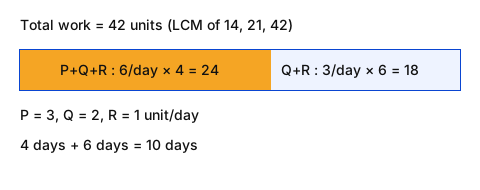
- LCM(14, 21, 42) units. P , Q , R unit/day.
- First 4 days (all three): units; remaining .
- Q + R units/day → days.
- Total days.
Trick: P's 4 days units; the other units are done by Q + R at 3/day = 10 days, which is the total time.
Answer: (A) 10 days
अवधारणा: कुल कार्य = दिनों का LCM; दक्षता = इकाई प्रति दिन।
- LCM(14, 21, 42) इकाई; P , Q , R इकाई/दिन।
- पहले 4 दिन तीनों: इकाई; शेष ।
- Q + R इकाई/दिन → दिन।
- कुल दिन।
ट्रिक: Q + R पूरे समय काम करते हैं: दिन।
उत्तर: (A) 10 days
RRB NTPC Undergraduate CBT 1MathematicsTime and workRRB NTPC Undergraduate CBT 1 2025 · 14 Jun Shift 3
Q1757.A shopkeeper fixes the marked price of an item 150% above its cost price. What percentage of discount on marked price should be allowed to gain 110%?
एक दुकानदार किसी वस्तु का अंकित मूल्य उसके क्रय मूल्य से 150% अधिक निर्धारित करता है। 110% का लाभ प्राप्त करने के लिए अंकित मूल्य पर कितने प्रतिशत की छूट दी जानी चाहिए?
- A17%
- B16%
- C14%
- D15%
Show answer
Concept: SP = MP × (1 − discount); required SP comes from the desired profit on CP.
- Let CP . MP (150% above CP).
- Required SP for 110% gain .
- Discount ; .
Trick: , so discount .
Answer: (B) 16%
अवधारणा: SP = MP × (1 − छूट); अभीष्ट SP, CP पर वांछित लाभ से मिलता है।
- CP मानें, MP ।
- 110% लाभ के लिए SP ।
- छूट ; ।
ट्रिक: → छूट ।
उत्तर: (B) 16%
RRB NTPC Undergraduate CBT 1MathematicsProfit, loss and discountRRB NTPC Undergraduate CBT 1 2025 · 14 Jun Shift 3
Q1758.A ladder of length 8 m is placed against a vertical wall, making an angle of 60° with the ground. How high does the ladder reach up the wall?
8 m लंबी एक सीढ़ी एक ऊर्ध्वाधर दीवार के सहारे इस प्रकार रखी गई है कि वह भूमि के साथ 60° का कोण बनाती है। सीढ़ी दीवार पर कितनी ऊँचाई तक पहुँचती है?
- A m
- B m
- C m
- D m
Show answer
Concept: In a right triangle, ; the ladder is the hypotenuse.
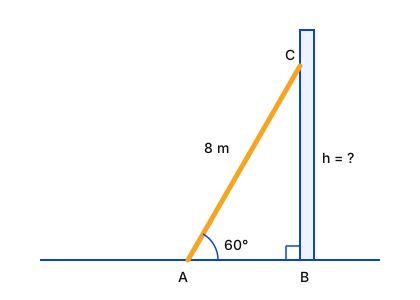
- Height .
- m m.
Yaad rakhein: -- triangle sides are ; hypotenuse 8 → side opposite is .
Answer: (A) m
अवधारणा: समकोण त्रिभुज में ; सीढ़ी कर्ण है।
- ऊँचाई ।
- m m।
याद रखें: -- त्रिभुज की भुजाएँ ; कर्ण 8 → के सामने की भुजा ।
उत्तर: (A) m
RRB NTPC Undergraduate CBT 1MathematicsHeights and distancesRRB NTPC Undergraduate CBT 1 2025 · 14 Jun Shift 3
Q1759.Which of the following pairs of numbers is co-prime?
A) (15, 25)
B) (14, 35)
C) (9, 28)
D) (21, 49)
निम्नलिखित में से कौन-सा संख्या युग्म सह-अभाज्य (co-prime) है?
A) (15, 25)
B) (14, 35)
C) (9, 28)
D) (21, 49)
- AB
- BC
- CD
- DA
Show answer
Concept: Two numbers are co-prime when their HCF is 1.
- (15, 25): HCF 5; (14, 35): HCF 7; (21, 49): HCF 7 – not co-prime.
- (9, 28): , – no common factor, HCF 1. So pair C is co-prime.
- Pair C corresponds to option (B).
Trick: Pairs with both numbers multiples of 5 or 7 are instantly out; 9 and 28 share nothing.
Answer: (B) C
अवधारणा: दो संख्याएँ सह-अभाज्य हैं जब उनका HCF 1 हो।
- (15, 25): HCF 5; (14, 35): HCF 7; (21, 49): HCF 7 – सह-अभाज्य नहीं।
- (9, 28): , – HCF 1, अतः युग्म C सह-अभाज्य है।
- युग्म C विकल्प (B) है।
ट्रिक: जिन युग्मों में दोनों संख्याएँ 5 या 7 की गुणज हों, वे तुरंत बाहर।
उत्तर: (B) C
RRB NTPC Undergraduate CBT 1MathematicsCo-prime numbersRRB NTPC Undergraduate CBT 1 2025 · 14 Jun Shift 3
Q1760.Three positive integers a, b, and c satisfy the following conditions: (i) a and b are coprime, (ii) b and c are coprime, (iii) a and c are not coprime, (iv) abc = 360. The minimum possible value of a + b + c is:
तीन धनात्मक पूर्णांक a, b और c निम्नलिखित शर्तों को संतुष्ट करते हैं: (i) a और b सह-अभाज्य हैं, (ii) b और c सह-अभाज्य हैं, (iii) a और c सह-अभाज्य नहीं हैं, (iv) abc = 360. a + b + c का न्यूनतम संभव मान कितना है?
- A95
- B27
- C23
- D33
Show answer
Concept: . must share no prime with or , while and share a prime.
- Give a prime of its own and split the rest between and so they share a factor.
- , with a common factor: → .
- Check: gcd(6,5) = 1, gcd(5,12) = 1, gcd(6,12) = 6. Sum .
- Other splits ( → 26; → 51) give larger sums.
Trick: Keep the lone prime 5 as and make as balanced as possible ( and ) – balanced factors give the smallest sum.
Answer: (C) 23
अवधारणा: । का या से कोई उभयनिष्ठ अभाज्य नहीं, जबकि और में एक उभयनिष्ठ अभाज्य हो।
- को अलग अभाज्य दें, बाकी और में बाँटें ताकि वे एक गुणनखंड साझा करें।
- , , → ।
- जाँच: gcd(6,5) = 1, gcd(5,12) = 1, gcd(6,12) = 6; योग ।
- अन्य विभाजन ( → 26) बड़े योग देते हैं।
ट्रिक: अकेले अभाज्य 5 को रखें और को यथासंभव संतुलित () बनाएँ – संतुलित गुणनखंडों का योग न्यूनतम होता है।
उत्तर: (C) 23
RRB NTPC Undergraduate CBT 1MathematicsNumber system – co-primesRRB NTPC Undergraduate CBT 1 2025 · 14 Jun Shift 3

