Q1.A shopkeeper purchases 20 identical items for ₹400. To make a profit of 25%, how many items should he sell for ₹400, if the selling price is uniform for all items?
एक दुकानदार 20 एक जैसी वस्तुएँ ₹400 में खरीदता है। 25% का लाभ कमाने के लिए उसे ₹400 में कितनी वस्तुएँ बेचनी चाहिए, यदि सभी वस्तुओं का विक्रय मूल्य समान हो?
- A20
- B16
- C15
- D18
Show answer
Concept: ; find the SP of one item, then see how many fit into ₹400.
- CP of 1 item ₹20.
- SP of 1 item at profit ₹25.
- Number of items sold for ₹400 .
Trick: Same money both sides → .
Answer: (B) 16
अवधारणा: ; एक वस्तु का SP निकालें, फिर देखें ₹400 में कितनी आएँगी।
- 1 वस्तु का CP ₹20।
- लाभ पर 1 वस्तु का SP ₹25।
- ₹400 में बेची गई वस्तुएँ ।
ट्रिक: दोनों ओर समान राशि → ।
उत्तर: (B) 16
RRB NTPC Undergraduate CBT 2MathematicsProfit and LossRRB NTPC Undergraduate CBT 2 2025 · 17 Sep Shift 1
Q2.Lines AB and CD are parallel, with A and C to the left of the transversal XY, and B and D to the right. The transversal intersects AB at M and CD at N, where X, M, N, and Y are collinear in that order. If measure of ∠XMA=125°, then the measure of ∠CNY is:
रेखाएँ AB और CD समांतर हैं, जिनमें A और C तिर्यक रेखा XY के बाईं ओर तथा B और D दाईं ओर हैं। तिर्यक रेखा AB को M पर और CD को N पर काटती है, जहाँ X, M, N और Y इसी क्रम में संरेख हैं। यदि ∠XMA की माप = 125° है, तो ∠CNY की माप है:
- A52°
- B58°
- C55°
- D50°
Show answer
Concept: When a transversal cuts two parallel lines, corresponding angles are equal, and angles on a straight line add up to .
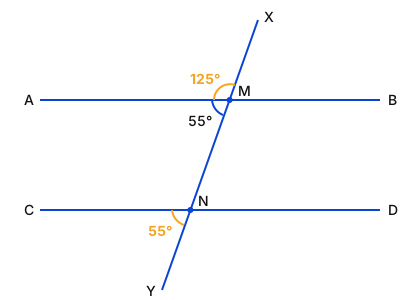
- At M, and form a linear pair on line XY: .
- (at M, between MA and MN) and (at N, between NC and NY) are corresponding angles for .
- So .
Trick: With parallel lines every angle at the two crossings is either or ; here , so the answer must be .
Answer: (C)
अवधारणा: जब तिर्यक रेखा दो समांतर रेखाओं को काटती है तो संगत कोण (corresponding angles) बराबर होते हैं, और एक सरल रेखा पर बने कोणों का योग होता है।
- M पर और रेखा XY पर रैखिक युग्म हैं: ।
- (M पर, MA व MN के बीच) और (N पर, NC व NY के बीच) के लिए संगत कोण हैं।
- अतः ।
ट्रिक: समांतर रेखाओं में दोनों कटान बिंदुओं पर हर कोण या तो या होता है; यहाँ , इसलिए उत्तर ही होगा।
उत्तर: (C)
RRB NTPC Undergraduate CBT 2MathematicsLines and AnglesRRB NTPC Undergraduate CBT 2 2025 · 17 Sep Shift 1
Q3.The LCM of the numbers 3, 77 and 33 is:
संख्याओं 3, 77 और 33 का LCM है:
- A242
- B231
- C77
- D462
Show answer
Concept: LCM = product of the highest powers of all prime factors present in the numbers.
- , , .
- Primes involved: 3, 7, 11 (each to power 1).
- LCM .
Trick: 3 already divides 33, so LCM(3, 77, 33) = LCM(77, 33) .
Answer: (B) 231
अवधारणा: LCM = संख्याओं में उपस्थित सभी अभाज्य गुणनखंडों की उच्चतम घातों का गुणनफल।
- , , ।
- अभाज्य: 3, 7, 11 (प्रत्येक घात 1)।
- LCM ।
ट्रिक: 3 पहले से 33 को विभाजित करता है, इसलिए LCM(3, 77, 33) = LCM(77, 33) ।
उत्तर: (B) 231
RRB NTPC Undergraduate CBT 2MathematicsLCM and HCFRRB NTPC Undergraduate CBT 2 2025 · 17 Sep Shift 1
Q4.₹620 amounts to ₹910 at a certain rate of simple interest in 2 years. Find the interest (in ₹) for the given 2 years.
₹620 साधारण ब्याज की एक निश्चित दर से 2 वर्षों में ₹910 हो जाता है। दिए गए 2 वर्षों का ब्याज (₹ में) ज्ञात कीजिए।
- A290
- B300
- C285
- D305
Show answer
Concept: Amount = Principal + Simple Interest, so – the rate is not needed.
- Principal = ₹620, Amount after 2 years = ₹910.
- SI ₹290.
- (If asked, rate p.a.)
Trick: Do not get distracted by "certain rate" – interest for the whole period is just .
Answer: (A) 290
अवधारणा: मिश्रधन = मूलधन + साधारण ब्याज, अतः – दर की ज़रूरत ही नहीं।
- मूलधन = ₹620, 2 वर्ष बाद मिश्रधन = ₹910।
- SI ₹290।
- (यदि पूछा जाए तो दर वार्षिक।)
ट्रिक: "निश्चित दर" से भ्रमित न हों – पूरी अवधि का ब्याज बस है।
उत्तर: (A) 290
RRB NTPC Undergraduate CBT 2MathematicsSimple InterestRRB NTPC Undergraduate CBT 2 2025 · 17 Sep Shift 1
Q5.A sum of money is divided among A, B, and C so that A gets twice as much as B and B gets three times as much as C. If the total sum is ₹720, how much does C get?
एक धनराशि को A, B और C के बीच इस प्रकार बाँटा जाता है कि A को B से दोगुना और B को C से तीन गुना मिलता है। यदि कुल राशि ₹720 है, तो C को कितना मिलता है?
- A₹60
- B₹96
- C₹72
- D₹84
Show answer
Concept: Express all shares in terms of the smallest share, add the parts and divide the total.
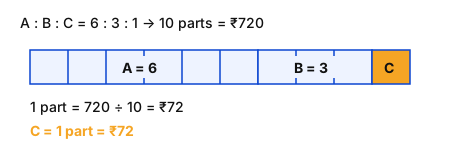
- Let C . Then B and A .
- Total .
- So C gets ₹72 (B = ₹216, A = ₹432).
Trick: A : B = 2 : 1 and B : C = 3 : 1 → A : B : C = 6 : 3 : 1; C's share .
Answer: (C) ₹72
अवधारणा: सभी हिस्सों को सबसे छोटे हिस्से के रूप में लिखें, भागों को जोड़ें और कुल को बाँटें।
- माना C । तब B और A ।
- कुल ।
- अतः C को ₹72 मिलते हैं (B = ₹216, A = ₹432)।
ट्रिक: A : B = 2 : 1 और B : C = 3 : 1 → A : B : C = 6 : 3 : 1; C का हिस्सा ।
उत्तर: (C) ₹72
RRB NTPC Undergraduate CBT 2MathematicsRatio and ProportionRRB NTPC Undergraduate CBT 2 2025 · 17 Sep Shift 1
Q6.In a division sum, the divisor is 3 times the quotient and 8 times the remainder. If the remainder is 12, what is the dividend?
एक भाग के प्रश्न में भाजक, भागफल का 3 गुना और शेषफल का 8 गुना है। यदि शेषफल 12 है, तो भाज्य क्या है?
- A3048
- B3084
- C3072
- D3066
Show answer
Concept: Dividend .
- Remainder ; divisor .
- Divisor quotient quotient .
- Dividend .
Trick: ; add the remainder 12 → 3084 (ends in 4, so options A/C/D are out).
Answer: (B) 3084
अवधारणा: भाज्य ।
- शेषफल ; भाजक ।
- भाजक भागफल भागफल ।
- भाज्य ।
ट्रिक: ; शेषफल 12 जोड़ें → 3084 (अंत में 4, अतः विकल्प A/C/D बाहर)।
उत्तर: (B) 3084
RRB NTPC Undergraduate CBT 2MathematicsNumber System – Division AlgorithmRRB NTPC Undergraduate CBT 2 2025 · 17 Sep Shift 1
Q7.Consider the data set: 4, 8, 6, 5, 3, 9. Find the variance.
आँकड़ों के समुच्चय 4, 8, 6, 5, 3, 9 पर विचार कीजिए। प्रसरण (variance) ज्ञात कीजिए।
- A
- B
- C
- D
Show answer
Concept: Variance (population variance, ).
- , so .
- .
- .
Trick: Keep the mean as a fraction () instead of a decimal; the denominator 36 appears directly, which eliminates options B and D.
Answer: (C)
अवधारणा: प्रसरण (समष्टि प्रसरण, )।
- , अतः ।
- ।
- ।
ट्रिक: माध्य को दशमलव की बजाय भिन्न () में रखें; हर 36 सीधे आता है, जिससे विकल्प B और D हट जाते हैं।
उत्तर: (C)
RRB NTPC Undergraduate CBT 2MathematicsStatistics – VarianceRRB NTPC Undergraduate CBT 2 2025 · 17 Sep Shift 1
Q8.A shopkeeper expects a gain of 40% on his cost price. If in a week, his sale proceeds were ₹3,955, what was his profit (in ₹)?
एक दुकानदार अपने क्रय मूल्य पर 40% लाभ की अपेक्षा करता है। यदि एक सप्ताह में उसकी बिक्री से प्राप्त राशि ₹3,955 थी, तो उसका लाभ (₹ में) क्या था?
- A1,130
- B1,133
- C1,129
- D1,132
Show answer
Concept: If gain is on CP, then , so .
- Sale proceeds (SP) = ₹3,955.
- CP ₹2,825.
- Profit ₹1,130.
Trick: Profit (since ).
Answer: (A) 1,130
अवधारणा: यदि CP पर लाभ है तो , अतः ।
- बिक्री राशि (SP) = ₹3,955।
- CP ₹2,825।
- लाभ ₹1,130।
ट्रिक: लाभ (क्योंकि )।
उत्तर: (A) 1,130
RRB NTPC Undergraduate CBT 2MathematicsProfit and LossRRB NTPC Undergraduate CBT 2 2025 · 17 Sep Shift 1
Q9.Find the area of a square, which has twice the area of a triangle whose base length is 23 cm and corresponding height is 12 cm.
एक ऐसे वर्ग का क्षेत्रफल ज्ञात कीजिए जिसका क्षेत्रफल उस त्रिभुज के क्षेत्रफल का दोगुना है, जिसके आधार की लंबाई 23 cm और संगत ऊँचाई 12 cm है।
- A256 cm2
- B204 cm2
- C218 cm2
- D276 cm2
Show answer
Concept: Area of triangle ; the square's area is twice this.
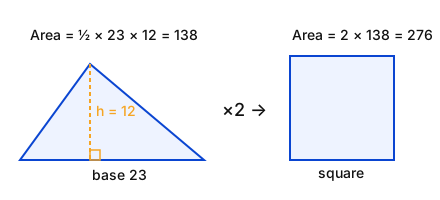
- Triangle area .
- Square area .
- (Its side would be cm, but only the area is asked.)
Trick: Twice the triangle's area is simply – no halving needed.
Answer: (D)
अवधारणा: त्रिभुज का क्षेत्रफल ; वर्ग का क्षेत्रफल इसका दोगुना है।
- त्रिभुज का क्षेत्रफल ।
- वर्ग का क्षेत्रफल ।
- (इसकी भुजा cm होगी, पर केवल क्षेत्रफल पूछा है।)
ट्रिक: त्रिभुज के क्षेत्रफल का दोगुना = – आधा करने की ज़रूरत ही नहीं।
उत्तर: (D)
RRB NTPC Undergraduate CBT 2MathematicsMensuration – AreaRRB NTPC Undergraduate CBT 2 2025 · 17 Sep Shift 1
Q10.If , find the value of .
यदि है, तो का मान ज्ञात कीजिए।
- A
- B
- C
- D
Show answer
Concept: Divide the whole equation by to get , then invert and rationalise.
- .
- .
- Rationalise: .
Trick: Since , and have opposite signs, so must be negative with denominator – only option C matches.
Answer: (C)
अवधारणा: पूरे समीकरण को से भाग देकर निकालें, फिर उलटकर परिमेयकरण (rationalise) करें।
- ।
- ।
- परिमेयकरण: ।
ट्रिक: चूँकि , और के चिह्न विपरीत हैं, अतः ऋणात्मक होगा और हर – केवल विकल्प C मेल खाता है।
उत्तर: (C)
RRB NTPC Undergraduate CBT 2MathematicsTrigonometry – IdentitiesRRB NTPC Undergraduate CBT 2 2025 · 17 Sep Shift 1
Q11.Find the fourth proportional to , and .
, और का चतुर्थानुपाती ज्ञात कीजिए।
- A
- B
- C
- D
Show answer
Concept: Fourth proportional to is with , so . With powers of the same base, add/subtract exponents.
Trick: Fourth proportional = (2nd × 3rd) ÷ 1st. For same base: multiply → add powers, divide → subtract powers.
Answer: (D)
अवधारणा: का चतुर्थानुपाती (fourth proportional) है जहाँ , अतः । समान आधार की घातों में घातांक जोड़ते/घटाते हैं।
ट्रिक: चतुर्थानुपाती = (दूसरा × तीसरा) ÷ पहला। समान आधार: गुणा → घात जोड़ें, भाग → घात घटाएँ।
उत्तर: (D)
RRB NTPC Undergraduate CBT 2MathematicsProportionRRB NTPC Undergraduate CBT 2 2025 · 17 Sep Shift 1
Q12.Evaluate: (−37) + (−56) ÷ (−3) × 3
मान ज्ञात कीजिए: (−37) + (−56) ÷ (−3) × 3
- A21
- B15
- C19
- D17
Show answer
Concept: Apply BODMAS: division and multiplication (left to right) before addition.
- , then
Trick: Negative ÷ negative = positive. The and cancel, leaving .
Answer: (C) 19
अवधारणा: BODMAS लागू करें: जोड़ से पहले भाग और गुणा (बाएँ से दाएँ)।
- , फिर
ट्रिक: ऋण ÷ ऋण = धन। और कट जाते हैं, बचता है ।
उत्तर: (C) 19
RRB NTPC Undergraduate CBT 2MathematicsSimplification (BODMAS)RRB NTPC Undergraduate CBT 2 2025 · 17 Sep Shift 1
Q13.7% of a number is what percentage of the 9% of the same number? (Rounded off to two decimal places.)
किसी संख्या का 7%, उसी संख्या के 9% का कितना प्रतिशत है? (दो दशमलव स्थानों तक पूर्णांकित)
- A43.75%
- B21.87%
- C78.57%
- D77.78%
Show answer
Concept: Required percentage ; the number itself cancels out.
Trick: Such questions never depend on the number — just divide the two percentages: .
Answer: (D) 77.78%
अवधारणा: अभीष्ट प्रतिशत ; संख्या स्वयं कट जाती है।
ट्रिक: ऐसे प्रश्न संख्या पर निर्भर नहीं करते — बस दोनों प्रतिशतों का भाग करें: ।
उत्तर: (D) 77.78%
RRB NTPC Undergraduate CBT 2MathematicsPercentageRRB NTPC Undergraduate CBT 2 2025 · 17 Sep Shift 1
Q14.Find the total number of prime factors of the number .
संख्या के अभाज्य गुणनखंडों की कुल संख्या ज्ञात कीजिए।
- A26
- B22
- C28
- D30
Show answer
Concept: Write every base as a product of primes; the total number of prime factors is the sum of all exponents (counted with repetition).
- Total prime factors
Trick: Only 6 is composite here — split it first. (Distinct primes would be 4; total prime factors counts repetition.)
Answer: (A) 26
अवधारणा: हर आधार को अभाज्य संख्याओं के गुणनफल में लिखें; कुल अभाज्य गुणनखंड = सभी घातांकों का योग (पुनरावृत्ति सहित)।
- कुल अभाज्य गुणनखंड
ट्रिक: यहाँ केवल 6 भाज्य है — उसे पहले तोड़ें। (भिन्न अभाज्य 4 होते; 'कुल' में पुनरावृत्ति गिनी जाती है।)
उत्तर: (A) 26
RRB NTPC Undergraduate CBT 2MathematicsNumber System – Prime FactorsRRB NTPC Undergraduate CBT 2 2025 · 17 Sep Shift 1
Q15.If 25% of A is equal to 40% of B, and 30% of B is equal to 45% of C, then A:B:C is:
यदि A का 25%, B के 40% के बराबर है और B का 30%, C के 45% के बराबर है, तो A:B:C है:
- A8:5:3
- B12:9:7
- C24:14:9
- D24:15:10
Show answer
Concept: Convert each percentage relation into a ratio, then combine by making the common term (B) equal.
- Make B equal: , →
Trick: gives (the numbers swap sides).
Answer: (D) 24:15:10
अवधारणा: हर प्रतिशत संबंध को अनुपात में बदलें, फिर उभयनिष्ठ पद (B) को बराबर करके जोड़ें।
- B बराबर करें: , →
ट्रिक: से (संख्याएँ पक्ष बदल लेती हैं)।
उत्तर: (D) 24:15:10
RRB NTPC Undergraduate CBT 2MathematicsRatioRRB NTPC Undergraduate CBT 2 2025 · 17 Sep Shift 1
Q16.If the average of three numbers is 15 and two of the numbers are 10 and 20, what is the third number?
यदि तीन संख्याओं का औसत 15 है और उनमें से दो संख्याएँ 10 और 20 हैं, तो तीसरी संख्या क्या है?
- A10
- B15
- C20
- D25
Show answer
Concept: Sum average number of terms.
- Sum of three numbers
- Third number
Trick: If two numbers average to the given mean (here ), the third must equal the mean itself.
Answer: (B) 15
अवधारणा: योग औसत पदों की संख्या।
- तीन संख्याओं का योग
- तीसरी संख्या
ट्रिक: यदि दो संख्याओं का औसत दिए गए औसत के बराबर है (यहाँ ), तो तीसरी संख्या भी औसत ही होगी।
उत्तर: (B) 15
RRB NTPC Undergraduate CBT 2MathematicsAverageRRB NTPC Undergraduate CBT 2 2025 · 17 Sep Shift 1
Q17.A water tank is of cuboidal shape having length 15 m and breadth 12 m. The sum of the area of the floor and ceiling of the tank is same as the area of four walls of the tank. How many liters of rainwater can be collected in this tank?
एक पानी की टंकी घनाभाकार है जिसकी लंबाई 15 m और चौड़ाई 12 m है। टंकी के फर्श और छत के क्षेत्रफलों का योग टंकी की चारों दीवारों के क्षेत्रफल के बराबर है। इस टंकी में कितने लीटर वर्षा जल एकत्र किया जा सकता है?
- A1000 × 102 liters1000 × 102 लीटर
- B1200 × 102 liters1200 × 102 लीटर
- C1200 litres1200 लीटर
- D1200 × 103 liters1200 × 103 लीटर
Show answer
Concept: Floor + ceiling ; four walls . Volume , and litres.
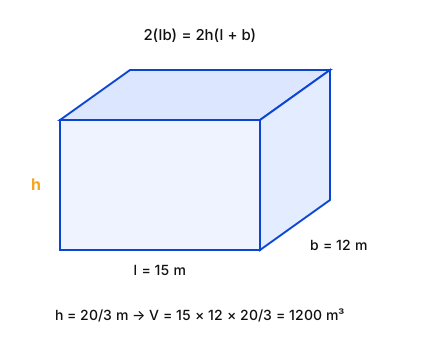
- Volume
- litres
Trick: Floor + ceiling = walls ⇒ . Then always convert m³ → litres by .
Answer: (D) liters
अवधारणा: फर्श + छत ; चार दीवारें । आयतन , और लीटर।
- आयतन
- लीटर
ट्रिक: फर्श + छत = दीवारें ⇒ । फिर m³ → लीटर के लिए करें।
उत्तर: (D) लीटर
RRB NTPC Undergraduate CBT 2MathematicsMensuration – CuboidRRB NTPC Undergraduate CBT 2 2025 · 17 Sep Shift 1
Q18.A, B and C together can complete a certain work in 37 days. B and C together can complete the same work in 74 days. B is 50% more efficient than A. A, B and C work together for 28 days. B alone will complete the remaining work in:
A, B और C मिलकर एक निश्चित कार्य को 37 दिनों में पूरा कर सकते हैं। B और C मिलकर उसी कार्य को 74 दिनों में पूरा कर सकते हैं। B, A से 50% अधिक कार्यकुशल है। A, B और C 28 दिनों तक एक साथ कार्य करते हैं। शेष कार्य को B अकेले कितने दिनों में पूरा करेगा?
- A9 days9 दिन
- B13 days13 दिन
- C12 days12 दिन
- D14 days14 दिन
Show answer
Concept: Work per day . Efficiency of B efficiency of A.
- A's one-day work
- B's one-day work
- Work done in 28 days , remaining
- B alone: days
Trick: Take total work units: group does 4/day, A does 2/day, B does 3/day. Remaining units days.
Answer: (C) 12 days
अवधारणा: प्रतिदिन कार्य । B की दक्षता A की दक्षता।
- A का एक दिन का कार्य
- B का एक दिन का कार्य
- 28 दिन में कार्य , शेष
- B अकेला: दिन
ट्रिक: कुल कार्य इकाई लें: समूह 4/दिन, A 2/दिन, B 3/दिन। शेष इकाई दिन।
उत्तर: (C) 12 दिन
RRB NTPC Undergraduate CBT 2MathematicsTime and WorkRRB NTPC Undergraduate CBT 2 2025 · 17 Sep Shift 1
Q19.Evaluate: 11 − 12 ÷ 12 × 8
मान ज्ञात कीजिए: 11 − 12 ÷ 12 × 8
- A3
- B4
- C2
- D1
Show answer
Concept: Division and multiplication first (left to right), then subtraction.
- , then
Trick: Never subtract first: is the classic trap. Resolve the and chain before touching .
Answer: (A) 3
अवधारणा: पहले भाग और गुणा (बाएँ से दाएँ), फिर घटाव।
- , फिर
ट्रिक: पहले घटाना मत: आम जाल है। से पहले और की श्रृंखला हल करें।
उत्तर: (A) 3
RRB NTPC Undergraduate CBT 2MathematicsSimplification (BODMAS)RRB NTPC Undergraduate CBT 2 2025 · 17 Sep Shift 1
Q20.A cyclist travels the first 30 km at 20 km/h, the next 50 km at 25 km/h, and the final 20 km at 10 km/h. What is the cyclist's average speed for the entire 100 km trip (round off to the nearest integer)?
एक साइकिल सवार पहले 30 km की दूरी 20 km/h की चाल से, अगले 50 km की दूरी 25 km/h की चाल से और अंतिम 20 km की दूरी 10 km/h की चाल से तय करता है। पूरी 100 km की यात्रा के लिए साइकिल सवार की औसत चाल क्या है (निकटतम पूर्णांक तक पूर्णांकित)?
- A18 km/h
- B20 km/h
- C19 km/h
- D21 km/h
Show answer
Concept: Average speed (never the average of speeds).
- Times: h, h, h → total h
- Average speed
Trick: Different distances at different speeds → compute each time separately; the slow 10 km/h stretch pulls the average well below 20.
Answer: (A) 18 km/h
अवधारणा: औसत चाल (चालों का औसत कभी नहीं)।
- समय: h, h, h → कुल h
- औसत चाल
ट्रिक: अलग-अलग दूरियाँ अलग चालों पर → हर भाग का समय अलग निकालें; धीमा 10 km/h वाला हिस्सा औसत को 20 से काफी नीचे खींच देता है।
उत्तर: (A) 18 km/h
RRB NTPC Undergraduate CBT 2MathematicsSpeed – Average SpeedRRB NTPC Undergraduate CBT 2 2025 · 17 Sep Shift 1

