Q21.In this question, a question is followed by two statements numbered (I) and (II). You have to decide whether the data provided in the statements are sufficient to answer the question. Read both the statements and decide the appropriate answer.
Question: Five people A, B, C, D and E are sitting in a straight row, facing north. Who sits second to the right of A?
Statement (I): The number of people sitting to the right of A is equal to the number of people sitting to the left of A. One person sits between A and B. D sits to the immediate left of B.
Statement (II): E sits at the extreme left end of the row. Only one person sits between E and A. B sits to the immediate right of D.
इस प्रश्न में, एक प्रश्न के बाद (I) और (II) क्रमांकित दो कथन दिए गए हैं। आपको यह निर्णय करना है कि कथनों में दिए गए आँकड़े प्रश्न का उत्तर देने के लिए पर्याप्त हैं या नहीं। दोनों कथनों को पढ़िए और उपयुक्त उत्तर का निर्णय कीजिए।
प्रश्न: पाँच व्यक्ति A, B, C, D और E एक सीधी पंक्ति में उत्तर की ओर मुख करके बैठे हैं। A के दाएँ से दूसरे स्थान पर कौन बैठा है?
कथन (I): A के दाएँ बैठे व्यक्तियों की संख्या A के बाएँ बैठे व्यक्तियों की संख्या के बराबर है। A और B के बीच एक व्यक्ति बैठा है। D, B के ठीक बाएँ बैठा है।
कथन (II): E पंक्ति के सबसे बाएँ छोर पर बैठा है। E और A के बीच केवल एक व्यक्ति बैठा है। B, D के ठीक दाएँ बैठा है।
- AData in statements I and II together are sufficient to answer the question.कथन I और II के आँकड़े मिलाकर प्रश्न का उत्तर देने के लिए पर्याप्त हैं।
- BData in Statement I alone is sufficient to answer the question while data in statement II is not.केवल कथन I के आँकड़े प्रश्न का उत्तर देने के लिए पर्याप्त हैं, जबकि कथन II के आँकड़े पर्याप्त नहीं हैं।
- CData in Statement II alone is sufficient to answer the question while data in statement I is not.केवल कथन II के आँकड़े प्रश्न का उत्तर देने के लिए पर्याप्त हैं, जबकि कथन I के आँकड़े पर्याप्त नहीं हैं।
- DData in either statement I alone or statement II alone are sufficient to answer the question.या तो केवल कथन I या केवल कथन II के आँकड़े प्रश्न का उत्तर देने के लिए पर्याप्त हैं।
Show answer
Concept: Five people facing north; "right" means towards the higher position number (1 = extreme left).
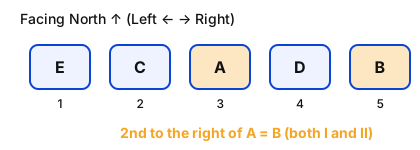
- Statement I: equal people on both sides of A → A at position 3. One person between A and B → B at 1 or 5. D immediately left of B is impossible if B is at 1, so B = 5, D = 4. Second to the right of A = position 5 = B. Sufficient.
- Statement II: E at 1, one between E and A → A at 3. D–B adjacent with B to the right of D → D = 4, B = 5 (C = 2). Second right of A = B. Sufficient.
Trick: Fix A in the middle first; the D-B pair must then fit at 4–5.
Answer: (D) Data in either statement I alone or statement II alone are sufficient to answer the question.
अवधारणा: पाँच लोग उत्तर की ओर मुख; "दाएँ" = बड़ी स्थिति संख्या की ओर (1 = सबसे बाएँ)।
- कथन I: A के दोनों ओर बराबर लोग → A स्थिति 3 पर। A और B के बीच एक → B 1 या 5 पर। B = 1 हो तो D उसके ठीक बाएँ नहीं बैठ सकता, अतः B = 5, D = 4। A के दाएँ दूसरा = स्थिति 5 = B। पर्याप्त।
- कथन II: E = 1, E और A के बीच एक → A = 3। B, D के ठीक दाएँ → D = 4, B = 5 (C = 2)। A के दाएँ दूसरा = B। पर्याप्त।
ट्रिक: पहले A को बीच में रखें; फिर D-B जोड़ी 4–5 पर ही बैठ सकती है।
उत्तर: (D) Data in either statement I alone or statement II alone are sufficient to answer the question.
RRB Technician Grade I (Signal)General Intelligence and ReasoningData sufficiency – seatingRRB Technician Grade I (Signal) 2024 · 20 Dec Shift 1
Q22.Based on the English alphabetical order, three of the following four letter-clusters are alike in a certain way and thus form a group. Which letter-cluster DOES NOT belong to that group?
(Note: The odd one out is not based on the number of consonants/vowels or their position in the letter-cluster.)
अंग्रेज़ी वर्णमाला क्रम के आधार पर, निम्नलिखित चार अक्षर-समूहों में से तीन किसी निश्चित प्रकार से एक समान हैं और इस प्रकार एक समूह बनाते हैं। कौन-सा अक्षर-समूह उस समूह से संबंधित नहीं है?
(नोट: असंगत विकल्प व्यंजनों/स्वरों की संख्या या अक्षर-समूह में उनकी स्थिति पर आधारित नहीं है।)
- AUXEK
- BJMTZ
- CCFMS
- DQXEG
Show answer
Concept: Compare the gaps between consecutive letters (positions A=1 … Z=26).
- UXEK: U(21)→X(24) , X→E (wrapping past Z), E(5)→K(11) .
- JMTZ: ; CFMS: — same pattern.
- QXEG: Q(17)→X(24) , X→E , E→G — different.
Trick: Check only the first gap: vs — QXEG breaks it.
Answer: (D) QXEG
अवधारणा: क्रमागत अक्षरों के अंतर देखें (A=1 … Z=26)।
- UXEK: U(21)→X(24) , X→E (Z के बाद घूमकर), E(5)→K(11) ।
- JMTZ: ; CFMS: — एक ही पैटर्न।
- QXEG: Q(17)→X(24) , X→E , E→G — अलग।
ट्रिक: केवल पहला अंतर देखें: बनाम — QXEG अलग है।
उत्तर: (D) QXEG
RRB Technician Grade I (Signal)General Intelligence and ReasoningLetter-cluster odd one outRRB Technician Grade I (Signal) 2024 · 20 Dec Shift 1
Q23.Uday starts from Point Y and drives 16 km towards the North. He then takes a right turn, drives 28 km, turns right and drives 31 km. He then takes a right turn and drives 13 km. He takes a right turn and drives 41 km. He then turns left, drives 15 km, turns right and drives 8 km to stop at Point Z. How far (shortest distance) and towards which direction should he drive in order to reach Point Y again? (All turns are 90 degrees turns only unless specified)
उदय बिंदु Y से चलना शुरू करता है और उत्तर की ओर 16 km गाड़ी चलाता है। फिर वह दाएँ मुड़ता है, 28 km चलता है, दाएँ मुड़ता है और 31 km चलता है। फिर वह दाएँ मुड़ता है और 13 km चलता है। वह दाएँ मुड़ता है और 41 km चलता है। फिर वह बाएँ मुड़ता है, 15 km चलता है, दाएँ मुड़ता है और 8 km चलकर बिंदु Z पर रुक जाता है। पुनः बिंदु Y पर पहुँचने के लिए उसे कितनी दूरी (न्यूनतम दूरी) और किस दिशा में गाड़ी चलानी चाहिए? (जब तक अन्यथा न कहा गया हो, सभी मोड़ केवल 90 डिग्री के मोड़ हैं)
- A34 km towards South34 km दक्षिण की ओर
- B47 km towards North47 km उत्तर की ओर
- C49 km towards East49 km पूर्व की ओर
- D25 km towards South25 km दक्षिण की ओर
Show answer
Concept: Track the position on a grid; take Y as , North , East .
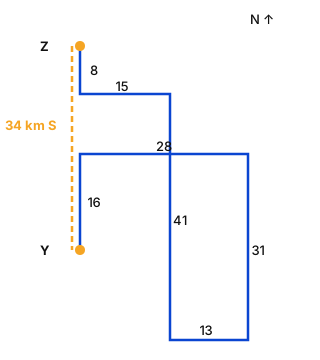
- N 16 → ; right (E) 28 → ; right (S) 31 → ; right (W) 13 → .
- Right (N) 41 → ; left (W) 15 → ; right (N) 8 → = Z.
- Z is directly north of Y by 34 km → he must drive 34 km South.
Trick: East–West: ; North–South: (north) → go 34 km South.
Answer: (A) 34 km towards South
अवधारणा: ग्रिड पर स्थिति ट्रैक करें; Y , उत्तर , पूर्व ।
- N 16 → ; दाएँ (E) 28 → ; दाएँ (S) 31 → ; दाएँ (W) 13 → ।
- दाएँ (N) 41 → ; बाएँ (W) 15 → ; दाएँ (N) 8 → = Z।
- Z, Y के ठीक उत्तर में 34 km है → 34 km दक्षिण जाना होगा।
ट्रिक: पूर्व–पश्चिम: ; उत्तर–दक्षिण: (उत्तर) → 34 km दक्षिण।
उत्तर: (A) 34 km towards South
RRB Technician Grade I (Signal)General Intelligence and ReasoningDirection senseRRB Technician Grade I (Signal) 2024 · 20 Dec Shift 1
Q24.Which of the following terms will replace the question mark (?) in the given series to make it logically complete?
IO19 KQ30 MS41 OU52 ?
निम्नलिखित में से कौन-सा पद दी गई श्रृंखला में प्रश्नचिह्न (?) के स्थान पर आकर इसे तार्किक रूप से पूर्ण करेगा?
IO19 KQ30 MS41 OU52 ?
- AQX64
- BQW63
- CQX63
- DQW64
Show answer
Concept: Treat the letter pair and the number as separate patterns.
- First letters: I, K, M, O → each → next Q.
- Second letters: O, Q, S, U → each → next W.
- Numbers: → each → .
- Next term: QW63.
Trick: Letters jump by 2, number by 11 — eliminate QX and 64 immediately.
Answer: (B) QW63
अवधारणा: अक्षर-युग्म और संख्या के पैटर्न अलग-अलग देखें।
- पहले अक्षर: I, K, M, O → हर बार → अगला Q।
- दूसरे अक्षर: O, Q, S, U → → अगला W।
- संख्याएँ: → → ।
- अगला पद: QW63।
ट्रिक: अक्षर 2 बढ़ते हैं, संख्या 11 — QX और 64 तुरंत हटाएँ।
उत्तर: (B) QW63
RRB Technician Grade I (Signal)General Intelligence and ReasoningAlphanumeric seriesRRB Technician Grade I (Signal) 2024 · 20 Dec Shift 1
Q25.EDSP is related to NMBY in a certain way based on the English alphabetical order. In the same way, ONCZ is related to XWLI. To which of the following options is PODA related, following the same logic?
अंग्रेज़ी वर्णमाला क्रम के आधार पर EDSP, NMBY से एक निश्चित प्रकार से संबंधित है। उसी प्रकार ONCZ, XWLI से संबंधित है। उसी तर्क का अनुसरण करते हुए PODA निम्नलिखित में से किस विकल्प से संबंधित है?
- AYXMK
- BYUIJ
- CYXMJ
- DYUTR
Show answer
Concept: Find the position shift applied to each letter (A=1 … Z=26, wrapping after Z).
- EDSP → NMBY: E(5)+9=N(14), D(4)+9=M(13), S(19)+9=B(28−26=2), P(16)+9=Y(25). Every letter moves .
- Check ONCZ → XWLI: O+9=X, N+9=W, C+9=L, Z+9=I ✓.
- PODA: P+9=Y, O+9=X, D+9=M, A+9=J → YXMJ.
Trick: Same shift for all letters – test only the first letter (P→Y) and the last (A→J) to pick the option quickly.
Answer: (C) YXMJ
अवधारणा: हर अक्षर पर लगाया गया स्थान-परिवर्तन खोजें (A=1 … Z=26, Z के बाद फिर A से)।
- EDSP → NMBY: E(5)+9=N(14), D(4)+9=M(13), S(19)+9=B(28−26=2), P(16)+9=Y(25)। हर अक्षर आगे।
- जाँच ONCZ → XWLI: O+9=X, N+9=W, C+9=L, Z+9=I ✓।
- PODA: P+9=Y, O+9=X, D+9=M, A+9=J → YXMJ।
ट्रिक: सभी अक्षरों पर एक ही shift – केवल पहला (P→Y) और अंतिम (A→J) अक्षर जाँचकर विकल्प तुरंत चुनें।
उत्तर: (C) YXMJ
RRB Technician Grade I (Signal)General Intelligence and ReasoningLetter analogyRRB Technician Grade I (Signal) 2024 · 20 Dec Shift 1
Q26.Select the set in which the numbers are related in the same way as are the numbers of the following sets.
(NOTE: Operations should be performed on the whole numbers, without breaking down the numbers into its constituent digits. E.g., 13 – Operations on 13 such as
adding/deleting/multiplying etc. to 13 can be performed. Breaking down 13 into 1 and 3 and then performing mathematical operations on 1 and 3 is not allowed)
(19, 6, 17)
(79, 11, 42)
उस समुच्चय का चयन कीजिए जिसमें संख्याएँ उसी प्रकार संबंधित हैं जिस प्रकार निम्नलिखित समुच्चयों की संख्याएँ संबंधित हैं।
(नोट: संक्रियाएँ पूर्ण संख्याओं पर की जानी चाहिए, संख्याओं को उनके घटक अंकों में तोड़े बिना। उदाहरण के लिए, 13 – 13 पर संक्रियाएँ जैसे
13 में जोड़ना/घटाना/गुणा करना आदि किया जा सकता है। 13 को 1 और 3 में तोड़कर फिर 1 और 3 पर गणितीय संक्रियाएँ करने की अनुमति नहीं है)
(19, 6, 17)
(79, 11, 42)
- A(2, 6, 5)
- B(15, 5, 6)
- C(13, 49, 2)
- D(14, 4, 2)
Show answer
Concept: Find one rule connecting the three numbers of each given set and apply it to the options.
- : ✓.
- : ✓. Rule: third = (second) − first.
- Option (D) : ✓. Others fail: , , .
Trick: When one number is much bigger than the third, try the square of the small middle number.
Answer: (D) (14, 4, 2)
अवधारणा: दिए गए हर समुच्चय की तीन संख्याओं को जोड़ने वाला एक नियम खोजें और विकल्पों पर लगाएँ।
- : ✓।
- : ✓। नियम: तीसरी = (दूसरी) − पहली।
- विकल्प (D) : ✓। बाकी असफल: , , ।
ट्रिक: जब एक संख्या तीसरी से बहुत बड़ी हो, तो छोटी बीच वाली संख्या का वर्ग आज़माएँ।
उत्तर: (D) (14, 4, 2)
RRB Technician Grade I (Signal)General Intelligence and ReasoningNumber set relationRRB Technician Grade I (Signal) 2024 · 20 Dec Shift 1
Q27.In the following number-pairs, the second number is obtained by applying certain mathematical operations to the first number. Which numbers should replace X and Y so that the pattern followed by the two numbers on the left side of :: is same as that on the right side of ::?
(NOTE: Operations should be performed on the whole numbers, without breaking down the numbers into their constituent digits. E.g. 13 – Operations on 13 such as
adding/subtracting/multiplying to 13 can be performed. Breaking down 13 into 1 and 3 and then performing mathematical operations on 1 and 3 is not allowed.)
X : 130 :: 34 : Y
निम्नलिखित संख्या-युग्मों में, दूसरी संख्या पहली संख्या पर कुछ निश्चित गणितीय संक्रियाएँ करके प्राप्त की गई है। X और Y के स्थान पर कौन-सी संख्याएँ आनी चाहिए ताकि :: के बाईं ओर की दो संख्याओं द्वारा अनुसरण किया गया पैटर्न :: के दाईं ओर के पैटर्न के समान हो?
(नोट: संक्रियाएँ पूर्ण संख्याओं पर की जानी चाहिए, संख्याओं को उनके घटक अंकों में तोड़े बिना। उदाहरण के लिए, 13 – 13 पर संक्रियाएँ जैसे
13 में जोड़ना/घटाना/गुणा करना किया जा सकता है। 13 को 1 और 3 में तोड़कर फिर 1 और 3 पर गणितीय संक्रियाएँ करने की अनुमति नहीं है।)
X : 130 :: 34 : Y
- AX=26, Y=170
- BX=24, Y=160
- CX=29, Y=185
- DX=28, Y=190
Show answer
Concept: The same operation turns the first number into the second on both sides of ::.
- Test the options on the known pair – with , and then .
- Option (A) gives exactly , ; the other options do not satisfy one common rule (, , ).
Trick: and – both end in 0 because of the rule.
Answer: (A) X = 26, Y = 170
अवधारणा: :: के दोनों ओर पहली संख्या से दूसरी संख्या एक ही संक्रिया से बनती है।
- ज्ञात युग्म पर विकल्प जाँचें – से और फिर ।
- विकल्प (A) में ठीक , है; बाकी विकल्प एक समान नियम पर खरे नहीं उतरते (, , )।
ट्रिक: और – नियम के कारण दोनों 0 पर खत्म होते हैं।
उत्तर: (A) X = 26, Y = 170
RRB Technician Grade I (Signal)General Intelligence and ReasoningNumber pair analogyRRB Technician Grade I (Signal) 2024 · 20 Dec Shift 1
Q28.Each of members , P, Q, R, S, T, U and V, of a certain department has to attend a seminar on different days of the same week starting from Monday to Sunday.
T has to attend the seminar immediately before P. Q has to attend the seminar on Tuesday. V has to attend the seminar on Sunday. Only U has to attend the seminar between P and R. S has to attend the seminar on one of the days before Q. Who has to attend the seminar on Monday?
किसी विभाग के सदस्यों P, Q, R, S, T, U और V में से प्रत्येक को सोमवार से रविवार तक एक ही सप्ताह के अलग-अलग दिनों में एक सेमिनार में भाग लेना है।
T को P के ठीक पहले सेमिनार में भाग लेना है। Q को मंगलवार को सेमिनार में भाग लेना है। V को रविवार को सेमिनार में भाग लेना है। P और R के बीच केवल U को सेमिनार में भाग लेना है। S को Q से पहले के किसी एक दिन सेमिनार में भाग लेना है। सोमवार को किसे सेमिनार में भाग लेना है?
- AS
- BT
- CR
- DP
Show answer
Concept: Fix the definite positions first, then fit the remaining people using the "immediately before" and "only one between" clues.
- Q – Tuesday, V – Sunday. S is before Q, so S – Monday.
- Remaining days Wed–Sat for T, P, U, R: T immediately before P and only U between P and R gives the block T–P–U–R.
- Final order: Mon S, Tue Q, Wed T, Thu P, Fri U, Sat R, Sun V.
Trick: "S before Q (Tuesday)" leaves only Monday for S – the answer comes in one step.
Answer: (A) S
अवधारणा: पहले निश्चित स्थान भरें, फिर "ठीक पहले" और "बीच में केवल एक" संकेतों से बाकी लोगों को बिठाएँ।
- Q – मंगलवार, V – रविवार। S, Q से पहले है, अतः S – सोमवार।
- बचे दिन बुध–शनि T, P, U, R के लिए: T, P से ठीक पहले और P व R के बीच केवल U – यानी ब्लॉक T–P–U–R।
- अंतिम क्रम: सोम S, मंगल Q, बुध T, गुरु P, शुक्र U, शनि R, रवि V।
ट्रिक: "S, Q (मंगलवार) से पहले" – S के लिए केवल सोमवार बचता है, उत्तर एक कदम में।
उत्तर: (A) S
RRB Technician Grade I (Signal)General Intelligence and ReasoningScheduling (days of week)RRB Technician Grade I (Signal) 2024 · 20 Dec Shift 1
Q29.If ‘A’ stands for ‘÷’, ‘B’ stands for ‘×’, ‘C’ stands for ‘+’ and ‘D’ stands for ‘−’, then what will come in place of the question mark (?) in the following equation?
45 C 30 A 10 D 7 B 2 = ?
यदि ‘A’ का अर्थ ‘÷’, ‘B’ का अर्थ ‘×’, ‘C’ का अर्थ ‘+’ और ‘D’ का अर्थ ‘−’ है, तो निम्नलिखित समीकरण में प्रश्नचिह्न (?) के स्थान पर क्या आएगा?
45 C 30 A 10 D 7 B 2 = ?
- A32
- B31
- C33
- D34
Show answer
Concept: Replace the letters by the given signs and apply BODMAS (÷ and × before + and −).
- .
- , .
- .
Trick: Do ÷ and × first, then add and subtract in one go: .
Answer: (D) 34
अवधारणा: अक्षरों की जगह दिए गए चिह्न रखें और BODMAS लगाएँ (÷ और × पहले, + और − बाद में)।
- ।
- , ।
- ।
ट्रिक: पहले ÷ और ×, फिर एक साथ जोड़-घटाव: ।
उत्तर: (D) 34
RRB Technician Grade I (Signal)General Intelligence and ReasoningMathematical operations (coded)RRB Technician Grade I (Signal) 2024 · 20 Dec Shift 1
Q30.If ‘A’ stands for ‘÷’, ‘B’ stands for ‘×’, ‘C’ stands for ‘+’ and ‘D’ stands for ‘−’, then what will come in place of the question mark (?) in the following equation?
15 D 12 A 6 C 3 B 7 = ?
यदि ‘A’ का अर्थ ‘÷’, ‘B’ का अर्थ ‘×’, ‘C’ का अर्थ ‘+’ और ‘D’ का अर्थ ‘−’ है, तो निम्नलिखित समीकरण में प्रश्नचिह्न (?) के स्थान पर क्या आएगा?
15 D 12 A 6 C 3 B 7 = ?
- A34
- B31
- C32
- D33
Show answer
Concept: Replace the letters by the given operators and apply BODMAS.
- A = ÷, B = ×, C = +, D = −, so the expression becomes .
- Division and multiplication first: and .
- .
Trick: Write the real symbols above the letters first, then solve left to right in BODMAS order – never solve in the written order.
Answer: (A) 34
अवधारणा: अक्षरों की जगह दिए गए चिह्न रखें और BODMAS लागू करें।
- A = ÷, B = ×, C = +, D = −, अतः व्यंजक बनता है।
- पहले भाग और गुणा: और ।
- ।
ट्रिक: पहले अक्षरों के ऊपर असली चिह्न लिख लें, फिर BODMAS क्रम में हल करें – लिखे हुए क्रम में कभी नहीं।
उत्तर: (A) 34
RRB Technician Grade I (Signal)General Intelligence and ReasoningMathematical operationsRRB Technician Grade I (Signal) 2024 · 19 Dec Shift 3
Q31.Which of the given options can replace the question mark (?) in the following series to make it logically complete?
FHI 21 IKL 18 LNO 15 OQR 12 ?
दिए गए विकल्पों में से कौन-सा विकल्प निम्नलिखित श्रृंखला में प्रश्नचिह्न (?) के स्थान पर आकर उसे तार्किक रूप से पूर्ण कर सकता है?
FHI 21 IKL 18 LNO 15 OQR 12 ?
- ARTU 9
- BRTV 10
- CRST 9
- DRTU 10
Show answer
Concept: Treat the letter part and the number part as two separate patterns.
- Letters: F H I → I K L → L N O → O Q R. The first letter of each group is the last letter of the previous group, and within a group the pattern is +2, +1.
- So the next group starts with R: R, T (+2), U (+1) = RTU.
- Numbers: 21, 18, 15, 12 – decreasing by 3, so next is 9.
Trick: Convert letters to positions (F=6, H=8, I=9): gaps +2, +1 repeat, and each group starts where the last one ended.
Answer: (A) RTU 9
अवधारणा: अक्षर वाले भाग और संख्या वाले भाग को दो अलग पैटर्न मानें।
- अक्षर: F H I → I K L → L N O → O Q R। हर समूह का पहला अक्षर पिछले समूह का अंतिम अक्षर है, और समूह के भीतर पैटर्न +2, +1 है।
- अतः अगला समूह R से शुरू होगा: R, T (+2), U (+1) = RTU।
- संख्याएँ: 21, 18, 15, 12 – हर बार 3 घट रही हैं, अतः अगली 9।
ट्रिक: अक्षरों को स्थान-संख्या में बदलें (F=6, H=8, I=9): अंतर +2, +1 दोहराता है, और हर समूह वहीं से शुरू होता है जहाँ पिछला खत्म हुआ।
उत्तर: (A) RTU 9
RRB Technician Grade I (Signal)General Intelligence and ReasoningLetter–number seriesRRB Technician Grade I (Signal) 2024 · 19 Dec Shift 3
Q32.A statement is given followed by two arguments. Decide which of the arguments is/are strong with respect to the statement.
Statement:
For the fifth consecutive day, the government announced an increase in the price of petrol by ₹2.
Arguments:
I. The international market has reduced fuel production.
II.Taxes on petrol imports have increased.
एक कथन के बाद दो तर्क दिए गए हैं। निर्णय कीजिए कि कथन के संदर्भ में कौन-सा/कौन-से तर्क प्रबल है/हैं।
कथन:
लगातार पाँचवें दिन सरकार ने पेट्रोल के मूल्य में ₹2 की वृद्धि की घोषणा की।
तर्क:
I. अंतर्राष्ट्रीय बाज़ार ने ईंधन उत्पादन कम कर दिया है।
II. पेट्रोल आयात पर कर बढ़ गए हैं।
- AII weakens while I strengthens the statement.II कथन को दुर्बल करता है जबकि I उसे सशक्त करता है।
- BBoth I and II weaken the statement.I और II दोनों कथन को दुर्बल करते हैं।
- CI weakens while II strengthens the statement.I कथन को दुर्बल करता है जबकि II उसे सशक्त करता है।
- DBoth I and II strengthen the statement.I और II दोनों कथन को सशक्त करते हैं।
Show answer
Concept: An argument strengthens a statement if it gives a logical reason that explains or supports it.
- Statement: petrol price has been raised by ₹2 for five days in a row – we need reasons for repeated price rises.
- Argument I: reduced fuel production abroad → less supply → higher price. It explains the rise – strengthens.
- Argument II: higher taxes on petrol imports → higher cost → higher price. It also explains the rise – strengthens.
Trick: Ask "does this give a cause for what the statement says?" If yes → strengthens; if it gives a reason the statement should not happen → weakens.
Answer: (D) Both I and II strengthen the statement.
अवधारणा: कोई तर्क कथन को मज़बूत करता है यदि वह उसे समझाने या समर्थन देने वाला तार्किक कारण देता है।
- कथन: पेट्रोल का दाम लगातार पाँच दिन ₹2 बढ़ाया गया – हमें बार-बार दाम बढ़ने के कारण चाहिए।
- तर्क I: विदेश में ईंधन उत्पादन घटा → आपूर्ति कम → दाम ऊँचे। यह वृद्धि को समझाता है – मज़बूत करता है।
- तर्क II: पेट्रोल आयात पर कर बढ़ा → लागत बढ़ी → दाम ऊँचे। यह भी वृद्धि को समझाता है – मज़बूत करता है।
ट्रिक: पूछें "क्या यह कथन की बात का कारण देता है?" हाँ → मज़बूत; यदि यह बताता है कि ऐसा नहीं होना चाहिए → कमज़ोर।
उत्तर: (D) I और II दोनों कथन को मज़बूत करते हैं।
RRB Technician Grade I (Signal)General Intelligence and ReasoningStatement and argumentsRRB Technician Grade I (Signal) 2024 · 19 Dec Shift 3
Q33.In the following triad, each group of letters is related to the subsequent one following a certain logic. Select from the given options, the one that follows the same logic. SALT - LSAT - TLAS
MAID - IMAD - DIAM
निम्नलिखित त्रिक में, अक्षरों का प्रत्येक समूह एक निश्चित तर्क के अनुसार अपने अगले समूह से संबंधित है। दिए गए विकल्पों में से उस विकल्प का चयन कीजिए जो उसी तर्क का अनुसरण करता है। SALT - LSAT - TLAS
MAID - IMAD - DIAM
- ABEAR - ABER - EARB
- BLIFT - LFIT - TFIL
- CKITE - TKIE - ETIK
- DMAIN - AMIN - NAIM
Show answer
Concept: Number the letters 1-2-3-4 and find the position pattern used in each step.
- SALT (1234) → LSAT = positions 3,1,2,4 → TLAS = positions 4,3,2,1 (reverse of the original).
- Check MAID: 3,1,2,4 → IMAD ✓; reverse → DIAM ✓.
- Apply to KITE: 3,1,2,4 → TKIE ✓; reverse → ETIK ✓. Other options break the pattern (e.g. LIFT → 3,1,2,4 gives FLIT, not LFIT).
Trick: First check the last word – it must be the exact reverse of the first word; only option C (KITE ↔ ETIK) and D (MAIN ↔ NAIM) pass, then test the middle word.
Answer: (C) KITE - TKIE - ETIK
अवधारणा: अक्षरों को 1-2-3-4 क्रमांक दें और हर चरण का स्थान-पैटर्न पहचानें।
- SALT (1234) → LSAT = स्थान 3,1,2,4 → TLAS = स्थान 4,3,2,1 (मूल शब्द का उल्टा)।
- MAID जाँचें: 3,1,2,4 → IMAD ✓; उल्टा → DIAM ✓।
- KITE पर लागू करें: 3,1,2,4 → TKIE ✓; उल्टा → ETIK ✓। बाकी विकल्प पैटर्न तोड़ते हैं (जैसे LIFT → 3,1,2,4 से FLIT बनता है, LFIT नहीं)।
ट्रिक: पहले अंतिम शब्द देखें – वह पहले शब्द का ठीक उल्टा होना चाहिए; केवल C (KITE ↔ ETIK) और D (MAIN ↔ NAIM) पास होते हैं, फिर बीच का शब्द जाँचें।
उत्तर: (C) KITE - TKIE - ETIK
RRB Technician Grade I (Signal)General Intelligence and ReasoningLetter rearrangement analogyRRB Technician Grade I (Signal) 2024 · 19 Dec Shift 3
Q34.What should come in place of the question mark (?) in the given series?
1230 1232 1236 1242 1250 ?
दी गई श्रृंखला में प्रश्नचिह्न (?) के स्थान पर क्या आना चाहिए?
1230 1232 1236 1242 1250 ?
- A1264
- B1263
- C1262
- D1260
Show answer
Concept: Find the differences between consecutive terms.
- 1232 − 1230 = 2, 1236 − 1232 = 4, 1242 − 1236 = 6, 1250 − 1242 = 8.
- Differences 2, 4, 6, 8 increase by 2, so the next difference is 10.
- .
Trick: Differences forming an even-number sequence (2, 4, 6, 8…) are a very common pattern – check them first.
Answer: (D) 1260
अवधारणा: क्रमागत पदों के अंतर निकालें।
- 1232 − 1230 = 2, 1236 − 1232 = 4, 1242 − 1236 = 6, 1250 − 1242 = 8।
- अंतर 2, 4, 6, 8 हर बार 2 बढ़ रहे हैं, अतः अगला अंतर 10।
- ।
ट्रिक: सम संख्याओं (2, 4, 6, 8…) के रूप में बढ़ते अंतर बहुत सामान्य पैटर्न है – पहले इसे ही जाँचें।
उत्तर: (D) 1260
RRB Technician Grade I (Signal)General Intelligence and ReasoningNumber seriesRRB Technician Grade I (Signal) 2024 · 19 Dec Shift 3
Q35.In a certain code language, ‘CARE’ is coded as ‘6975’ and ‘RISK’ is coded as ‘4386’. What is the code for ‘R’ in that language?
एक निश्चित कूट भाषा में, ‘CARE’ को ‘6975’ के रूप में कूटबद्ध किया जाता है और ‘RISK’ को ‘4386’ के रूप में कूटबद्ध किया जाता है। उस भाषा में ‘R’ का कूट क्या है?
- A6
- B7
- C5
- D4
Show answer
Concept: When two coded words share a letter, the digit common to both codes is the code of that letter.
- CARE → 6975 and RISK → 4386.
- The only common letter is R; the only common digit is 6.
- Hence R = 6.
Trick: Common letter ↔ common digit – no need to find the order of coding.
Answer: (A) 6
अवधारणा: जब दो कोडित शब्दों में एक अक्षर समान हो, तो दोनों कोडों में समान अंक उसी अक्षर का कोड होता है।
- CARE → 6975 और RISK → 4386।
- एकमात्र समान अक्षर R है; एकमात्र समान अंक 6 है।
- अतः R = 6।
ट्रिक: समान अक्षर ↔ समान अंक – कोडिंग का क्रम खोजने की ज़रूरत नहीं।
उत्तर: (A) 6
RRB Technician Grade I (Signal)General Intelligence and ReasoningCoding–decoding (common letter)RRB Technician Grade I (Signal) 2024 · 19 Dec Shift 3
Q36.Refer to the following letter, number and symbol series and answer the question that follows.
(Left) Q C 9 U @ 8 D & A D V 9 2 2 @ ^ L Y A / + K (Right)
How many such letters are there that are immediately preceded by a number and immediately followed by a symbol?
निम्नलिखित अक्षर, संख्या और प्रतीक श्रृंखला को देखिए और उसके बाद दिए गए प्रश्न का उत्तर दीजिए।
(बाएँ) Q C 9 U @ 8 D & A D V 9 2 2 @ ^ L Y A / + K (दाएँ)
ऐसे कितने अक्षर हैं जिनके ठीक पहले एक संख्या और ठीक बाद एक प्रतीक है?
- ATwoदो
- BFourचार
- COneएक
- DThreeतीन
Show answer
Concept: Scan the series for the pattern "number – letter – symbol" in that exact order.
- Series: Q C 9 U @ 8 D & A D V 9 2 2 @ ^ L Y A / + K.
- 9 U @ → U is preceded by 9 (number) and followed by @ (symbol) ✓.
- 8 D & → D is preceded by 8 and followed by & ✓. No other letter has a number just before and a symbol just after (e.g. 2 @ has no letter between).
Trick: Mark every number first, look at the element right after it – if it is a letter, check the element after that for a symbol.
Answer: (A) Two
अवधारणा: श्रृंखला में ठीक "संख्या – अक्षर – प्रतीक" क्रम वाला पैटर्न खोजें।
- श्रृंखला: Q C 9 U @ 8 D & A D V 9 2 2 @ ^ L Y A / + K।
- 9 U @ → U से पहले 9 (संख्या) और बाद में @ (प्रतीक) ✓।
- 8 D & → D से पहले 8 और बाद में & ✓। किसी और अक्षर के ठीक पहले संख्या और ठीक बाद प्रतीक नहीं है (जैसे 2 @ के बीच कोई अक्षर नहीं)।
ट्रिक: पहले हर संख्या पर निशान लगाएँ, उसके ठीक बाद का तत्व देखें – अक्षर हो तो उसके बाद वाला प्रतीक है या नहीं जाँचें।
उत्तर: (A) दो
RRB Technician Grade I (Signal)General Intelligence and ReasoningMixed series – position countingRRB Technician Grade I (Signal) 2024 · 19 Dec Shift 3
Q37.Read the given statements and conclusions carefully. Assuming that the information given in the statements is true, even if it appears to be at variance with commonly known facts, decide which of the given conclusions logically follow(s) from the statement(s).
Statements:
All roofs are sheds.
No shed is a window.
No shed is an door.
Conclusions:
(I) No roof is a window.
(II) Some doors are windows.
दिए गए कथनों और निष्कर्षों को ध्यानपूर्वक पढ़िए। यह मानते हुए कि कथनों में दी गई जानकारी सत्य है, भले ही वह सामान्यतः ज्ञात तथ्यों से भिन्न प्रतीत होती हो, निर्णय कीजिए कि दिए गए निष्कर्षों में से कौन-सा/कौन-से निष्कर्ष कथनों का तार्किक रूप से अनुसरण करता है/करते हैं।
कथन:
सभी छतें, शेड हैं।
कोई शेड, खिड़की नहीं है।
कोई शेड, दरवाज़ा नहीं है।
निष्कर्ष:
(I) कोई छत, खिड़की नहीं है।
(II) कुछ दरवाज़े, खिड़कियाँ हैं।
- ANeither conclusion (I) nor (II) follows.न तो निष्कर्ष (I) और न ही (II) अनुसरण करता है।
- BOnly conclusion (I) follows.केवल निष्कर्ष (I) अनुसरण करता है।
- COnly conclusion (II) follows.केवल निष्कर्ष (II) अनुसरण करता है।
- DBoth conclusions (I) and (II) follow.निष्कर्ष (I) और (II) दोनों अनुसरण करते हैं।
Show answer
Concept: Draw the Venn picture of the statements and test each conclusion; a conclusion follows only if it is true in every possible diagram.
- All roofs are sheds, and no shed is a window → the whole roof-circle lies inside sheds, which is completely separate from windows. So No roof is a window definitely follows (I ✓).
- Doors and windows are each only separated from sheds; nothing links doors with windows. "Some doors are windows" may or may not be true → (II) does not follow.
Trick: All A are B + No B is C ⇒ No A is C (always). Two terms linked only through negatives give no conclusion.
Answer: (B) Only conclusion (I) follows.
अवधारणा: कथनों का वेन चित्र बनाकर हर निष्कर्ष जाँचें; निष्कर्ष तभी निकलता है जब वह हर संभव चित्र में सत्य हो।
- सभी roofs, sheds हैं और कोई shed, window नहीं → roof का पूरा वृत्त sheds के अंदर है, जो windows से पूरी तरह अलग है। अतः No roof is a window निश्चित रूप से निकलता है (I ✓)।
- Doors और windows दोनों केवल sheds से अलग हैं; doors और windows के बीच कोई संबंध नहीं दिया। "Some doors are windows" सत्य हो भी सकता है, नहीं भी → (II) नहीं निकलता।
ट्रिक: All A are B + No B is C ⇒ No A is C (हमेशा)। केवल नकारात्मक कथनों से जुड़े दो पदों से कोई निष्कर्ष नहीं।
उत्तर: (B) Only conclusion (I) follows.
RRB Technician Grade I (Signal)General Intelligence and ReasoningSyllogismRRB Technician Grade I (Signal) 2024 · 19 Dec Shift 3
Q38.In a class of 37 students, 25 like to play cricket and 16 like to play football. Also, each student likes to play at least one of the two games. How many students like to play both cricket and football ?
37 विद्यार्थियों की एक कक्षा में, 25 विद्यार्थी क्रिकेट खेलना पसंद करते हैं और 16 विद्यार्थी फुटबॉल खेलना पसंद करते हैं। साथ ही, प्रत्येक विद्यार्थी दोनों खेलों में से कम-से-कम एक खेलना पसंद करता है। कितने विद्यार्थी क्रिकेट और फुटबॉल दोनों खेलना पसंद करते हैं?
- A5
- B6
- C3
- D4
Show answer
Concept: . Since every student plays at least one game, .
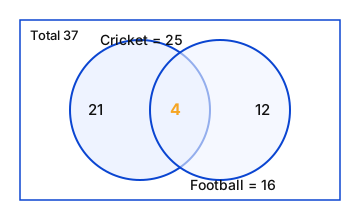
- .
- .
- Check: only cricket , only football , both ; ✓.
Trick: Both = (sum of the two groups) − (total), when nobody is outside.
Answer: (D) 4
अवधारणा: । हर छात्र कम-से-कम एक खेल खेलता है, अतः ।
- ।
- ।
- जाँच: केवल क्रिकेट , केवल फुटबॉल , दोनों ; ✓।
ट्रिक: दोनों = (दोनों समूहों का योग) − (कुल), जब कोई बाहर न हो।
उत्तर: (D) 4
RRB Technician Grade I (Signal)General Intelligence and ReasoningVenn diagram / set unionRRB Technician Grade I (Signal) 2024 · 19 Dec Shift 3
Q39.Based on the English alphabetical order, three of the following four letter-cluster pairs are alike in a certain way and thus form a group. Which pair DOES NOT belong to that group?
(Note: The odd one out is not based on the number of consonants/vowels or their position in the letter-cluster pair.)
अंग्रेज़ी वर्णमाला क्रम के आधार पर, निम्नलिखित चार अक्षर-समूह युग्मों में से तीन किसी निश्चित प्रकार से समान हैं और इस प्रकार एक समूह बनाते हैं। कौन-सा युग्म उस समूह से संबंधित नहीं है?
(नोट: असंगत युग्म, अक्षर-समूह युग्म में व्यंजनों/स्वरों की संख्या या उनकी स्थिति पर आधारित नहीं है।)
- AEX-OK
- BZS-JF
- CIB-PO
- DMF-WS
Show answer
Concept: Compare the positional gap between the first letters and between the second letters of each pair (A = 1 … Z = 26).
- EX–OK: ; .
- ZS–JF: ; .
- MF–WS: ; .
- IB–PO: ; . Also note the inner gaps: first clusters are all (E→X, Z→S, I→B, M→F), second clusters are (O→K, J→F, W→S) except P→O .
Trick: Check the gap inside each cluster too: ZS, IB, MF (and EX going round) are all "−7"; OK, JF, WS are "−4" but PO is "−1".
Answer: (C) IB-PO
अवधारणा: हर युग्म में पहले अक्षरों के बीच और दूसरे अक्षरों के बीच स्थान-अंतर की तुलना करें (A = 1 … Z = 26)।
- EX–OK: ; ।
- ZS–JF: ; ।
- MF–WS: ; ।
- IB–PO: ; । साथ ही अंदर के अंतर देखें: पहले समूह सब (E→X, Z→S, I→B, M→F), दूसरे समूह (O→K, J→F, W→S) पर P→O ।
ट्रिक: हर समूह के अंदर का अंतर भी जाँचें: ZS, IB, MF (और घूमकर EX) सब "−7"; OK, JF, WS "−4" हैं पर PO "−1"।
उत्तर: (C) IB-PO
RRB Technician Grade I (Signal)General Intelligence and ReasoningLetter-cluster analogy (odd one out)RRB Technician Grade I (Signal) 2024 · 19 Dec Shift 3
Q40.In the following number-pairs, the second number is obtained by applying certain mathematical operations to the first number. Which numbers should replace X and Y so that the pattern followed by the two numbers on the left side of :: is same as that on the right side of ::?
(NOTE: Operations should be performed on the whole numbers, without breaking down the numbers into their constituent digits. E.g. 13 – Operations on 13 such as
adding/subtracting/multiplying to 13 can be performed. Breaking down 13 into 1 and 3 and then performing mathematical operations on 1 and 3 is not allowed.)
X : 32 :: 18 : Y
निम्नलिखित संख्या-युग्मों में, दूसरी संख्या पहली संख्या पर कुछ निश्चित गणितीय संक्रियाएँ करके प्राप्त की गई है। X और Y के स्थान पर कौन-सी संख्याएँ आनी चाहिए ताकि :: के बाईं ओर की दो संख्याओं द्वारा अनुसरण किया गया पैटर्न :: के दाईं ओर के पैटर्न के समान हो?
(नोट: संक्रियाएँ पूर्ण संख्याओं पर की जानी चाहिए, संख्याओं को उनके घटक अंकों में तोड़े बिना। उदाहरण के लिए 13 – 13 पर संक्रियाएँ जैसे
13 में जोड़ना/घटाना/गुणा करना किया जा सकता है। 13 को 1 और 3 में तोड़कर फिर 1 और 3 पर गणितीय संक्रियाएँ करने की अनुमति नहीं है।)
X : 32 :: 18 : Y
- AX=15, Y=37
- BX=13, Y=37
- CX=14, Y=35
- DX=13, Y=30
Show answer
Concept: Find one operation that converts the first number into the second and apply the same to the other pair.
- Try option B: : ✓.
- Same rule on the right: ✓.
- Other options fail: A gives but (different additions); C and D cannot use one common operation.
Trick: Test the options – the pair with the same difference () is the answer.
Answer: (B) X=13, Y=37
अवधारणा: एक ऐसी संक्रिया खोजें जो पहली संख्या को दूसरी में बदले और वही दूसरे युग्म पर लागू करें।
- विकल्प B जाँचें: : ✓।
- वही नियम दाईं ओर: ✓।
- बाकी विकल्प विफल: A में पर (अलग-अलग योग); C और D में एक समान संक्रिया नहीं बनती।
ट्रिक: विकल्पों को जाँचें – जिस युग्म में अंतर समान हो () वही उत्तर है।
उत्तर: (B) X=13, Y=37
RRB Technician Grade I (Signal)General Intelligence and ReasoningNumber analogyRRB Technician Grade I (Signal) 2024 · 19 Dec Shift 3

