Q41.In this question, a question is followed by two statements numbered (I) and (II). You have to decide whether the data provided in the statements are sufficient to answer the question. Read both the statements and decide the appropriate answer.
Question: Six people sit in two parallel rows. In Row 1- A, B and C sit facing towards north and in Row 2 - P, Q and R sit facing the south. Each person in a row faces a person in the other row. Who sits at the right extreme end of Row 1?
Statement (I): R sits to the immediate left of Q. Q faces A. B sits to the immediate left of A.
Statement (II): Only one person sits between B and C. B faces an immediate neighbour of Q.
इस प्रश्न में, एक प्रश्न के बाद (I) और (II) क्रमांकित दो कथन दिए गए हैं। आपको यह निर्णय करना है कि कथनों में दिए गए आँकड़े प्रश्न का उत्तर देने के लिए पर्याप्त हैं या नहीं। दोनों कथनों को पढ़िए और उचित उत्तर का चयन कीजिए।
प्रश्न: छह व्यक्ति दो समानांतर पंक्तियों में बैठे हैं। पंक्ति 1 में A, B और C उत्तर की ओर मुख करके बैठे हैं और पंक्ति 2 में P, Q और R दक्षिण की ओर मुख करके बैठे हैं। एक पंक्ति का प्रत्येक व्यक्ति दूसरी पंक्ति के किसी व्यक्ति के सामने बैठा है। पंक्ति 1 के दाएँ छोर पर कौन बैठा है?
कथन (I): R, Q के ठीक बाएँ बैठा है। Q का मुख A की ओर है। B, A के ठीक बाएँ बैठा है।
कथन (II): B और C के बीच केवल एक व्यक्ति बैठा है। B का मुख Q के एक निकटतम पड़ोसी की ओर है।
- AData in statements I and II together are NOT sufficient to answer the question.कथन I और II के आँकड़े मिलकर भी प्रश्न का उत्तर देने के लिए पर्याप्त नहीं हैं।
- BData in Statement I alone is sufficient to answer the question while data in statement II is not.कथन I के आँकड़े अकेले प्रश्न का उत्तर देने के लिए पर्याप्त हैं, जबकि कथन II के आँकड़े पर्याप्त नहीं हैं।
- CData in Statement II alone is sufficient to answer the question while data in statement I is not.कथन II के आँकड़े अकेले प्रश्न का उत्तर देने के लिए पर्याप्त हैं, जबकि कथन I के आँकड़े पर्याप्त नहीं हैं।
- DData in statements I and II together are sufficient to answer the question.कथन I और II के आँकड़े मिलकर प्रश्न का उत्तर देने के लिए पर्याप्त हैं।
Show answer
Concept: Row 1 faces north (its right = east); Row 2 faces south (its left = east). Test each statement separately.
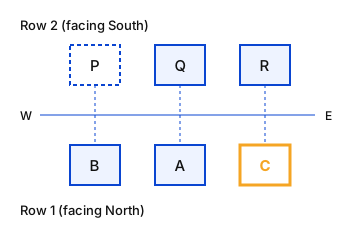
- Statement I: R is to the immediate left of Q → R is east of Q, so Q is west or middle. Q faces A, and B is to A's immediate left (west). If Q were at the west end, A would be at the west end and B could not be west of it. Hence Q and A are in the middle, R and C at the east ends, B and P at the west ends.
- Right extreme of Row 1 (east) = C. Statement I alone is sufficient.
- Statement II: one person between B and C → B and C occupy the two ends, A in the middle; B faces a neighbour of Q – true for either end. B or C can be at the east end → not sufficient.
Trick: For south-facing people, "left" is east. Fix one certain position first, then try to place the others.
Answer: (B) Data in Statement I alone is sufficient to answer the question while data in statement II is not.
अवधारणा: Row 1 उत्तर की ओर मुख (इसका दायाँ = पूर्व); Row 2 दक्षिण की ओर मुख (इसका बायाँ = पूर्व)। हर कथन अलग-अलग जाँचें।
- कथन I: R, Q के ठीक बाएँ → R, Q के पूर्व में है, अतः Q पश्चिम छोर या मध्य में। Q का मुख A की ओर, और B, A के ठीक बाएँ (पश्चिम)। यदि Q पश्चिम छोर पर होता तो A भी पश्चिम छोर पर होता और B उसके पश्चिम में नहीं आ सकता। अतः Q और A मध्य में, R और C पूर्वी छोर पर, B और P पश्चिमी छोर पर।
- Row 1 का दायाँ छोर (पूर्व) = C। कथन I अकेला पर्याप्त है।
- कथन II: B और C के बीच एक व्यक्ति → B और C दोनों छोरों पर, A मध्य में; B, Q के पड़ोसी के सामने – दोनों छोरों पर सत्य। पूर्वी छोर पर B या C कोई भी हो सकता है → पर्याप्त नहीं।
ट्रिक: दक्षिणमुखी व्यक्तियों के लिए "बायाँ" = पूर्व। पहले एक निश्चित स्थान तय करें, फिर बाकी को बिठाएँ।
उत्तर: (B) Data in Statement I alone is sufficient to answer the question while data in statement II is not.
RRB Technician Grade I (Signal)General Intelligence and ReasoningData sufficiency – seating arrangementRRB Technician Grade I (Signal) 2024 · 19 Dec Shift 3
Q42.Six people A, B, C, D, E and F live on six different floors of the same building. The bottom-most floor of the building is numbered as 1; the floor above it is numbered as 2 and so on. The topmost floor is numbered as 6.
A lives on an even-numbered floor. Only three people live between A and B. F lives immediately above E. B does not live on floor number 2. Only two people live between F and D. F lives on an even-numbered floor. Who lives on floor number 3?
छह व्यक्ति A, B, C, D, E और F एक ही भवन की छह अलग-अलग मंज़िलों पर रहते हैं। भवन की सबसे निचली मंज़िल की संख्या 1 है; उसके ऊपर की मंज़िल की संख्या 2 है और इसी प्रकार आगे। सबसे ऊपरी मंज़िल की संख्या 6 है।
A एक सम-संख्या वाली मंज़िल पर रहता है। A और B के बीच केवल तीन व्यक्ति रहते हैं। F, E के ठीक ऊपर रहता है। B मंज़िल संख्या 2 पर नहीं रहता है। F और D के बीच केवल दो व्यक्ति रहते हैं। F एक सम-संख्या वाली मंज़िल पर रहता है। मंज़िल संख्या 3 पर कौन रहता है?
- AE
- BC
- CB
- DD
Show answer
Concept: Use the strongest clues first ("only three between", parity conditions), then fit the rest.
- Three people between A and B → (A, B) on floors (1, 5) or (2, 6). A is even → A = 2, B = 6 (B ≠ 2 rules out A = 6, B = 2).
- F even and F immediately above E: F = 4 (6 is taken by B) → E = 3.
- Two people between F and D → D = 1. The remaining floor 5 → C.
- Final: 6-B, 5-C, 4-F, 3-E, 2-A, 1-D. Floor 3 = E.
Trick: "Exactly between" means a gap of floors – list the only possible pairs and apply the even/odd condition.
Answer: (A) E
अवधारणा: पहले सबसे मज़बूत सुराग ("केवल तीन के बीच", सम/विषम शर्तें) लगाएँ, फिर बाकी बिठाएँ।
- A और B के बीच तीन लोग → (A, B) मंज़िल (1, 5) या (2, 6) पर। A सम → A = 2, B = 6 (B ≠ 2 से A = 6, B = 2 खारिज)।
- F सम और F, E के ठीक ऊपर: F = 4 (6 पर B है) → E = 3।
- F और D के बीच दो लोग → D = 1। बची मंज़िल 5 → C।
- अंतिम: 6-B, 5-C, 4-F, 3-E, 2-A, 1-D। मंज़िल 3 = E।
ट्रिक: "ठीक लोग बीच में" = मंज़िल का अंतर – संभावित युग्म लिखें और सम/विषम शर्त लगाएँ।
उत्तर: (A) E
RRB Technician Grade I (Signal)General Intelligence and ReasoningFloor puzzleRRB Technician Grade I (Signal) 2024 · 19 Dec Shift 3
Q43.In the following number-pairs, the second number is obtained by applying certain mathematical operations to the first number. Which numbers should replace X and Y so that the pattern followed by the two numbers on the left side of :: is same as that on the right side of ::?
(NOTE: Operations should be performed on the whole numbers, without breaking down the numbers into its constituent digits. E.g. 13 – Operations on 13 such as adding /subtracting /multiplying etc. to 13 can be performed. Breaking down 13 into 1 and 3 and then performing mathematical operations on 1 and 3 is not allowed.)
X : 49 :: 17 : Y
निम्नलिखित संख्या-युग्मों में, दूसरी संख्या पहली संख्या पर कुछ निश्चित गणितीय संक्रियाएँ करके प्राप्त की गई है। X और Y के स्थान पर कौन-सी संख्याएँ आनी चाहिए ताकि :: के बाईं ओर की दो संख्याओं द्वारा अनुसरण किया गया पैटर्न :: के दाईं ओर के पैटर्न के समान हो?
(नोट: संक्रियाएँ पूर्ण संख्याओं पर की जानी चाहिए, संख्याओं को उनके घटक अंकों में तोड़े बिना। उदाहरण के लिए 13 – 13 पर संक्रियाएँ जैसे 13 में जोड़ना/घटाना/गुणा करना आदि किया जा सकता है। 13 को 1 और 3 में तोड़कर फिर 1 और 3 पर गणितीय संक्रियाएँ करने की अनुमति नहीं है।)
X : 49 :: 17 : Y
- AX = 23, Y = 37
- BX = 25, Y = 39
- CX = 21, Y = 37
- DX = 31, Y = 34
Show answer
Concept: Find a single operation (on the whole number) linking the first number to the second and apply it to both pairs.
- Rule: second first .
- Option A: ✓ and ✓.
- Other options: B but ; C but ; D fails similarly.
Trick: Compute for the common rules () and match with the options.
Answer: (A) X = 23, Y = 37
अवधारणा: पूरी संख्या पर एक ही संक्रिया खोजें जो पहली संख्या को दूसरी से जोड़े और दोनों युग्मों पर लागू करें।
- नियम: दूसरी पहली ।
- विकल्प A: ✓ और ✓।
- अन्य विकल्प: B पर ; C पर ; D भी विफल।
ट्रिक: सामान्य नियमों () से निकालें और विकल्पों से मिलाएँ।
उत्तर: (A) X = 23, Y = 37
RRB Technician Grade I (Signal)General Intelligence and ReasoningNumber analogyRRB Technician Grade I (Signal) 2024 · 19 Dec Shift 3
Q44.Anurag starts from Point Y and drives 11 km towards North. He then takes a right turn, drives 25 km, turns right and drives 27 km. He then takes a right turn and drives 11 km. He takes a right turn, drives 41 km. He then turns left, drives 14 km and stops at Point Z. How far (shortest distance) and towards which direction should he drive in order to reach Point Y again? (All turns are 90 degrees turns only unless specified)
अनुराग बिंदु Y से चलना शुरू करता है और उत्तर की ओर 11 km गाड़ी चलाता है। फिर वह दाएँ मुड़ता है, 25 km चलता है, दाएँ मुड़ता है और 27 km चलता है। फिर वह दाएँ मुड़ता है और 11 km चलता है। वह दाएँ मुड़कर 41 km चलता है। फिर वह बाएँ मुड़ता है, 14 km चलता है और बिंदु Z पर रुक जाता है। बिंदु Y पर पुनः पहुँचने के लिए उसे कितनी दूर (न्यूनतम दूरी) और किस दिशा में गाड़ी चलानी चाहिए? (जब तक अन्यथा निर्दिष्ट न हो, सभी मोड़ केवल 90 डिग्री के मोड़ हैं)
- A36 km towards North36 km उत्तर की ओर
- B14 km towards North14 km उत्तर की ओर
- C30 km towards South30 km दक्षिण की ओर
- D25 km towards South25 km दक्षिण की ओर
Show answer
Concept: Plot the path on a grid with Y at the origin; the final position relative to Y gives the shortest return distance and direction.
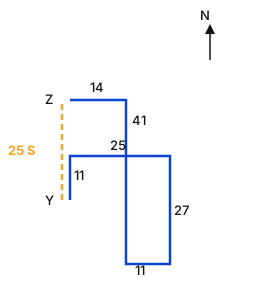
- Y(0, 0) → 11 km N → (0, 11) → right (E) 25 km → (25, 11) → right (S) 27 km → (25, −16).
- Right (W) 11 km → (14, −16) → right (N) 41 km → (14, 25) → left (W) 14 km → Z(0, 25).
- Z is directly 25 km north of Y, so he must drive 25 km towards South.
Trick: Net E–W: ; net N–S: (north). Return = 25 km south.
Answer: (D) 25 km towards South
अवधारणा: Y को मूलबिंदु मानकर पथ ग्रिड पर बनाएँ; Y के सापेक्ष अंतिम स्थिति से लौटने की न्यूनतम दूरी और दिशा मिलती है।
- Y(0, 0) → 11 km उत्तर → (0, 11) → दाएँ (पूर्व) 25 km → (25, 11) → दाएँ (दक्षिण) 27 km → (25, −16)।
- दाएँ (पश्चिम) 11 km → (14, −16) → दाएँ (उत्तर) 41 km → (14, 25) → बाएँ (पश्चिम) 14 km → Z(0, 25)।
- Z, Y के ठीक 25 km उत्तर में है, अतः उसे 25 km दक्षिण की ओर चलना होगा।
ट्रिक: शुद्ध पूर्व–पश्चिम: ; शुद्ध उत्तर–दक्षिण: (उत्तर)। वापसी = 25 km दक्षिण।
उत्तर: (D) 25 km towards South
RRB Technician Grade I (Signal)General Intelligence and ReasoningDirection senseRRB Technician Grade I (Signal) 2024 · 19 Dec Shift 3
Q45.K is the husband of S. B is the sister of T. Q is the daughter of E. T is the brother of E. S is the mother of B. How is T related to K?
K, S का पति है। B, T की बहन है। Q, E की पुत्री है। T, E का भाई है। S, B की माता है। T, K से किस प्रकार संबंधित है?
- ABrotherभाई
- BFatherपिता
- CSonपुत्र
- DDaughterपुत्री
Show answer
Concept: Build the family tree step by step from the given relations and then read off the required relation.
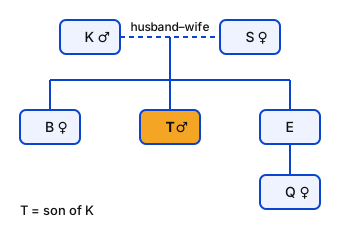
- K is the husband of S, and S is the mother of B → K is the father of B.
- B is the sister of T → T is also a child of S and K.
- T is the brother of E → T is male.
- So T is the male child of K, i.e. T is the son of K. (E and Q are not needed for the answer.)
Trick: First find the gender of the person asked about (brother → male), then find the parent link; "male child of a man" = son.
Answer: (C) Son
अवधारणा: दिए गए संबंधों से क्रमशः परिवार-वृक्ष बनाइए और फिर पूछा गया संबंध पढ़िए।
- K, S का पति है और S, B की माँ है → K, B का पिता है।
- B, T की बहन है → T भी S और K की संतान है।
- T, E का भाई है → T पुरुष है।
- अतः T, K की पुरुष संतान है, अर्थात T, K का पुत्र (Son) है। (E और Q उत्तर के लिए आवश्यक नहीं हैं।)
ट्रिक: पहले पूछे गए व्यक्ति का लिंग तय करें (भाई → पुरुष), फिर माता-पिता का संबंध जोड़ें; "पुरुष की पुरुष संतान" = पुत्र।
उत्तर: (C) पुत्र (Son)
RRB Technician Grade I (Signal)General Intelligence and ReasoningBlood RelationsRRB Technician Grade I (Signal) 2024 · 19 Dec Shift 2
Q46.What will come in the place of the question mark ‘(?)’ in the following equation, if ‘+’ and ‘−’ are interchanged and ‘×’ and ‘÷’ are interchanged?
15 × 5 ÷ 7 − 8 + 9 = ?
यदि '+' और '−' को परस्पर बदल दिया जाए तथा '×' और '÷' को परस्पर बदल दिया जाए, तो निम्नलिखित समीकरण में प्रश्नचिह्न '(?)' के स्थान पर क्या आएगा?
15 × 5 ÷ 7 − 8 + 9 = ?
- A17
- B20
- C18
- D19
Show answer
Concept: Replace the signs as instructed, then apply BODMAS (division and multiplication before addition and subtraction, left to right).
- Interchange and : .
- ; .
- .
Trick: Rewrite the whole expression with new signs first, then solve – never mix the two steps.
Answer: (B) 20
अवधारणा: निर्देशानुसार चिह्न बदलें, फिर BODMAS लगाएँ (भाग और गुणा पहले, फिर जोड़-घटाव, बाएँ से दाएँ)।
- और बदलने पर: ।
- ; ।
- ।
ट्रिक: पहले पूरा व्यंजक नए चिह्नों के साथ लिखें, फिर हल करें – दोनों चरण कभी न मिलाएँ।
उत्तर: (B) 20
RRB Technician Grade I (Signal)General Intelligence and ReasoningMathematical Operations – sign interchangeRRB Technician Grade I (Signal) 2024 · 19 Dec Shift 2
Q47.In the following number-pairs, the second number is obtained by applying certain mathematical operations to the first number. Which numbers should replace X and Y so that the pattern followed by the two numbers on the left side of :: is same as that on the right side of ::?
(NOTE: Operations should be performed on the whole numbers, without breaking down the numbers into their constituent digits. E.g. 13 – Operations on 13 such as
adding/subtracting/multiplying to 13 can be performed. Breaking down 13 into 1 and 3 and then performing mathematical operations on 1 and 3 is not allowed.)
X : 40 :: 60 : Y
निम्नलिखित संख्या-युग्मों में, दूसरी संख्या पहली संख्या पर कुछ निश्चित गणितीय संक्रियाएँ करके प्राप्त की गई है। X और Y के स्थान पर कौन-सी संख्याएँ आनी चाहिए ताकि :: के बाईं ओर की दोनों संख्याओं द्वारा अनुसरण किया गया पैटर्न :: के दाईं ओर के पैटर्न के समान हो?
(नोट: संक्रियाएँ पूर्ण संख्याओं पर की जानी चाहिए, संख्याओं को उनके घटक अंकों में तोड़े बिना। उदाहरण के लिए 13 – 13 पर संक्रियाएँ जैसे
13 में जोड़ना/घटाना/गुणा करना किया जा सकता है। 13 को 1 और 3 में तोड़कर फिर 1 और 3 पर गणितीय संक्रियाएँ करने की अनुमति नहीं है।)
X : 40 :: 60 : Y
- AX=32, Y=70
- BX=36, Y=68
- CX=32, Y=75
- DX=30, Y=75
Show answer
Concept: The same operation must convert X into 40 and 60 into Y. Test each option with the whole number.
- Option C: and → same operation (multiply by ) ✓.
- Option A: but – different additions.
- Option B: , – no common rule; Option D: , – different additions/ratios ( vs ).
Trick: Check ratios first: .
Answer: (C) X=32, Y=75
अवधारणा: एक ही संक्रिया X को 40 और 60 को Y में बदले। प्रत्येक विकल्प को पूरी संख्या पर जाँचें।
- विकल्प C: और → समान संक्रिया ( से गुणा) ✓।
- विकल्प A: पर – अलग-अलग जोड़।
- विकल्प B: , – कोई समान नियम नहीं; विकल्प D: , – अलग जोड़/अनुपात ( बनाम )।
ट्रिक: पहले अनुपात देखें: ।
उत्तर: (C) X=32, Y=75
RRB Technician Grade I (Signal)General Intelligence and ReasoningNumber AnalogyRRB Technician Grade I (Signal) 2024 · 19 Dec Shift 2
Q48.In the following number-pairs, the second number is obtained by applying certain mathematical operations to the first number. Which numbers should replace X and Y so that the pattern followed by the two numbers on the left side of :: is same as that on the right side of ::?
(NOTE : Operations should be performed on the whole numbers, without breaking down the numbers into its constituent digits. E.g. 13 – Operations on 13 such as adding /subtracting /multiplying etc. to 13 can be performed. Breaking down 13 into 1 and 3 and then performing mathematical operations on 1 and 3 is not allowed.)
X : 35 :: 8 : Y
निम्नलिखित संख्या-युग्मों में, दूसरी संख्या पहली संख्या पर कुछ निश्चित गणितीय संक्रियाएँ करके प्राप्त की गई है। X और Y के स्थान पर कौन-सी संख्याएँ आनी चाहिए ताकि :: के बाईं ओर की दोनों संख्याओं द्वारा अनुसरण किया गया पैटर्न :: के दाईं ओर के पैटर्न के समान हो?
(नोट : संक्रियाएँ पूर्ण संख्याओं पर की जानी चाहिए, संख्याओं को उनके घटक अंकों में तोड़े बिना। उदाहरण के लिए 13 – 13 पर संक्रियाएँ जैसे 13 में जोड़ना/घटाना/गुणा करना आदि किया जा सकता है। 13 को 1 और 3 में तोड़कर फिर 1 और 3 पर गणितीय संक्रियाएँ करने की अनुमति नहीं है।)
X : 35 :: 8 : Y
- AX = 10 , Y = 20
- BX = 7 , Y = 48
- CX = 3 , Y = 74
- DX = 6 , Y = 68
Show answer
Concept: Find one rule that maps X → 35 and 8 → Y; test the options with whole numbers.
- Option B: and , i.e. or : , ✓.
- Option A: ( or ) but ( or ) – no common rule.
- Options C and D: and have no natural rule that also gives or .
Trick: pairs: , , – a common pattern in these questions.
Answer: (B) X = 7, Y = 48
अवधारणा: ऐसा एक नियम खोजें जो X → 35 और 8 → Y दे; विकल्पों को पूरी संख्या पर जाँचें।
- विकल्प B: और , अर्थात या : , ✓।
- विकल्प A: ( या ) पर ( या ) – समान नियम नहीं।
- विकल्प C और D: और का कोई स्वाभाविक नियम नहीं जो या भी दे।
ट्रिक: युग्म: , , – ऐसे प्रश्नों में सामान्य पैटर्न।
उत्तर: (B) X = 7, Y = 48
RRB Technician Grade I (Signal)General Intelligence and ReasoningNumber AnalogyRRB Technician Grade I (Signal) 2024 · 19 Dec Shift 2
Q49.What should come in place of the question mark (?) in the given series?
1023 1024 1027 1032 1039 ?
दी गई श्रेणी में प्रश्नचिह्न (?) के स्थान पर क्या आना चाहिए?
1023 1024 1027 1032 1039 ?
- A1046
- B1048
- C1045
- D1047
Show answer
Concept: Look at the differences between consecutive terms.
- , , , .
- Differences are consecutive odd numbers ; the next difference is .
- .
Trick: Differences – term equals ; for : .
Answer: (B) 1048
अवधारणा: क्रमागत पदों के अंतर देखें।
- , , , ।
- अंतर क्रमागत विषम संख्याएँ हैं; अगला अंतर ।
- ।
ट्रिक: अंतर – वाँ पद ; के लिए ।
उत्तर: (B) 1048
RRB Technician Grade I (Signal)General Intelligence and ReasoningNumber SeriesRRB Technician Grade I (Signal) 2024 · 19 Dec Shift 2
Q50.Read the given statements and conclusions carefully. You have to take the given statements to be true even if they seem to be at variance from commonly known facts. You have to decide which conclusion/s logically follow/s from the given statements. Statements:
All parks are grounds.
Some grounds are museums.
No museum is a theatre.
Conclusions:
(I) All museums are parks.
(II) No ground is a theatre.
दिए गए कथनों और निष्कर्षों को ध्यानपूर्वक पढ़िए। आपको दिए गए कथनों को सत्य मानना है, भले ही वे सामान्यतः ज्ञात तथ्यों से भिन्न प्रतीत होते हों। आपको यह निर्णय लेना है कि दिए गए कथनों से कौन-सा/कौन-से निष्कर्ष तार्किक रूप से अनुसरण करता है/करते हैं। कथन:
सभी पार्क, मैदान हैं।
कुछ मैदान, संग्रहालय हैं।
कोई संग्रहालय, थिएटर नहीं है।
निष्कर्ष:
(I) सभी संग्रहालय, पार्क हैं।
(II) कोई मैदान, थिएटर नहीं है।
- AOnly conclusion I follows.केवल निष्कर्ष I अनुसरण करता है।
- BNeither conclusion I nor II follows.न तो निष्कर्ष I और न ही II अनुसरण करता है।
- COnly conclusion II follows.केवल निष्कर्ष II अनुसरण करता है।
- DBoth conclusions I and II follow.निष्कर्ष I और II दोनों अनुसरण करते हैं।
Show answer
Concept: Draw the Venn diagram of the statements and accept a conclusion only if it is true in every possible diagram.
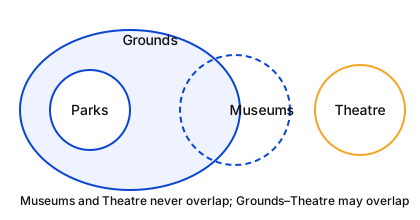
- "All parks are grounds" – parks circle lies inside grounds. "Some grounds are museums" – museums overlaps grounds. "No museum is a theatre" – museums and theatre are separate.
- Conclusion I "All museums are parks": museums only partly overlap grounds and need not touch parks at all → does not follow.
- Conclusion II "No ground is a theatre": only museums are separated from theatre; the part of grounds that is not museum can still overlap theatre → does not follow.
Trick: "Some A are B" + "No B is C" gives only "Some A are not C" – never "No A is C".
Answer: (B) Neither conclusion I nor II follows.
अवधारणा: कथनों का वेन आरेख बनाएँ और निष्कर्ष तभी स्वीकारें जब वह हर संभव आरेख में सत्य हो।
- "सभी पार्क ग्राउंड हैं" – पार्क वृत्त ग्राउंड के अंदर। "कुछ ग्राउंड म्यूज़ियम हैं" – म्यूज़ियम ग्राउंड से आंशिक रूप से मिलता है। "कोई म्यूज़ियम थिएटर नहीं" – म्यूज़ियम और थिएटर अलग।
- निष्कर्ष I "सभी म्यूज़ियम पार्क हैं": म्यूज़ियम ग्राउंड से केवल आंशिक मिलता है और पार्क को छूना भी ज़रूरी नहीं → अनुसरण नहीं करता।
- निष्कर्ष II "कोई ग्राउंड थिएटर नहीं": केवल म्यूज़ियम थिएटर से अलग है; ग्राउंड का गैर-म्यूज़ियम भाग थिएटर से मिल सकता है → अनुसरण नहीं करता।
ट्रिक: "कुछ A, B हैं" + "कोई B, C नहीं" से केवल "कुछ A, C नहीं हैं" निकलता है – कभी "कोई A, C नहीं" नहीं।
उत्तर: (B) न तो निष्कर्ष I न II अनुसरण करता है।
RRB Technician Grade I (Signal)General Intelligence and ReasoningSyllogismRRB Technician Grade I (Signal) 2024 · 19 Dec Shift 2
Q51.In this question, a question is followed by two statements numbered (I) and (II). You have to decide whether the data provided in the statements are sufficient to answer the question. Read both the statements and decide the appropriate answer.
Question: Five people V, W, X, Y and Z are sitting in a straight row, facing north. Who sits to the immediate left of Z?
Statement (I): Both V and X are immediate neighbours of Y. V sits at one of the extreme ends of the row.
Statement (II): Z sits to the immediate left of W. W sits at one of the extreme ends of the row.
इस प्रश्न में, एक प्रश्न के बाद (I) और (II) क्रमांकित दो कथन दिए गए हैं। आपको यह निर्णय लेना है कि कथनों में दिए गए आँकड़े प्रश्न का उत्तर देने के लिए पर्याप्त हैं या नहीं। दोनों कथनों को पढ़िए और उपयुक्त उत्तर का चयन कीजिए।
प्रश्न: पाँच व्यक्ति V, W, X, Y और Z एक सीधी पंक्ति में उत्तर की ओर मुख करके बैठे हैं। Z के ठीक बाईं ओर कौन बैठा है?
कथन (I): V और X दोनों Y के निकटतम पड़ोसी हैं। V पंक्ति के किसी एक अंतिम छोर पर बैठा है।
कथन (II): Z, W के ठीक बाईं ओर बैठा है। W पंक्ति के किसी एक अंतिम छोर पर बैठा है।
- AData in either statement I alone or statement II alone are sufficient to answer the question.या तो कथन I अकेले या कथन II अकेले के आँकड़े प्रश्न का उत्तर देने के लिए पर्याप्त हैं।
- BData in statement II alone is sufficient to answer the question while data in statement I is not.कथन II अकेले के आँकड़े प्रश्न का उत्तर देने के लिए पर्याप्त हैं, जबकि कथन I के आँकड़े पर्याप्त नहीं हैं।
- CData in statements I and II together are sufficient to answer the question.कथन I और II दोनों के आँकड़े मिलाकर प्रश्न का उत्तर देने के लिए पर्याप्त हैं।
- DData in statement I alone is sufficient to answer the question while data in statement II is not.कथन I अकेले के आँकड़े प्रश्न का उत्तर देने के लिए पर्याप्त हैं, जबकि कथन II के आँकड़े पर्याप्त नहीं हैं।
Show answer
Concept: Test each statement alone, then together; the question is "answerable" only when the arrangement fixes the required person uniquely.
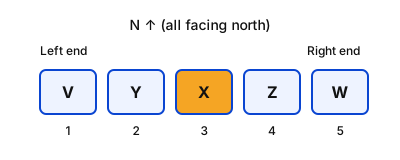
- Statement I alone: V at an end with Y, X next → V Y X _ _ (or mirror). Positions of Z and W are not fixed → not sufficient.
- Statement II alone: W at an end and Z immediately left of W → W at the right end, Z at 4th place. The 3rd place could be V, X or Y → not sufficient.
- Together: Places 4, 5 = Z, W, so V Y X occupy 1–3: V Y X Z W. Immediate left of Z is X → answer found.
Trick: "Immediate left" of someone facing north = the position with the smaller number from the left end.
Answer: (C) Data in statements I and II together are sufficient to answer the question.
अवधारणा: प्रत्येक कथन को अकेले, फिर दोनों को मिलाकर जाँचें; प्रश्न तभी "हल" माना जाएगा जब व्यवस्था पूछे गए व्यक्ति को अद्वितीय रूप से तय करे।
- कथन I अकेले: V एक छोर पर, Y और X उसके बाद → V Y X _ _ (या दर्पण)। Z और W के स्थान तय नहीं → पर्याप्त नहीं।
- कथन II अकेले: W एक छोर पर और Z उसके ठीक बाएँ → W दाएँ छोर पर, Z चौथे स्थान पर। तीसरा स्थान V, X या Y हो सकता है → पर्याप्त नहीं।
- दोनों मिलाकर: स्थान 4, 5 = Z, W, अतः V Y X स्थान 1–3 पर: V Y X Z W। Z के ठीक बाएँ X → उत्तर मिल गया।
ट्रिक: उत्तर की ओर मुख वाले व्यक्ति का "ठीक बायाँ" = बाएँ छोर से छोटी संख्या वाला स्थान।
उत्तर: (C) कथन I और II मिलकर प्रश्न का उत्तर देने के लिए पर्याप्त हैं।
RRB Technician Grade I (Signal)General Intelligence and ReasoningData Sufficiency – seating arrangementRRB Technician Grade I (Signal) 2024 · 19 Dec Shift 2
Q52.A statement is given followed by two arguments. Decide which of the arguments is/are strong with respect to the statement.
Statement:
The Government of country B has urged its citizens to invest in rain water harvesting and avail subsidies in doing so.
Arguments:
I. Ground water resources have been continuously depleting in country B.
II. Country B experiences heavy rainfall during the monsoon season leading to flooding in many low-lying areas.
एक कथन के बाद दो तर्क दिए गए हैं। निर्णय कीजिए कि कथन के संबंध में कौन-सा/कौन-से तर्क प्रबल है/हैं।
कथन:
देश B की सरकार ने अपने नागरिकों से वर्षा जल संचयन में निवेश करने और ऐसा करने में सब्सिडी का लाभ उठाने का आग्रह किया है।
तर्क:
I. देश B में भूजल संसाधन निरंतर घटते जा रहे हैं।
II. देश B में मानसून के मौसम में भारी वर्षा होती है, जिससे कई निचले क्षेत्रों में बाढ़ आ जाती है।
- ABoth I and II weaken the statement.I और II दोनों कथन को कमज़ोर करते हैं।
- BBoth I and II strengthen the statement.I और II दोनों कथन को मज़बूत करते हैं।
- CII weakens while I strengthens the statement.II कथन को कमज़ोर करता है जबकि I कथन को मज़बूत करता है।
- DI weakens while II strengthens the statement.I कथन को कमज़ोर करता है जबकि II कथन को मज़बूत करता है।
Show answer
Concept: An argument strengthens a statement if it gives a sound reason that supports the action recommended in it.
- Statement: the government urges citizens to invest in rainwater harvesting (with subsidies).
- Argument I: ground water is depleting → harvested rainwater recharges ground water and reduces dependence on it → strong reason to harvest → strengthens.
- Argument II: heavy monsoon rain causes flooding → plenty of rainwater is available to collect, and capturing it reduces run-off and flooding → also supports harvesting → strengthens.
Trick: Ask "does this fact make the recommended action more sensible?" Both facts (scarcity below, abundance above) say yes.
Answer: (B) Both I and II strengthen the statement.
अवधारणा: कोई तर्क कथन को मज़बूत करता है यदि वह कथन में सुझाए गए कार्य के पक्ष में ठोस कारण दे।
- कथन: सरकार नागरिकों से वर्षा जल संचयन में निवेश (सब्सिडी के साथ) का आग्रह करती है।
- तर्क I: भूजल घट रहा है → संचित वर्षा जल भूजल को पुनर्भरित करता है और उस पर निर्भरता घटाता है → संचयन का ठोस कारण → मज़बूत करता है।
- तर्क II: मानसून की भारी वर्षा से बाढ़ आती है → एकत्र करने के लिए प्रचुर वर्षा जल उपलब्ध है, और उसे रोकने से बहाव व बाढ़ घटती है → यह भी संचयन का समर्थन करता है → मज़बूत करता है।
ट्रिक: पूछें "क्या यह तथ्य सुझाए गए कार्य को अधिक उचित बनाता है?" दोनों तथ्य (नीचे कमी, ऊपर प्रचुरता) हाँ कहते हैं।
उत्तर: (B) I और II दोनों कथन को मज़बूत करते हैं।
RRB Technician Grade I (Signal)General Intelligence and ReasoningStatement and ArgumentsRRB Technician Grade I (Signal) 2024 · 19 Dec Shift 2
Q53.Refer to the following letter, number and symbol series and answer the question that follows.
(Left) + 2 $ Q = Y L A S S X L / % 9 T \ = X H 6 ? (Right)
How many such numbers are there that are immediately preceded by a symbol and immediately followed by a letter?
निम्नलिखित अक्षर, संख्या और प्रतीक श्रेणी को देखिए और उसके बाद दिए गए प्रश्न का उत्तर दीजिए।
(बाएँ) + 2 $ Q = Y L A S S X L / % 9 T \ = X H 6 ? (दाएँ)
ऐसी कितनी संख्याएँ हैं जिनके ठीक पहले एक प्रतीक है और ठीक बाद एक अक्षर है?
- AThreeतीन
- BOneएक
- CTwoदो
- DFourचार
Show answer
Concept: Locate every number in the series and check its left neighbour (must be a symbol) and right neighbour (must be a letter).
- Series: + 2 $ Q = Y L A S S X L / % 9 T \ = X H 6 ?
- 2: left "+", right "$" (symbol) → fails the "followed by a letter" condition.
- 9: left "%" (symbol), right "T" (letter) → ✓.
- 6: left "H" (letter) → fails. So only one such number.
Trick: Mark the numbers first (here 2, 9, 6), then check neighbours – it takes seconds.
Answer: (B) One
अवधारणा: श्रृंखला में हर अंक खोजें और उसका बायाँ पड़ोसी (प्रतीक होना चाहिए) व दायाँ पड़ोसी (अक्षर होना चाहिए) जाँचें।
- श्रृंखला: + 2 $ Q = Y L A S S X L / % 9 T \ = X H 6 ?
- 2: बाएँ "+", दाएँ "$" (प्रतीक) → "अक्षर के बाद" शर्त विफल।
- 9: बाएँ "%" (प्रतीक), दाएँ "T" (अक्षर) → ✓।
- 6: बाएँ "H" (अक्षर) → विफल। अतः ऐसा केवल एक अंक।
ट्रिक: पहले अंकों को चिह्नित करें (यहाँ 2, 9, 6), फिर पड़ोसी जाँचें – कुछ सेकंड का काम।
उत्तर: (B) एक (One)
RRB Technician Grade I (Signal)General Intelligence and ReasoningAlpha-numeric-symbol seriesRRB Technician Grade I (Signal) 2024 · 19 Dec Shift 2
Q54.D, E, F, G, H, I, and J, each has an exam on a different day of a week starting from Monday and ending on Sunday of the same week.
E has the exam on Friday. Only one person has the exam between E and D. J has the exam on the day immediately after E. H has the exam on the day immediately after D. Only two people have exams between H and G. F has the exam on the day immediately before D. I does not have the exam on Monday.
How many people have exams between J and F?
D, E, F, G, H, I और J में से प्रत्येक की परीक्षा एक ही सप्ताह के सोमवार से रविवार तक, सप्ताह के अलग-अलग दिन है।
E की परीक्षा शुक्रवार को है। E और D के बीच केवल एक व्यक्ति की परीक्षा है। J की परीक्षा E के ठीक अगले दिन है। H की परीक्षा D के ठीक अगले दिन है। H और G के बीच केवल दो व्यक्तियों की परीक्षा है। F की परीक्षा D के ठीक पहले वाले दिन है। I की परीक्षा सोमवार को नहीं है।
J और F के बीच कितने व्यक्तियों की परीक्षा है?
- AFiveपाँच
- BFourचार
- CThreeतीन
- DTwoदो
Show answer
Concept: Start from the fixed clue, place the people with "immediately before/after" clues, then use the counting clues.
- E = Friday; J immediately after E → J = Saturday.
- Exactly one person between E and D → D = Wednesday or Sunday. H is immediately after D, so D cannot be Sunday → D = Wednesday, H = Thursday.
- F immediately before D → F = Tuesday.
- Two people between H (Thu) and G → G = Monday or Sunday. I is not on Monday → I = Sunday, G = Monday.
- Order: G(Mon) F(Tue) D(Wed) H(Thu) E(Fri) J(Sat) I(Sun). Between J (Sat) and F (Tue): Wed, Thu, Fri → three people.
Trick: Draw the 7 boxes Mon–Sun and fill the definite clue (E = Fri) first; chains like F-D-H then drop in place.
Answer: (C) Three
अवधारणा: निश्चित सुराग से शुरू करें, "ठीक पहले/बाद" वाले लोगों को रखें, फिर गिनती वाले सुराग लगाएँ।
- E = शुक्रवार; J, E के ठीक बाद → J = शनिवार।
- E और D के बीच ठीक एक व्यक्ति → D = बुधवार या रविवार। H, D के ठीक बाद है, अतः D रविवार नहीं हो सकता → D = बुधवार, H = गुरुवार।
- F, D के ठीक पहले → F = मंगलवार।
- H (गुरु) और G के बीच दो व्यक्ति → G = सोमवार या रविवार। I सोमवार को नहीं → I = रविवार, G = सोमवार।
ट्रिक: सोम–रवि के 7 खाने बनाएँ और निश्चित सुराग (E = शुक्र) पहले भरें; F-D-H जैसी शृंखलाएँ अपने आप बैठ जाती हैं। क्रम: G F D H E J I → J (शनि) और F (मंगल) के बीच बुध, गुरु, शुक्र = तीन।
उत्तर: (C) तीन (Three)
RRB Technician Grade I (Signal)General Intelligence and ReasoningScheduling puzzle – days of the weekRRB Technician Grade I (Signal) 2024 · 19 Dec Shift 2
Q55.Which of the following terms will replace the question mark (?) in the given series to make it logically complete?
LQ13 MR20 NS27 OT34 ?
दी गई श्रेणी को तार्किक रूप से पूर्ण करने के लिए निम्नलिखित में से कौन-सा पद प्रश्नचिह्न (?) के स्थान पर आएगा?
LQ13 MR20 NS27 OT34 ?
- APV41
- BPV42
- CPU42
- DPU41
Show answer
Concept: Treat each part of the term separately – first letter, second letter and number.
- First letters: L, M, N, O → next P (+1 each).
- Second letters: Q, R, S, T → next U (+1 each).
- Numbers: 13, 20, 27, 34 → .
- Next term = PU41.
Trick: Options PV41/PV42 break the +1 letter pattern (T→U, not V) – eliminate them at once.
Answer: (D) PU41
अवधारणा: पद के हर भाग को अलग-अलग देखें – पहला अक्षर, दूसरा अक्षर और संख्या।
- पहले अक्षर: L, M, N, O → अगला P (हर बार +1)।
- दूसरे अक्षर: Q, R, S, T → अगला U (+1)।
- संख्याएँ: 13, 20, 27, 34 → ।
- अगला पद = PU41।
ट्रिक: PV41/PV42 में +1 अक्षर पैटर्न टूटता है (T→U, V नहीं) – तुरंत हटाएँ।
उत्तर: (D) PU41
RRB Technician Grade I (Signal)General Intelligence and ReasoningAlphanumeric seriesRRB Technician Grade I (Signal) 2024 · 19 Dec Shift 2
Q56.கொடுக்கப்பட்டஅறிக்கைகள்மற்றும்முடிவுகளைகவனமாகபடித்து, கொடுக்கப்பட்டமுடிவுகளில்எதுஅறிக்கைகளைபின்பற்றுகிறது என்பதைமுடிவுசெய்யுங்கள்.
அறிக்கைகள்:
'இன்றுஒருபிரகாசமானசூரியஒளிமிகுந்தநாள், எனவேகடற்கரையில் காலைஉணவைசாப்பிட்டுவிட்டுபின்னர்நீங்கள்அனைவரும்பார்க்க விரும்பியஅருங்காட்சியகத்திற்குச்செல்வோம்' - ஒருதந்தைதனது குழந்தைகளிடம்கூறினார்.
முடிவுகள்:
(i) அனைத்துகுடும்பசுற்றுலாக்களும்பிரகாசமானசூரியஒளிமிகுந்த நாட்களில்மட்டுமேதிட்டமிடப்படவேண்டும்.
(ii) அறிவியல்அருங்காட்சியகங்கள்குழந்தைகளின்கல்விக்குமிகவும் பயனளிப்பவைஅதேசமயம்வேடிக்கையானவையும்ஆகும்.
दिए गए कथन और निष्कर्षों को ध्यानपूर्वक पढ़िए और निर्णय कीजिए कि दिए गए निष्कर्षों में से कौन-सा कथन का अनुसरण करता है।
कथन:
'आज एक उजला, धूप वाला दिन है, इसलिए समुद्र तट पर नाश्ता करने के बाद हम उस संग्रहालय को देखने चलेंगे जिसे तुम सब देखना चाहते थे' - एक पिता ने अपने बच्चों से कहा।
निष्कर्ष:
(i) सभी पारिवारिक भ्रमण केवल उजले, धूप वाले दिनों में ही नियोजित किए जाने चाहिए।
(ii) विज्ञान संग्रहालय बच्चों की शिक्षा के लिए बहुत उपयोगी होने के साथ-साथ मनोरंजक भी होते हैं।
- Aமுடிவு (I) அல்லது (II) ஆகியஎதுவும்பின்பற்றவில்லைन तो निष्कर्ष (I) और न ही (II) अनुसरण करता है
- Bமுடிவு (II) மட்டும்பின்பற்றுகிறதுकेवल निष्कर्ष (II) अनुसरण करता है
- Cமுடிவு (I) மட்டும்பின்பற்றுகிறதுकेवल निष्कर्ष (I) अनुसरण करता है
- Dமுடிவுகள் (I) மற்றும் (II) இரண்டும்பின்பற்றுகின்றனनिष्कर्ष (I) और (II) दोनों अनुसरण करते हैं
Show answer
Concept: A conclusion follows only if it is a definite, logical consequence of the statement. (Statement: a father tells his children, 'Today is a bright sunny day, so let us have breakfast on the beach and then visit the museum you all wanted to see.' Conclusions: (i) all family outings should be planned only on bright sunny days; (ii) science museums are very useful for children's education and also fun.)
- Conclusion (i) generalises one outing to all outings and adds 'only' – not implied.
- Conclusion (ii) talks about science museums being educational and fun; the statement says nothing about education or the type of museum.
- Hence neither conclusion follows.
Trick: Words like 'all', 'only', 'always' in a conclusion are usually a sign that it does NOT follow.
Answer: (A) Neither conclusion (I) nor (II) follows
अवधारणा: निष्कर्ष तभी अनुसरण करता है जब वह कथन का निश्चित, तार्किक परिणाम हो। (कथन: एक पिता बच्चों से कहते हैं, 'आज धूप वाला सुंदर दिन है, इसलिए समुद्र तट पर नाश्ता करके फिर उस संग्रहालय चलेंगे जिसे तुम सब देखना चाहते थे।' निष्कर्ष: (i) सभी पारिवारिक सैर केवल धूप वाले दिनों में ही होनी चाहिए; (ii) विज्ञान संग्रहालय बच्चों की शिक्षा के लिए बहुत उपयोगी और मनोरंजक भी हैं।)
- निष्कर्ष (i) एक सैर को सभी सैरों पर लागू करता है और 'केवल' जोड़ता है – कथन से नहीं निकलता।
- निष्कर्ष (ii) विज्ञान संग्रहालय की शिक्षा और मनोरंजन की बात करता है; कथन में शिक्षा या संग्रहालय के प्रकार का कोई ज़िक्र नहीं।
- अतः कोई भी निष्कर्ष अनुसरण नहीं करता।
ट्रिक: निष्कर्ष में 'सभी', 'केवल', 'हमेशा' जैसे शब्द प्रायः संकेत हैं कि वह अनुसरण नहीं करता।
उत्तर: (A) न निष्कर्ष (I) न (II) अनुसरण करता है
RRB Technician Grade I (Signal)General Intelligence and ReasoningStatement and conclusionsRRB Technician Grade I (Signal) 2024 · 19 Dec Shift 2
Q57.Based on the English alphabetical order, three of the following four letter-cluster pairs are alike in a certain way and thus form a group. Which pair DOES NOT belong to that group?
(Note: The odd one out is not based on the number of consonants/vowels or their position in the letter-cluster pair.)
अंग्रेज़ी वर्णमाला क्रम के आधार पर, निम्नलिखित चार अक्षर-समूह युग्मों में से तीन एक निश्चित प्रकार से समान हैं और इस प्रकार एक समूह बनाते हैं। कौन-सा युग्म उस समूह से संबंधित नहीं है?
(नोट: असंगत युग्म व्यंजनों/स्वरों की संख्या या अक्षर-समूह युग्म में उनकी स्थिति पर आधारित नहीं है।)
- AOH-MT
- BSL-RX
- CRK-QW
- DLE-KQ
Show answer
Concept: Compare the position shift of each letter in the pair.
- SL-RX: S→R , L→X .
- RK-QW: R→Q , K→W .
- LE-KQ: L→K , E→Q .
- OH-MT: O→M , H→T – the first shift is instead of , so it is the odd one.
Trick: Check the first letters only: S→R, R→Q, L→K are all previous letters; O→M skips one.
Answer: (A) OH-MT
अवधारणा: जोड़े के हर अक्षर के स्थान-परिवर्तन की तुलना करें।
- SL-RX: S→R , L→X ।
- RK-QW: R→Q , K→W ।
- LE-KQ: L→K , E→Q ।
- OH-MT: O→M , H→T – पहला परिवर्तन की जगह है, अतः यह विषम है।
ट्रिक: केवल पहले अक्षर देखें: S→R, R→Q, L→K सब ठीक पिछला अक्षर; O→M एक छोड़ता है।
उत्तर: (A) OH-MT
RRB Technician Grade I (Signal)General Intelligence and ReasoningLetter-cluster odd one outRRB Technician Grade I (Signal) 2024 · 19 Dec Shift 2
Q58.In the following triad, each group of letters is related to the subsequent one following a certain logic. Select from the given options, the one that follows the same logic. LIVE - IVLE - EVIL
REST - ESRT - TSER
निम्नलिखित त्रिक में, अक्षरों का प्रत्येक समूह एक निश्चित तर्क के अनुसार अपने अगले समूह से संबंधित है। दिए गए विकल्पों में से उस विकल्प का चयन कीजिए जो उसी तर्क का अनुसरण करता है। LIVE - IVLE - EVIL
REST - ESRT - TSER
- AWIND - INWD - INDW
- BWEST - WSET - TSEW
- CMUTE - UTME - ETUM
- DYORK - OYRK - KORY
Show answer
Concept: Find how the positions 1-2-3-4 of the first word are rearranged in the second and third words.
- LIVE → IVLE: positions 2,3,1,4 (first letter moves to third place). REST → ESRT: same, 2,3,1,4.
- LIVE → EVIL and REST → TSER: the third word is the first word reversed (4,3,2,1).
- MUTE → UTME (2,3,1,4 ✓) → ETUM (MUTE reversed ✓). Others fail: WIND→INWD ✓ but INDW is not DNIW; WEST→WSET ✗; YORK→OYRK ✗.
Trick: Check the third word first – it must be the exact reverse of the first; only C satisfies it.
Answer: (C) MUTE - UTME - ETUM
अवधारणा: देखें कि पहले शब्द के स्थान 1-2-3-4 दूसरे और तीसरे शब्द में कैसे बदलते हैं।
- LIVE → IVLE: स्थान 2,3,1,4 (पहला अक्षर तीसरे स्थान पर)। REST → ESRT: वही, 2,3,1,4।
- LIVE → EVIL और REST → TSER: तीसरा शब्द पहले शब्द का उल्टा है (4,3,2,1)।
- MUTE → UTME (2,3,1,4 ✓) → ETUM (MUTE का उल्टा ✓)। बाकी असफल: WIND→INWD ✓ पर INDW, DNIW नहीं; WEST→WSET ✗; YORK→OYRK ✗।
ट्रिक: पहले तीसरा शब्द जाँचें – वह पहले शब्द का ठीक उल्टा होना चाहिए; केवल C में ऐसा है।
उत्तर: (C) MUTE - UTME - ETUM
RRB Technician Grade I (Signal)General Intelligence and ReasoningLetter rearrangement analogyRRB Technician Grade I (Signal) 2024 · 19 Dec Shift 2
Q59.What should come in place of the question mark (?) in the given series?
901 903 ? 913 921 931
दी गई श्रेणी में प्रश्नचिह्न (?) के स्थान पर क्या आना चाहिए?
901 903 ? 913 921 931
- A909
- B906
- C907
- D905
Show answer
Concept: Check the differences between consecutive terms; here they form an even-number pattern.
- , , , .
- Differences should be , so (check: ✓).
Trick: Known differences 2 … 8, 10 → the missing ones are 4 and 6.
Answer: (C) 907
अवधारणा: क्रमागत पदों के अंतर देखें; यहाँ वे सम संख्याओं का पैटर्न बनाते हैं।
- , , , ।
- अंतर होने चाहिए, अतः (जाँच: ✓)।
ट्रिक: ज्ञात अंतर 2 … 8, 10 → बीच के अंतर 4 और 6।
उत्तर: (C) 907
RRB Technician Grade I (Signal)General Intelligence and ReasoningNumber seriesRRB Technician Grade I (Signal) 2024 · 19 Dec Shift 1
Q60.In the following number-pairs, the second number is obtained by applying certain mathematical operations to the first number. Which numbers should replace X and Y so that the pattern followed by the two numbers on the left side of :: is same as that on the right side of ::?
(NOTE: Operations should be performed on the whole numbers, without breaking down the numbers into their constituent digits. E.g. 13 – Operations on 13 such as
adding/subtracting/multiplying to 13 can be performed. Breaking down 13 into 1 and 3 and then performing mathematical operations on 1 and 3 is not allowed.)
X : 16.2 :: 23 : Y
निम्नलिखित संख्या-युग्मों में, दूसरी संख्या पहली संख्या पर कुछ निश्चित गणितीय संक्रियाएँ करके प्राप्त की गई है। X और Y के स्थान पर कौन-सी संख्याएँ आनी चाहिए ताकि :: के बाईं ओर की दो संख्याओं द्वारा अनुसरण किया गया पैटर्न :: के दाईं ओर के पैटर्न के समान हो?
(नोट: संक्रियाएँ पूर्ण संख्याओं पर की जानी चाहिए, संख्याओं को उनके घटक अंकों में तोड़े बिना। उदाहरण के लिए 13 – 13 पर संक्रियाएँ जैसे
13 में जोड़ना/घटाना/गुणा करना किया जा सकता है। 13 को 1 और 3 में तोड़कर फिर 1 और 3 पर गणितीय संक्रियाएँ करने की अनुमति नहीं है।)
X : 16.2 :: 23 : Y
- AX=19, Y=22.2
- BX=17, Y=22.2
- CX=19, Y=21.2
- DX=17, Y=21.2
Show answer
Concept: The same operation must take and . Test each option.
- Option B: and ✓ (same rule: subtract ).
- Option A: is but is ✗. Option D: is but is ✗. Option C fails both ways.
Trick: In X : Y analogies, plug the options and keep the one where both pairs share one rule.
Answer: (B) X=17, Y=22.2
अवधारणा: एक ही संक्रिया से और होना चाहिए। हर विकल्प जाँचें।
- विकल्प B: और ✓ (एक ही नियम: घटाना)।
- विकल्प A: में पर में ✗। विकल्प D: में पर में ✗। विकल्प C दोनों तरह गलत।
ट्रिक: X : Y सादृश्य में विकल्प रखकर देखें – जिसमें दोनों जोड़ों का नियम एक हो, वही सही।
उत्तर: (B) X=17, Y=22.2
RRB Technician Grade I (Signal)General Intelligence and ReasoningNumber analogyRRB Technician Grade I (Signal) 2024 · 19 Dec Shift 1

