Q61.A particle of mass m starts from rest and moves with a constant acceleration a along a straight line. What is the relationship between the distance travelled x and the kinetic energy K of the particle?
m द्रव्यमान का एक कण विराम से चलना प्रारंभ करता है और एक सरल रेखा में नियत त्वरण a से गति करता है। कण द्वारा चली गई दूरी x और उसकी गतिज ऊर्जा K के बीच क्या संबंध है?
- A
- B
- C
- D
Show answer
Concept: Work-energy theorem: the work done by the net force equals the gain in kinetic energy, .
- Starting from rest, .
- .
- Since and are constant, – a straight-line (linear) relation.
Trick: Constant force ⇒ ⇒ (not or ).
Answer: (C)
अवधारणा: कार्य-ऊर्जा प्रमेय: नेट बल द्वारा किया गया कार्य गतिज ऊर्जा में वृद्धि के बराबर होता है, ।
- विराम से चलने पर ।
- ।
- और नियत हैं, अतः – सीधी रेखा (रैखिक) संबंध।
ट्रिक: नियत बल ⇒ ⇒ ( या नहीं)।
उत्तर: (C)
RRB Technician Grade I (Signal)Basic Science and EngineeringKinetic energy and distanceRRB Technician Grade I (Signal) 2024 · 20 Dec Shift 1
Q62.Which of the following combinations represents a derived unit?
निम्नलिखित में से कौन-सा संयोजन व्युत्पन्न इकाई (derived unit) को दर्शाता है?
- AMetre, Kilogram, Ampereमीटर, किलोग्राम, ऐम्पियर
- BKelvin, Mole, Ampereकेल्विन, मोल, ऐम्पियर
- CMetre, Second, Kilogramमीटर, सेकंड, किलोग्राम
- DVolt, Newton, Jouleवोल्ट, न्यूटन, जूल
Show answer
Concept: SI has seven fundamental units (m, kg, s, A, K, mol, cd); any unit formed by combining them is a derived unit.
- Volt , Newton , Joule – all derived.
- Options (A), (B), (C) contain only fundamental units (metre, kilogram, ampere, kelvin, mole, second).
Yaad rakhein: Units named after scientists (volt, newton, joule, watt, pascal) are always derived.
Answer: (D) Volt, Newton, Joule
अवधारणा: SI में सात मूल मात्रक (m, kg, s, A, K, mol, cd) हैं; इनके संयोजन से बना कोई भी मात्रक व्युत्पन्न (derived) मात्रक है।
- वोल्ट , न्यूटन , जूल – सभी व्युत्पन्न।
- विकल्प (A), (B), (C) में केवल मूल मात्रक हैं (मीटर, किलोग्राम, ऐम्पियर, केल्विन, मोल, सेकंड)।
याद रखें: वैज्ञानिकों के नाम वाले मात्रक (volt, newton, joule, watt, pascal) हमेशा व्युत्पन्न होते हैं।
उत्तर: (D) Volt, Newton, Joule
RRB Technician Grade I (Signal)Basic Science and EngineeringFundamental and derived unitsRRB Technician Grade I (Signal) 2024 · 20 Dec Shift 1
Q63.In the given circuit, if the input voltage lies between +E
1 and −E
2, then output is zero.
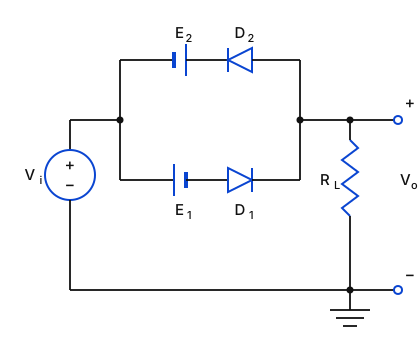
Input and output characteristics are shown below.
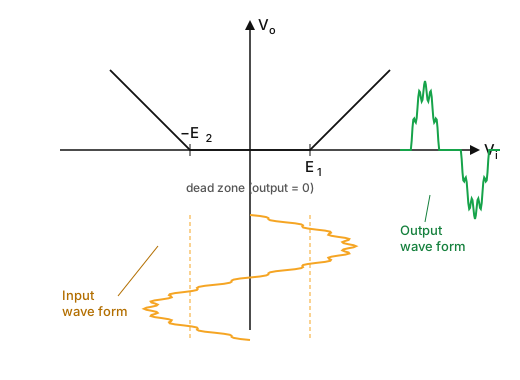
The region between +E
1 and −E
2 is known as _____.
दिए गए परिपथ में, यदि इनपुट वोल्टता +E
1 और −E
2 के बीच हो, तो आउटपुट शून्य होता है।
इनपुट और आउटपुट अभिलक्षण (characteristics) नीचे दर्शाए गए हैं।
+E
1 और −E
2 के बीच के क्षेत्र को _____ कहा जाता है।
- Aactive zoneसक्रिय क्षेत्र (active zone)
- Bcut off zoneकट-ऑफ क्षेत्र (cut off zone)
- Csaturation zoneसंतृप्ति क्षेत्र (saturation zone)
- Ddead zoneमृत क्षेत्र (dead zone)
Show answer
Concept: In this two-diode circuit each diode conducts only when the input exceeds its battery voltage; between the two thresholds both diodes stay off and no output appears.
- For , conducts and output follows ; for , conducts.
- For both diodes are reverse biased, so – the transfer curve is flat.
- This flat band where the input produces no output is called the dead zone (dead band).
Yaad rakhein: Input present but output zero = dead zone; cut-off and saturation are transistor regions, not diode-clipper terms.
Answer: (D) dead zone
अवधारणा: इस दो-डायोड परिपथ में हर डायोड तभी चालन करता है जब इनपुट उसकी बैटरी वोल्टता से अधिक हो; दोनों सीमाओं के बीच दोनों डायोड बंद रहते हैं और कोई आउटपुट नहीं आता।
- पर चालन करता है और आउटपुट के अनुसार चलता है; पर चालन करता है।
- के लिए दोनों डायोड पश्च-अभिनत (reverse biased) हैं, अतः – transfer curve सपाट है।
- जहाँ इनपुट होते हुए भी आउटपुट शून्य रहता है, उस सपाट भाग को dead zone (dead band) कहते हैं।
याद रखें: इनपुट है पर आउटपुट शून्य = dead zone; cut-off और saturation ट्रांजिस्टर के क्षेत्र हैं, डायोड-क्लिपर के नहीं।
उत्तर: (D) dead zone
RRB Technician Grade I (Signal)Basic Science and EngineeringDiode clipper / dead zoneRRB Technician Grade I (Signal) 2024 · 20 Dec Shift 1
Q64.The range of electrostatic voltmeter can be extended with the help of:
स्थिरवैद्युत वोल्टमीटर (electrostatic voltmeter) का परास (range) किसकी सहायता से बढ़ाया जा सकता है:
- AResistance Potential Dividerप्रतिरोध विभव विभाजक (Resistance Potential Divider)
- BRegisterरजिस्टर (Register)
- CCapacitance Potential Dividerधारिता विभव विभाजक (Capacitance Potential Divider)
- DCapacitorसंधारित्र (Capacitor)
Show answer
Concept: An electrostatic voltmeter measures voltage by the force between charged plates. Its range is extended by a potential divider, not by a series resistor as in ordinary voltmeters.
- With a resistance potential divider the instrument reads only a known fraction of the total voltage (used for DC and low-frequency AC); for pure AC a capacitance divider is also used.
- A plain resistor or capacitor in series cannot give a fixed multiplying factor for an instrument that draws almost no current, so options (B) and (D) are wrong.
Yaad rakhein: Electrostatic voltmeter range ↑ → potential divider (resistance / capacitance).
Answer: (A) Resistance Potential Divider
अवधारणा: स्थिरवैद्युत वोल्टमीटर आवेशित प्लेटों के बीच बल से वोल्टता मापता है। इसका परास (range) पोटेंशियल डिवाइडर से बढ़ाया जाता है, साधारण वोल्टमीटर की तरह श्रेणी प्रतिरोध से नहीं।
- प्रतिरोध पोटेंशियल डिवाइडर (resistance potential divider) से यंत्र कुल वोल्टता का एक ज्ञात अंश ही पढ़ता है (DC और कम आवृत्ति AC के लिए); शुद्ध AC के लिए धारिता (capacitance) डिवाइडर भी प्रयोग होता है।
- केवल श्रेणी में प्रतिरोध या संधारित्र लगाने से लगभग शून्य धारा लेने वाले इस यंत्र के लिए नियत गुणक नहीं मिलता, अतः (B) और (D) गलत हैं।
याद रखें: स्थिरवैद्युत वोल्टमीटर का परास ↑ → पोटेंशियल डिवाइडर (प्रतिरोध / धारिता)।
उत्तर: (A) Resistance Potential Divider
RRB Technician Grade I (Signal)Basic Science and EngineeringElectrostatic voltmeterRRB Technician Grade I (Signal) 2024 · 20 Dec Shift 1
Q65.Which of the following statements for Piezoelectric transducer is correct?
दाबविद्युत ट्रांसड्यूसर (Piezoelectric transducer) के लिए निम्नलिखित में से कौन-सा कथन सही है?
- APiezoelectric transducer can be used for the measurement of static displacement only.दाबविद्युत ट्रांसड्यूसर का उपयोग केवल स्थैतिक विस्थापन (static displacement) के मापन के लिए किया जा सकता है।
- BPiezoelectric transducer can be used for the measurement of dynamic displacement only.दाबविद्युत ट्रांसड्यूसर का उपयोग केवल गतिक विस्थापन (dynamic displacement) के मापन के लिए किया जा सकता है।
- CPiezoelectric transducer can be used for the measurement of both static and dynamic displacement.दाबविद्युत ट्रांसड्यूसर का उपयोग स्थैतिक और गतिक दोनों विस्थापनों के मापन के लिए किया जा सकता है।
- DPiezoelectric transducer cannot be used for the measurement of both static and dynamic displacement.दाबविद्युत ट्रांसड्यूसर का उपयोग स्थैतिक और गतिक दोनों में से किसी भी विस्थापन के मापन के लिए नहीं किया जा सकता है।
Show answer
Concept: A piezoelectric crystal (quartz, Rochelle salt) produces charge only while the applied force is changing; under a steady force the charge leaks away through the crystal and amplifier resistance.
- Hence it responds to dynamic (varying) displacement, vibration, shock and pressure, but cannot hold a reading for a static displacement.
- Its high natural frequency makes it ideal for vibration and accelerometer applications.
Yaad rakhein: Piezo = dynamic only; for static displacement use LVDT or strain gauge.
Answer: (B) Piezoelectric transducer can be used for the measurement of dynamic displacement only.
अवधारणा: पीज़ोइलेक्ट्रिक क्रिस्टल (quartz, Rochelle salt) तभी आवेश देता है जब लगाया गया बल बदल रहा हो; स्थिर बल पर आवेश क्रिस्टल और amplifier के प्रतिरोध से रिस (leak) जाता है।
- इसलिए यह गतिक (dynamic) विस्थापन, कंपन, झटके और दाब को मापता है, पर स्थैतिक (static) विस्थापन का पाठ्यांक नहीं रख पाता।
- उच्च प्राकृतिक आवृत्ति के कारण यह कंपन और accelerometer के लिए आदर्श है।
याद रखें: Piezo = केवल dynamic; static विस्थापन के लिए LVDT या strain gauge।
उत्तर: (B) Piezoelectric transducer can be used for the measurement of dynamic displacement only.
RRB Technician Grade I (Signal)Basic Science and EngineeringPiezoelectric transducerRRB Technician Grade I (Signal) 2024 · 20 Dec Shift 1
Q66.A machine performs work W in time t, and its power output is P. If the machine’s power output is doubled, how much time will it take to perform the same amount of work?
एक मशीन समय t में कार्य W करती है, और उसका शक्ति निर्गत (power output) P है। यदि मशीन का शक्ति निर्गत दुगुना कर दिया जाए, तो उतना ही कार्य करने में उसे कितना समय लगेगा?
- At/2
- Bt/4
- C2t
- Dt
Show answer
Concept: Power is the rate of doing work: , so for fixed work , i.e. .
- Original: .
- New power : .
Trick: Double the power → half the time (inverse relation).
Answer: (A)
अवधारणा: शक्ति कार्य करने की दर है: , अतः समान कार्य के लिए , यानी ।
- पहले: ।
- नई शक्ति : ।
ट्रिक: शक्ति दोगुनी → समय आधा (व्युत्क्रम संबंध)।
उत्तर: (A)
RRB Technician Grade I (Signal)Basic Science and EngineeringPower, work and timeRRB Technician Grade I (Signal) 2024 · 20 Dec Shift 1
Q67.Which factor does NOT affect the resistivity of a material?
कौन-सा कारक किसी पदार्थ की प्रतिरोधकता (resistivity) को प्रभावित नहीं करता है?
- AAtomic structureपरमाणु संरचना
- BMaterial typeपदार्थ का प्रकार
- CLength of the conductorचालक की लंबाई
- DTemperatureतापमान
Show answer
Concept: Resistivity is a property of the material; resistance depends on dimensions.
- depends on the material and its atomic structure (free-electron density) and on temperature.
- Length and area change , not – a long and a short copper wire have the same resistivity.
Yaad rakhein: Resistance → size matters; resistivity → only material and temperature.
Answer: (C) Length of the conductor
अवधारणा: प्रतिरोधकता (resistivity) पदार्थ का गुण है; प्रतिरोध आकार पर निर्भर करता है।
- पदार्थ और उसकी परमाणु संरचना (मुक्त इलेक्ट्रॉन घनत्व) तथा ताप पर निर्भर करती है।
- लंबाई और क्षेत्रफल बदलते हैं, नहीं – लंबे और छोटे ताँबे के तार की प्रतिरोधकता समान होती है।
याद रखें: प्रतिरोध → आकार मायने रखता है; प्रतिरोधकता → केवल पदार्थ और ताप।
उत्तर: (C) Length of the conductor
RRB Technician Grade I (Signal)Basic Science and EngineeringResistivityRRB Technician Grade I (Signal) 2024 · 20 Dec Shift 1
Q68.If a body falls freely under gravity from rest, what fraction of its initial potential energy has been converted into kinetic energy when it has fallen to half of its initial height?
यदि कोई पिंड विराम से गुरुत्व के अंतर्गत मुक्त रूप से गिरता है, तो अपनी प्रारंभिक ऊँचाई के आधे तक गिरने पर उसकी प्रारंभिक स्थितिज ऊर्जा का कितना भाग गतिज ऊर्जा में परिवर्तित हो चुका होगा?
- A1/2
- B7/8
- C1/4
- D3/4
Show answer
Concept: In free fall, total mechanical energy is conserved: loss in PE = gain in KE.
- Initial PE ; at half height PE .
- KE gained , i.e. of the initial PE.
Trick: PE ∝ height, so fraction of PE converted = fraction of height fallen .
Answer: (A)
अवधारणा: मुक्त पतन में कुल यांत्रिक ऊर्जा संरक्षित रहती है: PE में कमी = KE में वृद्धि।
- प्रारंभिक PE ; आधी ऊँचाई पर PE ।
- प्राप्त KE , यानी प्रारंभिक PE का ।
ट्रिक: PE ∝ ऊँचाई, इसलिए बदली गई PE का अंश = गिरी हुई ऊँचाई का अंश ।
उत्तर: (A)
RRB Technician Grade I (Signal)Basic Science and EngineeringConservation of mechanical energyRRB Technician Grade I (Signal) 2024 · 20 Dec Shift 1
Q69.Which of the following is the correct equation for power (P) in terms of energy (E) and time (t)?
ऊर्जा (E) और समय (t) के पदों में शक्ति (P) के लिए निम्नलिखित में से कौन-सा समीकरण सही है?
- AP = E/t
- BP = E/t2
- CP = E + t
- DP = E × t
Show answer
Concept: Power is the rate at which energy is transferred or work is done.
- ; SI unit watt .
- , or do not have the unit of watt, so they are wrong.
Yaad rakhein: Watt = joule per second → .
Answer: (A)
अवधारणा: शक्ति (power) वह दर है जिससे ऊर्जा स्थानांतरित होती है या कार्य होता है।
- ; SI मात्रक वाट ।
- , या का मात्रक वाट नहीं बनता, अतः वे गलत हैं।
याद रखें: वाट = जूल प्रति सेकंड → ।
उत्तर: (A)
RRB Technician Grade I (Signal)Basic Science and EngineeringPower formulaRRB Technician Grade I (Signal) 2024 · 20 Dec Shift 1
Q70.Two resistors, R1 and R2, are connected in series across a voltage source. If the power dissipated by R1 is 4 times the power dissipated by R2, what is the ratio of their resistances R1 : R2?
दो प्रतिरोधक R1 और R2 एक वोल्टता स्रोत के साथ श्रेणीक्रम (series) में संयोजित हैं। यदि R1 द्वारा क्षयित शक्ति R2 द्वारा क्षयित शक्ति की 4 गुनी है, तो उनके प्रतिरोधों का अनुपात R1 : R2 क्या है?
- A1 : 4
- B16 : 1
- C1 : 16
- D4 : 1
Show answer
Concept: In series the same current flows through both resistors, so gives .
- .
- .
Trick: Series → ; parallel → (then the answer would be ).
Answer: (D) 4 : 1
अवधारणा: श्रेणी में दोनों प्रतिरोधों से समान धारा बहती है, अतः से ।
- ।
- ।
ट्रिक: श्रेणी → ; समांतर → (तब उत्तर होता)।
उत्तर: (D) 4 : 1
RRB Technician Grade I (Signal)Basic Science and EngineeringPower in series resistorsRRB Technician Grade I (Signal) 2024 · 20 Dec Shift 1
Q71.Select the correct option for the band gap energies of Ge, Si and GaAs.
Where E(Ge) = band gap energy of Ge, E(Si) = band gap energy of Si and E(GaAs) = band gap energy of GaAs
Ge, Si और GaAs की बैंड गैप ऊर्जाओं (band gap energies) के लिए सही विकल्प का चयन कीजिए।
जहाँ E(Ge) = Ge की बैंड गैप ऊर्जा, E(Si) = Si की बैंड गैप ऊर्जा और E(GaAs) = GaAs की बैंड गैप ऊर्जा
- AE(GaAs) > E (Si) > E (Ge)
- BE(Ge) > E (GaAs) > E (Si)
- CE(GaAs) > E (Ge) > E (Si)
- DE(Ge) > E (Si) > E (GaAs)
Show answer
Concept: Band gap energy () is the energy needed to move an electron from the valence band to the conduction band.
- Standard values at room temperature: , , .
- Hence .
- This is why Ge devices are more temperature-sensitive (smallest gap) and GaAs is used in LEDs/high-frequency devices.
Yaad rakhein: "Ge < Si < GaAs" – 0.7, 1.1, 1.4 eV (roughly increasing by 0.35).
Answer: (A) E(GaAs) > E(Si) > E(Ge)
अवधारणा: बैंड अंतराल ऊर्जा (band gap energy, ) वह ऊर्जा है जो इलेक्ट्रॉन को संयोजकता बैंड से चालन बैंड में ले जाने के लिए चाहिए।
- कमरे के ताप पर मानक मान: , , ।
- अतः ।
- इसीलिए Ge युक्तियाँ ताप के प्रति अधिक संवेदनशील हैं (सबसे छोटा अंतराल) और GaAs का उपयोग LED/उच्च-आवृत्ति युक्तियों में होता है।
याद रखें: "Ge < Si < GaAs" – 0.7, 1.1, 1.4 eV (लगभग 0.35 बढ़ता हुआ)।
उत्तर: (A) E(GaAs) > E(Si) > E(Ge)
RRB Technician Grade I (Signal)Basic Science and EngineeringSemiconductor band gapRRB Technician Grade I (Signal) 2024 · 19 Dec Shift 3
Q72.Find the Boolean expression for the given logic gate circuit diagram where inputs are A and B.
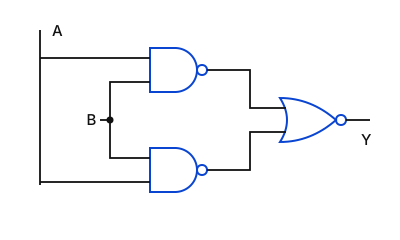
दिए गए लॉजिक गेट परिपथ आरेख के लिए बूलियन व्यंजक (Boolean expression) ज्ञात कीजिए, जहाँ इनपुट A और B हैं।
- A
- B
- C
- D
Show answer
Concept: NAND output ; NOR output . Use De Morgan's laws to simplify.
- Both NAND gates have inputs A and B, so each gives .
- The NOR gate receives and : .
- (double negation).
Trick: A NOR gate with both inputs tied together is just a NOT gate. NOT of NAND = AND.
Answer: (B)
अवधारणा: NAND का आउटपुट ; NOR का आउटपुट । सरल करने के लिए डी मॉर्गन के नियम प्रयोग करें।
- दोनों NAND गेटों के इनपुट A और B हैं, अतः प्रत्येक देता है ।
- NOR गेट को और मिलते हैं: ।
- (दोहरा निषेध)।
ट्रिक: जिस NOR गेट के दोनों इनपुट जुड़े हों, वह केवल NOT गेट है। NAND का NOT = AND।
उत्तर: (B)
RRB Technician Grade I (Signal)Basic Science and EngineeringLogic gates – NAND and NORRRB Technician Grade I (Signal) 2024 · 19 Dec Shift 3
Q73.An infinitely long straight wire carries a current of I. At what distance r from the wire is the magnetic field 5 × 10⁻⁶ T if I = 15 A?
एक अनंत लंबाई का सीधा तार I धारा वहन करता है। यदि I = 15 A है, तो तार से किस दूरी r पर चुंबकीय क्षेत्र 5 × 10⁻⁶ T होगा?
- A0.6 m
- B0.3 m
- C7.5 m
- D3 m
Show answer
Concept: For an infinitely long straight wire, , where .
- .
- .
Trick: Remember – it avoids writing and every time.
Answer: (A) 0.6 m
अवधारणा: अनंत लंबे सीधे तार के लिए , जहाँ ।
- ।
- ।
ट्रिक: याद रखें – हर बार और लिखने से बच जाते हैं।
उत्तर: (A) 0.6 m
RRB Technician Grade I (Signal)Basic Science and EngineeringMagnetic field of a straight wireRRB Technician Grade I (Signal) 2024 · 19 Dec Shift 3
Q74.The direction of the magnetic field around an infinitely long straight current-carrying wire is:
एक अनंत लंबाई के सीधे धारावाही तार के चारों ओर चुंबकीय क्षेत्र की दिशा होती है:
- Atangential to the wire and depends on the direction of the currentतार के स्पर्शरेखीय (tangential) और धारा की दिशा पर निर्भर
- Bradial outward from the wireतार से त्रिज्यीय रूप से बाहर की ओर
- Cperpendicular to the plane containing the wire and the pointतार और बिंदु को समाविष्ट करने वाले तल के लंबवत
- Dradial inward toward the wireतार की ओर त्रिज्यीय रूप से अंदर की ओर
Show answer
Concept: The magnetic field lines around a straight current-carrying wire are concentric circles centred on the wire (right-hand thumb rule).
- At any point the field is tangent to the circle through that point, i.e. tangential and perpendicular to the radius.
- Reversing the current reverses the direction of circulation (thumb = current, curled fingers = field).
- The field is neither radially outward nor inward – that would be the pattern of an electric field around a line charge.
Yaad rakhein: Electric field of a line charge = radial; magnetic field of a line current = circular/tangential.
Answer: (A) tangential to the wire and depends on the direction of the current
अवधारणा: सीधे धारावाही तार के चारों ओर चुंबकीय क्षेत्र रेखाएँ तार को केंद्र मानकर संकेंद्री वृत्त होती हैं (दाहिने हाथ के अंगूठे का नियम)।
- किसी भी बिंदु पर क्षेत्र उस बिंदु से गुज़रने वाले वृत्त की स्पर्श रेखा की दिशा में होता है, अर्थात स्पर्शीय (tangential) और त्रिज्या के लंबवत।
- धारा उलटने पर परिक्रमण की दिशा उलट जाती है (अंगूठा = धारा, मुड़ी उँगलियाँ = क्षेत्र)।
- क्षेत्र न त्रिज्यीय बाहर है न अंदर – वह पैटर्न रेखीय आवेश के विद्युत क्षेत्र का होता है।
याद रखें: रेखीय आवेश का विद्युत क्षेत्र = त्रिज्यीय; रेखीय धारा का चुंबकीय क्षेत्र = वृत्तीय/स्पर्शीय।
उत्तर: (A) तार के स्पर्शीय और धारा की दिशा पर निर्भर
RRB Technician Grade I (Signal)Basic Science and EngineeringMagnetic field direction – right-hand ruleRRB Technician Grade I (Signal) 2024 · 19 Dec Shift 3
Q75.Select the most appropriate option to fill in the blank.
_____ error occurs as the value of flux density is different for the same value of current when increasing and decreasing.
रिक्त स्थान की पूर्ति के लिए सबसे उपयुक्त विकल्प का चयन कीजिए।
_____ त्रुटि इसलिए होती है क्योंकि धारा को बढ़ाते और घटाते समय धारा के समान मान के लिए फ्लक्स घनत्व का मान भिन्न होता है।
- AHysteresisशैथिल्य (Hysteresis)
- BFrequencyआवृत्ति (Frequency)
- CFrictionघर्षण (Friction)
- DTemperatureतापमान (Temperature)
Show answer
Concept: Hysteresis is the lag between cause and effect – the output depends on whether the input is increasing or decreasing.
- In a magnetic material, flux density for the same current (same ) is different on the rising and falling curves – this forms the B–H loop.
- The difference in readings for the same input value is called hysteresis error.
- Frequency, friction and temperature errors do not depend on the direction of change of input.
Yaad rakhein: "Increasing vs decreasing gives different reading" = Hysteresis (the loop).
Answer: (A) Hysteresis
अवधारणा: हिस्टैरिसिस (hysteresis) कारण और प्रभाव के बीच का पिछड़ापन है – आउटपुट इस पर निर्भर करता है कि इनपुट बढ़ रहा है या घट रहा है।
- चुंबकीय पदार्थ में एक ही धारा (समान ) के लिए फ्लक्स घनत्व बढ़ते और घटते वक्र पर अलग-अलग होता है – इससे B–H लूप बनता है।
- एक ही इनपुट मान पर पाठ्यांकों का यह अंतर हिस्टैरिसिस त्रुटि कहलाता है।
- आवृत्ति, घर्षण और ताप त्रुटियाँ इनपुट के बदलने की दिशा पर निर्भर नहीं करतीं।
याद रखें: "बढ़ने और घटने पर अलग पाठ्यांक" = हिस्टैरिसिस (लूप)।
उत्तर: (A) Hysteresis
RRB Technician Grade I (Signal)Basic Science and EngineeringMeasurement errors – hysteresisRRB Technician Grade I (Signal) 2024 · 19 Dec Shift 3
Q76.Select the most appropriate option to fill in the blanks.
Repeatability is defined as the ability of an instrument to give the ____ output (with limited variations) for repeated applications of ____ input value under same
environmental conditions.
रिक्त स्थानों की पूर्ति के लिए सबसे उपयुक्त विकल्प का चयन कीजिए।
पुनरावृत्तियता (Repeatability) को किसी यंत्र की उस क्षमता के रूप में परिभाषित किया जाता है जिसके द्वारा वह समान
पर्यावरणीय परिस्थितियों में ____ इनपुट मान के बार-बार अनुप्रयोग के लिए ____ आउटपुट (सीमित विचरण के साथ) देता है।
- Asame; sameसमान; समान
- Bdifferent; sameभिन्न; समान
- Cdifferent; differentभिन्न; भिन्न
- Dsame; differentसमान; भिन्न
Show answer
Concept: Repeatability is the closeness of repeated readings of the same input by the same instrument, same observer, same conditions, in a short time.
- So the instrument should give the same output for repeated applications of the same input value.
- Any option with "different" breaks the definition – an instrument giving different outputs for the same input is not repeatable.
Yaad rakhein: Repeatability = same–same–same (output, input, conditions); Reproducibility = same output, same input, but different conditions/observer/location.
Answer: (A) same; same
अवधारणा: पुनरावृत्ति (repeatability) = एक ही यंत्र, एक ही प्रेक्षक, समान परिस्थितियों में, कम समय में एक ही इनपुट के बार-बार पाठ्यांकों की निकटता।
- अतः यंत्र को समान इनपुट मान के बार-बार प्रयोग पर समान आउटपुट देना चाहिए।
- जिस विकल्प में "different" है वह परिभाषा तोड़ता है – एक ही इनपुट पर अलग आउटपुट देने वाला यंत्र पुनरावृत्ति-योग्य नहीं है।
याद रखें: Repeatability = same–same–same (आउटपुट, इनपुट, परिस्थितियाँ); Reproducibility = समान आउटपुट, समान इनपुट, पर अलग परिस्थितियाँ/प्रेक्षक/स्थान।
उत्तर: (A) same; same
RRB Technician Grade I (Signal)Basic Science and EngineeringInstrument characteristics – repeatabilityRRB Technician Grade I (Signal) 2024 · 19 Dec Shift 3
Q77.Intel 8051 provides _____ interrupt structures and 8052 provides _____ interrupt structures.
Intel 8051 _____ इंटरप्ट संरचनाएँ (interrupt structures) प्रदान करता है और 8052 _____ इंटरप्ट संरचनाएँ प्रदान करता है।
- A6; 7
- B4; 5
- C7; 8
- D5; 6
Show answer
Concept: The 8051 has five interrupt sources plus RESET; the 8052 adds a Timer 2 interrupt.
- 8051: INT0, Timer 0, INT1, Timer 1, Serial (TI/RI) = 5 sources; with RESET counted, 6 interrupts (vectors 0000H, 0003H, 000BH, 0013H, 001BH, 0023H).
- 8052: the same plus Timer 2 (vector 002BH) = 6 sources, i.e. 7 with RESET.
Yaad rakhein: Vector addresses jump by 8 bytes: 03, 0B, 13, 1B, 23 (8051), 2B (8052 Timer 2).
Answer: (A) 6; 7
अवधारणा: 8051 में पाँच इंटरप्ट स्रोत और RESET होते हैं; 8052 में Timer 2 का इंटरप्ट जुड़ जाता है।
- 8051: INT0, Timer 0, INT1, Timer 1, Serial (TI/RI) = 5 स्रोत; RESET सहित 6 इंटरप्ट (वेक्टर 0000H, 0003H, 000BH, 0013H, 001BH, 0023H)।
- 8052: वही और Timer 2 (वेक्टर 002BH) = 6 स्रोत, अर्थात RESET सहित 7।
याद रखें: वेक्टर पते 8 बाइट के अंतर पर: 03, 0B, 13, 1B, 23 (8051), 2B (8052 Timer 2)।
उत्तर: (A) 6; 7
RRB Technician Grade I (Signal)Basic Science and Engineering8051 microcontroller interruptsRRB Technician Grade I (Signal) 2024 · 19 Dec Shift 3
Q78.If the period T of a simple pendulum depends on its length L, mass m and acceleration due to gravity g, then using dimensional analysis, the period T is proportional to __________.
यदि किसी सरल लोलक का आवर्तकाल T उसकी लंबाई L, द्रव्यमान m और गुरुत्वीय त्वरण g पर निर्भर करता है, तो विमीय विश्लेषण (dimensional analysis) का उपयोग करते हुए, आवर्तकाल T __________ के समानुपाती होता है।
- A
- B
- C
- D
Show answer
Concept: Assume and equate dimensions on both sides.
- .
- Compare with : , , ⇒ , .
- So ; the period does not depend on mass.
Trick: Only has the dimension of time (); gives and does not give seconds – eliminate by units.
Answer: (C)
अवधारणा: मान लें और दोनों ओर की विमाएँ बराबर करें।
- ।
- से तुलना: , , ⇒ , ।
- अतः ; आवर्तकाल द्रव्यमान पर निर्भर नहीं करता।
ट्रिक: केवल की विमा समय की है (); से मिलता है और से सेकंड नहीं मिलता – इकाइयों से विकल्प हटाएँ।
उत्तर: (C)
RRB Technician Grade I (Signal)Basic Science and EngineeringDimensional analysis – pendulumRRB Technician Grade I (Signal) 2024 · 19 Dec Shift 3
Q79.Reproducibility is defined as the ability of an instrument to reproduce (the) _____ output(s) for repeated applications of (the) _____ input value(s) under (the) _____ environment condition(s).
पुनरुत्पादकता (Reproducibility) को किसी यंत्र की उस क्षमता के रूप में परिभाषित किया जाता है जिसके द्वारा वह _____ पर्यावरणीय परिस्थिति(यों) में _____ इनपुट मान(ों) के बार-बार अनुप्रयोग के लिए _____ आउटपुट पुनरुत्पादित करता है।
- Asame; same; differentसमान; समान; भिन्न
- Bsame; same; sameसमान; समान; समान
- Cdifferent; same; differentभिन्न; समान; भिन्न
- Dsame; different; sameसमान; भिन्न; समान
Show answer
Concept: Reproducibility is the degree of closeness with which a given value may be repeatedly measured – the same output for the same input under the same conditions, over a longer period.
- The definition requires same output for same input under same environmental conditions.
- Any "different" in the blanks would describe drift or poor reproducibility, not the property itself.
Yaad rakhein: Repeatability = short time; Reproducibility = long time – both: same–same–same.
Answer: (B) same; same; same
अवधारणा: पुनरुत्पादकता (reproducibility) = किसी मान को बार-बार मापने पर मिलने वाली निकटता – समान इनपुट पर, समान परिस्थितियों में, लंबे समय तक समान आउटपुट।
- परिभाषा में समान इनपुट पर समान पर्यावरणीय परिस्थितियों में समान आउटपुट चाहिए।
- रिक्त स्थानों में कोई भी "different" ड्रिफ्ट या खराब पुनरुत्पादकता बताएगा, गुण को नहीं।
याद रखें: Repeatability = कम समय; Reproducibility = लंबा समय – दोनों: same–same–same।
उत्तर: (B) same; same; same
RRB Technician Grade I (Signal)Basic Science and EngineeringInstrument characteristics – reproducibilityRRB Technician Grade I (Signal) 2024 · 19 Dec Shift 3
Q80.Find the Boolean expression for the output Y if inputs are A and B.
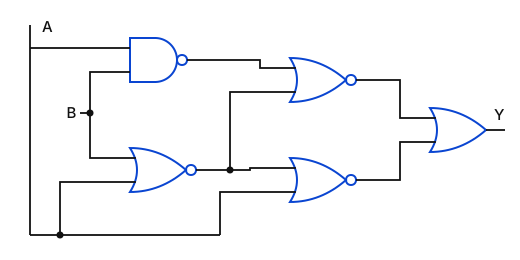
यदि इनपुट A और B हैं, तो आउटपुट Y के लिए बूलियन व्यंजक (Boolean expression) ज्ञात कीजिए।
- AB
- BA+B
- CAB
- DA
Show answer
Concept: Write the output of each gate and simplify with Boolean laws: , .
- First stage: NAND gives ; NOR gives .
- Upper NOR: .
- Lower NOR (inputs and ): .
- Final OR: .
Trick: Quick check with A = 0, B = 1 and A = 1, B = 0: output follows B both times, so .
Answer: (A) B
अवधारणा: हर गेट का आउटपुट लिखें और बूलियन नियमों से सरल करें: , ।
- पहला चरण: NAND से ; NOR से ।
- ऊपरी NOR: ।
- निचला NOR (इनपुट और ): ।
- अंतिम OR: ।
ट्रिक: A = 0, B = 1 और A = 1, B = 0 रखकर जाँचें: दोनों बार आउटपुट B के बराबर है, अतः ।
उत्तर: (A) B
RRB Technician Grade I (Signal)Basic Science and EngineeringLogic circuit simplificationRRB Technician Grade I (Signal) 2024 · 19 Dec Shift 3

