RRB Technician Grade I (Signal) · 494 questions

RRB Technician Grade I (Signal) 2024, 2025 PYQs

Real previous year questions, subject-wise. Try the question, then open the answer and the explanation in Hindi & English – free, no login.

Courses – airGurukul

72 questions in General Intelligence and Reasoning.

Q61.
UDVA is related to CLDI in a certain way based on the English alphabetical order. In the same way, AJBG is related to IRJO. To which of the following options is YHZE related, following the same logic?
अंग्रेज़ी वर्णमाला क्रम के आधार पर UDVA एक निश्चित प्रकार से CLDI से संबंधित है। उसी प्रकार AJBG, IRJO से संबंधित है। उसी तर्क का अनुसरण करते हुए YHZE निम्नलिखित में से किस विकल्प से संबंधित है?
  1. AGPHM
  2. BGTFY
  3. CGHYT
  4. DGBHY
Show answer

Concept: Compare letter positions (A=1 … Z=26); find the shift applied to each letter and apply it to the new word.

  1. UDVA → CLDI: U(21)+8=29→C(3), D(4)+8=L(12), V(22)+8=D(4), A(1)+8=I(9). Each letter moves +8.
  2. Check AJBG → IRJO: A+8=I, J+8=R, B+8=J, G+8=O ✓.
  3. YHZE: Y(25)+8=33→G(7), H(8)+8=P(16), Z(26)+8=34→H(8), E(5)+8=M(13) → GPHM.

Trick: +8 past Z wraps around (subtract 26).

Answer: (A) GPHM

अवधारणा: अक्षरों की स्थिति (A=1 … Z=26) तुलना करें; हर अक्षर पर लगा shift निकालकर नए शब्द पर लगाएँ।

  1. UDVA → CLDI: U(21)+8=29→C(3), D(4)+8=L(12), V(22)+8=D(4), A(1)+8=I(9)। हर अक्षर +8 बढ़ता है।
  2. जाँच AJBG → IRJO: A+8=I, J+8=R, B+8=J, G+8=O ✓।
  3. YHZE: Y(25)+8=33→G(7), H(8)+8=P(16), Z(26)+8=34→H(8), E(5)+8=M(13) → GPHM।

ट्रिक: Z के आगे +8 घूमकर आता है (26 घटाएँ)।

उत्तर: (A) GPHM
RRB Technician Grade I (Signal)General Intelligence and ReasoningLetter-cluster analogyRRB Technician Grade I (Signal) 2024 · 19 Dec Shift 1
Q62.
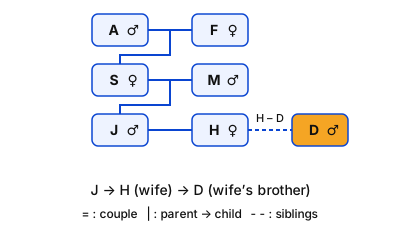
M, S, A, F, J, H and D are seven family members living in the same apartment. M is S’s husband. H is J’s wife. S is the mother of J and daughter of A. D is the brother of H. F is the wife of A. How is D related to J?
M, S, A, F, J, H और D एक परिवार के सात सदस्य हैं जो एक ही अपार्टमेंट में रहते हैं। M, S का पति है। H, J की पत्नी है। S, J की माता और A की पुत्री है। D, H का भाई है। F, A की पत्नी है। D, J से किस प्रकार संबंधित है?
  1. AWife’s brotherपत्नी का भाई
  2. BFatherपिता
  3. CHusbandपति
  4. DBrotherभाई
Show answer

Concept: Build the family tree generation by generation, then read the path from J to D.

  1. A (♂) and F (♀) are a couple; S is their daughter. M is S's husband.
  2. J is the son of S and M (J has a wife H, so J is male).
  3. D is the brother of H, and H is J's wife → D is J's wife's brother (brother-in-law).

Trick: Follow the chain J → wife (H) → her brother (D).

Answer: (A) Wife's brother

अवधारणा: पीढ़ी-दर-पीढ़ी वंश वृक्ष बनाएँ, फिर J से D तक का रास्ता पढ़ें।

  1. A (♂) और F (♀) दंपति हैं; S उनकी बेटी है। M, S का पति है।
  2. J, S और M का बेटा है (J की पत्नी H है, अतः J पुरुष)।
  3. D, H का भाई है और H, J की पत्नी → D, J की पत्नी का भाई (साला) है।

ट्रिक: श्रृंखला J → पत्नी (H) → उसका भाई (D) पकड़ें।

उत्तर: (A) Wife's brother

RRB Technician Grade I (Signal)General Intelligence and ReasoningBlood relations – family treeRRB Technician Grade I (Signal) 2024 · 19 Dec Shift 1
Q63.
Read the given statement and conclusions carefully and decide which of the given conclusions follow(s) from the statement.
Statement:
Book-reading is a very healthy habit because it keeps our learning process alive even after our college or school education.
Conclusions:
I. Nowadays, e-books are gaining far more popularity than hardcovers.
II. Students gain a lot of knowledge and improve language by keeping the habit of book-reading alive.
दिए गए कथन और निष्कर्षों को ध्यानपूर्वक पढ़िए और निर्णय लीजिए कि दिए गए निष्कर्षों में से कौन-सा/कौन-से निष्कर्ष कथन का अनुसरण करता है/करते हैं।
कथन:
पुस्तक पढ़ना एक बहुत ही स्वस्थ आदत है, क्योंकि यह हमारी कॉलेज या स्कूल की शिक्षा के बाद भी हमारी सीखने की प्रक्रिया को जीवित रखती है।
निष्कर्ष:
I. आजकल ई-पुस्तकें हार्डकवर पुस्तकों की तुलना में कहीं अधिक लोकप्रिय हो रही हैं।
II. विद्यार्थी पुस्तक पढ़ने की आदत को जीवित रखकर बहुत ज्ञान प्राप्त करते हैं और भाषा में सुधार करते हैं।
  1. AOnly conclusion I followsकेवल निष्कर्ष I अनुसरण करता है
  2. BNeither conclusion I nor II followsन तो निष्कर्ष I और न ही II अनुसरण करता है
  3. COnly conclusion II followsकेवल निष्कर्ष II अनुसरण करता है
  4. DBoth the conclusions followदोनों निष्कर्ष अनुसरण करते हैं
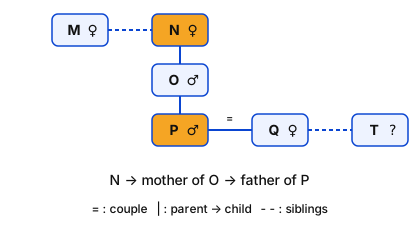
Show answer

Concept: A conclusion "follows" only if it is directly implied by the statement; it must not bring in new information.

  1. The statement says book-reading keeps learning alive even after formal education. Conclusion II (students gain knowledge and improve language by reading) is a direct implication → follows.
  2. Conclusion I talks about e-books vs hardcovers – nothing in the statement compares formats → does not follow.

Trick: Any conclusion that introduces a new topic (e-books, popularity) is out.

Answer: (C) Only conclusion II follows

अवधारणा: निष्कर्ष तभी "अनुसरण करता है" जब वह कथन से सीधे निकलता हो; उसमें नई जानकारी नहीं आनी चाहिए।

  1. कथन कहता है कि पुस्तक पढ़ना औपचारिक शिक्षा के बाद भी सीखने की प्रक्रिया जीवित रखता है। निष्कर्ष II (पढ़ने से छात्र ज्ञान पाते और भाषा सुधारते हैं) इसका सीधा अर्थ है → अनुसरण करता है।
  2. निष्कर्ष I e-book बनाम hardcover की बात करता है – कथन में प्रारूपों की कोई तुलना नहीं → अनुसरण नहीं करता।

ट्रिक: जो निष्कर्ष नया विषय (e-book, लोकप्रियता) लाए, वह बाहर।

उत्तर: (C) Only conclusion II follows

RRB Technician Grade I (Signal)General Intelligence and ReasoningStatement and conclusionsRRB Technician Grade I (Signal) 2024 · 19 Dec Shift 1
Q64.
In a certain code language,
‘R + S’ means ‘R is the mother of S’,
‘R @ S’ means ‘R is the husband of S’,
‘R # S’ means ‘R is the sister of S’ and
‘R % S’ means ‘R is the father of S’.
How is N related to P if ‘M # N + O % P @ Q # T’?
एक निश्चित कूट भाषा में,
‘R + S’ का अर्थ है ‘R, S की माता है’,
‘R @ S’ का अर्थ है ‘R, S का पति है’,
‘R # S’ का अर्थ है ‘R, S की बहन है’ और
‘R % S’ का अर्थ है ‘R, S का पिता है’।
यदि ‘M # N + O % P @ Q # T’ है, तो N, P से किस प्रकार संबंधित है?
  1. AFather’s sisterपिता की बहन
  2. BMotherमाता
  3. CSisterबहन
  4. DFather’s motherपिता की माता
Show answer

Concept: Decode the chain symbol by symbol and draw the tree; N and P are the two people to connect.

  1. M # N → M is the sister of N; N + O → N is the mother of O.
  2. O % P → O is the father of P; P @ Q → P is the husband of Q; Q # T → Q is the sister of T.
  3. N is the mother of O, and O is P's father → N is P's father's mother (grandmother).

Trick: Only the middle part "N + O % P" matters; the ends (M, Q, T) are distractions.

Answer: (D) Father's mother

अवधारणा: श्रृंखला को एक-एक प्रतीक से decode कर वृक्ष बनाएँ; N और P को जोड़ना है।

  1. M # N → M, N की बहन; N + O → N, O की माता।
  2. O % P → O, P का पिता; P @ Q → P, Q का पति; Q # T → Q, T की बहन।
  3. N, O की माता है और O, P का पिता → N, P की पिता की माता (दादी) है।

ट्रिक: केवल बीच का भाग "N + O % P" काम का है; सिरे (M, Q, T) भटकाने के लिए हैं।

उत्तर: (D) Father's mother

RRB Technician Grade I (Signal)General Intelligence and ReasoningCoded blood relationsRRB Technician Grade I (Signal) 2024 · 19 Dec Shift 1
Q65.
In this question, a question is followed by two statements numbered (I) and (II). You have to decide whether the data provided in the statements are sufficient to answer the question. Read both the statements and decide the appropriate answer.
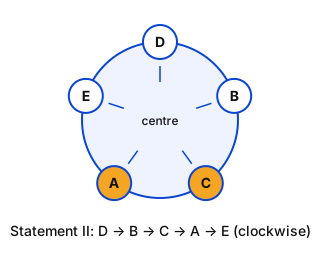
Question: A, B, C, D and E are sitting around a circular table facing the centre. Who sits to the immediate right of A?
Statement (I): Only one person sits between D and C. E sits to the immediate right of D. Statement (II): B sits to the immediate left of D. Only one person sits between B and E. Only one person sits between E and C.
इस प्रश्न में, एक प्रश्न के बाद (I) और (II) क्रमांकित दो कथन दिए गए हैं। आपको यह निर्णय लेना है कि कथनों में दिए गए आँकड़े प्रश्न का उत्तर देने के लिए पर्याप्त हैं या नहीं। दोनों कथनों को पढ़िए और उपयुक्त उत्तर का चयन कीजिए।
प्रश्न: A, B, C, D और E एक वृत्ताकार मेज़ के चारों ओर केंद्र की ओर मुख करके बैठे हैं। A के ठीक दाईं ओर कौन बैठा है?
कथन (I): D और C के बीच केवल एक व्यक्ति बैठा है। E, D के ठीक दाईं ओर बैठा है। कथन (II): B, D के ठीक बाईं ओर बैठा है। B और E के बीच केवल एक व्यक्ति बैठा है। E और C के बीच केवल एक व्यक्ति बैठा है।
  1. AData in statements I and II together are sufficient to answer the question.कथन I और II के आँकड़े मिलाकर प्रश्न का उत्तर देने के लिए पर्याप्त हैं।
  2. BData in Statement I alone is sufficient to answer the question while data in statement II is not.कथन I के आँकड़े अकेले प्रश्न का उत्तर देने के लिए पर्याप्त हैं, जबकि कथन II के आँकड़े पर्याप्त नहीं हैं।
  3. CData in statements I and II together are NOT sufficient to answer the question.कथन I और II के आँकड़े मिलाकर भी प्रश्न का उत्तर देने के लिए पर्याप्त नहीं हैं।
  4. DData in Statement II alone is sufficient to answer the question while data in statement I is not.कथन II के आँकड़े अकेले प्रश्न का उत्तर देने के लिए पर्याप्त हैं, जबकि कथन I के आँकड़े पर्याप्त नहीं हैं।
Show answer

Concept: Five people face the centre, so "immediate right" means the anticlockwise neighbour. Test each statement alone.

  1. Statement I: E is to D's immediate right and one person sits between D and C. A and B can still swap places, so A's right neighbour is not fixed → not sufficient.
  2. Statement II: B is to D's immediate left; one person between B and E; one between E and C. Going clockwise this forces D, B, C, A, E (the alternative places E where B and D already sit).
  3. Then A's immediate right is C – a unique answer from II alone.

Trick: In data sufficiency, stop as soon as one statement fixes the arrangement uniquely; here II does, I does not.

Answer: (D) Data in Statement II alone is sufficient to answer the question while data in statement I is not.

अवधारणा: पाँच व्यक्ति केंद्र की ओर मुख किए हैं, अतः "तुरंत दाएँ" का अर्थ है घड़ी की विपरीत दिशा वाला पड़ोसी। हर कथन अकेले जाँचें।

  1. कथन I: E, D के तुरंत दाएँ है और D व C के बीच एक व्यक्ति है। A और B की जगह अभी भी बदल सकती है, अतः A का दायाँ पड़ोसी तय नहीं → अपर्याप्त।
  2. कथन II: B, D के तुरंत बाएँ; B व E के बीच एक; E व C के बीच एक। घड़ी की दिशा में इससे क्रम D, B, C, A, E बनता है (दूसरी संभावना में E की जगह पर B/D पहले से बैठे हैं)।
  3. तब A के तुरंत दाएँ C है – केवल II से अद्वितीय उत्तर।

ट्रिक: डेटा पर्याप्तता में जैसे ही एक कथन व्यवस्था को अद्वितीय रूप से तय कर दे, रुक जाएँ; यहाँ II करता है, I नहीं।

उत्तर: (D) Data in Statement II alone is sufficient to answer the question while data in statement I is not.

RRB Technician Grade I (Signal)General Intelligence and ReasoningData sufficiency – circular seatingRRB Technician Grade I (Signal) 2024 · 19 Dec Shift 1
Q66.
Based on the English alphabetical order, three of the following four letter-clusters are alike in a certain way and thus form a group. Which letter-cluster DOES NOT belong to that group?
(Note: The odd one out is not based on the number of consonants/vowels or their position in the letter-cluster.)
अंग्रेज़ी वर्णमाला क्रम के आधार पर, निम्नलिखित चार अक्षर-समूहों में से तीन एक निश्चित प्रकार से समान हैं और इस प्रकार एक समूह बनाते हैं। कौन-सा अक्षर-समूह उस समूह से संबंधित नहीं है?
(नोट: असंगत अक्षर-समूह व्यंजनों/स्वरों की संख्या या अक्षर-समूह में उनकी स्थिति पर आधारित नहीं है।)
  1. AEIRV
  2. BXBIO
  3. CKOVB
  4. DAELR
Show answer

Concept: Write the alphabet positions and check the gaps between consecutive letters.

  1. XBIO: X(24)→B(2)→I(9)→O(15): +4, +7, +6 (cyclic after Z)
  2. KOVB: 11→15→22→2: +4, +7, +6
  3. AELR: 1→5→12→18: +4, +7, +6
  4. EIRV: 5→9→18→22: +4, +9, +4 — different pattern

Trick: Use the EJOTY anchors (E=5, J=10, O=15, T=20, Y=25) to find positions fast; count past Z as wrapping to A.

Answer: (A) EIRV

अवधारणा: अक्षरों के स्थान लिखकर क्रमागत अक्षरों के अंतर देखें।

  1. XBIO: X(24)→B(2)→I(9)→O(15): +4, +7, +6 (Z के बाद A से)
  2. KOVB: 11→15→22→2: +4, +7, +6
  3. AELR: 1→5→12→18: +4, +7, +6
  4. EIRV: 5→9→18→22: +4, +9, +4 — अलग पैटर्न

ट्रिक: EJOTY (E=5, J=10, O=15, T=20, Y=25) से स्थान जल्दी निकालें; Z के बाद गिनती A से जारी रखें।

उत्तर: (A) EIRV

RRB Technician Grade I (Signal)General Intelligence and ReasoningLetter-cluster odd one outRRB Technician Grade I (Signal) 2024 · 19 Dec Shift 1
Q67.
Select the set in which the numbers are related in the same way as are the numbers of the following sets.
(NOTE: Operations should be performed on the whole numbers, without breaking down the numbers into its constituent digits. E.g., 13 – Operations on 13 such as
adding/deleting/multiplying etc. to 13 can be performed. Breaking down 13 into 1 and 3 and then performing mathematical operations on 1 and 3 is not allowed)
(5, 9, 52)
(11, 7, 90)
उस समुच्चय का चयन कीजिए जिसमें संख्याएँ उसी प्रकार संबंधित हैं जिस प्रकार निम्नलिखित समुच्चयों की संख्याएँ संबंधित हैं।
(नोट: संक्रियाएँ पूर्ण संख्याओं पर की जानी चाहिए, संख्याओं को उनके घटक अंकों में तोड़े बिना। उदाहरण के लिए, 13 – 13 पर संक्रियाएँ जैसे
13 में जोड़ना/घटाना/गुणा करना आदि किया जा सकता है। 13 को 1 और 3 में तोड़कर फिर 1 और 3 पर गणितीय संक्रियाएँ करने की अनुमति नहीं है)
(5, 9, 52)
(11, 7, 90)
  1. A(7, 13, 98)
  2. B(14, 4, 63)
  3. C(8, 11, 95)
  4. D(9, 6, 65)
Show answer

Concept: Find one rule relating the three numbers (a,b,c) of each given set and apply it to the options.

  1. (5,9,52): 5×(9+1)+2=50+2=52
  2. (11,7,90): 11×(7+1)+2=88+2=90 → rule: c=a×(b+1)+2
  3. (9,6,65): 9×7+2=65 ✓; A: 7×14+2=100, B: 14×5+2=72, C: 8×12+2=98 ✗

Trick: When c is close to a×b, check a×b± something or a×(b±1)± something.

Answer: (D) (9, 6, 65)

अवधारणा: दिए गए दोनों समूहों (a,b,c) में एक समान नियम खोजें और विकल्पों पर लागू करें।

  1. (5,9,52): 5×(9+1)+2=50+2=52
  2. (11,7,90): 11×(7+1)+2=88+2=90 → नियम: c=a×(b+1)+2
  3. (9,6,65): 9×7+2=65 ✓; A: 7×14+2=100, B: 14×5+2=72, C: 8×12+2=98 ✗

ट्रिक: जब c, a×b के पास हो तो a×b± कुछ या a×(b±1)± कुछ जाँचें।

उत्तर: (D) (9, 6, 65)

RRB Technician Grade I (Signal)General Intelligence and ReasoningNumber-set analogyRRB Technician Grade I (Signal) 2024 · 19 Dec Shift 1
Q68.
If ‘A’ stands for ‘÷’, ‘B’ stands for ‘×’, ‘C’ stands for ‘+’ and ‘D’ stands for ‘−’, then what will come in place of the question mark (?) in the following equation?
18 A 6 B 11 C 8 D 6 = ?
यदि ‘A’ का अर्थ ‘÷’, ‘B’ का अर्थ ‘×’, ‘C’ का अर्थ ‘+’ और ‘D’ का अर्थ ‘−’ है, तो निम्नलिखित समीकरण में प्रश्नचिह्न (?) के स्थान पर क्या आएगा?
18 A 6 B 11 C 8 D 6 = ?
  1. A35
  2. B33
  3. C36
  4. D34
Show answer

Concept: Replace the letters by the given operators and apply BODMAS.

  1. 18 A 6 B 11 C 8 D 6=18÷6×11+8−6
  2. 18÷6=3; 3×11=33
  3. 33+8−6=35

Trick: Do ÷ and × left to right first, then + and −.

Answer: (A) 35

अवधारणा: अक्षरों की जगह दिए गए चिह्न रखें और BODMAS लागू करें।

  1. 18 A 6 B 11 C 8 D 6=18÷6×11+8−6
  2. 18÷6=3; 3×11=33
  3. 33+8−6=35

ट्रिक: पहले ÷ और × बाएँ से दाएँ, फिर + और −।

उत्तर: (A) 35

RRB Technician Grade I (Signal)General Intelligence and ReasoningMathematical operations – symbol substitutionRRB Technician Grade I (Signal) 2024 · 19 Dec Shift 1
Q69.
Which of the following terms will replace the question mark (?) in the given series to make it logically complete?
PU16 QV18 RW22 SX28 ?
दी गई श्रेणी को तार्किक रूप से पूर्ण करने के लिए निम्नलिखित में से कौन-सा पद प्रश्नचिह्न (?) के स्थान पर आएगा?
PU16 QV18 RW22 SX28 ?
  1. ATZ36
  2. BTZ37
  3. CTY36
  4. DTY37
Show answer

Concept: Treat the letters and the numbers as separate series.

  1. First letters: P, Q, R, S → T; second letters: U, V, W, X → Y.
  2. Numbers: 16, 18, 22, 28: differences +2,+4,+6 → next +8: 28+8=36.
  3. Next term: TY36.

Trick: Check the letter part first — it eliminates two options (TZ) instantly.

Answer: (C) TY36

अवधारणा: अक्षरों और संख्याओं को अलग-अलग श्रृंखला मानें।

  1. पहले अक्षर: P, Q, R, S → T; दूसरे अक्षर: U, V, W, X → Y।
  2. संख्याएँ: 16, 18, 22, 28: अंतर +2,+4,+6 → अगला +8: 28+8=36।
  3. अगला पद: TY36।

ट्रिक: पहले अक्षर भाग देखें — दो विकल्प (TZ) तुरंत कट जाते हैं।

उत्तर: (C) TY36

RRB Technician Grade I (Signal)General Intelligence and ReasoningAlphanumeric seriesRRB Technician Grade I (Signal) 2024 · 19 Dec Shift 1
Q70.
Refer to the following letter, number and symbol series and answer the question that follows.
(Left) 6 2 8 # 7 \ 2 L % 9 3 3 \ / + H 2 $ S P # H (Right)
How many such symbols are there that are immediately preceded by a letter and immediately followed by a number?
निम्नलिखित अक्षर, संख्या और प्रतीक श्रेणी को देखिए और उसके बाद दिए गए प्रश्न का उत्तर दीजिए।
(बाएँ) 6 2 8 # 7 \ 2 L % 9 3 3 \ / + H 2 $ S P # H (दाएँ)
ऐसे कितने प्रतीक हैं जिनके ठीक पहले एक अक्षर और ठीक बाद एक संख्या है?
  1. AOneएक
  2. BTwoदो
  3. CFourचार
  4. DThreeतीन
Show answer

Concept: Scan each symbol and check its immediate left (must be a letter) and immediate right (must be a number).

  1. Symbols with neighbours: 8 # 7 (number–number), 7 \ 2 (number–number), L % 9 (letter–number ✓), 3 \ / , \ / +, / + H, 2 $ S (number–letter), P # H (letter–letter).
  2. Only L % 9 satisfies the condition.

Trick: Mark the symbols first, then look only at the two neighbours of each — do not re-read the whole series.

Answer: (A) One

अवधारणा: प्रत्येक प्रतीक के ठीक बाएँ (अक्षर होना चाहिए) और ठीक दाएँ (संख्या होनी चाहिए) को जाँचें।

  1. प्रतीक और पड़ोसी: 8 # 7 (संख्या–संख्या), 7 \ 2 (संख्या–संख्या), L % 9 (अक्षर–संख्या ✓), 3 \ /, \ / +, / + H, 2 $ S (संख्या–अक्षर), P # H (अक्षर–अक्षर)।
  2. केवल L % 9 शर्त पूरी करता है।

ट्रिक: पहले प्रतीक चिह्नित करें, फिर हर प्रतीक के केवल दो पड़ोसी देखें — पूरी श्रृंखला दोबारा न पढ़ें।

उत्तर: (A) एक

RRB Technician Grade I (Signal)General Intelligence and ReasoningLetter-number-symbol seriesRRB Technician Grade I (Signal) 2024 · 19 Dec Shift 1
Q71.
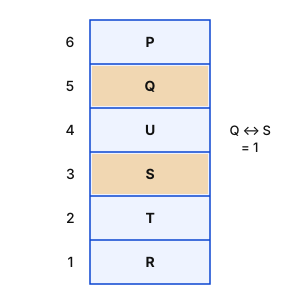
Six people P, Q, R, S, T and U live on six different floors of the same building. The bottom-most floor of the building is numbered as 1; the floor above it is numbered as 2 and so on. The topmost floor is numbered as 6.
P lives on an even-numbered floor but not on floor number 4. Only two people live between S and P. R lives immediately below T. U lives on an even-numbered floor. Q does not live on the bottom-most floor. How many people live between Q and S?
छह व्यक्ति P, Q, R, S, T और U एक ही भवन की छह अलग-अलग मंज़िलों पर रहते हैं। भवन की सबसे निचली मंज़िल की संख्या 1 है; उसके ऊपर की मंज़िल की संख्या 2 है और इसी प्रकार आगे। सबसे ऊपरी मंज़िल की संख्या 6 है।
P एक सम संख्या वाली मंज़िल पर रहता है, लेकिन मंज़िल संख्या 4 पर नहीं। S और P के बीच केवल दो व्यक्ति रहते हैं। R, T के ठीक नीचे रहता है। U एक सम संख्या वाली मंज़िल पर रहता है। Q सबसे निचली मंज़िल पर नहीं रहता है। Q और S के बीच कितने व्यक्ति रहते हैं?
  1. AThreeतीन
  2. BOneएक
  3. CFourचार
  4. DTwoदो
Show answer

Concept: Fix the most restricted person first (P: floor 2 or 6), then test each case against the remaining clues.

  1. Case P = 2 → S = 5 (two between). R–T must be consecutive from {1,3,4,6} → (3,4). Then Q and U take {1,6}; Q ≠ 1 so U = 1, but U must be even. ✗
  2. Case P = 6 → S = 3. R–T consecutive from {1,2,4,5}: (4,5) forces Q = 1 ✗; so R = 1, T = 2, U = 4, Q = 5. ✓
  3. Floors: 1-R, 2-T, 3-S, 4-U, 5-Q, 6-P. Between Q (5) and S (3): only U → one person.

Trick: 'Only two people between X and Y' in 6 floors means they are at (1,4), (2,5) or (3,6).

Answer: (B) One

अवधारणा: सबसे अधिक बंधन वाले व्यक्ति (P: मंज़िल 2 या 6) को पहले रखें, फिर बाकी शर्तों से हर case जाँचें।

  1. Case P = 2 → S = 5 (बीच में दो)। R–T लगातार {1,3,4,6} से → (3,4)। तब Q, U को {1,6}; Q ≠ 1 अतः U = 1, पर U सम मंज़िल पर है। ✗
  2. Case P = 6 → S = 3। R–T लगातार {1,2,4,5} से: (4,5) लेने पर Q = 1 ✗; अतः R = 1, T = 2, U = 4, Q = 5। ✓
  3. मंज़िलें: 1-R, 2-T, 3-S, 4-U, 5-Q, 6-P। Q (5) और S (3) के बीच केवल U → एक व्यक्ति।

ट्रिक: 6 मंज़िलों में 'X और Y के बीच केवल दो' का अर्थ है जोड़ा (1,4), (2,5) या (3,6)।

उत्तर: (B) एक

RRB Technician Grade I (Signal)General Intelligence and ReasoningFloor-based puzzleRRB Technician Grade I (Signal) 2024 · 19 Dec Shift 1
Q72.
A statement is given followed by two arguments. Decide which of the arguments is/are strong with respect to the statement.
Statement:
The Government of State A is planning to shut down all markets by 7 pm.
Arguments:
I. Incidents of shoplifting and attempted robberies have increased especially during night time.
II. Many people get time to shop only after office hours.
एक कथन के बाद दो तर्क दिए गए हैं। निर्णय लीजिए कि कथन के संदर्भ में कौन-सा/कौन-से तर्क प्रबल है/हैं।
कथन:
राज्य A की सरकार सभी बाज़ारों को शाम 7 बजे तक बंद करने की योजना बना रही है।
तर्क:
I. दुकानों में चोरी और डकैती के प्रयासों की घटनाएँ विशेष रूप से रात के समय बढ़ गई हैं।
II. बहुत से लोगों को खरीदारी के लिए समय केवल कार्यालय समय के बाद ही मिलता है।
  1. ABoth I and II strengthen the statement.I और II दोनों कथन को प्रबल करते हैं।
  2. BI weakens while II strengthens the statement.I कथन को कमज़ोर करता है जबकि II उसे प्रबल करता है।
  3. CBoth I and II weaken the statement.I और II दोनों कथन को कमज़ोर करते हैं।
  4. DII weakens while I strengthens the statement.II कथन को कमज़ोर करता है जबकि I उसे प्रबल करता है।
Show answer

Concept: A strong argument is directly related to the statement, realistic, and gives a solid reason for or against it.

  1. Argument I: rising night-time thefts/robberies is a direct public-safety reason to close markets early → strengthens (supports) the plan.
  2. Argument II: many people can shop only after office hours → closing at 7 pm would hurt them → weakens (opposes) the plan.
  3. Both are relevant; one supports, the other opposes.

Trick: Ask of each argument: 'Does this give a reason to do it, or a reason not to?'

Answer: (D) II weakens while I strengthens the statement.

अवधारणा: प्रबल तर्क वह है जो कथन से सीधे जुड़ा, यथार्थवादी और उसके पक्ष या विपक्ष में ठोस कारण देता हो।

  1. तर्क I: रात में चोरी/डकैती की घटनाएँ बढ़ना बाज़ार जल्दी बंद करने का सीधा सुरक्षा-कारण है → कथन को मज़बूत (समर्थन) करता है।
  2. तर्क II: कई लोग ऑफिस के बाद ही खरीदारी कर पाते हैं → 7 बजे बंद करना उन्हें नुकसान देगा → कथन को कमज़ोर (विरोध) करता है।
  3. दोनों प्रासंगिक हैं; एक समर्थन, दूसरा विरोध।

ट्रिक: हर तर्क से पूछें: 'यह करने का कारण देता है या न करने का?'

उत्तर: (D) II कमज़ोर करता है जबकि I कथन को मज़बूत करता है।

RRB Technician Grade I (Signal)General Intelligence and ReasoningStatement and argumentsRRB Technician Grade I (Signal) 2024 · 19 Dec Shift 1