Q301.A sum of money triples itself at compound interest in 10 years. In how many years will it become nine times?
चक्रवृद्धि ब्याज पर कोई राशि 10 वर्ष में तिगुनी हो जाती है। वह कितने वर्षों में नौ गुनी होगी?
- A20
- B25
- C30
- D15
Show answer
Concept: At CI, if P becomes k times in t years, it becomes times in years.
- 3 times in 10 years.
- .
- Time = years.
Trick: Write the new multiple as a power of the old one; multiply the time by that power.
Answer: (A) 20
अवधारणा: चक्रवृद्धि में यदि राशि t वर्षों में k गुना हो, तो वर्षों में गुना होगी।
- 10 वर्ष में 3 गुना।
- .
- समय = वर्ष।
ट्रिक: नए गुणक को पुराने गुणक की घात में लिखें, समय को उसी घात से गुणा करें।
उत्तर: (A) 20
SSC CGLQuantitative AptitudeCompound interest – time to become n timesSSC CGL 2025 · 23 Sep Shift 3
Q302.Which of these numbers is neither Rational nor an Integer?
इनमें से कौन-सी संख्या न परिमेय है न पूर्णांक?
- A
- B−5
- C0
- D4.5
Show answer
Concept: Rational = can be written as ; its decimal ends or repeats.
- , , ⇒ all rational.
- never ends or repeats ⇒ irrational, and clearly not an integer.
Yaad rakhein: is irrational whenever n is not a perfect square (, , …).
Answer: (A)
अवधारणा: परिमेय = रूप में लिखी जा सके; दशमलव रुकता है या दोहराता है।
- , , ⇒ सभी परिमेय।
- न रुकता है न दोहराता ⇒ अपरिमेय, पूर्णांक भी नहीं।
याद रखें: जो n पूर्ण वर्ग नहीं, उसका अपरिमेय होता है।
उत्तर: (A)
SSC CGLQuantitative AptitudeNumber system – irrational numbersSSC CGL 2025 · 23 Sep Shift 3
Q303.A train starts from Mumbai at 6 a.m. and arrives at Kolhapur at 2:30 p.m. on the same day. If the speed of the train is 120 km per hour, find the distance travelled by the train.
एक रेलगाड़ी मुंबई से सुबह 6 बजे चलकर उसी दिन दोपहर 2:30 बजे कोल्हापुर पहुँचती है। यदि रेलगाड़ी की चाल 120 km प्रति घंटा है, तो तय की गई दूरी ज्ञात कीजिए।
- A900 km
- B980 km
- C1020 km
- D1000 km
Show answer
Concept: Distance = speed × time.
- 6:00 a.m. → 2:30 p.m. = 8 h 30 min = 8.5 h ( h).
- Distance = km.
Trick: , plus ⇒ 1020.
Answer: (C) 1020 km
अवधारणा: दूरी = चाल × समय।
- सुबह 6:00 से दोपहर 2:30 = 8 घंटे 30 मिनट = 8.5 घंटे।
- दूरी = किमी।
ट्रिक: , आधे घंटे के 60 जोड़ें ⇒ 1020.
उत्तर: (C) 1020 km
SSC CGLQuantitative AptitudeSpeed–distance – time from clock readingsSSC CGL 2025 · 23 Sep Shift 3
Q304.A spherical tank is filled with water. The radius of the sphere is 12 metres. The tank is used to fill cylindrical containers, each with a radius of 2 metres and a height of 24 metres. How many containers can be filled?
एक गोलाकार टंकी पानी से भरी है। गोले की त्रिज्या 12 मीटर है। इससे बेलनाकार पात्र भरे जाते हैं, जिनमें प्रत्येक की त्रिज्या 2 मीटर और ऊँचाई 24 मीटर है। कितने पात्र भरे जा सकते हैं?
- A24
- B28
- C54
- D30
Show answer
Concept: Number of containers = volume of sphere ÷ volume of one cylinder.
- Sphere = .
- One cylinder = .
- Count = .
Trick: cancels: .
Answer: (A) 24
अवधारणा: बेलनों की संख्या = गोले का आयतन ÷ एक बेलन का आयतन।
- गोला = .
- एक बेलन = .
- संख्या = .
ट्रिक: कट जाता है: .
उत्तर: (A) 24
SSC CGLQuantitative AptitudeMensuration – sphere emptied into cylindersSSC CGL 2025 · 23 Sep Shift 3
Q305.A perfect cube with a side length of 4 cm has the largest possible sphere fitted inside it. What is the volume of the empty space within the cube?
4 cm भुजा वाले एक पूर्ण घन के भीतर सबसे बड़ा संभव गोला रखा गया है। घन के भीतर खाली स्थान का आयतन क्या है?
- A64 − cm³
- B12 − cm³
- C64 − cm³
- D cm³
Show answer
Concept: Largest sphere in a cube: diameter = edge of the cube.
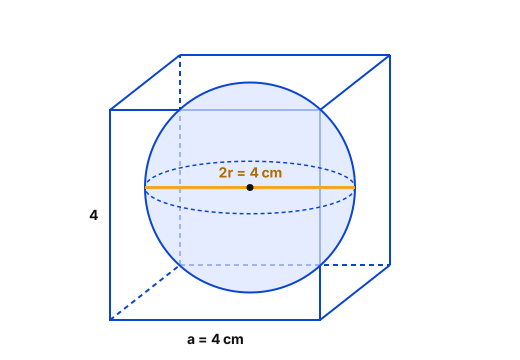
- Cube volume = .
- cm ⇒ sphere = .
- Empty space = .
Trick: Answer must start with 64 (cube's volume) and subtract .
Answer: (A) 64 − cm³
अवधारणा: घन में सबसे बड़ा गोला: व्यास = घन की भुजा।
- घन = .
- r = 2 cm ⇒ गोला = .
- खाली स्थान = .
ट्रिक: गोले का आयतन = ; उत्तर 64 से शुरू होगा।
उत्तर: (A) 64 − cm³
SSC CGLQuantitative AptitudeMensuration – sphere inscribed in a cubeSSC CGL 2025 · 23 Sep Shift 3
Q306.'A' and 'B' entered a joint venture. 'A' brought ₹3,00,000 and 'B' ₹4,00,000. 'A' also contributed skilled labour equivalent to ₹1,00,000. At the end of the year they earned ₹2,40,000 in profit. If they agreed to divide the profit in proportion to their effective contributions, what is A's share?
'A' और 'B' ने संयुक्त उद्यम शुरू किया। 'A' ने ₹3,00,000 और 'B' ने ₹4,00,000 लगाए। 'A' ने ₹1,00,000 के बराबर कुशल श्रम भी दिया। वर्ष के अंत में उन्हें ₹2,40,000 का लाभ हुआ। यदि लाभ प्रभावी योगदान के अनुपात में बाँटा जाए, तो A का हिस्सा क्या होगा?
- A₹1,10,000
- B₹1,20,000
- C₹1,24,500
- D₹1,50,000
Show answer
Concept: Profit is shared in the ratio of total contributions (money + valued labour).
- A = ₹3 lakh cash + ₹1 lakh labour = ₹4 lakh; B = ₹4 lakh.
- Ratio A : B = 4 : 4 = 1 : 1.
- A's share = ₹1,20,000.
Trick: Equal contributions ⇒ simply halve the profit.
Answer: (B) ₹1,20,000
अवधारणा: लाभ कुल योगदान (धन + श्रम का मूल्य) के अनुपात में बँटता है।
- A = ₹3 लाख नकद + ₹1 लाख श्रम = ₹4 लाख; B = ₹4 लाख।
- अनुपात 1 : 1.
- A का हिस्सा = ₹1,20,000.
ट्रिक: योगदान बराबर ⇒ लाभ आधा-आधा।
उत्तर: (B) ₹1,20,000
SSC CGLQuantitative AptitudePartnership – effective contributionSSC CGL 2025 · 23 Sep Shift 3
Q307.A banner is shaped like a trapezium with parallel sides 10 m and 6 m, and height 8 m. If printing costs ₹500 per m², what is the total cost?
एक बैनर समलंब आकार का है जिसकी समांतर भुजाएँ 10 m और 6 m तथा ऊँचाई 8 m है। यदि छपाई ₹500 प्रति m² है, तो कुल लागत क्या होगी?
- A₹32,000
- B₹30,000
- C₹28,000
- D₹25,000
Show answer
Concept: Area of trapezium = .
- Area = .
- Cost = ₹32,000.
Trick: is just the mean of the parallel sides: , then .
Answer: (A) ₹32,000
अवधारणा: समलंब का क्षेत्रफल = .
- क्षेत्रफल = .
- लागत = ₹32,000.
ट्रिक: समांतर भुजाओं का औसत (8) × ऊँचाई (8) = 64.
उत्तर: (A) ₹32,000
SSC CGLQuantitative AptitudeMensuration – trapezium area & costSSC CGL 2025 · 23 Sep Shift 3
Q308.A farmer's land consists of two adjoining trapezoids: T₁ with parallel sides 35 m and 25 m and height 10 m; T₂ with parallel sides 25 m and 15 m and height 10 m. Land costs ₹30 per m². What is the total land cost?
एक किसान की भूमि दो सटे हुए समलंबों से बनी है: T₁ जिसकी समांतर भुजाएँ 35 m और 25 m तथा ऊँचाई 10 m; T₂ जिसकी समांतर भुजाएँ 25 m और 15 m तथा ऊँचाई 10 m है। भूमि की कीमत ₹30 प्रति m² है। कुल लागत क्या होगी?
- A₹15,000
- B₹30,000
- C₹24,000
- D₹25,000
Show answer
Concept: Total area = sum of the two trapezium areas; cost = area × rate.
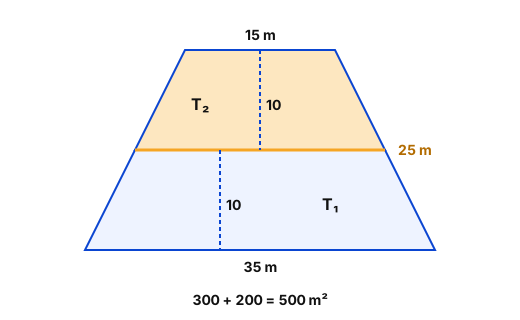
- .
- .
- Total = 500 m² ⇒ cost = ₹15,000.
Trick: Same height 10 ⇒ total = .
Answer: (A) ₹15,000
अवधारणा: कुल क्षेत्रफल = दोनों समलंबों का योग; लागत = क्षेत्रफल × दर।
- .
- .
- कुल 500 m² ⇒ ₹15,000.
ट्रिक: ऊँचाई समान ⇒ .
उत्तर: (A) ₹15,000
SSC CGLQuantitative AptitudeMensuration – combined trapeziumsSSC CGL 2025 · 23 Sep Shift 3
Q309.The ratio of areas of two regular polygons with the same number of sides is 16 : 25. What is the ratio of their side lengths?
समान भुजाओं वाले दो सम बहुभुजों के क्षेत्रफलों का अनुपात 16 : 25 है। उनकी भुजाओं की लंबाई का अनुपात क्या है?
- A5 : 4
- B4 : 5
- C2 : 3
- D4 :
Show answer
Concept: Regular polygons with equal number of sides are similar: area ratio = .
- Side ratio = .
- ⇒ 4 : 5.
Trick: Area ratio → take square root; volume ratio → take cube root.
Answer: (B) 4 : 5
अवधारणा: समान भुजाओं वाले सम बहुभुज समरूप होते हैं: क्षेत्रफल अनुपात = (भुजा अनुपात).
- भुजा अनुपात = .
- = 4 : 5.
ट्रिक: क्षेत्रफल अनुपात → वर्गमूल; आयतन अनुपात → घनमूल।
उत्तर: (B) 4 : 5
SSC CGLQuantitative AptitudeSimilar figures – area and side ratioSSC CGL 2025 · 23 Sep Shift 3
Q310.A student scored 40% in one subject and 30% in another. Both subjects have equal maximum marks. What is the overall percentage?
एक विद्यार्थी ने एक विषय में 40% और दूसरे में 30% अंक पाए। दोनों विषयों के अधिकतम अंक समान हैं। कुल प्रतिशत क्या है?
- A30%
- B35%
- C32%
- D38%
Show answer
Concept: With equal maximum marks, the overall % is the simple average of the two %s.
- Overall = .
- Check with 100 + 100: .
Trick: Equal weights ⇒ plain average; unequal maximums ⇒ weighted average.
Answer: (B) 35%
अवधारणा: अधिकतम अंक बराबर हों तो कुल % = दोनों % का साधारण औसत।
- कुल = .
- जाँच: .
ट्रिक: भार बराबर ⇒ साधारण औसत; अलग हों ⇒ भारित औसत।
उत्तर: (B) 35%
SSC CGLQuantitative AptitudePercentage – overall scoreSSC CGL 2025 · 23 Sep Shift 3
Q311.A seller offers a combo deal: "Buy 4 shirts for the price of 3". If each shirt costs him ₹1,500, what is the effective loss percentage?
एक विक्रेता ऑफ़र देता है: "4 कमीज़ें 3 की कीमत में"। यदि प्रत्येक कमीज़ उसे ₹1,500 की पड़ती है, तो प्रभावी हानि प्रतिशत क्या है?
- A20%
- B25%
- C30%
- D33%
Show answer
Concept: Loss % = .
- Gives 4 shirts, gets money for 3 ⇒ 1 shirt free.
- Loss % = .
- (₹6,000 cost vs ₹4,500 received ⇒ loss ₹1,500 = 25%.)
Trick: 'Buy x, get y free' ⇒ discount/loss % = ; here .
Answer: (B) 25%
अवधारणा: हानि % = (मुफ़्त वस्तुएँ ÷ कुल दी गई वस्तुएँ) × 100.
- 4 कमीज़ें दीं, पैसे 3 के मिले ⇒ 1 मुफ़्त।
- हानि % = .
- (लागत ₹6,000, मिले ₹4,500 ⇒ हानि ₹1,500.)
ट्रिक: 'x खरीदो, y मुफ़्त' ⇒ .
उत्तर: (B) 25%
SSC CGLQuantitative AptitudeProfit & loss – buy 4 pay for 3SSC CGL 2025 · 23 Sep Shift 3
Q312.The price of a product is decreased by y% and then increased by y%. The final price becomes 10% less than the original. What is the value of y (approximately)?
किसी उत्पाद का मूल्य पहले y% घटाया जाता है और फिर y% बढ़ाया जाता है। अंतिम मूल्य मूल से 10% कम हो जाता है। y का मान (लगभग) क्या है?
- A31.6
- B20.6
- C25.6
- D29.6
Show answer
Concept: A y% fall followed by a y% rise always gives a net loss of .
- Net loss = 10% ⇒ .
- .
Trick: Use the shortcut: net ; then (since ).
Answer: (A) 31.6
अवधारणा: y% घटाकर फिर y% बढ़ाने पर हमेशा की शुद्ध कमी होती है।
- कमी = 10% ⇒ .
- .
ट्रिक: शॉर्टकट: शुद्ध % ; .
उत्तर: (A) 31.6
SSC CGLQuantitative AptitudePercentage – equal fall then riseSSC CGL 2025 · 23 Sep Shift 3
Q313.The average of 6 different numbers is 120. If the smallest number is 18, what is the average of the remaining five numbers?
6 भिन्न संख्याओं का औसत 120 है। यदि सबसे छोटी संख्या 18 है, तो शेष पाँच संख्याओं का औसत क्या है?
- A127.5
- B140.4
- C125.5
- D124.5
Show answer
Concept: Total = average × count.
- Total of 6 = .
- Remaining 5 = .
- Average = .
Trick: Removed number is 102 below the mean; that deficit spread over 5 = 20.4 ⇒ .
Answer: (B) 140.4
अवधारणा: योग = औसत × संख्या।
- 6 का योग = 720.
- शेष 5 का योग = .
- औसत = .
ट्रिक: 18 औसत से 102 कम है; ⇒ .
उत्तर: (B) 140.4
SSC CGLQuantitative AptitudeAverage – removing one numberSSC CGL 2025 · 23 Sep Shift 3
Q314.A prism with a parallelogram base has base area 160 cm² and height 24 cm. If its lateral surface area is 768 cm², what is the perimeter of the base?
समांतर चतुर्भुज आधार वाले एक प्रिज़्म का आधार क्षेत्रफल 160 cm² और ऊँचाई 24 cm है। यदि उसका पार्श्व पृष्ठीय क्षेत्रफल 768 cm² है, तो आधार का परिमाप क्या है?
- A26 cm
- B22 cm
- C36 cm
- D32 cm
Show answer
Concept: Lateral surface area of any prism = perimeter of base × height.
- 768 = perimeter × 24.
- Perimeter = cm.
- (Base area 160 cm is not needed.)
Trick: Ignore extra data – LSA links only perimeter and height.
Answer: (D) 32 cm
अवधारणा: किसी भी प्रिज़्म का पार्श्व पृष्ठ = आधार का परिमाप × ऊँचाई।
- 768 = परिमाप × 24.
- परिमाप = 32 cm.
- (आधार क्षेत्रफल 160 की ज़रूरत नहीं।)
ट्रिक: अतिरिक्त आँकड़े छोड़ दें – LSA में केवल परिमाप और ऊँचाई।
उत्तर: (D) 32 cm
SSC CGLQuantitative AptitudeMensuration – lateral surface of a prismSSC CGL 2025 · 23 Sep Shift 3
Q315.The average score of 50 students in a test is 136. The top 5 scorers had an average of 160 and the lowest 5 had an average of 100. What is the average of the remaining 40 students?
एक परीक्षा में 50 विद्यार्थियों का औसत अंक 136 है। शीर्ष 5 का औसत 160 और सबसे निचले 5 का औसत 100 रहा। शेष 40 विद्यार्थियों का औसत क्या है?
- A158
- B137.5
- C117
- D216
Show answer
Concept: Total of the rest = overall total − totals of the removed groups.
- All 50: .
- Top 5: 800; bottom 5: 500.
- Rest 40: ⇒ average .
Trick: Deviation method: top adds , bottom ; net −60 must be offset by 40 ⇒ +1.5 ⇒ 137.5.
Answer: (B) 137.5
अवधारणा: शेष का योग = कुल योग − हटाए गए समूहों का योग।
- 50 का योग = 6800.
- ऊपर के 5 = 800; नीचे के 5 = 500.
- शेष 40 = 5500 ⇒ औसत 137.5.
ट्रिक: विचलन: +120 और −180 = −60; 40 पर बाँटें ⇒ +1.5 ⇒ 137.5.
उत्तर: (B) 137.5
SSC CGLQuantitative AptitudeAverage – middle groupSSC CGL 2025 · 23 Sep Shift 3
Q316.A wholesaler offers a bulk order deal where a 20% discount is applied to orders above ₹10,000, and a 5% additional seasonal discount is available. What is the effective price paid for an order worth ₹50,000?
एक थोक विक्रेता ₹10,000 से अधिक के ऑर्डर पर 20% छूट देता है और उसके बाद 5% अतिरिक्त मौसमी छूट भी उपलब्ध है। ₹50,000 के ऑर्डर पर प्रभावी भुगतान कितना होगा?
- A₹34,100
- B₹25,500
- C₹30,000
- D₹38,000
Show answer
Concept: Successive discounts multiply: price .
- After 20%: ₹40,000.
- After 5%: ₹38,000.
Trick: Equivalent single discount = ⇒ 76% of 50,000 = ₹38,000.
Answer: (D) ₹38,000
अवधारणा: क्रमागत छूट गुणा होती है: मूल्य .
- 20% के बाद: ₹40,000.
- 5% के बाद: ₹38,000.
ट्रिक: समतुल्य छूट = ⇒ 50,000 का 76% = ₹38,000.
उत्तर: (D) ₹38,000
SSC CGLQuantitative AptitudeDiscount – successive discountsSSC CGL 2025 · 23 Sep Shift 3
Q317.If cosA = x, then what is the value of cotA in terms of x?
यदि cosA = x है, तो cotA का मान x के पदों में क्या होगा?
- A
- B
- C
- D2x²
Show answer
Concept: and .
- .
- .
Trick: Draw a right triangle: base = x, hypotenuse = 1 ⇒ perpendicular ; .
Answer: (A)
अवधारणा: , और .
- .
- .
ट्रिक: समकोण त्रिभुज: आधार = x, कर्ण = 1 ⇒ लंब ; cot = आधार/लंब।
उत्तर: (A)
SSC CGLQuantitative AptitudeTrigonometry – cot in terms of cosSSC CGL 2025 · 23 Sep Shift 3
Q318.If cosA = and A lies in the 1st quadrant, what is the value of cotA?
यदि cosA = है और A पहले चतुर्थांश में है, तो cotA का मान क्या है?
- A−
- B
- C
- D
Show answer
Concept: ; complete the right triangle.
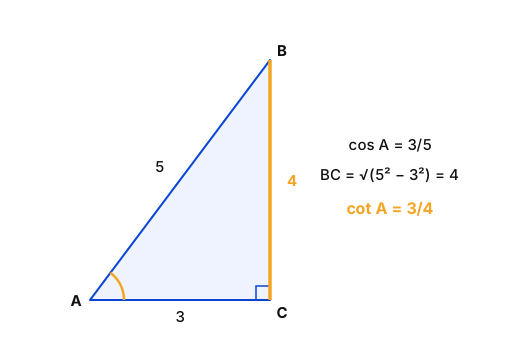
- ⇒ base 3, hypotenuse 5 ⇒ perpendicular 4.
- (positive in Quadrant I).
Trick: Spot the triplet 3-4-5 – no calculation needed.
Answer: (B)
अवधारणा: cos = आधार/कर्ण; समकोण त्रिभुज पूरा करें।
- ⇒ आधार 3, कर्ण 5 ⇒ लंब 4.
- आधार/लंब (प्रथम चतुर्थांश में धनात्मक)।
ट्रिक: त्रिक 3-4-5 पहचानें – गणना की ज़रूरत नहीं।
उत्तर: (B)
SSC CGLQuantitative AptitudeTrigonometry – using the 3-4-5 triangleSSC CGL 2025 · 23 Sep Shift 3
Q319.The angle of a sector is radians and the radius of the circle is 16 cm. What is the area of the sector?
एक त्रिज्यखंड का कोण रेडियन है और वृत्त की त्रिज्या 16 cm है। त्रिज्यखंड का क्षेत्रफल क्या है?
- A6π cm²
- B22π cm²
- C32π cm²
- D28π cm²
Show answer
Concept: Sector area = ( in radians).
- .
- .
Trick: of the circle ⇒ .
Answer: (C) 32π cm²
अवधारणा: त्रिज्यखंड का क्षेत्रफल = ( रेडियन में)।
- .
- .
ट्रिक: वृत्त का ⇒ .
उत्तर: (C) 32π cm²
SSC CGLQuantitative AptitudeCircle – area of a sector (radians)SSC CGL 2025 · 23 Sep Shift 3
Q320.If tan x = cot(2x − 10°), find the value of x.
यदि tan x = cot(2x − 10°) है, तो x का मान ज्ञात कीजिए।
- A50°
- B25.52°
- C40°
- D33.33°
Show answer
Concept: If (acute angles), then .
- .
- .
Yaad rakhein: Same rule for and : .
Answer: (D) 33.33°
अवधारणा: यदि (न्यून कोण), तो .
- .
- .
याद रखें: , में भी .
उत्तर: (D) 33.33°
SSC CGLQuantitative AptitudeTrigonometry – tan A = cot BSSC CGL 2025 · 23 Sep Shift 3

