Q321.Two circles have radii of 16 cm and 6 cm. The distance between their centres is 30 cm. What is the length of a direct common tangent?
दो वृत्तों की त्रिज्याएँ 16 cm और 6 cm हैं। उनके केंद्रों के बीच की दूरी 30 cm है। सीधी उभयनिष्ठ स्पर्श रेखा की लंबाई क्या है?
- A20 cm
- B22 cm
- C20 cm
- D12 cm
Show answer
Concept: Direct common tangent = .
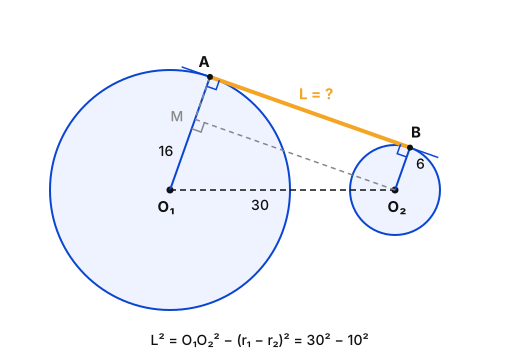
- d = 30, ⇒ length .
- cm.
Yaad rakhein: Transverse common tangent uses : .
Answer: (C) 20 cm
अवधारणा: प्रत्यक्ष उभयनिष्ठ स्पर्श रेखा = .
- .
- cm.
याद रखें: अनुप्रस्थ स्पर्श रेखा में लगता है।
उत्तर: (C) 20 cm
SSC CGLQuantitative AptitudeCircles – direct common tangentSSC CGL 2025 · 23 Sep Shift 3
Q322.A line drawn from the centre of a circle is perpendicular to a chord. What does it do to the chord?
वृत्त के केंद्र से खींची गई रेखा किसी जीवा पर लंब है। वह जीवा के साथ क्या करती है?
- ADivides the chord into two equal partsजीवा को दो बराबर भागों में बाँट देती है
- BDoubles the length of the chordजीवा की लंबाई दोगुनी कर देती है
- CMakes the chord tangent to the circleजीवा को वृत्त की स्पर्श रेखा बना देती है
- DReduces the chord length to halfजीवा की लंबाई आधी कर देती है
Show answer
Concept: The perpendicular from the centre to a chord bisects the chord.
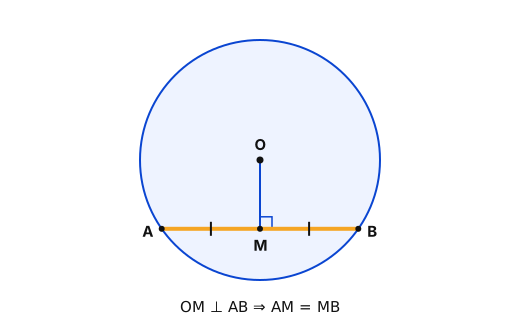
- Join the centre to both ends: two right triangles with equal hypotenuse (radius) and common side ⇒ congruent (RHS).
- So the foot of the perpendicular is the mid-point – the chord is split into two equal parts.
Yaad rakhein: Converse: the line from the centre to the mid-point of a chord is perpendicular to it.
Answer: (A) Divides the chord into two equal parts
अवधारणा: केंद्र से जीवा पर डाला गया लंब जीवा को समद्विभाजित करता है।
- केंद्र को जीवा के सिरों से मिलाएँ: दो समकोण त्रिभुज RHS से सर्वांगसम।
- अतः लंब का पाद जीवा का मध्य बिंदु है।
याद रखें: विलोम: केंद्र को जीवा के मध्य बिंदु से मिलाने वाली रेखा जीवा पर लंब होती है।
उत्तर: (A) जीवा को दो बराबर भागों में बाँट देती है
SSC CGLQuantitative AptitudeCircle theorem – perpendicular to a chordSSC CGL 2025 · 23 Sep Shift 3
Q323.A chord divides a circle into two arcs. The angle subtended by the major arc at the circumference is 90°. What is the central angle subtended by the major arc?
एक जीवा वृत्त को दो चापों में बाँटती है। दीर्घ चाप द्वारा परिधि पर बनाया गया कोण 90° है। दीर्घ चाप द्वारा केंद्र पर बनाया गया कोण क्या होगा?
- A180°
- B110°
- C270°
- D150°
Show answer
Concept: An arc subtends at the centre twice the angle it subtends on the circle.
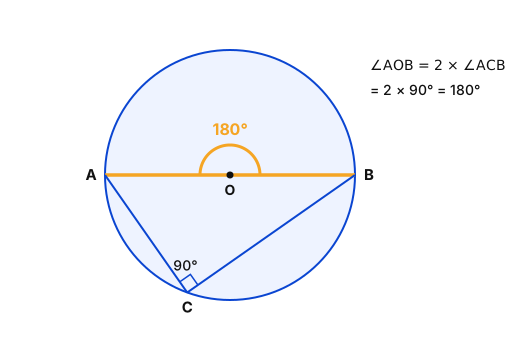
- Angle on the circle = 90°.
- Central angle = .
Yaad rakhein: An angle of 90° on the circle means the chord is a diameter (angle in a semicircle).
Answer: (A) 180°
अवधारणा: चाप द्वारा केंद्र पर बना कोण, परिधि पर बने कोण का दोगुना होता है।
- परिधि पर कोण = 90°.
- केंद्र पर = .
याद रखें: परिधि पर 90° का अर्थ – जीवा व्यास है (अर्धवृत्त का कोण)।
उत्तर: (A) 180°
SSC CGLQuantitative AptitudeCircle theorem – centre angle = 2 × circumference angleSSC CGL 2025 · 23 Sep Shift 3
Q324.In a circle, chord AB subtends an angle of 85° at a point C on the circle. What is the angle subtended by the same chord AB at another point D on the same arc as C?
एक वृत्त में जीवा AB, वृत्त पर स्थित बिंदु C पर 85° का कोण बनाती है। वही जीवा AB, C वाले चाप पर स्थित किसी अन्य बिंदु D पर कितना कोण बनाएगी?
- A55°
- B50°
- C85°
- D40°
Show answer
Concept: Angles made by the same chord at points of the same arc are equal.
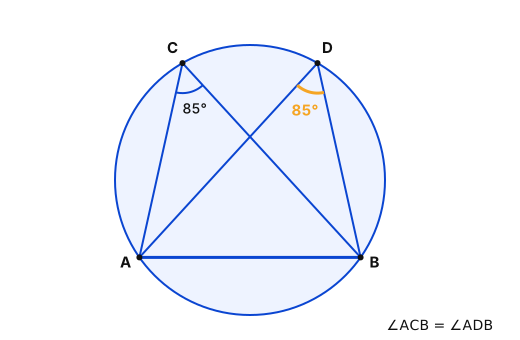
- C and D are on the same arc w.r.t. chord AB.
- ∠ADB = ∠ACB = 85°.
Yaad rakhein: On the opposite arc the angle would be 180° − 85° = 95° (cyclic quadrilateral).
Answer: (C) 85°
अवधारणा: एक ही जीवा द्वारा एक ही चाप के बिंदुओं पर बने कोण बराबर होते हैं।
- C और D, जीवा AB के सापेक्ष एक ही चाप पर हैं।
- ∠ADB = ∠ACB = 85°.
याद रखें: विपरीत चाप पर कोण 180° − 85° = 95° होता।
उत्तर: (C) 85°
SSC CGLQuantitative AptitudeCircle theorem – angles in the same segmentSSC CGL 2025 · 23 Sep Shift 3
Q325.From an outside point P, two tangents PA and PB are drawn to a circle. A third tangent to the circle at a point Q intersects PA and PB at R and S respectively. If PA = 20 cm, what is the perimeter of △PRS?
बाहरी बिंदु P से एक वृत्त पर दो स्पर्श रेखाएँ PA और PB खींची गई हैं। बिंदु Q पर खींची गई तीसरी स्पर्श रेखा PA और PB को क्रमशः R और S पर काटती है। यदि PA = 20 cm है, तो △PRS का परिमाप क्या है?
- A40 cm
- B25 cm
- C20 cm
- D10 cm
Show answer
Concept: Tangents from one external point are equal in length.
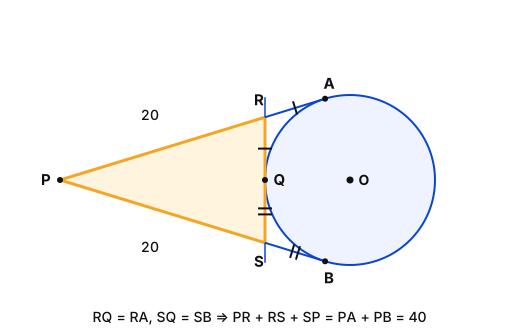
- RQ = RA and SQ = SB.
- Perimeter PRS = PR + RQ + QS + SP = (PR + RA) + (PS + SB) = PA + PB.
- PA = PB = 20 ⇒ perimeter = 40 cm.
Trick: Perimeter of such a triangle is always 2 × PA – memorise it.
Answer: (A) 40 cm
अवधारणा: बाहरी बिंदु से खींची गई स्पर्श रेखाएँ बराबर होती हैं।
- RQ = RA और SQ = SB.
- परिमाप = (PR + RA) + (PS + SB) = PA + PB.
- = 20 + 20 = 40 cm.
ट्रिक: ऐसे त्रिभुज का परिमाप हमेशा 2 × PA होता है।
उत्तर: (A) 40 cm
SSC CGLQuantitative AptitudeTangents – perimeter of triangle cut by a tangentSSC CGL 2025 · 23 Sep Shift 3
Q326.The number of students in two sections A and B having different heights is shown in the table below.
Height 1.56 m — A: 5, B: 4 | 1.60 m — A: 9, B: 0 | 1.68 m — A: 8, B: 9 | 1.64 m — A: 15, B: 10 | 1.69 m — A: 8, B: 7 | 1.72 m — A: 6, B: 5 | 1.78 m — A: 4, B: 3.
What is the ratio of the number of students with a height of 1.68 metres in Section A to the total number of students in Section A?
दो वर्गों A और B में विभिन्न ऊँचाई वाले विद्यार्थियों की संख्या नीचे दी गई है।
ऊँचाई 1.56 m — A: 5, B: 4 | 1.60 m — A: 9, B: 0 | 1.68 m — A: 8, B: 9 | 1.64 m — A: 15, B: 10 | 1.69 m — A: 8, B: 7 | 1.72 m — A: 6, B: 5 | 1.78 m — A: 4, B: 3।
वर्ग A में 1.68 मीटर ऊँचाई वाले विद्यार्थियों और वर्ग A के कुल विद्यार्थियों का अनुपात क्या है?
- A8 : 55
- B15 : 62
- C6 : 4
- D4 : 33
Show answer
Concept: Ratio = students of the required height in A : sum of all students in A.
- Section A at 1.68 m → 8 students.
- Section A total = 5 + 9 + 8 + 15 + 8 + 6 + 4 = 55.
- Required ratio = 8 : 55.
Trick: Only (A) starts with 8 (the 1.68 m entry) – you can pick it even before adding the total.
Answer: (A) 8 : 55
अवधारणा: अनुपात = A में उस ऊँचाई के छात्र : A के कुल छात्र।
हल:
- Section A में 1.68 m वाले छात्र = 8।
- Section A के कुल छात्र = 5 + 9 + 8 + 15 + 8 + 6 + 4 = 55।
- अनुपात = 8 : 55।
ट्रिक: केवल (A) 8 से शुरू होता है – कुल जोड़े बिना भी चुना जा सकता है।
उत्तर: (A) 8 : 55
SSC CGLQuantitative AptitudeData table – part to total ratioSSC CGL 2025 · 23 Sep Shift 2
Q327.Solve:
हल कीजिए:
- A
- B
- C
- D
Show answer
Concept: Order: Division and Multiplication (left to right) before Addition and Subtraction.
- .
- .
- .
Trick: – same result either way since × and ÷ are done left to right.
Answer: (A)
अवधारणा: क्रम: भाग और गुणा (बाएँ से दाएँ) पहले, फिर जोड़ और घटाना।
हल:
- ।
- ।
- ।
ट्रिक: – बाएँ से दाएँ करने पर भी वही उत्तर।
उत्तर: (A)
SSC CGLQuantitative AptitudeSimplification – BODMASSSC CGL 2025 · 23 Sep Shift 2
Q328.A sum amounts to ₹5,800 in 2 years and ₹6,200 in 4 years at simple interest. What is the rate of interest per annum?
साधारण ब्याज पर कोई राशि 2 वर्ष में ₹5,800 और 4 वर्ष में ₹6,200 हो जाती है। वार्षिक ब्याज दर क्या है?
- A2%
- B4.1%
- C3.7%
- D1.5%
Show answer
Concept: Under SI, interest is equal every year; extra amount ÷ extra years = 1-year interest.
- Interest for years ₹400 → ₹200 per year.
- Principal = ₹5400.
- Rate = (approx.).
Trick: .
Answer: (C) 3.7%
अवधारणा: साधारण ब्याज में हर वर्ष ब्याज बराबर; अतिरिक्त राशि ÷ अतिरिक्त वर्ष = 1 वर्ष का ब्याज।
हल:
- वर्ष का ब्याज ₹400 → ₹200 प्रति वर्ष।
- मूलधन = ₹5400।
- दर = ।
ट्रिक: ।
उत्तर: (C) 3.7%
SSC CGLQuantitative AptitudeSimple interest – rate from two amountsSSC CGL 2025 · 23 Sep Shift 2
Q329.A man reduces his speed from 16 km/h to 14 km/h, and so takes 6 minutes more than the normal time. What is the distance travelled by him?
एक व्यक्ति अपनी चाल 16 km/h से घटाकर 14 km/h कर देता है, जिससे उसे सामान्य समय से 6 मिनट अधिक लगते हैं। उसने कितनी दूरी तय की?
- A10 km
- B9.2 km
- C18 km
- D11.2 km
Show answer
Concept: Distance = (product of speeds ÷ difference of speeds) × time difference.
- Time difference = 6 min h.
- → .
- km.
Trick: km.
Answer: (D) 11.2 km
अवधारणा: दूरी = (दोनों चालों का गुणनफल ÷ चालों का अंतर) × समय का अंतर।
हल:
- समय का अंतर = 6 मिनट घंटा।
- → ।
- km।
ट्रिक: km।
उत्तर: (D) 11.2 km
SSC CGLQuantitative AptitudeSpeed–time – late due to lower speedSSC CGL 2025 · 23 Sep Shift 2
Q330.A kite is soaring at an altitude of 45 metres above the ground, with its string temporarily secured to a point on the ground. The angle of elevation of the string relative to the ground is 30°. Given that the string remains taut, what is the length of the string?
एक पतंग ज़मीन से 45 मीटर की ऊँचाई पर उड़ रही है और उसकी डोर ज़मीन के एक बिंदु पर बँधी है। ज़मीन के सापेक्ष डोर का उन्नयन कोण 30° है। यदि डोर तनी हुई है, तो उसकी लंबाई क्या है?
- A60 m
- B45 m
- C90 m
- D55 m
Show answer
Concept: Height is opposite the angle and the string is the hypotenuse → use sin.
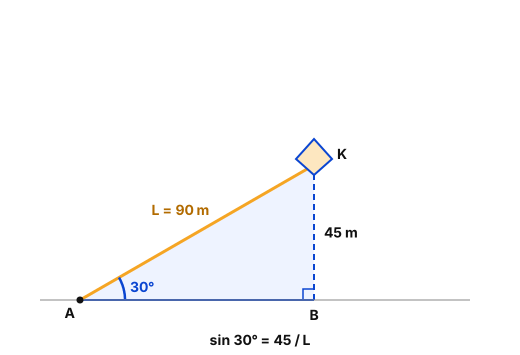
- = height/string .
- .
- m.
Trick: At 30°, the side opposite is half the hypotenuse – just double the height: m.
Answer: (C) 90 m
अवधारणा: ऊँचाई कोण के सामने की भुजा और डोर कर्ण है → sin लगाइए।
हल:
- = ऊँचाई/डोर ।
- ।
- m।
ट्रिक: 30° पर सामने की भुजा कर्ण की आधी होती है – ऊँचाई का दोगुना: m।
उत्तर: (C) 90 m
SSC CGLQuantitative AptitudeHeights & distances – kite stringSSC CGL 2025 · 23 Sep Shift 2
Q331.A rectangular fish tank with a base of 80 cm × 60 cm contains water up to a height of 25 cm. If 4 identical spherical stones, each of radius 5 cm, are dropped into the tank and fully submerged, what is the rise in the water level?
80 cm × 60 cm आधार वाले एक आयताकार मछली-टैंक में 25 cm ऊँचाई तक पानी है। यदि 5 cm त्रिज्या के 4 एक जैसे गोलाकार पत्थर उसमें डालकर पूरी तरह डुबो दिए जाएँ, तो जल-स्तर कितना बढ़ेगा?
- A cm
- B cm
- C cm
- D cm
Show answer
Concept: Rise in level = volume of objects dropped ÷ base area of the tank.
- One sphere = cm³; four spheres cm³.
- Base area = cm².
- Rise = cm.
Trick: Water height (25 cm) is extra data – the rise depends only on volume and base area.
Answer: (B) cm
अवधारणा: जल-स्तर में वृद्धि = डाली गई वस्तुओं का आयतन ÷ टैंक का आधार क्षेत्रफल।
हल:
- एक गोला = cm³; चार गोले cm³।
- आधार क्षेत्रफल = cm²।
- वृद्धि = cm।
ट्रिक: पानी की ऊँचाई (25 cm) अतिरिक्त जानकारी है – वृद्धि केवल आयतन और आधार पर निर्भर।
उत्तर: (B) cm
SSC CGLQuantitative AptitudeMensuration – rise in water levelSSC CGL 2025 · 23 Sep Shift 2
Q332.Partners X and Y invest ₹40,000 and ₹60,000 respectively. X works for 8 months and Y for 6 months. Profit is divided on the basis of capital × time. Find their profit ratio.
साझेदार X और Y क्रमशः ₹40,000 और ₹60,000 निवेश करते हैं। X 8 माह और Y 6 माह कार्य करता है। लाभ पूँजी × समय के आधार पर बँटता है। उनके लाभ का अनुपात ज्ञात कीजिए।
- A3 : 6
- B8 : 9
- C4 : 2
- D6 : 4
Show answer
Concept: Profit ratio = (capital × months) of each partner.
- Capital-months of X : Y = (40 thousand × 8) : (60 thousand × 6).
- = 320 : 360 (in thousands).
- Divide by 40 → 8 : 9.
Trick: Drop zeros first: .
Answer: (B) 8 : 9
अवधारणा: लाभ का अनुपात = हर साझेदार की (पूँजी × महीने)।
हल:
- X : Y की पूँजी-माह = (40 हज़ार × 8) : (60 हज़ार × 6)।
- = 320 : 360 (हज़ार में)।
- 40 से भाग → 8 : 9।
ट्रिक: पहले शून्य हटाएँ: ।
उत्तर: (B) 8 : 9
SSC CGLQuantitative AptitudePartnership – capital × timeSSC CGL 2025 · 23 Sep Shift 2
Q333.If the difference between the interior and exterior angles of a regular polygon is 60°, find the number of sides of the polygon.
यदि किसी सम बहुभुज के अंतःकोण और बाह्य कोण का अंतर 60° है, तो बहुभुज की भुजाओं की संख्या ज्ञात कीजिए।
- A6
- B9
- C13
- D11
Show answer
Concept: Interior + exterior = 180°; number of sides = 360° ÷ exterior angle.
- , .
- Subtracting: → .
- Sides = .
Trick: → (a hexagon).
Answer: (A) 6
अवधारणा: अंतः + बाह्य कोण = 180°; भुजाओं की संख्या = 360° ÷ बाह्य कोण।
हल:
- , ।
- घटाने पर: → ।
- भुजाएँ = ।
ट्रिक: → (षट्भुज)।
उत्तर: (A) 6
SSC CGLQuantitative AptitudeRegular polygon – interior vs exterior angleSSC CGL 2025 · 23 Sep Shift 2
Q334.A value is increased by 10% and then decreased by an unknown percentage to return to the original value. What is the percentage decrease required?
एक मान 10% बढ़ाया जाता है और फिर किसी अज्ञात प्रतिशत से घटाकर मूल मान पर लाया जाता है। कितने प्रतिशत की कमी आवश्यक है?
- A9.09%
- B6.92%
- C3.26%
- D2.22%
Show answer
Concept: Required decrease = .
- Let value = 100 → after 10% rise = 110.
- To return to 100, fall = 10 on a base of 110.
- Decrease = .
Trick: – remember the fraction table: a 10% rise is cancelled by a fall.
Answer: (A) 9.09%
अवधारणा: आवश्यक कमी = ।
हल:
- मान = 100 → 10% वृद्धि पर 110।
- वापस 100 पर लाने को 110 में से 10 घटाने होंगे।
- कमी = ।
ट्रिक: – 10% वृद्धि को कमी बराबर कर देती है।
उत्तर: (A) 9.09%
SSC CGLQuantitative AptitudePercentage – undoing an increaseSSC CGL 2025 · 23 Sep Shift 2
Q335.A square field has a diagonal of m. What is its area?
एक वर्गाकार खेत का विकर्ण m है। उसका क्षेत्रफल क्या है?
- A46 m²
- B24 m²
- C40 m²
- D12 m²
Show answer
Concept: Area of a square = (no need to find the side).
- Diagonal m (the root sign is lost in print; 48 m would give 1152 m², not in options).
- .
- Area = m².
Trick: Side , so side – one-line formula for any diagonal question.
Answer: (B) 24 m²
अवधारणा: वर्ग का क्षेत्रफल = (भुजा निकालने की ज़रूरत नहीं)।
हल:
- विकर्ण m (छपाई में मूल चिह्न छूट गया; 48 m लें तो 1152 m² आता, जो विकल्प में नहीं)।
- ।
- क्षेत्रफल = m²।
ट्रिक: भुजा , अतः भुजा – विकर्ण वाले हर प्रश्न का एक-पंक्ति सूत्र।
उत्तर: (B) 24 m²
SSC CGLQuantitative AptitudeSquare – area from diagonalSSC CGL 2025 · 23 Sep Shift 2
Q336.A 30-litre solution contains acid and water in the ratio 2 : 1. How much water must be added to make the ratio 1 : 1?
30 लीटर घोल में अम्ल और पानी 2 : 1 के अनुपात में हैं। अनुपात 1 : 1 करने के लिए कितना पानी मिलाना होगा?
- A11 L
- B10 L
- C12 L
- D21 L
Show answer
Concept: The acid quantity does not change; only water is increased.
- Acid = L; water = 10 L.
- For 1 : 1, water must equal acid = 20 L.
- Water to add = L.
Trick: Ratio 2 : 1 → 1 : 1 means water goes from 1 part to 2 parts; 1 part = 10 L, so add 10 L.
Answer: (B) 10 L
अवधारणा: अम्ल की मात्रा नहीं बदलती; केवल पानी बढ़ता है।
हल:
- अम्ल = L; पानी = 10 L।
- 1 : 1 के लिए पानी भी 20 L होना चाहिए।
- मिलाना है = L।
ट्रिक: 2 : 1 → 1 : 1 यानी पानी 1 भाग से 2 भाग; 1 भाग = 10 L, अतः 10 L।
उत्तर: (B) 10 L
SSC CGLQuantitative AptitudeMixture – adding water to change ratioSSC CGL 2025 · 23 Sep Shift 2
Q337.If the selling price of an item is increased by 10% and the profit also increases from 15% to 20%, what is the percentage increase in the cost price?
यदि किसी वस्तु का विक्रय मूल्य 10% बढ़ा दिया जाए और लाभ भी 15% से बढ़कर 20% हो जाए, तो क्रय मूल्य में कितने प्रतिशत वृद्धि हुई?
- A3.5%
- B4.6%
- C1.28%
- D5.41%
Show answer
Concept: Assume CP = 100, find old SP, raise it, then get new CP from the new profit %.
- Old CP = 100, profit 15% → SP = 115.
- New SP = ; this gives 20% profit.
- New CP = → CP rises by about 5.41%.
Trick: = → about 5.4% – only (D) fits.
Answer: (D) 5.41%
अवधारणा: CP = 100 मानकर पुराना SP, फिर नया SP और नए लाभ% से नया CP निकालिए।
हल:
- पुराना CP = 100, लाभ 15% → SP = 115।
- नया SP = ; इस पर 20% लाभ है।
- नया CP = → CP लगभग 5.41% बढ़ा।
ट्रिक: नया CP/पुराना CP = → लगभग 5.4% – केवल (D)।
उत्तर: (D) 5.41%
SSC CGLQuantitative AptitudeProfit – change in cost priceSSC CGL 2025 · 23 Sep Shift 2
Q338.A group of 5 students went on a trip and spent ₹1,000 in total. If one of them spent ₹400 while the rest spent equally, what was the average spending of the other 4 students?
5 विद्यार्थियों के समूह ने यात्रा पर कुल ₹1,000 खर्च किए। यदि उनमें से एक ने ₹400 खर्च किए और शेष ने बराबर-बराबर, तो अन्य 4 विद्यार्थियों का औसत खर्च क्या था?
- A₹150
- B₹180
- C₹210
- D₹230
Show answer
Concept: Average = total of the group ÷ number of members in it.
- Spent by the other 4 = ₹600.
- Their average = ₹150.
Trick: Options above ₹150 would make the 4 spend more than ₹600 – impossible, so (A).
Answer: (A) ₹150
अवधारणा: औसत = समूह का कुल योग ÷ सदस्यों की संख्या।
हल:
- बाकी 4 का खर्च = ₹600।
- उनका औसत = ₹150।
ट्रिक: ₹150 से अधिक वाले विकल्पों में 4 का खर्च ₹600 से ज़्यादा हो जाता – असंभव, अतः (A)।
उत्तर: (A) ₹150
SSC CGLQuantitative AptitudeAverage – of the remaining membersSSC CGL 2025 · 23 Sep Shift 2
Q339.A computer is sold at ₹6,800 after applying a 15% discount. What was its marked price?
15% छूट के बाद एक कंप्यूटर ₹6,800 में बिकता है। उसका अंकित मूल्य क्या था?
- A₹7,500
- B₹6,800
- C₹8,000
- D₹6,500
Show answer
Concept: SP = MP .
- .
- ₹8000.
Trick: (since ) → MP = ₹8000.
Answer: (C) ₹8,000
अवधारणा: विक्रय मूल्य = अंकित मूल्य ।
हल:
- ।
- ₹8000।
ट्रिक: , अतः → MP = ₹8000।
उत्तर: (C) ₹8,000
SSC CGLQuantitative AptitudeDiscount – marked price from SPSSC CGL 2025 · 23 Sep Shift 2
Q340.If 4 men or 6 women can complete a work in 18 days, how long will 2 men and 3 women take to complete the same work?
यदि 4 पुरुष या 6 महिलाएँ एक कार्य 18 दिनों में पूरा करें, तो 2 पुरुष और 3 महिलाएँ वही कार्य कितने दिनों में पूरा करेंगे?
- A12 days12 दिन
- B10 days10 दिन
- C18 days18 दिन
- D13 days13 दिन
Show answer
Concept: Convert everyone into one kind of worker using the given equality.
- 4 men = 6 women → 2 men = 3 women.
- So the team 2M + 3W equals 2M + 2M, i.e. a team of 4 men.
- 4 men take 18 days → answer 18 days.
Trick: 2M + 3W is exactly half of (4M) + half of (6W) = one full 'team' → same 18 days.
Answer: (C) 18 days
अवधारणा: दी गई समानता से सबको एक प्रकार के कर्मचारी में बदलिए।
हल:
- 4 पुरुष = 6 महिलाएँ → 2 पुरुष = 3 महिलाएँ।
- 2 पुरुष + 3 महिलाएँ = 2 + 2 = 4 पुरुष।
- 4 पुरुष 18 दिन लेते हैं → उत्तर 18 दिन।
ट्रिक: 2M + 3W = (4M का आधा) + (6W का आधा) = एक पूरी टीम → वही 18 दिन।
उत्तर: (C) 18 दिन
SSC CGLQuantitative AptitudeTime & work – men and women equivalenceSSC CGL 2025 · 23 Sep Shift 2

