Q381.A recipe requires 0.85 litres of milk for 15 servings. How many servings can be made with 4.25 litres of milk?
एक व्यंजन-विधि में 15 सर्विंग के लिए 0.85 लीटर दूध चाहिए। 4.25 लीटर दूध से कितनी सर्विंग बनेंगी?
- A78
- B70
- C72
- D75
Show answer
Concept: Servings are directly proportional to milk.
- → milk is 5 times.
- Servings = .
Trick: Spot that – no need to find milk per serving.
Answer: (D) 75
अवधारणा: सर्विंग्स दूध के सीधे अनुपात में हैं।
हल:
- → दूध 5 गुना
- सर्विंग्स =
ट्रिक: तुरंत दिखता है – प्रति सर्विंग दूध निकालने की ज़रूरत नहीं।
उत्तर: (D) 75
SSC CGLQuantitative AptitudeUnitary method – proportionSSC CGL 2025 · 22 Sep Shift 3
Q382.D and E start a business with equal investments. After 6 months D adds ₹15,000 more. At the end of 1 year the total profit is ₹35,000 and E's share is ₹10,000. What was their initial investment?
D और E समान निवेश से व्यवसाय शुरू करते हैं। 6 माह बाद D ₹15,000 और मिलाता है। एक वर्ष के अंत में कुल लाभ ₹35,000 है और E का हिस्सा ₹10,000। उनका आरंभिक निवेश कितना था?
- A₹6,000
- B₹4,000
- C₹5,000
- D₹7,000
Show answer
Concept: Profit is shared in the ratio of capital × time.
- Let each invest x. D: ; E: .
- D's profit = → D : E = 5 : 2.
- ₹5,000.
Trick: Option check: → D = 1,50,000, E = 60,000 → 5 : 2 ✓.
Answer: (C) ₹5,000
अवधारणा: लाभ (पूंजी × समय) के अनुपात में बँटता है।
हल:
- प्रत्येक का निवेश x; D: ; E:
- D का लाभ = 25,000 → D : E = 5 : 2
- ₹5,000
ट्रिक: विकल्प जाँच: → D = 1,50,000, E = 60,000 → 5 : 2 ✓
उत्तर: (C) ₹5,000
SSC CGLQuantitative AptitudePartnership – additional investmentSSC CGL 2025 · 22 Sep Shift 3
Q383.If x : y = 3 : 7, then what is (2x + 3y) : (x + y)?
यदि x : y = 3 : 7 है, तो (2x + 3y) : (x + y) क्या होगा?
- A27 : 10
- B7 : 19
- C16 : 7
- D7 : 16
Show answer
Concept: When x : y is given, put x = 3, y = 7 directly.
- 2x + 3y = 6 + 21 = 27.
- x + y = 10.
- Required ratio = 27 : 10.
Trick: Expression ratios are homogeneous (degree 1), so plugging the ratio numbers always works.
Answer: (A) 27 : 10
अवधारणा: x : y दिया हो तो सीधे x = 3, y = 7 रखें।
हल:
- 2x + 3y = 6 + 21 = 27
- x + y = 10
- अनुपात = 27 : 10
ट्रिक: दोनों व्यंजक एक ही घात के हैं, इसलिए अनुपात के अंक रखना सही रहता है।
उत्तर: (A) 27 : 10
SSC CGLQuantitative AptitudeRatio – substitute valuesSSC CGL 2025 · 22 Sep Shift 3
Q384.A number is such that if you square it and then subtract five times the number, the result is 150. What is the number?
एक संख्या ऐसी है कि उसका वर्ग करके उसमें से संख्या का पाँच गुना घटाने पर 150 मिलता है। वह संख्या क्या है?
- A10
- B15
- C20
- D25
Show answer
Concept: Form the equation and factorise.
- .
- (or −10).
- Among the options, 15.
Trick: Option test: ✓ – faster than solving.
Answer: (B) 15
अवधारणा: समीकरण बनाकर गुणनखंड करें।
हल:
- (या −10)
- विकल्पों में 15।
ट्रिक: विकल्प से जाँचें: ✓
उत्तर: (B) 15
SSC CGLQuantitative AptitudeQuadratic equation – word problemSSC CGL 2025 · 22 Sep Shift 3
Q385.A triangle has vertices at A(4, 6), B(14, 2) and C(8, 12). What is its area?
एक त्रिभुज के शीर्ष A(4, 6), B(14, 2) और C(8, 12) हैं। उसका क्षेत्रफल क्या है?
- A30 square units30 वर्ग इकाई
- B38 square units38 वर्ग इकाई
- C15.5 square units15.5 वर्ग इकाई
- D33 square units33 वर्ग इकाई
Show answer
Concept: Area .
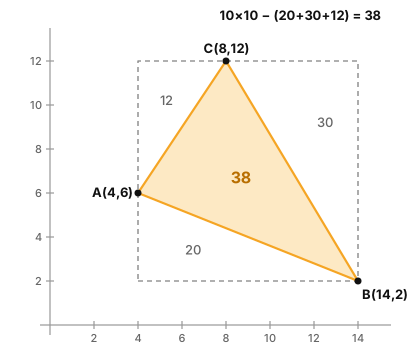
- ; ; .
- Sum = 76.
- Area sq units.
Trick: Shift origin to A: B(10, −4), C(4, 6) → .
Answer: (B) 38 square units
अवधारणा: क्षेत्रफल
हल:
- ; ;
- योग = 76
- क्षेत्रफल = 38 वर्ग इकाई
ट्रिक: मूलबिंदु A पर लाएँ: B(10, −4), C(4, 6) → ।
उत्तर: (B) 38 वर्ग इकाई
SSC CGLQuantitative AptitudeCoordinate geometry – area of triangleSSC CGL 2025 · 22 Sep Shift 3
Q386.A person bought a cycle at a discount of 25% on the marked price. He spent ₹510 on repairs and sold it for ₹5,760, gaining 20%. What was the marked price?
एक व्यक्ति ने अंकित मूल्य पर 25% छूट लेकर साइकिल खरीदी। उसने ₹510 मरम्मत पर खर्च किए और उसे ₹5,760 में बेचकर 20% लाभ कमाया। अंकित मूल्य क्या था?
- A₹5,500
- B₹6,000
- C₹5,600
- D₹5,720
Show answer
Concept: Total CP = purchase price + repair; SP = 120% of total CP.
- Total CP = ₹4,800.
- Price paid = ₹4,290.
- This is 75% of MP → ₹5,720.
Trick: Work backward: , , – three quick steps.
Answer: (D) ₹5,720
अवधारणा: कुल क्रय मूल्य = खरीद मूल्य + मरम्मत; विक्रय मूल्य = कुल CP का 120%।
हल:
- कुल CP = ₹4,800
- खरीद मूल्य = ₹4,290
- यह MP का 75% है → ₹5,720
ट्रिक: उल्टा चलें: , फिर , फिर ।
उत्तर: (D) ₹5,720
SSC CGLQuantitative AptitudeDiscount, repair and profitSSC CGL 2025 · 22 Sep Shift 3
Q387.A mixture contains 60% water. If 20 litres of milk is added to the 80-litre mixture, what is the new percentage of water?
एक मिश्रण में 60% पानी है। यदि 80 लीटर मिश्रण में 20 लीटर दूध मिला दिया जाए, तो पानी का नया प्रतिशत क्या होगा?
- A40%
- B48%
- C45%
- D50%
Show answer
Concept: Water quantity stays fixed; only the total changes.
- Water = 60% of 80 = 48 L.
- New total = L.
- Water % = .
Trick: New total is exactly 100 L, so litres of water = percentage of water.
Answer: (B) 48%
अवधारणा: पानी की मात्रा स्थिर है; केवल कुल मात्रा बदलती है।
हल:
- पानी = 80 का 60% = 48 लीटर
- नया कुल = 100 लीटर
- पानी % = 48%
ट्रिक: नया कुल ठीक 100 लीटर है, इसलिए पानी के लीटर = प्रतिशत।
उत्तर: (B) 48%
SSC CGLQuantitative AptitudeMixture – new percentageSSC CGL 2025 · 22 Sep Shift 3
Q388.If 20 boys can build a house in 15 days, in how many days can 15 boys complete the same work?
यदि 20 लड़के एक मकान 15 दिनों में बनाते हैं, तो 15 लड़के वही कार्य कितने दिनों में पूरा करेंगे?
- A25
- B10
- C20
- D15
Show answer
Concept: For the same work, .
- Total work = boy-days.
- Days for 15 boys = .
Trick: Fewer boys → more days: .
Answer: (C) 20
अवधारणा: एक ही कार्य के लिए ।
हल:
- कुल कार्य = लड़का-दिन
- 15 लड़कों को = दिन
ट्रिक: कम लड़के → अधिक दिन: ।
उत्तर: (C) 20
SSC CGLQuantitative AptitudeWork – men and daysSSC CGL 2025 · 22 Sep Shift 3
Q389.40 men can do a piece of work in 90 days. Find the percentage of the work done by 80 men in 15 days.
40 आदमी एक कार्य 90 दिनों में करते हैं। 80 आदमी 15 दिनों में कितने प्रतिशत कार्य करेंगे?
- A35.32%
- B31.21%
- C40%
- D33.33%
Show answer
Concept: Work done = men × days; compare with total man-days.
- Whole job = man-days.
- 80 men in 15 days = 1200 man-days.
- Fraction = .
Trick: Double the men () and of the days () → of the work.
Answer: (D) 33.33%
अवधारणा: किया गया कार्य = व्यक्ति × दिन; कुल से तुलना करें।
हल:
- पूरा कार्य = व्यक्ति-दिन
- 80 व्यक्ति × 15 दिन = 1200
- भाग
ट्रिक: व्यक्ति दोगुने, दिन → कार्य।
उत्तर: (D) 33.33%
SSC CGLQuantitative AptitudeWork – fraction completedSSC CGL 2025 · 22 Sep Shift 3
Q390.The base of a prism is a rectangle whose length is twice its width. The perimeter of the base is 54 cm. The prism's height decreases in an arithmetic progression from 17 cm in the first layer to 11 cm in the fourth layer. What is the total volume of the prism?
एक प्रिज़्म का आधार आयत है जिसकी लंबाई चौड़ाई की दोगुनी है। आधार का परिमाप 54 cm है। प्रिज़्म की ऊँचाई समांतर श्रेढ़ी में पहली परत के 17 cm से चौथी परत के 11 cm तक घटती है। प्रिज़्म का कुल आयतन क्या है?
- A9000 cm³
- B9500 cm³
- C9060 cm³
- D9072 cm³
Show answer
Concept: Volume = base area × total height; heights form an AP.
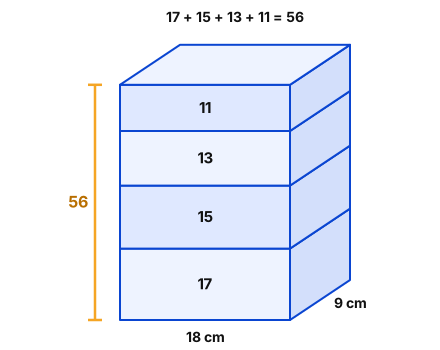
- → , → base = 162 cm².
- Heights 17, 15, 13, 11 → total = 56 cm.
- Volume = cm³.
Trick: Sum of AP = (number of terms/2) × (first + last) .
Answer: (D) 9072 cm³
अवधारणा: आयतन = आधार क्षेत्रफल × कुल ऊँचाई; ऊँचाइयाँ समांतर श्रेढ़ी में।
हल:
- → , → आधार = 162 cm²
- ऊँचाइयाँ 17, 15, 13, 11 → योग 56 cm
- आयतन = cm³
ट्रिक: AP योग = (पदों की संख्या/2) × (पहला + अंतिम) ।
उत्तर: (D) 9072 cm³
SSC CGLQuantitative AptitudePrism with layered heights (AP)SSC CGL 2025 · 22 Sep Shift 3
Q391.A merchant wants to mix two types of tea priced at ₹400/kg and ₹340/kg. In what ratio should they be mixed to sell the mixture at ₹370/kg without profit or loss?
एक व्यापारी ₹400/किग्रा और ₹340/किग्रा की दो किस्म की चाय मिलाना चाहता है। बिना लाभ-हानि के मिश्रण ₹370/किग्रा बेचने हेतु उन्हें किस अनुपात में मिलाना चाहिए?
- A1 : 1
- B2 : 1
- C3 : 2
- D1 : 2
Show answer
Concept: Ratio = (dearer − mean) : (mean − cheaper).
- Mean price = ₹370 (no profit, no loss).
- (400 − 370) : (370 − 340) = 30 : 30 = 1 : 1.
Trick: 370 is exactly midway between 340 and 400 → equal quantities.
Answer: (A) 1 : 1
अवधारणा: अनुपात = (महँगा − औसत) : (औसत − सस्ता)।
हल:
- औसत मूल्य = ₹370
- (400 − 370) : (370 − 340) = 30 : 30 = 1 : 1
ट्रिक: 370, 340 और 400 के ठीक बीच में है → बराबर मात्रा।
उत्तर: (A) 1 : 1
SSC CGLQuantitative AptitudeAlligation – mixing two teasSSC CGL 2025 · 22 Sep Shift 3
Q392.The average marks of 40 students in a class is 72. If the marks of one student were wrongly entered as 92 instead of 72, what is the CORRECT average?
एक कक्षा के 40 विद्यार्थियों का औसत अंक 72 है। यदि एक विद्यार्थी के अंक 72 के बजाय गलती से 92 दर्ज हो गए, तो सही औसत क्या है?
- A71.5
- B71.67
- C71
- D70.35
Show answer
Concept: Change in average = error ÷ number of items.
- Excess entered = .
- Average drops by .
- Correct average = .
Trick: No need for totals – just divide the error by n.
Answer: (A) 71.5
अवधारणा: औसत में परिवर्तन = त्रुटि ÷ संख्या।
हल:
- अधिक लिखा =
- औसत घटेगा
- सही औसत = 71.5
ट्रिक: कुल योग की ज़रूरत नहीं – त्रुटि को n से भाग दें।
उत्तर: (A) 71.5
SSC CGLQuantitative AptitudeAverage – correcting a wrong entrySSC CGL 2025 · 22 Sep Shift 3
Q393.If sinθ + cosθ = , find the value of sin²θ + cos²θ + 2sinθcosθ.
यदि sinθ + cosθ = है, तो sin²θ + cos²θ + 2sinθcosθ का मान ज्ञात कीजिए।
- A1
- B
- C
- D
Show answer
Concept: .
- Given .
- Required = .
Trick: Recognise before using – don't stop at 1.
Answer: (C)
अवधारणा:
हल:
- दिया है
- मान =
ट्रिक: पहचानें – केवल लिखकर रुकें नहीं।
उत्तर: (C)
SSC CGLQuantitative AptitudeTrigonometric identity – perfect squareSSC CGL 2025 · 22 Sep Shift 3
Q394.Find the point where y = 10x − 20 crosses the x-axis.
ज्ञात कीजिए कि y = 10x − 20 x-अक्ष को किस बिंदु पर काटती है।
- A(4, 0)
- B(0, −10)
- C(−4, 0)
- D(2, 0)
Show answer
Concept: On the x-axis, y = 0.
- 0 = 10x − 20 → x = 2.
- Point = (2, 0).
Trick: Options with y ≠ 0 are out immediately; then test x in 10x = 20.
Answer: (D) (2, 0)
अवधारणा: x-अक्ष पर y = 0 होता है।
हल:
- 0 = 10x − 20 → x = 2
- बिंदु = (2, 0)
ट्रिक: जिन विकल्पों में y ≠ 0 है वे तुरंत बाहर।
उत्तर: (D) (2, 0)
SSC CGLQuantitative Aptitudex-intercept of a lineSSC CGL 2025 · 22 Sep Shift 3
Q395.The sum of the measures of 8 interior angles of a 9-sided polygon is 1,120°. What is the measure of the 9th exterior angle?
9 भुजाओं वाले बहुभुज के 8 अंतःकोणों का योग 1,120° है। नौवाँ बाह्य कोण कितना है?
- A60°
- B20°
- C40°
- D80°
Show answer
Concept: Interior sum = ; interior + exterior = 180°.
- → sum .
- 9th interior = .
- 9th exterior = .
Trick: Exterior angles total 360°: 8 exteriors = → 9th = .
Answer: (C) 40°
अवधारणा: अंतः कोणों का योग = ; अंतः + बाह्य = 180°।
हल:
- → योग = 1260°
- 9वाँ अंतः कोण = 140°
- 9वाँ बाह्य कोण = 40°
ट्रिक: बाह्य कोणों का योग 360°: 8 बाह्य = → 9वाँ = 40°।
उत्तर: (C) 40°
SSC CGLQuantitative AptitudePolygon – interior & exterior anglesSSC CGL 2025 · 22 Sep Shift 3
Q396.Two triangles, △ABC and △XYZ, have AB = XY, AC = XZ and ∠BAC = ∠YXZ. By what rule are they congruent?
दो त्रिभुज △ABC और △XYZ में AB = XY, AC = XZ और ∠BAC = ∠YXZ है। वे किस नियम से सर्वांगसम हैं?
- ASSS
- BSAS
- CASA
- DAAS
Show answer
Concept: Two sides and the angle between them equal → SAS.
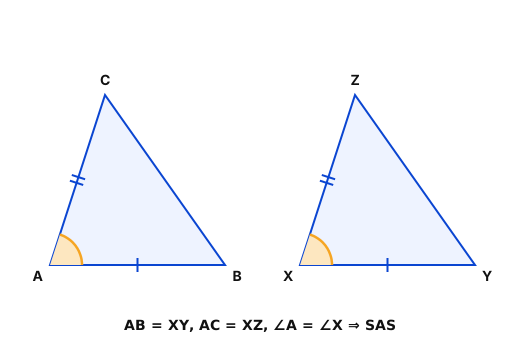
- AB = XY and AC = XZ (two sides).
- ∠BAC is formed by AB and AC – the included angle, matching ∠YXZ.
- So △ABC ≅ △XYZ by SAS.
Trick: The angle's middle letter (A) is common to both sides AB and AC → included angle.
Answer: (B) SAS
अवधारणा: दो भुजाएँ और उनके बीच का कोण बराबर → SAS।
हल:
- AB = XY तथा AC = XZ
- ∠BAC, AB व AC के बीच का कोण है और ∠YXZ के बराबर।
- अतः SAS से सर्वांगसम।
ट्रिक: कोण का बीच वाला अक्षर (A) दोनों भुजाओं AB, AC में है → अंतर्गत कोण।
उत्तर: (B) SAS
SSC CGLQuantitative AptitudeCongruence – SASSSC CGL 2025 · 22 Sep Shift 3
Q397.Simplify:
सरल कीजिए:
- A2
- B
- C3
- D
Show answer
Concept: .
- and .
- ; .
- Sum ; divide by → .
Trick: Find two numbers adding to 16 and multiplying to 55 → 11, 5; the and cancel.
Answer: (B)
अवधारणा:
हल:
- तथा
- दोनों मूल = और
- योग ; से भाग →
ट्रिक: ऐसी दो संख्याएँ खोजें जिनका योग 16 व गुणनफल 55 हो → 11, 5; कट जाते हैं।
उत्तर: (B)
SSC CGLQuantitative AptitudeSurds – √(a ± 2√b)SSC CGL 2025 · 22 Sep Shift 3
Q398.A chord subtends an angle of 140° at the centre of a circle. What is the measure of the angle subtended by the same chord at any point on the remaining part of the circle?
एक जीवा वृत्त के केंद्र पर 140° का कोण बनाती है। वही जीवा शेष परिधि के किसी बिंदु पर कितना कोण बनाएगी?
- A35°
- B70°
- C140°
- D105°
Show answer
Concept: Angle at centre = 2 × angle at the remaining (major) arc.
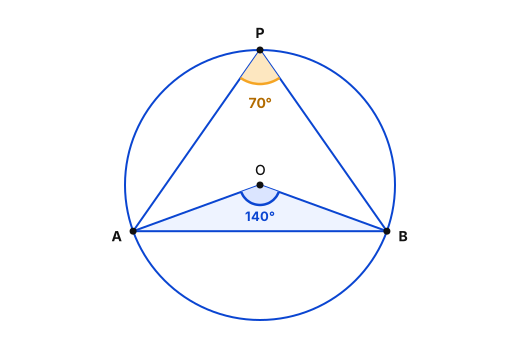
- Angle at centre = 140°.
- Angle on the remaining part = 140° ÷ 2 = 70°.
Yaad rakhein: On the minor arc it would be 180° − 70° = 110° (cyclic quadrilateral) – read 'remaining part' carefully.
Answer: (B) 70°
अवधारणा: केंद्र पर कोण = शेष (दीर्घ) चाप पर बने कोण का दोगुना।
हल:
- केंद्र पर कोण = 140°
- शेष भाग पर कोण = 70°
याद रखें: लघु चाप पर बिंदु हो तो कोण 180° − 70° = 110° होता (चक्रीय चतुर्भुज)।
उत्तर: (B) 70°
SSC CGLQuantitative AptitudeCircle – angle at centre vs circumferenceSSC CGL 2025 · 22 Sep Shift 3
Q399.A circle is inscribed in a regular hexagon. What is the angle subtended by one side of the hexagon at the centre?
एक सम षट्भुज में वृत्त अंतर्निहित है। षट्भुज की एक भुजा केंद्र पर कितना कोण बनाती है?
- A36°
- B54°
- C60°
- D108°
Show answer
Concept: Central angle of a regular n-gon = 360°/n.
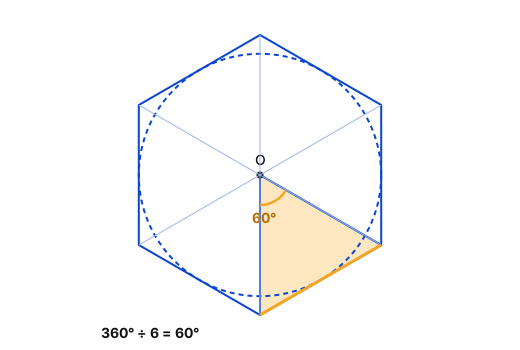
- n = 6 → 360° ÷ 6 = 60°.
- The incircle doesn't change this angle.
Trick: Hexagon = 6 equilateral triangles meeting at the centre, each with a 60° angle.
Answer: (C) 60°
अवधारणा: सम n-भुज का केंद्रीय कोण = 360°/n।
हल:
- n = 6 → 360° ÷ 6 = 60°
- अंतःवृत्त से यह कोण नहीं बदलता।
ट्रिक: षट्भुज = केंद्र पर मिलते 6 समबाहु त्रिभुज, हर एक 60°।
उत्तर: (C) 60°
SSC CGLQuantitative AptitudeRegular hexagon – central angleSSC CGL 2025 · 22 Sep Shift 3
Q400.If sinC = , then find cotC in simplest form.
यदि sinC = है, तो cotC को सरलतम रूप में ज्ञात कीजिए।
- A
- B
- C3
- D
Show answer
Concept: sin = perpendicular/hypotenuse; cot = base/perpendicular.
- → P = 1, H .
- B .
- .
Trick: → .
Answer: (C) 3
अवधारणा: sin = लंब/कर्ण; cot = आधार/लंब।
हल:
- → लंब = 1, कर्ण
- आधार
ट्रिक: → ।
उत्तर: (C) 3
SSC CGLQuantitative AptitudeTrigonometric ratios – cot from sinSSC CGL 2025 · 22 Sep Shift 3

