Q401.What will come in place of ? to satisfy the equation:
( − 2)² = ? − 4
समीकरण को संतुष्ट करने हेतु ? के स्थान पर क्या आएगा:
( − 2)² = ? − 4
- A12
- B11
- C10
- D13
Show answer
Concept: Equation is ; expand with .
- , , .
- .
- Compare with .
Trick: The rational part of is simply .
Answer: (B) 11
अवधारणा: समीकरण है; से फैलाएँ।
- , , ।
- ।
- से तुलना → ।
ट्रिक: का परिमेय भाग सीधे होता है।
उत्तर: (B) 11
SSC CGLQuantitative AptitudeAlgebraic identity – (a − b)² with surdsSSC CGL 2025 · 22 Sep Shift 2
Q402.What will be the compound interest on a sum of ₹21,000 after 3 years at the rate of 10% per annum?
₹21,000 पर 10% वार्षिक दर से 3 वर्ष का चक्रवृद्धि ब्याज कितना होगा?
- A₹6,951
- B₹6,421
- C₹6,541
- D₹6,351
Show answer
Concept: , .
- .
- ₹27,951.
- ₹6,951.
Trick: CI% for 3 years at 10% = 33.1%. 33.1% of 21,000 = ₹6,951.
Answer: (A) ₹6,951
अवधारणा: , ।
- ।
- ₹27,951।
- ₹6,951।
ट्रिक: 10% पर 3 वर्ष का प्रभावी CI = 33.1%; 21,000 का 33.1% = ₹6,951।
उत्तर: (A) ₹6,951
SSC CGLQuantitative AptitudeCompound interest – 3 yearsSSC CGL 2025 · 22 Sep Shift 2
Q403.If the simple interest on a certain sum of money for 3 years at 8% per annum is ₹480, what would be the simple interest on the same sum for 5 years at 12% per annum?
यदि किसी राशि पर 8% वार्षिक दर से 3 वर्ष का साधारण ब्याज ₹480 है, तो उसी राशि पर 12% वार्षिक दर से 5 वर्ष का साधारण ब्याज कितना होगा?
- A₹960
- B₹1,200
- C₹1,000
- D₹1,440
Show answer
Concept: For a fixed principal, .
- Old → SI ₹480.
- New .
- New SI = ₹1,200.
Trick: ₹480 for 24 'rate-years' = ₹20 per rate-year → ₹1,200. No need to find P (= ₹2,000).
Answer: (B) ₹1,200
अवधारणा: मूलधन समान हो तो SI दर समय।
- पुराना → SI ₹480।
- नया ।
- नया SI = ₹1,200।
ट्रिक: 24 इकाई का ₹480 → 1 इकाई = ₹20 → ₹1,200; P (= ₹2,000) निकालने की ज़रूरत नहीं।
उत्तर: (B) ₹1,200
SSC CGLQuantitative AptitudeSimple interest – same principal, new rate and timeSSC CGL 2025 · 22 Sep Shift 2
Q404.The decimal 0.785 is best classified as:
दशमलव 0.785 को किस श्रेणी में रखा जाएगा?
- AWhole Numberपूर्ण संख्या
- BIrrational Numberअपरिमेय संख्या
- CIntegerपूर्णांक
- DRational Numberपरिमेय संख्या
Show answer
Concept: A terminating decimal can be written as (), so it is rational.
- → rational.
- It has a fractional part, so it is not a whole number or an integer.
- Irrational numbers are non-terminating and non-repeating – not the case here.
Yaad rakhein: Terminating or repeating decimal → rational; never-ending, non-repeating (like , ) → irrational.
Answer: (D) Rational Number
अवधारणा: सांत दशमलव को () के रूप में लिखा जा सकता है, अतः वह परिमेय है।
- → परिमेय।
- इसमें भिन्नात्मक भाग है, अतः पूर्ण संख्या या पूर्णांक नहीं।
- अपरिमेय संख्याएँ अनंत व अनावर्ती होती हैं – यहाँ ऐसा नहीं।
याद रखें: सांत या आवर्ती दशमलव → परिमेय; अनंत अनावर्ती (जैसे , ) → अपरिमेय।
उत्तर: (D) परिमेय संख्या
SSC CGLQuantitative AptitudeNumber system – classifying decimalsSSC CGL 2025 · 22 Sep Shift 2
Q405.A cyclist covers a distance of 450 metres in 25 seconds. What is his speed in km/h?
एक साइकिल चालक 450 मीटर की दूरी 25 सेकंड में तय करता है। उसकी चाल km/h में कितनी है?
- A64.8 km/h
- B42 km/h
- C45 km/h
- D48 km/h
Show answer
Concept: Speed = distance ÷ time; to convert m/s to km/h multiply by .
- Speed = m/s.
- km/h.
Trick: is the same as : .
Answer: (A) 64.8 km/h
अवधारणा: चाल = दूरी ÷ समय; m/s को km/h में बदलने के लिए से गुणा करें।
- चाल = m/s।
- km/h।
ट्रिक: से गुणा = 3.6 से गुणा: ।
उत्तर: (A) 64.8 km/h
SSC CGLQuantitative AptitudeSpeed – m/s to km/hSSC CGL 2025 · 22 Sep Shift 2
Q406.A pyramid is inscribed inside a cube with edge 9 cm, sharing the base and with its apex at the centre of the top face. Find the volume of the pyramid.
9 cm भुजा वाले घन के भीतर एक पिरामिड अंकित है, जिसका आधार घन के आधार जैसा है और शीर्ष ऊपरी फलक के केंद्र पर है। पिरामिड का आयतन ज्ञात कीजिए।
- A180 cm³
- B220 cm³
- C243 cm³
- D270 cm³
Show answer
Concept: Volume of pyramid = × base area × height.
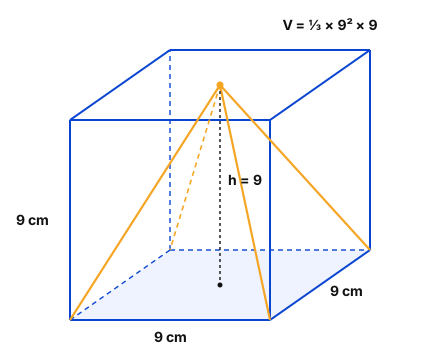
- Base = cube face: cm².
- Height = edge = 9 cm (apex on top face).
- cm³.
Trick: Such a pyramid is always of the cube: → .
Answer: (C) 243 cm³
अवधारणा: पिरामिड का आयतन = × आधार क्षेत्रफल × ऊँचाई।
- आधार = घन का फलक: सेमी²।
- ऊँचाई = कोर = 9 सेमी (शीर्ष ऊपरी फलक पर)।
- सेमी³।
ट्रिक: ऐसा पिरामिड हमेशा घन का होता है: → ।
उत्तर: (C) 243 cm³
SSC CGLQuantitative AptitudeMensuration – pyramid inside a cubeSSC CGL 2025 · 22 Sep Shift 2
Q407.A, B and C invest in the ratio 5 : 6 : 7. The time ratio is 4 : 3 : 2. What is the ratio of their profits?
A, B और C 5 : 6 : 7 के अनुपात में निवेश करते हैं। समय का अनुपात 4 : 3 : 2 है। उनके लाभ का अनुपात क्या होगा?
- A9 : 10 : 7
- B10 : 12 : 7
- C10 : 5 : 6
- D10 : 9 : 7
Show answer
Concept: Profit share ∝ capital × time.
- Products: 20 for A, 18 for B, 14 for C.
- Halving each: 10 : 9 : 7.
Trick: Check just A : B = 20 : 18 = 10 : 9 – only option (D) starts with 10 : 9.
Answer: (D) 10 : 9 : 7
अवधारणा: लाभ का भाग ∝ पूँजी × समय।
- गुणनफल: A का 20, B का 18, C का 14।
- सबको आधा करें: 10 : 9 : 7।
ट्रिक: केवल A : B = 20 : 18 = 10 : 9 देखें – यह केवल (D) में है।
उत्तर: (D) 10 : 9 : 7
SSC CGLQuantitative AptitudePartnership – capital × timeSSC CGL 2025 · 22 Sep Shift 2
Q408.A rectangular park has an area of 720 square metres. If its length is increased by 8 metres and its width decreased by 3 metres, the area remains unchanged. Find the original dimensions of the park.
एक आयताकार पार्क का क्षेत्रफल 720 वर्ग मीटर है। यदि उसकी लंबाई 8 मीटर बढ़ा दी जाए और चौड़ाई 3 मीटर घटा दी जाए, तो क्षेत्रफल वही रहता है। पार्क की मूल विमाएँ ज्ञात कीजिए।
- ALength = 45 m, Width = 16 mलंबाई = 45 m, चौड़ाई = 16 m
- BLength = 40 m, Width = 18 mलंबाई = 40 m, चौड़ाई = 18 m
- CLength = 48 m, Width = 15 mलंबाई = 48 m, चौड़ाई = 15 m
- DLength = 36 m, Width = 20 mलंबाई = 36 m, चौड़ाई = 20 m
Show answer
Concept: Both and must hold.
- Expand: .
- Option (B): ✓, and ✓.
- Check: ✓.
Trick: Every option gives area 720, so test only .
Answer: (B) Length = 40 m, Width = 18 m
अवधारणा: और दोनों सत्य हों।
- फैलाएँ: ।
- विकल्प (B): ✓, और ✓।
- जाँच: ✓।
ट्रिक: सभी विकल्पों का क्षेत्रफल 720 है, इसलिए केवल जाँचें।
उत्तर: (B) लंबाई = 40 m, चौड़ाई = 18 m
SSC CGLQuantitative AptitudeMensuration – rectangle with unchanged areaSSC CGL 2025 · 22 Sep Shift 2
Q409.A garden is in the shape of a regular hexagon with each side 30 m. If 5% of it is occupied by a circular fountain, find the remaining area.
एक बगीचा सम षट्भुज आकार का है जिसकी प्रत्येक भुजा 30 m है। यदि उसका 5% भाग एक गोल फव्वारे ने घेरा है, तो शेष क्षेत्रफल ज्ञात कीजिए।
- A2,131.5 m²
- B2,351.9 m²
- C2,221.3 m²
- D2,421.7 m²
Show answer
Concept: Area of regular hexagon = .
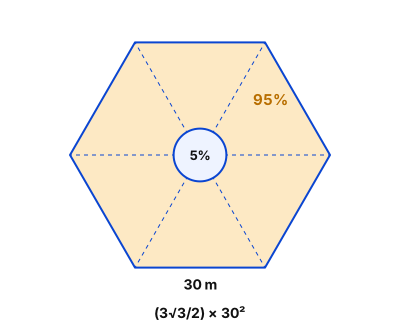
- Area = m².
- Remaining = 95% of it = m².
Trick: Hexagon = 6 equilateral triangles: ; then just take 95%.
Answer: (C) 2,221.3 m²
अवधारणा: समषट्भुज का क्षेत्रफल = ।
- क्षेत्रफल = मी²।
- शेष = इसका 95% = मी²।
ट्रिक: षट्भुज = 6 समबाहु त्रिभुज: ; फिर 95% लें।
उत्तर: (C) 2,221.3 m²
SSC CGLQuantitative AptitudeMensuration – regular hexagon areaSSC CGL 2025 · 22 Sep Shift 2
Q410.The weights of three friends are in the ratio 4 : 5 : 6. If each gains 9 kg, the new ratio becomes 13 : 14 : 15. What is the original weight of the heaviest friend?
तीन मित्रों के भार 4 : 5 : 6 के अनुपात में हैं। यदि प्रत्येक का भार 9 kg बढ़ जाए, तो नया अनुपात 13 : 14 : 15 हो जाता है। सबसे भारी मित्र का मूल भार क्या था?
- A5 kg
- B7 kg
- C6 kg
- D9 kg
Show answer
Concept: Adding the same amount to each term keeps the differences unchanged.
- Old difference (5 − 4) = x; new difference (14 − 13) = k, so x = k.
- 4x + 9 = 13x → 9x = 9 → x = 1.
- Heaviest = 6x = 6 kg.
Trick: Test options directly: heaviest 6 → weights 4, 5, 6 → +9 → 13, 14, 15 ✓.
Answer: (C) 6 kg
अवधारणा: हर पद में बराबर मात्रा जोड़ने पर अंतर नहीं बदलता।
- पुराना अंतर (5 − 4) = x; नया अंतर (14 − 13) = k, अतः x = k।
- 4x + 9 = 13x → 9x = 9 → x = 1।
- सबसे भारी = 6x = 6 किग्रा।
ट्रिक: विकल्प से जाँचें: सबसे भारी 6 → भार 4, 5, 6 → +9 → 13, 14, 15 ✓।
उत्तर: (C) 6 kg
SSC CGLQuantitative AptitudeRatio – equal quantity addedSSC CGL 2025 · 22 Sep Shift 2
Q411.A triangular field has sides in the ratio 3 : 5 : 7 and a perimeter of 90 m. What is the area of the field?
एक त्रिभुजाकार खेत की भुजाएँ 3 : 5 : 7 के अनुपात में हैं और परिमाप 90 m है। खेत का क्षेत्रफल क्या है?
- A196 m²
- B234 m²
- C186 m²
- D182 m²
Show answer
Concept: Area = , s = half perimeter.
- → sides 18, 30, 42 m; .
- .
- Area = m².
Trick: Sides 3 : 5 : 7 make a triangle with a angle, so area = .
Answer: (B) 234 m²
अवधारणा: क्षेत्रफल = , s = अर्ध परिमाप।
- → भुजाएँ 18, 30, 42 मी; ।
- ।
- क्षेत्रफल = मी²।
ट्रिक: 3 : 5 : 7 भुजाओं वाले त्रिभुज में एक कोण होता है: क्षेत्रफल = ।
उत्तर: (B) 234 m²
SSC CGLQuantitative AptitudeMensuration – Heron's formulaSSC CGL 2025 · 22 Sep Shift 2
Q412.The value of a machine depreciates 10% in the first year, 20% in the second year and 33.33% in the third year. If the initial value was ₹20,000, what is its value at the end of 3 years?
एक मशीन का मूल्य पहले वर्ष 10%, दूसरे वर्ष 20% और तीसरे वर्ष 33.33% घटता है। यदि आरंभिक मूल्य ₹20,000 था, तो 3 वर्ष बाद उसका मूल्य क्या होगा?
- A₹9,200
- B₹9,700
- C₹9,500
- D₹9,600
Show answer
Concept: Multiply the original value by each remaining fraction.
- .
- .
Trick: Convert odd percentages to fractions: , so the value keeps .
Answer: (D) ₹9,600
अवधारणा: मूल मूल्य को हर बार बची हुई भिन्न से गुणा करें।
- 10% घटा → ; 20% घटा → ; घटा → ।
- ।
ट्रिक: याद रखें; मूल्य का बचता है।
उत्तर: (D) ₹9,600
SSC CGLQuantitative AptitudePercentage – successive depreciationSSC CGL 2025 · 22 Sep Shift 2
Q413.An electronics dealer marks an item 50% above cost and offers a festival discount of 20%, plus a cashback of ₹200 on the final selling price. If he still makes a 15% profit, what is the cost price?
एक इलेक्ट्रॉनिक्स विक्रेता वस्तु को लागत से 50% अधिक अंकित करता है, 20% त्योहारी छूट देता है और अंतिम विक्रय मूल्य पर ₹200 कैशबैक भी देता है। फिर भी उसे 15% लाभ होता है। क्रय मूल्य क्या है?
- A₹4,300
- B₹4,000
- C₹4,100
- D₹4,200
Show answer
Concept: Final SP = MP × (1 − discount) − cashback = CP × 1.15.
- Let CP = x → MP = 1.5x → after 20% off = 1.2x.
- 1.2x − 200 = 1.15x → 0.05x = 200.
- x = ₹4,000.
Trick: Verify option: CP 4,000 → MP 6,000 → 4,800 → 4,600 = 115% of 4,000 ✓.
Answer: (B) ₹4,000
अवधारणा: अंतिम SP = MP × (1 − छूट) − कैशबैक = CP × 1.15।
- CP = x → MP = 1.5x → 20% छूट के बाद 1.2x।
- 1.2x − 200 = 1.15x → 0.05x = 200।
- x = ₹4,000।
ट्रिक: विकल्प से जाँचें: CP 4,000 → MP 6,000 → 4,800 → 4,600 = 4,000 का 115% ✓।
उत्तर: (B) ₹4,000
SSC CGLQuantitative AptitudeProfit & loss – markup, discount and cashbackSSC CGL 2025 · 22 Sep Shift 2
Q414.Ravi can do a job in the same amount of time as Sonu and Monu together. If Ravi and Sonu together can do it in 12 days and Monu alone can do it in 48 days, in how many days can Sonu do it alone?
रवि किसी काम को उतने ही समय में करता है जितने में सोनू और मोनू साथ मिलकर। यदि रवि और सोनू साथ में उसे 12 दिनों में करते हैं और मोनू अकेला 48 दिनों में, तो सोनू अकेला उसे कितने दिनों में करेगा?
- A16 days16 दिन
- B30 days30 दिन
- C24 days24 दिन
- D32 days32 दिन
Show answer
Concept: Take total work as LCM of the days and work with daily units.
- Total = 48 units; /day, /day.
- /day.
- Sonu alone = days.
Trick: Replace R by : .
Answer: (D) 32 days
अवधारणा: कुल कार्य = दिनों का LCM लें और प्रतिदिन इकाइयों में हल करें।
- कुल = 48 इकाई; /दिन, /दिन।
- /दिन।
- सोनू अकेला = दिन।
ट्रिक: R की जगह रखें: ।
उत्तर: (D) 32 दिन
SSC CGLQuantitative AptitudeTime and work – efficiency methodSSC CGL 2025 · 22 Sep Shift 2
Q415.A storage box is in the shape of a right rectangular prism with internal dimensions 60 cm × 50 cm × 40 cm. How many litres can it hold?
एक भंडारण बॉक्स लंब आयताकार प्रिज़्म के आकार का है जिसकी भीतरी विमाएँ 60 cm × 50 cm × 40 cm हैं। उसमें कितने लीटर आ सकते हैं?
- A150
- B120
- C140
- D170
Show answer
Concept: Volume of cuboid = ; 1 litre = 1000 cm³.
- cm³.
- Litres = .
Trick: Convert to decimetres first (1 dm³ = 1 L): L.
Answer: (B) 120
अवधारणा: घनाभ का आयतन = ; 1 लीटर = 1000 सेमी³।
- सेमी³।
- लीटर = ।
ट्रिक: पहले डेसीमीटर में बदलें (1 dm³ = 1 L): L।
उत्तर: (B) 120
SSC CGLQuantitative AptitudeMensuration – volume in litresSSC CGL 2025 · 22 Sep Shift 2
Q416.A trader bought 5 varieties of rice whose weights are in the ratio 3 : 4 : 5 : 6 : 7. Their respective prices per kg are ₹42, ₹45, ₹47, ₹48 and ₹50. What is the average cost per kg of the mixture?
एक व्यापारी ने पाँच किस्म के चावल खरीदे जिनके भार 3 : 4 : 5 : 6 : 7 के अनुपात में हैं। उनके क्रमशः मूल्य ₹42, ₹45, ₹47, ₹48 और ₹50 प्रति किग्रा हैं। मिश्रण की औसत लागत प्रति किग्रा क्या है?
- A₹47.1
- B₹44.1
- C₹44.8
- D₹46.3
Show answer
Concept: Average price = Σ(weight × price) ÷ Σweights.
- .
- .
- Average = ₹47.16 ₹47.1.
Trick: Heavier weights go to costlier rice, so the average must exceed the simple mean (₹46.4) – only ₹47.1 fits.
Answer: (A) ₹47.1
अवधारणा: औसत मूल्य = Σ(भार × मूल्य) ÷ Σभार।
- ।
- ।
- औसत = ₹47.16 ₹47.1।
ट्रिक: अधिक भार महँगे चावल का है, अतः औसत साधारण माध्य (₹46.4) से अधिक होगा – केवल ₹47.1।
उत्तर: (A) ₹47.1
SSC CGLQuantitative AptitudeMixture – weighted average priceSSC CGL 2025 · 22 Sep Shift 2
Q417.An alloy contains gold and silver in the ratio 5 : 3. A second alloy contains gold and silver in the ratio 3 : 1. What quantity of the first alloy must be added to 40 kg of the second alloy to form a new alloy containing gold and silver in the ratio 4 : 2?
एक मिश्रधातु में सोना और चाँदी 5 : 3 के अनुपात में हैं। दूसरी में 3 : 1 के अनुपात में। 40 kg दूसरी मिश्रधातु में पहली की कितनी मात्रा मिलाई जाए कि नई मिश्रधातु में सोना और चाँदी 4 : 2 के अनुपात में हों?
- A20 kg
- B60 kg
- C80 kg
- D40 kg
Show answer
Concept: Apply alligation on the fraction of gold.
- Gold fractions: 1st = , 2nd = , target = .
- 1st : 2nd = .
- 1st alloy = kg.
Trick: Check: 80 kg → 50 gold + 30 silver; 40 kg → 30 + 10; total 80 : 40 = 2 : 1 ✓.
Answer: (C) 80 kg
अवधारणा: सोने के भाग पर एलीगेशन लगाएँ।
- सोने का भाग: पहली = , दूसरी = , लक्ष्य = ।
- पहली : दूसरी = ।
- पहली मिश्रधातु = किग्रा।
ट्रिक: जाँच: 80 किग्रा → 50 सोना + 30 चाँदी; 40 किग्रा → 30 + 10; कुल 80 : 40 = 2 : 1 ✓।
उत्तर: (C) 80 kg
SSC CGLQuantitative AptitudeAlligation – mixing two alloysSSC CGL 2025 · 22 Sep Shift 2
Q418.If sinA = , find the value of (15sinA + 20cosA)² + (5sinA + 10cosA)².
यदि sinA = है, तो (15sinA + 20cosA)² + (5sinA + 10cosA)² का मान ज्ञात कीजिए।
- A746
- B625
- C713
- D734
Show answer
Concept: (3-4-5 triplet).
- .
- .
- .
Trick: The answer is 625 + something positive, so 625 itself is out; unit digit → 746.
Answer: (A) 746
अवधारणा: (3-4-5 त्रिक)।
- ।
- ।
- ।
ट्रिक: उत्तर 625 + धनात्मक संख्या है, अतः 625 नहीं; इकाई अंक → 746।
उत्तर: (A) 746
SSC CGLQuantitative AptitudeTrigonometry – value from a tripletSSC CGL 2025 · 22 Sep Shift 2
Q419.If sinβ = cosβ, then find sin³β + cos³β.
यदि sinβ = cosβ है, तो sin³β + cos³β ज्ञात कीजिए।
- A
- B
- C
- D
Show answer
Concept: .
- .
- for each.
- Sum = .
Trick: Use with , : .
Answer: (A)
अवधारणा: ।
- ।
- हर एक का घन = ।
- योग = ।
ट्रिक: , जहाँ , : ।
उत्तर: (A)
SSC CGLQuantitative AptitudeTrigonometry – sinβ = cosβSSC CGL 2025 · 22 Sep Shift 2
Q420.Are these lines y = 3x + 2 and y = −x + 5 perpendicular?
क्या रेखाएँ y = 3x + 2 और y = −x + 5 परस्पर लंब हैं?
- AYesहाँ
- BNoनहीं
- COnly if they intersect at the originकेवल तभी जब वे मूल बिंदु पर मिलें
- DCannot be determinedज्ञात नहीं किया जा सकता
Show answer
Concept: Lines are perpendicular when .
- .
- .
- → perpendicular.
Trick: Slopes that are negative reciprocals (3 and ) always give perpendicular lines; the intercepts do not matter.
Answer: (A) Yes
अवधारणा: दो रेखाएँ लंब होती हैं जब ।
- ।
- ।
- → लंब।
ट्रिक: ढलान एक-दूसरे के ऋणात्मक व्युत्क्रम (3 और ) हों तो रेखाएँ लंब होती हैं; अंतःखंड का कोई असर नहीं।
उत्तर: (A) हाँ
SSC CGLQuantitative AptitudeCoordinate geometry – perpendicular linesSSC CGL 2025 · 22 Sep Shift 2

