Q441.A 32-litre mixture of milk and water contains milk and water in the ratio 3 : 5. How much water must be added to make the ratio 3 : 6?
32 लीटर दूध-पानी के मिश्रण में दूध और पानी 3 : 5 के अनुपात में हैं। अनुपात 3 : 6 करने के लिए कितना पानी मिलाना होगा?
- A3 L
- B4 L
- C5 L
- D7.5 L
Show answer
Concept: Milk stays the same; only water changes.
- Milk = L, water = 20 L.
- For 3 : 6, water = 2 × milk = 24 L.
- Water to add = L.
Trick: Milk part is 3 in both ratios, so 1 extra part of water = L.
Answer: (B) 4 L
अवधारणा: दूध नहीं बदलता, केवल पानी बढ़ता है।
हल:
- दूध = 12 L, पानी = 20 L।
- 3 : 6 के लिए पानी = 24 L।
- मिलाना = 4 L।
ट्रिक: दोनों अनुपात में दूध 3 भाग ⇒ 1 भाग पानी = 4 L।
उत्तर: (B) 4 L
SSC CGLQuantitative AptitudeMixture – adding waterSSC CGL 2025 · 22 Sep Shift 1
Q442.If sinA = and A lies in the 2nd quadrant, then find the value of sinA × secA.
यदि sinA = है और A दूसरे चतुर्थांश में है, तो sinA × secA का मान ज्ञात कीजिए।
- A
- B−
- C
- D−
Show answer
Concept: ; in Q2 only sin (and cosec) are positive.
- → triplet (9, 40, 41), so .
- In Q2 .
- .
Trick: ; tan is negative in Q2 – keep only negative options.
Answer: (B) −
अवधारणा: ; द्वितीय चतुर्थांश में केवल sin (और cosec) धनात्मक।
हल:
- ⇒ (9, 40, 41) ⇒ ।
- Q2 में ।
- ।
ट्रिक: , और Q2 में tan ऋणात्मक।
उत्तर: (B) −
SSC CGLQuantitative AptitudeTrigonometry – sign in 2nd quadrantSSC CGL 2025 · 22 Sep Shift 1
Q443.What is the length of the segment joining (2, 4) and (8, 12)?
(2, 4) और (8, 12) को जोड़ने वाले रेखाखंड की लंबाई क्या है?
- A10
- B12
- C14
- D13
Show answer
Concept: .
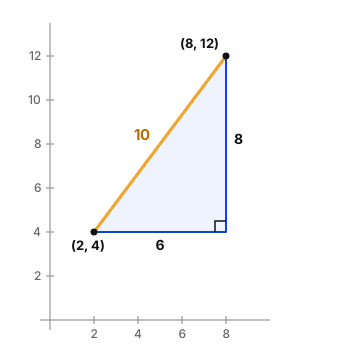
- , .
- .
Trick: 6, 8 → 10 is the 3-4-5 triplet doubled.
Answer: (A) 10
अवधारणा: ।
हल:
- , ।
- ।
ट्रिक: 6, 8, 10 = (3, 4, 5) × 2।
उत्तर: (A) 10
SSC CGLQuantitative AptitudeCoordinate geometry – distanceSSC CGL 2025 · 22 Sep Shift 1
Q444.In a triangle ABC, side BC is extended to a point D. The exterior angle at C is 112°. The interior angles at A and B are in the ratio 3 : 4. What is the measure of the largest interior angle of the triangle?
त्रिभुज ABC में भुजा BC को बिंदु D तक बढ़ाया गया है। C पर बाह्य कोण 112° है। A और B के अंतःकोण 3 : 4 के अनुपात में हैं। त्रिभुज का सबसे बड़ा अंतःकोण कितना है?
- A60°
- B68°
- C105°
- D15°
Show answer
Concept: Exterior angle = sum of the two opposite interior angles.
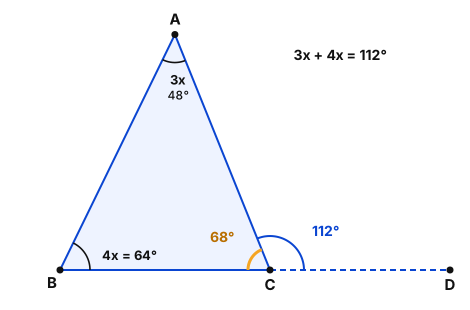
- ∠A + ∠B = 112°, ratio 3 : 4 → 7 parts = 112° → 1 part = 16°.
- ∠A = 48°, ∠B = 64°.
- ∠C = 180° − 112° = 68° → largest.
Trick: Interior angle at C = 180° − exterior angle; compare it with the bigger of A, B.
Answer: (B) 68°
अवधारणा: बाह्य कोण = दोनों सम्मुख अंतः कोणों का योग।
हल:
- ∠A + ∠B = 112°, 7 भाग = 112° ⇒ 1 भाग = 16°।
- ∠A = 48°, ∠B = 64°।
- ∠C = 68° – सबसे बड़ा।
ट्रिक: ∠C = 180° − बाह्य कोण।
उत्तर: (B) 68°
SSC CGLQuantitative AptitudeTriangles – exterior angleSSC CGL 2025 · 22 Sep Shift 1
Q445.Two triangles △ABC and △DEF are congruent, written as △ABC ≅ △DEF. If ∠A = 40°, what is the measure of ∠D?
दो त्रिभुज △ABC और △DEF सर्वांगसम हैं, जिसे △ABC ≅ △DEF लिखा जाता है। यदि ∠A = 40° है, तो ∠D की माप क्या है?
- A40°
- B50°
- C60°
- D130°
Show answer
Concept: In △ABC ≅ △DEF the letters match in order: A↔D, B↔E, C↔F.
- ∠A corresponds to ∠D.
- Corresponding parts of congruent triangles are equal (CPCT).
- ∠D = 40°.
Trick: Read the congruence statement letter by letter – position gives the pair.
Answer: (A) 40°
अवधारणा: △ABC ≅ △DEF में अक्षर क्रम से मिलते हैं: A↔D, B↔E, C↔F।
हल:
- ∠A का संगत ∠D है।
- सर्वांगसम त्रिभुजों के संगत भाग बराबर (CPCT)।
- ∠D = 40°।
ट्रिक: सर्वांगसमता कथन में स्थान से जोड़ी पहचानें।
उत्तर: (A) 40°
SSC CGLQuantitative AptitudeCongruent triangles – corresponding anglesSSC CGL 2025 · 22 Sep Shift 1
Q446.Given x + = 9, determine the value of .
यदि x + = 9 है, तो का मान ज्ञात कीजिए।
- A
- B
- C
- D
Show answer
Concept: .
- (taking the positive root).
- : divide top and bottom by x → .
- .
Trick: Any form = – just divide by x.
Answer: (A)
अवधारणा: ।
हल:
- ।
- अंश-हर को x से भाग: ।
- ।
ट्रिक: – बस x से भाग दें।
उत्तर: (A)
SSC CGLQuantitative AptitudeAlgebra – x − 1/x from x + 1/xSSC CGL 2025 · 22 Sep Shift 1
Q447.A chord of length 8 cm is at a distance of 6 cm away from the centre of a circle. What is the approximate radius of the circle?
8 cm लंबी एक जीवा वृत्त के केंद्र से 6 cm दूर है। वृत्त की अनुमानित त्रिज्या क्या है?
- A10 cm
- B14 cm
- C7 cm
- D25 cm
Show answer
Concept: The perpendicular from the centre bisects the chord: = (half-chord) + .
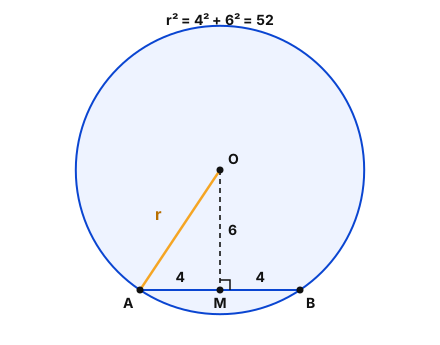
- Half-chord = 4 cm, d = 6 cm.
- cm.
- Nearest option: 7 cm.
Trick: and , so lies just above 7.
Answer: (C) 7 cm
अवधारणा: केंद्र से लंब जीवा को समद्विभाजित करता है: = (आधी जीवा) + ।
हल:
- आधी जीवा = 4, d = 6।
- cm।
- निकटतम विकल्प 7 cm।
ट्रिक: , ⇒ थोड़ा 7 से अधिक।
उत्तर: (C) 7 cm
SSC CGLQuantitative AptitudeCircle – radius from chord and distanceSSC CGL 2025 · 22 Sep Shift 1
Q448.A chord AB of a circle has a length of 20 cm. The angle subtended by the chord at a point C on the major arc is 30°. Find the radius of the circle.
किसी वृत्त की जीवा AB की लंबाई 20 cm है। दीर्घ चाप पर स्थित बिंदु C पर यह जीवा 30° का कोण बनाती है। वृत्त की त्रिज्या ज्ञात कीजिए।
- A17 cm
- B20 cm
- C12 cm
- D18 cm
Show answer
Concept: Angle at the centre = 2 × angle at the circumference; chord = 2r sin(inscribed angle).
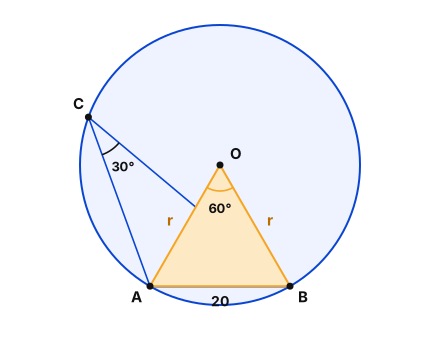
- Angle at C = ⇒ .
- and ⇒ is equilateral.
- So cm. (Check: .)
Trick: Central angle ⇒ radius = chord (equilateral △).
Answer: (B) 20 cm
अवधारणा: केंद्र पर कोण = परिधि पर कोण का दोगुना; जीवा = 2r sin(परिधि कोण)।
- C पर कोण ⇒ ।
- और ⇒ समबाहु।
- अतः cm।
ट्रिक: केंद्र पर ⇒ त्रिज्या = जीवा।
उत्तर: (B) 20 cm
SSC CGLQuantitative AptitudeCircle – chord, inscribed angle and radiusSSC CGL 2025 · 22 Sep Shift 1
Q449.If tanA = and A ∈ (0, ), then what is sinA in terms of x and y?
यदि tanA = और A ∈ (0, ) है, तो sinA का मान x और y के पदों में क्या होगा?
- A
- B
- C
- D
Show answer
Concept: = perpendicular/base; = perpendicular/hypotenuse.
- Perpendicular = x, base = y.
- Hypotenuse = .
- (positive in the 1st quadrant).
Trick: Put , : ; only gives .
Answer: (C)
अवधारणा: = लंब/आधार; = लंब/कर्ण।
हल:
- लंब = x, आधार = y।
- कर्ण = ।
- ।
ट्रिक: , रखें: – केवल यही विकल्प मेल खाता है।
उत्तर: (C)
SSC CGLQuantitative AptitudeTrigonometry – sin from tanSSC CGL 2025 · 22 Sep Shift 1
Q450.You earn ₹157.5 in 10.5 hours. Find your hourly wage as a fraction.
आप 10.5 घंटे में ₹157.5 कमाते हैं। अपनी प्रति घंटा मज़दूरी भिन्न के रूप में ज्ञात कीजिए।
- A
- B
- C
- D
Show answer
Concept: Hourly wage = total pay ÷ hours.
- .
- = 15 → ₹15 per hour = .
Trick: – check by multiplying.
Answer: (A)
अवधारणा: प्रति घंटा मज़दूरी = कुल कमाई ÷ घंटे।
हल:
- ।
- = 15 ⇒ ।
ट्रिक: जाँच: ।
उत्तर: (A)
SSC CGLQuantitative AptitudeUnitary method – rate per hourSSC CGL 2025 · 22 Sep Shift 1
Q451.What will come in place of ? to satisfy the equation:
( − 1)² = ? − 2
समीकरण को संतुष्ट करने हेतु ? के स्थान पर क्या आएगा:
( − 1)² = ? − 2
- A9
- B3
- C5
- D4
Show answer
Concept: ; read the equation as .
- .
- Middle term: .
- So .
Trick: The '? −' part always equals ; just add the squares: .
Answer: (A) 9
अवधारणा: ; समीकरण है।
हल:
- ।
- मध्य पद: ।
- अतः ।
ट्रिक: '? −' वाला भाग हमेशा होता है; सीधे ।
उत्तर: (A) 9
SSC CGLQuantitative AptitudeAlgebraic identity – (a − b)²SSC CGL 2025 · 21 Sep Shift 3
Q452.A vendor lends ₹84,000 at a rate of 12% compound interest per annum, compounded annually. Find the interest for the 3rd year.
एक विक्रेता ₹84,000, 12% वार्षिक चक्रवृद्धि ब्याज (वार्षिक संयोजन) पर उधार देता है। तीसरे वर्ष का ब्याज ज्ञात कीजिए।
- A10,000.35
- B11,000
- C12,644.35
- D12,000
Show answer
Concept: CI of the nth year = .
- 1st-year interest = 12% of 84,000 = ₹10,080.
- Each later year's interest grows by 12%: (2nd year).
- 3rd year = ₹12,644.35.
Trick: Year-wise CI forms a GP with ratio (1 + r): find year 1 and multiply by 1.12 twice.
Answer: (C) 12,644.35
अवधारणा: n-वें वर्ष का CI = ।
हल:
- पहले वर्ष का ब्याज = 84,000 का 12% = ₹10,080।
- हर अगले वर्ष ब्याज 12% बढ़ता है: (दूसरा वर्ष)।
- तीसरा वर्ष = ₹12,644.35।
ट्रिक: वर्षवार CI गुणोत्तर श्रेणी है (अनुपात 1 + r): पहले वर्ष का ब्याज निकालकर दो बार 1.12 से गुणा करें।
उत्तर: (C) 12,644.35
SSC CGLQuantitative AptitudeCompound interest – interest of a particular yearSSC CGL 2025 · 21 Sep Shift 3
Q453.If the simple interest on a sum of ₹A at 12% per annum for 4 years is equal to the simple interest on ₹B at 8% per annum for 6 years, then what is the ratio of A to B?
यदि ₹A पर 12% वार्षिक दर से 4 वर्ष का साधारण ब्याज, ₹B पर 8% वार्षिक दर से 6 वर्ष के साधारण ब्याज के बराबर है, तो A और B का अनुपात क्या है?
- A1 : 1
- B2 : 3
- C2 : 1
- D1 : 2
Show answer
Concept: Equal SI ⇒ equal on both sides.
- For A: rate × time = .
- For B: .
- Same ⇒ principals must be equal ⇒ A : B = 1 : 1.
Trick: Principal ratio = inverse ratio of (): 48 : 48 → 1 : 1.
Answer: (A) 1 : 1
अवधारणा: SI बराबर ⇒ दोनों ओर बराबर।
हल:
- A के लिए: दर × समय = ।
- B के लिए: ।
- समान ⇒ मूलधन भी समान ⇒ A : B = 1 : 1।
ट्रिक: मूलधन का अनुपात = () का उल्टा अनुपात: 48 : 48 → 1 : 1।
उत्तर: (A) 1 : 1
SSC CGLQuantitative AptitudeSimple interest – ratio of principalsSSC CGL 2025 · 21 Sep Shift 3
Q454.Which of these is a number that is real but NOT rational?
इनमें से कौन-सी संख्या वास्तविक है परंतु परिमेय नहीं है?
- A
- B7
- CSquare root of 55 का वर्गमूल
- D−3
Show answer
Concept: Rational = can be written as ; irrational = non-terminating, non-repeating decimal.
- , 7 and −3 can all be written as → rational.
- never ends or repeats → irrational, but it lies on the number line → real.
Trick: is irrational whenever n is not a perfect square (, , …).
Answer: (C) Square root of 5
अवधारणा: परिमेय = रूप ; अपरिमेय = न रुकने वाला, न दोहराने वाला दशमलव।
हल:
- , 7 और −3 को रूप में लिख सकते हैं → परिमेय।
- न रुकता है न दोहराता है → अपरिमेय, पर संख्या रेखा पर है → वास्तविक।
ट्रिक: जब n पूर्ण वर्ग न हो तो सदा अपरिमेय होता है (, , …)।
उत्तर: (C) 5 का वर्गमूल
SSC CGLQuantitative AptitudeNumber system – irrational numbersSSC CGL 2025 · 21 Sep Shift 3
Q455.Manoj crosses an 800 m long street in 8 minutes. What is his speed in km per hour?
मनोज 800 मीटर लंबी एक सड़क 8 मिनट में पार करता है। उसकी चाल किलोमीटर प्रति घंटा में क्या है?
- A5.5 km/h
- B5 km/h
- C6 km/h
- D7 km/h
Show answer
Concept: Speed = distance ÷ time; convert to km and hours.
- 800 m = 0.8 km; 8 min = h = h.
- Speed = km/h.
Trick: Metres per minute = km/h → .
Answer: (C) 6 km/h
अवधारणा: चाल = दूरी ÷ समय; km और घंटे में बदलें।
हल:
- 800 m = 0.8 km; 8 मिनट = घंटा = घंटा।
- चाल = km/h।
ट्रिक: मीटर प्रति मिनट × 0.06 = km/h → ।
उत्तर: (C) 6 km/h
SSC CGLQuantitative AptitudeSpeed – unit conversionSSC CGL 2025 · 21 Sep Shift 3
Q456.A pyramid with an equilateral triangular base of side 15 cm and height 20 cm is placed on top of a cube with side length 15 cm. Find the total volume of the composite solid.
15 cm भुजा वाले समबाहु त्रिभुजाकार आधार और 20 cm ऊँचाई का एक पिरामिड, 15 cm भुजा वाले घन के ऊपर रखा गया है। संयुक्त ठोस का कुल आयतन ज्ञात कीजिए।
- A2102.3 cm³
- B1202.5 cm³
- C4024.5 cm³
- D6202.3 cm³
Show answer
Concept: Total volume = cube () + pyramid ( base area ).
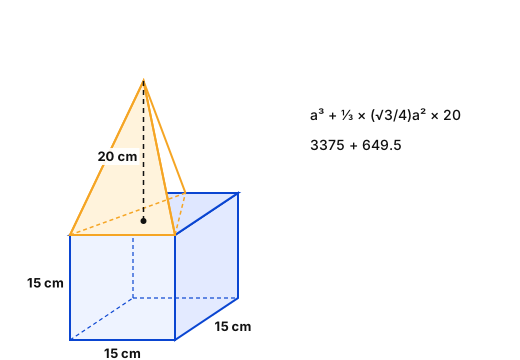
- Cube: .
- Base (equilateral): .
- Pyramid: .
- Sum ≈ 4024.5 cm³.
Trick: Answer must exceed the cube alone (3375) – only 4024.5 and 6202.3 qualify; the pyramid is small, so 4024.5.
Answer: (C) 4024.5 cm³
अवधारणा: कुल आयतन = घन () + पिरामिड ( आधार क्षेत्रफल )।
हल:
- घन: ।
- समबाहु आधार: ।
- पिरामिड: ।
- योग ≈ 4024.5 cm³।
ट्रिक: उत्तर अकेले घन (3375) से बड़ा होगा – 4024.5 या 6202.3; पिरामिड छोटा है, अतः 4024.5।
उत्तर: (C) 4024.5 cm³
SSC CGLQuantitative AptitudeMensuration – cube + pyramidSSC CGL 2025 · 21 Sep Shift 3
Q457.A and B invested ₹80,000 and ₹60,000 respectively for 12 months. A takes 10% of the profit for managing. The remaining profit of ₹1,40,000 is divided based on capital. What is B's share?
A और B ने क्रमशः ₹80,000 और ₹60,000, 12 माह के लिए निवेश किए। A प्रबंधन हेतु लाभ का 10% लेता है। शेष ₹1,40,000 का लाभ पूँजी के आधार पर बँटता है। B का हिस्सा क्या है?
- A₹60,000
- B₹30,000
- C₹40,000
- D₹35,000
Show answer
Concept: Same time period ⇒ profit is shared in capital ratio.
- Capital ratio = 80,000 : 60,000 = 4 : 3 (total 7 parts).
- Distributable profit ₹1,40,000 ⇒ 1 part = ₹20,000.
- B's share = ₹60,000.
Trick: The 10% management cut is already removed – just split the given ₹1,40,000.
Answer: (A) ₹60,000
अवधारणा: समय समान ⇒ लाभ पूँजी के अनुपात में बँटता है।
हल:
- पूँजी अनुपात = 80,000 : 60,000 = 4 : 3 (कुल 7 भाग)।
- बाँटने योग्य लाभ ₹1,40,000 ⇒ 1 भाग = ₹20,000।
- B का हिस्सा = ₹60,000।
ट्रिक: प्रबंधन का 10% पहले ही निकल चुका है – सीधे ₹1,40,000 बाँटें।
उत्तर: (A) ₹60,000
SSC CGLQuantitative AptitudePartnership – share of profitSSC CGL 2025 · 21 Sep Shift 3
Q458.A triangular field with base 80 m and height 60 m shares a side with a rectangle of length 80 m and breadth 50 m. Find the combined area and the percentage of the triangle's area in the total.
80 m आधार और 60 m ऊँचाई वाला एक त्रिभुजाकार खेत, 80 m लंबाई और 50 m चौड़ाई वाले आयत के साथ एक भुजा साझा करता है। संयुक्त क्षेत्रफल और कुल में त्रिभुज के क्षेत्रफल का प्रतिशत ज्ञात कीजिए।
- A1,450 m² and 24.5%1,450 m² और 24.5%
- B2,450 m² and 25.5%2,450 m² और 25.5%
- C6,400 m² and 37.5%6,400 m² और 37.5%
- D2,500 m² and 25%2,500 m² और 25%
Show answer
Concept: Triangle = ; rectangle = .
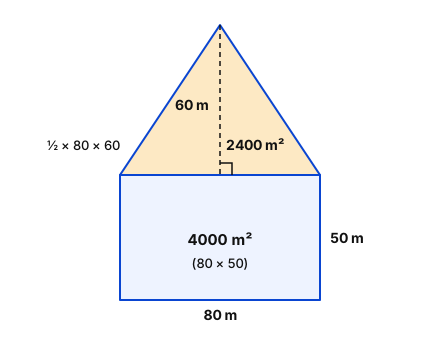
- Triangle: .
- Rectangle: ; total = 6,400 m².
- Triangle's share = .
Trick: Total area alone (6,400) points to the single option with it.
Answer: (C) 6,400 m² and 37.5%
अवधारणा: त्रिभुज = आधार ऊँचाई; आयत = ।
हल:
- त्रिभुज: ।
- आयत: ; कुल = 6,400 m²।
- त्रिभुज का भाग = ।
ट्रिक: केवल कुल क्षेत्रफल 6,400 से ही विकल्प तय हो जाता है।
उत्तर: (C) 6,400 m² और 37.5%
SSC CGLQuantitative AptitudeMensuration – combined area and percentageSSC CGL 2025 · 21 Sep Shift 3
Q459.A regular hexagon is inscribed inside a circle of radius 18 cm. Find the area of the hexagon.
18 cm त्रिज्या वाले वृत्त के भीतर एक सम षट्भुज अंकित है। षट्भुज का क्षेत्रफल ज्ञात कीजिए।
- A438.5 cm²
- B841.8 cm²
- C598.4 cm²
- D638.7 cm²
Show answer
Concept: A regular hexagon in a circle has side = radius; area = .
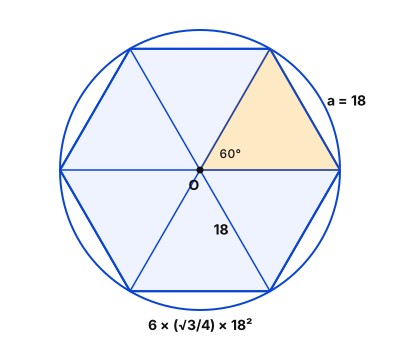
- cm ⇒ .
- Area = .
- .
Trick: Hexagon = 6 equilateral triangles of side r: .
Answer: (B) 841.8 cm²
अवधारणा: वृत्त में बने सम षट्भुज की भुजा = त्रिज्या; क्षेत्रफल = ।
हल:
- cm ⇒ ।
- क्षेत्रफल = ।
- ।
ट्रिक: षट्भुज = r भुजा वाले 6 समबाहु त्रिभुज: ।
उत्तर: (B) 841.8 cm²
SSC CGLQuantitative AptitudeMensuration – regular hexagonSSC CGL 2025 · 21 Sep Shift 3
Q460.Three numbers are such that the second is 160% of the first, and the third is 90% of the second. What is the ratio of the first to the third?
तीन संख्याएँ इस प्रकार हैं कि दूसरी पहली की 160% है और तीसरी दूसरी की 90% है। पहली और तीसरी का अनुपात क्या है?
- A25 : 36
- B22 : 23
- C25 : 14
- D15 : 8
Show answer
Concept: Express all numbers in terms of the first.
- Third = 90% of 160% of first = first.
- First : Third = 1 : 1.44 = 100 : 144 = 25 : 36.
Trick: Multiply the percentage factors directly: → ratio 25 : 36 (squares of 5 and 6).
Answer: (A) 25 : 36
अवधारणा: सभी संख्याओं को पहली के रूप में लिखें।
हल:
- तीसरी = पहली का 160% का 90% = पहली।
- पहली : तीसरी = 1 : 1.44 = 100 : 144 = 25 : 36।
ट्रिक: प्रतिशत गुणक सीधे गुणा करें: → अनुपात 25 : 36 ()।
उत्तर: (A) 25 : 36
SSC CGLQuantitative AptitudePercentage – successive comparisonSSC CGL 2025 · 21 Sep Shift 3

