Q481.A runner completes 5.2 km in 38 minutes. What is his speed in km/h?
एक धावक 5.2 km की दूरी 38 मिनट में तय करता है। उसकी चाल km/h में कितनी है?
- A8.21 km/h
- B9.21 km/h
- C11.21 km/h
- D13.42 km/h
Show answer
Concept: Convert time to hours before dividing.
- 38 min = h
- Speed =
- = 8.21 km/h (approx.)
Trick: In 38 min ≈ 5.2 km, so in 60 min a bit over 8 km → only 8.21 fits.
Answer: (A) 8.21 km/h
अवधारणा: भाग देने से पहले समय को घंटों में बदलें।
- 38 मिनट = घंटा
- चाल =
- ≈ 8.21 km/h
ट्रिक: 38 मिनट में 5.2 km, तो 60 मिनट में 8 km से थोड़ा अधिक → 8.21।
उत्तर: (A) 8.21 km/h
SSC CGLQuantitative AptitudeSpeed – minutes to hoursSSC CGL 2025 · 21 Sep Shift 2
Q482.Partners A and B entered into a business investing ₹40,000 and ₹90,000 respectively. After 6 months C joins with ₹1,40,000. At year-end the profit was ₹80,000. How much more did C earn than A?
साझेदार A और B ने क्रमशः ₹40,000 और ₹90,000 लगाकर व्यवसाय शुरू किया। 6 माह बाद C ₹1,40,000 के साथ जुड़ा। वर्ष के अंत में लाभ ₹80,000 हुआ। C ने A से कितना अधिक कमाया?
- A₹5,000
- B₹12,000
- C₹10,000
- D₹15,000
Show answer
Concept: Profit share ∝ capital × months.
- ; ;
- Ratio = 4 : 9 : 7 (sum 20) → 1 part = ₹4,000
- C − A = ₹12,000
Trick: Find only the difference: 3 parts of ₹4,000 — no need to compute each share.
Answer: (B) ₹12,000
अवधारणा: लाभ का हिस्सा ∝ पूंजी × महीने।
- A = 40 हज़ार × 12, B = 90 हज़ार × 12, C = 1.4 लाख × 6
- अनुपात 4 : 9 : 7 (योग 20) → 1 भाग = ₹4,000
- C − A = 3 भाग = ₹12,000
ट्रिक: सिर्फ अंतर चाहिए: 3 भाग × ₹4,000।
उत्तर: (B) ₹12,000
SSC CGLQuantitative AptitudePartnership – unequal timeSSC CGL 2025 · 21 Sep Shift 2
Q483.Three friends share a winning prize in the ratio 3 : 4 : 5. If the total prize is ₹15,000, how much more does the person with the highest share get than the lowest?
तीन मित्र एक पुरस्कार 3 : 4 : 5 के अनुपात में बाँटते हैं। यदि कुल पुरस्कार ₹15,000 है, तो सर्वाधिक हिस्सा पाने वाले को सबसे कम पाने वाले से कितना अधिक मिलेगा?
- A₹3,500
- B₹3,000
- C₹2,500
- D₹1,250
Show answer
Concept: Value of 1 part = total ÷ sum of ratio terms.
- Sum = → 1 part = ₹1,250
- Highest − lowest = parts
- ₹2,500
Trick: Difference = .
Answer: (C) ₹2,500
अवधारणा: 1 भाग का मान = कुल ÷ अनुपात का योग।
- योग = 12 → 1 भाग = ₹1,250
- सबसे बड़ा − सबसे छोटा = 2 भाग
- ₹2,500
ट्रिक: अंतर = कुल का = ।
उत्तर: (C) ₹2,500
SSC CGLQuantitative AptitudeRatio – difference of sharesSSC CGL 2025 · 21 Sep Shift 2
Q484.A triangular flag has base and height in the ratio 3 : 4. If the area is 216 cm², what are the base and height?
एक त्रिभुजाकार झंडे का आधार और ऊँचाई 3 : 4 के अनुपात में हैं। यदि क्षेत्रफल 216 cm² है, तो आधार और ऊँचाई क्या हैं?
- A16 cm and 12 cm16 cm और 12 cm
- B18 cm and 24 cm18 cm और 24 cm
- C20 cm and 25 cm20 cm और 25 cm
- D18 cm and 20 cm18 cm और 20 cm
Show answer
Concept: Area of triangle = base height.
- Base = 3k, height = 4k
- Base = 18 cm, height = 24 cm
Trick: Check options: ratio 3 : 4 and → only .
Answer: (B) 18 cm and 24 cm
अवधारणा: त्रिभुज का क्षेत्रफल = आधार ऊँचाई।
- आधार = 3k, ऊँचाई = 4k
- आधार = 18 सेमी, ऊँचाई = 24 सेमी
ट्रिक: विकल्प जाँचें: अनुपात 3 : 4 और ✓।
उत्तर: (B) 18 cm और 24 cm
SSC CGLQuantitative AptitudeTriangle – area with ratioSSC CGL 2025 · 21 Sep Shift 2
Q485.The population of a village increases by 10% annually. If the current population is 72,600, what was it two years ago?
एक गाँव की जनसंख्या प्रतिवर्ष 10% बढ़ती है। यदि वर्तमान जनसंख्या 72,600 है, तो दो वर्ष पहले वह कितनी थी?
- A60,000
- B59,500
- C62,000
- D61,000
Show answer
Concept: Past = Present .
Trick: , so at sight.
Answer: (A) 60,000
अवधारणा: पहले की जनसंख्या = वर्तमान ।
- = 60,000
ट्रिक: , इसलिए तुरंत।
उत्तर: (A) 60,000
SSC CGLQuantitative AptitudePopulation growth – going backwardSSC CGL 2025 · 21 Sep Shift 2
Q486.A person invested in two items — one gave an 8% profit and the other a 6% loss. If the total investment was ₹6,000 and the net result was a ₹200 profit, what was the investment in the profit-making item?
एक व्यक्ति ने दो वस्तुओं में निवेश किया — एक पर 8% लाभ और दूसरी पर 6% हानि हुई। यदि कुल निवेश ₹6,000 था और शुद्ध परिणाम ₹200 लाभ रहा, तो लाभ वाली वस्तु में कितना निवेश था?
- A₹4,000
- B₹3,500
- C₹4,500
- D₹3,000
Show answer
Concept: Net gain = 8% of first − 6% of second.
- Let profit item = x, other =
- ₹4,000
Trick: Alligation: net . Distances: and → ratio 2 : 1 → 4,000 : 2,000.
Answer: (A) ₹4,000
अवधारणा: शुद्ध लाभ = पहले का 8% − दूसरे का 6%।
- लाभ वाली वस्तु = x, दूसरी =
- ₹4,000
ट्रिक: विकल्प जाँच: 4000 का 8% = 320, 2000 का 6% = 120 → ✓।
उत्तर: (A) ₹4,000
SSC CGLQuantitative AptitudeProfit & loss – two investmentsSSC CGL 2025 · 21 Sep Shift 2
Q487.A group of 6 men or 15 women can complete a task in 80 days. Find the time taken by 4 men and 10 women to complete the task.
6 पुरुष या 15 महिलाएँ एक कार्य 80 दिनों में पूरा करती हैं। 4 पुरुष और 10 महिलाएँ उसे कितने दिनों में पूरा करेंगे?
- A70 days70 दिन
- B60 days60 दिन
- C75 days75 दिन
- D80 days80 दिन
Show answer
Concept: Equate the efficiencies, then convert everyone into one unit.
- 6 M = 15 W → 1 M = 2.5 W
- 4 M + 10 W = 10 W + 10 W = 20 W
- 15 W take 80 days → 20 W take days
Trick: Convert everything to women: .
Answer: (B) 60 days
अवधारणा: क्षमताएँ बराबर करें, फिर सबको एक इकाई में बदलें।
- 6 पुरुष = 15 महिलाएँ → 1 पुरुष = 2.5 महिला
- 4 पुरुष + 10 महिलाएँ = 20 महिलाएँ
- दिन
ट्रिक: सबको महिलाओं में बदलें और लगाएँ।
उत्तर: (B) 60 दिन
SSC CGLQuantitative AptitudeTime & work – men and womenSSC CGL 2025 · 21 Sep Shift 2
Q488.A machine can fill 110 milk bottles in 5 minutes. How many milk bottles can it fill in 12 minutes?
एक मशीन 5 मिनट में 110 दूध की बोतलें भरती है। वह 12 मिनट में कितनी बोतलें भरेगी?
- A190 bottles190 बोतलें
- B250 bottles250 बोतलें
- C264 bottles264 बोतलें
- D200 bottles200 बोतलें
Show answer
Concept: Find output per minute, then multiply.
- bottles per minute
- bottles
Trick: 12 min = min + 2 min → .
Answer: (C) 264 bottles
अवधारणा: पहले प्रति मिनट उत्पादन, फिर गुणा।
- बोतल प्रति मिनट
- बोतलें
ट्रिक: 12 मिनट = 10 + 2 → ।
उत्तर: (C) 264 बोतलें
SSC CGLQuantitative AptitudeUnitary method – rate of workSSC CGL 2025 · 21 Sep Shift 2
Q489.The average weight of 12 boxes is 18 kg. If the heaviest box weighs 24 kg and the lightest weighs 12 kg, what is the average weight of the remaining boxes?
12 डिब्बों का औसत भार 18 kg है। यदि सबसे भारी डिब्बा 24 kg और सबसे हल्का 12 kg का है, तो शेष डिब्बों का औसत भार क्या है?
- A17 kg
- B18 kg
- C19 kg
- D16 kg
Show answer
Concept: New average = (old total − removed) ÷ remaining count.
- Total = kg
- Removed = kg → left 180 kg
- kg
Trick: 24 and 12 average to 18 (same as the overall average), so the rest also average 18.
Answer: (B) 18 kg
अवधारणा: नया औसत = (पुराना योग − हटाया भार) ÷ शेष संख्या।
- योग = 216 kg
- हटाया = 36 kg → शेष 180 kg
- kg
ट्रिक: 24 और 12 का औसत 18 ही है, इसलिए बाकी का औसत भी 18 रहेगा।
उत्तर: (B) 18 kg
SSC CGLQuantitative AptitudeAverage – removing two itemsSSC CGL 2025 · 21 Sep Shift 2
Q490.A mixture of 200 litres contains acid and water in the ratio 3 : 5. If 40 litres of the mixture is replaced with water, what will be the percentage of acid in the final mixture?
200 लीटर मिश्रण में अम्ल और पानी 3 : 5 के अनुपात में हैं। यदि 40 लीटर मिश्रण निकालकर उतना ही पानी मिला दिया जाए, तो अंतिम मिश्रण में अम्ल का प्रतिशत क्या होगा?
- A29%
- B28%
- C32%
- D30%
Show answer
Concept: Removing part of a mixture removes acid in the same ratio; total volume stays 200 L.
- Acid = L
- After removing 40 L (th), acid left = L
- Acid % =
Trick: Original acid % = 37.5%; th replaced → .
Answer: (D) 30%
अवधारणा: मिश्रण निकालने पर अम्ल उसी अनुपात में निकलता है; कुल मात्रा 200 L ही रहती है।
- अम्ल = L
- 40 L ( भाग) निकालने पर अम्ल = L
- अम्ल % =
ट्रिक: शुरुआती अम्ल 37.5%; बदलने पर ।
उत्तर: (D) 30%
SSC CGLQuantitative AptitudeMixture – replacement with waterSSC CGL 2025 · 21 Sep Shift 2
Q491.A water tank is shaped like a composite prism: the bottom part is a triangular prism with base area 80 cm² and height 1.5 m, while the top part is a rectangular prism with base 50 cm × 35 cm and height 0.9 m. What is the total volume of the tank in litres? (1 m³ = 1000 L)
एक जल टंकी संयुक्त प्रिज़्म के आकार की है: निचला भाग त्रिभुजाकार प्रिज़्म है जिसका आधार क्षेत्रफल 80 cm² और ऊँचाई 1.5 m है, जबकि ऊपरी भाग आयताकार प्रिज़्म है जिसका आधार 50 cm × 35 cm और ऊँचाई 0.9 m है। टंकी का कुल आयतन लीटर में क्या है? (1 m³ = 1000 L)
- A160.8 L
- B178.5 L
- C169.5 L
- D201.5 L
Show answer
Concept: Volume of a prism = base area × height; .
- Triangular part: = 12 L
- Rectangular part: = 157.5 L
- Total = L
Trick: Work fully in cm³ and divide by 1000 — avoids m²/m³ decimal errors.
Answer: (C) 169.5 L
अवधारणा: प्रिज्म का आयतन = आधार क्षेत्रफल × ऊँचाई; ।
- त्रिभुजाकार भाग: = 12 L
- आयताकार भाग: = 157.5 L
- कुल = 169.5 L
ट्रिक: सब कुछ cm³ में निकालकर 1000 से भाग दें — दशमलव की गलती नहीं होगी।
उत्तर: (C) 169.5 L
SSC CGLQuantitative AptitudeMensuration – composite prism volumeSSC CGL 2025 · 21 Sep Shift 2
Q492.If tanA = x + , then what is sec²A?
यदि tanA = x + है, तो sec²A क्या है?
- Ax² + + 3
- Bx² + − 1
- Cx² + + 1
- Dx² + − 2
Show answer
Concept: Use .
Trick: Put : , . Only gives 5.
Answer: (A) x² + + 3
अवधारणा: सूत्र लगाएँ।
ट्रिक: रखें: , — केवल (A) से 5 आता है।
उत्तर: (A) x² + + 3
SSC CGLQuantitative AptitudeTrigonometry – sec² from tanSSC CGL 2025 · 21 Sep Shift 2
Q493.Find the slope of the line passing through the points (−3, 7) and (5, −9).
(−3, 7) और (5, −9) बिंदुओं से गुजरने वाली रेखा की प्रवणता ज्ञात कीजिए।
- A2
- B−2
- C3
- D−3
Show answer
Concept: Slope .
- Rise =
- Run =
Trick: y falls as x rises → slope negative; only (B), (D) remain, and .
Answer: (B) −2
अवधारणा: ढलान ।
- y में परिवर्तन =
- x में परिवर्तन =
ट्रिक: x बढ़ने पर y घट रहा है → ढलान ऋणात्मक; → −2।
उत्तर: (B) −2
SSC CGLQuantitative AptitudeCoordinate geometry – slopeSSC CGL 2025 · 21 Sep Shift 2
Q494.What is the minimum distance from the origin (0, 0) to a point on the line segment connecting A(6, 0) and B(0, 8)?
मूल बिंदु (0, 0) से A(6, 0) और B(0, 8) को जोड़ने वाले रेखाखंड पर स्थित किसी बिंदु तक न्यूनतम दूरी क्या है?
- A4.8
- B3.2
- C2.4
- D6.8
Show answer
Concept: Shortest distance = perpendicular distance = .
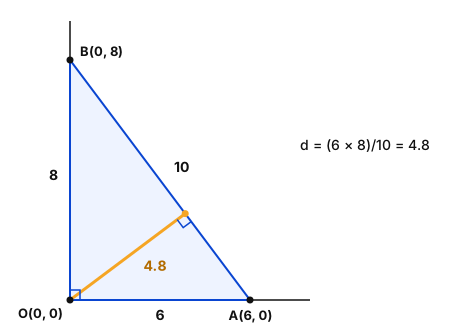
- Line through (6, 0) and (0, 8):
- Distance =
Trick: Right triangle with legs 6, 8, hypotenuse 10: altitude to hypotenuse = .
Answer: (A) 4.8
अवधारणा: न्यूनतम दूरी = लम्ब दूरी = ।
- (6, 0) और (0, 8) से होकर रेखा:
- दूरी =
ट्रिक: 6, 8, 10 का समकोण त्रिभुज: कर्ण पर लम्ब = ।
उत्तर: (A) 4.8
SSC CGLQuantitative AptitudeDistance of origin from a lineSSC CGL 2025 · 21 Sep Shift 2
Q495.If in △ABC and △DEF, ∠A = ∠D, AB = DE and ∠B = ∠E, which rule proves △ABC ≅ △DEF?
यदि △ABC और △DEF में ∠A = ∠D, AB = DE और ∠B = ∠E है, तो कौन-सा नियम △ABC ≅ △DEF सिद्ध करता है?
- ASSS
- BSAS
- CASA
- DAAS
Show answer
Concept: If two angles and the side between them are equal, triangles are congruent (ASA).
- Given ∠A = ∠D and ∠B = ∠E.
- AB is the side joining vertices A and B → it is the included side.
- Hence ASA.
Trick: Side between the two angles → ASA; side not between them → AAS.
Answer: (C) ASA
अवधारणा: दो कोण और उनके बीच की भुजा बराबर हों तो त्रिभुज सर्वांगसम (ASA)।
- ∠A = ∠D, ∠B = ∠E दिया है।
- AB, A और B को जोड़ती है → यह बीच की भुजा है।
- अतः ASA।
ट्रिक: भुजा दोनों कोणों के बीच → ASA; बीच में नहीं → AAS।
उत्तर: (C) ASA
SSC CGLQuantitative AptitudeCongruence – ASASSC CGL 2025 · 21 Sep Shift 2
Q496.The value of − is:
− का मान है:
- A1 +
- B2
- C−2
- D1 −
Show answer
Concept: .
- (since )
Trick: Find two numbers with sum 13 and product 42 → 7 and 6.
Answer: (C) −2
अवधारणा: ।
- → मूल =
- अंतर =
ट्रिक: योग 13 और गुणनफल 42 वाली संख्याएँ → 7 और 6।
उत्तर: (C) −2
SSC CGLQuantitative AptitudeSurds – nested square rootSSC CGL 2025 · 21 Sep Shift 2
Q497.The line segment from the centre of a circle to the midpoint of a chord is 8 cm long. If the radius is 17 cm, what is the length of the chord?
वृत्त के केंद्र से जीवा के मध्यबिंदु तक का रेखाखंड 8 cm लंबा है। यदि त्रिज्या 17 cm है, तो जीवा की लंबाई क्या है?
- A12 cm
- B24 cm
- C36 cm
- D30 cm
Show answer
Concept: The line from the centre to the chord's midpoint is perpendicular to the chord.
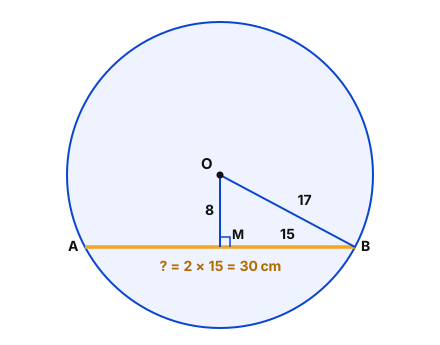
- Let half chord = h. Then
- cm
- Full chord = cm
Trick: 8-15-17 is a Pythagorean triplet — half chord = 15 instantly.
Answer: (D) 30 cm
अवधारणा: केंद्र से जीवा के मध्य बिंदु तक की रेखा जीवा पर लम्ब होती है।
- आधी जीवा = h, तो
- सेमी
- पूरी जीवा = सेमी
ट्रिक: 8-15-17 पाइथागोरस त्रिक है — आधी जीवा सीधे 15।
उत्तर: (D) 30 cm
SSC CGLQuantitative AptitudeCircle – chord lengthSSC CGL 2025 · 21 Sep Shift 2
Q498.A chord of a circle subtends an angle of 80° at the centre. What is the angle subtended at a point on the circle in the same segment?
किसी वृत्त की जीवा केंद्र पर 80° का कोण बनाती है। उसी वृत्तखंड में वृत्त पर स्थित बिंदु पर वह कितना कोण बनाएगी?
- A60°
- B40°
- C30°
- D90°
Show answer
Concept: Angle at the centre = 2 × angle at any point on the circle (same segment).
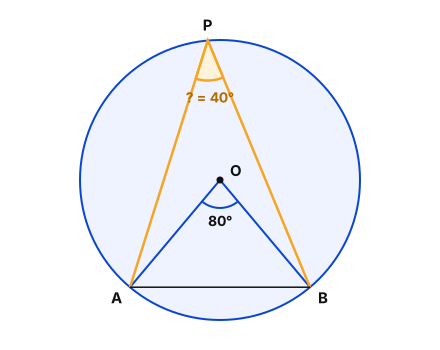
- Central angle = 80°
- Angle on the circle = 80° ÷ 2 = 40°
Yaad rakhein: Angles in the same segment are equal; angle in a semicircle = 90°.
Answer: (B) 40°
अवधारणा: केंद्र पर कोण = परिधि पर कोण का दोगुना (उसी खंड में)।
- केंद्र पर कोण = 80°
- परिधि पर कोण = 80° ÷ 2 = 40°
याद रखें: एक ही खंड के कोण बराबर होते हैं; अर्धवृत्त में कोण = 90°।
उत्तर: (B) 40°
SSC CGLQuantitative AptitudeCircle – angle at centre vs circumferenceSSC CGL 2025 · 21 Sep Shift 2
Q499.If secA + tanA = , then what is secA − tanA?
यदि secA + tanA = है, तो secA − tanA क्या होगा?
- A
- B
- C
- D
Show answer
Concept: .
Trick: sec − tan is always the reciprocal of sec + tan.
Answer: (A)
अवधारणा: ।
ट्रिक: sec − tan हमेशा sec + tan का व्युत्क्रम होता है।
उत्तर: (A)
SSC CGLQuantitative AptitudeTrigonometry – sec + tan identitySSC CGL 2025 · 21 Sep Shift 2
Q500.You earn ₹84 in 4.2 hours. Find your hourly wage as a fraction.
आप 4.2 घंटे में ₹84 कमाते हैं। अपनी प्रति घंटा मज़दूरी भिन्न के रूप में ज्ञात कीजिए।
- A
- B
- C
- D
Show answer
Concept: Wage per hour = total earning ÷ hours.
- As a fraction: (₹20 per hour)
Trick: Shift decimals: .
Answer: (A)
अवधारणा: प्रति घंटा मज़दूरी = कुल कमाई ÷ घंटे।
- 4.2 घंटे = घंटे
- भिन्न रूप: (₹20 प्रति घंटा)
ट्रिक: दशमलव हटाएँ: ।
उत्तर: (A)
SSC CGLQuantitative AptitudeUnitary method – hourly wageSSC CGL 2025 · 21 Sep Shift 2

