Q521.If cosA = and A is an acute angle, find tan(90° − A).
यदि cosA = है और A न्यून कोण है, तो tan(90° − A) ज्ञात कीजिए।
- A
- B
- C
- D
Show answer
Concept: .
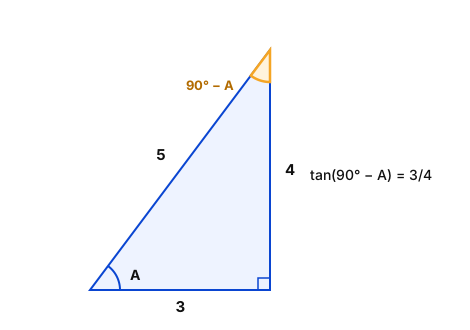
- → 3-4-5 triangle → .
- .
Trick: Triplet 3-4-5: base 3, perpendicular 4 → = .
Answer: (A)
अवधारणा: ।
- → 3-4-5 त्रिभुज → ।
- ।
ट्रिक: त्रिक 3-4-5: आधार 3, लंब 4 → = ।
उत्तर: (A)
SSC CGLQuantitative AptitudeComplementary angle – tan(90° − A)SSC CGL 2025 · 21 Sep Shift 1
Q522.If the measure of an exterior angle of a regular polygon is 30°, determine the total number of its sides.
यदि किसी सम बहुभुज का बाह्य कोण 30° है, तो उसकी भुजाओं की कुल संख्या ज्ञात कीजिए।
- A10
- B12
- C8
- D6
Show answer
Concept: Sum of exterior angles of any polygon = 360°.
- Number of sides = 360° ÷ exterior angle.
- = .
Trick: Interior angle here = – a regular dodecagon.
Answer: (B) 12
अवधारणा: किसी भी बहुभुज के बाह्य कोणों का योग = 360°।
- भुजाओं की संख्या = 360° ÷ बाह्य कोण।
- = ।
ट्रिक: यहाँ अंतः कोण = – सम द्वादशभुज।
उत्तर: (B) 12
SSC CGLQuantitative AptitudeExterior angle of a regular polygonSSC CGL 2025 · 21 Sep Shift 1
Q523.In a triangle with vertices A(x, y), B(6, 2) and C(3, 7), the centroid is at G(4, 4). Find the coordinates of vertex A.
A(x, y), B(6, 2) और C(3, 7) शीर्षों वाले त्रिभुज का केंद्रक G(4, 4) है। शीर्ष A के निर्देशांक ज्ञात कीजिए।
- A(3, 3)
- B(4, 2)
- C(3, 4)
- D(2, 3)
Show answer
Concept: Centroid = average of the three vertices.
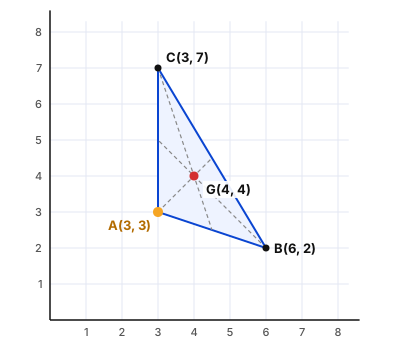
- x: → .
- y: → .
- .
Trick: Missing vertex = .
Answer: (A) (3, 3)
अवधारणा: केन्द्रक = तीनों शीर्षों का औसत।
- x: → ।
- y: → ।
- ।
ट्रिक: लुप्त शीर्ष = ।
उत्तर: (A) (3, 3)
SSC CGLQuantitative AptitudeCentroid – finding a vertexSSC CGL 2025 · 21 Sep Shift 1
Q524.If x = 3 + , find the value of x² − 6x + 7.
यदि x = 3 + है, तो x² − 6x + 7 का मान ज्ञात कीजिए।
- A3 + 2
- B4 +
- C0
- D2
Show answer
Concept: Rewrite the expression around .
- .
- → .
- Value = .
Trick: Complete the square first – no need to expand .
Answer: (C) 0
अवधारणा: व्यंजक को के रूप में लिखो।
- ।
- → ।
- मान = ।
ट्रिक: पहले पूर्ण वर्ग बनाओ – खोलने की ज़रूरत नहीं।
उत्तर: (C) 0
SSC CGLQuantitative AptitudeAlgebra – surd substitutionSSC CGL 2025 · 21 Sep Shift 1
Q525.In △PQR a median PS is drawn to the side QR. What is the ratio of the area of △PQS to the area of △PRS?
△PQR में भुजा QR पर माध्यिका PS खींची गई है। △PQS और △PRS के क्षेत्रफलों का अनुपात क्या है?
- A1 : 1
- B3 : 2
- C2 : 1
- D1 : 2
Show answer
Concept: A median splits a triangle into two triangles of equal area.
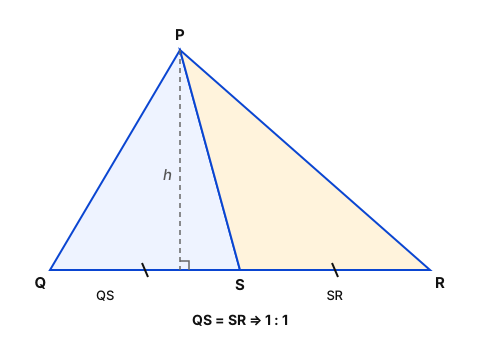
- S is the midpoint of QR → QS = SR.
- △PQS and △PRS have the same height from P.
- Equal base × equal height → equal areas → 1 : 1.
Yaad rakhein: The three medians together divide a triangle into 6 triangles of equal area.
Answer: (A) 1 : 1
अवधारणा: माध्यिका त्रिभुज को बराबर क्षेत्रफल वाले दो त्रिभुजों में बाँटती है।
- S, QR का मध्यबिंदु → QS = SR।
- △PQS और △PRS की P से ऊँचाई समान।
- बराबर आधार × बराबर ऊँचाई → क्षेत्रफल बराबर → 1 : 1।
याद रखें: तीनों माध्यिकाएँ त्रिभुज को बराबर क्षेत्रफल के 6 त्रिभुजों में बाँटती हैं।
उत्तर: (A) 1 : 1
SSC CGLQuantitative AptitudeMedian divides triangle areaSSC CGL 2025 · 21 Sep Shift 1
Q526.Find the value of x in the given equation:
= 5
दिए गए समीकरण में x का मान ज्ञात कीजिए:
= 5
- A
- B
- C
- D
Show answer
Concept: If , then .
- Here , , .
- Square:
Trick: Componendo-dividendo turns the whole fraction into a simple ratio in one step – then just square.
Answer: (C)
अवधारणा: यदि , तो ।
- , ,
- वर्ग करें:
ट्रिक: योगांतरानुपात से पूरा भिन्न एक ही चरण में सरल अनुपात बन जाता है – फिर बस वर्ग करें।
उत्तर: (C)
SSC CGLQuantitative AptitudeSurd equation – componendo-dividendoSSC CGL 2025 · 20 Sep Shift 3
Q527.How much will the compound interest on ₹24,000 at 20% per annum for 9 months be, if it is compounded quarterly?
₹24,000 पर 20% वार्षिक दर से 9 माह का चक्रवृद्धि ब्याज कितना होगा, यदि ब्याज तिमाही चक्रवृद्धि हो?
- A₹3,222
- B₹3,422
- C₹1,622
- D₹3,783
Show answer
Concept: Quarterly: rate ÷ 4, number of periods = quarters.
- Rate per quarter = ; 9 months = 3 quarters.
- ⇒ growth factor over 9 months
- CI = ₹3,783
Trick: Effective rate for 3 periods at 5% = 15.7625% . 15.7625% of 24,000 = ₹3,783.
Answer: (D) ₹3,783
अवधारणा: त्रैमासिक: दर ÷ 4, अवधि = तिमाहियों की संख्या।
- प्रति तिमाही दर = 5%; 9 महीने = 3 तिमाही।
- मिश्रधन = ₹27,783
- CI = ₹3,783
ट्रिक: 5% पर 3 वर्ष की प्रभावी दर = 15.7625%; 24,000 का 15.7625% = ₹3,783।
उत्तर: (D) ₹3,783
SSC CGLQuantitative AptitudeCompound interest – quarterlySSC CGL 2025 · 20 Sep Shift 3
Q528.15 women can do a work in 14 days. 30 men can complete the same work in 10 days. What is the ratio between the efficiency of a man and a woman?
15 महिलाएँ एक कार्य 14 दिनों में करती हैं। 30 पुरुष वही कार्य 10 दिनों में पूरा करते हैं। एक पुरुष और एक महिला की कार्यक्षमता का अनुपात क्या है?
- A7 : 10
- B8 : 4
- C7 : 9
- D10 : 9
Show answer
Concept: Same work ⇒ (persons × days) × efficiency is equal.
- 15 women × 14 days = 210 woman-days.
- 30 men × 10 days = 300 man-days.
Trick: Efficiency is inversely proportional to the person-days needed: M : W = 210 : 300 = 7 : 10.
Answer: (A) 7 : 10
अवधारणा: एक ही काम ⇒ (व्यक्ति × दिन) × दक्षता बराबर।
- 15 महिला × 14 दिन = 210 महिला-दिन
- 30 पुरुष × 10 दिन = 300 पुरुष-दिन
ट्रिक: दक्षता ज़रूरी व्यक्ति-दिनों के व्युत्क्रमानुपाती है: 210 : 300 = 7 : 10।
उत्तर: (A) 7 : 10
SSC CGLQuantitative AptitudeWork – man vs woman efficiencySSC CGL 2025 · 20 Sep Shift 3
Q529.Which of the following numbers is an integer but NOT a natural number?
निम्न में से कौन-सी संख्या पूर्णांक है परंतु प्राकृत संख्या नहीं है?
- A2
- B0
- C7
- D9
Show answer
Concept: Natural numbers: 1, 2, 3, …; integers: …, −2, −1, 0, 1, 2, ….
- 2, 7, 9 are natural numbers (and integers).
- 0 is an integer but natural numbers start from 1.
- So 0 is the required number.
Yaad rakhein: Whole numbers = 0 + natural numbers. So 0 is whole and integer, but not natural.
Answer: (B) 0
अवधारणा: प्राकृत संख्याएँ: 1, 2, 3, …; पूर्णांक: …, −1, 0, 1, …।
- 2, 7, 9 प्राकृत संख्याएँ हैं।
- 0 पूर्णांक है, पर प्राकृत संख्याएँ 1 से शुरू होती हैं।
- अतः उत्तर 0।
याद रखें: पूर्ण संख्याएँ = 0 + प्राकृत संख्याएँ। 0 पूर्ण व पूर्णांक है, प्राकृत नहीं।
उत्तर: (B) 0
SSC CGLQuantitative AptitudeNumber system – integers vs naturalsSSC CGL 2025 · 20 Sep Shift 3
Q530.Naveen covers half of his journey at 18 km/h and the remaining half at 9 km/h. His average speed is:
नवीन अपनी यात्रा का आधा भाग 18 km/h और शेष आधा 9 km/h की चाल से तय करता है। उसकी औसत चाल क्या है?
- A12 km/h
- B11 km/h
- C14 km/h
- D13 km/h
Show answer
Concept: Equal distances at speeds a and b ⇒ average = .
- ,
- Average =
- = 12 km/h
Trick: Take the half-distance as 18 km: times 1 h + 2 h = 3 h for 36 km ⇒ 12 km/h.
Answer: (A) 12 km/h
अवधारणा: समान दूरियाँ a और b चाल से ⇒ औसत = ।
- ,
- औसत =
- = 12 km/h
ट्रिक: आधी दूरी 18 km मानें: समय 1 + 2 = 3 घंटे, कुल 36 km ⇒ 12 km/h।
उत्तर: (A) 12 km/h
SSC CGLQuantitative AptitudeAverage speed – equal distancesSSC CGL 2025 · 20 Sep Shift 3
Q531.A hemisphere is inscribed in a cube of side 12 cm. What is the volume of the hemisphere?
12 cm भुजा वाले घन में एक अर्धगोला अंतर्निहित है। अर्धगोले का आयतन क्या है?
- A356.55 cm³
- B354.24 cm³
- C350.26 cm³
- D452.16 cm³
Show answer
Concept: Largest hemisphere in a cube: flat face on a cube face, diameter = side.
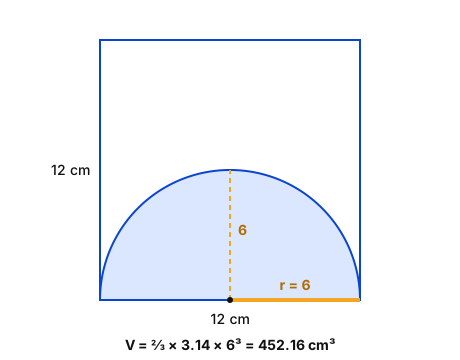
- Diameter = 12 cm ⇒ r = 6 cm
- Volume =
- = cm³
Trick: , so just multiply – the decimal .16 matches only option (d).
Answer: (D) 452.16 cm³
अवधारणा: घन में बड़ा अर्धगोला: समतल सतह घन की एक सतह पर, व्यास = भुजा।
- व्यास = 12 cm ⇒ r = 6 cm
- आयतन =
- = cm³
ट्रिक: ; का दशमलव .16 केवल (d) में है।
उत्तर: (D) 452.16 cm³
SSC CGLQuantitative AptitudeMensuration – hemisphere in a cubeSSC CGL 2025 · 20 Sep Shift 3
Q532.A bus travels 11.9 km using 1.4 litres of fuel. How many kilometres does it travel per litre?
एक बस 1.4 लीटर ईंधन में 11.9 km चलती है। वह प्रति लीटर कितने किलोमीटर चलती है?
- A8.25 km
- B8.5 km
- C8.75 km
- D8.0 km
Show answer
Concept: Distance per litre = total distance ÷ fuel used.
- Mileage =
- =
- = 8.5 km per litre
Trick: Check backwards: ✓.
Answer: (B) 8.5 km
अवधारणा: प्रति लीटर दूरी = कुल दूरी ÷ ईंधन।
- माइलेज =
- =
- = 8.5 km प्रति लीटर
ट्रिक: उल्टा जाँचें: ✓।
उत्तर: (B) 8.5 km
SSC CGLQuantitative AptitudeUnitary method – mileageSSC CGL 2025 · 20 Sep Shift 3
Q533.A venture has three stakeholders. P brought 60% of the capital and Q brought the rest. R joined later and was promised 30% of the total profit for branding. If the total profit was ₹3,50,000, how much was Q's share?
एक उद्यम में तीन साझेदार हैं। P ने 60% पूँजी लगाई और शेष Q ने। R बाद में जुड़ा और उसे ब्रांडिंग हेतु कुल लाभ का 30% देना तय हुआ। यदि कुल लाभ ₹3,50,000 है, तो Q का हिस्सा कितना होगा?
- A₹84,000
- B₹90,000
- C₹98,000
- D₹1,05,000
Show answer
Concept: Give R's fixed share first; split the rest in the capital ratio.
- R = 30% of 3,50,000 = ₹1,05,000
- Remaining = ₹2,45,000; P : Q =
- Q = ₹98,000
Trick: Q's share = of total ⇒ ₹98,000.
Answer: (C) ₹98,000
अवधारणा: पहले R का निश्चित हिस्सा दें, बचा लाभ पूँजी अनुपात में बाँटें।
- R = 3,50,000 का 30% = ₹1,05,000
- शेष = ₹2,45,000; P : Q = 3 : 2
- Q = ₹98,000
ट्रिक: Q का हिस्सा = = कुल का 28% ⇒ ₹98,000।
उत्तर: (C) ₹98,000
SSC CGLQuantitative AptitudePartnership – fixed share to a third partnerSSC CGL 2025 · 20 Sep Shift 3
Q534.A vessel contains milk and water in the ratio 6 : 5. If 10 litres of milk are removed and 9 litres of water are added, the new ratio becomes 2 : 3. What was the original quantity of the mixture in the vessel?
एक बर्तन में दूध और पानी 6 : 5 के अनुपात में हैं। यदि 10 लीटर दूध निकालकर 9 लीटर पानी मिलाया जाए, तो नया अनुपात 2 : 3 हो जाता है। बर्तन में मिश्रण की मूल मात्रा कितनी थी?
- A67 L
- B66 L
- C68 L
- D78 L
Show answer
Concept: Write milk and water as multiples of x and form the new ratio.
- Milk = 6x, water = 5x
- Total = L
Trick: Total must be a multiple of 11 (6 + 5) – only 66 among the options.
Answer: (B) 66 L
अवधारणा: दूध और पानी को x के गुणज मानकर नया अनुपात बनाएँ।
- दूध = 6x, पानी = 5x
- कुल = L
ट्रिक: कुल मात्रा 11 (6 + 5) का गुणज होगी – विकल्पों में केवल 66।
उत्तर: (B) 66 L
SSC CGLQuantitative AptitudeMixture – remove milk, add waterSSC CGL 2025 · 20 Sep Shift 3
Q535.A triangular window has an area equal to 35% of a square window of area 300 m². If its base is 20 m, find its height.
एक त्रिभुजाकार खिड़की का क्षेत्रफल 300 m² वाली वर्गाकार खिड़की के क्षेत्रफल का 35% है। यदि उसका आधार 20 m है, तो ऊँचाई ज्ञात कीजिए।
- A12.5 m
- B18.6 m
- C10.5 m
- D24.5 m
Show answer
Concept: Area of triangle = base height.
- Triangle area = 35% of 300 = 105 m²
- m
Trick: Area base .
Answer: (C) 10.5 m
अवधारणा: त्रिभुज का क्षेत्रफल = आधार ऊँचाई।
- क्षेत्रफल = 300 का 35% = 105 m²
- m
ट्रिक: h = 2 × क्षेत्रफल ÷ आधार = ।
उत्तर: (C) 10.5 m
SSC CGLQuantitative AptitudeArea – triangle from percentageSSC CGL 2025 · 20 Sep Shift 3
Q536.P and Q can complete a task in 18 days together. P is 20% more efficient than Q. What percentage of the work is done by P alone?
P और Q मिलकर एक कार्य 18 दिनों में पूरा करते हैं। P, Q से 20% अधिक कुशल है। कुल कार्य का कितना प्रतिशत P अकेले करता है?
- A54.54%
- B60.6%
- C62.5%
- D66.66%
Show answer
Concept: When working together, work done is in the ratio of efficiencies.
- P is 20% more efficient ⇒ P : Q =
- P's share = of the work
Trick: The 18 days is extra data – the share depends only on the efficiency ratio.
Answer: (A) 54.54%
अवधारणा: साथ काम करने पर किया गया काम दक्षता के अनुपात में होता है।
- P, Q से 20% अधिक दक्ष ⇒ P : Q = 6 : 5
- P का हिस्सा =
ट्रिक: 18 दिन अतिरिक्त जानकारी है – हिस्सा केवल दक्षता अनुपात पर निर्भर है।
उत्तर: (A) 54.54%
SSC CGLQuantitative AptitudeWork – share by efficiencySSC CGL 2025 · 20 Sep Shift 3
Q537.A businessman invests ₹40,000 in buying a bike and spends ₹8,000 on transportation and ₹7,000 on storage. If he sells the bike for ₹60,000, what is the profit or loss percentage?
एक व्यापारी ₹40,000 में बाइक खरीदता है और ₹8,000 परिवहन तथा ₹7,000 भंडारण पर खर्च करता है। यदि वह बाइक ₹60,000 में बेचता है, तो लाभ/हानि प्रतिशत क्या है?
- A9.09% profit9.09% लाभ
- B8.42% loss8.42% हानि
- C8.26% loss8.26% हानि
- D5.26% profit5.26% लाभ
Show answer
Concept: Cost price includes all expenses (transport, storage).
- CP = ₹55,000
- Profit = ₹5,000
- Profit% =
Trick: – memorise fraction-percent pairs (, ).
Answer: (A) 9.09% profit
अवधारणा: क्रय मूल्य में सभी खर्च (परिवहन, भंडारण) जुड़ते हैं।
- CP = ₹55,000
- लाभ = ₹5,000
- लाभ% =
ट्रिक: – भिन्न-प्रतिशत जोड़े याद रखें (, )।
उत्तर: (A) 9.09% लाभ
SSC CGLQuantitative AptitudeProfit % with overheadsSSC CGL 2025 · 20 Sep Shift 3
Q538.Rahul can do a piece of work in 12 days and Pawan can do it in 15 days. If they work together for 2 days, how much of the work will be left?
राहुल एक कार्य 12 दिनों में और पवन 15 दिनों में कर सकता है। यदि वे 2 दिन साथ काम करें, तो कितना कार्य शेष रहेगा?
- A
- B
- C
- D
Show answer
Concept: Use LCM as total work, then units per day.
- Total = units; Rahul 5, Pawan 4 units/day
- 2 days together = units
- Left =
Trick: Fraction done = left .
Answer: (A)
अवधारणा: LCM को कुल काम मानकर प्रतिदिन इकाइयाँ निकालें।
- कुल = 60 इकाई; राहुल 5, पवन 4 इकाई/दिन
- 2 दिन में = 18 इकाई
- शेष =
ट्रिक: काम हुआ ⇒ शेष ।
उत्तर: (A)
SSC CGLQuantitative AptitudeWork – remaining after joint workSSC CGL 2025 · 20 Sep Shift 3
Q539.A train covered a certain distance in 3 parts with average speeds of 12 km/h, 15 km/h and 30 km/h. What is the average speed over the entire journey, assuming equal distances?
एक रेलगाड़ी ने एक दूरी तीन भागों में क्रमशः 12 km/h, 15 km/h और 30 km/h की औसत चाल से तय की। समान दूरियाँ मानते हुए पूरी यात्रा की औसत चाल क्या है?
- A12.05 km/h
- B16.36 km/h
- C19.09 km/h
- D16.25 km/h
Show answer
Concept: Average speed = total distance ÷ total time.
- Take each part = km; total 180 km
- Times: 5 h + 4 h + 2 h = 11 h
- Average = km/h
Trick: For 3 equal distances: .
Answer: (B) 16.36 km/h
अवधारणा: औसत चाल = कुल दूरी ÷ कुल समय।
- हर भाग = 60 km; कुल 180 km
- समय: घंटे
- औसत = km/h
ट्रिक: तीन समान दूरियों के लिए: ।
उत्तर: (B) 16.36 km/h
SSC CGLQuantitative AptitudeAverage speed – three equal partsSSC CGL 2025 · 20 Sep Shift 3
Q540.A display stand is shaped like a right triangular prism. The triangular base is a right-angled triangle with perpendicular sides measuring 8 cm and 15 cm. The height of the prism is 5 cm. What is the ratio of the area of the largest rectangular face to the area of the smallest rectangular face?
एक प्रदर्शन स्टैंड लंब त्रिभुजाकार प्रिज़्म के आकार का है। उसका आधार एक समकोण त्रिभुज है जिसकी लंब भुजाएँ 8 cm और 15 cm हैं। प्रिज़्म की ऊँचाई 5 cm है। सबसे बड़े और सबसे छोटे आयताकार फलक के क्षेत्रफलों का अनुपात क्या है?
- A13 : 8
- B17 : 8
- C15 : 13
- D5 : 14
Show answer
Concept: Each rectangular face = (side of base triangle) × prism height.
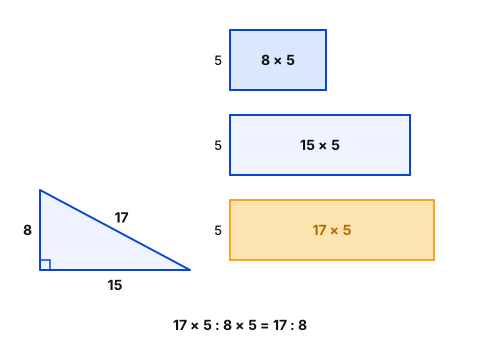
- Hypotenuse = cm
- Faces: , ,
- Largest : smallest =
Trick: Height is common, so the ratio = longest side : shortest side = 17 : 8 directly.
Answer: (B) 17 : 8
अवधारणा: हर आयताकार फलक = आधार त्रिभुज की भुजा × प्रिज़्म की ऊँचाई।
- कर्ण = cm
- फलक: , ,
- सबसे बड़ा : सबसे छोटा = 17 : 8
ट्रिक: ऊँचाई समान है, इसलिए अनुपात = सबसे लंबी भुजा : सबसे छोटी भुजा = 17 : 8।
उत्तर: (B) 17 : 8
SSC CGLQuantitative AptitudePrism – lateral face ratioSSC CGL 2025 · 20 Sep Shift 3

