Q41.If two complementary angles are in the ratio 2 : 7, find the angles.
यदि दो पूरक कोण 2 : 7 के अनुपात में हैं, तो कोण ज्ञात कीजिए।
- A10°, 80°
- B20°, 70°
- C40°, 50°
- D35°, 55°
Show answer
Concept: Complementary angles sum to 90°.
- 2k + 7k = 90° → k = 10°
- Angles = 20° and 70°
Trick: Only pairs adding to 90° in ratio 2 : 7 – 20 : 70 = 2 : 7 ✓.
Answer: (B) 20°, 70°
अवधारणा: पूरक कोणों का योग 90° होता है।
- 2k + 7k = 90° → k = 10°
- कोण = 20° और 70°
ट्रिक: 20 : 70 = 2 : 7 ✓ – विकल्प से सीधे।
उत्तर: (B) 20°, 70°
SSC CGLQuantitative AptitudeComplementary angles in a ratioSSC CGL 2025 · 14 Oct Shift 2
Q42.From the top of a 60 m tower, the angles of depression of two objects on the same side of the tower are 30° and 45°. Find the distance between the objects.
60 मीटर ऊँची मीनार के शीर्ष से उसी ओर स्थित दो वस्तुओं के अवनमन कोण 30° और 45° हैं। वस्तुओं के बीच की दूरी ज्ञात कीजिए।
- A21.13 m
- B28.7 m
- C43.92 m
- D58.87 m
Show answer
Concept: Distance = ; same side → subtract.
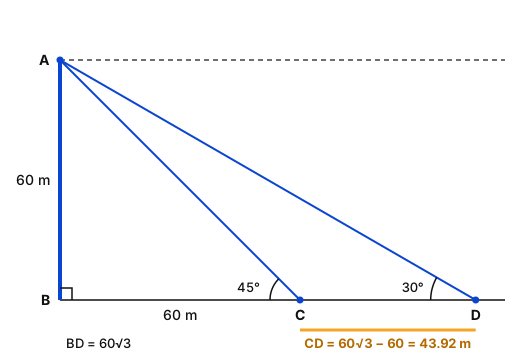
- 45°: 60 m from tower.
- 30°: m from tower.
- Gap = m
Trick: : multiply height by 0.732 directly.
Answer: (C) 43.92 m
अवधारणा: दूरी = ; एक ही ओर → घटाएँ।
- 45°: टावर से 60 मी.
- 30°: मी.
- अंतर = मी.
ट्रिक: : ऊँचाई सीधा।
उत्तर: (C) 43.92 m
SSC CGLQuantitative AptitudeHeights – two objects same sideSSC CGL 2025 · 14 Oct Shift 2
Q43.If tanθ = , what is secθ?
यदि tanθ = है, तो secθ क्या होगा?
- A
- B
- C
- D
Show answer
Concept: ; .
- ,
Trick: → .
Answer: (D)
अवधारणा: = लंब/आधार; = कर्ण/आधार।
- लंब = 5, आधार = 12
- कर्ण = 13
ट्रिक: → ।
उत्तर: (D)
SSC CGLQuantitative AptitudeTrigonometry – sec from tanSSC CGL 2025 · 14 Oct Shift 2
Q44.Find the y-intercept of 4x + 5y = 20.
4x + 5y = 20 का y-अंतःखंड ज्ञात कीजिए।
- A3
- B4
- C5
- D−2
Show answer
Concept: Put to get the y-intercept.
Trick: Intercept form → y-intercept 4 (x-intercept 5).
Answer: (B) 4
अवधारणा: y-अंतःखंड के लिए रखें।
ट्रिक: रूप से सीधे y-अंतःखंड 4।
उत्तर: (B) 4
SSC CGLQuantitative AptitudeCoordinate geometry – y-interceptSSC CGL 2025 · 14 Oct Shift 2
Q45.Two lines intersect, forming four angles. One of the angles measures (4x − 5)° and its adjacent angle measures (6x + 25)°. What is the measure of the angle vertically opposite to the (4x − 5)° angle?
दो रेखाएँ काटती हैं और चार कोण बनते हैं। एक कोण (4x − 5)° का है और उसका आसन्न कोण (6x + 25)° का। (4x − 5)° वाले कोण के शीर्षाभिमुख कोण का माप क्या होगा?
- A59°
- B55°
- C45°
- D60°
Show answer
Concept: Adjacent angles on a line = 180°; vertically opposite angles are equal.
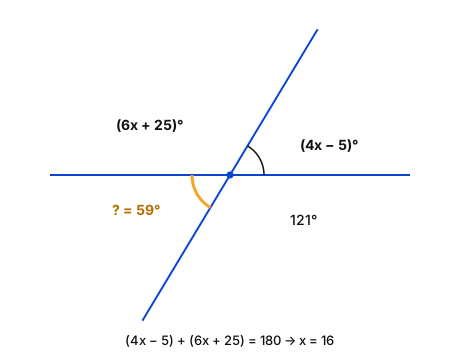
- Opposite angle = 59°
Yaad rakhein: The adjacent angle is , and ✓.
Answer: (A) 59°
अवधारणा: रेखा पर आसन्न कोण = 180°; शीर्षाभिमुख कोण बराबर।
- शीर्षाभिमुख कोण = 59°
याद रखें: आसन्न कोण 121° है, ✓।
उत्तर: (A) 59°
SSC CGLQuantitative AptitudeLines – linear pair and vertical anglesSSC CGL 2025 · 14 Oct Shift 2
Q46.Which of the following statements is always true for a right-angled triangle?
समकोण त्रिभुज के लिए निम्न में से कौन-सा कथन सदैव सत्य है?
- AThe centroid is outside the triangleकेंद्रक त्रिभुज के बाहर होता है
- BThe circumcentre is at the midpoint of the hypotenuseपरिकेंद्र कर्ण के मध्यबिंदु पर होता है
- CThe orthocentre, centroid, incentre and circumcentre all coincideलंबकेंद्र, केंद्रक, अंतःकेंद्र और परिकेंद्र सभी संपाती होते हैं
- DThe incentre is one of the vertices of the triangleअंतःकेंद्र त्रिभुज का कोई एक शीर्ष होता है
Show answer
Concept: Angle in a semicircle is 90°, so the hypotenuse is the circumcircle's diameter.
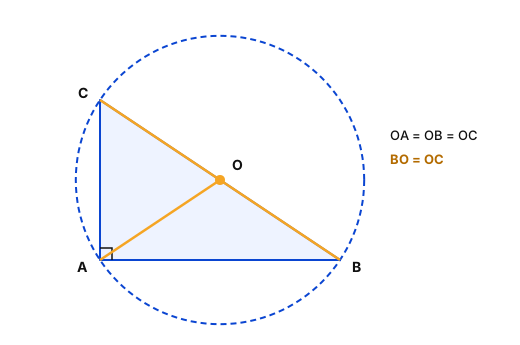
- Circumcentre = midpoint of hypotenuse ✓
- Centroid and incentre are always inside any triangle.
- All centres coincide only in an equilateral triangle.
Yaad rakhein: In a right triangle the orthocentre lies at the right-angle vertex.
Answer: (B) The circumcentre is at the midpoint of the hypotenuse
अवधारणा: अर्धवृत्त में कोण 90° होता है, अतः कर्ण परिवृत्त का व्यास है।
- परिकेंद्र = कर्ण का मध्यबिंदु ✓
- केन्द्रक और अंतःकेंद्र हमेशा त्रिभुज के अंदर।
- सभी केंद्र केवल समबाहु त्रिभुज में मिलते हैं।
याद रखें: समकोण त्रिभुज में लंबकेंद्र समकोण वाले शीर्ष पर होता है।
उत्तर: (B) परिकेंद्र कर्ण के मध्यबिंदु पर होता है
SSC CGLQuantitative AptitudeRight triangle – circumcentreSSC CGL 2025 · 14 Oct Shift 2
Q47.In △KLM, NO ‖ LM and intersects KL and KM at N and O. If KN = 2, NL = 4 and KO = 3, find OM.
त्रिभुज KLM में NO ‖ LM है और KL तथा KM को N और O पर काटता है। यदि KN = 2, NL = 4 और KO = 3 है, तो OM ज्ञात कीजिए।
- A6
- B4.5
- C3
- D9
Show answer
Concept: A line parallel to one side divides the other two sides in the same ratio.
- OM = 6
Trick: KN : NL = 1 : 2, so .
Answer: (A) 6
अवधारणा: एक भुजा के समांतर रेखा बाकी दो भुजाओं को समान अनुपात में बाँटती है।
- OM = 6
ट्रिक: KN : NL = 1 : 2, अतः ।
उत्तर: (A) 6
SSC CGLQuantitative AptitudeBasic Proportionality TheoremSSC CGL 2025 · 14 Oct Shift 2
Q48.The length of a direct common tangent to two circles is 24 cm. Their centres are 25 cm apart. If the larger circle has a radius of 10 cm, what is the radius of the smaller circle?
दो वृत्तों की सीधी उभयनिष्ठ स्पर्श रेखा की लंबाई 24 cm है। उनके केंद्रों के बीच की दूरी 25 cm है। यदि बड़े वृत्त की त्रिज्या 10 cm है, तो छोटे वृत्त की त्रिज्या क्या है?
- A2 cm
- B3 cm
- C4 cm
- D5 cm
Show answer
Concept: Direct tangent.
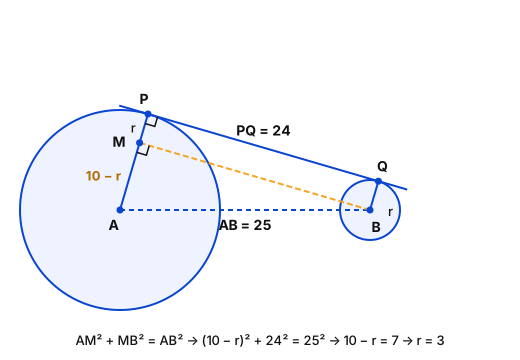
- cm
Trick: 7-24-25 triplet: difference of radii = 7 → .
Answer: (B) 3 cm
अवधारणा: सीधी स्पर्श रेखा।
- सेमी
ट्रिक: 7-24-25 त्रिक: त्रिज्याओं का अंतर 7 → ।
उत्तर: (B) 3 cm
SSC CGLQuantitative AptitudeCircles – direct common tangentSSC CGL 2025 · 14 Oct Shift 2
Q49.If cos(2x + 15°) = sin(x − 5°), what is the value of x?
यदि cos(2x + 15°) = sin(x − 5°) है, तो x का मान क्या है?
- A45.57°
- B60°
- C30°
- D26.67°
Show answer
Concept: If (acute angles), then .
- Angles must add to 90°:
- So
Trick: is not whole → only the decimal option 26.67° can fit.
Answer: (D) 26.67°
अवधारणा: (न्यून कोण) हो तो ।
ट्रिक: पूर्णांक नहीं → दशमलव वाला विकल्प 26.67° ही।
उत्तर: (D) 26.67°
SSC CGLQuantitative AptitudeTrigonometry – sin A = cos BSSC CGL 2025 · 14 Oct Shift 2
Q50.A contractor hires 12 workers who can complete a task in 20 days. After 5 days he lets 3 workers go. How many more days will the remaining workers take to complete the task?
एक ठेकेदार 12 श्रमिक लगाता है जो कार्य 20 दिन में पूरा करते हैं। 5 दिन बाद वह 3 श्रमिक हटा देता है। शेष श्रमिक कार्य पूरा करने में कितने दिन और लेंगे?
- A20 days20 दिन
- B14 days14 दिन
- C15 days15 दिन
- D16 days16 दिन
Show answer
Concept: Total work = workers × days (man-days).
- Work = man-days
- Done in 5 days = 60 → left 180
- 9 workers: days
Trick: Remaining 15 days 12 workers 9 workers .
Answer: (A) 20 days
अवधारणा: कुल कार्य = श्रमिक × दिन (मानव-दिवस)।
- कार्य =
- 5 दिन में 60 → शेष 180
- 9 श्रमिक: दिन
ट्रिक: शेष 15 दिन ।
उत्तर: (A) 20 दिन
SSC CGLQuantitative AptitudeWork – workers leaving midwaySSC CGL 2025 · 14 Oct Shift 2
Q51.If 50% of A = of B = of C, find A : B : C.
यदि A का 50% = B का = C का है, तो A : B : C ज्ञात कीजिए।
- A1 : 2 : 3
- B11 : 12 : 13
- C6 : 4 : 5
- D7 : 4 : 8
Show answer
Concept: If a fraction of each quantity is equal, each quantity = common value ÷ its fraction.
- Let (50% means half).
- So A is 2k, B is 4k and C is 6k.
- Dividing by 2k: ratio of A, B, C is 1 : 2 : 3.
Trick: ⇒ ratio is simply the denominators: 2 : 4 : 6.
Answer: (A) 1 : 2 : 3
अवधारणा: यदि हर राशि का कोई भाग बराबर हो, तो राशि = साझा मान ÷ उसका भिन्न।
हल:
- A का = B का = C का ।
- , , ।
- A : B : C = 2 : 4 : 6 = 1 : 2 : 3।
ट्रिक: अनुपात सीधे हरों का होगा: 2 : 4 : 6 = 1 : 2 : 3।
उत्तर: (A) 1 : 2 : 3
SSC CGLQuantitative AptitudeRatio from equal fractional partsSSC CGL 2025 · 14 Oct Shift 1
Q52.Evaluate:
9 − [ ÷ { − ( × ( − ))}]
मान ज्ञात कीजिए:
9 − [ ÷ { − ( × ( − ))}]
- A−
- B3
- C−2
- D7
Show answer
Concept: Here the expression is ; open brackets from the inside.
- ; then .
- .
- .
- .
Trick: is just under 10, so the answer is a small negative number below 1 – only fits.
Answer: (A) −
अवधारणा: व्यंजक है; कोष्ठक अंदर से खोलें।
हल:
- ; ।
- ।
- ।
- ।
ट्रिक: दस से थोड़ा कम है, अतः उत्तर 1 से छोटा ऋणात्मक – केवल ।
उत्तर: (A) −
SSC CGLQuantitative AptitudeSimplification – brackets with fractionsSSC CGL 2025 · 14 Oct Shift 1
Q53.Evaluate the continued fraction:
x = 5 +
सतत भिन्न का मान ज्ञात कीजिए:
x = 5 +
- A
- B
- C
- D
Show answer
Concept: ; always simplify from the bottom up.
- .
- .
- .
Trick: Each step just flips the fraction below; the last denominator (67) comes from .
Answer: (A)
अवधारणा: ; हमेशा नीचे से ऊपर हल करें।
हल:
- ⇒ उल्टा ।
- ⇒ उल्टा ।
- ।
ट्रिक: हर चरण में नीचे वाला भिन्न उलटता है; अंतिम हर 67 = ।
उत्तर: (A)
SSC CGLQuantitative AptitudeContinued fractionSSC CGL 2025 · 14 Oct Shift 1
Q54.A contractor employs 15 men to complete a work in 40 days, working 8 hours per day. After ten days he adds five more men but also reduces the working hours to 6 per day from the 11th day onwards. If all men work with the same efficiency throughout, how many more days will be required to finish the remaining work?
एक ठेकेदार 15 आदमियों से एक कार्य 40 दिन में, प्रतिदिन 8 घंटे काम कराकर पूरा कराता है। दस दिन बाद वह पाँच आदमी और लगाता है पर 11वें दिन से काम के घंटे घटाकर 6 प्रतिदिन कर देता है। यदि सभी की कार्यक्षमता समान हो, तो शेष कार्य पूरा करने में कितने दिन और लगेंगे?
- A25
- B30
- C35
- D28
Show answer
Concept: Total work = men × days × hours (man-hours) stays constant.
- Whole work = man-hours.
- Done in 10 days = ; left = 3600.
- New daily rate = ⇒ days = .
Trick: Remaining 30 days' work at old rate (/day) and new rate is also 120/day ⇒ still 30 days.
Answer: (B) 30
अवधारणा: कुल कार्य = व्यक्ति × दिन × घंटे (मानव-घंटे) स्थिर रहता है।
हल:
- पूरा कार्य = मानव-घंटे।
- 10 दिन में = 1200; शेष = 3600।
- नई दर = प्रतिदिन ⇒ दिन।
ट्रिक: पुरानी दर और नई दर – बराबर, अतः शेष 30 दिन ही लगेंगे।
उत्तर: (B) 30
SSC CGLQuantitative AptitudeWork – men, days, hoursSSC CGL 2025 · 14 Oct Shift 1
Q55.Deepak covers half of his journey at 27 km/h and the remaining half at 9 km/h. His average speed is:
दीपक अपनी यात्रा का आधा भाग 27 km/h और शेष आधा 9 km/h की चाल से तय करता है। उसकी औसत चाल क्या है?
- A12.5 km/h
- B11.5 km/h
- C14.5 km/h
- D13.5 km/h
Show answer
Concept: For equal distances at speeds a and b, average speed = .
- .
- km/h.
Trick: Speeds 3 : 1 ⇒ write : average .
Answer: (D) 13.5 km/h
अवधारणा: समान दूरी a और b चाल से तय हो तो औसत चाल = ।
हल:
- ।
- km/h।
ट्रिक: ⇒ औसत ।
उत्तर: (D) 13.5 km/h
SSC CGLQuantitative AptitudeAverage speed – equal distancesSSC CGL 2025 · 14 Oct Shift 1
Q56.The speed of a car is 126 km/h. Find the distance covered by the car in 60 seconds.
एक कार की चाल 126 km/h है। 60 सेकंड में कार द्वारा तय दूरी ज्ञात कीजिए।
- A1900 m
- B2054 m
- C2100 m
- D2300 m
Show answer
Concept: ; distance = speed × time.
- m/s.
- Distance in 60 s = m.
Trick: In 1 minute a car covers speed/60 km: km = 2100 m.
Answer: (C) 2100 m
अवधारणा: ; दूरी = चाल × समय।
हल:
- m/s।
- 60 s में दूरी = m।
ट्रिक: 1 मिनट में दूरी = चाल/60 km = km = 2100 m।
उत्तर: (C) 2100 m
SSC CGLQuantitative AptitudeSpeed conversion – km/h to m/sSSC CGL 2025 · 14 Oct Shift 1
Q57.Partners A and B entered into a business investing ₹50,000 and ₹80,000 respectively. After 5 months C joins with ₹1,20,000. At the year-end the profit was ₹1,00,000. How much more did C earn than A?
साझेदार A और B ने क्रमशः ₹50,000 और ₹80,000 से व्यवसाय शुरू किया। 5 माह बाद C ₹1,20,000 के साथ जुड़ा। वर्ष के अंत में लाभ ₹1,00,000 था। C ने A से कितना अधिक कमाया?
- A₹6,000
- B₹11,000
- C₹10,000
- D₹14,000
Show answer
Concept: Profit share ∝ capital × months.
- A = ; B = ; C = (in ₹ thousand-months).
- Ratio 600 : 960 : 840 = 15 : 24 : 21; total 60 parts.
- 1 part ; parts = ₹10,000.
Trick: Work only with the difference: = of profit = ₹10,000.
Answer: (C) ₹10,000
अवधारणा: लाभ का हिस्सा ∝ पूँजी × महीने।
हल:
- A = ; B = ; C = (हज़ार में)।
- अनुपात = 15 : 24 : 21; कुल 60 भाग।
- भाग = ₹10,000।
ट्रिक: सीधे अंतर निकालें: लाभ = ₹10,000।
उत्तर: (C) ₹10,000
SSC CGLQuantitative AptitudePartnership – unequal timeSSC CGL 2025 · 14 Oct Shift 1
Q58.A triangular field with base 70 m and height 96 m shares a side with a rectangle of length 65 m and breadth 35 m. Find the combined area and the percentage of the triangle's area in the total.
70 m आधार और 96 m ऊँचाई वाला एक त्रिभुजाकार खेत 65 m लंबाई और 35 m चौड़ाई वाले आयत से एक भुजा साझा करता है। कुल क्षेत्रफल और उसमें त्रिभुज के क्षेत्रफल का प्रतिशत ज्ञात कीजिए।
- A4,450 m² and 34.5%4,450 m² और 34.5%
- B3,450 m² and 25%3,450 m² और 25%
- C5,635 m² and 59.62%5,635 m² और 59.62%
- D5,500 m² and 59%5,500 m² और 59%
Show answer
Concept: Triangle = base × height; rectangle = .
- Area of triangle: .
- Area of rectangle: 2275 m² ().
- Together 5635 m²; triangle's share = .
Trick: Total area alone decides it: only one option shows 5,635 m².
Answer: (C) 5,635 m² and 59.62%
अवधारणा: त्रिभुज = आधार × ऊँचाई; आयत = ।
हल:
- त्रिभुज का क्षेत्रफल: ।
- आयत का क्षेत्रफल: 2275 m² ()।
- दोनों मिलाकर 5635 m²; त्रिभुज का हिस्सा = ।
ट्रिक: केवल कुल क्षेत्रफल 5,635 m² से ही विकल्प तय हो जाता है।
उत्तर: (C) 5,635 m² और 59.62%
SSC CGLQuantitative AptitudeMensuration – combined areaSSC CGL 2025 · 14 Oct Shift 1
Q59.The area of an equilateral triangle increases by 44%. By what percentage did the side length increase?
एक समबाहु त्रिभुज का क्षेत्रफल 44% बढ़ जाता है। भुजा की लंबाई कितने प्रतिशत बढ़ी?
- A30%
- B20%
- C34%
- D16%
Show answer
Concept: , so .
- New area = .
- Side factor = .
- Increase = 20%.
Trick: Check with successive %: ✓.
Answer: (B) 20%
अवधारणा: , अतः ।
हल:
- नया क्षेत्रफल = 1.44 गुना।
- भुजा = गुना।
- वृद्धि = 20%।
ट्रिक: जाँच: ✓।
उत्तर: (B) 20%
SSC CGLQuantitative AptitudeArea and side – percentage changeSSC CGL 2025 · 14 Oct Shift 1
Q60.The weights of three friends are in the ratio 8 : 7 : 3. If each gains 9 kg, the new ratio becomes 17 : 16 : 12. What is the original weight of the heaviest friend?
तीन मित्रों के भार 8 : 7 : 3 के अनुपात में हैं। यदि प्रत्येक का भार 9 kg बढ़ जाए, तो नया अनुपात 17 : 16 : 12 हो जाता है। सबसे भारी मित्र का मूल भार क्या था?
- A4 kg
- B8 kg
- C10 kg
- D7 kg
Show answer
Concept: Take weights 8x, 7x, 3x and use the new ratio of any two.
- .
- .
- Weights 8, 7, 3 kg → 17, 16, 12 ✓; heaviest = 8 kg.
Trick: Difference of ratio terms is unchanged by adding: and ; then .
Answer: (B) 8 kg
अवधारणा: वज़न 8x, 7x, 3x लें और किन्हीं दो का नया अनुपात लगाएँ।
हल:
- ।
- ।
- वज़न 8, 7, 3 kg → 17, 16, 12 ✓; सबसे भारी = 8 kg।
ट्रिक: समान जोड़ से अंतर नहीं बदलता: ।
उत्तर: (B) 8 kg
SSC CGLQuantitative AptitudeRatio – equal additionSSC CGL 2025 · 14 Oct Shift 1

