Q601.If (A + B) : (A − B) = 7 : 3, find (A³ + B³) : (A³ − B³).
यदि (A + B) : (A − B) = 7 : 3 है, तो (A³ + B³) : (A³ − B³) ज्ञात कीजिए।
- A195 : 148
- B125 : 137
- C133 : 117
- D123 : 117
Show answer
Concept: From (A+B):(A−B) find A:B, then cube.
- Put .
- (taking ).
- .
Trick: Componendo–dividendo: in one line.
Answer: (C) 133 : 117
अवधारणा: (A+B):(A−B) से A:B निकालें, फिर घन लें।
- ।
- ।
- ।
ट्रिक: योगांतरानुपात: – एक पंक्ति में।
उत्तर: (C) 133 : 117
SSC CGLQuantitative AptitudeRatio – sum/difference to cubesSSC CGL 2025 · 19 Sep Shift 3
Q602.If you subtract the square of a number from 2796 and then multiply the result by 13, you get 35711. What is that number?
यदि 2796 में से किसी संख्या का वर्ग घटाकर परिणाम को 13 से गुणा किया जाए तो 35711 मिलता है। वह संख्या क्या है?
- A±8
- B±6
- C±9
- D±7
Show answer
Concept: Form the equation and undo the operations in reverse order.
- .
- .
- .
Trick: Unit digit: 35711 ends in 1 and 13 × …7 ends in 1, so the quotient ends in 7; then is quick.
Answer: (D) ±7
अवधारणा: समीकरण बनाकर संक्रियाएँ उल्टे क्रम में हटाएँ।
- ।
- ।
- ।
ट्रिक: भाग का इकाई अंक: 13 × _7 = …1, अतः भागफल 7 पर समाप्त होगा।
उत्तर: (D) ±7
SSC CGLQuantitative AptitudeLinear equation with a squareSSC CGL 2025 · 19 Sep Shift 3
Q603.Choose the correct relation:
(i) < 3.1
(ii) <
(iii) <
सही संबंध चुनिए:
(i) < 3.1
(ii) <
(iii) <
- A(i) onlyकेवल (i)
- B(i), (ii) and (iii)(i), (ii) और (iii)
- C(ii) and (iii)(ii) और (iii)
- D(i) and (ii)(i) और (ii)
Show answer
Concept: For positive numbers, a larger number has a larger square root.
- (i) , and – true.
- (ii) – true.
- (iii) – true.
Trick: Compare the numbers under the root directly; no need to evaluate them.
Answer: (B) (i), (ii) and (iii)
अवधारणा: धनात्मक संख्याओं में बड़ी संख्या का वर्गमूल भी बड़ा होता है।
- (i) – सही।
- (ii) – सही।
- (iii) – सही।
ट्रिक: मूल के अंदर की संख्याएँ सीधे तुलना करें।
उत्तर: (B) (i), (ii) और (iii)
SSC CGLQuantitative AptitudeComparing square rootsSSC CGL 2025 · 19 Sep Shift 3
Q604.A trader marked an article 30% above its cost price. He then allowed a discount of 10% on the marked price. If the selling price of the article was ₹702, what was its cost price?
एक व्यापारी ने वस्तु को क्रय मूल्य से 30% अधिक अंकित किया और फिर अंकित मूल्य पर 10% छूट दी। यदि विक्रय मूल्य ₹702 था, तो क्रय मूल्य क्या था?
- A₹600
- B₹880
- C₹950
- D₹550
Show answer
Concept: .
- .
- .
- ₹600.
Trick: Net effect of +30% and −10% = ; so .
Answer: (A) ₹600
अवधारणा: विक्रय मूल्य = क्रय मूल्य × × (1 − छूट%)।
- ।
- ।
- ₹600।
ट्रिक: +30% और −10% का शुद्ध प्रभाव = +17%; ।
उत्तर: (A) ₹600
SSC CGLQuantitative AptitudeMarked price & discount – find CPSSC CGL 2025 · 19 Sep Shift 3
Q605.A and B together earn ₹960 for a job. A works the whole time; B joins after the job is 40% done. B is twice as efficient as A. Find A's share.
A और B मिलकर एक कार्य के लिए ₹960 कमाते हैं। A पूरे समय काम करता है; B तब जुड़ता है जब कार्य का 40% हो चुका होता है। B, A से दोगुना कुशल है। A का हिस्सा ज्ञात कीजिए।
- A₹720
- B₹384
- C₹360
- D₹576
Show answer
Concept: Wages are shared in the ratio of work actually done.
- Total work = 100 units; A : B efficiency = 1 : 2.
- A alone finishes 40 units.
- Remaining 60 units split 1 : 2 → A 20, B 40.
- A's work share ₹576.
Trick: A does 40% + one-third of 60% = 60% of the job, so his share is 60% of ₹960.
Answer: (D) ₹576
अवधारणा: मज़दूरी किए गए कार्य के अनुपात में बँटती है।
- कुल कार्य = 100 इकाई; A : B दक्षता = 1 : 2।
- पहली 40 इकाई A अकेला करता है।
- बचा 60 इकाई 1 : 2 में → A 20, B 40।
- A का कार्य 60% ⇒ हिस्सा ₹576।
ट्रिक: A = 40% + 60% का = 60% कार्य ⇒ ₹960 का 60%।
उत्तर: (D) ₹576
SSC CGLQuantitative AptitudeWork & wages – late joinerSSC CGL 2025 · 19 Sep Shift 3
Q606.Given m + = −3, determine the value of m⁵ + − 2(m³ + ) + 4(m + ).
यदि m + = −3 है, तो m⁵ + − 2(m³ + ) + 4(m + ) का मान ज्ञात कीजिए।
- A−99
- B−98
- C−95
- D99
Show answer
Concept: Build higher powers from using standard identities.
- .
- .
- .
- Expression = .
Trick: Use to reach the 5th power fast.
Answer: (A) −99
अवधारणा: से सूत्रों द्वारा ऊँची घातें निकालें।
- ।
- ।
- ।
- मान = ।
ट्रिक: – पाँचवीं घात तुरंत।
उत्तर: (A) −99
SSC CGLQuantitative AptitudeAlgebra – powers of m + 1/mSSC CGL 2025 · 19 Sep Shift 3
Q607.A sum becomes 3.1 times itself in 7 years under simple interest. In how many years will it become 6 times itself at the same rate?
साधारण ब्याज पर कोई राशि 7 वर्ष में स्वयं की 3.1 गुनी हो जाती है। उसी दर पर वह कितने वर्षों में 6 गुनी हो जाएगी?
- A years वर्ष
- B years वर्ष
- C years वर्ष
- D years वर्ष
Show answer
Concept: Under SI, interest grows linearly with time.
- In 7 years interest = ⇒ per year (rate 30%).
- To become 6 times, interest needed = .
- Time = years years.
Trick: Time : .
Answer: (B) years
अवधारणा: साधारण ब्याज में ब्याज समय के अनुपात में बढ़ता है।
- 7 वर्ष में ब्याज = ⇒ प्रति वर्ष (दर 30%)।
- 6 गुना होने के लिए ब्याज = ।
- समय = वर्ष।
ट्रिक: समय : ।
उत्तर: (B) वर्ष
SSC CGLQuantitative AptitudeSimple interest – sum becomes n timesSSC CGL 2025 · 19 Sep Shift 3
Q608.A person invested a total sum of ₹2,700 in three different simple-interest schemes at 3%, 4% and 6% per annum. At the end of one year he got the same interest from all three schemes. What was the amount invested at 6%?
एक व्यक्ति ने कुल ₹2,700 तीन अलग साधारण ब्याज योजनाओं में क्रमशः 3%, 4% और 6% वार्षिक दर पर निवेश किए। एक वर्ष बाद तीनों से समान ब्याज मिला। 6% पर कितनी राशि निवेश की गई?
- A₹1100
- B₹760
- C₹600
- D₹850
Show answer
Concept: For equal interest in the same time, principal .
- Principals ∝ (multiply by 12).
- Total 9 parts = ₹2,700 ⇒ 1 part = ₹300.
- At 6%: 2 parts = ₹600.
Trick: Check: ; ; ✓.
Answer: (C) ₹600
अवधारणा: समान समय में समान ब्याज के लिए मूलधन ∝ 1/दर।
- मूलधन ∝ ।
- 9 भाग = ₹2,700 ⇒ 1 भाग = ₹300।
- 6% वाला = 2 भाग = ₹600।
ट्रिक: जाँच: 600 का 6% = 36; 1200 का 3% = 36; 900 का 4% = 36 ✓।
उत्तर: (C) ₹600
SSC CGLQuantitative AptitudeSI – equal interest from three partsSSC CGL 2025 · 19 Sep Shift 3
Q609.A ladder reaches a window 9 metres high on a vertical wall. If the ladder is positioned at a 30° angle to the ground, what is its length?
एक सीढ़ी ऊर्ध्वाधर दीवार पर 9 मीटर ऊँची खिड़की तक पहुँचती है। यदि सीढ़ी ज़मीन से 30° का कोण बनाती है, तो उसकी लंबाई क्या है?
- A18 m
- B20 m
- C32 m
- D12 m
Show answer
Concept: The ladder is the hypotenuse; use sin of the angle with the ground.
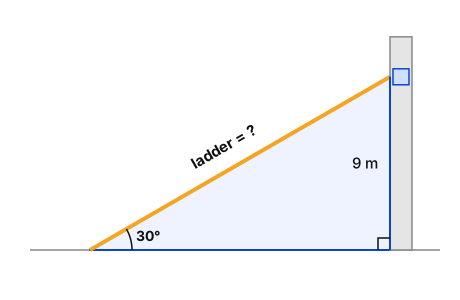
- .
- Ladder = m.
Trick: In a 30° right triangle the side opposite 30° is half the hypotenuse.
Answer: (A) 18 m
अवधारणा: सीढ़ी कर्ण है; ज़मीन से कोण का sin लें।
- ऊँचाई / सीढ़ी ।
- सीढ़ी = मी.।
ट्रिक: 30° के सामने की भुजा कर्ण की आधी होती है।
उत्तर: (A) 18 m
SSC CGLQuantitative AptitudeHeights & distances – ladderSSC CGL 2025 · 19 Sep Shift 3
Q610.A solid cylinder has a radius of 8 cm and a height of 15 cm. A smaller cylindrical hole of radius 4 cm is drilled coaxially through its entire length. What is the approximate volume of the remaining solid?
एक ठोस बेलन की त्रिज्या 8 cm और ऊँचाई 15 cm है। उसमें पूरी लंबाई में 4 cm त्रिज्या का बेलनाकार छेद किया जाता है। शेष ठोस का अनुमानित आयतन क्या है?
- A2825 cm³
- B2785 cm³
- C2502 cm³
- D2263 cm³
Show answer
Concept: Remaining volume = .
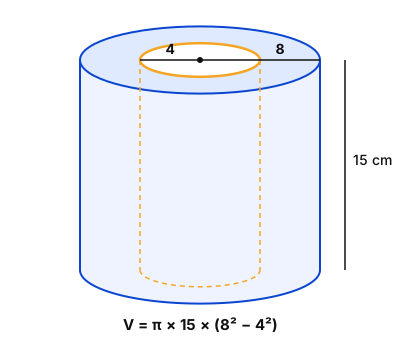
- .
- Volume = .
- cm³.
Trick: , so remaining of the full cylinder: .
Answer: (D) 2263 cm³
अवधारणा: शेष आयतन = ।
- ।
- आयतन = ।
- घन सेमी।
ट्रिक: ⇒ छेद पूरे का , शेष ।
उत्तर: (D) 2263 cm³
SSC CGLQuantitative AptitudeMensuration – hollow cylinderSSC CGL 2025 · 19 Sep Shift 3
Q611.A tank is in the shape of a rectangular parallelepiped of size 30 m × 20 m × 5 m. Its capacity in kilolitres is:
एक टंकी 30 m × 20 m × 5 m आकार के आयताकार घनाभ के रूप में है। उसकी क्षमता किलोलीटर में कितनी है?
- A7,000 kilolitres7,000 किलोलीटर
- B3,000 kilolitres3,000 किलोलीटर
- C5,500 kilolitres5,500 किलोलीटर
- D3,500 kilolitres3,500 किलोलीटर
Show answer
Concept: 1 m³ holds 1000 L, which is exactly 1 kL.
- Volume = m³.
- 3000 m³ = 3000 kL.
Trick: m³ and kL are numerically equal – no conversion needed.
Answer: (B) 3,000 kilolitres
अवधारणा: 1 घन मीटर = 1000 लीटर = 1 किलोलीटर।
- आयतन = घन मी.।
- 3000 घन मी. = 3000 किलोलीटर।
ट्रिक: m³ और kL का मान बराबर होता है – सीधे लिख दें।
उत्तर: (B) 3,000 किलोलीटर
SSC CGLQuantitative AptitudeCuboid – capacity in kilolitresSSC CGL 2025 · 19 Sep Shift 3
Q612.A right circular cone of height 15 cm is cut by two parallel planes at heights 5 cm and 10 cm from the base. What is the ratio of the volumes of the three parts (from top to bottom)?
15 cm ऊँचाई वाले लंब वृत्तीय शंकु को आधार से 5 cm और 10 cm की ऊँचाई पर दो समांतर तलों से काटा जाता है। तीनों भागों (ऊपर से नीचे) के आयतनों का अनुपात क्या है?
- A8 : 19 : 27
- B1 : 6 : 20
- C8 : 19 : 64
- D1 : 7 : 19
Show answer
Concept: Similar cones: volume , heights measured from the vertex.
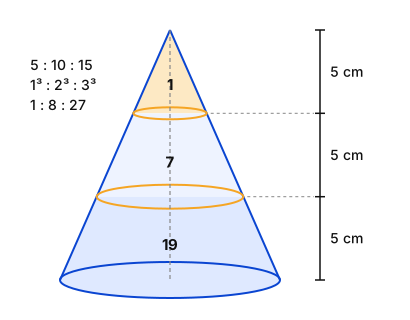
- From the top, cut heights are 5, 10, 15 → ratio 1 : 2 : 3.
- Cumulative volumes 1 : 8 : 27.
- Parts: 1, , .
Trick: For n equal height-slices, part volumes go 1, 7, 19, 37 … (differences of cubes).
Answer: (D) 1 : 7 : 19
अवधारणा: समरूप शंकु: , ऊँचाई शीर्ष से नापें।
- शीर्ष से ऊँचाइयाँ 5, 10, 15 → 1 : 2 : 3।
- कुल आयतन 1 : 8 : 27।
- भाग: 1, 7, 19।
ट्रिक: बराबर ऊँचाई के टुकड़े हों तो भाग 1, 7, 19, 37… (घनों का अंतर)।
उत्तर: (D) 1 : 7 : 19
SSC CGLQuantitative AptitudeCone cut by parallel planesSSC CGL 2025 · 19 Sep Shift 3
Q613.A solid sphere of radius P is melted and recast into n smaller spheres, each of radius q. Find the value of n.
P त्रिज्या वाले एक ठोस गोले को पिघलाकर q त्रिज्या वाले n छोटे गोले बनाए जाते हैं। n का मान ज्ञात कीजिए।
- A()³
- B()³
- C()³
- D()³
Show answer
Concept: Melting keeps total volume unchanged.
- .
- .
Trick: Number of small solids = for similar shapes.
Answer: (A) ()³
अवधारणा: पिघलाने पर कुल आयतन समान रहता है।
- ।
- ।
ट्रिक: समरूप ठोसों में ।
उत्तर: (A) ()³
SSC CGLQuantitative AptitudeRecasting spheresSSC CGL 2025 · 19 Sep Shift 3
Q614.If tanA = , what is the value of (1 + secA)(1 + cosecA)?
यदि tanA = है, तो (1 + secA)(1 + cosecA) का मान क्या है?
- A
- B
- C
- D
Show answer
Concept: means .
- .
- .
- Rationalise: .
Trick: ; compute this decimal and match options.
Answer: (D)
अवधारणा: ⇒ ।
- ।
- ।
- (परिमेयकरण से)।
ट्रिक: मान ; विकल्पों का दशमलव मान मिलाएँ।
उत्तर: (D)
SSC CGLQuantitative AptitudeTrigonometry – standard angle 30°SSC CGL 2025 · 19 Sep Shift 3
Q615.If secx + tanx = , what is the value of secx − tanx?
यदि secx + tanx = है, तो secx − tanx का मान क्या है?
- A
- B
- C
- D
Show answer
Concept: factorises to .
- So .
- .
Trick: sec + tan and sec − tan are always reciprocals – same for cosec + cot and cosec − cot.
Answer: (B)
अवधारणा: ⇒ ।
- अतः ।
- ।
ट्रिक: sec + tan और sec − tan हमेशा व्युत्क्रम होते हैं; cosec ± cot पर भी यही।
उत्तर: (B)
SSC CGLQuantitative AptitudeTrigonometric identity – sec & tanSSC CGL 2025 · 19 Sep Shift 3
Q616.Which point lies on y = 2x − 5?
कौन-सा बिंदु y = 2x − 5 पर स्थित है?
- A(0, −5)
- B(3, 1)
- C(1, −3)
- D(0, −5), (3, 1) and (1, −3) all(0, −5), (3, 1) और (1, −3) सभी
Show answer
Concept: A point lies on a line if its coordinates satisfy the equation.
- (0, −5): 2·0 − 5 = −5 ✓.
- (3, 1): 6 − 5 = 1 ✓.
- (1, −3): 2 − 5 = −3 ✓ – all three lie on it.
Trick: When a 'all of these' option exists, test every point – here each one works.
Answer: (D) (0, −5), (3, 1) and (1, −3) all
अवधारणा: बिंदु रेखा पर है यदि उसके निर्देशांक समीकरण को संतुष्ट करें।
- (0, −5): 0 − 5 = −5 ✓।
- (3, 1): 6 − 5 = 1 ✓।
- (1, −3): 2 − 5 = −3 ✓।
ट्रिक: 'सभी' वाला विकल्प हो तो हर बिंदु जाँचें।
उत्तर: (D) (0, −5), (3, 1) और (1, −3) सभी
SSC CGLQuantitative AptitudeCoordinate geometry – point on a lineSSC CGL 2025 · 19 Sep Shift 3
Q617.A sector has a central angle of 60° and a radius of 18 cm. Another sector has a central angle of radians. What is the ratio of the area of the first sector to the area of the second sector?
एक त्रिज्यखंड का केंद्रीय कोण 60° और त्रिज्या 18 cm है। दूसरे त्रिज्यखंड का केंद्रीय कोण रेडियन है। पहले और दूसरे त्रिज्यखंड के क्षेत्रफलों का अनुपात क्या है?
- A4 : 3
- B1 : 2
- C7 : 2
- D2 : 1
Show answer
Concept: Sector area = ; for equal radii, area ∝ angle.
- .
- Ratio = .
Trick: , so just substitute 180 for π.
Answer: (B) 1 : 2
अवधारणा: त्रिज्यखंड क्षेत्रफल = ; समान त्रिज्या पर क्षेत्रफल ∝ कोण।
- रेडियन ।
- अनुपात = 60 : 120 = 1 : 2।
ट्रिक: रेडियन ; π की जगह 180 रखें।
उत्तर: (B) 1 : 2
SSC CGLQuantitative AptitudeSector area – degrees vs radiansSSC CGL 2025 · 19 Sep Shift 3
Q618.A regular polygon has each interior angle measuring 120°. Find the number of its sides.
एक सम बहुभुज का प्रत्येक अंतःकोण 120° है। उसकी भुजाओं की संख्या ज्ञात कीजिए।
- A6
- B1
- C13
- D8
Show answer
Concept: Exterior angle = 180° − interior angle; sides = 360° ÷ exterior.
- Exterior = .
- .
Trick: 120° interior = regular hexagon (like a honeycomb cell).
Answer: (A) 6
अवधारणा: बाह्य कोण = 180° − अंतः कोण; भुजाएँ = 360° ÷ बाह्य कोण।
- बाह्य = 60°।
- ।
ट्रिक: 120° अंतः कोण = षट्भुज (मधुमक्खी के छत्ते का खाना)।
उत्तर: (A) 6
SSC CGLQuantitative AptitudeRegular polygon – sides from angleSSC CGL 2025 · 19 Sep Shift 3
Q619.A point P is 17 cm away from the centre of a circle. A tangent drawn from P to the circle has length 15 cm. What is the area of the circle?
बिंदु P वृत्त के केंद्र से 17 cm दूर है। P से खींची गई स्पर्श रेखा की लंबाई 15 cm है। वृत्त का क्षेत्रफल क्या है?
- A121π cm²
- B512π cm²
- C64π cm²
- D16π cm²
Show answer
Concept: Radius ⟂ tangent, so centre–point distance is the hypotenuse.
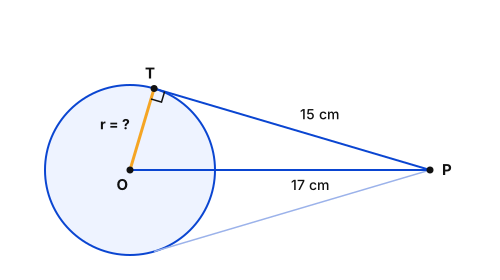
- .
- cm.
- Area .
Trick: 8–15–17 is a Pythagorean triplet – spot it and skip the squares.
Answer: (C) 64π cm²
अवधारणा: त्रिज्या स्पर्शरेखा पर लंब होती है; केंद्र से बिंदु की दूरी कर्ण है।
- ।
- सेमी।
- क्षेत्रफल वर्ग सेमी।
ट्रिक: 8–15–17 पाइथागोरस त्रिक है – तुरंत पहचानें।
उत्तर: (C) 64π cm²
SSC CGLQuantitative AptitudeCircle – tangent length & radiusSSC CGL 2025 · 19 Sep Shift 3
Q620.In △PQR, an angle bisector from P meets QR at S. If PS bisects ∠QPR and PQ = PR, are △PQS and △PRS congruent? If so, by what rule?
△PQR में P से खींची गई कोण-समद्विभाजक QR को S पर मिलती है। यदि PS, ∠QPR को समद्विभाजित करती है और PQ = PR है, तो क्या △PQS और △PRS सर्वांगसम हैं? यदि हाँ, तो किस नियम से?
- AYes, by SSSहाँ, SSS से
- BYes, by SASहाँ, SAS से
- CYes, by ASAहाँ, ASA से
- DNo, they are not congruentनहीं, वे सर्वांगसम नहीं हैं
Show answer
Concept: SAS: two sides and the angle between them equal.
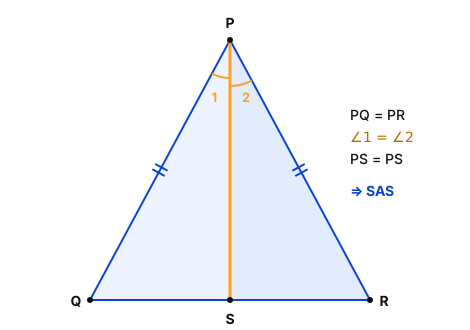
- PQ = PR (given).
- ∠QPS = ∠RPS (PS is the bisector) – this angle lies between the sides.
- PS common ⇒ △PQS ≅ △PRS by SAS.
Trick: Check whether the equal angle is sandwiched between the equal sides – if yes, SAS.
Answer: (B) Yes, by SAS
अवधारणा: SAS: दो भुजाएँ और उनके बीच का कोण बराबर।
- PQ = PR (दिया है)।
- ∠QPS = ∠RPS (PS समद्विभाजक) – यह कोण दोनों भुजाओं के बीच है।
- PS उभयनिष्ठ ⇒ SAS से सर्वांगसम।
ट्रिक: बराबर कोण बराबर भुजाओं के बीच हो तो SAS।
उत्तर: (B) हाँ, SAS से
SSC CGLQuantitative AptitudeTriangle congruence – SASSSC CGL 2025 · 19 Sep Shift 3

