Q621.Simplify: +
सरल कीजिए: +
- A
- B
- C
- D
Show answer
Concept: .
- Here .
- Numerator = ; denominator = .
- Sum = .
Trick: The parts cancel, so only can appear in the answer.
Answer: (D)
अवधारणा: ।
- ।
- अंश = ; हर = ।
- योग = ।
ट्रिक: वाले भाग कट जाते हैं – उत्तर में केवल होगा।
उत्तर: (D)
SSC CGLQuantitative AptitudeSurds – sum of reciprocalsSSC CGL 2025 · 19 Sep Shift 3
Q622.If cosecA = y, then what is cot²A in terms of y?
यदि cosecA = y है, तो cot²A का मान y के पदों में क्या होगा?
- Ay² − 3
- By² − 2
- Cy² − 1
- D2y² − 1
Show answer
Concept: .
- .
- .
Trick: Check with : , ✓.
Answer: (C) y² − 1
अवधारणा: ।
- ।
- ।
ट्रिक: रखकर जाँचें: ✓।
उत्तर: (C) y² − 1
SSC CGLQuantitative AptitudeTrig identity – cosec & cotSSC CGL 2025 · 19 Sep Shift 3
Q623.The angle between two tangents drawn from an external point to a circle is 70°. What is the angle subtended by the chord connecting their points of contact at the centre?
किसी बाह्य बिंदु से वृत्त पर खींची गई दो स्पर्श रेखाओं के बीच का कोण 70° है। उनके स्पर्श-बिंदुओं को जोड़ने वाली जीवा द्वारा केंद्र पर बनाया गया कोण क्या है?
- A80°
- B110°
- C115°
- D60°
Show answer
Concept: The angle between two tangents and the angle at the centre are supplementary.
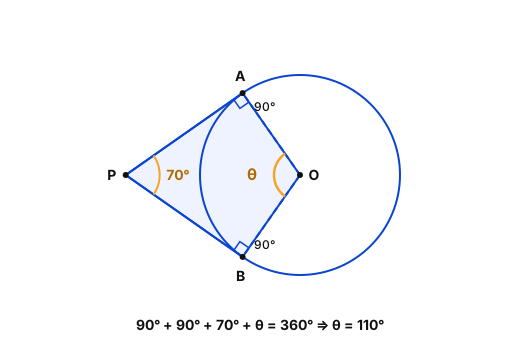
- Each radius–tangent angle = 90°.
- Quadrilateral sum: 90 + 90 + 70 + θ = 360.
- θ = 110°.
Trick: Directly: angle at centre = 180° − 70° = 110°.
Answer: (B) 110°
अवधारणा: दो स्पर्शरेखाओं के बीच का कोण और केंद्र पर कोण संपूरक होते हैं।
- त्रिज्या-स्पर्शरेखा कोण = 90°।
- चतुर्भुज: 90 + 90 + 70 + θ = 360।
- θ = 110°।
ट्रिक: सीधे: 180° − 70° = 110°।
उत्तर: (B) 110°
SSC CGLQuantitative AptitudeTangents – angle at centreSSC CGL 2025 · 19 Sep Shift 3
Q624.From a point L outside a circle, a tangent LK and a secant LMN are drawn. If LK = 10 cm and MN = 15 cm, what is the length of the segment LM?
वृत्त के बाहर बिंदु L से एक स्पर्श रेखा LK और एक छेदक LMN खींची गई है। यदि LK = 10 cm और MN = 15 cm है, तो LM की लंबाई क्या है?
- A6 cm
- B8 cm
- C5 cm
- D11 cm
Show answer
Concept: (Tangent)² = external part × whole secant.
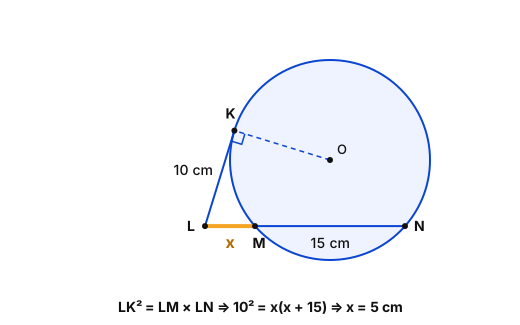
- Let .
- .
- cm.
Trick: Try options: ✓ instantly.
Answer: (C) 5 cm
अवधारणा: (स्पर्शरेखा)² = बाहरी भाग × पूरा छेदक।
- ।
- ।
- सेमी।
ट्रिक: विकल्प रखें: ✓।
उत्तर: (C) 5 cm
SSC CGLQuantitative AptitudeTangent–secant theoremSSC CGL 2025 · 19 Sep Shift 3
Q625.What is the value of (0.3³ + 0.03³) ÷ (0.6³ + 0.06³)?
(0.3³ + 0.03³) ÷ (0.6³ + 0.06³) का मान क्या है?
- A0.065
- B0.005
- C0.225
- D0.125
Show answer
Concept: Take the common factor out of numerator and denominator.
- Numerator = ; denominator = .
- Ratio = .
- .
Trick: Each denominator term is exactly double the numerator term ⇒ answer is .
Answer: (D) 0.125
अवधारणा: अंश और हर से उभयनिष्ठ गुणनखंड बाहर निकालें।
- अंश = ; हर = ।
- अनुपात = ।
- = 0.125।
ट्रिक: हर का हर पद अंश का ठीक दोगुना ⇒ ।
उत्तर: (D) 0.125
SSC CGLQuantitative AptitudeSimplification – cubes of decimalsSSC CGL 2025 · 19 Sep Shift 3
Q626.If + = 7 and − = 1, what is the value of a and b?
यदि + = 7 और − = 1 है, तो a और b के मान क्या हैं?
- Aa = 4, b = 3
- Ba = 9, b = 16
- Ca = 16, b = 9
- Da = 3, b = 4
Show answer
Concept: Treat and as unknowns, solve by adding and subtracting, then square.
- and
- Add:
- Subtract:
Trick: Options (A) and (D) give – a trap for those who forget the roots; the answer must be perfect squares, 16 and 9.
Answer: (C) a = 16, b = 9
अवधारणा: और को अज्ञात मानकर जोड़-घटाकर हल करें, फिर वर्ग करें।
हल:
- और
- जोड़ें:
- घटाएँ:
ट्रिक: (A) और (D) में – मूल भूलने वालों का जाल; उत्तर पूर्ण वर्ग 16 और 9 होंगे।
उत्तर: (C) a = 16, b = 9
SSC CGLQuantitative AptitudeLinear equations in √a and √bSSC CGL 2025 · 19 Sep Shift 2
Q627.Which of the following is the least 6-digit number which is NOT a perfect square?
निम्न में से कौन-सी सबसे छोटी 6-अंकीय संख्या है जो पूर्ण वर्ग नहीं है?
- A100489
- B100000
- C101124
- D100788
Show answer
Concept: Start from the smallest 6-digit number and test whether it is a perfect square.
- Smallest 6-digit number = 100000.
- and , so 100000 lies between two squares → not a perfect square.
- Since it is already the smallest 6-digit number, it is the answer.
Trick: has an odd power of 10 (odd number of zeros) – it can never be a perfect square.
Answer: (B) 100000
अवधारणा: सबसे छोटी 6-अंकीय संख्या से शुरू करें और देखें कि वह पूर्ण वर्ग है या नहीं।
हल:
- सबसे छोटी 6-अंकीय संख्या = 100000
- और , अतः 100000 पूर्ण वर्ग नहीं।
- यह स्वयं सबसे छोटी 6-अंकीय संख्या है, अतः यही उत्तर।
ट्रिक: विषम संख्या में शून्य () वाली संख्या कभी पूर्ण वर्ग नहीं होती।
उत्तर: (B) 100000
SSC CGLQuantitative AptitudePerfect squares – smallest 6-digit non-squareSSC CGL 2025 · 19 Sep Shift 2
Q628.If 37.5% of p is equal to 25% of q, what is the ratio p : q?
यदि p का 37.5%, q के 25% के बराबर है, तो अनुपात p : q क्या है?
- A1 : 4
- B4 : 1
- C3 : 2
- D2 : 3
Show answer
Concept: If x% of p = y% of q, then p : q = y : x.
- ,
- p : q = 2 : 3
Trick: Cross-swap the percentages: p : q = 25 : 37.5 = 2 : 3.
Answer: (D) 2 : 3
अवधारणा: यदि p का x% = q का y%, तो p : q = y : x।
हल:
- ,
- p : q = 2 : 3
ट्रिक: प्रतिशत उलटकर रखें: p : q = 25 : 37.5 = 2 : 3।
उत्तर: (D) 2 : 3
SSC CGLQuantitative AptitudePercentage – ratio from equal partsSSC CGL 2025 · 19 Sep Shift 2
Q629.A grocer mixes two varieties of rice — one costing ₹40 per kg and the other ₹50 per kg — in the ratio 3 : 5. If he sells the mixed variety at ₹55.50 per kg, find his gain or loss percent.
एक दुकानदार ₹40 प्रति किग्रा और ₹50 प्रति किग्रा की दो किस्म की चावल 3 : 5 के अनुपात में मिलाता है। यदि वह मिश्रण ₹55.50 प्रति किग्रा बेचता है, तो लाभ/हानि प्रतिशत ज्ञात कीजिए।
- A20% Loss20% हानि
- B20% Gain20% लाभ
- C18% Gain18% लाभ
- D18% Loss18% हानि
Show answer
Concept: Find the cost price per kg of the mixture (weighted average), then compare with SP.
- CP of 8 kg = ₹370 → ₹46.25 per kg
- SP per kg = ₹55.50 → profit = ₹9.25
- Gain% =
Trick: SP is clearly above both ₹40 and ₹50, so it must be a gain – remove both loss options; then confirms 20%.
Answer: (B) 20% Gain
अवधारणा: मिश्रण का प्रति किग्रा क्रय मूल्य (भारित औसत) निकालें, फिर विक्रय मूल्य से तुलना करें।
हल:
- 8 किग्रा का CP = ₹370 → ₹46.25 प्रति किग्रा
- SP = ₹55.50 → लाभ = ₹9.25 प्रति किग्रा
- लाभ% =
ट्रिक: SP दोनों किस्मों (₹40, ₹50) से अधिक है, अतः लाभ ही होगा; से 20% पक्का।
उत्तर: (B) 20% लाभ
SSC CGLQuantitative AptitudeMixture – profit percentSSC CGL 2025 · 19 Sep Shift 2
Q630.A book originally priced at ₹800 is subject to two successive discounts: an initial markdown of 30%, followed by an additional 20% discount. Determine the final selling price of the book.
₹800 अंकित मूल्य की एक पुस्तक पर दो क्रमिक छूट दी जाती हैं — पहले 30% और फिर 20%। पुस्तक का अंतिम विक्रय मूल्य ज्ञात कीजिए।
- A₹432
- B₹396
- C₹448
- D₹350
Show answer
Concept: Each discount is applied on the price left after the previous one.
- After 30% off: ₹560
- After 20% more: ₹448
- Final SP = ₹448
Trick: Net discount of 30% and 20% = → ₹448.
Answer: (C) ₹448
अवधारणा: हर छूट पिछली छूट के बाद बचे मूल्य पर लगती है।
हल:
- 30% छूट के बाद: ₹560
- फिर 20% छूट: ₹448
- अंतिम SP = ₹448
ट्रिक: कुल छूट = → ₹448।
उत्तर: (C) ₹448
SSC CGLQuantitative AptitudeSuccessive discountsSSC CGL 2025 · 19 Sep Shift 2
Q631.A retailer marked a commodity at 25% above its cost price and then gave a discount. If the sale finally yielded a profit of 20% on the cost price, what was the discount percentage?
एक विक्रेता ने वस्तु को क्रय मूल्य से 25% अधिक अंकित किया और फिर छूट दी। यदि अंततः क्रय मूल्य पर 20% लाभ हुआ, तो छूट कितने प्रतिशत थी?
- A8%
- B4%
- C5%
- D10%
Show answer
Concept: Take CP = 100; discount% is always on the marked price.
- CP = 100 → MP = 125, SP = 120
- Discount =
- Discount% =
Trick: Formula: → .
Answer: (B) 4%
अवधारणा: CP = 100 मानें; छूट% हमेशा अंकित मूल्य पर होती है।
हल:
- CP = 100 → MP = 125, SP = 120
- छूट =
- छूट% =
ट्रिक: सूत्र: (100 + markup)(100 − d) = 100(100 + लाभ) → ।
उत्तर: (B) 4%
SSC CGLQuantitative AptitudeMarkup, discount and profitSSC CGL 2025 · 19 Sep Shift 2
Q632.If a³ + b³ = 152 and ab = 15, find the value of a + b.
यदि a³ + b³ = 152 और ab = 15 है, तो a + b का मान ज्ञात कीजिए।
- A9
- B6
- C10
- D8
Show answer
Concept: Use .
- Let :
- Try : ✓
- So (e.g. , )
Trick: With test the factor pair 5 and 3: → in seconds.
Answer: (D) 8
अवधारणा: का प्रयोग करें।
- मानें:
- रखें: ✓
- अतः (, )
ट्रिक: के गुणनखंड 5 और 3 जाँचें: → ।
उत्तर: (D) 8
SSC CGLQuantitative AptitudeAlgebraic identity – a + b from a³ + b³SSC CGL 2025 · 19 Sep Shift 2
Q633.At what rate of simple interest will ₹3,000 become ₹4,020 in 5 years?
किस साधारण ब्याज दर पर ₹3,000, 5 वर्ष में ₹4,020 हो जाएँगे?
- A8.5%
- B5.5%
- C8.8%
- D6.8%
Show answer
Concept: .
- SI = ₹1020
Trick: Total growth = in 5 years → per year.
Answer: (D) 6.8%
अवधारणा: ।
हल:
- SI = ₹1020
ट्रिक: 5 वर्ष में कुल वृद्धि = → प्रति वर्ष।
उत्तर: (D) 6.8%
SSC CGLQuantitative AptitudeSimple interest – find rateSSC CGL 2025 · 19 Sep Shift 2
Q634.A person invested ₹8,000 in one scheme at 6% simple interest and ₹5,000 in another at 8% simple interest for the same duration. If he received a total interest of ₹2,640, what was the duration of the investments?
एक व्यक्ति ने ₹8,000, 6% साधारण ब्याज पर और ₹5,000, 8% साधारण ब्याज पर समान अवधि के लिए निवेश किए। यदि कुल ब्याज ₹2,640 मिला, तो निवेश की अवधि क्या थी?
- A3.5 years3.5 वर्ष
- B6 years6 वर्ष
- C5 years5 वर्ष
- D3 years3 वर्ष
Show answer
Concept: Same time for both, so add the yearly interests and divide the total interest by it.
- Yearly SI on ₹8000 at 6% = ₹480
- Yearly SI on ₹5000 at 8% = ₹400 → total ₹880 per year
- T = years
Trick: 2640 is exactly – check divisibility of the total by the yearly interest straight away.
Answer: (D) 3 years
अवधारणा: दोनों का समय समान है, अतः वार्षिक ब्याज जोड़कर कुल ब्याज से भाग दें।
हल:
- ₹8000 पर 6% वार्षिक ब्याज = ₹480
- ₹5000 पर 8% वार्षिक ब्याज = ₹400 → कुल ₹880 प्रति वर्ष
- T = वर्ष
ट्रिक: – कुल ब्याज को वार्षिक ब्याज से सीधे भाग दें।
उत्तर: (D) 3 वर्ष
SSC CGLQuantitative AptitudeSimple interest – two investments, find timeSSC CGL 2025 · 19 Sep Shift 2
Q635.A wheelchair ramp needs to reach a platform that is 2.5 metres high. If the ramp makes an angle of 30° with the level ground, what is the length of the ramp?
एक व्हीलचेयर रैंप को 2.5 मीटर ऊँचे प्लेटफ़ॉर्म तक पहुँचना है। यदि रैंप ज़मीन से 30° का कोण बनाता है, तो रैंप की लंबाई क्या होगी?
- A1.5 m
- B2 m
- C5 m
- D3 m
Show answer
Concept: The ramp is the hypotenuse; height is opposite the 30° angle, so use sin.
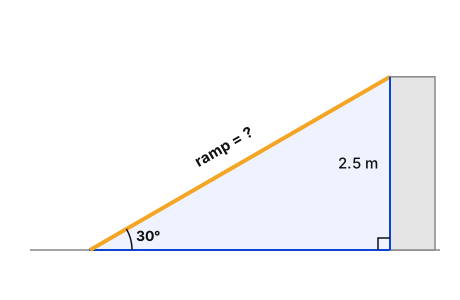
- = height/ramp
- Ramp = m
Trick: In a 30° right triangle, the hypotenuse is always twice the side opposite 30°.
Answer: (C) 5 m
अवधारणा: रैंप कर्ण है; ऊँचाई 30° कोण के सामने की भुजा है, अतः sin लें।
हल:
- = ऊँचाई/रैंप
- 2.5/रैंप
- रैंप = m
ट्रिक: 30° वाले समकोण त्रिभुज में कर्ण = 30° के सामने की भुजा का दोगुना।
उत्तर: (C) 5 m
SSC CGLQuantitative AptitudeHeights – ramp length with sin 30°SSC CGL 2025 · 19 Sep Shift 2
Q636.From a point A on the ground, the angle of elevation to the top of a building is 30°. From a point B, which is directly between A and the foot of the building, the angle of elevation is 45°. What is the ratio of the distance of A from the foot to the distance of B from the foot?
ज़मीन पर स्थित बिंदु A से किसी भवन के शीर्ष का उन्नयन कोण 30° है। A और भवन के आधार के बीच स्थित बिंदु B से उन्नयन कोण 45° है। भवन के आधार से A की दूरी और B की दूरी का अनुपात क्या है?
- A : 3
- B : 1
- C :
- D2 : 3
Show answer
Concept: With the same height h, distance = .
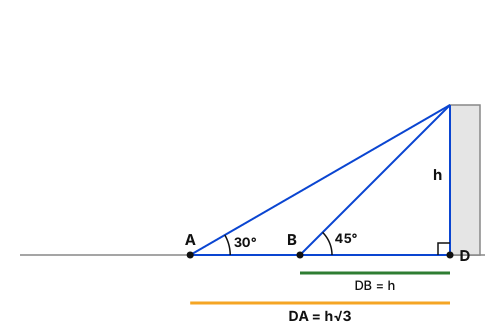
- From A:
- From B:
Trick: Distance ratio = – no need to assume h.
Answer: (B) : 1
अवधारणा: समान ऊँचाई h के लिए दूरी = ।
हल:
- A से:
- B से:
ट्रिक: दूरियों का अनुपात = – h मानने की ज़रूरत नहीं।
उत्तर: (B) : 1
SSC CGLQuantitative AptitudeHeights & distances – ratio of distancesSSC CGL 2025 · 19 Sep Shift 2
Q637.If the curved surface area of a sphere is 154 cm², find its diameter.
यदि किसी गोले का वक्र पृष्ठीय क्षेत्रफल 154 cm² है, तो उसका व्यास ज्ञात कीजिए।
- A9 cm
- B8 cm
- C7 cm
- D5 cm
Show answer
Concept: Surface area of sphere = .
- cm → diameter = 7 cm
Trick: , so directly.
Answer: (C) 7 cm
अवधारणा: गोले का पृष्ठीय क्षेत्रफल = ।
हल:
- cm → व्यास = 7 cm
ट्रिक: , अतः सीधे।
उत्तर: (C) 7 cm
SSC CGLQuantitative AptitudeSphere – diameter from surface areaSSC CGL 2025 · 19 Sep Shift 2
Q638.A cone has height h and radius r. It is melted and recast into a smaller cone whose height is and radius is . What fraction of the original volume is unused?
एक शंकु की ऊँचाई h और त्रिज्या r है। उसे पिघलाकर ऐसा छोटा शंकु बनाया जाता है जिसकी ऊँचाई और त्रिज्या है। मूल आयतन का कितना भाग अप्रयुक्त रहता है?
- A
- B
- C
- D
Show answer
Concept: Cone volume ∝ .
- New cone: radius , height
- New volume = of original
- Unused =
Trick: Scale factors multiply: used → left.
Answer: (B)
अवधारणा: शंकु का आयतन ∝ ।
हल:
- नया शंकु: त्रिज्या , ऊँचाई
- नया आयतन = = मूल का
- अप्रयुक्त =
ट्रिक: गुणांक गुणा करें: प्रयुक्त → बचा।
उत्तर: (B)
SSC CGLQuantitative AptitudeCone – recasting, unused volumeSSC CGL 2025 · 19 Sep Shift 2
Q639.If a regular hexagon and a square have the same side length, what will be the ratio of their areas?
यदि एक सम षट्भुज और एक वर्ग की भुजा समान हो, तो उनके क्षेत्रफलों का अनुपात क्या होगा?
- A3 : 2
- B2 : 3
- C : 1
- D1 : 6
Show answer
Concept: A regular hexagon = 6 equilateral triangles: area = .
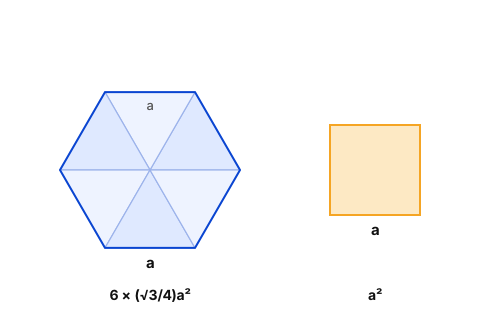
- Hexagon area =
- Square area =
- Ratio =
Trick: Hexagon area , more than the square's – so the ratio must exceed 1; only (≈ 2.6) and 3 : 1 qualify, and .
Answer: (A) 3 : 2
अवधारणा: सम षट्भुज = 6 समबाहु त्रिभुज: क्षेत्रफल = ।
हल:
- षट्भुज का क्षेत्रफल =
- वर्ग का क्षेत्रफल =
- अनुपात =
ट्रिक: षट्भुज , वर्ग से बड़ा – अनुपात 1 से अधिक; ≈ 2.6 ही सही।
उत्तर: (A) 3 : 2
SSC CGLQuantitative AptitudeAreas – regular hexagon vs squareSSC CGL 2025 · 19 Sep Shift 2
Q640.A prism has an equilateral triangular base with a side length of 6 cm. Its height starts at 1 cm and increases by 1 cm for each subsequent layer, forming 5 layers in total. What is the total volume of the prism? (Use = 1.732)
एक प्रिज़्म का आधार 6 cm भुजा वाला समबाहु त्रिभुज है। उसकी ऊँचाई 1 cm से शुरू होकर हर अगली परत में 1 cm बढ़ती है, कुल 5 परतें हैं। प्रिज़्म का कुल आयतन क्या है? ( = 1.732 लीजिए)
- A207.84 cm³
- B233.82 cm³
- C259.80 cm³
- D303.10 cm³
Show answer
Concept: Volume of prism = base area × height; layers with the same base simply add their heights.
- Base area = cm²
- Total height = cm
- Volume = cm³
Trick: : , plus → 233.82.
Answer: (B) 233.82 cm³
अवधारणा: प्रिज़्म का आयतन = आधार क्षेत्रफल × ऊँचाई; समान आधार वाली परतों की ऊँचाइयाँ जुड़ती हैं।
हल:
- आधार क्षेत्रफल = cm²
- कुल ऊँचाई = cm
- आयतन = cm³
ट्रिक: : + → 233.82।
उत्तर: (B) 233.82 cm³
SSC CGLQuantitative AptitudePrism – layered volumeSSC CGL 2025 · 19 Sep Shift 2

