Q61.A triangle has vertices at A(8, 10), B(4, 4) and C(16, 6). What is its area?
एक त्रिभुज के शीर्ष A(8, 10), B(4, 4) और C(16, 6) हैं। उसका क्षेत्रफल क्या है?
- A32 square units32 वर्ग इकाई
- B36 square units36 वर्ग इकाई
- C14.5 square units14.5 वर्ग इकाई
- D35 square units35 वर्ग इकाई
Show answer
Concept: Area = .
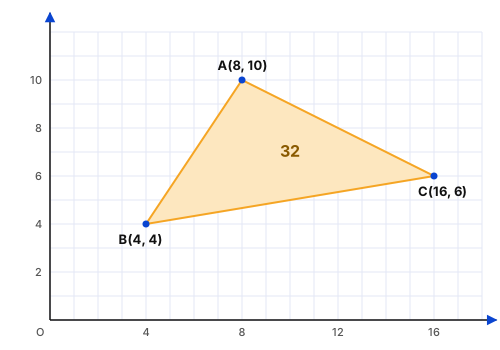
- ; ; .
- Sum = 64.
- Area sq units.
Trick: Shift origin to B(4, 4): A(4, 6), C(12, 2) ⇒ area .
Answer: (A) 32 square units
अवधारणा: तीन शीर्ष दिए हों तो क्षेत्रफल = आधा × |सारणिक (shoelace) मान|।
हल:
- , , ।
- इनका योग 64 है।
- आधा करने पर क्षेत्रफल = 32 वर्ग इकाई।
ट्रिक: मूल बिंदु B(4, 4) पर लाएँ: A(4, 6), C(12, 2) ⇒ ।
उत्तर: (A) 32 वर्ग इकाई
SSC CGLQuantitative AptitudeCoordinate geometry – area of triangleSSC CGL 2025 · 14 Oct Shift 1
Q62.The average of a certain number of quantities is 48. If 6 is added to each quantity, what will be the new average?
कुछ राशियों का औसत 48 है। यदि प्रत्येक राशि में 6 जोड़ दिया जाए, तो नया औसत क्या होगा?
- A39
- B54
- C41
- D52
Show answer
Concept: Adding a constant to every value adds the same constant to the average.
- New average = .
- The number of quantities does not matter.
Trick: Add/subtract/multiply/divide every term by k ⇒ do the same to the average.
Answer: (B) 54
अवधारणा: हर राशि में समान संख्या जोड़ें तो औसत में भी वही संख्या जुड़ती है।
हल:
- नया औसत = ।
- राशियों की संख्या से फ़र्क नहीं पड़ता।
ट्रिक: हर पद पर +, −, ×, ÷ k करें तो औसत पर भी वही क्रिया होगी।
उत्तर: (B) 54
SSC CGLQuantitative AptitudeAverage – same number addedSSC CGL 2025 · 14 Oct Shift 1
Q63.A wholesaler sells a packet of tea to a retailer at a profit of 20%. The retailer then marks up the price by 35% and offers a discount of 16.67% to the customer. If the customer pays ₹864, find the cost price of the packet for the wholesaler.
एक थोक विक्रेता चाय का पैकेट फुटकर विक्रेता को 20% लाभ पर बेचता है। फुटकर विक्रेता मूल्य 35% बढ़ाकर अंकित करता है और ग्राहक को 16.67% छूट देता है। यदि ग्राहक ₹864 देता है, तो थोक विक्रेता के लिए पैकेट का क्रय मूल्य ज्ञात कीजिए।
- A₹600
- B₹400
- C₹640
- D₹750
Show answer
Concept: Multiply the successive factors: profit , markup , discount .
- Final price = .
- .
- ₹640.
Trick: and cancel each other – only the 35% markup survives: .
Answer: (C) ₹640
अवधारणा: क्रमागत गुणकों को गुणा करें: लाभ , बढ़ोतरी , छूट ।
हल:
- अंतिम मूल्य = ।
- ।
- ₹640।
ट्रिक: और कट जाते हैं – केवल 35% बचता है: ।
उत्तर: (C) ₹640
SSC CGLQuantitative AptitudeProfit, markup and discount chainSSC CGL 2025 · 14 Oct Shift 1
Q64.A group of 7 students went on a trip and spent ₹2,500 in total. If one of them spent ₹700 while the rest spent equally, what was the average spending of the other 6 students?
7 विद्यार्थियों के एक समूह ने यात्रा पर कुल ₹2,500 खर्च किए। यदि उनमें से एक ने ₹700 खर्च किए और शेष ने बराबर-बराबर, तो अन्य 6 विद्यार्थियों का औसत खर्च क्या था?
- A₹300
- B₹360
- C₹500
- D₹240
Show answer
Concept: Average = total of the group ÷ number in the group.
- Spent by other six = ₹1800.
- Average = ₹300.
Trick: Use only the six people's total; the 7 is a distractor.
Answer: (A) ₹300
अवधारणा: औसत = समूह का योग ÷ सदस्यों की संख्या।
हल:
- बाकी छह का खर्च = ₹1800।
- औसत = ₹300।
ट्रिक: केवल छह लोगों का योग लें; 7 संख्या भ्रमित करने के लिए है।
उत्तर: (A) ₹300
SSC CGLQuantitative AptitudeAverage – excluding one memberSSC CGL 2025 · 14 Oct Shift 1
Q65.In a quadrilateral ABCD, angles A, B and C are in the ratio 5 : 4 : 5. If angle D = 80°, what is angle B?
चतुर्भुज ABCD में कोण A, B और C 5 : 4 : 5 के अनुपात में हैं। यदि कोण D = 80° है, तो कोण B क्या होगा?
- A80°
- B72°
- C45°
- D120°
Show answer
Concept: Sum of the angles of a quadrilateral = 360°.
- .
- Ratio 5 : 4 : 5 ⇒ 14 parts = 280° ⇒ 1 part = 20°.
- .
Trick: Subtract the known angle first, then split 280 in 14 parts.
Answer: (A) 80°
अवधारणा: चतुर्भुज के कोणों का योग = 360°।
हल:
- ।
- 5 : 4 : 5 ⇒ 14 भाग = 280° ⇒ 1 भाग = 20°।
- ।
ट्रिक: पहले ज्ञात कोण घटाएँ, फिर 280 को 14 भागों में बाँटें।
उत्तर: (A) 80°
SSC CGLQuantitative AptitudeQuadrilateral – angle sumSSC CGL 2025 · 14 Oct Shift 1
Q66.A distributor marks a batch of 280 identical mobile chargers at 60% above the cost price and offers a 20% discount to retailers. A retailer purchases all the chargers and spends ₹15,360. What is the cost price per charger for the wholesaler?
एक वितरक 280 एक जैसे मोबाइल चार्जर क्रय मूल्य से 60% ऊपर अंकित करता है और फुटकर विक्रेताओं को 20% छूट देता है। एक फुटकर विक्रेता सभी चार्जर ₹15,360 में खरीदता है। थोक विक्रेता के लिए प्रति चार्जर क्रय मूल्य क्या है?
- A₹42.85
- B₹57.75
- C₹56.65
- D₹55.55
Show answer
Concept: .
- SP factor = .
- Total CP = ₹12,000.
- Per charger = ₹42.86 (listed as ₹42.85).
Trick: 60% up and 20% down = net +28% ().
Answer: (A) ₹42.85
अवधारणा: विक्रय मूल्य = क्रय मूल्य × (1 + बढ़ोतरी) × (1 − छूट)।
हल:
- गुणक = ।
- कुल CP = ₹12,000।
- प्रति चार्जर = ₹42.85।
ट्रिक: 60% बढ़ोतरी और 20% छूट = शुद्ध +28% ()।
उत्तर: (A) ₹42.85
SSC CGLQuantitative AptitudeMarkup and discount – CP per itemSSC CGL 2025 · 14 Oct Shift 1
Q67.Three numbers are in the ratio 4 : 5 : 7. If their average is 480, what is the difference between the largest and the smallest number?
तीन संख्याएँ 4 : 5 : 7 के अनुपात में हैं। यदि उनका औसत 480 है, तो सबसे बड़ी और सबसे छोटी संख्या का अंतर क्या है?
- A270
- B300
- C240
- D250
Show answer
Concept: Sum = average × count; then split the sum in the ratio.
- Sum = .
- 16 parts = 1440 ⇒ 1 part = 90.
- Largest − smallest = .
Trick: Find only the needed difference: 3 parts × 90 = 270.
Answer: (A) 270
अवधारणा: योग = औसत × संख्या; फिर योग को अनुपात में बाँटें।
हल:
- योग = ।
- 16 भाग = 1440 ⇒ 1 भाग = 90।
- अंतर = ।
ट्रिक: सीधे अंतर वाले 3 भाग × 90 = 270।
उत्तर: (A) 270
SSC CGLQuantitative AptitudeRatio and averageSSC CGL 2025 · 14 Oct Shift 1
Q68.A 136-litre container of pure milk undergoes a process in which 17 litres is removed and replaced with water. The process is carried out 3 times in all. Approximately how much of the original milk remains?
136 लीटर शुद्ध दूध वाले पात्र में से 17 लीटर निकालकर उतना पानी मिलाया जाता है। यह क्रिया कुल तीन बार की जाती है। मूल दूध लगभग कितना शेष रहेगा?
- A17 litres17 लीटर
- B17 litres17 लीटर
- C81 litres81 लीटर
- D91 litres91 लीटर
Show answer
Concept: Milk left = initial .
- Fraction kept each time = .
- Milk left = .
- L (≈ 91.1 L).
Trick: , so – cancel 8 first.
Answer: (D) 91 litres
अवधारणा: ।
हल:
- हर बार बचा भाग = ।
- शेष दूध = ।
- लीटर (≈ 91.1 L)।
ट्रिक: , अतः पहले 8 काटें: ।
उत्तर: (D) 91 लीटर
SSC CGLQuantitative AptitudeRepeated replacement – milk and waterSSC CGL 2025 · 14 Oct Shift 1
Q69.If secx − tanx = , then what is the value of secx + tanx?
यदि secx − tanx = है, तो secx + tanx का मान क्या है?
- A9
- B3
- C4
- D1
Show answer
Concept: .
- Given .
- .
Trick: sec + tan and sec − tan are always reciprocals – just flip the given value.
Answer: (B) 3
अवधारणा: ।
हल:
- दिया है ।
- ।
ट्रिक: sec + tan और sec − tan हमेशा एक-दूसरे के व्युत्क्रम – बस मान उलट दें।
उत्तर: (B) 3
SSC CGLQuantitative AptitudeTrigonometric identity – sec and tanSSC CGL 2025 · 14 Oct Shift 1
Q70.Two circles of radii 8 cm and 5 cm are such that the distance between their centres is 13 cm. How many common tangents can be drawn?
8 cm और 5 cm त्रिज्या वाले दो वृत्तों के केंद्रों के बीच की दूरी 13 cm है। कितनी उभयनिष्ठ स्पर्श रेखाएँ खींची जा सकती हैं?
- A0
- B1
- C2
- D3
Show answer
Concept: Compare distance between centres d with r₁ + r₂ and |r₁ − r₂|.
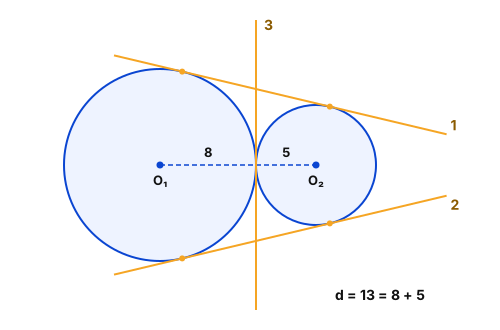
- r₁ + r₂ = 8 + 5 = 13 = d.
- So the circles touch externally.
- Common tangents = 2 direct + 1 at the point of contact = 3.
Trick: d > r₁+r₂ → 4; d = r₁+r₂ → 3; between → 2; d = |r₁−r₂| → 1; inside → 0.
Answer: (D) 3
अवधारणा: केंद्रों की दूरी d की तुलना r₁ + r₂ और |r₁ − r₂| से करें।
हल:
- r₁ + r₂ = 8 + 5 = 13 = d।
- अतः वृत्त बाहर से स्पर्श करते हैं।
- उभयनिष्ठ स्पर्श रेखाएँ = 2 सीधी + 1 स्पर्श बिंदु पर = 3।
ट्रिक: d > r₁+r₂ → 4; d = r₁+r₂ → 3; बीच में → 2; d = |r₁−r₂| → 1; अंदर → 0।
उत्तर: (D) 3
SSC CGLQuantitative AptitudeCommon tangents of two circlesSSC CGL 2025 · 14 Oct Shift 1
Q71.What is radians in degrees?
रेडियन डिग्री में कितने होंगे?
- A180°
- B360°
- C270°
- D150°
Show answer
Concept: radians , so degrees = radians .
- .
- .
Trick: Put directly: .
Answer: (C) 270°
अवधारणा: रेडियन , अतः डिग्री = रेडियन ।
हल:
- ।
- ।
ट्रिक: सीधे रखें: ।
उत्तर: (C) 270°
SSC CGLQuantitative AptitudeRadian to degreeSSC CGL 2025 · 14 Oct Shift 1
Q72.If P = ₹2,400, R = 37.5% and T = 2 years, find the simple interest.
यदि P = ₹2,400, R = 37.5% और T = 2 वर्ष है, तो साधारण ब्याज ज्ञात कीजिए।
- A₹1,000
- B₹1,200
- C₹1,800
- D₹2,000
Show answer
Concept: .
- .
- ₹1800.
Trick: , and : .
Answer: (C) ₹1,800
अवधारणा: साधारण ब्याज = ।
हल:
- ।
- ₹1800।
ट्रिक: कुल दर = ; ।
उत्तर: (C) ₹1,800
SSC CGLQuantitative AptitudeSimple interestSSC CGL 2025 · 14 Oct Shift 1
Q73.In a circle, the chords EF and GH are equal. The angle subtended by EF at the circumference is 95°. What is the angle subtended by GH at the circumference?
एक वृत्त में जीवाएँ EF और GH बराबर हैं। EF परिधि पर 95° का कोण बनाती है। GH परिधि पर कितना कोण बनाएगी?
- A95°
- B47.5°
- C120°
- D85°
Show answer
Concept: Equal chords subtend equal angles at the centre, and hence equal angles at the circumference (same side).
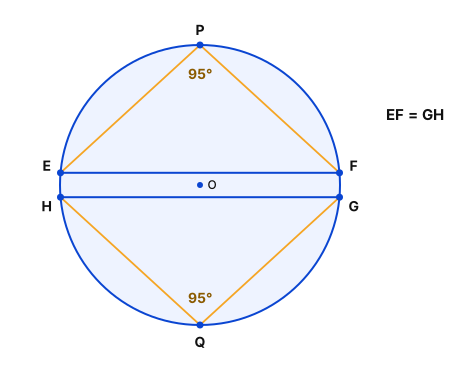
- EF = GH ⇒ their central angles are equal.
- Inscribed angle = half the central angle ⇒ equal too.
- Angle by GH = 95°.
Yaad rakhein: Equal chords are also equidistant from the centre.
Answer: (A) 95°
अवधारणा: समान जीवाएँ केंद्र पर समान कोण बनाती हैं, इसलिए परिधि पर भी समान कोण बनाती हैं।
हल:
- EF = GH ⇒ केंद्रीय कोण बराबर।
- परिधि कोण = केंद्रीय कोण का आधा ⇒ ये भी बराबर।
- GH द्वारा कोण = 95°।
याद रखें: समान जीवाएँ केंद्र से समान दूरी पर भी होती हैं।
उत्तर: (A) 95°
SSC CGLQuantitative AptitudeCircle – equal chordsSSC CGL 2025 · 14 Oct Shift 1
Q74.The number of students in two sections A and B having different heights is shown in the table below.
Height 1.35 m — A: 7, B: 6
Height 1.40 m — A: 9, B: 8
Height 1.45 m — A: 10, B: 12
Height 1.50 m — A: 13, B: 11
Height 1.55 m — A: 3, B: 2
Height 1.60 m — A: 12, B: 6
Height 1.65 m — A: 1, B: 4
What is the ratio of the total number of students in Section A whose height is less than 1.50 m to the total number of students in Section B whose height is more than 1.50 m?
दो वर्गों A और B में विभिन्न ऊँचाई वाले विद्यार्थियों की संख्या नीचे दी गई है।
ऊँचाई 1.35 m — A: 7, B: 6
ऊँचाई 1.40 m — A: 9, B: 8
ऊँचाई 1.45 m — A: 10, B: 12
ऊँचाई 1.50 m — A: 13, B: 11
ऊँचाई 1.55 m — A: 3, B: 2
ऊँचाई 1.60 m — A: 12, B: 6
ऊँचाई 1.65 m — A: 1, B: 4
वर्ग A में 1.50 m से कम ऊँचाई वाले विद्यार्थियों की कुल संख्या और वर्ग B में 1.50 m से अधिक ऊँचाई वाले विद्यार्थियों की कुल संख्या का अनुपात क्या है?
- A15 : 16
- B13 : 6
- C13 : 5
- D17 : 13
Show answer
Concept: Pick exactly the rows the condition asks for ('less than' and 'more than' exclude 1.50 m itself).
- Section A rows 1.35, 1.40, 1.45 m give 26 students (7, 9, 10).
- Section B rows 1.55, 1.60, 1.65 m give 12 students (2, 6, 4).
- 26 : 12, divide by 2 ⇒ 13 : 6.
Trick: Don't include the 1.50 m row in either count – that is the usual trap.
Answer: (B) 13 : 6
अवधारणा: शर्त के अनुसार सही पंक्तियाँ चुनें ('कम' और 'अधिक' में 1.50 m शामिल नहीं)।
हल:
- सेक्शन A की 1.35, 1.40, 1.45 m वाली पंक्तियाँ: 26 छात्र (7, 9, 10)।
- सेक्शन B की 1.55, 1.60, 1.65 m वाली पंक्तियाँ: 12 छात्र (2, 6, 4)।
- 26 : 12 को 2 से भाग देने पर 13 : 6।
ट्रिक: 1.50 m वाली पंक्ति किसी गिनती में न जोड़ें – यही जाल है।
उत्तर: (B) 13 : 6
SSC CGLQuantitative AptitudeData interpretation – tableSSC CGL 2025 · 14 Oct Shift 1
Q75.Which of these lines is parallel to 3x − 2y = 7?
इनमें से कौन-सी रेखा 3x − 2y = 7 के समांतर है?
- A3x + 2y = 7
- B4x + y = 15
- C3x − 2y = 11
- Dx + 5y = 10
Show answer
Concept: has slope ; parallel lines have equal slopes.
- Given line: slope .
- has the same a and b ⇒ slope ⇒ parallel.
- Others: , , – not equal.
Trick: Parallel line = same x and y part, only the constant changes: .
Answer: (C) 3x − 2y = 11
अवधारणा: की ढाल होती है; समांतर रेखाओं की ढाल बराबर होती है।
हल:
- दी गई रेखा की ढाल ।
- में a, b वही ⇒ ढाल ⇒ समांतर।
- बाकी की ढाल: , , ।
ट्रिक: समांतर रेखा = x, y वाला भाग वही, केवल अचर बदलता है: ।
उत्तर: (C) 3x − 2y = 11
SSC CGLQuantitative AptitudeParallel lines – slopeSSC CGL 2025 · 14 Oct Shift 1
Q76.Solve: (12.12)² − 396
हल कीजिए: (12.12)² − 396
- A−249.1056
- B249.10566
- C−251.1056
- D251.1056
Show answer
Concept: with , .
- Square: 146.8944 (from ).
- Now 396 is bigger, so value = .
Trick: but far below 396, so the answer is negative and → (A) or (C); last digits ...44 − ...6 give ...56 with 249 → (A).
Answer: (A) −249.1056
अवधारणा: , जहाँ , ।
- वर्ग: 146.8944 ( से)।
- 396 बड़ा है, अतः मान = ।
ट्रिक: लगभग 147 है, 396 से काफी छोटा – उत्तर ऋणात्मक, लगभग → (A)।
उत्तर: (A) −249.1056
SSC CGLQuantitative AptitudeSimplification – square of a decimalSSC CGL 2025 · 26 Sep Shift 3
Q77.The production of bottles rose from 32,000 to 52,000 in 2 years. Find the rate of growth per annum.
बोतलों का उत्पादन 2 वर्षों में 32,000 से बढ़कर 52,000 हो गया। वार्षिक वृद्धि दर ज्ञात कीजिए।
- A36.47%
- B17.47%
- C18.47%
- D27.47%
Show answer
Concept: Final = Initial .
- .
- .
- per annum.
Trick: Simple average would be ; compound rate must be a bit less – only 27.47% fits.
Answer: (D) 27.47%
अवधारणा: अंतिम = प्रारंभिक ।
- ।
- ।
- प्रति वर्ष।
ट्रिक: कुल 62.5% वृद्धि का साधारण औसत ≈ 31%; चक्रवृद्धि दर इससे थोड़ी कम होगी – केवल 27.47% बैठता है।
उत्तर: (D) 27.47%
SSC CGLQuantitative AptitudeGrowth rate – compoundSSC CGL 2025 · 26 Sep Shift 3
Q78.₹3,000 is lent out at 3% per annum simple interest for 3 years. Find the amount after 3 years.
₹3,000 को 3% वार्षिक साधारण ब्याज पर 3 वर्ष के लिए उधार दिया जाता है। 3 वर्ष बाद राशि ज्ञात कीजिए।
- A₹2,900
- B₹4,000
- C₹3,600
- D₹3,270
Show answer
Concept: ; Amount = .
- ₹270.
- Amount = ₹3,270.
Trick: Total rate = ; 9% of 3000 = 270 – amount must exceed ₹3,000 only slightly.
Answer: (D) ₹3,270
अवधारणा: ; मिश्रधन = ।
- ₹270।
- मिश्रधन = ₹3,270।
ट्रिक: कुल दर = ; 3000 का 9% = 270 – मिश्रधन 3000 से थोड़ा ही अधिक होगा।
उत्तर: (D) ₹3,270
SSC CGLQuantitative AptitudeSimple interest – amountSSC CGL 2025 · 26 Sep Shift 3
Q79.Suraj travels at a speed of 90 km/h. Find the distance covered by him in 22 seconds.
सूरज 90 km/h की चाल से चलता है। 22 सेकंड में उसके द्वारा तय दूरी ज्ञात कीजिए।
- A550 m
- B700 m
- C350 m
- D800 m
Show answer
Concept: Multiply km/h by to get m/s; distance = speed × time.
- m/s.
- Distance = m.
Yaad rakhein: Handy pairs: 36 km/h = 10 m/s, 72 km/h = 20 m/s, 90 km/h = 25 m/s, 108 km/h = 30 m/s.
Answer: (A) 550 m
अवधारणा: km/h को से गुणा कर m/s बनाएँ; दूरी = चाल × समय।
- m/s।
- दूरी = m।
याद रखें: याद रखें: 36 km/h = 10 m/s, 72 km/h = 20 m/s, 90 km/h = 25 m/s, 108 km/h = 30 m/s।
उत्तर: (A) 550 m
SSC CGLQuantitative AptitudeSpeed – km/h to m/sSSC CGL 2025 · 26 Sep Shift 3
Q80.A rectangular parallelepiped has dimensions in arithmetic progression. If the sum of its dimensions is 42 cm and the volume is 1344 cm³, find its dimensions.
एक आयताकार समांतर षट्फलक की विमाएँ समांतर श्रेढ़ी में हैं। यदि विमाओं का योग 42 cm और आयतन 1344 cm³ हो, तो विमाएँ ज्ञात कीजिए।
- A8 cm, 14 cm, 20 cm
- B6 cm, 14 cm, 22 cm
- C10 cm, 12 cm, 20 cm
- D4 cm, 14 cm, 24 cm
Show answer
Concept: Take the sides as , , .
- Sum: .
- Volume gives , so and .
- Sides: 4, 14, 24 cm.
Trick: Check options: sum 42 is true for all, but only and is an AP.
Answer: (D) 4 cm, 14 cm, 24 cm
अवधारणा: भुजाएँ , , मानें।
- योग: ।
- आयतन से , अतः और ।
- भुजाएँ: 4, 14, 24 cm।
ट्रिक: विकल्प जाँचें: केवल है और समांतर श्रेढ़ी में भी है।
उत्तर: (D) 4 cm, 14 cm, 24 cm
SSC CGLQuantitative AptitudeMensuration – cuboid with AP sidesSSC CGL 2025 · 26 Sep Shift 3

