Q801.Simplify:
सरल कीजिए:
- A2 +
- B3 +
- C + 2
- D9 +
Show answer
Concept: when .
- Write as .
- Need two numbers with sum 14 and product 45: 9 and 5.
- So .
- .
Trick: Square the options: ✓ – done in 5 seconds.
Answer: (B) 3 +
अवधारणा: , जहाँ ।
- लिखें।
- ऐसी दो संख्याएँ जिनका योग 14 और गुणनफल 45 हो: 9 और 5।
- अतः ।
- ।
ट्रिक: विकल्पों का वर्ग करें: ✓।
उत्तर: (B) 3 +
SSC CGLQuantitative AptitudeSquare root of a surd – (a + √b)² formSSC CGL 2025 · 17 Sep Shift 1
Q802.Given that W : X = 3 : 5, X : Y = 5 : 7, and Y : Z = 7 : 9, find the compound ratio W : X : Y : Z.
यदि W : X = 3 : 5, X : Y = 5 : 7 और Y : Z = 7 : 9 है, तो संयुक्त अनुपात W : X : Y : Z ज्ञात कीजिए।
- A20 : 24 : 56 : 63
- B3 : 5 : 7 : 9
- C5 : 6 : 14 : 9
- D20 : 24 : 42 : 63
Show answer
Concept: To join ratios, the common term must have the same value in both.
- W : X = 3 : 5 and X : Y = 5 : 7 – X is 5 in both, no scaling needed.
- Y : Z = 7 : 9 – Y is 7 in both, again no scaling.
- So W : X : Y : Z = 3 : 5 : 7 : 9.
Trick: When the linking terms already match, just write the numbers one after another.
Answer: (B) 3 : 5 : 7 : 9
अवधारणा: अनुपात जोड़ने के लिए साझा पद का मान दोनों में समान होना चाहिए।
- W : X = 3 : 5 और X : Y = 5 : 7 – दोनों में X = 5, बदलाव की ज़रूरत नहीं।
- Y : Z = 7 : 9 – दोनों में Y = 7।
- अतः W : X : Y : Z = 3 : 5 : 7 : 9।
ट्रिक: जोड़ने वाले पद पहले से बराबर हों तो संख्याएँ क्रम से लिख दें।
उत्तर: (B) 3 : 5 : 7 : 9
SSC CGLQuantitative AptitudeContinued ratio of four quantitiesSSC CGL 2025 · 17 Sep Shift 1
Q803.What is the value of
का मान क्या है?
- A4
- B7
- C5
- D6
Show answer
Concept: If , then .
- .
- Factorise: .
- A square root is positive, so .
Trick: Write : , so (the larger factor). For minus signs it is the smaller one.
Answer: (C) 5
अवधारणा: यदि , तो ।
- ।
- गुणनखंड: ।
- वर्गमूल धनात्मक होता है, अतः ।
ट्रिक: 20 को क्रमागत संख्याओं के गुणनफल में तोड़ें: ; '+' वाले में बड़ा गुणनखंड (5) उत्तर है, '−' वाले में छोटा।
उत्तर: (C) 5
SSC CGLQuantitative AptitudeInfinite nested square rootSSC CGL 2025 · 17 Sep Shift 1
Q804.A vendor purchases 5 shirts at the marked price of 4 shirts. If he sells each shirt after giving an 8% discount on its marked price, what is his profit percentage?
एक विक्रेता 4 शर्टों के अंकित मूल्य पर 5 शर्ट खरीदता है। यदि वह हर शर्ट अंकित मूल्य पर 8% छूट देकर बेचता है, तो उसका लाभ प्रतिशत क्या है?
- A10%
- B11%
- C15%
- D13%
Show answer
Concept: Take a convenient marked price and compare total CP with total SP.
- Let MP of one shirt = ₹100. He pays for 4 but gets 5: CP of 5 = ₹400.
- Selling price per shirt = ₹92; for 5 shirts = ₹460.
- Profit = ₹60.
- Profit% = .
Trick: Per-shirt view: CP = of MP , SP = 92 → profit 12 on 80 = 15%.
Answer: (C) 15%
अवधारणा: सुविधाजनक अंकित मूल्य मानकर कुल क्रय मूल्य और कुल विक्रय मूल्य की तुलना करें।
- एक शर्ट का MP = ₹100 मानें। 5 शर्ट 4 के दाम पर: CP = ₹400।
- हर शर्ट का SP = ₹92; 5 शर्ट = ₹460।
- लाभ = ₹60।
- लाभ% = ।
ट्रिक: एक शर्ट पर: CP = MP का , SP = 92 → 80 पर 12 लाभ = 15%।
उत्तर: (C) 15%
SSC CGLQuantitative AptitudeProfit and discount – buy 5 pay 4SSC CGL 2025 · 17 Sep Shift 1
Q805.Pipe P is capable of filling a tank in 32 minutes while Pipe Q can fill the same tank in 48 minutes. Both pipes are opened together, but after 8 minutes, the rate of Pipe P doubles and the rate of Pipe Q becomes half of its original. How many more minutes will it take to fill the tank completely?
पाइप P एक टंकी 32 मिनट में और पाइप Q वही टंकी 48 मिनट में भरता है। दोनों साथ खोले जाते हैं, पर 8 मिनट बाद P की दर दोगुनी और Q की दर आधी हो जाती है। टंकी पूरी भरने में और कितने मिनट लगेंगे?
- A4 min4 मिनट
- B5 min5 मिनट
- C6 min6 मिनट
- D8 min8 मिनट
Show answer
Concept: Take tank capacity = LCM of the times and work in units per minute.
- units. P fills units/min, Q fills units/min.
- First 8 min together: units. Left = 56 units.
- New rates: , → 7 units/min.
- Time = min.
Trick: LCM method avoids fractions; once rates are whole numbers the rest is simple division.
Answer: (D) 8 min
अवधारणा: टंकी की क्षमता = समयों का LCM मानें और प्रति मिनट इकाइयों में हल करें।
- इकाई। P = इकाई/मिनट, Q = इकाई/मिनट।
- पहले 8 मिनट साथ: इकाई। शेष = 56 इकाई।
- नई दर: , → 7 इकाई/मिनट।
- समय = मिनट।
ट्रिक: LCM विधि से भिन्न नहीं आतीं; दरें पूर्णांक हों तो बाकी केवल भाग है।
उत्तर: (D) 8 मिनट
SSC CGLQuantitative AptitudePipes and cisterns – rates change midwaySSC CGL 2025 · 17 Sep Shift 1
Q806.If a + b = 7 and ab = 12, find: (a³ + b³)² − 8a²b²(a + b)².
यदि a + b = 7 और ab = 12 है, तो ज्ञात कीजिए: (a³ + b³)² − 8a²b²(a + b)²।
- A−48167
- B68752
- C38761
- D38767
Show answer
Concept: Use .
- ; square = 8281.
- .
- Value = .
Trick: The second term is clearly larger than the first, so the answer must be negative – only (A) is negative.
Answer: (A) −48167
अवधारणा: का प्रयोग करें।
- ; वर्ग = 8281।
- ।
- मान = ।
ट्रिक: दूसरा पद पहले से बहुत बड़ा है, अतः उत्तर ऋणात्मक – केवल (A) ऋणात्मक है।
उत्तर: (A) −48167
SSC CGLQuantitative AptitudeAlgebraic identities – value from a + b and abSSC CGL 2025 · 17 Sep Shift 1
Q807.A sum of ₹15,000 is lent out in two parts, one at 14% simple interest and the other at 20% simple interest. If the annual interest is ₹2,400, the sum lent at 20% is:
₹15,000 दो भागों में उधार दिए जाते हैं — एक 14% और दूसरा 20% साधारण ब्याज पर। यदि वार्षिक ब्याज ₹2,400 है, तो 20% पर दी गई राशि क्या है?
- A₹5500
- B₹4400
- C₹4000
- D₹5000
Show answer
Concept: Find the average rate and split the sum by alligation.
- Average rate = .
- Alligation: 14% part : 20% part = .
- Sum at 20% = ₹5000.
- Check: ✓
Trick: Assume all at 14%: interest 2100. Extra 300 comes from 6% extra on the 20% part → ₹5000.
Answer: (D) ₹5000
अवधारणा: औसत दर निकालें और मिश्रण (alligation) से धन बाँटें।
- औसत दर = ।
- Alligation: 14% वाला भाग : 20% वाला भाग = ।
- 20% पर धन = ₹5000।
- जाँच: ✓
ट्रिक: मानें सारा धन 14% पर: ब्याज 2100। बचा 300, जो 20% वाले भाग पर 6% अतिरिक्त से आया → ₹5000।
उत्तर: (D) ₹5000
SSC CGLQuantitative AptitudeSimple interest – sum split at two ratesSSC CGL 2025 · 17 Sep Shift 1
Q808.₹1800 is lent at a certain rate of simple interest. After 9 months, another ₹1200 is lent at a rate that is 1.5 times the original rate. If the total simple interest after 1 year is ₹144, find the original rate.
₹1800 किसी दर पर साधारण ब्याज पर दिए जाते हैं। 9 माह बाद ₹1200 उससे 1.5 गुनी दर पर दिए जाते हैं। यदि 1 वर्ष बाद कुल साधारण ब्याज ₹144 है, तो मूल दर ज्ञात कीजिए।
- A6.4%
- B6.5%
- C4.2%
- D4.6%
Show answer
Concept: ; the second sum earns interest only for the remaining 3 months.
- First: .
- Second: rate 1.5r for 3 months year → .
- .
- .
Trick: Check the option directly: at 6.4%, 1800 earns 115.2 and 1200 at 9.6% for yr earns 28.8; total 144 ✓.
Answer: (A) 6.4%
अवधारणा: ; दूसरा धन केवल शेष 3 महीने ब्याज कमाता है।
- पहला: ।
- दूसरा: दर 1.5r, समय 3 माह वर्ष → ।
- ।
- ।
ट्रिक: विकल्प से जाँचें: 6.4% पर 1800 का ब्याज 115.2; 1200 का 9.6% पर वर्ष का 28.8; कुल 144 ✓।
उत्तर: (A) 6.4%
SSC CGLQuantitative AptitudeSimple interest – second loan for part of the yearSSC CGL 2025 · 17 Sep Shift 1
Q809.A flagpole has a shadow measuring 20 metres. Given that the height of the flagpole is 20 metres, what is the angle at which the sun is elevated?
एक ध्वजदंड की छाया 20 मीटर है। यदि ध्वजदंड की ऊँचाई 20 मीटर है, तो सूर्य का उन्नयन कोण क्या है?
- A45°
- B30°
- C60°
- D90°
Show answer
Concept: .
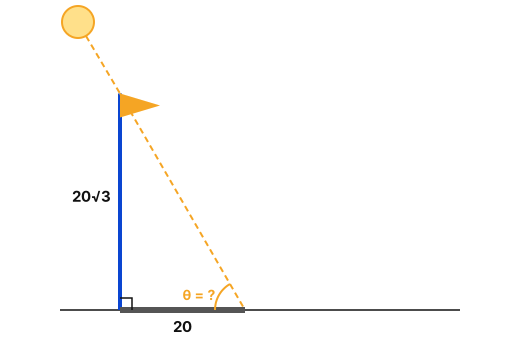
- .
- .
- So the sun's angle of elevation = 60°.
Trick: Height : shadow = .
Answer: (C) 60°
अवधारणा: ऊँचाई छाया की लंबाई।
- ।
- ।
- अतः सूर्य का उन्नयन कोण = 60°।
ट्रिक: ऊँचाई : छाया = ।
उत्तर: (C) 60°
SSC CGLQuantitative AptitudeHeights and distances – angle of elevationSSC CGL 2025 · 17 Sep Shift 1
Q810.A hollow metallic sphere has outer radius 14 cm and is melted to make 25 smaller solid spheres of radius 4 cm. What is the inner radius of the original sphere?
एक खोखले धात्विक गोले की बाह्य त्रिज्या 14 cm है; उसे पिघलाकर 4 cm त्रिज्या के 25 छोटे ठोस गोले बनाए जाते हैं। मूल गोले की आंतरिक त्रिज्या क्या है?
- A10.45 cm
- B17.48 cm
- C15.46 cm
- D16.44 cm
Show answer
Concept: Volume of metal stays the same: .
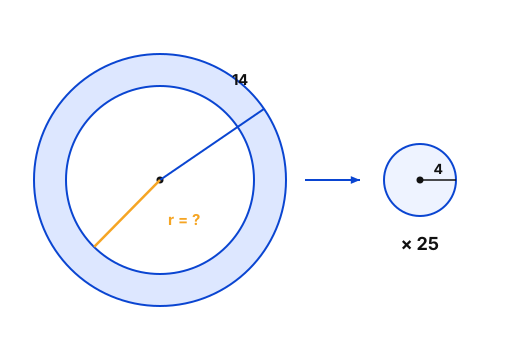
- Cancel : .
- .
- cm (since and ).
Trick: Inner radius must be less than 14 and between 1000 and 1331 – only 10.45 lies between 10 and 11.
Answer: (A) 10.45 cm
अवधारणा: धातु का आयतन नहीं बदलता: ।
- हटाएँ: ।
- ।
- सेमी (, )।
ट्रिक: आंतरिक त्रिज्या 14 से कम और 1000 से 1331 के बीच – केवल 10.45 ही 10 और 11 के बीच है।
उत्तर: (A) 10.45 cm
SSC CGLQuantitative AptitudeMensuration – recasting a hollow sphereSSC CGL 2025 · 17 Sep Shift 1
Q811.The volume of a hemisphere is numerically equal to five times its curved surface area. Find its radius.
एक अर्धगोले का आयतन संख्यात्मक रूप से उसके वक्र पृष्ठीय क्षेत्रफल के पाँच गुने के बराबर है। उसकी त्रिज्या ज्ञात कीजिए।
- A13 cm
- B15 cm
- C20 cm
- D11 cm
Show answer
Concept: Hemisphere: , .
- .
- Divide both sides by : .
- cm.
Trick: for a hemisphere is always (same as for a sphere). So .
Answer: (B) 15 cm
अवधारणा: अर्धगोला: , वक्र पृष्ठ ।
- ।
- दोनों ओर से भाग दें: ।
- सेमी।
ट्रिक: अर्धगोले (और गोले) में आयतन ÷ वक्र पृष्ठ = ; अतः ।
उत्तर: (B) 15 cm
SSC CGLQuantitative AptitudeHemisphere – volume vs curved surfaceSSC CGL 2025 · 17 Sep Shift 1
Q812.What is the minimum number of cuts required to divide a cuboid into 16 equal cuboids?
एक घनाभ को 16 समान घनाभों में बाँटने के लिए न्यूनतम कितने कट आवश्यक हैं?
- A3
- B4
- C5
- D6
Show answer
Concept: With a, b, c cuts along three directions, pieces = .
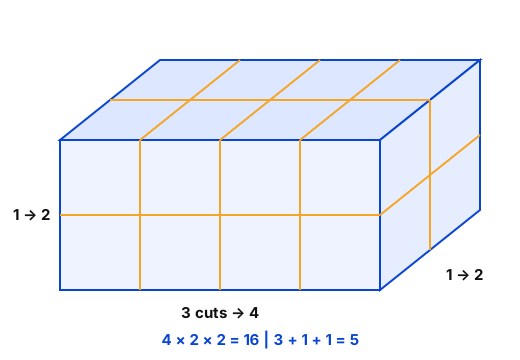
- Split 16 into three factors that are as close as possible: .
- 4 slices along one edge need 3 cuts; 2 slices along each other edge need 1 cut each → cuts.
- 4 cuts give at most pieces, which is not enough.
Trick: Spread the cuts evenly over the three directions – that gives the most pieces per cut.
Answer: (C) 5
अवधारणा: तीन दिशाओं में a, b, c कट से टुकड़े = ।
- 16 को तीन लगभग बराबर गुणनखंडों में तोड़ें: ।
- एक किनारे पर 4 भाग = 3 कट; बाकी दोनों किनारों पर 2-2 भाग = 1-1 कट → कुल कट।
- 4 कट से अधिकतम टुकड़े ही बनते हैं।
ट्रिक: कट तीनों दिशाओं में बराबर बाँटें – हर कट से अधिकतम टुकड़े मिलते हैं।
उत्तर: (C) 5
SSC CGLQuantitative AptitudeCube/cuboid cutting – minimum cutsSSC CGL 2025 · 17 Sep Shift 1
Q813.If the height of a cone is made four times and the radius is doubled, how does the volume change?
यदि किसी शंकु की ऊँचाई चार गुनी और त्रिज्या दोगुनी कर दी जाए, तो आयतन में क्या परिवर्तन होगा?
- ADoublesदोगुना हो जाता है
- BBecomes sixteen times of the originalमूल का सोलह गुना हो जाता है
- CBecomes one-third of the originalमूल का एक-तिहाई हो जाता है
- DRemains unchangedअपरिवर्तित रहता है
Show answer
Concept: Volume of a cone = , so .
- New radius 2r → becomes 4 times.
- New height 4h → 4 times.
- Volume factor = .
Trick: Just multiply (radius factor) × (height factor) = .
Answer: (B) Becomes sixteen times of the original
अवधारणा: शंकु का आयतन = , अतः ।
- त्रिज्या 2r → चार गुना।
- ऊँचाई 4h → चार गुना।
- आयतन = गुना।
ट्रिक: (त्रिज्या गुणक) × (ऊँचाई गुणक) = ।
उत्तर: (B) मूल का सोलह गुना हो जाता है
SSC CGLQuantitative AptitudeCone – effect of changing r and hSSC CGL 2025 · 17 Sep Shift 1
Q814.If sinθ = , and θ ∈ (0, ), then what is the value of tanθ?
यदि sinθ = और θ ∈ (0, ) है, तो tanθ का मान क्या है?
- A
- B
- C
- D
Show answer
Concept: ; find the base by Pythagoras.
- → perpendicular 15, hypotenuse 17.
- Base = .
- (positive, since θ is acute).
Trick: Remember the triplet 8-15-17; the numerator of sin stays as numerator of tan.
Answer: (C)
अवधारणा: ; आधार पाइथागोरस से निकालें।
- → लंब 15, कर्ण 17।
- आधार = ।
- (θ न्यून कोण, अतः धनात्मक)।
ट्रिक: त्रिक 8-15-17 याद रखें; sin का अंश tan में भी अंश रहता है।
उत्तर: (C)
SSC CGLQuantitative AptitudeTrigonometric ratios from a tripletSSC CGL 2025 · 17 Sep Shift 1
Q815.What is the value of tanX + cotX if tanX = 3?
यदि tanX = 3 है, तो tanX + cotX का मान क्या है?
- A
- B
- C
- D
Show answer
Concept: .
- .
- .
Trick: For any t, .
Answer: (A)
अवधारणा: ।
- ।
- ।
ट्रिक: किसी भी t के लिए ।
उत्तर: (A)
SSC CGLQuantitative AptitudeReciprocal trigonometric ratiosSSC CGL 2025 · 17 Sep Shift 1
Q816.What is the slope of the line 4x + 6y = 12?
रेखा 4x + 6y = 12 की प्रवणता क्या है?
- A−
- B
- C−
- D
Show answer
Concept: For , slope .
- Here .
- .
- Check: .
Trick: Slope = – no rearranging needed.
Answer: (A) −
अवधारणा: के लिए ढाल ।
- यहाँ ।
- ।
- जाँच: ।
ट्रिक: – समीकरण बदलने की ज़रूरत नहीं।
उत्तर: (A) −
SSC CGLQuantitative AptitudeCoordinate geometry – slope of a lineSSC CGL 2025 · 17 Sep Shift 1
Q817.A sector of a circle has a central angle of 90° and a radius of 10 cm. Another sector of the same circle has a central angle of radians. What is the ratio of the area of the first sector to the area of the second sector?
एक वृत्त के त्रिज्यखंड का केंद्रीय कोण 90° और त्रिज्या 10 cm है। उसी वृत्त के दूसरे त्रिज्यखंड का केंद्रीय कोण रेडियन है। पहले और दूसरे त्रिज्यखंड के क्षेत्रफलों का अनुपात क्या है?
- A2 : 3
- B1 : 2
- C1 : 1
- D1 : 3
Show answer
Concept: Area of a sector = ; radians .
- radians .
- Both sectors have angle 90° and the same radius 10 cm.
- So their areas are equal: ratio 1 : 1.
Trick: Same circle + same angle (after converting units) = same area – no calculation needed.
Answer: (C) 1 : 1
अवधारणा: त्रिज्यखंड का क्षेत्रफल = ; रेडियन ।
- रेडियन ।
- दोनों का कोण 90° और त्रिज्या समान (10 सेमी)।
- अतः क्षेत्रफल बराबर: अनुपात 1 : 1।
ट्रिक: एक ही वृत्त + इकाई बदलने पर समान कोण = समान क्षेत्रफल – गणना की ज़रूरत नहीं।
उत्तर: (C) 1 : 1
SSC CGLQuantitative AptitudeSector area – degrees and radiansSSC CGL 2025 · 17 Sep Shift 1
Q818.A triangle can have:
एक त्रिभुज में हो सकता है:
- Athree right anglesतीन समकोण
- BOne acute angle and one right angleएक न्यूनकोण और एक समकोण
- COnly one right or one obtuse angleकेवल एक समकोण या एक अधिककोण
- DThree obtuse angles each measuring less than 90°तीन अधिककोण, प्रत्येक 90° से कम
Show answer
Concept: Angle sum of a triangle = 180°.
- Two angles of 90° or more would already reach 180°, leaving nothing for the third angle.
- So a triangle can have at most one right angle or one obtuse angle.
- Option (B) is incomplete – a right triangle has two acute angles; (A) and (D) are impossible.
Yaad rakhein: Every triangle has at least two acute angles.
Answer: (C) Only one right or one obtuse angle
अवधारणा: त्रिभुज के कोणों का योग = 180°।
- यदि दो कोण 90° या उससे बड़े हों तो उनका योग ही 180° या अधिक होगा – तीसरा कोण शून्य या ऋणात्मक, जो असंभव है।
- इसलिए एक त्रिभुज में समकोण या अधिक कोण में से कोई एक ही, और वह भी केवल एक बार, आ सकता है।
- (B) अधूरा है – समकोण त्रिभुज में दो न्यून कोण होते हैं; (A) और (D) असंभव।
याद रखें: हर त्रिभुज में कम से कम दो न्यून कोण होते हैं।
उत्तर: (C) केवल एक समकोण या एक अधिककोण
SSC CGLQuantitative AptitudeTriangle – possible anglesSSC CGL 2025 · 17 Sep Shift 1
Q819.A line L is the perpendicular bisector of the line segment connecting points A(4, 10) and B(16, −2). What is the y-intercept of line L?
रेखा L बिंदुओं A(4, 10) और B(16, −2) को जोड़ने वाले रेखाखंड का लंब समद्विभाजक है। रेखा L का y-अंतःखंड क्या है?
- A−6
- B4
- C6
- D10
Show answer
Concept: The perpendicular bisector passes through the midpoint and has slope = .
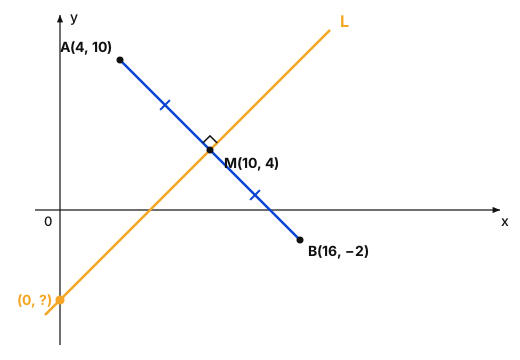
- Midpoint = .
- Slope AB = → slope of L = 1.
- L: .
- y-intercept = −6.
Trick: With slope 1, intercept at the midpoint .
Answer: (A) −6
अवधारणा: लंब समद्विभाजक मध्यबिंदु से गुज़रता है और उसकी ढाल = ।
- मध्यबिंदु = ।
- AB की ढाल = → L की ढाल = 1।
- L: ।
- y-अंतःखंड = −6।
ट्रिक: ढाल 1 हो तो c = मध्यबिंदु पर ।
उत्तर: (A) −6
SSC CGLQuantitative AptitudePerpendicular bisector – y-interceptSSC CGL 2025 · 17 Sep Shift 1
Q820.The area of a triangle PQR is 8 cm². If a similar triangle DEF has sides that are twice the length of △PQR's sides, what is the area of △DEF?
त्रिभुज PQR का क्षेत्रफल 8 cm² है। यदि समरूप त्रिभुज DEF की भुजाएँ △PQR की भुजाओं से दोगुनी हैं, तो △DEF का क्षेत्रफल क्या है?
- A32 cm²
- B48 cm²
- C64 cm²
- D80 cm²
Show answer
Concept: For similar triangles, area ratio = .
- Side ratio DEF : PQR = 2 : 1.
- Area ratio = .
- Area of DEF = cm².
Trick: Lengths → areas , volumes .
Answer: (A) 32 cm²
अवधारणा: समरूप त्रिभुजों में क्षेत्रफल का अनुपात = ।
- भुजाओं का अनुपात DEF : PQR = 2 : 1।
- क्षेत्रफल अनुपात = ।
- DEF का क्षेत्रफल = सेमी²।
ट्रिक: लंबाई → क्षेत्रफल , आयतन ।
उत्तर: (A) 32 cm²
SSC CGLQuantitative AptitudeSimilar triangles – ratio of areasSSC CGL 2025 · 17 Sep Shift 1

