Q821.42³ + 45³ − 63³ + 149 is equal to:
42³ + 45³ − 63³ + 149 किसके बराबर है?
- A−84685
- B0
- C−78659
- D1
Show answer
Concept: Compute each cube, then combine; use unit digits to check.
- → sum = 165213.
- .
- ; .
Trick: All three bases share 3: . Answer is negative, so (A) or (C); ends in 5 → (A).
Answer: (A) −84685
अवधारणा: हर घन निकालें, फिर जोड़-घटाव करें; इकाई अंक से जाँचें।
- → योग = 165213।
- ।
- ; ।
ट्रिक: तीनों आधारों में 3 साझा: । उत्तर ऋणात्मक – (A) या (C); इकाई अंक 5 → (A)।
उत्तर: (A) −84685
SSC CGLQuantitative AptitudeSimplification – sum of cubesSSC CGL 2025 · 17 Sep Shift 1
Q822.If sinB + cosB = , find sin2B.
यदि sinB + cosB = है, तो sin2B ज्ञात कीजिए।
- A
- B
- C
- D
Show answer
Concept: .
- .
- .
- .
Trick: – one line.
Answer: (D)
अवधारणा: ।
- ।
- ।
- ।
ट्रिक: (दिया गया मान) – एक पंक्ति में।
उत्तर: (D)
SSC CGLQuantitative AptitudeTrigonometry – sin 2B from sin B + cos BSSC CGL 2025 · 17 Sep Shift 1
Q823.From an outside point T, two tangents, TP and TQ, are drawn to a circle. Given that the length of TP is 15 cm, what is the length of TQ?
बाहरी बिंदु T से एक वृत्त पर दो स्पर्श रेखाएँ TP और TQ खींची गई हैं। यदि TP की लंबाई 15 cm है, तो TQ की लंबाई क्या है?
- A16 cm
- B10 cm
- C15 cm
- D24 cm
Show answer
Concept: The two tangent segments from one outside point to a circle are equal in length.
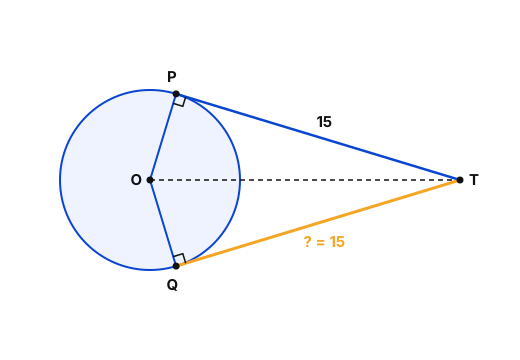
- T is the external point; TP and TQ are both tangents from T.
- So cm.
Yaad rakhein: A tangent is perpendicular to the radius at the point of contact, so .
Answer: (C) 15 cm
अवधारणा: किसी बाहरी बिंदु से वृत्त पर खींची गई दोनों स्पर्श रेखाओं की लंबाई बराबर होती है।
- T बाहरी बिंदु है; TP और TQ दोनों T से स्पर्श रेखाएँ हैं।
- अतः सेमी।
याद रखें: स्पर्श बिंदु पर स्पर्श रेखा त्रिज्या पर लंब होती है, इसलिए ।
उत्तर: (C) 15 cm
SSC CGLQuantitative AptitudeCircle – tangents from an external pointSSC CGL 2025 · 17 Sep Shift 1
Q824.A circle is inscribed within a right triangle. Considering that the lengths of the two legs measure 12 cm and 16 cm, what is the radius of the inscribed circle?
एक समकोण त्रिभुज के अंदर वृत्त अंकित है। यदि दोनों भुजाएँ 12 cm और 16 cm हैं, तो अंतःवृत्त की त्रिज्या क्या है?
- A6 cm
- B9 cm
- C4 cm
- D5 cm
Show answer
Concept: For a right triangle with legs a, b and hypotenuse c, inradius .
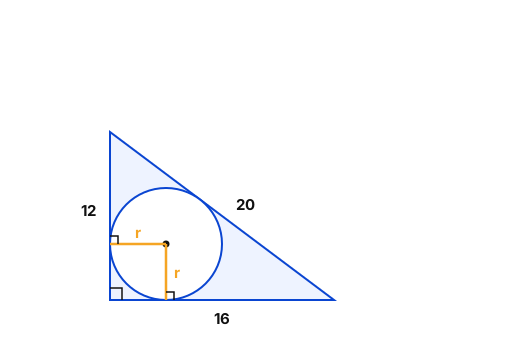
- cm.
- cm.
- Check with : area = 96, s = 24 → r = 4 ✓
Trick: 12-16-20 is 4 × (3-4-5); the 3-4-5 triangle has r = 1, so here .
Answer: (C) 4 cm
अवधारणा: समकोण त्रिभुज (भुजाएँ a, b, कर्ण c) में अंतःत्रिज्या ।
- सेमी।
- सेमी।
- जाँच r = क्षेत्रफल/s: क्षेत्रफल = 96, s = 24 → r = 4 ✓
ट्रिक: 12-16-20 = 4 × (3-4-5); 3-4-5 का r = 1, इसलिए यहाँ r = 4।
उत्तर: (C) 4 cm
SSC CGLQuantitative AptitudeIncircle of a right triangleSSC CGL 2025 · 17 Sep Shift 1
Q825.If a = 0.04, b = 0.06, c = −0.10, and a + b + c = 0, find (a³ + b³ + c³) ÷ (3abc).
यदि a = 0.04, b = 0.06, c = −0.10 और a + b + c = 0 है, तो (a³ + b³ + c³) ÷ (3abc) ज्ञात कीजिए।
- A−1
- B0
- C1
- D−2
Show answer
Concept: If , then .
- ✓
- So .
- .
Trick: Whenever the sum is zero, this ratio is always 1 – no decimals to compute.
Answer: (C) 1
अवधारणा: यदि , तो ।
- ✓
- अतः ।
- ।
ट्रिक: योग शून्य हो तो यह अनुपात हमेशा 1 – दशमलव गणना की ज़रूरत नहीं।
उत्तर: (C) 1
SSC CGLQuantitative AptitudeIdentity – a³ + b³ + c³ when a + b + c = 0SSC CGL 2025 · 17 Sep Shift 1
Q826.Convert 4.625 into a fraction in simplest form.
4.625 को सरलतम भिन्न में बदलिए।
- A
- B
- C
- D
Show answer
Concept: Write the decimal part over a power of 10 and simplify.
- .
- Divide by 125: , .
- .
Trick: (memorise eighths: 0.125, 0.25, 0.375, 0.5, 0.625…). So .
Answer: (A)
अवधारणा: दशमलव को 10 की घात के हर वाली भिन्न में लिखकर सरल करें।
- 125 से भाग: ,
ट्रिक: याद रखें।
उत्तर: (A)
SSC CGLQuantitative AptitudeDecimal to fractionSSC CGL 2025 · 16 Sep Shift 3
Q827.If 20% of a is equal to 15% of b, then find the ratio a : b.
यदि a का 20%, b के 15% के बराबर है, तो अनुपात a : b ज्ञात कीजिए।
- A6 : 5
- B3 : 4
- C2 : 5
- D5 : 4
Show answer
Concept: If x% of a = y% of b, then a : b = y : x.
- .
- .
- a : b = 3 : 4.
Trick: Cross the percentages: a : b = 15 : 20 = 3 : 4.
Answer: (B) 3 : 4
अवधारणा: यदि a का x% = b का y%, तो a : b = y : x
- a : b = 3 : 4
ट्रिक: प्रतिशत उलटकर लिखें: a : b = 15 : 20 = 3 : 4
उत्तर: (B) 3 : 4
SSC CGLQuantitative AptitudePercentage – finding a ratioSSC CGL 2025 · 16 Sep Shift 3
Q828.What should be subtracted from 5, 8, 7, 12 so that the remaining numbers may be proportional?
5, 8, 7, 12 में से क्या घटाया जाए कि शेष संख्याएँ समानुपाती हो जाएँ?
- A2
- B3
- C4
- D5
Show answer
Concept: a : b :: c : d means .
- .
- .
- . Check: 3 : 6 = 5 : 10 = 1 : 2 ✓.
Trick: Shortcut .
Answer: (A) 2
अवधारणा: a : b :: c : d हो तो
- ; जाँच: 3 : 6 = 5 : 10 ✓
ट्रिक: सूत्र
उत्तर: (A) 2
SSC CGLQuantitative AptitudeProportion – subtracting a numberSSC CGL 2025 · 16 Sep Shift 3
Q829.Find the difference: 7.4 − (2 + 2.75)
अंतर ज्ञात कीजिए: 7.4 − (2 + 2.75)
- A7.822
- B1.775
- C1.522
- D2.025
Show answer
Concept: Convert everything to decimals, solve the bracket first.
- is (the mixed number in the question).
- Bracket sum: .
- Difference: .
Trick: Last decimal digit: ends in 5 — only 1.775 and 2.025 fit; the bracket ≈ 5.6, so .
Answer: (B) 1.775
अवधारणा: सब कुछ दशमलव में बदलें और पहले कोष्ठक हल करें।
- कोष्ठक का योग:
- अंतर:
ट्रिक: कोष्ठक ≈ 5.6, तो — निकटतम विकल्प 1.775।
उत्तर: (B) 1.775
SSC CGLQuantitative AptitudeFractions and decimals – simplificationSSC CGL 2025 · 16 Sep Shift 3
Q830.Sumit starts a business with ₹80,000. Three months later, Sachin joins with ₹1,00,000. Six months after starting, Sumit increases his investment by ₹40,000. Sachin leaves the business three months before the end of the year. What is their profit-sharing ratio?
सुमित ₹80,000 से व्यवसाय शुरू करता है। तीन माह बाद सचिन ₹1,00,000 लेकर जुड़ता है। शुरुआत के छह माह बाद सुमित अपना निवेश ₹40,000 बढ़ा देता है। सचिन वर्ष समाप्त होने से तीन माह पहले व्यवसाय छोड़ देता है। उनका लाभ-विभाजन अनुपात क्या है?
- A7 : 4
- B2 : 1
- C1 : 4
- D1 : 2
Show answer
Concept: Profit share capital time (in months).
- Sumit: ₹80k for months 1–6 and ₹120k for months 7–12 ⇒ (₹ thousand-months).
- Sachin: in from month 4 to month 9 = 6 months ⇒ .
- Ratio = 1200 : 600 = 2 : 1.
Trick: Both of Sumit's periods are 6 months, so just add his capitals () and compare with Sachin's 100 for the same 6 months ⇒ 2 : 1.
Answer: (B) 2 : 1
अवधारणा: लाभ का हिस्सा पूँजी समय (महीनों में)।
- सुमित: हज़ार हज़ार
- सचिन: चौथे से नौवें माह तक = 6 माह ⇒ हज़ार हज़ार
- अनुपात = 1200 : 600 = 2 : 1
ट्रिक: हज़ार में गणना करें: और ⇒ 2 : 1
उत्तर: (B) 2 : 1
SSC CGLQuantitative AptitudePartnership – changing investmentSSC CGL 2025 · 16 Sep Shift 3
Q831.The average age of 21 students is 17 years. A teacher joins the group, and the average becomes 20 years. What is the teacher's age?
21 विद्यार्थियों की औसत आयु 17 वर्ष है। एक शिक्षक के जुड़ने पर औसत 20 वर्ष हो जाता है। शिक्षक की आयु क्या है?
- A72
- B83
- C65
- D73
Show answer
Concept: New person = new total − old total.
- Old total = .
- New total = .
- Teacher = years.
Trick: Teacher = new average + (old count rise) = .
Answer: (B) 83
अवधारणा: नया व्यक्ति = नया योग − पुराना योग
- पुराना योग =
- नया योग =
- शिक्षक की आयु = वर्ष
ट्रिक: शिक्षक = नया औसत + (पुरानी संख्या वृद्धि) =
उत्तर: (B) 83
SSC CGLQuantitative AptitudeAverage – new member joinsSSC CGL 2025 · 16 Sep Shift 3
Q832.The average salary of a team of 90 employees is ₹58,000. If the average salary of 40 of them is ₹68,000, what is the average salary of the remaining employees?
90 कर्मचारियों की टीम का औसत वेतन ₹58,000 है। यदि उनमें से 40 का औसत वेतन ₹68,000 है, तो शेष कर्मचारियों का औसत वेतन क्या है?
- A₹52,000
- B₹48,000
- C₹50,000
- D₹54,000
Show answer
Concept: Use deviations from the overall average.
- 40 people are ₹10,000 above ₹58,000 ⇒ excess = ₹4,00,000.
- The other 50 must be short by the same ₹4,00,000 ⇒ ₹8,000 each.
- Average = ₹50,000.
Trick: Deviation method avoids big totals: below.
Answer: (C) ₹50,000
अवधारणा: कुल औसत से विचलन (deviation) का प्रयोग करें।
- 40 कर्मचारी औसत से ₹10,000 अधिक ⇒ कुल अधिकता = ₹4,00,000
- शेष 50 को उतना ही कम होना चाहिए ⇒ प्रत्येक ₹8,000 कम
- औसत = ₹50,000
ट्रिक: बड़े योग की ज़रूरत नहीं: कम।
उत्तर: (C) ₹50,000
SSC CGLQuantitative AptitudeAverage of remaining groupSSC CGL 2025 · 16 Sep Shift 3
Q833.A sum of money at compound interest doubles its original amount in 3 years. In how many years will it become 64 times its original amount?
चक्रवृद्धि ब्याज पर कोई राशि 3 वर्ष में दोगुनी हो जाती है। वह कितने वर्षों में 64 गुनी हो जाएगी?
- A16
- B20
- C14
- D18
Show answer
Concept: Under CI, if money becomes k times in T years, it becomes times in nT years.
- 2 times in 3 years.
- .
- Time = years.
Trick: Keep doubling: 2(3), 4(6), 8(9), 16(12), 32(15), 64(18 years).
Answer: (D) 18
अवधारणा: चक्रवृद्धि में राशि T वर्ष में k गुनी हो, तो nT वर्ष में गुनी होती है।
- 3 वर्ष में 2 गुनी
- समय = वर्ष
ट्रिक: दोगुना करते जाएँ: 2(3), 4(6), 8(9), 16(12), 32(15), 64(18 वर्ष)
उत्तर: (D) 18
SSC CGLQuantitative AptitudeCompound interest – multiplying timeSSC CGL 2025 · 16 Sep Shift 3
Q834.If the ratio between the loss and cost price of an article is 1 : 5, then the ratio between its selling price and cost price is ____.
यदि किसी वस्तु की हानि और क्रय मूल्य का अनुपात 1 : 5 है, तो उसके विक्रय मूल्य और क्रय मूल्य का अनुपात क्या होगा?
- A9 : 10
- B4 : 5
- C2 : 5
- D7 : 10
Show answer
Concept: .
- Loss : CP = 1 : 5 ⇒ take Loss = 1, CP = 5.
- .
- SP : CP = 4 : 5.
Trick: Loss is ⇒ SP is 80% of CP .
Answer: (B) 4 : 5
अवधारणा: विक्रय मूल्य = क्रय मूल्य − हानि
- हानि : CP = 1 : 5 ⇒ हानि = 1, CP = 5
- SP : CP = 4 : 5
ट्रिक: हानि ⇒ SP, CP का
उत्तर: (B) 4 : 5
SSC CGLQuantitative AptitudeProfit and loss – ratio formSSC CGL 2025 · 16 Sep Shift 3
Q835.An item costs ₹300. A customer gets a 20% discount on it. If the seller still makes a 25% profit, what is the cost price of the item?
एक वस्तु का मूल्य ₹300 है। ग्राहक को उस पर 20% छूट मिलती है। यदि विक्रेता को फिर भी 25% लाभ होता है, तो वस्तु का क्रय मूल्य क्या है?
- A₹192
- B₹209
- C₹186
- D₹159
Show answer
Concept: , and .
- ₹240.
- .
- ₹192.
Trick: profit ⇒ CP : SP = 4 : 5. So .
Answer: (A) ₹192
अवधारणा: SP = अंकित मूल्य × (1 − छूट%), CP = SP ÷ (1 + लाभ%)
- ₹240
- ₹192
ट्रिक: 25% लाभ CP : SP = 4 : 5;
उत्तर: (A) ₹192
SSC CGLQuantitative AptitudeDiscount and profit – finding CPSSC CGL 2025 · 16 Sep Shift 3
Q836.A web developer sells a premium website template to a distributor at a 25% discount. An additional 10% service fee is added to the discounted price. The distributor then sells the template for ₹9000 more, earning a 20% profit. What is the original marked price of the template fixed by the developer?
एक वेब डेवलपर एक प्रीमियम टेम्पलेट वितरक को 25% छूट पर बेचता है। छूट वाली कीमत पर 10% सेवा शुल्क जोड़ा जाता है। वितरक फिर उसे ₹9000 अधिक में बेचकर 20% लाभ कमाता है। डेवलपर द्वारा तय मूल अंकित मूल्य क्या है?
- A₹55,550.45
- B₹57,545.35
- C₹56,540.25
- D₹54,545.45
Show answer
Concept: Assume MP = 100 and follow each % change.
- After 25% discount: 75. Add 10% fee: = distributor's cost.
- 20% profit = units.
- 16.5 units = ₹9000 ⇒ 100 units = ₹54,545.45.
Trick: Net factor = ⇒ .
Answer: (D) ₹54,545.45
अवधारणा: अंकित मूल्य = 100 मानकर हर प्रतिशत बदलाव लगाएँ।
- 25% छूट के बाद 75; 10% शुल्क जोड़ने पर = वितरक का क्रय मूल्य
- 20% लाभ = इकाई
- 16.5 इकाई = ₹9000 ⇒ 100 इकाई = ₹54,545.45
ट्रिक: कुल गुणक = ⇒
उत्तर: (D) ₹54,545.45
SSC CGLQuantitative AptitudeSuccessive discount, fee and profitSSC CGL 2025 · 16 Sep Shift 3
Q837.A 120-litre mixture contains milk and water in the ratio 5 : 3. If 'x' litres of milk and 'x' litres of water are added to the mixture, the new ratio of milk to water becomes 3 : 2. What is the value of 'x'?
120 लीटर मिश्रण में दूध और पानी 5 : 3 के अनुपात में हैं। यदि x लीटर दूध और x लीटर पानी मिलाया जाए, तो नया अनुपात 3 : 2 हो जाता है। x का मान क्या है?
- A12.33 litres12.33 लीटर
- B11.54 litres11.54 लीटर
- C15 litres15 लीटर
- D30 litres30 लीटर
Show answer
Concept: Find each part, add x to both, equate to the new ratio.
- Milk = L; water = L.
- .
- L.
Trick: Adding equal amounts keeps the difference fixed: = 1 part of 3 : 2 ⇒ milk = 90 ⇒ .
Answer: (C) 15 litres
अवधारणा: दोनों भाग निकालें, दोनों में x जोड़ें और नए अनुपात के बराबर रखें।
- दूध = L; पानी = L
- L
ट्रिक: बराबर मात्रा मिलाने पर अंतर नहीं बदलता: = 3 : 2 का 1 भाग ⇒ दूध 90 ⇒
उत्तर: (C) 15 लीटर
SSC CGLQuantitative AptitudeMixture – adding equal quantitiesSSC CGL 2025 · 16 Sep Shift 3
Q838.A sphere is completely contained within a cylinder, with the height and diameter of the cylinder matching the diameter of the sphere. Given that the volume of the sphere is 288π cm³, what is the volume of the vacant space inside the cylinder?
एक गोला बेलन के भीतर पूर्णतः समाया है; बेलन की ऊँचाई और व्यास गोले के व्यास के बराबर हैं। यदि गोले का आयतन 288π cm³ है, तो बेलन के भीतर रिक्त स्थान का आयतन क्या है?
- A122π cm³
- B169π cm³
- C144π cm³
- D196π cm³
Show answer
Concept: For a sphere fitting exactly in a cylinder, sphere : cylinder volume = 2 : 3.
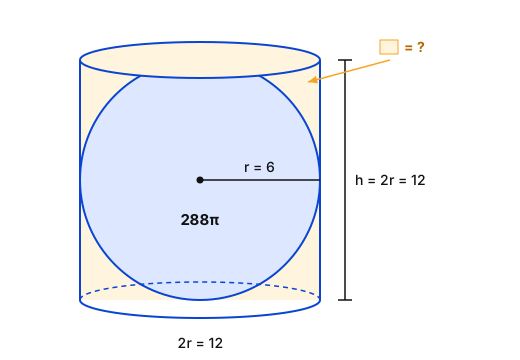
- cm.
- Cylinder = .
- Empty space = cm³.
Trick: Using 2 : 3, cylinder = ; empty part = half of the sphere = .
Answer: (C) 144π cm³
अवधारणा: बेलन में ठीक समाए गोले के लिए गोला : बेलन आयतन = 2 : 3
- cm
- बेलन =
- रिक्त स्थान = cm³
ट्रिक: 2 : 3 से रिक्त भाग = गोले का आधा =
उत्तर: (C) 144π cm³
SSC CGLQuantitative AptitudeSphere inside cylinder – empty spaceSSC CGL 2025 · 16 Sep Shift 3
Q839.A solid hemisphere is melted to form a cone whose radius is half that of the hemisphere. Find the height of the resulting cone.
एक ठोस अर्धगोले को पिघलाकर ऐसा शंकु बनाया जाता है जिसकी त्रिज्या अर्धगोले की आधी है। बने शंकु की ऊँचाई ज्ञात कीजिए।
- A4R
- B6R
- C8R
- D10R
Show answer
Concept: On melting and recasting, volume stays the same.
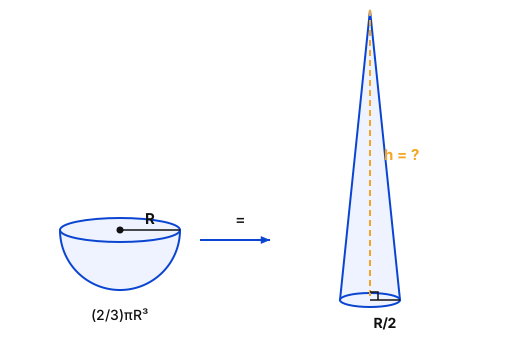
- Hemisphere volume = .
- Cone with radius : .
- .
Trick: Same-radius cone of a hemisphere has ; halving the radius makes area , so h becomes .
Answer: (C) 8R
अवधारणा: पिघलाकर नई आकृति बनाने पर आयतन समान रहता है।
- अर्धगोले का आयतन =
- त्रिज्या वाला शंकु:
ट्रिक: समान त्रिज्या पर शंकु की ऊँचाई 2R होती; त्रिज्या आधी करने पर आधार , अतः ऊँचाई
उत्तर: (C) 8R
SSC CGLQuantitative AptitudeRecasting – hemisphere into coneSSC CGL 2025 · 16 Sep Shift 3
Q840.Two solid hemispheres of radii 5 cm and 9 cm respectively are melted and recast into a single hemisphere. What is the approximate radius of the new hemisphere formed?
5 cm और 9 cm त्रिज्या वाले दो ठोस अर्धगोलों को पिघलाकर एक अर्धगोला बनाया जाता है। नए अर्धगोले की अनुमानित त्रिज्या क्या है?
- A9.5 cm
- B10.2 cm
- C10.5 cm
- D11 cm
Show answer
Concept: Volumes add; for the same shape, volume .
- .
- and , so R is just below 9.5 ().
- cm.
Trick: Test the smallest option: — done.
Answer: (A) 9.5 cm
अवधारणा: आयतन जुड़ते हैं; समान आकृति में आयतन
- , जो 854 के बहुत पास है।
- cm
ट्रिक: सबसे छोटे विकल्प का घन जाँचें:
उत्तर: (A) 9.5 cm
SSC CGLQuantitative AptitudeRecasting two hemispheres into oneSSC CGL 2025 · 16 Sep Shift 3

