Q861.P, Q, and R can complete a certain task in 20, 30, and 60 days, respectively. How many days will it take for P to finish the work if he receives help from Q and R every third day?
P, Q और R किसी कार्य को क्रमशः 20, 30 और 60 दिनों में पूरा कर सकते हैं। यदि P को हर तीसरे दिन Q और R की सहायता मिले, तो P कार्य कितने दिनों में पूरा करेगा?
- A15 days15 दिन
- B16 days16 दिन
- C9 days9 दिन
- D5 days5 दिन
Show answer
Concept: Use LCM units and count work in 3-day cycles.
- Take work = 60 units (LCM); daily efficiencies 3, 2, 1 for P, Q, R.
- Cycle: day 1, 2 → P alone 3 + 3; day 3 → . Total 12 units per 3 days.
- cycles = 15 days.
Trick: P+Q+R together = 6/day → they need 10 days alone; any answer below that (C, D) is impossible.
Answer: (A) 15 days
अवधारणा: LCM इकाइयाँ लें और 3-दिन के चक्र में काम गिनें।
- काम = 60 इकाई (LCM) मानें; प्रतिदिन क्षमता – P, Q, R क्रमशः 3, 2, 1।
- चक्र: दिन 1, 2 → केवल P = 6; दिन 3 → ; कुल 12 इकाई/3 दिन।
- चक्र = 15 दिन।
ट्रिक: तीनों साथ भी 10 दिन लेंगे; 10 से कम वाले विकल्प (C, D) असंभव।
उत्तर: (A) 15 दिन
SSC CGLQuantitative AptitudeTime & work – help on alternate daysSSC CGL 2025 · 16 Sep Shift 2
Q862.Two distinct varieties of wheat, valued at ₹80 per kilogram and ₹120 per kilogram respectively, are combined in an unknown ratio. The resulting mixture is sold at ₹130 per kilogram, yielding a profit of 25% on the aggregate cost price. Determine the ratio in which the two wheat varieties were blended.
₹80 प्रति किग्रा और ₹120 प्रति किग्रा की दो किस्मों का गेहूँ किसी अज्ञात अनुपात में मिलाया जाता है। मिश्रण ₹130 प्रति किग्रा पर बेचने से कुल क्रय मूल्य पर 25% लाभ होता है। दोनों किस्मों को किस अनुपात में मिलाया गया?
- A1 : 3
- B3 : 4
- C2 : 3
- D4 : 1
Show answer
Concept: First remove profit to get the mixture's cost price, then use alligation.
- CP of mixture = ₹104/kg.
- Cheaper : dearer = .
- = 2 : 3.
Trick: Never alligate with the selling price – convert to CP first.
Answer: (C) 2 : 3
अवधारणा: पहले लाभ हटाकर मिश्रण का क्रय मूल्य, फिर एलिगेशन।
- मिश्रण का CP = ₹104/kg।
- सस्ता : महँगा = ।
- = 2 : 3।
ट्रिक: एलिगेशन हमेशा क्रय मूल्य से लगाएँ, विक्रय मूल्य से नहीं।
उत्तर: (C) 2 : 3
SSC CGLQuantitative AptitudeAlligation – mixture of wheatSSC CGL 2025 · 16 Sep Shift 2
Q863.The ratio of the speeds of a car and a bus is 3 : 4. If the bus covers a distance of 480 km in 6 hours, what is the speed of the car in km/h?
एक कार और बस की चालों का अनुपात 3 : 4 है। यदि बस 6 घंटे में 480 km दूरी तय करती है, तो कार की चाल km/h में क्या है?
- A60 km/h
- B65 km/h
- C70 km/h
- D80 km/h
Show answer
Concept: Find the bus speed, then scale by the ratio.
- Bus speed = km/h.
- Car = km/h.
Trick: Ratio 3 : 4 means car is 25% slower: .
Answer: (A) 60 km/h
अवधारणा: बस की चाल निकालें, फिर अनुपात से गुणा करें।
- बस की चाल = km/h।
- कार = km/h।
ट्रिक: 3 : 4 यानी कार 25% धीमी: ।
उत्तर: (A) 60 km/h
SSC CGLQuantitative AptitudeSpeed ratioSSC CGL 2025 · 16 Sep Shift 2
Q864.An individual invested certain amounts in three different schemes A, B, and C at simple interest rates of 7% p.a., 9% p.a., and 11% p.a. respectively. If the total interest accrued in one year was ₹2520 and the amount invested in Scheme C was 250% of the amount invested in Scheme A and 300% of the amount invested in Scheme B, what was the amount invested in Scheme A?
एक व्यक्ति ने तीन योजनाओं A, B और C में क्रमशः 7%, 9% और 11% वार्षिक साधारण ब्याज पर कुछ राशि निवेश की। यदि एक वर्ष में कुल ब्याज ₹2520 मिला और योजना C में निवेश, योजना A के निवेश का 250% तथा योजना B के निवेश का 300% था, तो योजना A में निवेश की गई राशि क्या थी?
- A₹3000
- B₹5500
- C₹6000
- D₹6500
Show answer
Concept: Express all amounts through C, then add one-year interests.
- . Take C = 30k → A = 12k, B = 10k.
- Interest: 7% of 12k + 9% of 10k + 11% of 30k = .
- ₹6000.
Trick: Pick C as LCM of 2.5 and 3 multiples (30) to avoid fractions.
Answer: (C) ₹6000
अवधारणा: सभी राशियाँ C के रूप में लिखें, फिर एक वर्ष के ब्याज जोड़ें।
- ; C = 30k लें → A = 12k, B = 10k।
- ब्याज: 12k का 7% + 10k का 9% + 30k का 11% = ।
- ₹6000।
ट्रिक: C = 30k लेने से भिन्न नहीं आते।
उत्तर: (C) ₹6000
SSC CGLQuantitative AptitudeSimple interest – three schemesSSC CGL 2025 · 16 Sep Shift 2
Q865.A tower stands 60 meters tall. From its peak, the angles of depression to the top and bottom of a nearby building are measured at 45° and 60°, respectively. Determine the approximate height of the building as well as the horizontal distance separating the tower from the building.
एक मीनार 60 मीटर ऊँची है। उसके शिखर से पास की एक इमारत के शीर्ष और तल के अवनमन कोण क्रमशः 45° और 60° हैं। इमारत की अनुमानित ऊँचाई तथा मीनार और इमारत के बीच क्षैतिज दूरी ज्ञात कीजिए।
- Aheight = 21 m, distance = 50 mऊँचाई = 21 m, दूरी = 50 m
- Bheight = 25 m, distance = 35 mऊँचाई = 25 m, दूरी = 35 m
- Cheight = 28 m, distance = 15 mऊँचाई = 28 m, दूरी = 15 m
- Dheight = 18 m, distance = 15 mऊँचाई = 18 m, दूरी = 15 m
Show answer
Concept: Angle of depression from the tower top = angle of elevation from the object.
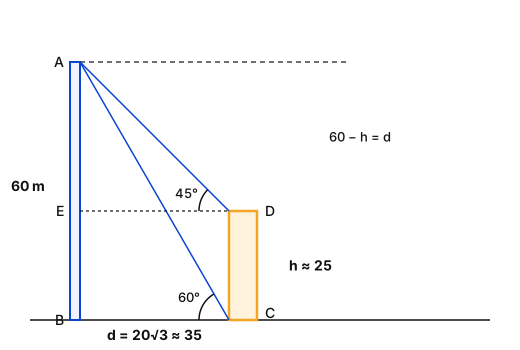
- Base of building at 60°: m.
- Top of building at 45°: drop from tower top = d ≈ 34.6 m.
- Building height = m → ≈ 25 m, distance ≈ 35 m.
Trick: 45° means vertical gap = horizontal gap; so height + distance = tower height () – only (B) fits.
Answer: (B) height = 25 m, distance = 35 m
अवधारणा: टावर के शीर्ष से अवनमन कोण = वस्तु से उन्नयन कोण।
- इमारत का आधार 60° पर: m।
- इमारत का शीर्ष 45° पर: टावर शीर्ष से ऊर्ध्व अंतर = d ≈ 34.6 m।
- इमारत की ऊँचाई = m, दूरी ≈ 35 m।
ट्रिक: 45° पर ऊर्ध्व अंतर = क्षैतिज दूरी; अतः ऊँचाई + दूरी = 60 – केवल (B)।
उत्तर: (B) ऊँचाई = 25 m, दूरी = 35 m
SSC CGLQuantitative AptitudeHeights & distances – angles of depressionSSC CGL 2025 · 16 Sep Shift 2
Q866.A sphere is melted and recast into 8 identical cones, each with diameter 6 cm and height 4 cm. What was the radius of the original sphere?
एक गोले को पिघलाकर 8 समान शंकु बनाए जाते हैं, प्रत्येक का व्यास 6 cm और ऊँचाई 4 cm है। मूल गोले की त्रिज्या क्या थी?
- A4.16 cm
- B3.26 cm
- C4.26 cm
- D5.56 cm
Show answer
Concept: Volume stays the same: sphere = 8 × cone.
- Cone: r = 3, h = 4 → .
- 8 cones = .
- cm.
Trick: and → R is just under 4.2.
Answer: (A) 4.16 cm
अवधारणा: आयतन समान रहता है: गोला = 8 × शंकु।
- शंकु: r = 3, h = 4 → ।
- 8 शंकु = ।
- cm।
ट्रिक: और → R, 4.2 से थोड़ा कम।
उत्तर: (A) 4.16 cm
SSC CGLQuantitative AptitudeMensuration – recasting solidsSSC CGL 2025 · 16 Sep Shift 2
Q867.The area of a regular octagon is made of how many isosceles triangles?
एक सम अष्टभुज का क्षेत्रफल कितने समद्विबाहु त्रिभुजों से मिलकर बनता है?
- A6
- B7
- C8
- D9
Show answer
Concept: Joining the centre to every vertex of a regular n-gon gives n congruent isosceles triangles.
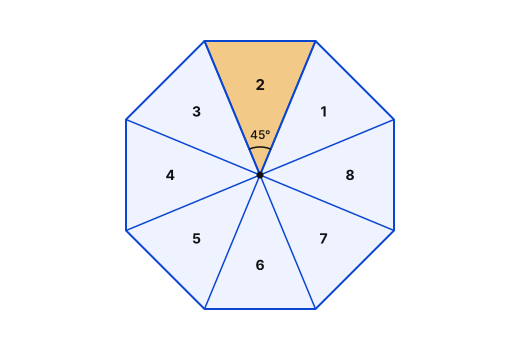
- Two sides of each triangle are radii (equal) → isosceles.
- Octagon has 8 vertices/sides → 8 triangles, each with a centre angle .
Yaad rakhein: A regular hexagon gives 6 such triangles – and they are equilateral.
Answer: (C) 8
अवधारणा: सम n-भुज के केंद्र को हर शीर्ष से जोड़ने पर n सर्वांगसम समद्विबाहु त्रिभुज बनते हैं।
- हर त्रिभुज की दो भुजाएँ त्रिज्याएँ (बराबर) → समद्विबाहु।
- अष्टभुज की 8 भुजाएँ → 8 त्रिभुज, केंद्र कोण ।
याद रखें: सम षट्भुज से 6 त्रिभुज बनते हैं – और वे समबाहु होते हैं।
उत्तर: (C) 8
SSC CGLQuantitative AptitudeRegular polygon – triangles from centreSSC CGL 2025 · 16 Sep Shift 2
Q868.A circular fountain with a diameter of 14 m is encircled by a grass bed that is 3.5 m wide. Determine the ratio of the area of the grass bed to the area of the fountain.
14 m व्यास के एक वृत्ताकार फव्वारे के चारों ओर 3.5 m चौड़ी घास की क्यारी है। घास की क्यारी और फव्वारे के क्षेत्रफलों का अनुपात ज्ञात कीजिए।
- A5 : 3
- B3 : 4
- C5 : 4
- D4 : 1
Show answer
Concept: Ring area = .
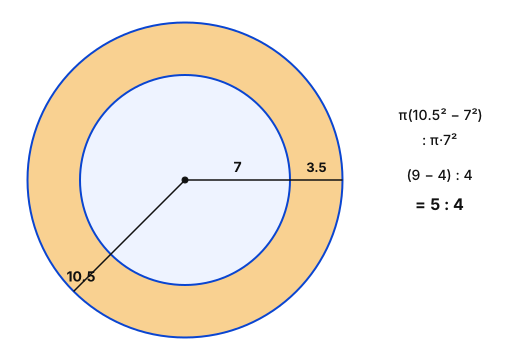
- r = 7 m, m.
- Ring : fountain = .
- = 5 : 4.
Trick: → ring : circle .
Answer: (C) 5 : 4
अवधारणा: वलय का क्षेत्रफल = ।
- r = 7 m, R = 10.5 m।
- वलय : फव्वारा = ।
- = 5 : 4।
ट्रिक: → वलय : वृत्त ।
उत्तर: (C) 5 : 4
SSC CGLQuantitative AptitudeCircular ring areaSSC CGL 2025 · 16 Sep Shift 2
Q869.A tent designed as a triangular prism features a triangular base with an area of 30 m² and a height of 7 m. What is the volume of this tent?
त्रिभुजाकार प्रिज्म के आकार के एक तंबू का त्रिभुजाकार आधार 30 m² क्षेत्रफल और 7 m ऊँचाई (लंबाई) का है। तंबू का आयतन क्या है?
- A210 m³
- B200 m³
- C220 m³
- D140 m³
Show answer
Concept: Prism volume = area of cross-section × length.
- Base (triangle) area = 30 m², length/height = 7 m.
- Volume = m³.
Yaad rakhein: Same rule for every prism or cylinder: base area × height.
Answer: (A) 210 m³
अवधारणा: प्रिज़्म का आयतन = अनुप्रस्थ काट का क्षेत्रफल × लंबाई।
- त्रिभुजाकार आधार = 30 m², ऊँचाई = 7 m।
- आयतन = m³।
याद रखें: हर प्रिज़्म/बेलन के लिए: आधार क्षेत्रफल × ऊँचाई।
उत्तर: (A) 210 m³
SSC CGLQuantitative AptitudeVolume of a prismSSC CGL 2025 · 16 Sep Shift 2
Q870.Which line has slope 2 and passes through (1, 4)?
कौन-सी रेखा की प्रवणता 2 है और वह (1, 4) से गुजरती है?
- Ay = 2x + 1
- By = 2x + 2
- Cy = 2x + 3
- Dy = x + 3
Show answer
Concept: Slope-intercept form: y = mx + c.
- Slope 2 gives y = 2x + c.
- Put x = 1, y = 4: c = 4 − 2 = 2, giving y = 2x + 2.
Trick: Just plug x = 1 into options: only y = 2x + 2 gives 4 (and slope 2).
Answer: (B) y = 2x + 2
अवधारणा: ढाल-अंतःखंड रूप: y = mx + c।
- m = 2 → y = 2x + c।
- (1, 4) रखें: 4 = 2 + c → c = 2।
- रेखा: y = 2x + 2।
ट्रिक: विकल्पों में x = 1 रखें: केवल y = 2x + 2 से 4 मिलता है।
उत्तर: (B) y = 2x + 2
SSC CGLQuantitative AptitudeEquation of a lineSSC CGL 2025 · 16 Sep Shift 2
Q871.Simplify: + − .
सरल कीजिए: + − ।
- A4
- B6
- C
- D7
Show answer
Concept: Express in terms of .
- .
- .
Trick: 45, 20, 80 are all 5 × a square (9, 4, 16) → add .
Answer: (C)
अवधारणा: को के रूप में लिखें।
- ।
- ।
ट्रिक: 45, 20, 80 = 5 × वर्ग (9, 4, 16) → ।
उत्तर: (C)
SSC CGLQuantitative AptitudeSurds – like termsSSC CGL 2025 · 16 Sep Shift 2
Q872.Four non-overlapping, non-touching circles are drawn in a plane. What is the maximum number of distinct common tangents that can be drawn to them in total?
एक तल में चार पृथक, एक-दूसरे को न छूने वाले वृत्त बने हैं। उन पर कुल अधिकतम कितनी भिन्न उभयनिष्ठ स्पर्श रेखाएँ खींची जा सकती हैं?
- A20
- B24
- C28
- D32
Show answer
Concept: Two separate (non-touching) circles have 4 common tangents.
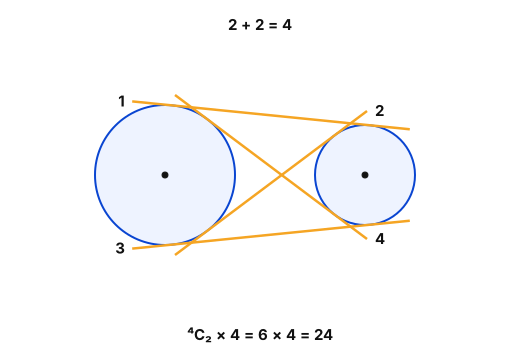
- Pairs from 4 circles = .
- Each pair gives 2 direct + 2 transverse = 4 tangents.
- Maximum = .
Yaad rakhein: Tangent count: separate 4, touching outside 3, intersecting 2, touching inside 1, one inside other 0.
Answer: (B) 24
अवधारणा: दो अलग (न छूते) वृत्तों की 4 उभयनिष्ठ स्पर्श रेखाएँ होती हैं।
- 4 वृत्तों से जोड़े = ।
- हर जोड़े की 2 अनुस्पर्श + 2 अनुप्रस्थ = 4।
- अधिकतम = ।
याद रखें: बाहर से स्पर्श 3, प्रतिच्छेदी 2, अंदर से स्पर्श 1, एक अंदर दूसरा 0।
उत्तर: (B) 24
SSC CGLQuantitative AptitudeCommon tangents of circlesSSC CGL 2025 · 16 Sep Shift 2
Q873.In a circle, chord AB and chord CD intersect at E such that AE : EB = 3 : 4 and CE : ED = 5 : 2. If AB = x and CD = y, which of the following is true?
एक वृत्त में जीवा AB और जीवा CD, E पर इस प्रकार प्रतिच्छेद करती हैं कि AE : EB = 3 : 4 और CE : ED = 5 : 2। यदि AB = x और CD = y है, तो निम्न में से कौन-सा सत्य है?
- A =
- B =
- C =
- D =
Show answer
Concept: .
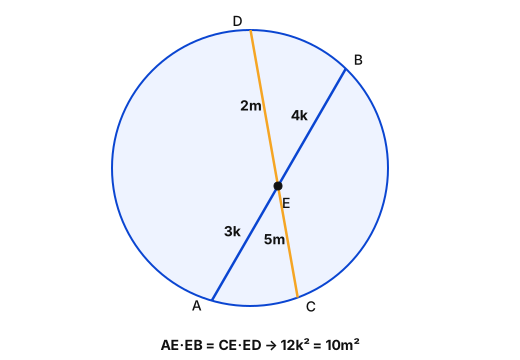
- .
- .
- .
Trick: Both chords split into 7 parts, so the 7s cancel: .
Answer: (A) =
अवधारणा: ।
- ।
- ।
- ।
ट्रिक: दोनों जीवाएँ 7 भागों में हैं, 7 कट जाता है: ।
उत्तर: (A) =
SSC CGLQuantitative AptitudeIntersecting chords theoremSSC CGL 2025 · 16 Sep Shift 2
Q874.A chord in a circle with radius 20 cm subtends an angle of 90° at the center. What is the area of the minor segment?
20 cm त्रिज्या वाले वृत्त की एक जीवा केंद्र पर 90° का कोण अंतरित करती है। लघु वृत्तखंड का क्षेत्रफल क्या है?
- A(25π − 50) sq.cm
- B(100π − 150) sq.cm
- C(50π − 100) sq.cm
- D(100π − 200) sq.cm
Show answer
Concept: Segment = sector − triangle formed by the two radii.
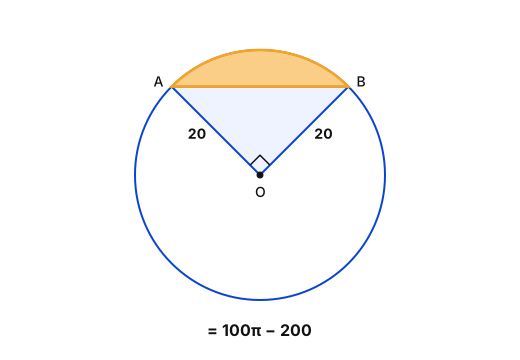
- Sector (90°) = .
- Right triangle = .
- Segment = cm².
Trick: For 90°: segment = .
Answer: (D) (100π − 200) sq.cm
अवधारणा: वृत्तखंड = त्रिज्यखंड − दोनों त्रिज्याओं से बना त्रिभुज।
- त्रिज्यखंड (90°) = ।
- समकोण त्रिभुज = ।
- वृत्तखंड = cm²।
ट्रिक: 90° के लिए: ।
उत्तर: (D) (100π − 200) sq.cm
SSC CGLQuantitative AptitudeArea of a minor segmentSSC CGL 2025 · 16 Sep Shift 2
Q875.Evaluate: (0.04³ + 0.01³) ÷ (0.16³ + 0.04³)
मान ज्ञात कीजिए: (0.04³ + 0.01³) ÷ (0.16³ + 0.04³)
- A0.008
- B0.015625
- C0.016
- D0.009
Show answer
Concept: Spot that each denominator term is 4 times a numerator term.
- Let : numerator = .
- Denominator = .
- So the value is .
Trick: is always – no cubing needed.
Answer: (B) 0.015625
अवधारणा: ध्यान दें – हर का हर पद अंश के पद का 4 गुना है।
- मानें: अंश = ।
- हर = ।
- मान = ।
ट्रिक: हमेशा – घन निकालने की ज़रूरत नहीं।
उत्तर: (B) 0.015625
SSC CGLQuantitative AptitudeCubes – common factorSSC CGL 2025 · 16 Sep Shift 2
Q876.If A : B = 4 : 7, B : C = 3 : 5, and C : D = 8 : 9, find A : B : C : D.
यदि A : B = 4 : 7, B : C = 3 : 5 और C : D = 8 : 9 है, तो A : B : C : D ज्ञात कीजिए।
- A96 : 168 : 280 : 315
- B168 : 96 : 280 : 315
- C96 : 168 : 315 : 280
- D96 : 280 : 168 : 315
Show answer
Concept: Make the common term equal in consecutive ratios, then join them.
- A : B = 4 : 7, B : C = 3 : 5 → make B = 21: A : B : C = 12 : 21 : 35.
- C : D = 8 : 9 → make C = LCM(35, 8) = 280: multiply first by 8, second by 35.
- A : B : C : D = 96 : 168 : 280 : 315.
Trick: Direct formula: A : B : C : D = (4·3·8) : (7·3·8) : (7·5·8) : (7·5·9) = 96 : 168 : 280 : 315.
Answer: (A) 96 : 168 : 280 : 315
अवधारणा: क्रमागत अनुपातों में साझा पद बराबर करके उन्हें जोड़िए।
- B का LCM 21 लें: पहला अनुपात ×3 → 12 : 21, दूसरा ×7 → 21 : 35; यानी A, B, C = 12, 21, 35।
- अब C का LCM 280: तीनों पदों को 8 से और 8 : 9 को 35 से गुणा कीजिए।
- A : B : C : D = 96 : 168 : 280 : 315।
ट्रिक: सीधा सूत्र: (4·3·8) : (7·3·8) : (7·5·8) : (7·5·9) = 96 : 168 : 280 : 315।
उत्तर: (A) 96 : 168 : 280 : 315
SSC CGLQuantitative AptitudeRatio – combining a chain of ratiosSSC CGL 2025 · 16 Sep Shift 1
Q877.A box contains ₹10, ₹5, and ₹2 coins in the ratio 1 : 2 : 3. If the total amount of money in the box is ₹416, find the number of coins of each kind.
एक डिब्बे में ₹10, ₹5 और ₹2 के सिक्के 1 : 2 : 3 के अनुपात में हैं। यदि कुल राशि ₹416 है, तो प्रत्येक प्रकार के सिक्कों की संख्या ज्ञात कीजिए।
- A20 coins of ₹10, 10 of ₹5, and 30 of ₹2₹10 के 20, ₹5 के 10, ₹2 के 30 सिक्के
- B16 coins of ₹10, 32 of ₹5, and 48 of ₹2₹10 के 16, ₹5 के 32, ₹2 के 48 सिक्के
- C40 coins of ₹10, 10 of ₹5, and 60 of ₹2₹10 के 40, ₹5 के 10, ₹2 के 60 सिक्के
- D10 coins of ₹10, 20 of ₹5, and 36 of ₹2₹10 के 10, ₹5 के 20, ₹2 के 36 सिक्के
Show answer
Concept: Value of a group of coins = number × face value.
- Coins: x, 2x, 3x of ₹10, ₹5, ₹2.
- Value = 10x + 10x + 6x = 26x = 416.
- x = 16 → 16, 32, 48 coins.
Trick: Only option (B) is in ratio 1 : 2 : 3 – check: 160 + 160 + 96 = ₹416.
Answer: (B) 16 coins of ₹10, 32 of ₹5, and 48 of ₹2
अवधारणा: सिक्कों का मूल्य = संख्या × अंकित मूल्य।
- सिक्के: x, 2x, 3x (₹10, ₹5, ₹2)।
- मूल्य = 10x + 10x + 6x = 26x = 416।
- x = 16 → 16, 32, 48 सिक्के।
ट्रिक: केवल (B) ही 1 : 2 : 3 में है – जाँच: 160 + 160 + 96 = ₹416।
उत्तर: (B) ₹10 के 16, ₹5 के 32, ₹2 के 48 सिक्के
SSC CGLQuantitative AptitudeCoins in a given ratioSSC CGL 2025 · 16 Sep Shift 1
Q878.A tank holds 7 liters of water. If 3.375 liters are drained twice, how much water remains?
एक टंकी में 7 लीटर पानी है। यदि 3.375 लीटर दो बार निकाला जाए, तो कितना पानी शेष रहेगा?
- A1
- B2
- C3
- D
Show answer
Concept: Convert the mixed number to a decimal and subtract the total drained.
- .
- Drained: L.
- Left: L.
Trick: ; twice instantly.
Answer: (A) 1
अवधारणा: मिश्रित भिन्न को दशमलव में बदलकर निकाली गई कुल मात्रा घटाइए।
- ।
- निकाला गया: L।
- शेष: L।
ट्रिक: ; दो बार ।
उत्तर: (A) 1
SSC CGLQuantitative AptitudeMixed fractions and decimalsSSC CGL 2025 · 16 Sep Shift 1
Q879.Simplify:
[() + ( ÷ )] ÷ [() − ( × )]
सरल कीजिए:
[() + ( ÷ )] ÷ [() − ( × )]
- A
- B
- C
- D
Show answer
Concept: Solve each bracket fully, then divide (multiply by the reciprocal).
- The expression reads .
- ; .
- ; .
- .
Trick: Denominator must be and numerator – just check 62 × 16 ends in 2.
Answer: (A)
अवधारणा: हर कोष्ठक को पूरा हल करके फिर भाग (व्युत्क्रम से गुणा) कीजिए।
- व्यंजक: ।
- ; ।
- ; ।
- ।
ट्रिक: हर और अंश – अंश का अंतिम अंक 2 है, यही पहचान है।
उत्तर: (A)
SSC CGLQuantitative AptitudeSimplification of fractionsSSC CGL 2025 · 16 Sep Shift 1
Q880.Simplify:
(2 + 2.6) ÷ 0.75 + (1.25 × )
सरल कीजिए:
(2 + 2.6) ÷ 0.75 + (1.25 × )
- A
- B
- C
- D
Show answer
Concept: Bring everything to decimals, follow BODMAS.
- Expression: .
- First bracket: , and .
- Second bracket: of 1.25 is 0.75.
- Sum: 6.8 plus 0.75 is 7.55, i.e. .
Trick: All options have denominator 20 → numerator = .
Answer: (C)
अवधारणा: सब कुछ दशमलव में बदलकर BODMAS लगाइए।
- व्यंजक: ।
- पहला कोष्ठक: , और ।
- दूसरा कोष्ठक: 1.25 का भाग 0.75।
- योग: 6.8 और 0.75 मिलकर 7.55, यानी ।
ट्रिक: सभी विकल्पों का हर 20 है → अंश = ।
उत्तर: (C)
SSC CGLQuantitative AptitudeSimplification – fractions with decimalsSSC CGL 2025 · 16 Sep Shift 1

