Q881.P and Q invested in a business in the ratio 4 : 5. The profit ratio was 8 : 9. If Q invested his money for 9 months, for how many months did P invest?
P और Q ने 4 : 5 के अनुपात में निवेश किया। लाभ का अनुपात 8 : 9 रहा। यदि Q का धन 9 माह लगा रहा, तो P ने कितने माह निवेश किया?
- A12 months12 माह
- B10 months10 माह
- C16 months16 माह
- D14 months14 माह
Show answer
Concept: Profit share ∝ capital × time.
- .
- .
- months.
Trick: t = (profit ratio ÷ capital ratio) × Q's time ratio → .
Answer: (B) 10 months
अवधारणा: लाभ का हिस्सा ∝ पूँजी × समय।
- ।
- ।
- महीने।
ट्रिक: समय अनुपात = लाभ अनुपात ÷ पूँजी अनुपात: → P = 10 महीने।
उत्तर: (B) 10 माह
SSC CGLQuantitative AptitudePartnership – finding timeSSC CGL 2025 · 16 Sep Shift 1
Q882.The average of 8 numbers is 56. When one number is removed, the average becomes 54. What number was removed?
8 संख्याओं का औसत 56 है। एक संख्या हटाने पर औसत 54 हो जाता है। कौन-सी संख्या हटाई गई?
- A52
- B70
- C80
- D92
Show answer
Concept: Removed number = old total − new total.
- Old total = .
- New total = .
- Removed = .
Trick: Removed = new avg + (old count × fall in avg) = .
Answer: (B) 70
अवधारणा: हटाई गई संख्या = पुराना योग − नया योग।
- पुराना योग = ।
- नया योग = ।
- हटाई गई = 70।
ट्रिक: हटाई गई = नया औसत + (पुरानी संख्या × औसत में कमी) = ।
उत्तर: (B) 70
SSC CGLQuantitative AptitudeAverage – removed numberSSC CGL 2025 · 16 Sep Shift 1
Q883.What is the overall average daily diesel usage for both cars?| Vehicle | Mon | Tue | Wed | Thu | Fri |
| Car 1 | 19 | 22 | 24 | 16 | 21 |
| Car 2 | 15 | 28 | 23 | 20 | 29 |
दोनों कारों की कुल औसत दैनिक डीज़ल खपत क्या है?| वाहन | सोम | मंगल | बुध | गुरु | शुक्र |
| Car 1 | 19 | 22 | 24 | 16 | 21 |
| Car 2 | 15 | 28 | 23 | 20 | 29 |
- A22.5 litres22.5 लीटर
- B21.7 litres21.7 लीटर
- C23.7 litres23.7 लीटर
- D25.5 litres25.5 लीटर
Show answer
Concept: Overall average = sum of all readings ÷ number of readings.
- Car 1 (Mon–Fri): L.
- Car 2: L.
- Average = L.
Trick: Pair days: – quick mental sum.
Answer: (B) 21.7 litres
अवधारणा: कुल औसत = सभी मानों का योग ÷ मानों की संख्या।
- कार 1: L।
- कार 2: L।
- औसत = L।
ट्रिक: दिनवार जोड़ें: – जल्दी गणना।
उत्तर: (B) 21.7 लीटर
SSC CGLQuantitative AptitudeData table – overall averageSSC CGL 2025 · 16 Sep Shift 1
Q884.Rohit invested a certain sum of money at 10% compound interest per annum. After 2 years, the amount became ₹24,200. Find the sum he had invested.
रोहित ने कुछ राशि 10% वार्षिक चक्रवृद्धि ब्याज पर निवेश की। 2 वर्ष बाद राशि ₹24,200 हो गई। उसने कितनी राशि निवेश की थी?
- A₹20000
- B₹21000
- C₹21500
- D₹10500
Show answer
Concept: .
- .
- ₹20,000.
Trick: At 10% for 2 years, amount = 121% of P → 24200 is 121 parts, 100 parts = 20000.
Answer: (A) ₹20000
अवधारणा: ।
- ।
- ₹20,000।
ट्रिक: 10% पर 2 वर्ष में मिश्रधन = P का 121% → 121 भाग = 24200, 100 भाग = 20000।
उत्तर: (A) ₹20000
SSC CGLQuantitative AptitudeCompound interest – principalSSC CGL 2025 · 16 Sep Shift 1
Q885.A grocer purchased 40 kg of rice at ₹40 per kg and 30 kg of another variety of rice at ₹55 per kg. He mixed the two varieties and sold the entire mixture at ₹48 per kg. Find his total profit or loss in this transaction.
एक व्यापारी ने ₹40 प्रति किग्रा की दर से 40 किग्रा चावल और ₹55 प्रति किग्रा की दर से 30 किग्रा दूसरी किस्म का चावल खरीदा। उसने मिश्रण को ₹48 प्रति किग्रा बेचा। कुल लाभ या हानि ज्ञात कीजिए।
- ALoss of ₹110₹110 की हानि
- BLoss of ₹240₹240 की हानि
- CProfit of ₹110₹110 का लाभ
- DLoss of ₹290₹290 की हानि
Show answer
Concept: Compare total cost of both varieties with total selling price.
- CP = ₹3250.
- SP = ₹3360.
- Profit = ₹110.
Trick: Per kg change: first rice gains ₹8 , second loses ₹7 → net +110.
Answer: (C) Profit of ₹110
अवधारणा: दोनों क़िस्मों की कुल लागत की तुलना कुल विक्रय मूल्य से कीजिए।
- क्रय मूल्य = ₹3250।
- विक्रय मूल्य = ₹3360।
- लाभ = ₹110।
ट्रिक: पहले चावल पर ₹8 लाभ, दूसरे पर ₹7 हानि → शुद्ध +110।
उत्तर: (C) ₹110 का लाभ
SSC CGLQuantitative AptitudeMixture – profit or lossSSC CGL 2025 · 16 Sep Shift 1
Q886.The marked price of a TV is ₹30,000. Amit receives two successive discounts while buying it. If the first discount is 20% and the final price he pays is ₹16,800, what is the second discount rate?
एक टीवी का अंकित मूल्य ₹30,000 है। अमित को दो क्रमिक छूट मिलती हैं। यदि पहली छूट 20% है और अंतिम भुगतान ₹16,800 है, तो दूसरी छूट की दर क्या है?
- A30%
- B16%
- C14%
- D15%
Show answer
Concept: Apply the first discount, then find what percentage the second cut is.
- After 20% off: ₹24,000.
- Second cut = ₹7,200.
- Rate = .
Trick: → second factor 0.7 → 30% off.
Answer: (A) 30%
अवधारणा: पहली छूट लगाकर देखें कि दूसरी कमी कितने प्रतिशत है।
- 20% छूट के बाद: ₹24,000।
- दूसरी कमी = ₹7,200।
- दर = ।
ट्रिक: → दूसरा गुणक 0.7 → 30% छूट।
उत्तर: (A) 30%
SSC CGLQuantitative AptitudeSuccessive discounts – second rateSSC CGL 2025 · 16 Sep Shift 1
Q887.A manufacturer marked a product 20% above its cost price. He provided a discount to a customer, which resulted in him making a profit of 8%. What was the rate of discount given by the manufacturer?
एक निर्माता ने उत्पाद को क्रय मूल्य से 20% अधिक अंकित किया। ग्राहक को छूट देने पर उसे 8% लाभ हुआ। निर्माता ने कितने प्रतिशत छूट दी?
- A22%
- B40%
- C30%
- D10%
Show answer
Concept: Discount % is always on the marked price.
- Take CP = 100 → MP = 120, SP = 108.
- Discount = .
- Rate = .
Trick: Discount % = .
Answer: (D) 10%
अवधारणा: छूट प्रतिशत सदैव अंकित मूल्य पर होता है।
- CP = 100 → MP = 120, SP = 108।
- छूट = 12।
- दर = ।
ट्रिक: छूट% = ।
उत्तर: (D) 10%
SSC CGLQuantitative AptitudeMark-up, discount and profitSSC CGL 2025 · 16 Sep Shift 1
Q888.Two containers, A and B, contain mixtures of alcohol and water. Container A has them in the ratio 2 : 1, while Container B has them in the ratio 4 : 3. If 9 liters are drawn from Container A and 14 liters from Container B, and the contents are mixed in a third container, what is the ratio of alcohol to water in the new mixture?
दो पात्र A और B में अल्कोहल और पानी के मिश्रण हैं। पात्र A में यह अनुपात 2 : 1 और पात्र B में 4 : 3 है। यदि A से 9 लीटर और B से 14 लीटर निकालकर तीसरे पात्र में मिलाया जाए, तो नए मिश्रण में अल्कोहल और पानी का अनुपात क्या होगा?
- A3 : 11
- B14 : 9
- C9 : 14
- D11 : 3
Show answer
Concept: Find alcohol and water separately from each part, then add.
- From A (2 : 1), 9 L → alcohol 6 L, water 3 L.
- From B (4 : 3), 14 L → alcohol 8 L, water 6 L.
- Total: alcohol 14 L, water 9 L → 14 : 9.
Trick: Total 23 L = 14 + 9 – only options with parts adding to 23 are 14 : 9 and 9 : 14; alcohol is the larger part.
Answer: (B) 14 : 9
अवधारणा: हर भाग से अल्कोहल और पानी अलग निकालकर जोड़िए।
- पहले पात्र के 9 लीटर में अल्कोहल = लीटर, शेष 3 लीटर पानी।
- दूसरे पात्र के 14 लीटर में अल्कोहल = लीटर, शेष 6 लीटर पानी।
- कुल: 14 : 9।
ट्रिक: कुल 23 L – केवल 14 : 9 और 9 : 14 का योग 23 है; अल्कोहल अधिक है, अतः 14 : 9।
उत्तर: (B) 14 : 9
SSC CGLQuantitative AptitudeMixing two solutionsSSC CGL 2025 · 16 Sep Shift 1
Q889.If the radius of a hemisphere is increased to twice its original size, what is the ratio of the new surface area to the original surface area, as well as the proportion of the new volume to the original volume?
यदि किसी अर्धगोले की त्रिज्या दोगुनी कर दी जाए, तो नए और मूल पृष्ठीय क्षेत्रफल का अनुपात तथा नए और मूल आयतन का अनुपात क्या होगा?
- A4 : 1 and 8 : 14 : 1 और 8 : 1
- B6 : 1 and 8 : 16 : 1 और 8 : 1
- C8 : 1 and 2 : 18 : 1 और 2 : 1
- D2 : 1 and 4 : 12 : 1 और 4 : 1
Show answer
Concept: Area , volume for similar solids.
- Surface area ( or ) → → 4 : 1.
- Volume → → 8 : 1.
Trick: Scale factor k: lengths , areas , volumes – for any shape.
Answer: (A) 4 : 1 and 8 : 1
अवधारणा: समरूप ठोसों में क्षेत्रफल , आयतन ।
- पृष्ठीय क्षेत्रफल → → 4 : 1।
- आयतन → → 8 : 1।
ट्रिक: स्केल k: लंबाई , क्षेत्रफल , आयतन – हर आकृति के लिए।
उत्तर: (A) 4 : 1 और 8 : 1
SSC CGLQuantitative AptitudeHemisphere – effect of doubling radiusSSC CGL 2025 · 16 Sep Shift 1
Q890.A hemisphere and a cone share the same base and have equal volumes. Given that their common radius is R, determine the height of the cone.
एक अर्धगोला और एक शंकु का आधार समान है और आयतन बराबर हैं। यदि उनकी उभयनिष्ठ त्रिज्या R है, तो शंकु की ऊँचाई ज्ञात कीजिए।
- AR
- B2R
- C5R
- D3R
Show answer
Concept: Equal volumes on the same base radius R.
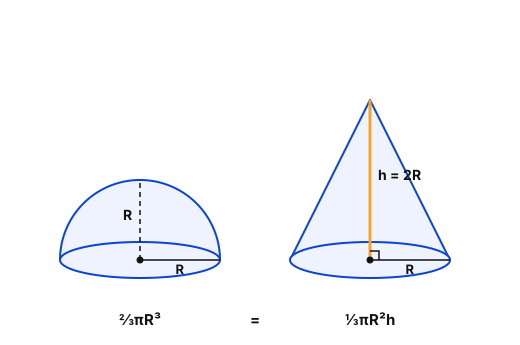
- Hemisphere: ; Cone: .
- .
Trick: Cone : hemisphere : cylinder of same r and h = r have volumes 1 : 2 : 3 → cone needs to match the hemisphere.
Answer: (B) 2R
अवधारणा: समान आधार त्रिज्या R पर समान आयतन।
- अर्धगोला: ; शंकु: ।
- ।
ट्रिक: समान r और h = r पर शंकु : अर्धगोला : बेलन = 1 : 2 : 3 → बराबरी हेतु शंकु की ऊँचाई 2R।
उत्तर: (B) 2R
SSC CGLQuantitative AptitudeCone and hemisphere – equal volumeSSC CGL 2025 · 16 Sep Shift 1
Q891.A solid sphere of radius 8 cm is melted into four cones of equal height. If each cone's radius is 4 cm, what is the height of each cone?
8 cm त्रिज्या के एक ठोस गोले को पिघलाकर समान ऊँचाई के चार शंकु बनाए जाते हैं। यदि प्रत्येक शंकु की त्रिज्या 4 cm है, तो प्रत्येक शंकु की ऊँचाई क्या है?
- A40 cm
- B32 cm
- C50 cm
- D52 cm
Show answer
Concept: Volume stays the same when a solid is melted and recast.
- Sphere: .
- 4 cones: .
- cm.
Trick: Cancel on both sides at once: .
Answer: (B) 32 cm
अवधारणा: पिघलाकर दोबारा ढालने पर आयतन वही रहता है।
- गोला: ।
- 4 शंकु: ।
- cm।
ट्रिक: दोनों ओर तुरंत काटें: ।
उत्तर: (B) 32 cm
SSC CGLQuantitative AptitudeRecasting – sphere into conesSSC CGL 2025 · 16 Sep Shift 1
Q892.If base perimeter = 30 cm and slant height = 10 cm, what is the lateral surface area of a square pyramid?
यदि आधार का परिमाप 30 cm और तिर्यक ऊँचाई 10 cm है, तो वर्गाकार पिरामिड का पार्श्व पृष्ठीय क्षेत्रफल क्या है?
- A160 cm²
- B200 cm²
- C150 cm²
- D152 cm²
Show answer
Concept: LSA of a regular pyramid = base perimeter slant height.
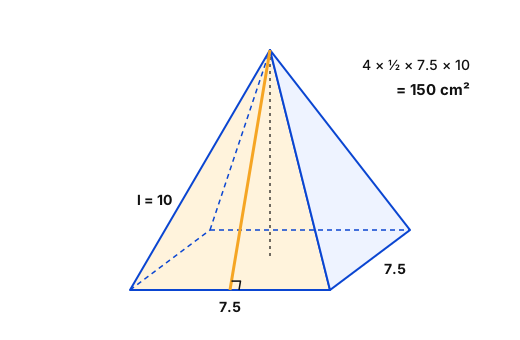
- Perimeter = 30 cm, slant height = 10 cm.
- LSA = cm².
Trick: Same as 4 triangles: each base 7.5, height 10 → .
Answer: (C) 150 cm²
अवधारणा: नियमित पिरामिड का पार्श्व क्षेत्रफल = आधार परिमाप तिर्यक ऊँचाई।
- परिमाप = 30 cm, तिर्यक ऊँचाई = 10 cm।
- LSA = cm²।
ट्रिक: 4 त्रिभुज: आधार 7.5, ऊँचाई 10 → ।
उत्तर: (C) 150 cm²
SSC CGLQuantitative AptitudeSquare pyramid – lateral surface areaSSC CGL 2025 · 16 Sep Shift 1
Q893.Two circular tracks have radii in the ratio 2 : 5. If the smaller track has an area of 100π cm², what is the area of the larger track?
दो वृत्ताकार ट्रैकों की त्रिज्याओं का अनुपात 2 : 5 है। यदि छोटे ट्रैक का क्षेत्रफल 100π cm² है, तो बड़े ट्रैक का क्षेत्रफल क्या है?
- A215π cm²
- B235π cm²
- C625π cm²
- D240π cm²
Show answer
Concept: Area ratio = .
- Radius 2 : 5 → area 4 : 25.
- Larger = cm².
Trick: Smaller 100π → → larger → .
Answer: (C) 625π cm²
अवधारणा: क्षेत्रफल अनुपात = ।
- त्रिज्या 2 : 5 → क्षेत्रफल 4 : 25।
- बड़ा = cm²।
ट्रिक: छोटा 100π → → बड़ा → ।
उत्तर: (C) 625π cm²
SSC CGLQuantitative AptitudeCircles – area from radius ratioSSC CGL 2025 · 16 Sep Shift 1
Q894.In a triangle PQR, medians PS and QT intersect at O. If the length of median PS is 15 cm, what is the length of the segment PO?
त्रिभुज PQR में माध्यिकाएँ PS और QT बिंदु O पर मिलती हैं। यदि माध्यिका PS की लंबाई 15 cm है, तो खंड PO की लंबाई क्या है?
- A10 cm
- B6 cm
- C8 cm
- D9 cm
Show answer
Concept: The centroid cuts each median in 2 : 1, the longer part towards the vertex.
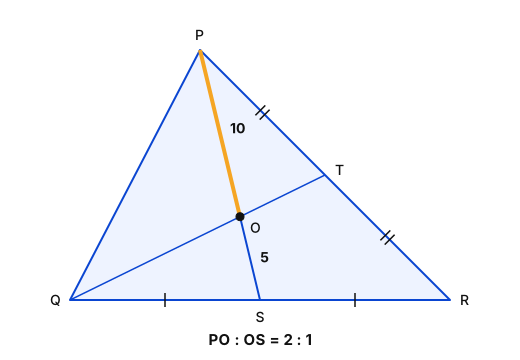
- O is the centroid (meeting point of medians).
- cm.
Trick: Median ÷ 3 = 5 → vertex side gets 2 parts (10), side part 1 (5).
Answer: (A) 10 cm
अवधारणा: केन्द्रक हर माध्यिका को 2 : 1 में बाँटता है, बड़ा भाग शीर्ष की ओर।
- O केन्द्रक है।
- cm।
ट्रिक: माध्यिका ÷ 3 = 5 → शीर्ष की ओर 2 भाग (10), भुजा की ओर 1 भाग (5)।
उत्तर: (A) 10 cm
SSC CGLQuantitative AptitudeCentroid – median divisionSSC CGL 2025 · 16 Sep Shift 1
Q895.Two right-angled triangular blocks, PQR and XYZ, have ∠Q = ∠Y = 90°. If the lengths of the hypotenuses PR and XZ are equal, and the sides PQ and XY are equal, are the triangles congruent? If so, by what rule?
दो समकोण त्रिभुजाकार ब्लॉक PQR और XYZ में ∠Q = ∠Y = 90° है। यदि कर्ण PR और XZ बराबर हैं तथा भुजाएँ PQ और XY बराबर हैं, तो क्या त्रिभुज सर्वांगसम हैं? यदि हाँ, तो किस नियम से?
- AYes, by RHSहाँ, RHS से
- BYes, by SASहाँ, SAS से
- CYes, by SSSहाँ, SSS से
- DYes, by ASAहाँ, ASA से
Show answer
Concept: RHS: right angle, equal hypotenuse and one equal side.
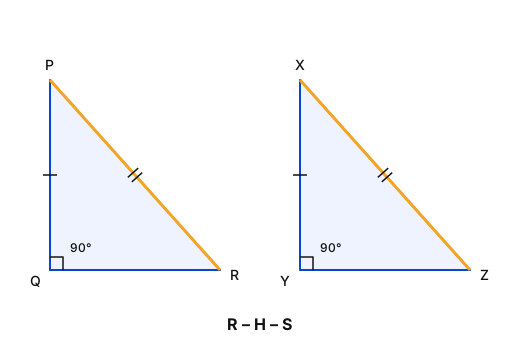
- ∠Q = ∠Y = 90° (Right angle).
- PR = XZ (Hypotenuse), PQ = XY (Side).
- So ΔPQR ≅ ΔXYZ by RHS.
Trick: SAS would need the included angle between the two equal sides – here the 90° angle is not between PQ and PR.
Answer: (A) Yes, by RHS
अवधारणा: RHS: समकोण, बराबर कर्ण और एक बराबर भुजा।
- ∠Q = ∠Y = 90° (समकोण)।
- PR = XZ (कर्ण), PQ = XY (भुजा)।
- अतः ΔPQR ≅ ΔXYZ (RHS)।
ट्रिक: SAS के लिए बराबर भुजाओं के बीच का कोण चाहिए – यहाँ 90° कोण PQ और PR के बीच नहीं है।
उत्तर: (A) हाँ, RHS से
SSC CGLQuantitative AptitudeCongruence of right triangles – RHSSSC CGL 2025 · 16 Sep Shift 1
Q896.A right triangle ABC is inscribed in a circle with a diameter of 26 cm. An altitude BD is drawn from the vertex B to the hypotenuse AC. If the length of the side AB is 10 cm, what is the length of the segment AD?
एक समकोण त्रिभुज ABC एक वृत्त में अंकित है जिसका व्यास 26 cm है। शीर्ष B से कर्ण AC पर लंब BD डाला गया है। यदि भुजा AB की लंबाई 10 cm है, तो खंड AD की लंबाई क्या है?
- A3.8 cm
- B3 cm
- C5.2 cm
- D4 cm
Show answer
Concept: In a right triangle, leg² = (its projection on hypotenuse) × hypotenuse.
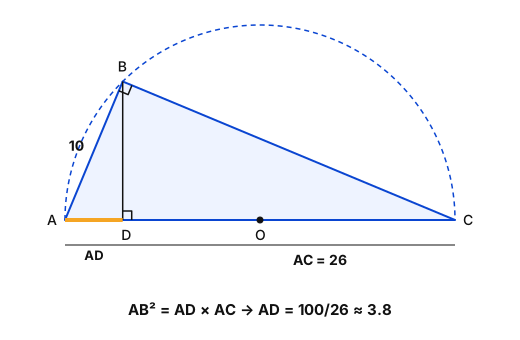
- Right angle at B lies on the circle → AC is the diameter = 26 cm.
- .
- cm.
Trick: Pattern: – the 'projection rule'.
Answer: (A) 3.8 cm
अवधारणा: समकोण त्रिभुज में भुजा² = (कर्ण पर उसका प्रक्षेप) × कर्ण।
- B पर समकोण वृत्त पर है → AC व्यास = 26 cm।
- ।
- cm।
ट्रिक: – प्रक्षेप नियम।
उत्तर: (A) 3.8 cm
SSC CGLQuantitative AptitudeAltitude on hypotenuseSSC CGL 2025 · 16 Sep Shift 1
Q897.Two circles touch each other externally. Which of the following statements is true?
दो वृत्त एक-दूसरे को बाह्यतः स्पर्श करते हैं। निम्न में से कौन-सा कथन सत्य है?
- AThere are three common tangents to the circlesवृत्तों की तीन उभयनिष्ठ स्पर्श रेखाएँ हैं
- BThere are two common tangents to the circlesवृत्तों की दो उभयनिष्ठ स्पर्श रेखाएँ हैं
- CThere are four common tangents to the circlesवृत्तों की चार उभयनिष्ठ स्पर्श रेखाएँ हैं
- DThere is only one common tangent to the circlesवृत्तों की केवल एक उभयनिष्ठ स्पर्श रेखा है
Show answer
Concept: Number of common tangents depends on how the circles are placed.
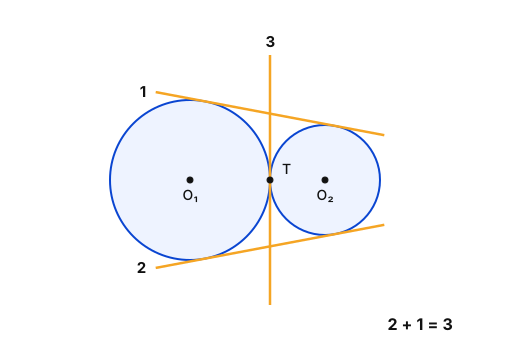
- Externally touching: 2 direct tangents + 1 tangent at the contact point = 3.
Trick: Separate 4 → touch externally 3 → intersect 2 → touch internally 1 → one inside other 0.
Answer: (A) There are three common tangents to the circles
अवधारणा: उभयनिष्ठ स्पर्श रेखाओं की संख्या वृत्तों की स्थिति पर निर्भर है।
- बाह्य स्पर्श: 2 अनुस्पर्श + स्पर्श बिंदु पर 1 = 3।
ट्रिक: अलग 4 → बाह्य स्पर्श 3 → प्रतिच्छेदी 2 → आंतरिक स्पर्श 1 → एक अंदर 0।
उत्तर: (A) वृत्तों की तीन उभयनिष्ठ स्पर्श रेखाएँ हैं
SSC CGLQuantitative AptitudeCommon tangents – touching circlesSSC CGL 2025 · 16 Sep Shift 1
Q898.Two circles with radii R and r touch each other externally. If the length of their direct common tangent is D, which of the following is the correct relationship between D, R, and r?
R और r त्रिज्या वाले दो वृत्त बाह्यतः स्पर्श करते हैं। यदि उनकी अनुप्रस्थ उभयनिष्ठ स्पर्श रेखा की लंबाई D है, तो D, R और r में सही संबंध कौन-सा है?
- AD = R + r
- BD = 2(R + r)
- CD = 2
- DD = R² + r²
Show answer
Concept: Direct common tangent length = , d = distance between centres.
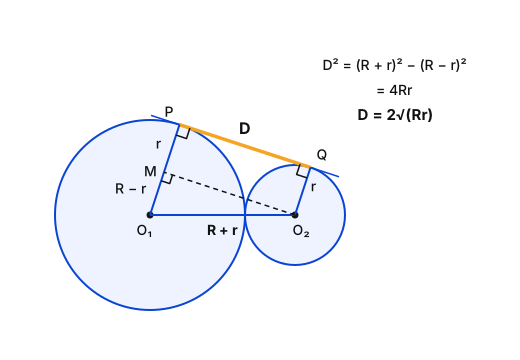
- Touching externally → centre distance .
- Using : minus equals .
- So .
Trick: D is twice the geometric mean of the radii – e.g. .
Answer: (C) D = 2
अवधारणा: अनुस्पर्श रेखा की लंबाई = , d = केंद्रों की दूरी।
- बाह्य स्पर्श → केंद्रों की दूरी ।
- से: में से घटाने पर ।
- अतः ।
ट्रिक: D = त्रिज्याओं के गुणोत्तर माध्य का दुगुना – जैसे ।
उत्तर: (C) D = 2
SSC CGLQuantitative AptitudeDirect common tangent – touching circlesSSC CGL 2025 · 16 Sep Shift 1
Q899.A chord of a circle has a length of 10 cm. The angle subtended by the chord at a point on the circumference is 30°. What is the distance from the center of the circle to the chord?
एक वृत्त की जीवा की लंबाई 10 cm है। यह जीवा परिधि के किसी बिंदु पर 30° का कोण अंतरित करती है। वृत्त के केंद्र से जीवा की दूरी क्या है?
- A5 cm
- B3 cm
- C5 cm
- D3 cm
Show answer
Concept: Angle at centre = 2 × angle at circumference; the perpendicular from the centre bisects the chord.
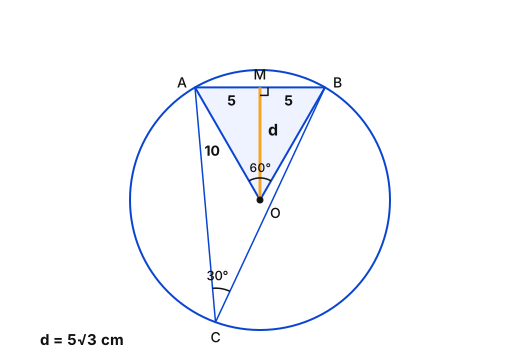
- Central angle = ; half of it = 30°.
- Half chord = 5 cm, opposite the 30° angle at O.
- cm.
Trick: 60° central angle makes an equilateral triangle: radius = chord = 10 → distance = .
Answer: (A) 5 cm
अवधारणा: केंद्र पर कोण = परिधि पर कोण का दुगुना; केंद्र से लंब जीवा को समद्विभाजित करता है।
- केंद्रीय कोण = 60°; आधा = 30°।
- आधी जीवा = 5 cm।
- cm।
ट्रिक: 60° केंद्रीय कोण से समबाहु त्रिभुज बनता है: त्रिज्या = 10 → दूरी = ।
उत्तर: (A) 5 cm
SSC CGLQuantitative AptitudeChord – distance from centreSSC CGL 2025 · 16 Sep Shift 1
Q900.What is the area of the segment formed by a chord in a circle of radius 4 cm, if the angle subtended at the center is 60°?
4 cm त्रिज्या वाले वृत्त में एक जीवा केंद्र पर 60° का कोण अंतरित करती है। उससे बने वृत्तखंड का क्षेत्रफल क्या है?
- A() − 4
- B() − 4
- C() − 8
- D() − 8
Show answer
Concept: Segment = sector − triangle formed by the two radii.
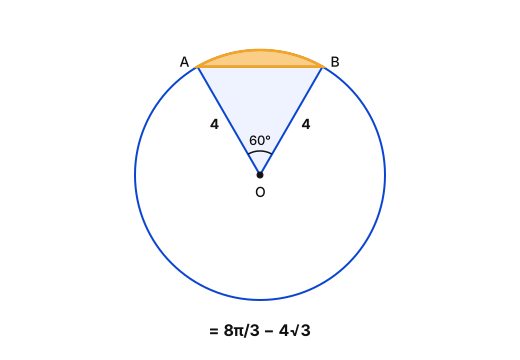
- Sector = .
- 60° with equal radii → equilateral triangle of side 4: area = .
- Segment = .
Trick: For 60°, segment = .
Answer: (A) () − 4
अवधारणा: वृत्तखंड = त्रिज्यखंड − दो त्रिज्याओं से बना त्रिभुज।
- त्रिज्यखंड = ।
- 60° पर समबाहु त्रिभुज (भुजा 4): क्षेत्रफल ।
- वृत्तखंड = ।
ट्रिक: 60° के लिए वृत्तखंड = ।
उत्तर: (A) () − 4
SSC CGLQuantitative AptitudeArea of a minor segmentSSC CGL 2025 · 16 Sep Shift 1

