Q921.A circular logo of radius 7 cm is fitted perfectly inside a square plaque. Find the area of unused square space around the circle.
7 cm त्रिज्या का एक वृत्ताकार लोगो एक वर्गाकार पट्टिका के भीतर पूर्णतः फिट है। वृत्त के चारों ओर बचे वर्ग-भाग का क्षेत्रफल ज्ञात कीजिए।
- A42 cm²
- B48 cm²
- C50.54 cm²
- D55 cm²
Show answer
Concept: A circle fitting exactly in a square has diameter = side.
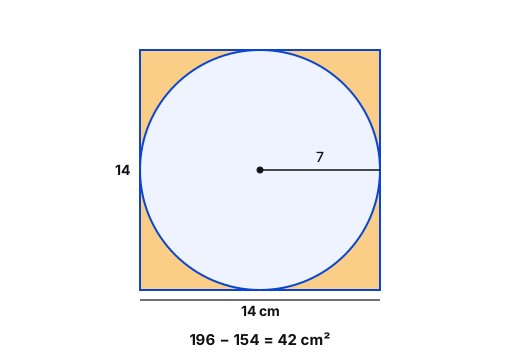
- Side = 14 cm → square = 196 cm².
- Circle = cm².
- Unused = 42 cm².
Trick: Unused area = (true for any inscribed circle with ).
Answer: (A) 42 cm²
अवधारणा: वर्ग में ठीक फिट वृत्त का व्यास = वर्ग की भुजा।
- भुजा = 14 cm → वर्ग = 196 cm²
- वृत्त = cm²
- खाली भाग = 42 cm²
ट्रिक: खाली क्षेत्र = भुजा² ( पर)।
उत्तर: (A) 42 cm²
SSC CGLQuantitative AptitudeMensuration – circle inside squareSSC CGL 2025 · 15 Sep Shift 3
Q922.A circular clock has a radius of 28 cm. Calculate the distance covered by the tip of the minute hand in 30 minutes, assuming it is positioned at the edge of the clock face. (Use π = )
एक वृत्ताकार घड़ी की त्रिज्या 28 cm है। यदि मिनट की सुई का सिरा घड़ी के किनारे पर हो, तो 30 मिनट में वह कितनी दूरी तय करेगा? (π = लीजिए)
- A88 cm
- B84 cm
- C82 cm
- D44 cm
Show answer
Concept: In 60 minutes the minute hand tip traces the full circle; in 30 minutes, half.
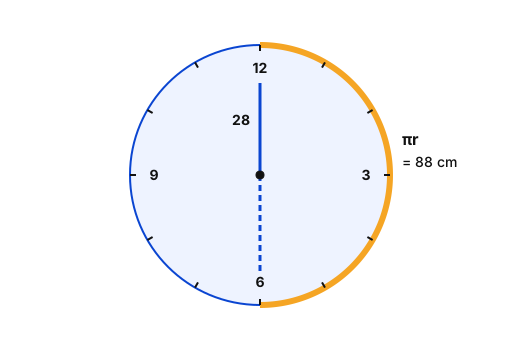
- Half circumference .
- 88 cm.
Trick: r = 28 is a multiple of 7 → instantly.
Answer: (A) 88 cm
अवधारणा: 60 मिनट में मिनट की सुई पूरा वृत्त, 30 मिनट में आधा वृत्त बनाती है।
- आधी परिधि
- 88 cm
ट्रिक: 28, 7 का गुणज → ।
उत्तर: (A) 88 cm
SSC CGLQuantitative AptitudeCircle – arc traced by clock handSSC CGL 2025 · 15 Sep Shift 3
Q923.What is the slope of the line perpendicular to y = −5x + 2?
y = −5x + 2 के लंबवत रेखा की प्रवणता क्या है?
- A−
- B5
- C
- D−5
Show answer
Concept: For perpendicular lines, .
- has slope .
- .
Trick: Perpendicular slope = negative reciprocal: flip the number and change its sign.
Answer: (C)
अवधारणा: लंब रेखाओं के लिए ।
- की ढाल
-
ट्रिक: लंब ढाल = ऋणात्मक व्युत्क्रम: संख्या उलटें और चिह्न बदलें।
उत्तर: (C)
SSC CGLQuantitative AptitudeCoordinate geometry – perpendicular slopeSSC CGL 2025 · 15 Sep Shift 3
Q924.Given, x − = 4, find the value of x⁴ + .
दिया है, x − = 4, तो x⁴ + का मान ज्ञात कीजिए।
- A322
- B318
- C320
- D325
Show answer
Concept: Square step by step: , and .
- .
- 322.
Trick: Chain: . For : .
Answer: (A) 322
अवधारणा: क्रम से वर्ग करें: और ।
- 322
ट्रिक: श्रृंखला: ; पर ।
उत्तर: (A) 322
SSC CGLQuantitative AptitudeAlgebra – x⁴ + 1/x⁴SSC CGL 2025 · 15 Sep Shift 3
Q925.2.5% of 100 = ?
100 का 2.5% = ?
- A6
- B2
- C3
- D2.5
Show answer
Concept: “Per cent” means “out of 100”.
- 2.5% of 100 .
- = 2.5.
Trick: x% of 100 is always x itself – no calculation needed.
Answer: (D) 2.5
अवधारणा: “प्रतिशत” का अर्थ है “100 में से”।
- 100 का 2.5%
- = 2.5
ट्रिक: 100 का x% हमेशा x ही होता है।
उत्तर: (D) 2.5
SSC CGLQuantitative AptitudePercentage – basicSSC CGL 2025 · 15 Sep Shift 3
Q926.What is the value of ( × 4.8) ÷ 0.12?
( × 4.8) ÷ 0.12 का मान क्या है?
- A35
- B25
- C32
- D28
Show answer
Concept: Convert to simple fractions and cancel.
- .
- .
- .
Trick: first, then .
Answer: (A) 35
अवधारणा: साधारण भिन्न बनाकर काटें।
- ।
- ।
- ।
ट्रिक: पहले , फिर ।
उत्तर: (A) 35
SSC CGLQuantitative AptitudeSimplification – fraction and decimalsSSC CGL 2025 · 15 Sep Shift 2
Q927.Which of the following equals 14?
निम्न में से कौन-सा 14 के बराबर है?
- A( + )² − 2
- B( + )²
- C( + )² + 2
- D( + )² − 2
Show answer
Concept: .
- .
- Subtract → 14 ✓.
- Others: .
Trick: The rational part is just : look for with the term cancelled → .
Answer: (D) ( + )² − 2
अवधारणा: ।
- ।
- घटाने पर = 14 ✓।
- बाकी: ।
ट्रिक: परिमेय भाग सिर्फ है: और कट जाए → ।
उत्तर: (D) ( + )² − 2
SSC CGLQuantitative AptitudeSurds – (√a + √b)²SSC CGL 2025 · 15 Sep Shift 2
Q928.If x : y = 2 : 5, then find (3x + 2y) : (7x − 2y).
यदि x : y = 2 : 5 है, तो (3x + 2y) : (7x − 2y) ज्ञात कीजिए।
- A3 : 2
- B4 : 1
- C7 : 4
- D9 : 5
Show answer
Concept: Put x and y equal to the ratio terms.
- Put x = 2k, y = 5k.
- Numerator: 6k + 10k = 16k.
- Denominator: 14k − 10k = 4k → ratio 16k : 4k = 4 : 1.
Trick: For homogeneous expressions, plug the ratio numbers directly – k cancels.
Answer: (B) 4 : 1
अवधारणा: x और y को अनुपात के मान रखें।
- x = 2, y = 5।
- 3x + 2y = 16।
- 7x − 2y = 4 → 16 : 4 = 4 : 1।
ट्रिक: समघातीय व्यंजक में अनुपात की संख्याएँ सीधे रखें – k कट जाता है।
उत्तर: (B) 4 : 1
SSC CGLQuantitative AptitudeRatio – value of expressionSSC CGL 2025 · 15 Sep Shift 2
Q929.Ram and Mohan invest ₹70,000 and ₹50,000 respectively. After 1 year, the total profit is distributed including simple interest at 10% per annum on the capital of each partner. If the total profit including interest is ₹18,000, what is Ram's share of the profit?
राम और मोहन क्रमशः ₹70,000 और ₹50,000 निवेश करते हैं। एक वर्ष बाद कुल लाभ, प्रत्येक साझेदार की पूँजी पर 10% वार्षिक साधारण ब्याज सहित, बाँटा जाता है। यदि ब्याज सहित कुल लाभ ₹18,000 है, तो राम का हिस्सा क्या है?
- A₹7,000
- B₹10,500
- C₹8,000
- D₹8,500
Show answer
Concept: Pay interest on capital first, share the rest in capital ratio.
- Interest: Ram 10% of 70,000 = ₹7,000; Mohan ₹5,000 → total ₹12,000.
- Balance = ₹6,000; ratio 7 : 5 → Ram gets ₹3,500.
- Ram gets interest + share = ₹7,000 + ₹3,500 = ₹10,500.
Trick: Interest and balance both follow 7 : 5 here, so Ram = ₹10,500 directly.
Answer: (B) ₹10,500
अवधारणा: पहले पूँजी पर ब्याज दें, बचा लाभ पूँजी अनुपात में बाँटें।
- ब्याज: राम 7,000, मोहन 5,000 → कुल 12,000।
- शेष = 6,000; अनुपात 7 : 5 → राम = ।
- राम का कुल = ₹10,500।
ट्रिक: यहाँ ब्याज और शेष दोनों 7 : 5 में हैं, इसलिए राम = ₹10,500।
उत्तर: (B) ₹10,500
SSC CGLQuantitative AptitudePartnership – interest on capitalSSC CGL 2025 · 15 Sep Shift 2
Q930.What is the average of all numbers between 1000 and 1500 that are divisible by 20?
1000 और 1500 के बीच 20 से विभाज्य सभी संख्याओं का औसत क्या है?
- A1150
- B1250
- C1575
- D1500
Show answer
Concept: Average of evenly spaced numbers = .
- Multiples of 20 strictly inside (1000, 1500) run from 1020 up to 1480.
- Average = .
Trick: The set is symmetric about the midpoint of 1000 and 1500 → 1250.
Answer: (B) 1250
अवधारणा: समान अंतर वाली संख्याओं का औसत = ।
- 1000 और 1500 के बीच 20 के गुणज: 1020 … 1480।
- औसत = ।
ट्रिक: संख्याएँ 1000 और 1500 के मध्य बिंदु के सममित हैं → 1250।
उत्तर: (B) 1250
SSC CGLQuantitative AptitudeAverage of an APSSC CGL 2025 · 15 Sep Shift 2
Q931.There are 2 consecutive even numbers and 3 consecutive natural numbers. The average of the even numbers is 3 more than the average of the three natural numbers. If the sum of the even numbers is 2 more than the sum of the three natural numbers, find the average of the three natural numbers.
2 क्रमागत सम संख्याएँ और 3 क्रमागत प्राकृत संख्याएँ हैं। सम संख्याओं का औसत तीनों प्राकृत संख्याओं के औसत से 3 अधिक है। यदि सम संख्याओं का योग तीनों प्राकृत संख्याओं के योग से 2 अधिक है, तो तीनों प्राकृत संख्याओं का औसत ज्ञात कीजिए।
- A3
- B4
- C5
- D6
Show answer
Concept: Write sums using averages: sum = average × count.
- Let the average of the three natural numbers = m → their sum = 3m.
- Even average = m + 3 → even sum = 2(m + 3) = 2m + 6.
- 2m + 6 = 3m + 2 → m = 4.
- Check: 3, 4, 5 (sum 12) and 6, 8 (average 7, sum 14 = 12 + 2).
Trick: Average of 3 consecutive numbers = middle number; of 2 = mean of the pair.
Answer: (B) 4
अवधारणा: योग = औसत × संख्या लिखें।
- तीनों प्राकृत संख्याओं का औसत = m → योग = 3m।
- सम संख्याओं का औसत = m + 3 → योग = 2m + 6।
- 2m + 6 = 3m + 2 → m = 4।
- जाँच: 3, 4, 5 (योग 12) और 6, 8 (औसत 7, योग 14 = 12 + 2)।
याद रखें: 3 क्रमागत संख्याओं का औसत = बीच वाली संख्या।
उत्तर: (B) 4
SSC CGLQuantitative AptitudeAverages – consecutive numbersSSC CGL 2025 · 15 Sep Shift 2
Q932.Evaluate: 40% of 175 − 37% of 160 + 10% of 250
मान ज्ञात कीजिए: 175 का 40% − 160 का 37% + 250 का 10%
- A25
- B50
- C35
- D30
Show answer
Concept: Use fraction equivalents of percentages.
- 40% of 175 = 70.
- → .
- . Then and .
Yaad rakhein: , , , .
Answer: (C) 35
अवधारणा: प्रतिशत के भिन्न रूप प्रयोग करें।
- 175 का 40% = 70।
- → ।
- 250 का 10% = 25 → ।
याद रखें: , , , ।
उत्तर: (C) 35
SSC CGLQuantitative AptitudePercentage – simplificationSSC CGL 2025 · 15 Sep Shift 2
Q933.Aman needed ₹60,000 and split the sum between two lenders: Lender A at 18% p.a. and Lender B at 12% p.a. (simple interest). After 2 years, the total interest paid was ₹19,200. If he had interchanged the principal amounts, his interest would have been ₹2,400 less. How much did Aman borrow from Lender A at 18% p.a.?
अमन को ₹60,000 चाहिए थे और उसने राशि दो ऋणदाताओं में बाँटी: ऋणदाता A 18% वार्षिक और ऋणदाता B 12% वार्षिक (साधारण ब्याज)। 2 वर्ष बाद कुल ब्याज ₹19,200 था। यदि वह मूलधन आपस में बदल देता, तो ब्याज ₹2,400 कम होता। अमन ने ऋणदाता A से 18% पर कितना उधार लिया?
- A₹20,000
- B₹16,000
- C₹14,000
- D₹40,000
Show answer
Concept: Find the average rate, then use alligation.
- Yearly interest = ₹9,600 → average rate = .
- Alligation: 18% and 12% around 16% → .
- At 18% = ₹40,000.
Trick: Check with the swap: ✓.
Answer: (D) ₹40,000
अवधारणा: औसत दर निकालें, फिर मिश्रण (alligation) लगाएँ।
- वार्षिक ब्याज = 9,600 → औसत दर = 16%।
- 18% और 12% से 16%: ।
- 18% पर = ₹40,000।
ट्रिक: अदला-बदली जाँच: ✓।
उत्तर: (D) ₹40,000
SSC CGLQuantitative AptitudeSimple interest – two partsSSC CGL 2025 · 15 Sep Shift 2
Q934.A shop sells a shirt for ₹P, incurring a loss of 10%. They mark it up to ₹1.8P and then provide a 20% discount. What is the percentage profit or loss?
एक दुकान एक शर्ट ₹P में बेचती है और 10% हानि उठाती है। वे इसे ₹1.8P अंकित कर 20% छूट देते हैं। प्रतिशत लाभ या हानि क्या है?
- A24.6% Profit24.6% लाभ
- B28.6% Loss28.6% हानि
- C29.6% Profit29.6% लाभ
- D34.6% Loss34.6% हानि
Show answer
Concept: Express everything in terms of cost price.
- at 10% loss → .
- New .
- Profit ratio = → 29.6% profit.
Trick: Take : , new SP = → 29.6%.
Answer: (C) 29.6% Profit
अवधारणा: सब कुछ क्रय मूल्य के रूप में लिखें।
- 10% हानि पर → ।
- नया ।
- → 29.6% लाभ।
ट्रिक: लें: , नया → 29.6%।
उत्तर: (C) 29.6% लाभ
SSC CGLQuantitative AptitudeProfit & loss – markup and discountSSC CGL 2025 · 15 Sep Shift 2
Q935.A shopkeeper marked an item 80% above its cost price. He then offered two successive discounts of 20% and 25%. If he made a profit of ₹160, at what price did he sell the item?
एक दुकानदार ने एक वस्तु को क्रय मूल्य से 80% अधिक अंकित किया। फिर 20% और 25% की दो क्रमिक छूट दीं। यदि उसे ₹160 का लाभ हुआ, तो उसने वस्तु किस मूल्य पर बेची?
- A₹2000
- B₹2500
- C₹2160
- D₹1000
Show answer
Concept: Take and apply markup and discounts multiplicatively.
- → after 20% off 144 → after 25% off 108.
- Profit = 8 units = ₹160 → 1 unit = ₹20.
- ₹2,160.
Trick: Discounts 20% and 25% together = 40% .
Answer: (C) ₹2160
अवधारणा: लेकर अंकन और छूट गुणा करें।
- ; ।
- लाभ 8 इकाई = ₹160 → 1 इकाई = ₹20।
- ₹2,160।
ट्रिक: 20% और 25% की कुल छूट = ।
उत्तर: (C) ₹2160
SSC CGLQuantitative AptitudeSuccessive discountsSSC CGL 2025 · 15 Sep Shift 2
Q936.A shopkeeper mixes two types of pulses costing ₹80/kg and ₹100/kg. He sells the mixture at ₹112.5/kg, earning a 25% profit. In what ratio did he mix the two types of pulses?
एक दुकानदार ₹80/kg और ₹100/kg की दो प्रकार की दालें मिलाता है। वह मिश्रण ₹112.5/kg पर बेचकर 25% लाभ कमाता है। उसने दोनों दालें किस अनुपात में मिलाईं?
- A1 : 3
- B1 : 1
- C3 : 2
- D4 : 1
Show answer
Concept: Find the cost price of the mixture, then alligate.
- CP of mixture = ₹90/kg.
- Ratio = .
Trick: 90 is exactly the midpoint of 80 and 100 → equal quantities.
Answer: (B) 1 : 1
अवधारणा: मिश्रण का क्रय मूल्य निकालें, फिर एलिगेशन।
- मिश्रण CP = ₹90/kg।
- अनुपात = ।
ट्रिक: 90 ठीक 80 और 100 के बीच है → बराबर मात्रा।
उत्तर: (B) 1 : 1
SSC CGLQuantitative AptitudeMixture – alligationSSC CGL 2025 · 15 Sep Shift 2
Q937.A is Four times more efficient as a worker than B, which allows A to complete a job in 60 days less than B. If they work together, they can finish the job in:
A, B से चार गुना अधिक कुशल है, जिससे A कार्य B से 60 दिन कम में पूरा करता है। साथ काम करने पर वे कार्य कितने दिनों में पूरा करेंगे?
- A19.2 days19.2 दिन
- B22.5 days22.5 दिन
- C16 days16 दिन
- D20 days20 दिन
Show answer
Concept: Time is inversely proportional to efficiency.
- A works 4 times as fast, so if A needs t days, B needs 4t days.
- → ; A = 20 days, B = 80 days.
- Together = days.
Trick: Together = B's time ÷ (sum of efficiencies) = .
Answer: (C) 16 days
अवधारणा: समय दक्षता के व्युत्क्रमानुपाती है।
- दक्षता A : B = 4 : 1 → समय 1 : 4।
- अंतर 3 भाग = 60 दिन → A = 20, B = 80 दिन।
- साथ में = दिन।
ट्रिक: साथ में समय = B का समय ÷ कुल दक्षता = ।
उत्तर: (C) 16 दिन
SSC CGLQuantitative AptitudeTime & work – efficiencySSC CGL 2025 · 15 Sep Shift 2
Q938.A cyclist has to cover 160 km. After cycling for 9 hours and 36 minutes, he finds that he has completed th of the total distance. What is his speed in km/h?
एक साइकिल चालक को 160 km तय करने हैं। 9 घंटे 36 मिनट चलने के बाद वह पाता है कि उसने कुल दूरी का भाग पूरा कर लिया है। उसकी चाल km/h में क्या है?
- A15.45 km/h
- B16 km/h
- C12.5 km/h
- D10 km/h
Show answer
Concept: Speed = distance covered ÷ time taken.
- Distance = km.
- Time = 9 h 36 min = h.
- Speed = km/h.
Trick: Minutes → hours: 36 min = 0.6 h (divide by 60).
Answer: (C) 12.5 km/h
अवधारणा: चाल = तय दूरी ÷ समय।
- दूरी = km।
- समय = h।
- चाल = km/h।
ट्रिक: मिनट को घंटे में: ।
उत्तर: (C) 12.5 km/h
SSC CGLQuantitative AptitudeSpeed – distance and timeSSC CGL 2025 · 15 Sep Shift 2
Q939.Sarah invested in three schemes M, N, and O at SI rates of 5%, 6%, and 10% p.a. Total interest in one year was ₹3664. The amount in O was 90% of M and 125% of N. What was the amount invested in Scheme N?
सारा ने तीन योजनाओं M, N और O में क्रमशः 5%, 6% और 10% वार्षिक साधारण ब्याज पर निवेश किया। एक वर्ष का कुल ब्याज ₹3664 था। O में राशि M की 90% और N की 125% थी। योजना N में निवेश कितना था?
- A₹14000
- B₹15000
- C₹14400
- D₹16500
Show answer
Concept: Convert the given percentages into a ratio of investments.
- → take : .
- Interest = 5% of 50k + 6% of 36k + 10% of 45k = .
- → → ₹14,400.
Trick: Choose O as LCM-friendly (45) so that 0.9 and 1.25 give whole numbers.
Answer: (C) ₹14400
अवधारणा: प्रतिशत संबंधों से निवेश का अनुपात बनाएँ।
- → लें: ।
- ब्याज = ।
- → → N = ₹14,400।
ट्रिक: O ऐसा मान लें (45) कि 0.9 और 1.25 से पूर्णांक मिलें।
उत्तर: (C) ₹14400
SSC CGLQuantitative AptitudeSimple interest – three schemesSSC CGL 2025 · 15 Sep Shift 2
Q940.A vertical pole of height H stands on the ground. From point P, the angle of elevation of the top is 45°. From point Q, 20 meters away from P, the angle of elevation is 30°. What is the height of the pole?
H ऊँचाई का एक ऊर्ध्वाधर खंभा ज़मीन पर खड़ा है। बिंदु P से शीर्ष का उन्नयन कोण 45° है। P से 20 मीटर दूर बिंदु Q से उन्नयन कोण 30° है। खंभे की ऊँचाई क्या है?
- A5( + 1) m
- B10( + 1) m
- C10 m
- D20 m
Show answer
Concept: = height / base distance.
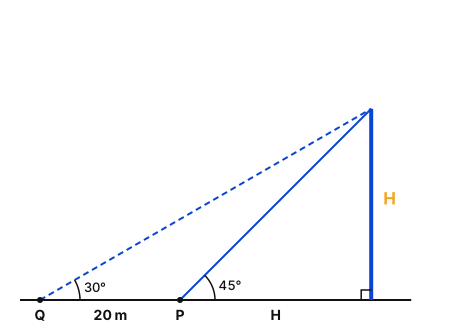
- At P (45°): distance from foot = H.
- At Q (30°): → .
- m.
Trick: For 45° & 30° with gap d: .
Answer: (B) 10( + 1) m
अवधारणा: = ऊँचाई / आधार दूरी।
- P (45°) पर: खंभे से दूरी = H।
- Q (30°) पर: → ।
- m।
ट्रिक: 45° और 30° तथा अंतर d हो तो: ।
उत्तर: (B) 10( + 1) m
SSC CGLQuantitative AptitudeHeights & distances – 45° and 30°SSC CGL 2025 · 15 Sep Shift 2

