Q81.The angle subtended by an arc at the centre is 36° and its length is 11 cm. Find the radius of the circle.
एक चाप केंद्र पर 36° का कोण बनाता है और उसकी लंबाई 11 cm है। वृत्त की त्रिज्या ज्ञात कीजिए।
- A22 cm
- B17.5 cm
- C30 cm
- D8.75 cm
Show answer
Concept: Arc = .
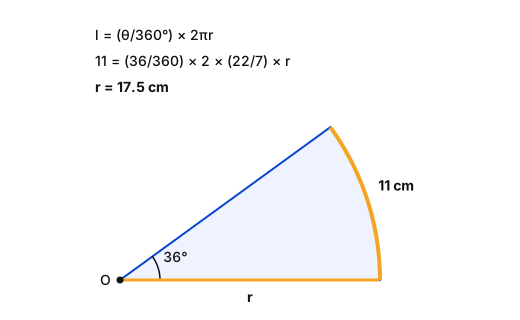
- .
- cm.
Trick: is of the circle, so circumference = .
Answer: (B) 17.5 cm
अवधारणा: चाप = ।
- ।
- cm।
ट्रिक: पूरे वृत्त का है, इसलिए परिधि = ।
उत्तर: (B) 17.5 cm
SSC CGLQuantitative AptitudeCircle – arc lengthSSC CGL 2025 · 26 Sep Shift 3
Q82.A man spends 20% of his salary on rent, 30% on groceries and 40% on other expenses. If he saves ₹90,000, what is his salary?
एक व्यक्ति अपने वेतन का 20% किराए पर, 30% किराने पर और 40% अन्य खर्चों पर व्यय करता है। यदि वह ₹90,000 बचाता है, तो उसका वेतन कितना है?
- A₹2,40,000
- B₹7,00,000
- C₹9,00,000
- D₹9,50,000
Show answer
Concept: Savings % = 100% − total spending %.
- Spent: → saved 10%.
- 10% = ₹90,000 → 100% = ₹9,00,000.
Trick: If , then salary = : .
Answer: (C) ₹9,00,000
अवधारणा: बचत % = 100% − कुल खर्च %।
- खर्च: → बचत 10%।
- 10% = ₹90,000 → 100% = ₹9,00,000।
ट्रिक: यदि , तो वेतन = : ।
उत्तर: (C) ₹9,00,000
SSC CGLQuantitative AptitudePercentage – income and savingsSSC CGL 2025 · 26 Sep Shift 3
Q83.A store offers a 50% discount but charges 10% VAT on the discounted price. If the marked price is ₹3,200, what is the final amount paid?
एक दुकान 50% छूट देती है पर छूट के बाद के मूल्य पर 10% वैट लगाती है। यदि अंकित मूल्य ₹3,200 है, तो अंत में कितना देना होगा?
- A₹1,760
- B₹1,260
- C₹1,275
- D₹1,320
Show answer
Concept: Apply discount first, then tax on the reduced price.
- After 50% off: ₹1,600.
- Add 10% VAT: ₹1,760.
Trick: Multiplier = ; in one step.
Answer: (A) ₹1,760
अवधारणा: पहले छूट, फिर घटी हुई कीमत पर कर लगाएँ।
- 50% छूट के बाद: ₹1,600।
- 10% VAT जोड़ें: ₹1,760।
ट्रिक: गुणक = ; एक ही चरण में।
उत्तर: (A) ₹1,760
SSC CGLQuantitative AptitudeDiscount and tax – successive changeSSC CGL 2025 · 26 Sep Shift 3
Q84.A car covers three equal distances at speeds of 60 km/h, 90 km/h and 180 km/h respectively. What is the average speed of the car for the entire journey?
एक कार तीन समान दूरियाँ क्रमशः 60 km/h, 90 km/h और 180 km/h की चाल से तय करती है। पूरी यात्रा की औसत चाल क्या है?
- A80 km/h
- B90 km/h
- C45 km/h
- D35 km/h
Show answer
Concept: For equal distances, average speed is the harmonic mean: .
- .
- Average = km/h.
Trick: Take each distance = LCM 180 km: times 3 h + 2 h + 1 h = 6 h; km/h.
Answer: (B) 90 km/h
अवधारणा: समान दूरियों के लिए औसत चाल = ।
- ।
- औसत = km/h।
ट्रिक: हर दूरी = LCM 180 km लें: समय घंटे; km/h।
उत्तर: (B) 90 km/h
SSC CGLQuantitative AptitudeAverage speed – equal distancesSSC CGL 2025 · 26 Sep Shift 3
Q85.An 80-litre mixture of acid and water contains them in the ratio 4 : 1. 10 litres of this mixture is removed and replaced with another solution of acid and water in the ratio 1 : 4. What is the final ratio of acid to water?
80 लीटर अम्ल-जल मिश्रण में उनका अनुपात 4 : 1 है। इसमें से 10 लीटर निकालकर 1 : 4 के अनुपात वाला दूसरा घोल मिलाया जाता है। अंत में अम्ल और जल का अनुपात क्या होगा?
- A29 : 11
- B11 : 5
- C11 : 29
- D17 : 13
Show answer
Concept: Removed mixture takes acid and water in the same 4 : 1 ratio.
- Start: acid 64 L, water 16 L. Left after removing 10 L: 70 L → acid 56, water 14.
- Added 10 L in 1 : 4 → acid 2, water 8.
- Final: 58 : 22 = 29 : 11.
Trick: Acid must stay above water (most of the mixture is 4 : 1) – only 29 : 11 and 11 : 5 qualify; total 80 = 40 parts × 2 fits 29 + 11.
Answer: (A) 29 : 11
अवधारणा: निकाला गया मिश्रण भी 4 : 1 अनुपात में ही अम्ल व पानी ले जाता है।
- शुरू में: अम्ल 64 L, पानी 16 L। 10 L निकालने पर 70 L → अम्ल 56, पानी 14।
- 1 : 4 वाला 10 L मिलाया → अम्ल 2, पानी 8।
- अंतिम: 58 : 22 = 29 : 11।
ट्रिक: अधिकांश मिश्रण 4 : 1 है, अतः अम्ल पानी से ज़्यादा रहेगा; 29 + 11 = 40, जो 80 का आधा – सही बैठता है।
उत्तर: (A) 29 : 11
SSC CGLQuantitative AptitudeMixture – removal and replacementSSC CGL 2025 · 26 Sep Shift 3
Q86.Rahul can finish a work in 20 days and Rajesh can finish the same work in 40 days. They work together for 8 days. If the rest of the work is finished by Rahul and Suresh in 4 days, then in how many days can Suresh alone finish the work?
राहुल एक कार्य 20 दिन में और राजेश वही कार्य 40 दिन में पूरा करता है। दोनों 8 दिन साथ काम करते हैं। शेष कार्य राहुल और सुरेश मिलकर 4 दिन में पूरा करते हैं। सुरेश अकेला कार्य कितने दिनों में पूरा करेगा?
- A30 days30 दिन
- B25 days25 दिन
- C21 days21 दिन
- D20 days20 दिन
Show answer
Concept: Use total work = LCM and per-day efficiencies.
- Work = 40 units; Rahul 2/day, Rajesh 1/day.
- 8 days together: ; left 16 units.
- Rahul + Suresh = /day → Suresh = 2/day → days.
Yaad rakhein: Efficiency method: Days = Total units ÷ units per day – avoids fractions completely.
Answer: (D) 20 days
अवधारणा: कुल कार्य = LCM लें और प्रतिदिन की क्षमता निकालें।
- कार्य = 40 इकाई; राहुल 2/दिन, राजेश 1/दिन।
- 8 दिन साथ: ; बचा 16 इकाई।
- राहुल + सुरेश = /दिन → सुरेश = 2/दिन → दिन।
याद रखें: क्षमता विधि: दिन = कुल इकाई ÷ प्रतिदिन इकाई – भिन्नों से बचाती है।
उत्तर: (D) 20 दिन
SSC CGLQuantitative AptitudeTime & work – finding third workerSSC CGL 2025 · 26 Sep Shift 3
Q87.The volumes of two right circular cylinders have a ratio of 7 : 9. If the radii of these cylinders are in the ratio 1 : 3, what is the ratio of their heights?
दो लंब वृत्तीय बेलनों के आयतनों का अनुपात 7 : 9 है। यदि उनकी त्रिज्याओं का अनुपात 1 : 3 है, तो उनकी ऊँचाइयों का अनुपात क्या है?
- A7 : 1
- B3 : 4
- C7 : 3
- D8 : 3
Show answer
Concept: , so .
- .
Trick: Divide volume ratio by squared radius ratio term-wise: and → 7 : 1.
Answer: (A) 7 : 1
अवधारणा: , अतः ।
- ।
ट्रिक: आयतन अनुपात को त्रिज्या के वर्ग से पद-दर-पद भाग दें: और → 7 : 1।
उत्तर: (A) 7 : 1
SSC CGLQuantitative AptitudeCylinder – ratio of heightsSSC CGL 2025 · 26 Sep Shift 3
Q88.If the base area of a prism is doubled while its height remains the same, what happens to the volume?
यदि किसी प्रिज़्म के आधार का क्षेत्रफल दोगुना कर दिया जाए और ऊँचाई वही रहे, तो आयतन का क्या होगा?
- ATripledतिगुना
- BDoubledदोगुना
- CQuadrupledचौगुना
- DRemains the sameअपरिवर्तित
Show answer
Concept: Volume of a prism = base area × height.
- Height fixed → volume ∝ base area.
- Base area × 2 → volume × 2.
Yaad rakhein: If instead height and base area both double, the volume becomes 4 times.
Answer: (B) Doubled
अवधारणा: प्रिज़्म का आयतन = आधार क्षेत्रफल × ऊँचाई।
- ऊँचाई स्थिर → आयतन ∝ आधार क्षेत्रफल।
- आधार × 2 → आयतन × 2।
याद रखें: यदि ऊँचाई और आधार दोनों दोगुने हों, तो आयतन 4 गुना होगा।
उत्तर: (B) दोगुना
SSC CGLQuantitative AptitudePrism – volumeSSC CGL 2025 · 26 Sep Shift 3
Q89.A cone is melted and recast into another cone with half the radius. Find the new height if the original height was 24 cm.
एक शंकु को पिघलाकर आधी त्रिज्या वाले दूसरे शंकु में ढाला जाता है। यदि मूल ऊँचाई 24 cm थी, तो नई ऊँचाई ज्ञात कीजिए।
- A68 cm
- B96 cm
- C64 cm
- D98 cm
Show answer
Concept: Volume stays equal: .
- .
- cm.
Trick: Radius ÷ 2 means height .
Answer: (B) 96 cm
अवधारणा: आयतन बराबर रहता है: ।
- ।
- cm।
ट्रिक: त्रिज्या आधी → ऊँचाई गुना।
उत्तर: (B) 96 cm
SSC CGLQuantitative AptitudeRecasting – cone to coneSSC CGL 2025 · 26 Sep Shift 3
Q90.In △ABC, right-angled at C, if sinA = , then cosB = ?
समकोण त्रिभुज ABC में C पर समकोण है। यदि sinA = है, तो cosB = ?
- A
- B
- C
- D1
Show answer
Concept: In a right triangle at C, , so .
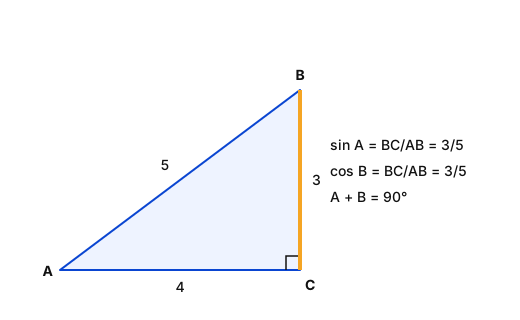
- .
- .
Trick: sin of one acute angle = cos of the other – no calculation needed.
Answer: (C)
अवधारणा: C पर समकोण हो तो , इसलिए ।
- ।
- ।
ट्रिक: एक न्यून कोण का sin = दूसरे का cos – गणना की ज़रूरत नहीं।
उत्तर: (C)
SSC CGLQuantitative AptitudeTrigonometry – complementary anglesSSC CGL 2025 · 26 Sep Shift 3
Q91.Convert 6° to radians.
6° को रेडियन में बदलिए।
- A
- B
- C
- D
Show answer
Concept: Radian = degree .
- .
- .
Yaad rakhein: rad; 1 rad .
Answer: (D)
अवधारणा: रेडियन = डिग्री ।
- ।
- ।
याद रखें: रेडियन; 1 रेडियन ।
उत्तर: (D)
SSC CGLQuantitative AptitudeAngle conversion – degree to radianSSC CGL 2025 · 26 Sep Shift 3
Q92.If A + B = 90° and sinA = , then what is cosB?
यदि A + B = 90° और sinA = है, तो cosB क्या होगा?
- A
- B
- C
- D0
Show answer
Concept: If , then .
- .
- .
Trick: Whenever angles add to , copy the given sin value as the cos answer.
Answer: (C)
अवधारणा: यदि , तो ।
- ।
- ।
ट्रिक: कोणों का योग हो तो दिया गया sin मान ही cos का उत्तर है।
उत्तर: (C)
SSC CGLQuantitative AptitudeTrigonometry – sin A = cos BSSC CGL 2025 · 26 Sep Shift 3
Q93.At the intersection of two lines, two angles are vertically opposite. If one of the angles measures 55°, what is the measure of the other angle?
दो रेखाओं के प्रतिच्छेद पर दो कोण शीर्षाभिमुख हैं। यदि एक कोण 55° का हो, तो दूसरे कोण का माप क्या होगा?
- A45°
- B55°
- C125°
- D180°
Show answer
Concept: Vertically opposite angles are always equal.
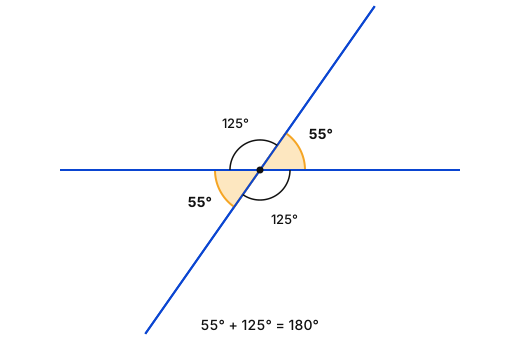
- One angle = 55° → its opposite angle = 55°.
- (The adjacent angle would be 180° − 55° = 125°.)
Trick: Opposite = equal, adjacent = 180° minus – 125° is the trap option.
Answer: (B) 55°
अवधारणा: शीर्षाभिमुख कोण सदैव बराबर होते हैं।
- एक कोण = 55° → सामने वाला कोण = 55°।
- (आसन्न कोण 180° − 55° = 125° होता।)
ट्रिक: सामने = बराबर, बगल वाला = 180° घटाकर – 125° भ्रम वाला विकल्प है।
उत्तर: (B) 55°
SSC CGLQuantitative AptitudeLines and angles – vertically oppositeSSC CGL 2025 · 26 Sep Shift 3
Q94.The incentre of a triangle is located at (4, 3). The perpendicular distance from the incentre to side AB is 3 units. What is the radius of the triangle's incircle?
एक त्रिभुज का अंतःकेंद्र (4, 3) पर है। अंतःकेंद्र से भुजा AB पर लंब दूरी 3 इकाई है। त्रिभुज के अंतःवृत्त की त्रिज्या क्या है?
- A1 unit1 इकाई
- B2 units2 इकाई
- C3 units3 इकाई
- D4 units4 इकाई
Show answer
Concept: The incircle touches every side, so incentre-to-side distance = inradius.
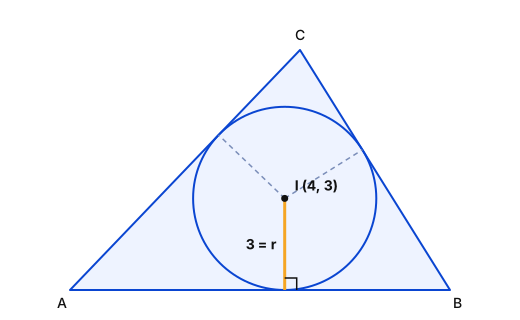
- Perpendicular distance from incentre to AB = 3 units.
- So inradius r = 3 units (the coordinates (4, 3) are not needed).
Yaad rakhein: Incentre = meeting point of angle bisectors; r = Area ÷ semi-perimeter.
Answer: (C) 3 units
अवधारणा: अंतःवृत्त हर भुजा को छूता है, इसलिए अंतःकेंद्र से भुजा की दूरी = अंतःत्रिज्या।
- अंतःकेंद्र से AB की लंबवत दूरी = 3 इकाई।
- अतः r = 3 इकाई (निर्देशांक (4, 3) की आवश्यकता नहीं)।
याद रखें: अंतःकेंद्र = कोण-समद्विभाजकों का मिलन बिंदु; r = क्षेत्रफल ÷ अर्ध-परिमाप।
उत्तर: (C) 3 इकाई
SSC CGLQuantitative AptitudeTriangle centres – inradiusSSC CGL 2025 · 26 Sep Shift 3
Q95.Given y = , what is (y + 1)² + (y − 1)²?
यदि y = है, तो (y + 1)² + (y − 1)² का मान क्या है?
- A12
- B17
- C9
- D16
Show answer
Concept: ; here , so .
- The terms cancel: sum = .
- With : .
Trick: Never expand fully – use .
Answer: (A) 12
अवधारणा: ; यहाँ , अतः ।
- वाले पद कट जाते हैं: योग = ।
- रखें: ।
ट्रिक: पूरा विस्तार न करें – लगाएँ।
उत्तर: (A) 12
SSC CGLQuantitative AptitudeAlgebra – identity evaluationSSC CGL 2025 · 26 Sep Shift 3
Q96.In triangle PQR, DE ‖ QR and = . If PE = 6 cm, then ER is:
त्रिभुज PQR में DE ‖ QR है और = है। यदि PE = 6 cm है, तो ER क्या होगा?
- A2.5 cm
- B12 cm
- C10 cm
- D14 cm
Show answer
Concept: If , then (Thales' theorem).
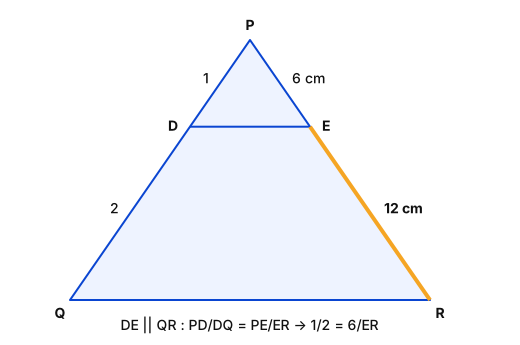
- .
- cm.
Trick: ER is twice PE because DQ is twice PD.
Answer: (B) 12 cm
अवधारणा: यदि , तो (थेल्स प्रमेय)।
- ।
- cm।
ट्रिक: DQ, PD का दोगुना है, इसलिए ER भी PE का दोगुना।
उत्तर: (B) 12 cm
SSC CGLQuantitative AptitudeTriangles – basic proportionalitySSC CGL 2025 · 26 Sep Shift 3
Q97.Chord AB and chord CD are equal and subtend angles of 35° and x° at the centre respectively. Find x.
जीवाएँ AB और CD बराबर हैं और केंद्र पर क्रमशः 35° और x° का कोण बनाती हैं। x ज्ञात कीजिए।
- A25°
- B30°
- C90°
- D35°
Show answer
Concept: Equal chords subtend equal angles at the centre.
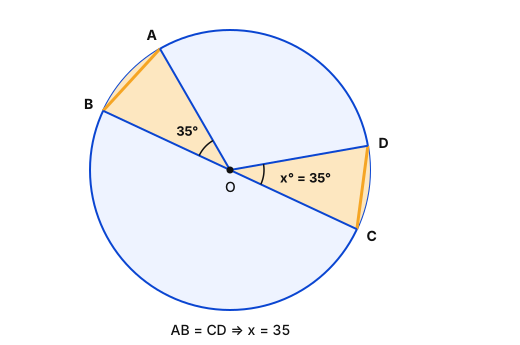
- AB = CD → central angles are equal.
- x = 35°.
Yaad rakhein: Equal chords are also equidistant from the centre.
Answer: (D) 35°
अवधारणा: समान जीवाएँ केंद्र पर समान कोण बनाती हैं।
- AB = CD → केंद्रीय कोण बराबर।
- x = 35°।
याद रखें: समान जीवाएँ केंद्र से समान दूरी पर भी होती हैं।
उत्तर: (D) 35°
SSC CGLQuantitative AptitudeCircle – equal chordsSSC CGL 2025 · 26 Sep Shift 3
Q98.What is the area of the segment formed by a chord in a circle of radius 5 cm, if the angle subtended at the centre is 90°?
5 cm त्रिज्या वाले वृत्त में जीवा द्वारा बने वृत्तखंड का क्षेत्रफल क्या है, यदि केंद्र पर बना कोण 90° हो?
- A − 12.5
- B − 12.5
- C100π − 12.5
- D25π − 12.5
Show answer
Concept: Minor segment = sector − triangle formed by the two radii.
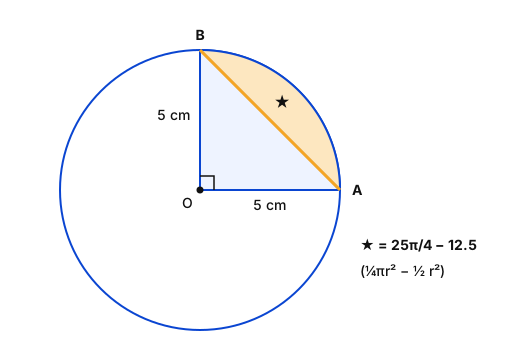
- Sector () = .
- Triangle = .
- Segment = cm².
Trick: For a angle the triangle is right-angled: area = straight away.
Answer: (A) − 12.5
अवधारणा: लघु वृत्तखंड = त्रिज्यखंड − दोनों त्रिज्याओं से बना त्रिभुज।
- त्रिज्यखंड () = ।
- त्रिभुज = ।
- वृत्तखंड = cm²।
ट्रिक: पर त्रिभुज समकोण होता है: क्षेत्रफल = सीधे।
उत्तर: (A) − 12.5
SSC CGLQuantitative AptitudeCircle – area of segmentSSC CGL 2025 · 26 Sep Shift 3
Q99.If tanA = , find sinA.
यदि tanA = है, तो sinA ज्ञात कीजिए।
- A
- B
- C
- D
Show answer
Concept: tan = perpendicular/base; find hypotenuse by Pythagoras.
- .
- .
Yaad rakhein: Common triplets: (3, 4, 5), (5, 12, 13), (7, 24, 25), (8, 15, 17).
Answer: (A)
अवधारणा: tan = लंब/आधार; पाइथागोरस से कर्ण निकालें।
- लंब = 7, आधार = 24 → कर्ण = ।
- = लंब/कर्ण = ।
याद रखें: सामान्य त्रिक: (3, 4, 5), (5, 12, 13), (7, 24, 25), (8, 15, 17)।
उत्तर: (A)
SSC CGLQuantitative AptitudeTrigonometry – sin from tanSSC CGL 2025 · 26 Sep Shift 3
Q100.Arun can complete a task in 40 days and Veena can complete the same task in 30 days. They work together for 5 days, and then Charu joins them and they complete the remaining work in 5 days. How long will Charu alone take to complete the task?
अरुण एक कार्य 40 दिन में और वीणा वही कार्य 30 दिन में पूरा करती है। दोनों 5 दिन साथ काम करते हैं, फिर चारु भी जुड़ जाती है और शेष कार्य 5 दिन में पूरा हो जाता है। चारु अकेली कार्य कितने दिनों में पूरा करेगी?
- A12 days12 दिन
- B26 days26 दिन
- C15 days15 दिन
- D27 days27 दिन
Show answer
Concept: Total work = LCM of days; compare units done per day.
- Work = 120 units; Arun 3/day, Veena 4/day.
- 5 days: ; left 85.
- All three: /day → Charu = /day → days.
Yaad rakhein: When someone joins later, always subtract the known workers' per-day share to isolate the new one.
Answer: (A) 12 days
अवधारणा: कुल कार्य = दिनों का LCM; प्रतिदिन की इकाइयाँ तुलना करें।
- कार्य = 120 इकाई; अरुण 3/दिन, वीणा 4/दिन।
- 5 दिन: ; बचा 85।
- तीनों: /दिन → चारु = /दिन → दिन।
याद रखें: कोई बाद में जुड़े तो कुल प्रतिदिन कार्य में से ज्ञात लोगों का हिस्सा घटाकर उसका कार्य निकालें।
उत्तर: (A) 12 दिन
SSC CGLQuantitative AptitudeTime & work – third person joinsSSC CGL 2025 · 26 Sep Shift 3

