Q981.What is the average of all three-digit numbers divisible by 19?
19 से विभाज्य सभी तीन-अंकीय संख्याओं का औसत क्या है?
- A752
- B551
- C552
- D352
Show answer
Concept: Average of an AP = .
- Smallest 3-digit multiple of 19: .
- Largest: ().
- Average = .
Trick: Average must itself be a multiple of 19 () — 552, 752, 352 fail.
Answer: (B) 551
अवधारणा: समांतर श्रेणी का औसत = ।
- सबसे छोटा 3-अंकीय गुणज =
- सबसे बड़ा =
- औसत =
ट्रिक: औसत भी 19 का गुणज होगा () — 552, 752, 352 नहीं।
उत्तर: (B) 551
SSC CGLQuantitative AptitudeAverage of an AP – multiplesSSC CGL 2025 · 14 Sep Shift 3
Q982.Two containers of the same volume are 30% and 50% full of milk, respectively. They are then filled completely with water. If the contents of both containers are mixed in a larger vessel, what percentage of the mixture is water?
समान आयतन के दो पात्र क्रमशः 30% और 50% दूध से भरे हैं। फिर उन्हें पानी से पूरा भर दिया जाता है। यदि दोनों पात्रों की सामग्री एक बड़े बर्तन में मिला दी जाए, तो मिश्रण में पानी का प्रतिशत क्या होगा?
- A45%
- B50%
- C55%
- D60%
Show answer
Concept: Take each container = 100 units.
- Milk = units out of 200.
- Water = units.
- Water% = .
Trick: Equal volumes → average the water %: .
Answer: (D) 60%
अवधारणा: हर बर्तन = 100 इकाई मानें।
- दूध = इकाई (कुल 200)
- पानी = 120 इकाई
- पानी% =
ट्रिक: बराबर आयतन → पानी% का सीधा औसत: ।
उत्तर: (D) 60%
SSC CGLQuantitative AptitudeMixture – equal containersSSC CGL 2025 · 14 Sep Shift 3
Q983.A stationery shop ordered 8 dozen red balls and some additional dozen blue balls. The price of the red balls per dozen was two times that of the blue ones. When the order was delivered, it was found that the number of dozens of the two colours had been interchanged. This increased the bill by 40%. Find the ratio of the number of dozens of red balls to the number of dozens of blue balls in the original order.
एक स्टेशनरी दुकान ने 8 दर्जन लाल गेंदें और कुछ दर्जन नीली गेंदें मंगाईं। लाल गेंदों का प्रति दर्जन मूल्य नीली गेंदों का दुगुना था। डिलीवरी में दोनों रंगों की दर्जन-संख्याएँ आपस में बदल गईं, जिससे बिल 40% बढ़ गया। मूल ऑर्डर में लाल और नीली गेंदों की दर्जन-संख्याओं का अनुपात ज्ञात कीजिए।
- A1 : 3
- B1 : 2
- C2 : 3
- D3 : 4
Show answer
Concept: Form the bill before and after the swap.
- Blue = ₹p/dozen, red = ₹2p; blue ordered = x dozen.
- Original bill = ; delivered bill = .
- .
- Red : Blue = 8 : 24 = 1 : 3.
Trick: Test option 1 : 3 (): ✓.
Answer: (A) 1 : 3
अवधारणा: अदला-बदली से पहले और बाद का बिल बनाएँ।
- नीली = ₹p/दर्जन, लाल = ₹2p; नीली = x दर्जन
- मूल बिल = ; नया बिल =
- लाल : नीली = 8 : 24 = 1 : 3
ट्रिक: विकल्प जाँचें: → 40 से 56, यानी 40% वृद्धि ✓।
उत्तर: (A) 1 : 3
SSC CGLQuantitative AptitudeInterchanged quantities – bill increaseSSC CGL 2025 · 14 Sep Shift 3
Q984.A flower vendor bought 300 flowers for ₹900. 90 flowers withered and became unsellable. At what price per flower should he sell the remaining flowers to earn a profit of 40% on his total cost?
एक फूल विक्रेता ने ₹900 में 300 फूल खरीदे। 90 फूल मुरझाकर बिक्री योग्य नहीं रहे। कुल लागत पर 40% लाभ कमाने के लिए उसे शेष फूल किस मूल्य प्रति फूल पर बेचने चाहिए?
- A₹7
- B₹6
- C₹5
- D₹3
Show answer
Concept: Total cost must be recovered from the sellable items only.
- Required SP = ₹1,260.
- Only flowers can be sold.
- So each must fetch ₹6.
Trick: — cancel the zero first.
Answer: (B) ₹6
अवधारणा: पूरी लागत केवल बिकने योग्य वस्तुओं से निकालनी है।
- आवश्यक विक्रय मूल्य = ₹1,260
- बिकने योग्य फूल = 210
- प्रति फूल = ₹6
ट्रिक: ।
उत्तर: (B) ₹6
SSC CGLQuantitative AptitudeProfit with wastageSSC CGL 2025 · 14 Sep Shift 3
Q985.A furniture store sells a chair for ₹Z, making a 20% loss. During a festive season, they increase the marked price of the same chair to ₹2.6Z. They then offer a special discount of 40% on this increased marked price. What will be the percentage profit made by the store during the festive season?
एक फर्नीचर स्टोर एक कुर्सी ₹Z में बेचकर 20% हानि उठाता है। त्योहार के मौसम में उसी कुर्सी का अंकित मूल्य बढ़ाकर ₹2.6Z कर दिया जाता है और इस पर 40% की विशेष छूट दी जाती है। त्योहार के मौसम में स्टोर को कितने प्रतिशत का लाभ होगा?
- A26%
- B24.8%
- C28%
- D30%
Show answer
Concept: Find CP from the loss, then the new SP after discount.
- Z = 80% of CP → .
- New SP = .
- Profit = .
Trick: Take Z = 100: CP = 125, SP = 156 → profit .
Answer: (B) 24.8%
अवधारणा: हानि से क्रय मूल्य, फिर छूट के बाद नया विक्रय मूल्य निकालें।
- Z = क्रय मूल्य का 80% →
- नया SP =
- लाभ =
ट्रिक: Z = 100 लें: CP = 125, SP = 156 → ।
उत्तर: (B) 24.8%
SSC CGLQuantitative AptitudeProfit & loss – markup and discountSSC CGL 2025 · 14 Sep Shift 3
Q986.A solution consists of milk and water in the ratio 3 : 5. If 8 litres of water is added, the new ratio becomes 3 : 7. What is the original quantity of milk in the solution?
एक विलयन में दूध और पानी का अनुपात 3 : 5 है। यदि 8 लीटर पानी मिलाया जाए, तो नया अनुपात 3 : 7 हो जाता है। विलयन में दूध की मूल मात्रा क्या है?
- A12 litres12 लीटर
- B15 litres15 लीटर
- C20 litres20 लीटर
- D30 litres30 लीटर
Show answer
Concept: Milk stays constant; only water changes.
- Milk = 3 parts in both ratios, so 1 part means the same amount before and after.
- Water: 5 → 7 parts, increase 2 parts = 8 L → 1 part = 4 L.
- Milk = L.
Trick: Same milk term (3) in both ratios → compare water parts directly.
Answer: (A) 12 litres
अवधारणा: दूध नहीं बदलता, केवल पानी बढ़ता है।
- दोनों अनुपात में दूध 3 भाग — इसलिए भाग का मान समान।
- पानी 5 → 7 भाग, 2 भाग = 8 L → 1 भाग = 4 L
- दूध = L
ट्रिक: दूध का भाग दोनों में 3 है — सीधे पानी के भाग तुलना करें।
उत्तर: (A) 12 लीटर
SSC CGLQuantitative AptitudeMixture – adding waterSSC CGL 2025 · 14 Sep Shift 3
Q987.Ram alone can complete a job in 12 days and Shyam alone in 18 days. Ram and Shyam agree to do the work for ₹3600. With Ghanshyam's help they finished it in 5 days. How much is Ghanshyam's share?
राम अकेले एक काम 12 दिन में और श्याम अकेले 18 दिन में कर सकता है। राम और श्याम ₹3600 में काम करने को तैयार हुए। घनश्याम की सहायता से काम 5 दिन में पूरा हो गया। घनश्याम का हिस्सा कितना है?
- A₹1,800
- B₹1,400
- C₹1,600
- D₹1,100
Show answer
Concept: Wages are shared in proportion to work done.
- Total work = units; Ram = 3/day, Shyam = 2/day.
- In 5 days: Ram 15, Shyam 10 → 25 units.
- Ghanshyam did units → ₹1,100.
Trick: ₹3600 ÷ 36 units = ₹100 per unit → 11 units = ₹1,100.
Answer: (D) ₹1,100
अवधारणा: मज़दूरी किए गए काम के अनुपात में बँटती है।
- कुल काम = इकाई; राम = 3/दिन, श्याम = 2/दिन
- 5 दिन में: राम 15, श्याम 10 = 25 इकाई
- घनश्याम = 11 इकाई → ₹1,100
ट्रिक: ₹3600 ÷ 36 = ₹100 प्रति इकाई → 11 इकाई = ₹1,100।
उत्तर: (D) ₹1,100
SSC CGLQuantitative AptitudeWork and wagesSSC CGL 2025 · 14 Sep Shift 3
Q988.A tank has a mixture of solutions A, B, and C in the respective ratio of 5 : 3 : 2. 10 litres of this mixture is drained out, and subsequently, 5 litres of solution A and 3 litres of solution C are added to the tank. If the resultant quantity of solution A is 25 litres more than the resultant quantity of solution B, what was the initial quantity of mixture in the tank (in litres)?
एक टंकी में विलयन A, B और C का मिश्रण 5 : 3 : 2 के अनुपात में है। 10 लीटर मिश्रण निकाला जाता है, फिर 5 लीटर विलयन A और 3 लीटर विलयन C टंकी में डाला जाता है। यदि परिणामी विलयन A की मात्रा परिणामी विलयन B से 25 लीटर अधिक है, तो टंकी में मिश्रण की प्रारंभिक मात्रा (लीटर में) क्या थी?
- A140
- B240
- C120
- D110
Show answer
Concept: Liquid drawn out has the same ratio as the mixture.
- Let total = 10x: A = 5x, B = 3x, C = 2x.
- 10 L removed = 5 L A, 3 L B, 2 L C.
- Then +5 L A → A = 5x; B = 3x − 3.
- 5x − (3x − 3) = 25 → 2x = 22 → x = 11 → total = 110 L.
Trick: A loses 5 and gets 5 back — so A is unchanged; only B drops by 3.
Answer: (D) 110
अवधारणा: निकाला गया मिश्रण उसी अनुपात में होता है।
- कुल = 10x: A = 5x, B = 3x, C = 2x
- 10 L निकालने पर A 5 L, B 3 L, C 2 L कम
- फिर A में 5 L जोड़ा → A = 5x, B = 3x − 3
- 5x − 3x + 3 = 25 → x = 11 → कुल 110 L
ट्रिक: A से 5 निकला और 5 ही वापस आया — A अपरिवर्तित, केवल B में 3 कम।
उत्तर: (D) 110
SSC CGLQuantitative AptitudeMixture – draw out and addSSC CGL 2025 · 14 Sep Shift 3
Q989.The ratio of the time taken by A and B to complete a task is 5 : 4. If B can complete the task alone in 18 hours, how many hours will they take to complete the task if they work together?
एक कार्य पूरा करने में A और B द्वारा लिए गए समय का अनुपात 5 : 4 है। यदि B अकेला कार्य 18 घंटे में कर सकता है, तो दोनों मिलकर कितने घंटों में कार्य पूरा करेंगे?
- A12 hours12 घंटे
- B10 hours10 घंटे
- C9 hours9 घंटे
- D11 hours11 घंटे
Show answer
Concept: Find A's time, then use .
- A : B = 5 : 4 and B = 18 h → A = h.
- Together = h.
Trick: Efficiency ratio = 4 : 5 (inverse); B's 5 units/h × 18 h = 90 units; together 9 units/h → 10 h.
Answer: (B) 10 hours
अवधारणा: A का समय निकालें, फिर ।
- A : B = 5 : 4, B = 18 घंटे → A = 22.5 घंटे
- साथ में = घंटे
ट्रिक: क्षमता अनुपात 4 : 5; कुल काम = ; साथ में 9/घंटा → 10 घंटे।
उत्तर: (B) 10 घंटे
SSC CGLQuantitative AptitudeTime and work – time ratioSSC CGL 2025 · 14 Sep Shift 3
Q990.Three friends, X, Y, and Z, are cycling on a circular track with a circumference of 3 km. They all start from the same point at 9:00 a.m. and travel in the same direction with speeds of 15 km/h, 10 km/h, and 12 km/h respectively. How many times will all three of them meet at the starting point if they continue cycling until 3:00 p.m.?
तीन मित्र X, Y और Z, 3 km परिधि वाले एक वृत्ताकार ट्रैक पर साइकिल चला रहे हैं। तीनों सुबह 9:00 बजे एक ही बिंदु से एक ही दिशा में क्रमशः 15 km/h, 10 km/h और 12 km/h की चाल से चलते हैं। यदि वे दोपहर 3:00 बजे तक चलते रहें, तो तीनों प्रारंभिक बिंदु पर कितनी बार मिलेंगे?
- A1 time1 बार
- B2 times2 बार
- C3 times3 बार
- D4 times4 बार
Show answer
Concept: All meet at the start after LCM of their lap times.
- Lap time = : X = 12 min, Y = 18 min, Z = 15 min.
- min = 3 h.
- In 6 hours (9 a.m.–3 p.m.) the 3-hour cycle gives the start moment plus two more (noon, 3 p.m.) → 3 times, counting the start.
Trick: Lap times in minutes = (since ).
Answer: (C) 3 times
अवधारणा: सभी आरंभ बिंदु पर अपने चक्कर-समय के LCM के बाद मिलते हैं।
- एक चक्कर का समय: X = 12 मिनट, Y = 18 मिनट, Z = 15 मिनट
- मिनट = 3 घंटे
- आरंभ बिंदु पर एक साथ: 9:00, 12:00 और 3:00 → 3 बार (आरंभ सहित)।
ट्रिक: मिनट में चक्कर-समय = 180/चाल ()।
उत्तर: (C) 3 बार
SSC CGLQuantitative AptitudeCircular track – meeting at startSSC CGL 2025 · 14 Sep Shift 3
Q991.A circular path of 3 m width runs around a circular park with radius 7 m. What is the area of the path?
7 m त्रिज्या वाले एक वृत्ताकार पार्क के चारों ओर 3 m चौड़ा वृत्ताकार पथ है। पथ का क्षेत्रफल क्या है?
- A160.28 m²
- B161.29 m²
- C158.02 m²
- D164.05 m²
Show answer
Concept: Area of ring = .
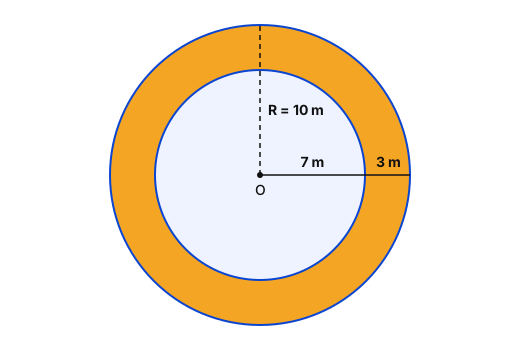
- r = 7 m, m.
- Area = m².
Trick: .
Answer: (A) 160.28 m²
अवधारणा: वलय का क्षेत्रफल = ।
- r = 7 m, R = 10 m
- क्षेत्रफल = m²
ट्रिक: ।
उत्तर: (A) 160.28 m²
SSC CGLQuantitative AptitudeMensuration – circular pathSSC CGL 2025 · 14 Sep Shift 3
Q992.Find the slope of the line perpendicular to y = x + 7
y = x + 7 रेखा पर लंब रेखा की प्रवणता (slope) ज्ञात कीजिए।
- A−3
- B3
- C−
- D
Show answer
Concept: For perpendicular lines, .
- → .
- .
Trick: Perpendicular slope = flip the fraction and change the sign: .
Answer: (A) −3
अवधारणा: लंब रेखाओं में ।
- →
ट्रिक: भिन्न उलटें और चिह्न बदलें: ।
उत्तर: (A) −3
SSC CGLQuantitative AptitudeCoordinate geometry – perpendicular slopeSSC CGL 2025 · 14 Sep Shift 3
Q993.Convert 3.5 radians to degrees.
3.5 रेडियन को डिग्री में बदलिए।
- A130°
- B143.24°
- C180°
- D200.56°
Show answer
Concept: Degrees = radians .
- .
- → nearest option 200.56°.
Trick: 1 radian ≈ 57.3°, so 3.5 rad ≈ 200° — only option (D) is near.
Answer: (D) 200.56°
अवधारणा: डिग्री = रेडियन ।
- → निकटतम विकल्प 200.56°
ट्रिक: 1 रेडियन ≈ 57.3°, अतः 3.5 रेडियन ≈ 200° — केवल (D) पास है।
उत्तर: (D) 200.56°
SSC CGLQuantitative AptitudeRadian to degreeSSC CGL 2025 · 14 Sep Shift 3
Q994.A sector of a circle having a radius of 5 cm has a central angle of radians. What is the area of the sector?
5 cm त्रिज्या वाले वृत्त के एक त्रिज्यखंड का केंद्रीय कोण रेडियन है। त्रिज्यखंड का क्षेत्रफल क्या है?
- A13.09 cm²
- B8.33 cm²
- C10.47 cm²
- D12.5 cm²
Show answer
Concept: Sector area = (θ in radians).
- .
- cm².
Trick: = of the circle → .
Answer: (A) 13.09 cm²
अवधारणा: त्रिज्यखंड का क्षेत्रफल = (θ रेडियन में)।
- cm²
ट्रिक: = वृत्त का भाग → ।
उत्तर: (A) 13.09 cm²
SSC CGLQuantitative AptitudeArea of sector – radian angleSSC CGL 2025 · 14 Sep Shift 3
Q995.If sin A = cos(2A − 30°), then what is the value of A?
यदि sin A = cos(2A − 30°) है, तो A का मान क्या है?
- A40°
- B25°
- C18°
- D30°
Show answer
Concept: If sin x = cos y (acute angles), then x + y = 90°.
- A + (2A − 30°) = 90°.
- 3A = 120° → A = 40°.
Trick: Check: sin 40° = cos(80° − 30°) = cos 50° ✓.
Answer: (A) 40°
अवधारणा: यदि sin x = cos y (न्यून कोण), तो x + y = 90°।
- A + 2A − 30° = 90°
- 3A = 120° → A = 40°
ट्रिक: जाँच: sin 40° = cos 50° ✓
उत्तर: (A) 40°
SSC CGLQuantitative AptitudeTrigonometry – complementary anglesSSC CGL 2025 · 14 Sep Shift 3
Q996.In similar triangles, the ratio of corresponding altitudes is 3 : 4. What is the ratio of their areas?
समरूप त्रिभुजों में संगत शीर्षलंबों का अनुपात 3 : 4 है। उनके क्षेत्रफलों का अनुपात क्या है?
- A2 : 5
- B9 : 16
- C2 : 25
- D5 : 2
Show answer
Concept: Area ratio = .
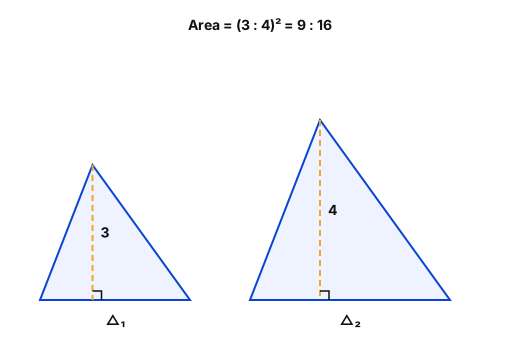
- Altitudes 3 : 4.
- Areas = .
Trick: Side, altitude, median, perimeter – all in the same ratio; area is its square.
Answer: (B) 9 : 16
अवधारणा: क्षेत्रफल अनुपात = ।
- शीर्षलंब 3 : 4
- क्षेत्रफल = 9 : 16
ट्रिक: भुजा, शीर्षलंब, माध्यिका, परिमाप — सबका अनुपात समान; क्षेत्रफल उसका वर्ग।
उत्तर: (B) 9 : 16
SSC CGLQuantitative AptitudeSimilar triangles – area ratioSSC CGL 2025 · 14 Sep Shift 3
Q997.Given, b = , what is (b + 1)² + (b − 1)²?
यदि b = है, तो (b + 1)² + (b − 1)² का मान क्या है?
- A13
- B12
- C14
- D16
Show answer
Concept: .
- .
- Value = .
Trick: The cross terms +2b and −2b cancel, so never needs expanding.
Answer: (D) 16
अवधारणा: ।
- मान =
ट्रिक: +2b और −2b कट जाते हैं, इसलिए का विस्तार नहीं करना पड़ता।
उत्तर: (D) 16
SSC CGLQuantitative AptitudeAlgebraic identitySSC CGL 2025 · 14 Sep Shift 3
Q998.Simplify: + −
सरल कीजिए: + −
- A7
- B6
- C5
- D8
Show answer
Concept: Write each surd as (perfect square) × 2.
- .
- .
Trick: Just add the outside numbers: .
Answer: (B) 6
अवधारणा: हर करणी को (पूर्ण वर्ग) × 2 में लिखें।
ट्रिक: बाहर की संख्याएँ जोड़ें: ।
उत्तर: (B) 6
SSC CGLQuantitative AptitudeSurds – simplificationSSC CGL 2025 · 14 Sep Shift 3
Q999.The diameter of a circle measures 15 cm. What is the maximum length of a chord in this circle?
एक वृत्त का व्यास 15 cm है। इस वृत्त में किसी जीवा की अधिकतम लंबाई क्या होगी?
- A15 cm
- B35 cm
- C65 cm
- D90 cm
Show answer
Concept: A chord through the centre is the longest one — the diameter.
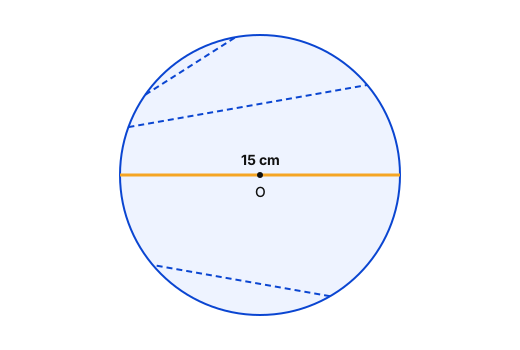
- Any chord not passing through the centre is shorter than the diameter.
- Diameter = 15 cm → maximum chord = 15 cm.
Yaad rakhein: No chord can exceed the diameter, so options above 15 cm are impossible.
Answer: (A) 15 cm
अवधारणा: केंद्र से होकर जाने वाली जीवा (व्यास) सबसे लंबी होती है।
- केंद्र से न गुज़रने वाली हर जीवा व्यास से छोटी होती है।
- व्यास = 15 cm → अधिकतम जीवा = 15 cm
याद रखें: कोई जीवा व्यास से बड़ी नहीं हो सकती।
उत्तर: (A) 15 cm
SSC CGLQuantitative AptitudeCircle – longest chordSSC CGL 2025 · 14 Sep Shift 3
Q1000.If sin A + cos A = cos A, then what is the value of cot A?
यदि sin A + cos A = cos A है, तो cot A का मान क्या है?
- A
- B1
- C + 1
- D − 1
Show answer
Concept: Bring sin and cos to one side, form .
- Move to the right: .
- Divide by : equals , hence .
- Rationalise: .
Trick: , so they are reciprocals of each other.
Answer: (C) + 1
अवधारणा: sin और cos को एक ओर लाकर बनाएँ।
- को दाईं ओर ले जाएँ:
- से भाग देने पर बराबर , अतः
- परिमेयीकरण:
ट्रिक: — दोनों एक-दूसरे के व्युत्क्रम हैं।
उत्तर: (C) + 1
SSC CGLQuantitative AptitudeTrigonometry – finding cot ASSC CGL 2025 · 14 Sep Shift 3

