Q1021.A square field of side 24 m has a square pond in the center. If the area of the pond is 484 m², what is the area of the remaining field?
24 m भुजा वाले एक वर्गाकार मैदान के बीच में एक वर्गाकार तालाब है। यदि तालाब का क्षेत्रफल 484 m² है, तो शेष मैदान का क्षेत्रफल क्या है?
- A48 m²
- B92 m²
- C78 m²
- D82 m²
Show answer
Concept: Remaining area = square area − pond area.
- Square = m².
- Remaining = m².
Trick: Remember and – squares up to 30 save time.
Answer: (B) 92 m²
अवधारणा: शेष क्षेत्रफल = वर्ग का क्षेत्रफल − तालाब का क्षेत्रफल।
- वर्ग = m²
- शेष = m²
ट्रिक: , जैसे वर्ग याद रखें।
उत्तर: (B) 92 m²
SSC CGLQuantitative AptitudeMensuration – area left after a pondSSC CGL 2025 · 14 Sep Shift 2
Q1022.If the height of a right prism is increased by 60% and base area remains the same, what is the percentage increase in volume?
यदि किसी लंब प्रिज़्म की ऊँचाई 60% बढ़ा दी जाए और आधार का क्षेत्रफल वही रहे, तो आयतन में कितने प्रतिशत की वृद्धि होगी?
- A25%
- B60%
- C75%
- D100%
Show answer
Concept: Volume of a prism = base area × height.
- Base area fixed → volume ∝ height.
- Height × 1.6 → volume × 1.6 → 60% increase.
Trick: Single-factor change: percentage change in volume = percentage change in that factor.
Answer: (B) 60%
अवधारणा: प्रिज़्म का आयतन = आधार क्षेत्रफल × ऊँचाई।
- आधार स्थिर → आयतन ∝ ऊँचाई
- ऊँचाई × 1.6 → आयतन × 1.6 → 60% वृद्धि
ट्रिक: केवल एक राशि बदले तो आयतन में भी उतना ही % बदलाव।
उत्तर: (B) 60%
SSC CGLQuantitative AptitudePrism – volume changeSSC CGL 2025 · 14 Sep Shift 2
Q1023.A circular decorative wall clock with a radius of 30 cm has a design where a chord connects two points on the circumference. This chord, along with two radii, forms an equilateral triangle at the center of the clock face. The smaller segment created by this chord is painted in a contrasting color. What percentage of the clock's total area does this smaller painted segment represent? (Use π = 3.14, ≈ 1.732)
30 cm त्रिज्या वाली एक वृत्ताकार सजावटी दीवार घड़ी में एक जीवा परिधि के दो बिंदुओं को जोड़ती है। यह जीवा दो त्रिज्याओं के साथ केंद्र पर एक समबाहु त्रिभुज बनाती है। जीवा से बना छोटा खंड विपरीत रंग में रंगा जाता है। यह छोटा खंड घड़ी के कुल क्षेत्रफल का कितना प्रतिशत है? (π = 3.14, ≈ 1.732 लीजिए)
- A2.88%
- B5.6%
- C9.08%
- D12.5%
Show answer
Concept: Segment = sector − triangle; equilateral triangle means central angle 60°.
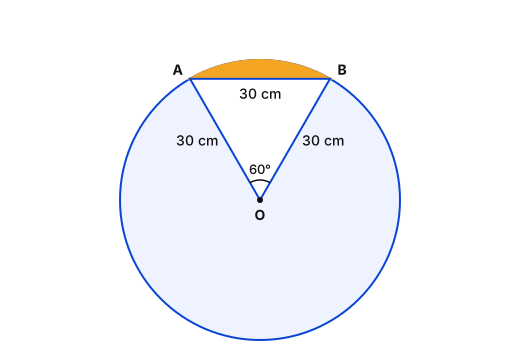
- Sector = cm².
- Triangle = cm².
- Segment = 81.3 cm²; circle = 2826 cm² → .
Trick: Radius cancels: % = .
Answer: (A) 2.88%
अवधारणा: वृत्तखंड = त्रिज्यखंड − त्रिभुज; समबाहु त्रिभुज → केंद्रीय कोण 60°।
- त्रिज्यखंड = cm²
- त्रिभुज = cm²
- वृत्तखंड = 81.3; वृत्त = 2826 →
ट्रिक: त्रिज्या कट जाती है: % = ।
उत्तर: (A) 2.88%
SSC CGLQuantitative AptitudeCircle – minor segment percentageSSC CGL 2025 · 14 Sep Shift 2
Q1024.A cylinder (r = 8 cm, h = 20 cm) is bored through by a hole (r = 4 cm, full height). What percentage of original volume is removed?
एक बेलन (r = 8 cm, h = 20 cm) में पूरी ऊँचाई तक एक छेद (r = 4 cm) किया जाता है। मूल आयतन का कितना प्रतिशत हटाया गया?
- A25%
- B50%
- C75%
- D37.5%
Show answer
Concept: Same height → volume ratio = ratio of .
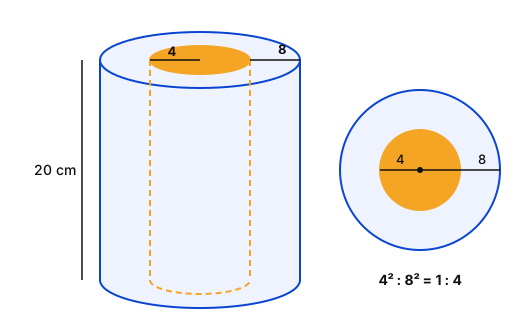
- Removed/original = .
- .
Trick: Half the radius → one-fourth the volume (same height).
Answer: (A) 25%
अवधारणा: ऊँचाई समान → आयतनों का अनुपात = का अनुपात।
- निकला/मूल =
ट्रिक: त्रिज्या आधी → आयतन एक-चौथाई (ऊँचाई समान)।
उत्तर: (A) 25%
SSC CGLQuantitative AptitudeCylinder – volume removed by a holeSSC CGL 2025 · 14 Sep Shift 2
Q1025.A sector of a circle with a radius of 12 cm has a central angle of 60°. Another sector of the same circle has a central angle of radians. What is the ratio of the areas of the two sectors?
12 cm त्रिज्या वाले वृत्त के एक त्रिज्यखंड का केंद्रीय कोण 60° है। उसी वृत्त के एक अन्य त्रिज्यखंड का केंद्रीय कोण रेडियन है। दोनों त्रिज्यखंडों के क्षेत्रफलों का अनुपात क्या है?
- A1 : 2
- B2 : 3
- C1 : 1
- D3 : 4
Show answer
Concept: radians ; in one circle, sector area ∝ angle.
- .
- Both sectors have 60° in the same circle → equal areas → 1 : 1.
Trick: Radius 12 cm is a distractor – equal angles in the same circle always give 1 : 1.
Answer: (C) 1 : 1
अवधारणा: रेडियन ; एक ही वृत्त में त्रिज्यखंड क्षेत्रफल ∝ कोण।
- रेडियन
- दोनों 60°, एक ही वृत्त → क्षेत्रफल बराबर → 1 : 1
ट्रिक: 12 cm त्रिज्या भटकाने के लिए है; समान कोण → 1 : 1।
उत्तर: (C) 1 : 1
SSC CGLQuantitative AptitudeSector area – degrees vs radiansSSC CGL 2025 · 14 Sep Shift 2
Q1026.Find the product: 1.2 × 2 ×
गुणनफल ज्ञात कीजिए: 1.2 × 2 ×
- A2.4
- B1.5
- C1.44
- D2.1
Show answer
Concept: Turn the mixed fraction and fraction into simple numbers, then multiply.
- and .
- .
- .
Trick: , so the product = — done in one look.
Answer: (C) 1.44
अवधारणा: मिश्र भिन्न और भिन्न को सरल रूप में बदलकर गुणा करें।
- और ।
- ।
- ।
ट्रिक: , इसलिए गुणनफल = ।
उत्तर: (C) 1.44
SSC CGLQuantitative AptitudeSimplification – decimals and fractionsSSC CGL 2025 · 14 Sep Shift 1
Q1027.What is the value of ?
का मान क्या है?
- A0.037
- B0.05
- C0.125
- D0.025
Show answer
Concept: If every base is doubled, a sum of cubes becomes times.
- Expression = .
- 0.4 is double 0.2, and 0.08 is double 0.04.
- Denominator = .
- Value = .
Trick: Ratio of bases = 1 : 2 in both terms → answer = , no cubing needed.
Answer: (C) 0.125
अवधारणा: हर आधार दोगुना हो तो घनों का योग गुना हो जाता है।
- व्यंजक = ।
- 0.4, 0.2 का दोगुना है और 0.08, 0.04 का दोगुना।
- हर = ।
- मान = ।
ट्रिक: दोनों पदों में आधारों का अनुपात 1 : 2 → उत्तर = , घन निकालने की ज़रूरत नहीं।
उत्तर: (C) 0.125
SSC CGLQuantitative AptitudeSimplification – common factor of cubesSSC CGL 2025 · 14 Sep Shift 1
Q1028.The number of students in two sections A and B having different heights is shown in the table given below:| Height (in metres) | Section A | Section B |
| 1.55 | 6 | 5 |
| 1.60 | 8 | 7 |
| 1.62 | 11 | 13 |
| 1.65 | 14 | 10 |
| 1.68 | 6 | 7 |
| 1.71 | 7 | 5 |
| 1.75 | 4 | 3 |
What is the ratio of the total number of students in Section A whose height is less than 1.65 metres to the total number of students in Section B whose height is less than 1.65 metres?
दो खंडों A और B में विभिन्न लंबाइयों वाले विद्यार्थियों की संख्या नीचे तालिका में दी गई है:| लंबाई (मीटर में) | खंड A | खंड B |
| 1.55 | 6 | 5 |
| 1.60 | 8 | 7 |
| 1.62 | 11 | 13 |
| 1.65 | 14 | 10 |
| 1.68 | 6 | 7 |
| 1.71 | 7 | 5 |
| 1.75 | 4 | 3 |
खंड A में 1.65 मीटर से कम लंबाई वाले कुल विद्यार्थियों और खंड B में 1.65 मीटर से कम लंबाई वाले कुल विद्यार्थियों का अनुपात क्या है?
- A15 : 16
- B1 : 1
- C26 : 25
- D25 : 25
Show answer
Concept: 'Less than 1.65 m' excludes the 1.65 m row.
- Rows used: 1.55, 1.60, 1.62 m.
- Section A = 6 + 8 + 11 = 25.
- Section B = 5 + 7 + 13 = 25.
- Ratio = 25 : 25 = 1 : 1.
Trick: Spot 'less than' vs 'up to' first — it decides whether the boundary row counts.
Answer: (B) 1 : 1
अवधारणा: '1.65 मी से कम' में 1.65 मी वाली पंक्ति नहीं जुड़ेगी।
- प्रयुक्त पंक्तियाँ: 1.55, 1.60, 1.62 मी।
- सेक्शन A = 6 + 8 + 11 = 25।
- सेक्शन B = 5 + 7 + 13 = 25।
- अनुपात = 25 : 25 = 1 : 1।
ट्रिक: पहले 'से कम' और 'तक' का अंतर देखें — सीमा वाली पंक्ति इसी से तय होती है।
उत्तर: (B) 1 : 1
SSC CGLQuantitative AptitudeData interpretation – table ratioSSC CGL 2025 · 14 Sep Shift 1
Q1029.Ravi, Aman, and Karan started a business together. They invested ₹40,000, ₹60,000, and ₹80,000 respectively for one year. If the total profit at the end of the year is ₹55,000, what will be Aman's share in the profit?
रवि, अमन और करण ने मिलकर व्यवसाय शुरू किया। उन्होंने एक वर्ष के लिए क्रमशः ₹40,000, ₹60,000 और ₹80,000 निवेश किए। यदि वर्ष के अंत में कुल लाभ ₹55,000 है, तो लाभ में अमन का हिस्सा क्या होगा?
- A₹18,333.33
- B₹19,333.67
- C₹23,333.76
- D₹28,333.33
Show answer
Concept: Equal time ⇒ profit is shared in the ratio of capitals.
- 40,000 : 60,000 : 80,000 = 2 : 3 : 4 (total 9 parts).
- 1 part = .
- Aman = 3 parts = ₹18,333.33.
Trick: Aman's 3 out of 9 = one-third of profit → directly.
Answer: (A) ₹18,333.33
अवधारणा: समय बराबर ⇒ लाभ पूँजी के अनुपात में बँटता है।
- 40,000 : 60,000 : 80,000 = 2 : 3 : 4 (कुल 9 भाग)।
- 1 भाग = ।
- अमन = 3 भाग = ₹18,333.33।
ट्रिक: 9 में से 3 = एक-तिहाई → सीधे ।
उत्तर: (A) ₹18,333.33
SSC CGLQuantitative AptitudePartnership – profit shareSSC CGL 2025 · 14 Sep Shift 1
Q1030.A and B invest ₹50,000 and ₹1,00,000 respectively, in a business. After one year, the profit is distributed, including simple interest at 10% per annum on the capital. Total profit, including interest, is ₹30,000. What is A's share?
A और B एक व्यवसाय में क्रमशः ₹50,000 और ₹1,00,000 निवेश करते हैं। एक वर्ष बाद लाभ बाँटा जाता है, जिसमें पूंजी पर 10% वार्षिक साधारण ब्याज भी शामिल है। ब्याज सहित कुल लाभ ₹30,000 है। A का हिस्सा क्या है?
- A₹9,000
- B₹10,000
- C₹11,000
- D₹12,000
Show answer
Concept: First pay interest on capital, then divide the balance in the capital ratio.
- Interest: A = 10% of 50,000 = 5,000; B = 10% of 1,00,000 = 10,000.
- Balance = ; ratio A : B = 1 : 2.
- A's balance share = .
- A total = ₹10,000.
Trick: Interest and balance both go in 1 : 2 here, so A simply gets of 30,000 = ₹10,000.
Answer: (B) ₹10,000
अवधारणा: पहले पूँजी पर ब्याज दें, फिर शेष को पूँजी के अनुपात में बाँटें।
- ब्याज: A = 50,000 का 10% = 5,000; B = 1,00,000 का 10% = 10,000।
- शेष = ; A : B = 1 : 2।
- A का शेष हिस्सा = ।
- A कुल = ₹10,000।
ट्रिक: ब्याज और शेष दोनों 1 : 2 में बँटते हैं, इसलिए A = 30,000 का = ₹10,000।
उत्तर: (B) ₹10,000
SSC CGLQuantitative AptitudePartnership – interest on capitalSSC CGL 2025 · 14 Sep Shift 1
Q1031.Table — Units Sold of 3 Products| Product | Jan | Feb | Mar |
| A | 80 | 105 | 103 |
| B | 80 | 70 | 90 |
| C | 155 | 145 | 120 |
Which product had the lowest average units sold?
तालिका — 3 उत्पादों की बिकी इकाइयाँ| उत्पाद | जनवरी | फरवरी | मार्च |
| A | 80 | 105 | 103 |
| B | 80 | 70 | 90 |
| C | 155 | 145 | 120 |
किस उत्पाद की औसत बिक्री इकाइयाँ सबसे कम रहीं?
- AB & C bothB और C दोनों
- BA
- CB
- DC
Show answer
Concept: Same number of months for each product, so compare totals.
- A = 80 + 105 + 103 = 288 → average 96.
- B = 80 + 70 + 90 = 240 → average 80.
- C = 155 + 145 + 120 = 420 → average 140.
- Lowest = B.
Trick: When the count is equal, the smallest total gives the smallest average — no need to divide.
Answer: (C) B
अवधारणा: हर उत्पाद के महीने बराबर हैं, अतः योग की तुलना करें।
- A = 80 + 105 + 103 = 288 → औसत 96।
- B = 80 + 70 + 90 = 240 → औसत 80।
- C = 155 + 145 + 120 = 420 → औसत 140।
- सबसे कम = B।
ट्रिक: संख्या बराबर हो तो सबसे छोटा योग = सबसे छोटा औसत — भाग देने की ज़रूरत नहीं।
उत्तर: (C) B
SSC CGLQuantitative AptitudeData interpretation – average from tableSSC CGL 2025 · 14 Sep Shift 1
Q1032.Three numbers are such that when the average of any two of them is added to the third, the results obtained are 210, 192, and 174, respectively. What is the average of the three numbers?
तीन संख्याएँ ऐसी हैं कि किन्हीं दो का औसत तीसरी में जोड़ने पर परिणाम क्रमशः 210, 192 और 174 प्राप्त होते हैं। तीनों संख्याओं का औसत क्या है?
- A93
- B94
- C95
- D96
Show answer
Concept: Write each result in terms of the total .
- .
- Adding all three: .
- .
- Average = .
Trick: Sum of the three results = 2 × (sum of numbers) → average = total of results ÷ 6 = .
Answer: (D) 96
अवधारणा: हर परिणाम को कुल योग के रूप में लिखें।
- ।
- तीनों जोड़ें: ।
- ।
- औसत = ।
ट्रिक: तीनों परिणामों का योग = 2 × संख्याओं का योग → औसत = ।
उत्तर: (D) 96
SSC CGLQuantitative AptitudeAverage – sum relationsSSC CGL 2025 · 14 Sep Shift 1
Q1033.A school conducted an educational tour for 100 students and 10 chaperones. Each student received a snack pack containing items equal to 20% of the total number of students, while each chaperone received a snack pack containing items equal to 25% of the total number of students. Calculate the total number of snack items distributed among all participants.
एक स्कूल ने 100 विद्यार्थियों और 10 अभिभावकों (chaperones) के लिए शैक्षिक भ्रमण आयोजित किया। प्रत्येक विद्यार्थी को कुल विद्यार्थियों की संख्या के 20% के बराबर वस्तुओं वाला स्नैक पैक मिला, जबकि प्रत्येक अभिभावक को कुल विद्यार्थियों की संख्या के 25% के बराबर वस्तुओं वाला पैक मिला। सभी प्रतिभागियों में बाँटी गई कुल स्नैक वस्तुएँ ज्ञात कीजिए।
- A1750
- B1760
- C2250
- D2000
Show answer
Concept: Percent is taken of the number of students (100).
- Per student pack = 20% of 100 = 20 items → .
- Per chaperone pack = 25% of 100 = 25 items → .
- Total = .
Trick: With base 100, x% of 100 = x — read the percentages directly as item counts.
Answer: (C) 2250
अवधारणा: प्रतिशत विद्यार्थियों की संख्या (100) का लेना है।
- प्रति विद्यार्थी = 100 का 20% = 20 वस्तुएँ → ।
- प्रति संरक्षक = 100 का 25% = 25 → ।
- कुल = ।
ट्रिक: आधार 100 हो तो x% = x — प्रतिशत को सीधे संख्या मान लें।
उत्तर: (C) 2250
SSC CGLQuantitative AptitudePercentage – counting itemsSSC CGL 2025 · 14 Sep Shift 1
Q1034.Anita invested ₹10,000 in a savings scheme that offers interest at the rate of 10% per annum, compounded annually. Find the compound interest earned by her at the end of 2 years 6 months.
अनीता ने एक बचत योजना में ₹10,000 निवेश किए जो 10% वार्षिक दर से वार्षिक चक्रवृद्धि ब्याज देती है। 2 वर्ष 6 माह के अंत में उसे मिला चक्रवृद्धि ब्याज ज्ञात कीजिए।
- A₹2,750
- B₹2,705
- C₹2,700
- D₹2,505
Show answer
Concept: For ½ year after full years, use half the rate as simple interest on the amount.
- After 2 years: .
- Next 6 months at 5%: .
- Amount = 12,705; CI = ₹2,705.
Trick: 2-year CI at 10% = 21% (2,100); add 5% of 12,100 = 605 → 2,705.
Answer: (B) ₹2,705
अवधारणा: पूरे वर्षों के बाद आधे वर्ष के लिए आधी दर से मिश्रधन पर ब्याज लें।
- 2 वर्ष बाद: ।
- अगले 6 महीने 5% पर: ।
- मिश्रधन = 12,705; चक्रवृद्धि ब्याज = ₹2,705।
ट्रिक: 10% पर 2 वर्ष का CI = 21% (2,100); फिर 12,100 का 5% = 605 जोड़ें → 2,705।
उत्तर: (B) ₹2,705
SSC CGLQuantitative AptitudeCompound interest – fractional yearSSC CGL 2025 · 14 Sep Shift 1
Q1035.A certain amount invested at compound interest of 15% per annum, compounded annually, amounts to ₹2645 in 2 years. What is 140% of the amount invested?
15% वार्षिक चक्रवृद्धि ब्याज (वार्षिक संयोजन) पर निवेशित कोई राशि 2 वर्षों में ₹2645 हो जाती है। निवेशित राशि का 140% क्या है?
- A₹2,600
- B₹2,800
- C₹2,500
- D₹2,000
Show answer
Concept: .
- .
- ₹2,000.
- 140% of 2,000 = ₹2,800.
Trick: → factor ; , so .
Answer: (B) ₹2,800
अवधारणा: ।
- ।
- ₹2,000।
- 2,000 का 140% = ₹2,800।
ट्रिक: → गुणक ; , अतः ।
उत्तर: (B) ₹2,800
SSC CGLQuantitative AptitudeCompound interest – find principalSSC CGL 2025 · 14 Sep Shift 1
Q1036.Two varieties of rice are sold at ₹72 per kg and ₹60 per kg respectively, with profit percentages of 20% and 25%. When they are mixed in the ratio 2 : 1 and sold at ₹70 per kg, what is the profit or loss percentage?
चावल की दो किस्में क्रमशः ₹72 प्रति kg और ₹60 प्रति kg पर, 20% और 25% लाभ के साथ बेची जाती हैं। जब उन्हें 2 : 1 के अनुपात में मिलाकर ₹70 प्रति kg पर बेचा जाता है, तो लाभ या हानि प्रतिशत क्या है?
- AProfit of 50%50% लाभ
- BLoss of 25%25% हानि
- CProfit of 25%25% लाभ
- DLoss of 50%50% हानि
Show answer
Concept: Get the cost price of each variety, then the mixture's cost.
- ₹60; ₹48.
- Mixture CP = ₹56.
- Profit = profit.
Trick: Profit 14 on 56 = — remember .
Answer: (C) Profit of 25%
अवधारणा: पहले हर किस्म का क्रय मूल्य, फिर मिश्रण का क्रय मूल्य निकालें।
- ₹60; ₹48।
- मिश्रण CP = ₹56।
- लाभ = लाभ।
ट्रिक: 56 पर 14 = ।
उत्तर: (C) 25% लाभ
SSC CGLQuantitative AptitudeProfit & loss – mixtureSSC CGL 2025 · 14 Sep Shift 1
Q1037.A clothing store sold three dresses, D1, D2, and D3, whose selling prices were in the ratio 12 : 6 : 3. They made a profit of 20% on D1, a loss of 10% on D2, and a profit of 5% on D3. What was their approximate total profit or loss percentage for the entire sale?
एक कपड़ा स्टोर ने तीन पोशाकें D1, D2 और D3 बेचीं, जिनके विक्रय मूल्य 12 : 6 : 3 के अनुपात में थे। D1 पर 20% लाभ, D2 पर 10% हानि और D3 पर 5% लाभ हुआ। पूरी बिक्री पर उनका अनुमानित कुल लाभ या हानि प्रतिशत क्या था?
- Aprofit of 7.58%7.58% लाभ
- Bloss of 10.78%10.78% हानि
- Cprofit of 10.78%10.78% लाभ
- Dloss of 7.58%7.58% हानि
Show answer
Concept: Find each CP from SP, then compare total SP with total CP.
- Take SP = 12, 6, 3 (total 21).
- CP = ; ; ; total ≈ 19.52.
- Profit ≈ 1.48 → profit (nearest option 7.58%).
Trick: Total SP > total CP, so it must be a profit — options (B) and (D) go at once; 10.78% is too big for a profit of 1.48 on ~19.5.
Answer: (A) profit of 7.58%
अवधारणा: SP से हर CP निकालें, फिर कुल SP और कुल CP की तुलना करें।
- SP = 12, 6, 3 मानें (कुल 21)।
- CP = ; ; ; कुल ≈ 19.52।
- लाभ ≈ 1.48 → लाभ (निकटतम विकल्प 7.58%)।
ट्रिक: कुल SP > कुल CP, अतः लाभ ही होगा — (B), (D) तुरंत हटें; 19.5 पर 1.48 का लाभ 10.78% नहीं हो सकता।
उत्तर: (A) 7.58% लाभ
SSC CGLQuantitative AptitudeProfit & loss – overall percentageSSC CGL 2025 · 14 Sep Shift 1
Q1038.A wholesaler marks up the price of a microwave oven by 50% above its cost price. He gives a 15% trade discount to a retailer. The retailer, in turn, marks up the price by 20% above his purchase price and offers a 10% festival discount to the customer. If the customer finally pays ₹12,200 for the microwave, what is the original approximate cost price of the oven to the wholesaler?
एक थोक विक्रेता माइक्रोवेव ओवन का मूल्य अपनी लागत से 50% अधिक अंकित करता है। वह खुदरा विक्रेता को 15% व्यापारिक छूट देता है। खुदरा विक्रेता अपने क्रय मूल्य से 20% अधिक मूल्य अंकित कर ग्राहक को 10% त्योहारी छूट देता है। यदि ग्राहक अंततः ₹12,200 देता है, तो थोक विक्रेता के लिए ओवन की मूल अनुमानित लागत क्या है?
- A₹8860
- B₹8,500
- C₹8,000
- D₹8650
Show answer
Concept: Multiply all the percentage factors on the cost.
- Factors: +50% → 1.5, −15% → 0.85, +20% → 1.2, −10% → 0.9.
- Net factor = .
- CP = ₹8,860.
Trick: Check backward: ✓ — the other options give much lower prices ().
Answer: (A) ₹8860
अवधारणा: लागत पर सभी प्रतिशत गुणक गुणा करें।
- गुणक: +50% → 1.5, −15% → 0.85, +20% → 1.2, −10% → 0.9।
- कुल गुणक = ।
- CP = ₹8,860।
ट्रिक: उल्टा जाँचें: ✓; — बहुत कम।
उत्तर: (A) ₹8860
SSC CGLQuantitative AptitudeProfit & loss – successive markup and discountSSC CGL 2025 · 14 Sep Shift 1
Q1039.A 30-litre solution of alcohol and water has 20% water. How many litres of alcohol must be added to the solution to make the water content 15%?
ऐल्कोहल और पानी के 30 लीटर विलयन में 20% पानी है। पानी की मात्रा 15% करने के लिए कितने लीटर ऐल्कोहल मिलाना होगा?
- A10 litres10 लीटर
- B20 litres20 लीटर
- C30 litres30 लीटर
- D40 litres40 लीटर
Show answer
Concept: Water stays fixed when only alcohol is added.
- Water = 20% of 30 = 6 L.
- New mixture: 6 L must be 15% → total = L.
- Alcohol to add = L.
Trick: Fixed part ÷ new % = new total; subtract the old total.
Answer: (A) 10 litres
अवधारणा: केवल अल्कोहल मिलाने पर पानी की मात्रा वही रहती है।
- पानी = 30 का 20% = 6 लीटर।
- नए मिश्रण में 6 लीटर = 15% → कुल = लीटर।
- मिलाया जाने वाला अल्कोहल = लीटर।
ट्रिक: स्थिर भाग ÷ नया % = नया कुल; पुराना कुल घटाएँ।
उत्तर: (A) 10 लीटर
SSC CGLQuantitative AptitudeMixture – adding one componentSSC CGL 2025 · 14 Sep Shift 1
Q1040.A can do work in 4 days and B in 8 days. They work together for 2 days. What part of the work is left?
A एक कार्य 4 दिनों में और B, 8 दिनों में कर सकता है। वे 2 दिन साथ काम करते हैं। कितना कार्य शेष रहेगा?
- A
- B
- C
- D
Show answer
Concept: Work done = days × combined one-day work.
- One day (A + B) = .
- 2 days = .
- Left = .
Trick: LCM method: total work 8 units; A = 2, B = 1 per day → done, 2 of 8 left.
Answer: (A)
अवधारणा: किया गया कार्य = दिन × एक दिन का संयुक्त कार्य।
- (A + B) का 1 दिन का कार्य = ।
- 2 दिन में = ।
- शेष = ।
ट्रिक: LCM विधि: कुल कार्य 8 इकाई; A = 2, B = 1 प्रतिदिन → 2 दिन में 6, शेष ।
उत्तर: (A)
SSC CGLQuantitative AptitudeTime & work – work leftSSC CGL 2025 · 14 Sep Shift 1

